cooling DODGE VIPER 2017 VX / 3.G User Guide
[x] Cancel search | Manufacturer: DODGE, Model Year: 2017, Model line: VIPER, Model: DODGE VIPER 2017 VX / 3.GPages: 329, PDF Size: 2.83 MB
Page 280 of 329
Cooling System Pressure Cap
The cap must be fully tightened to prevent loss of engine
coolant (antifreeze), and to insure that engine coolant
(antifreeze) will return to the radiator from the coolant
recovery bottle.
The cap should be inspected and cleaned if there is any
accumulation of foreign material on the sealing surfaces.
WARNING!
•The warning words “DO NOT OPEN HOT” on the
cooling system pressure cap are a safety precaution.
Never add engine coolant (antifreeze) when the
engine is overheated. Do not loosen or remove the
cap to cool an overheated engine. Heat causes pres-
sure to build up in the cooling system. To prevent
scalding or injury, do not remove the pressure cap
while the system is hot or under pressure.
• Do not use a pressure cap other than the one speci-
fied for your vehicle. Personal injury or engine
damage may result.
Disposal Of Used Engine Coolant
Used ethylene glycol-based engine coolant (antifreeze) is a
regulated substance requiring proper disposal. Check with your local authorities to determine the disposal rules for
your community. To prevent ingestion by animals or
children, do not store ethylene glycol-based engine coolant
(antifreeze) in open containers or allow it to remain in
puddles on the ground. If ingested by a child or pet, seek
emergency assistance immediately. Clean up any ground
spills immediately.
Coolant Level
The coolant bottle provides a quick visual method for
determining that the coolant level is adequate. With the
engine OFF and cold, the level of the engine coolant
(antifreeze) in the bottle should be between the ranges
indicated on the bottle.
The radiator normally remains completely full, so there is
no need to remove the radiator/coolant pressure cap
unless checking for engine coolant (antifreeze) freeze point
or replacing coolant. Advise your service attendant of this.
As long as the engine operating temperature is satisfactory,
the coolant bottle need only be checked once a month.
When additional engine coolant (antifreeze) is needed to
maintain the proper level, only OAT coolant that meets the
requirements of FCA Material Standard MS.90032 should
be added to the coolant bottle. Do not overfill.
278 MAINTAINING YOUR VEHICLE
Page 281 of 329
Points To Remember
NOTE:When the vehicle is stopped after a few miles/
kilometers of operation, you may observe vapor coming
from the front of the engine compartment. This is normally
a result of moisture from rain, snow, or high humidity
accumulating on the radiator and being vaporized when
the thermostat opens, allowing hot engine coolant (anti-
freeze) to enter the radiator.
If an examination of your engine compartment shows no
evidence of radiator or hose leaks, the vehicle may be
safely driven. The vapor will soon dissipate.
• Do not overfill the coolant expansion bottle.
• Check the coolant freeze point in the radiator and in the
coolant expansion bottle. If engine coolant (antifreeze)
needs to be added, the contents of the coolant expansion
bottle must also be protected against freezing.
• If frequent engine coolant (antifreeze) additions are
required, the cooling system should be pressure tested
for leaks.
•
Maintain engine coolant (antifreeze) concentration at a
minimum of 50% OAT coolant (conforming to MS.90032)
and distilled water for proper corrosion protection of your
engine which contains aluminum components.
• Make sure that the coolant expansion bottle overflow
hoses are not kinked or obstructed.
• Keep the front of the radiator clean. If your vehicle is
equipped with air conditioning, keep the front of the
condenser clean.
• Do not change the thermostat for Summer or Winter
operation. If replacement is ever necessary, install ONLY
the correct type thermostat. Other designs may result in
unsatisfactory engine coolant (antifreeze) performance,
poor gas mileage, and increased emissions.
Brake System
To ensure brake system performance, all brake system com-
ponents should be inspected periodically. Refer to “Mainte-
nance Schedule” for the proper maintenance intervals.
WARNING!
Riding the brakes can lead to brake failure and possi-
bly an accident. Driving with your foot resting or
riding on the brake pedal can result in abnormally
high brake temperatures, excessive lining wear, and
possible brake damage. You would not have your full
braking capacity in an emergency.
7
MAINTAINING YOUR VEHICLE 279
Page 300 of 329
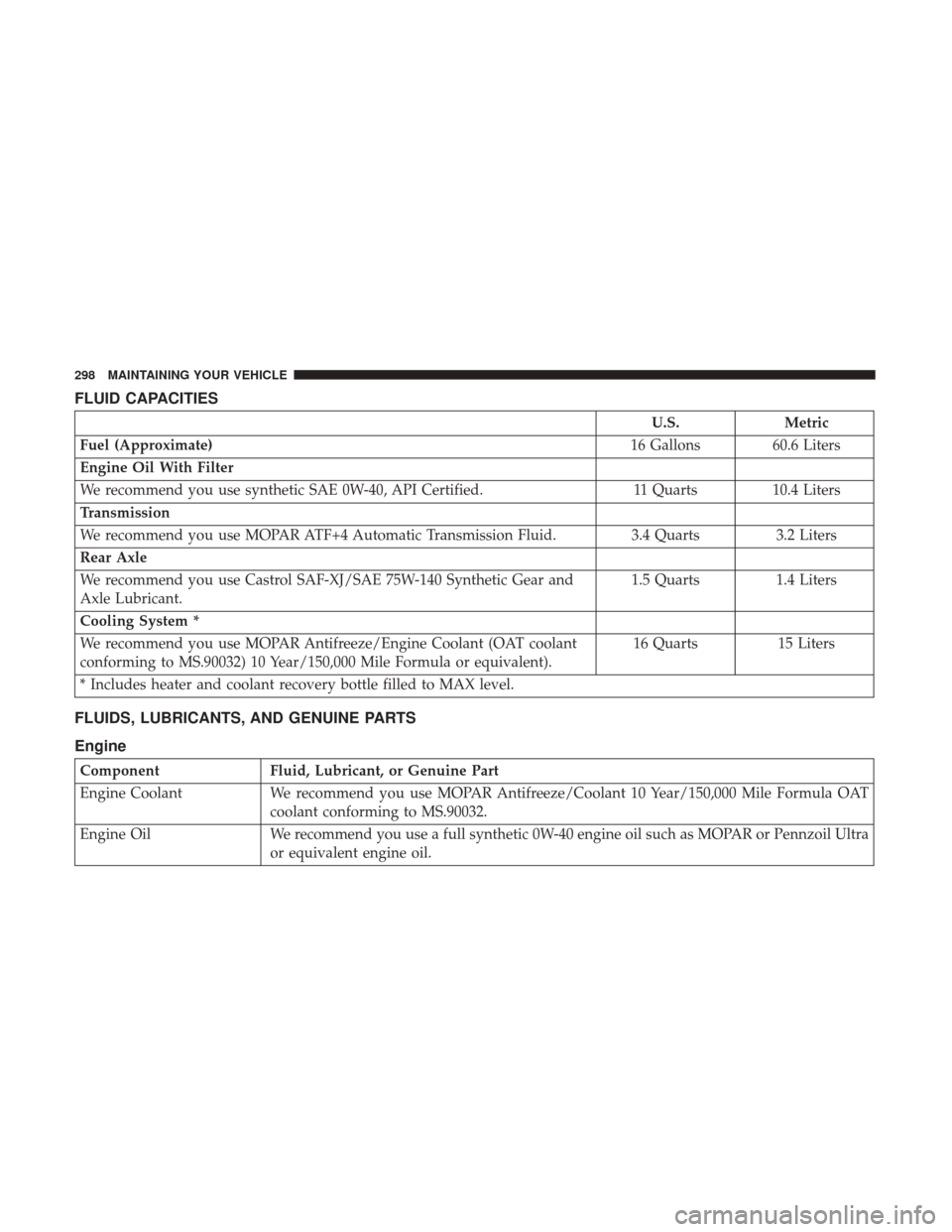
FLUID CAPACITIES
U.S.Metric
Fuel (Approximate) 16 Gallons 60.6 Liters
Engine Oil With Filter
We recommend you use synthetic SAE 0W-40, API Certified. 11 Quarts10.4 Liters
Transmission
We recommend you use MOPAR ATF+4 Automatic Transmission Fluid. 3.4 Quarts3.2 Liters
Rear Axle
We recommend you use Castrol SAF-XJ/SAE 75W-140 Synthetic Gear and
Axle Lubricant. 1.5 Quarts
1.4 Liters
Cooling System *
We recommend you use MOPAR Antifreeze/Engine Coolant (OAT coolant
conforming to MS.90032) 10 Year/150,000 Mile Formula or equivalent). 16 Quarts
15 Liters
* Includes heater and coolant recovery bottle filled to MAX level.
FLUIDS, LUBRICANTS, AND GENUINE PARTS
Engine
Component Fluid, Lubricant, or Genuine Part
Engine Coolant We recommend you use MOPAR Antifreeze/Coolant 10 Year/150,000 Mile Formula OAT
coolant conforming to MS.90032.
Engine Oil We recommend you use a full synthetic 0W-40 engine oil such as MOPAR or Pennzoil Ultra
or equivalent engine oil.
298 MAINTAINING YOUR VEHICLE
Page 301 of 329
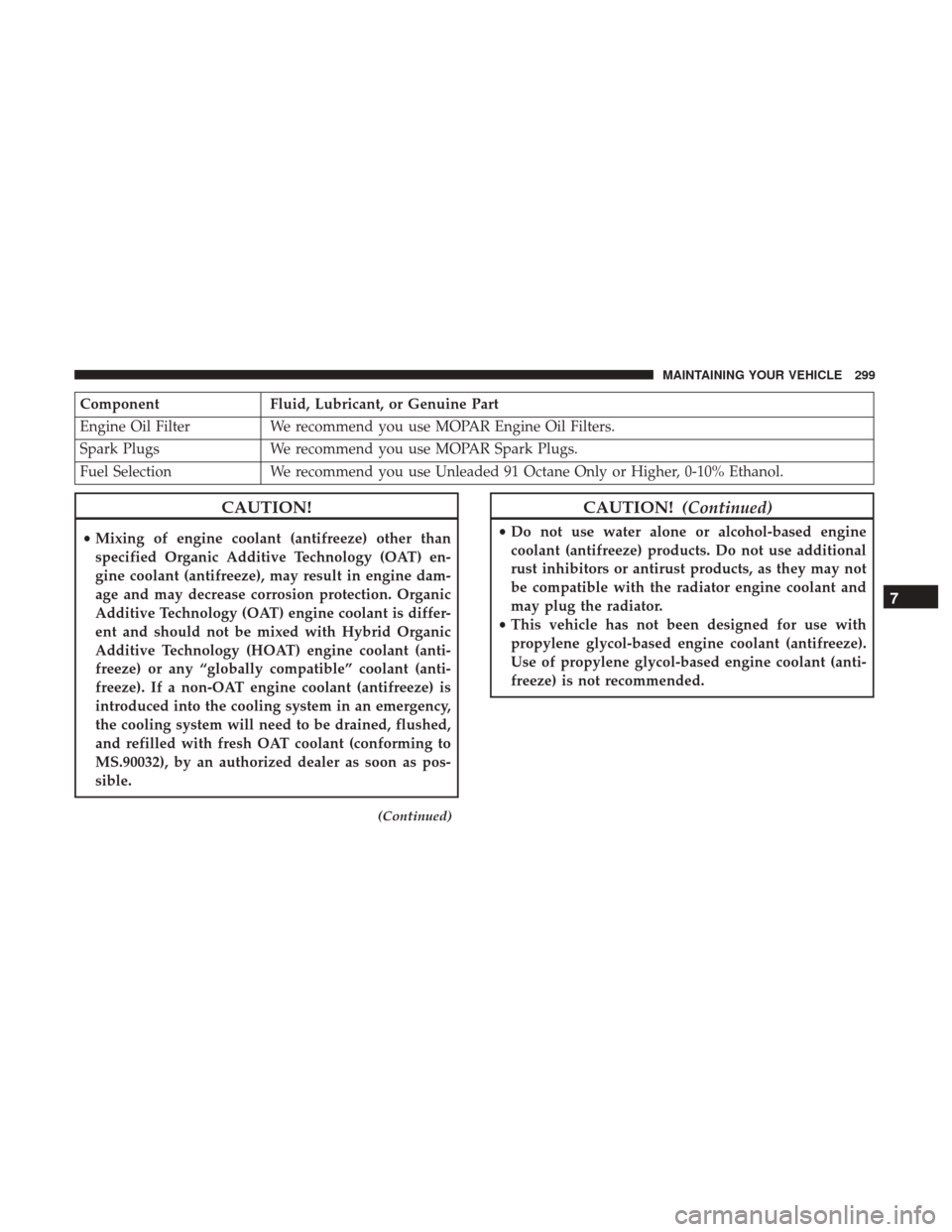
ComponentFluid, Lubricant, or Genuine Part
Engine Oil Filter We recommend you use MOPAR Engine Oil Filters.
Spark Plugs We recommend you use MOPAR Spark Plugs.
Fuel Selection We recommend you use Unleaded 91 Octane Only or Higher, 0-10% Ethanol.
CAUTION!
•Mixing of engine coolant (antifreeze) other than
specified Organic Additive Technology (OAT) en-
gine coolant (antifreeze), may result in engine dam-
age and may decrease corrosion protection. Organic
Additive Technology (OAT) engine coolant is differ-
ent and should not be mixed with Hybrid Organic
Additive Technology (HOAT) engine coolant (anti-
freeze) or any “globally compatible” coolant (anti-
freeze). If a non-OAT engine coolant (antifreeze) is
introduced into the cooling system in an emergency,
the cooling system will need to be drained, flushed,
and refilled with fresh OAT coolant (conforming to
MS.90032), by an authorized dealer as soon as pos-
sible.
(Continued)
CAUTION! (Continued)
•Do not use water alone or alcohol-based engine
coolant (antifreeze) products. Do not use additional
rust inhibitors or antirust products, as they may not
be compatible with the radiator engine coolant and
may plug the radiator.
• This vehicle has not been designed for use with
propylene glycol-based engine coolant (antifreeze).
Use of propylene glycol-based engine coolant (anti-
freeze) is not recommended.
7
MAINTAINING YOUR VEHICLE 299
Page 318 of 329
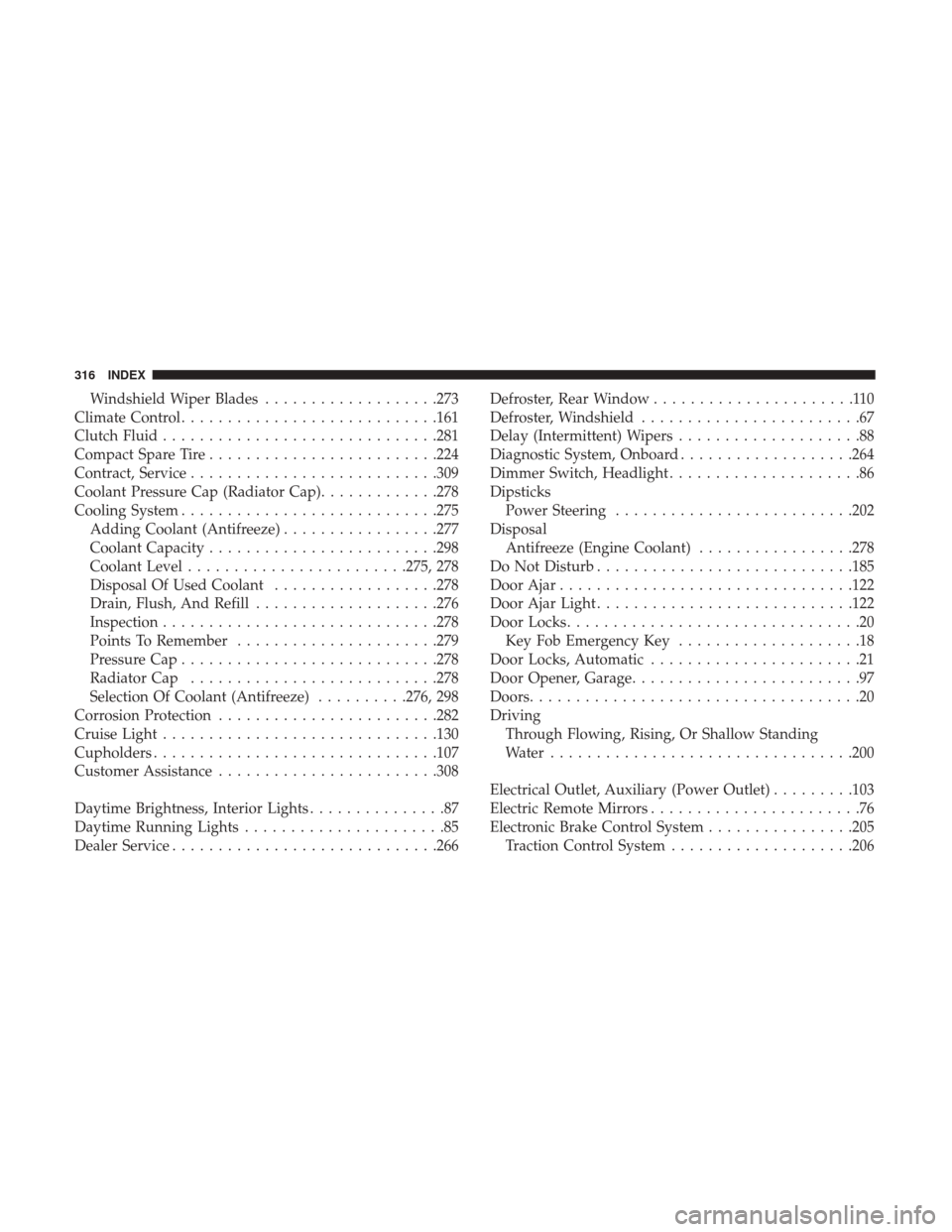
Windshield Wiper Blades...................273
Climate Control ........................... .161
Clutch Fluid ............................. .281
Compact Spare Tire ........................ .224
Contract, Service .......................... .309
Coolant Pressure Cap (Radiator Cap) .............278
Cooling System ........................... .275
Adding Coolant (Antifreeze) .................277
Coolant Capacity ........................ .298
Coolant Level ....................... .275, 278
Disposal Of Used Coolant ..................278
Drain, Flush, And Refill ....................276
Inspection ............................. .278
Points To Remember ..................... .279
Pressure Cap ........................... .278
Radiator Cap .......................... .278
Selection Of Coolant (Antifreeze) ..........276, 298
Corrosion Protection ....................... .282
Cruise Light ............................. .130
Cupholders .............................. .107
Customer Assistance ....................... .308
Daytime Brightness, Interior Lights ...............87
Daytime Running Lights ......................85
Dealer Service ............................ .266Defroster, Rear Window
......................110
Defroster, Windshield ........................67
Delay (Intermittent) Wipers ....................88
Diagnostic System, Onboard ...................264
Dimmer Switch, Headlight .....................86
Dipsticks Power Steering ......................... .202
Disposal Antifreeze (Engine Coolant) .................278
Do Not Disturb ........................... .185
Door Ajar ............................... .122
Door Ajar Light ........................... .122
Door Locks ................................20
Key Fob Emergency Key ....................18
Door
Locks, Automatic .......................21
Door Opener, Garage .........................97
Doors ....................................20
Driving Through Flowing, Rising, Or Shallow Standing
Water ................................ .200
Electrical Outlet, Auxiliary (Power Outlet) .........103
Electric Remote Mirrors .......................76
Electronic Brake Control System ................205
Traction Control System ....................206
316 INDEX
Page 319 of 329
Electronic Speed Control (Cruise Control)..........92
Electronic Stability Control (ESC) ...............207
Electronic Throttle Control Warning Light .........121
Emergency Brake .......................... .202
Emergency, In Case Of Freeing Vehicle When Stuck .................259
Hazard Warning Flasher ...................246
Jump Starting .......................... .256
Overheating ........................... .246
Towing ............................... .260
Emission Control System Maintenance ............265
Engine ................................. .263
Air Cleaner ............................ .269
Checking Oil Level ...................... .267
Compartment .......................... .263
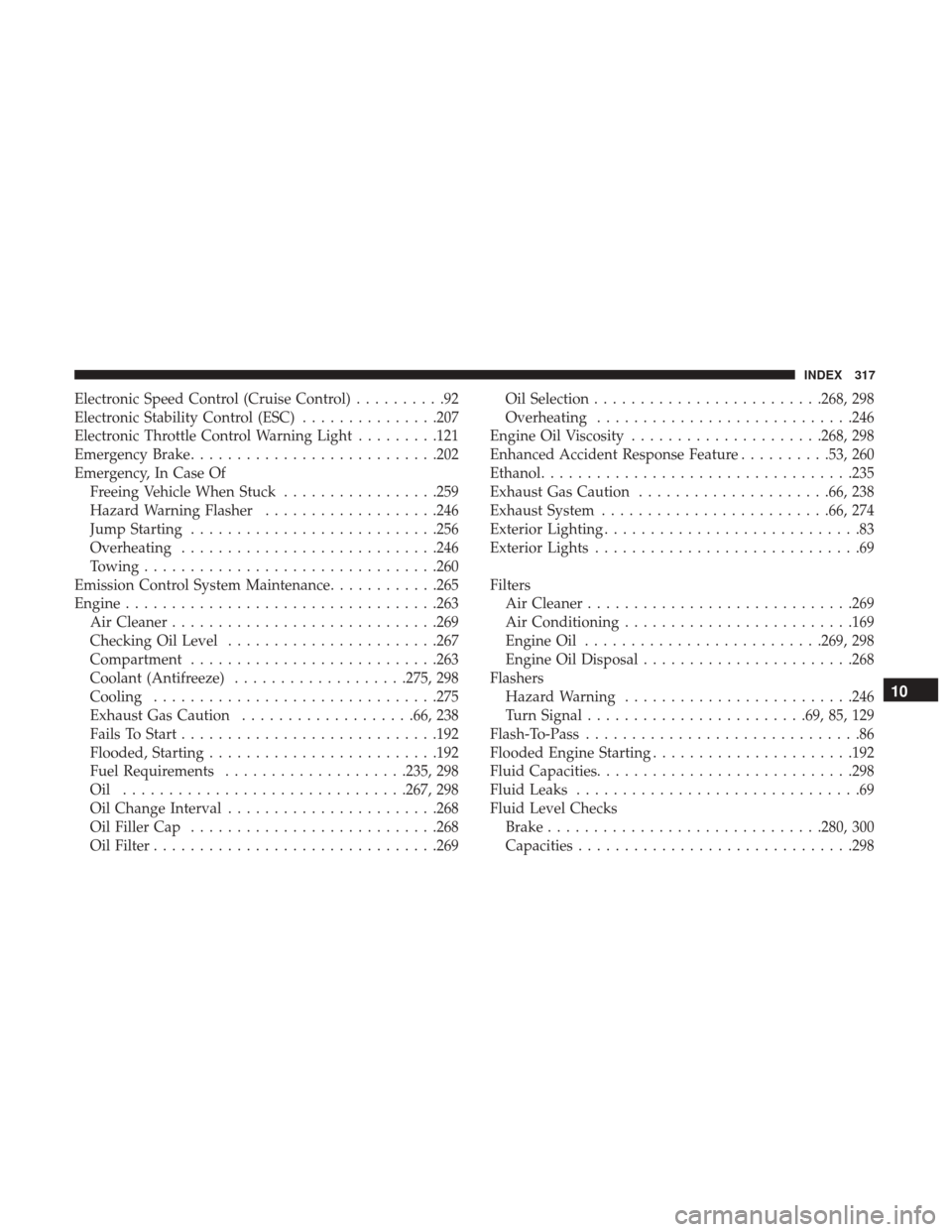
Coolant (Antifreeze) ...................275, 298
Cooling .............................. .275
Exhaust Gas Caution ...................66, 238
Fails To Start ........................... .192
Flooded, Starting ........................ .192
Fuel Requirements ....................235, 298
Oil .............................. .267, 298
Oil Change Interval ...................... .268
Oil Filler Cap .......................... .268
Oil Filter .............................. .269Oil Selection
........................ .268, 298
Overheating ........................... .246
Engine Oil Viscosity .....................268, 298
Enhanced Accident Response Feature ..........53, 260
Ethanol ................................. .235
Exhaust Gas Caution .....................66, 238
Exhaust System ........................ .66, 274
Exterior Lighting ............................83
Exterior Lights .............................69
Filters Air Cleaner ............................ .269
Air Conditioning ........................ .169
Engine
Oil ......................... .269, 298
Engine Oil Disposal ...................... .268
Flashers Hazard Warning ........................ .246
Turn Signal ....................... .69, 85, 129
Flash-To-Pass ..............................86
Flooded Engine Starting ..................... .192
Fluid Capacities ........................... .298
Fluid Leaks ...............................69
Fluid Level Checks Brake ............................. .280, 300
Capacities ............................. .298
10
INDEX 317
Page 320 of 329
Clutch Fluid........................... .281
Cooling System ......................... .275
Engine Oil ............................ .267
Manual Transmission ..................281, 300
Power Steering ...................... .202, 300
Fluids, Lubricants And Genuine Parts ............298
Four-Way Hazard Flasher .....................246
Freeing A Stuck Vehicle ..................... .259
Fuel ................................... .235
Additives ............................. .237
Clean Air ............................. .235
Ethanol .............................. .235
Gasoline .............................. .235
Light ................................ .128
Materials Added ........................ .237
Methanol ............................. .235
Octane Rating ....................... .235, 298
Requirements ....................... .235, 298
Tank Capacity .......................... .298
Fuses .................................. .289
Garage Door Opener (HomeLink) ............97, 101
Gasoline, Clean Air ........................ .235
Gasoline (Fuel) ........................... .235
Gasoline, Reformulated ..................... .235Glass Cleaning
........................... .285
Ground Clearance ......................... .243
Hazard Driving Through Flowing, Rising, Or Shallow
Standing Water ......................... .200
Hazard Warning Flasher ..................... .246
Headlights Automatic ..............................84
Delay ..................................84
High Beam/Low Beam Select Switch ...........86
Lights On Reminder .......................85
On With Wipers ....................... .84, 89
Passing ................................86
Switch .................................83
Time Delay ..............................
84
Head Restraints ............................81
High Beam/Low Beam Select (Dimmer) Switch ......86
Holder, Cup ............................. .107
HomeLink (Garage Door Opener) ................97
Hood Release ..............................81
Hydraulic Clutch Fluid ..................... .281
Illuminated Entry ...........................16
Immobilizer (Sentry Key) ......................12
318 INDEX