engine oil DODGE VIPER 2017 VX / 3.G Owner's Manual
[x] Cancel search | Manufacturer: DODGE, Model Year: 2017, Model line: VIPER, Model: DODGE VIPER 2017 VX / 3.GPages: 329, PDF Size: 2.83 MB
Page 275 of 329
The external lock cylinders should be lubricated twice a
year, preferably in the Fall and Spring. Apply a small
amount of a high quality lubricant, such as MOPAR Lock
Cylinder Lubricant directly into the lock cylinder.
Wiper Blades
Clean the rubber edges of the wiper blades, the windshield,
and rear window periodically with a sponge or soft cloth
and a mild nonabrasive cleaner. This will remove accumu-
lations of salt, waxes, or road film, and help reduce
streaking and smearing.
Operation of the wipers on dry glass for long periods may
cause deterioration of the wiper blades. Always use washer
fluid when using the wipers to remove salt or dirt from a
dry windshield or rear window.
Avoid using the wiper blades to remove frost or ice from
the windshield or rear window. Make sure that they are not
frozen to the glass before turning them on to avoid
damaging the blade. Keep the wiper blade out of contact
with petroleum products such as engine oil, gasoline, etc.NOTE:
Life expectancy of wiper blades varies depending
on geographical area and frequency of use. Poor perfor-
mance of blades may be present with chattering, marks,
water lines, or wet spots. If any of these conditions are
present, clean the wiper blades or replace as necessary.Adding Washer Fluid
The windshield washer fluid reservoir is located in the
front of the engine compartment on the passenger side of
the vehicle. Be sure to check the fluid level in the reservoir
at regular intervals. Fill the reservoir with windshield
washer solvent (not engine coolant (antifreeze) and operate
the system for a few seconds to flush out the residual
water.
WARNING!
Commercially available windshield washer solvents
are flammable. They could ignite and burn you. Care
must be exercised when filling or working around the
washer solution.
7
MAINTAINING YOUR VEHICLE 273
Page 276 of 329
Exhaust System
The best protection against carbon monoxide entry into the
vehicle body is a properly maintained engine exhaust
system.
If you notice a change in the sound of the exhaust system;
or if the exhaust fumes can be detected inside the vehicle;
or when the underside or rear of the vehicle is damaged;
have an authorized technician inspect the complete ex-
haust system and adjacent body areas for broken, dam-
aged, deteriorated, or mispositioned parts. Open seams or
loose connections could permit exhaust fumes to seep into
the passenger compartment. In addition, have the exhaust
system inspected each time the vehicle is raised for lubri-
cation or oil change. Replace as required.
WARNING!
•Exhaust gases can injure or kill. They contain carbon
monoxide (CO), which is colorless and odorless.
Breathing it can make you unconscious and can even-
tually poison you. To avoid breathing CO, refer to
“Safety Tips/Exhaust Gas” in “Things To Know Before
Starting Your Vehicle” for further information.
(Continued)
WARNING! (Continued)
•A hot exhaust system can start a fire if you park over
materials that can burn. Such materials might be
grass or leaves coming into contact with your exhaust
system. Do not park or operate your vehicle in areas
where your exhaust system can contact anything that
can burn.
CAUTION!
• The catalytic converter requires the use of unleaded
fuel only. Leaded gasoline will destroy the effective-
ness of the catalyst as an emissions control device
and may seriously reduce engine performance and
cause serious damage to the engine.
• Damage to the catalytic converter can result if your
vehicle is not kept in proper operating condition. In
the event of engine malfunction, particularly involv-
ing engine misfire or other apparent loss of perfor-
mance, have your vehicle serviced promptly. Contin-
ued operation of your vehicle with a severe
malfunction could cause the converter to overheat,
resulting in possible damage to the converter and
vehicle.
274 MAINTAINING YOUR VEHICLE
Page 282 of 329
Master Cylinder — Brake Fluid Level Check
Check the fluid level in the master cylinder immediately if
the brake system warning light indicates system failure.
Check the fluid level in the master cylinder when perform-
ing underhood services.
Clean the top of the master cylinder area before removing
the cap. If necessary, add fluid to bring the fluid level up to
the requirements described on the brake fluid reservoir.
Overfilling of fluid is not recommended because it may
cause leaking in the system.
With disc brakes, fluid level can be expected to fall as the
brake pads wear. However, low fluid level may be caused
by a leak and a checkup may be needed.
Use only the manufacturer’s recommended brake fluid.
Refer to “Fluids, Lubricants, And Genuine Parts” in “Main-
taining Your Vehicle” for further information. Use of a
brake fluid that may have a lower initial boiling point or
unidentified as to specification, may result in sudden brake
failure during hard prolonged braking.
WARNING!
•Use only manufacturer ’s recommended brake fluid.
Refer to “Fluids, Lubricants, And Genuine Parts” in
“Maintaining Your Vehicle” for further information.
Using the wrong type of brake fluid can severely
damage your brake system and/or impair its perfor-
mance. The proper type of brake fluid for your
vehicle is also identified on the original factory
installed hydraulic master cylinder reservoir.
• To avoid contamination from foreign matter or mois-
ture, use only new brake fluid or fluid that has been
in a tightly closed container. Keep the master cylin-
der reservoir cap secured at all times. Brake fluid in
a open container absorbs moisture from the air
resulting in a lower boiling point. This may cause it
to boil unexpectedly during hard or prolonged brak-
ing, resulting in sudden brake failure. This could
result in a accident.
• Overfilling the brake fluid reservoir can result in
spilling brake fluid on hot engine parts, causing the
brake fluid to catch fire. Brake fluid can also damage
painted and vinyl surfaces, care should be taken to
avoid its contact with these surfaces.
(Continued)
280 MAINTAINING YOUR VEHICLE
Page 300 of 329
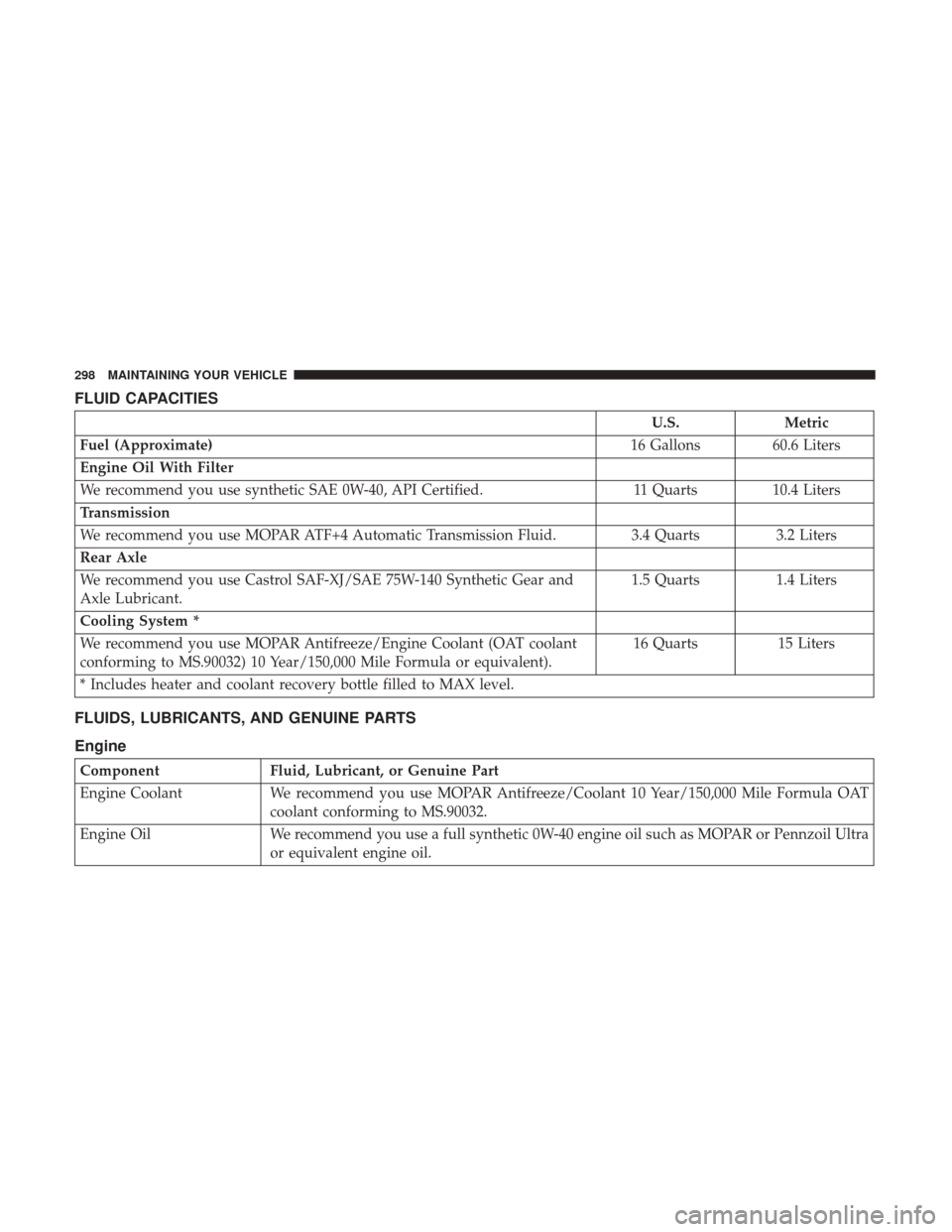
FLUID CAPACITIES
U.S.Metric
Fuel (Approximate) 16 Gallons 60.6 Liters
Engine Oil With Filter
We recommend you use synthetic SAE 0W-40, API Certified. 11 Quarts10.4 Liters
Transmission
We recommend you use MOPAR ATF+4 Automatic Transmission Fluid. 3.4 Quarts3.2 Liters
Rear Axle
We recommend you use Castrol SAF-XJ/SAE 75W-140 Synthetic Gear and
Axle Lubricant. 1.5 Quarts
1.4 Liters
Cooling System *
We recommend you use MOPAR Antifreeze/Engine Coolant (OAT coolant
conforming to MS.90032) 10 Year/150,000 Mile Formula or equivalent). 16 Quarts
15 Liters
* Includes heater and coolant recovery bottle filled to MAX level.
FLUIDS, LUBRICANTS, AND GENUINE PARTS
Engine
Component Fluid, Lubricant, or Genuine Part
Engine Coolant We recommend you use MOPAR Antifreeze/Coolant 10 Year/150,000 Mile Formula OAT
coolant conforming to MS.90032.
Engine Oil We recommend you use a full synthetic 0W-40 engine oil such as MOPAR or Pennzoil Ultra
or equivalent engine oil.
298 MAINTAINING YOUR VEHICLE
Page 301 of 329
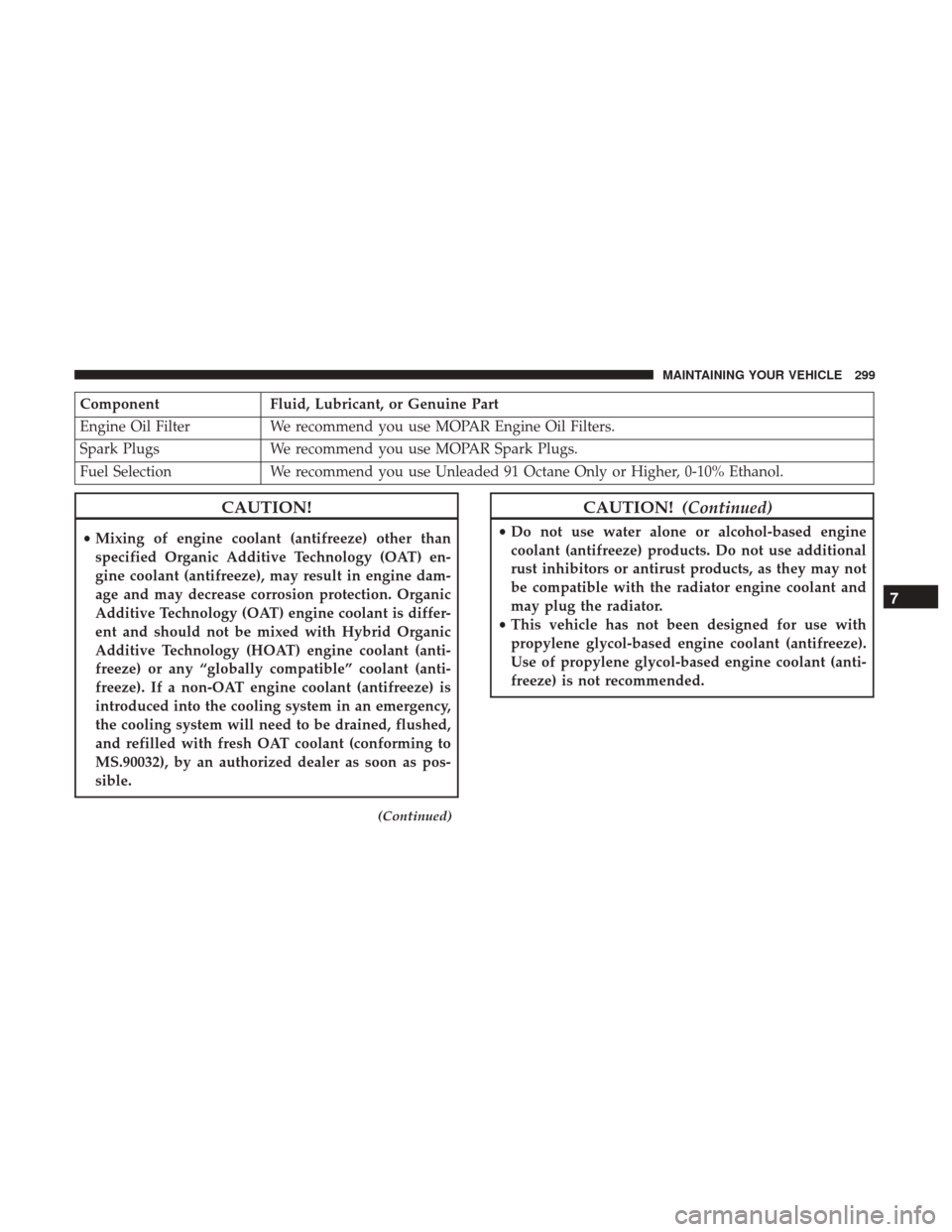
ComponentFluid, Lubricant, or Genuine Part
Engine Oil Filter We recommend you use MOPAR Engine Oil Filters.
Spark Plugs We recommend you use MOPAR Spark Plugs.
Fuel Selection We recommend you use Unleaded 91 Octane Only or Higher, 0-10% Ethanol.
CAUTION!
•Mixing of engine coolant (antifreeze) other than
specified Organic Additive Technology (OAT) en-
gine coolant (antifreeze), may result in engine dam-
age and may decrease corrosion protection. Organic
Additive Technology (OAT) engine coolant is differ-
ent and should not be mixed with Hybrid Organic
Additive Technology (HOAT) engine coolant (anti-
freeze) or any “globally compatible” coolant (anti-
freeze). If a non-OAT engine coolant (antifreeze) is
introduced into the cooling system in an emergency,
the cooling system will need to be drained, flushed,
and refilled with fresh OAT coolant (conforming to
MS.90032), by an authorized dealer as soon as pos-
sible.
(Continued)
CAUTION! (Continued)
•Do not use water alone or alcohol-based engine
coolant (antifreeze) products. Do not use additional
rust inhibitors or antirust products, as they may not
be compatible with the radiator engine coolant and
may plug the radiator.
• This vehicle has not been designed for use with
propylene glycol-based engine coolant (antifreeze).
Use of propylene glycol-based engine coolant (anti-
freeze) is not recommended.
7
MAINTAINING YOUR VEHICLE 299
Page 304 of 329
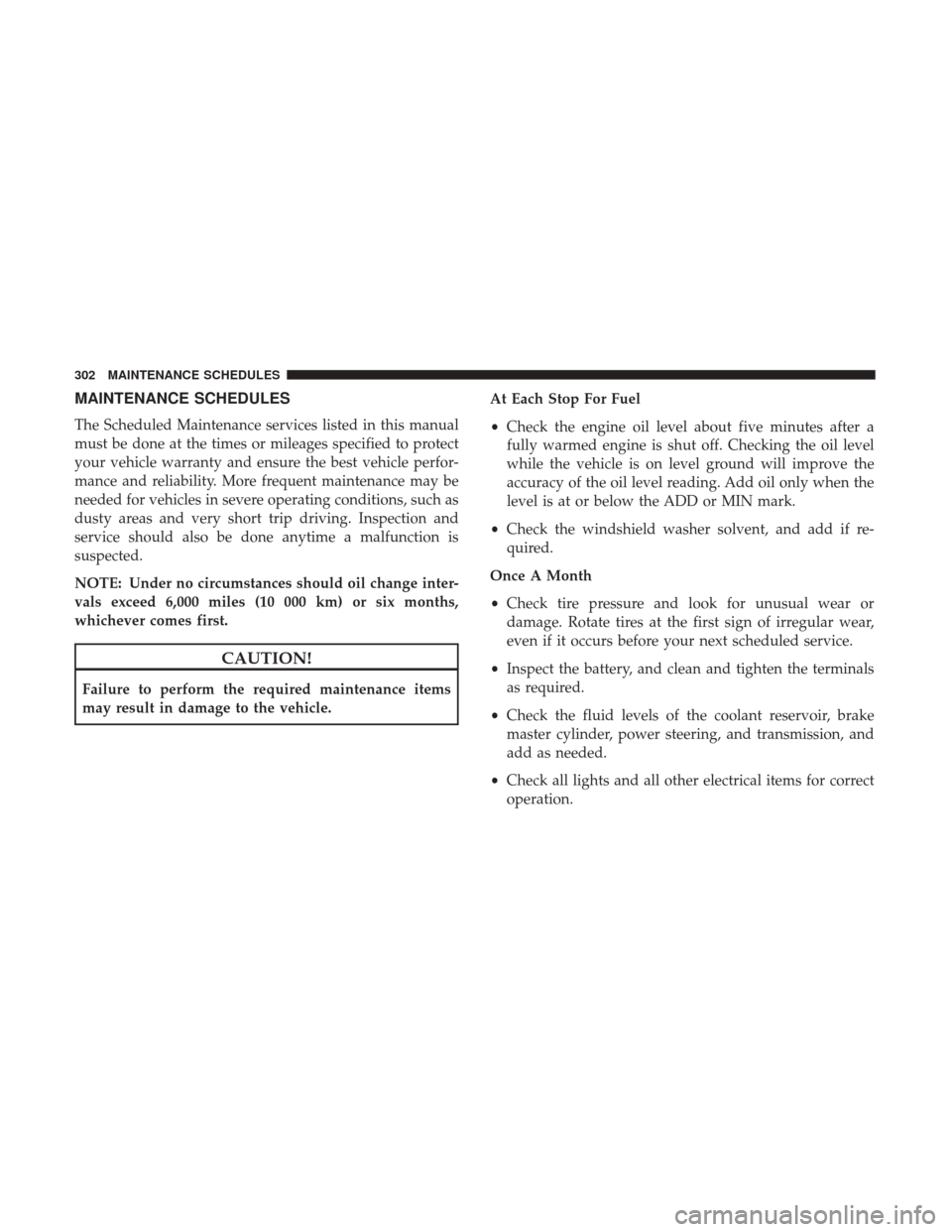
MAINTENANCE SCHEDULES
The Scheduled Maintenance services listed in this manual
must be done at the times or mileages specified to protect
your vehicle warranty and ensure the best vehicle perfor-
mance and reliability. More frequent maintenance may be
needed for vehicles in severe operating conditions, such as
dusty areas and very short trip driving. Inspection and
service should also be done anytime a malfunction is
suspected.
NOTE: Under no circumstances should oil change inter-
vals exceed 6,000 miles (10 000 km) or six months,
whichever comes first.
CAUTION!
Failure to perform the required maintenance items
may result in damage to the vehicle.At Each Stop For Fuel
•
Check the engine oil level about five minutes after a
fully warmed engine is shut off. Checking the oil level
while the vehicle is on level ground will improve the
accuracy of the oil level reading. Add oil only when the
level is at or below the ADD or MIN mark.
• Check the windshield washer solvent, and add if re-
quired.
Once A Month
• Check tire pressure and look for unusual wear or
damage. Rotate tires at the first sign of irregular wear,
even if it occurs before your next scheduled service.
• Inspect the battery, and clean and tighten the terminals
as required.
• Check the fluid levels of the coolant reservoir, brake
master cylinder, power steering, and transmission, and
add as needed.
• Check all lights and all other electrical items for correct
operation.
302 MAINTENANCE SCHEDULES
Page 305 of 329
At Each Oil Change
•Change the engine oil filter.
• Inspect the exhaust system.
NOTE: Also, inspect the exhaust system if you notice a
change in the sound of the exhaust system, or if the exhaust
fumes can be detected inside the vehicle. •
Inspect the brake hoses.
• Inspect the suspension components.
• Lubricate door hinges and check springs.
• Check the engine coolant level, hoses, and clamps.
• Check power steering fluid level.
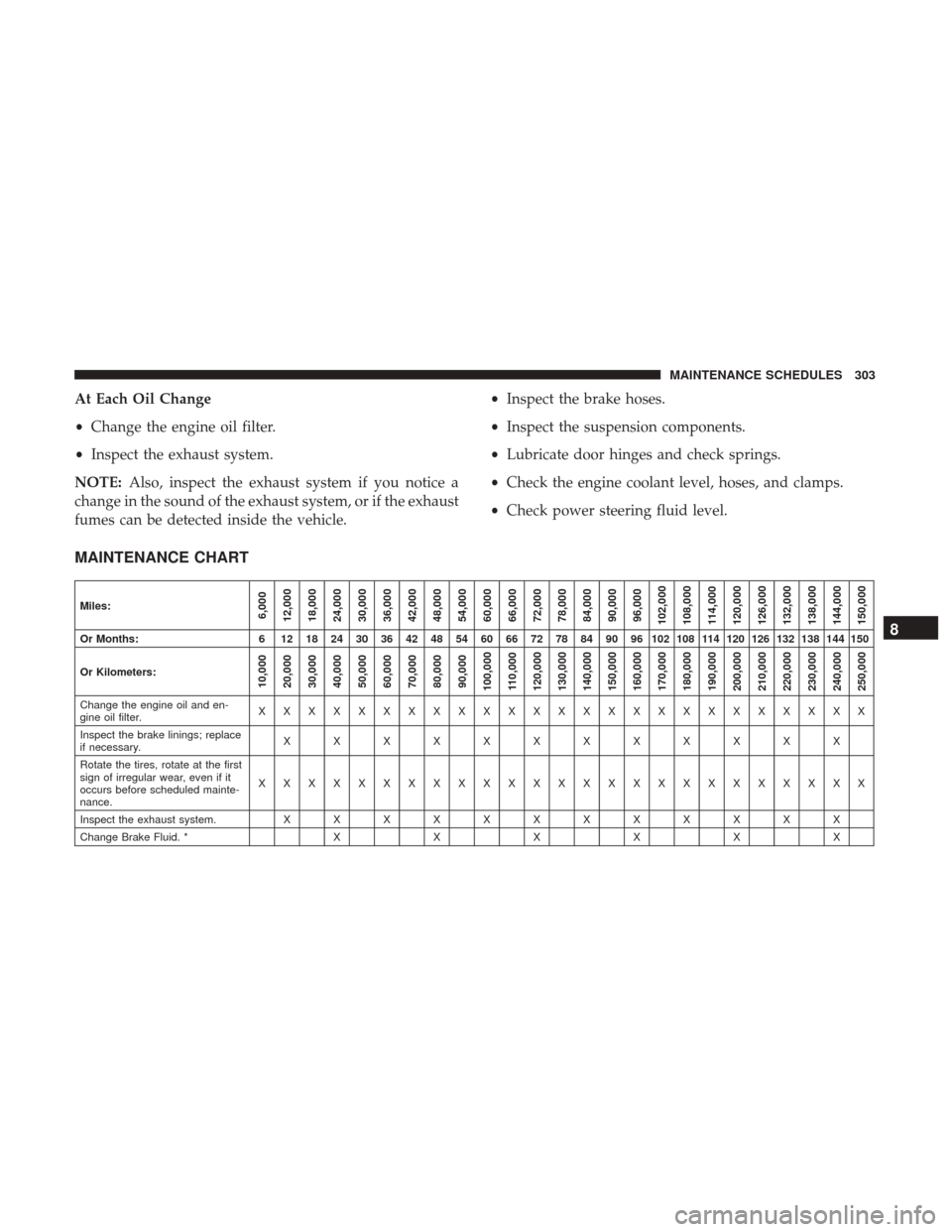
MAINTENANCE CHART
Miles:6,000
12,000
18,000
24,000
30,000
36,000
42,000
48,000
54,000
60,000
66,000
72,000
78,000
84,000
90,000
96,000
102,000
108,000 114,000
120,000
126,000
132,000
138,000
144,000
150,000
Or Months: 6 12 18 24 30 36 42 48 54 60 66 72 78 84 90 96 102 108 114 120 126 132 138 144 150
Or Kilometers:
10,000
20,000
30,000
40,000
50,000
60,000
70,000
80,000
90,000
100,000 110,000
120,000
130,000
140,000
150,000
160,000
170,000
180,000
190,000
200,000
210,000
220,000
230,000
240,000
250,000
Change the engine oil and en-
gine oil filter. XXXXXXXXXXXXXXXXXXXXXXXXX
Inspect the brake linings; replace
if necessary. XXXXXXXXXXXX
Rotate the tires, rotate at the first
sign of irregular wear, even if it
occurs before scheduled mainte-
nance. XXXXXXXXXXXXXXXXXXXXXXXXX
Inspect the exhaust system. XXXXXXXXXXXX
Change Brake Fluid. * XXXXXX
8
MAINTENANCE SCHEDULES 303
Page 317 of 329
Battery.............................. .120, 269
Charging System Light ....................120
Emergency Starting ...................... .256
Jump Starting .......................... .256
Key Fob Battery Replacement .................18
Keyless Key Fob Replacement ................18
Location .............................. .269
Remote Battery Replacement .................18
Saving Feature (Protection) ..................271
Storing Vehicle ......................... .271
Belts, Seat .................................67
Body Mechanism Lubrication ..................272
B-Pillar Location .......................... .215
Brake Control System, Electronic ................205
Brake, Parking ............................ .202
Brake System ......................... .203, 279
Anti-Lock (ABS) ..................... .203, 205
Fluid Check ........................ .280, 300
Master Cylinder ........................ .280
Warning Light ...........................117
Break-In Recommendations, New Vehicle ..........204
Brightness, Interior Lights .....................86
Bulb Replacement ......................... .297
Bulbs, Light ........................... .69, 296Camera, Rear
..............................95
Capacities, Antifreeze (Engine Coolant) ...........298
Capacities, Fluid .......................... .298
Caps, Filler Oil (Engine) ........................... .268
Power Steering ......................... .202
Radiator (Coolant Pressure) .................278
Carbon Monoxide Warning .................66, 238
Car Washes .............................. .282
Chains, Tire ............................. .228
Chart, Tire Sizing ...........................211
Check Engine Light (Malfunction Indicator Light). . . .265
Checking Your Vehicle For Safety ................66
Checks, Safety .............................66
Child Restraint .............................
55
Child Restraints Booster Seats ............................58
Child Restraints ..........................55
Child Seat Installation ......................61
Infants And Child Restraints .................57
Older Children And Child Restraints ...........57
Using The Top Tether Anchorage ..............62
Clean Air Gasoline ........................ .235
Cleaning Wheels ............................... .283
10
INDEX 315
Page 319 of 329
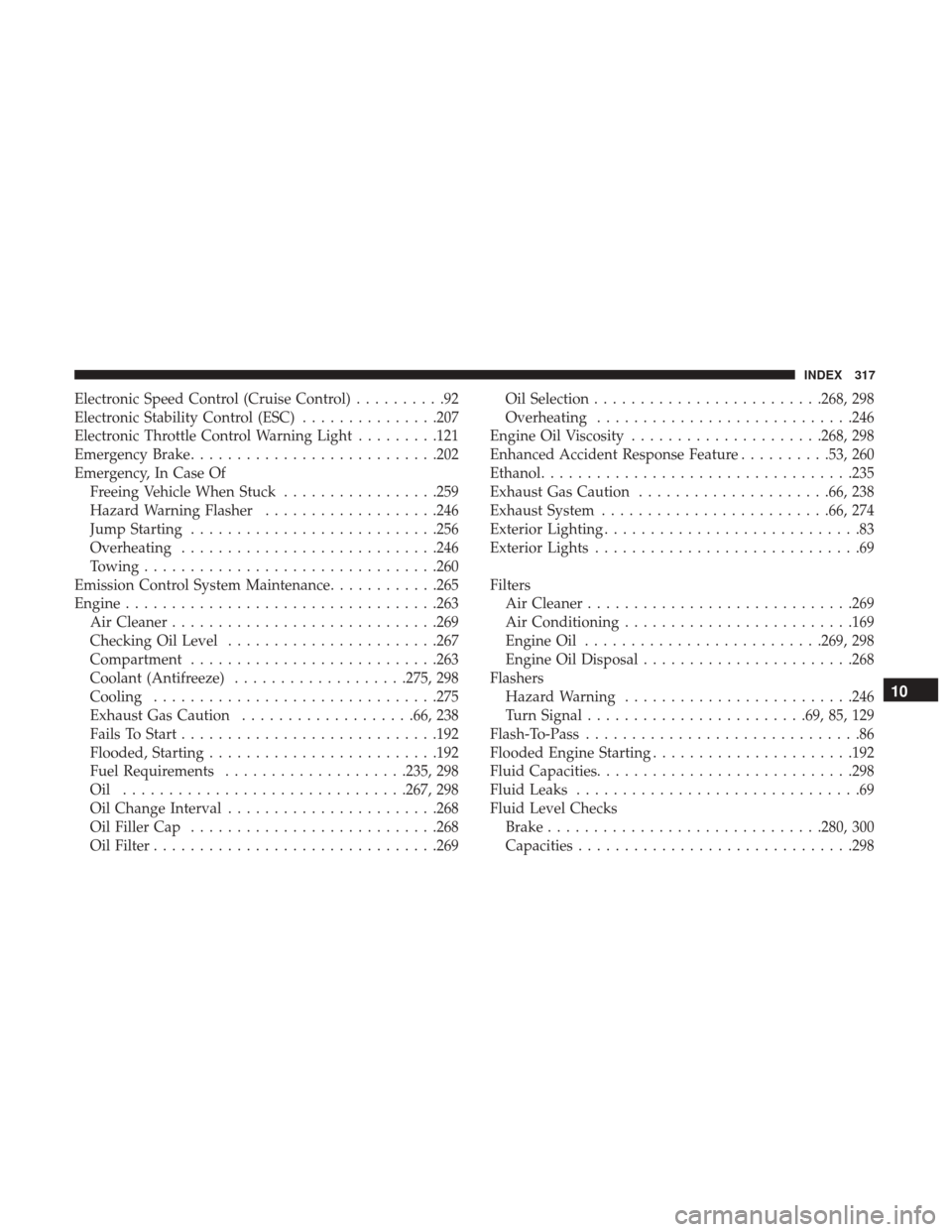
Electronic Speed Control (Cruise Control)..........92
Electronic Stability Control (ESC) ...............207
Electronic Throttle Control Warning Light .........121
Emergency Brake .......................... .202
Emergency, In Case Of Freeing Vehicle When Stuck .................259
Hazard Warning Flasher ...................246
Jump Starting .......................... .256
Overheating ........................... .246
Towing ............................... .260
Emission Control System Maintenance ............265
Engine ................................. .263
Air Cleaner ............................ .269
Checking Oil Level ...................... .267
Compartment .......................... .263
Coolant (Antifreeze) ...................275, 298
Cooling .............................. .275
Exhaust Gas Caution ...................66, 238
Fails To Start ........................... .192
Flooded, Starting ........................ .192
Fuel Requirements ....................235, 298
Oil .............................. .267, 298
Oil Change Interval ...................... .268
Oil Filler Cap .......................... .268
Oil Filter .............................. .269Oil Selection
........................ .268, 298
Overheating ........................... .246
Engine Oil Viscosity .....................268, 298
Enhanced Accident Response Feature ..........53, 260
Ethanol ................................. .235
Exhaust Gas Caution .....................66, 238
Exhaust System ........................ .66, 274
Exterior Lighting ............................83
Exterior Lights .............................69
Filters Air Cleaner ............................ .269
Air Conditioning ........................ .169
Engine
Oil ......................... .269, 298
Engine Oil Disposal ...................... .268
Flashers Hazard Warning ........................ .246
Turn Signal ....................... .69, 85, 129
Flash-To-Pass ..............................86
Flooded Engine Starting ..................... .192
Fluid Capacities ........................... .298
Fluid Leaks ...............................69
Fluid Level Checks Brake ............................. .280, 300
Capacities ............................. .298
10
INDEX 317
Page 320 of 329
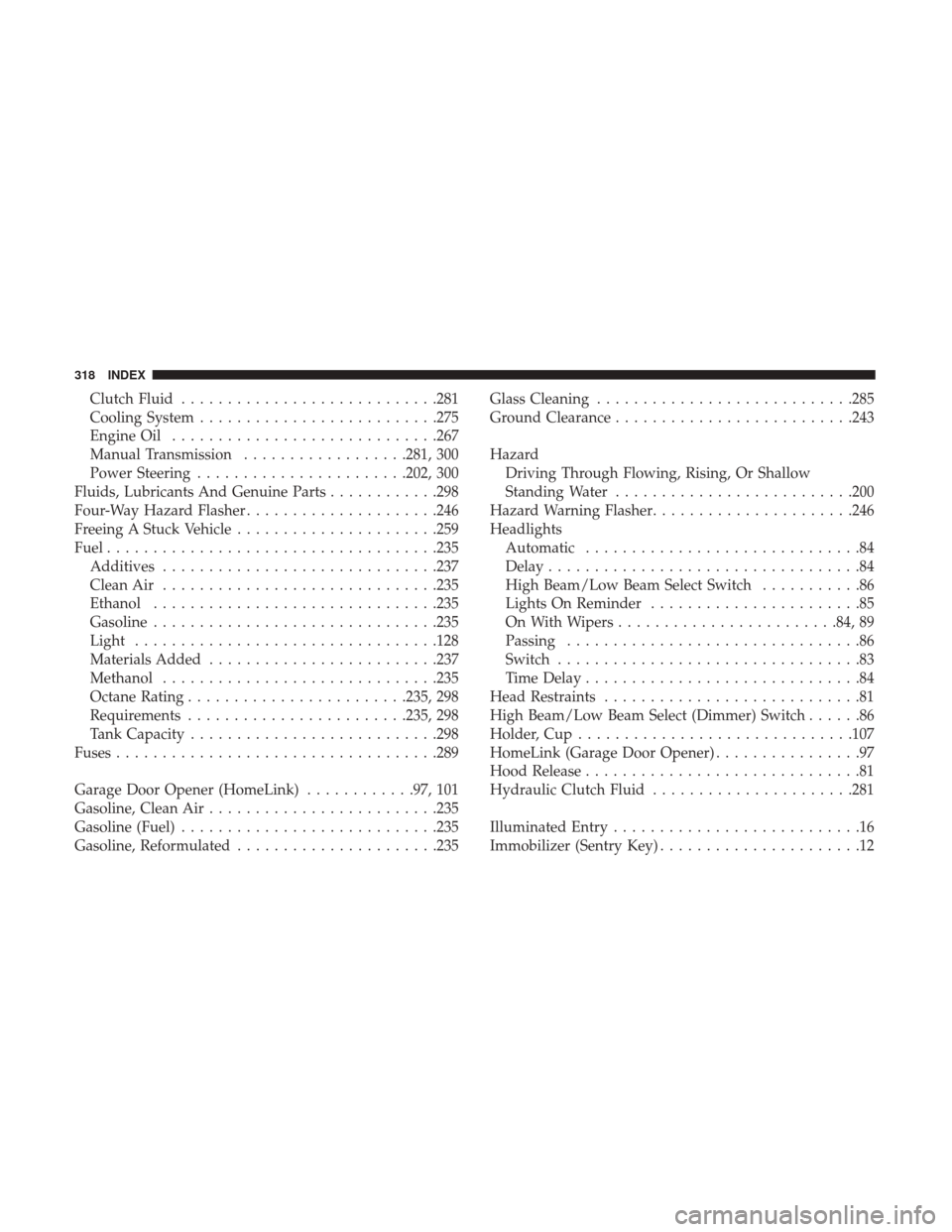
Clutch Fluid........................... .281
Cooling System ......................... .275
Engine Oil ............................ .267
Manual Transmission ..................281, 300
Power Steering ...................... .202, 300
Fluids, Lubricants And Genuine Parts ............298
Four-Way Hazard Flasher .....................246
Freeing A Stuck Vehicle ..................... .259
Fuel ................................... .235
Additives ............................. .237
Clean Air ............................. .235
Ethanol .............................. .235
Gasoline .............................. .235
Light ................................ .128
Materials Added ........................ .237
Methanol ............................. .235
Octane Rating ....................... .235, 298
Requirements ....................... .235, 298
Tank Capacity .......................... .298
Fuses .................................. .289
Garage Door Opener (HomeLink) ............97, 101
Gasoline, Clean Air ........................ .235
Gasoline (Fuel) ........................... .235
Gasoline, Reformulated ..................... .235Glass Cleaning
........................... .285
Ground Clearance ......................... .243
Hazard Driving Through Flowing, Rising, Or Shallow
Standing Water ......................... .200
Hazard Warning Flasher ..................... .246
Headlights Automatic ..............................84
Delay ..................................84
High Beam/Low Beam Select Switch ...........86
Lights On Reminder .......................85
On With Wipers ....................... .84, 89
Passing ................................86
Switch .................................83
Time Delay ..............................
84
Head Restraints ............................81
High Beam/Low Beam Select (Dimmer) Switch ......86
Holder, Cup ............................. .107
HomeLink (Garage Door Opener) ................97
Hood Release ..............................81
Hydraulic Clutch Fluid ..................... .281
Illuminated Entry ...........................16
Immobilizer (Sentry Key) ......................12
318 INDEX