steering wheel DODGE VIPER 2017 VX / 3.G Owner's Manual
[x] Cancel search | Manufacturer: DODGE, Model Year: 2017, Model line: VIPER, Model: DODGE VIPER 2017 VX / 3.GPages: 329, PDF Size: 2.83 MB
Page 209 of 329
Electronic Stability Control
In full on mode the TCS system enhances directional
control and stability of the vehicle under various driving
conditions. The ESC corrects for oversteering and under-
steering the vehicle by applying the brake of the appropri-
ate wheel. Engine power may also be reduced to assist in
counteracting the condition of oversteer or understeer and
help the vehicle maintain the desired path.
In full on mode ESC utilizes sensors in the vehicle to
determine the path that the driver intends to steer the
vehicle and compares it to the actual path of the vehicle.
When the actual path does not match the intended path,
the ESC applies the brake of the appropriate wheel to assist
in counteracting the condition of oversteer or understeer.
•Oversteer – when the vehicle is turning more than
appropriate for the steering wheel position.
• Understeer – when the vehicle is turning less than
appropriate for the steering wheel position.
WARNING!
The Electronic Stability Control System (ESC) cannot
prevent the natural laws of physics from acting on the
vehicle, nor can it increase the traction afforded by
prevailing road conditions. ESC cannot prevent all
accidents, including those resulting from excessive
speed in turns, driving on very slippery surfaces, or
hydroplaning. ESC also cannot prevent accidents re-
sulting from loss of vehicle control due to inappropri-
ate driver input for the conditions. Only a safe, atten-
tive, and skillful driver can prevent accidents. The
capabilities of an ESC equipped vehicle must never be
exploited in a reckless or dangerous manner which
could jeopardize the user ’s safety or the safety of
others.
5
STARTING AND OPERATING 207
Page 210 of 329
Electronic Stability Control (ESC) Operating Modes
The ESC system may have five available operating modes:
ESC On
This is the normal operating mode for the ESC system.
Whenever the vehicle is started, the ESC system will be in
this mode. The ESC On mode should be used for most
driving situations. The ESC should only be turned OFF for
specific reasons as noted in the following paragraphs.
ESC Full Off
The ESC Off mode is intended for off-highway or off-road
use only and should not be used on any public roadways.In this mode, all TCS and ESC stability features are turned
OFF. To enter the “Full Off” mode, push and hold the
“ESC” switch for five seconds while the vehicle is stopped
with the engine running. After five seconds, a chime will
sound, the “ESC OFF” telltale will illuminate, and the “ESC
OFF” will display in the vehicle cluster (left of the odom-
eter). The “ESC OFF” message may appear in the instru-
ment cluster display. Refer to “Instrument Cluster Display”
in “Understanding Your Instrument Panel” for further
information. To turn ESC ON again, momentarily push the
“ESC” switch.
WARNING!
With the ESC switched OFF, the enhanced vehicle sta-
bility offered by ESC is unavailable. In an emergency
evasive maneuver, the ESC system will not engage to
assist in maintaining stability. The “Full Off” ESC mode
is intended for off-highway or off-road only.
Sport Mode — If Equipped
Sport mode has reduced traction control and reduced
stability control. To enter the “Sport Mode” mode, push the
“ESC” switch once (located on the steering wheel). The
“ESC OFF” telltale will illuminate, and the “ESC SPORT”
ESC Button
208 STARTING AND OPERATING
Page 230 of 329
It is recommended you contact your authorized tire dealer
or original equipment dealer with any questions you may
have on tire specifications or capability. Failure to use
equivalent replacement tires may adversely affect the
safety, handling, and ride of your vehicle.
WARNING!
•Do not use a tire, wheel size or rating other than that
specified for your vehicle. Some combinations of
unapproved tires and wheels may change suspen-
sion dimensions and performance characteristics,
resulting in changes to steering, handling, and brak-
ing of your vehicle. This can cause unpredictable
handling and stress to steering and suspension com-
ponents. You could lose control and have a collision
resulting in serious injury or death. Use only the tire
and wheel sizes with load ratings approved for your
vehicle.
• Never use a tire with a smaller load index or capacity,
other than what was originally equipped on your
vehicle. Using a tire with a smaller load index could
result in tire overloading and failure. You could lose
control and have a collision.
(Continued)
WARNING! (Continued)
•Failure to equip your vehicle with tires having ad-
equate speed capability can result in sudden tire
failure and loss of vehicle control.
CAUTION!
Replacing original tires with tires of a different size
may result in false speedometer and odometer read-
ings.
TIRE CHAINS (TRACTION DEVICES)
Due to limited clearance, tire chains or traction devices are
not recommended.
CAUTION!
Damage to the vehicle may result if tire chains are
used.
228 STARTING AND OPERATING
Page 231 of 329
TIRE ROTATION RECOMMENDATIONS
Tires on the front and rear axles of vehicles operate at
different loads and perform different steering, driving, and
braking functions. For these reasons, they wear at unequal
rates.
These effects can be reduced by timely rotation of tires. The
benefits of rotation are especially worthwhile with aggres-
sive tread designs such as those on all season type tires.
Rotation will increase tread life, help to maintain mud,
snow, and wet traction levels, and contribute to a smooth,
quiet ride.
Refer to the “Maintenance Schedule” for the proper main-
tenance interval. Remember, more frequent rotation is
permissible if desired. Also, correct for anything causing
rapid or unusual wear prior to performing the tire rotation.
NOTE:Each wheel on your vehicle contains a tire pressure
sensor. The Tire Pressure Monitor System (TPMS) learns
the location of each sensor though system programming.
Although not required, the manufacturer recommends
reprogramming the TPMS after rotating the tires so that the
system can relearn each sensor ’s location. See your autho-
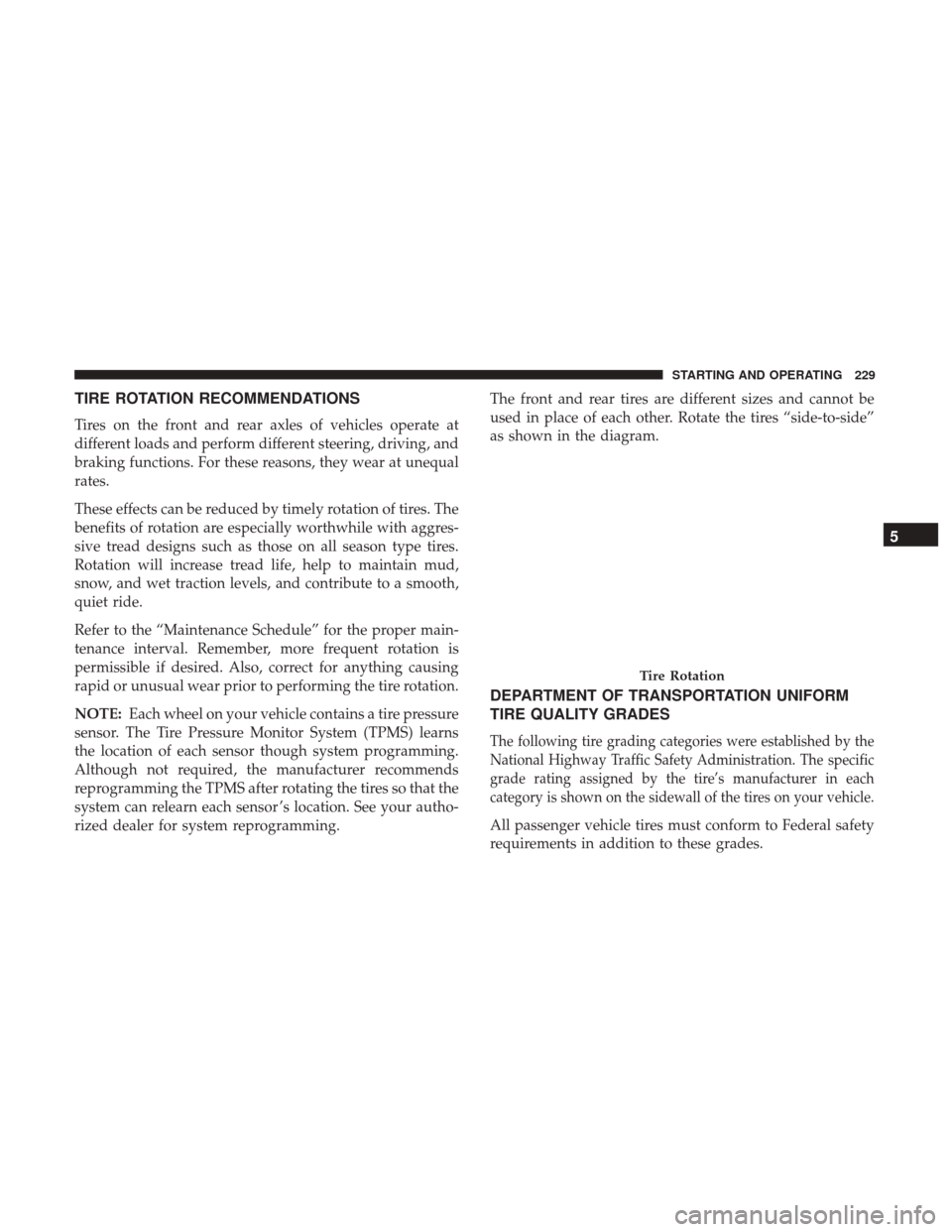
rized dealer for system reprogramming. The front and rear tires are different sizes and cannot be
used in place of each other. Rotate the tires “side-to-side”
as shown in the diagram.
DEPARTMENT OF TRANSPORTATION UNIFORM
TIRE QUALITY GRADES
The following tire grading categories were established by the
National Highway Traffic Safety Administration. The specific
grade rating assigned by the tire’s manufacturer in each
category is shown on the sidewall of the tires on your vehicle.
All passenger vehicle tires must conform to Federal safety
requirements in addition to these grades.
Tire Rotation
5
STARTING AND OPERATING 229
Page 261 of 329
Disconnecting The Jumper Cables
1. Disconnect the negative(-)end of the jumper cable from
the remote negative (-)post of the vehicle with the
discharged battery.
2. Disconnect the opposite end of the negative (-)jumper
cable from the negative (-)post of the booster battery.
3. Disconnect the positive (+)end of the jumper cable from
the positive (+)post of the booster battery.
4. Disconnect the opposite end of the positive (+)jumper
cable from the remote positive (+)post of the vehicle
with the discharged battery.
If frequent jump-starting is required to start your vehicle
you should have the battery and charging system in-
spected at your authorized dealer.
CAUTION!
Accessories plugged into the vehicle power outlets
draw power from the vehicle’s battery, even when not
in use (i.e., cellular devices, etc.). Eventually, if plugged
in long enough without engine operation, the vehicle’s
battery will discharge sufficiently to degrade battery
life and/or prevent the engine from starting.
FREEING A STUCK VEHICLE
If your vehicle becomes stuck in mud, sand, or snow, it can
often be moved using a rocking motion. Turn your steering
wheel right and left to clear the area around the front
wheels. Then shift back and forth between 1st gear and
REVERSE, while gently pushing the accelerator. Use the
least amount of pressure to maintain the rocking motion,
without spinning the wheels, or racing the engine.
WARNING!
Fast spinning tires can be dangerous. Forces generated
by excessive wheel speeds may cause damage, or even
failure, of the axle and tires. A tire could explode and
injure someone. Do not spin your vehicle’s wheels
faster than 30 mph (48 km/h) or for longer than 30
seconds continuously without stopping when you are
stuck. And do not let anyone near a spinning wheel, no
matter what the speed.
6
WHAT TO DO IN EMERGENCIES 259
Page 273 of 329
CAUTION!(Continued)
•If a “fast charger” is used while the battery is in the
vehicle, disconnect both vehicle battery cables before
connecting the charger to the battery. Do not use a
“fast charger” to provide starting voltage.
Hibernation Mode
The Hibernation mode feature conserves battery power
when storing the vehicle. It allows for up to three months
of storage time without losing radio and engine controller
adaptive memory. Using this feature is an alternative to
disconnecting the battery.
NOTE: This vehicle is designed to sit in storage with a
fully charged battery for up to 30 days. If you plan to store
the vehicle longer than 30 days, we recommend doing one
of the following:
• Disconnect the battery.
• Use the battery charger.
• Put the vehicle into Hibernation mode (3-month charge).
To Activate Hibernation Mode
1. Cycle the ignition switch to (ACC).
2. Select Hibernation mode within the instrument cluster
display.
3. Push the right arrow button on the steering wheel controls for one second. Vehicle will countdown from
ten seconds and enter Hibernation Mode.
NOTE: You may push the right arrow button on the
steering wheel controls during the countdown to abort
Hibernation Mode.
To Deactivate Hibernation Mode
1. Push the key fob UNLOCK button to unlock the vehicle.
2. Push the ignition switch to the ON/RUN position.
Air Conditioner Maintenance
For best possible performance, your air conditioner should
be checked and serviced by an authorized dealer at the
start of each warm season. This service should include
cleaning of the condenser fins and a performance test.
Drive belt tension should also be checked at this time.
7
MAINTAINING YOUR VEHICLE 271
Page 317 of 329
Battery.............................. .120, 269
Charging System Light ....................120
Emergency Starting ...................... .256
Jump Starting .......................... .256
Key Fob Battery Replacement .................18
Keyless Key Fob Replacement ................18
Location .............................. .269
Remote Battery Replacement .................18
Saving Feature (Protection) ..................271
Storing Vehicle ......................... .271
Belts, Seat .................................67
Body Mechanism Lubrication ..................272
B-Pillar Location .......................... .215
Brake Control System, Electronic ................205
Brake, Parking ............................ .202
Brake System ......................... .203, 279
Anti-Lock (ABS) ..................... .203, 205
Fluid Check ........................ .280, 300
Master Cylinder ........................ .280
Warning Light ...........................117
Break-In Recommendations, New Vehicle ..........204
Brightness, Interior Lights .....................86
Bulb Replacement ......................... .297
Bulbs, Light ........................... .69, 296Camera, Rear
..............................95
Capacities, Antifreeze (Engine Coolant) ...........298
Capacities, Fluid .......................... .298
Caps, Filler Oil (Engine) ........................... .268
Power Steering ......................... .202
Radiator (Coolant Pressure) .................278
Carbon Monoxide Warning .................66, 238
Car Washes .............................. .282
Chains, Tire ............................. .228
Chart, Tire Sizing ...........................211
Check Engine Light (Malfunction Indicator Light). . . .265
Checking Your Vehicle For Safety ................66
Checks, Safety .............................66
Child Restraint .............................
55
Child Restraints Booster Seats ............................58
Child Restraints ..........................55
Child Seat Installation ......................61
Infants And Child Restraints .................57
Older Children And Child Restraints ...........57
Using The Top Tether Anchorage ..............62
Clean Air Gasoline ........................ .235
Cleaning Wheels ............................... .283
10
INDEX 315
Page 325 of 329
Seat Belts............................. .26, 67
Child Restraint ...........................55
Extender ...............................32
Front Seat ........................ .26, 28, 30
Inspection ..............................67
Operating Instructions ......................30
Pregnant Women .........................33
Pretensioners ............................33
Rear Seat ...............................28
Reminder ..............................116
Untwisting Procedure ......................32
Seats ................................. .77, 79
Adjustment .......................... .77, 79
Reclining ...............................78
Security Alarm ......................... .14, 119
Selection Of Coolant (Antifreeze) ...............298
Selection Of Oil ........................... .268
Sentry Key Key Programming .........................13
Sentry Key (Immobilizer) ......................12
Sentry Key Replacement ......................13
Service Assistance ......................... .308
Service Contract .......................... .309
Service Manuals ...........................311
Shift Indicator Light ........................ .195Shift Speeds
.......................... .192, 195
Shoulder Belts .............................28
Signals, Turn ........................ .69, 85, 129
Snow Chains (Tire Chains) ....................228
Spare Tire ............................ .224, 225
Spark Plugs ............................. .298
Speed Control Resume ................................94
Speed Control (Cruise Control) ..................92
Starting ................................ .190
Emergency (Jump Starting) ..................256
Engine Fails To Start ..................... .192
Starting And Operating ..................... .190
Starting Procedures ........................ .190
Steering Column Controls .........................85
Power ............................ .201, 202
T
ilt Column .............................90
Steering Wheel Audio Controls .................159
Steering Wheel Mounted Sound System Controls . . . .159
Storage ................................. .294
Storage, Vehicle ........................... .169
Stuck, Freeing ............................ .259
Supplemental Restraint System - Air Bag ...........3810
INDEX 323