brake FIAT 124 SPIDER 2016 2.G User Guide
[x] Cancel search | Manufacturer: FIAT, Model Year: 2016, Model line: 124 SPIDER, Model: FIAT 124 SPIDER 2016 2.GPages: 216, PDF Size: 3.1 MB
Page 53 of 216
WARNING LIGHTS AND MESSAGES
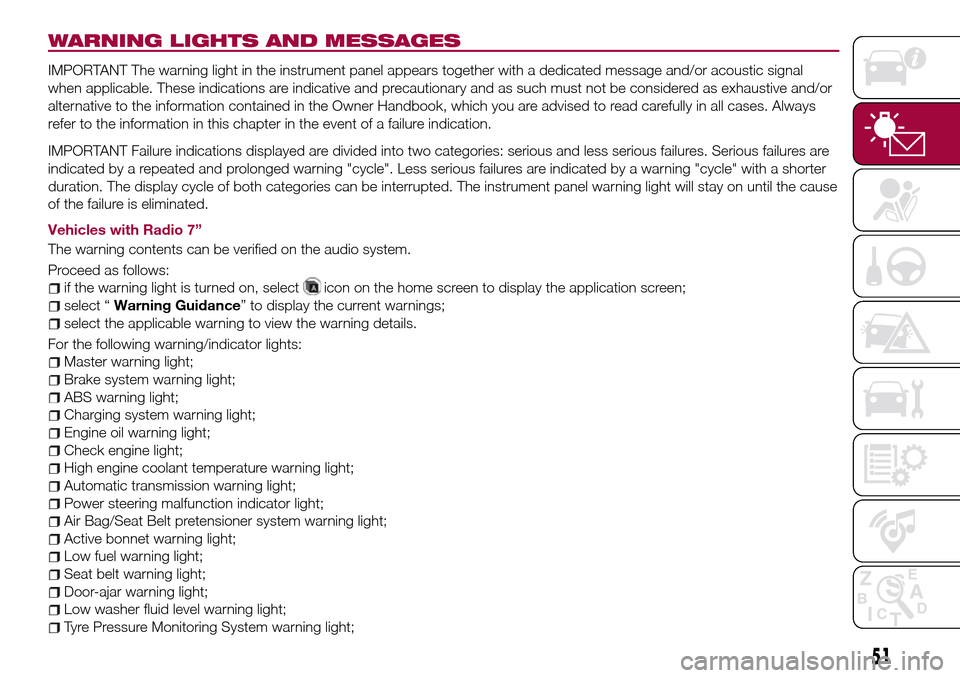
IMPORTANT The warning light in the instrument panel appears together with a dedicated message and/or acoustic signal
when applicable. These indications are indicative and precautionary and as such must not be considered as exhaustive and/or
alternative to the information contained in the Owner Handbook, which you are advised to read carefully in all cases. Always
refer to the information in this chapter in the event of a failure indication.
IMPORTANT Failure indications displayed are divided into two categories: serious and less serious failures. Serious failures are
indicated by a repeated and prolonged warning "cycle". Less serious failures are indicated by a warning "cycle" with a shorter
duration. The display cycle of both categories can be interrupted. The instrument panel warning light will stay on until the cause
of the failure is eliminated.
Vehicles with Radio 7”
The warning contents can be verified on the audio system.
Proceed as follows:
if the warning light is turned on, selecticon on the home screen to display the application screen;
select “Warning Guidance” to display the current warnings;
select the applicable warning to view the warning details.
For the following warning/indicator lights:
Master warning light;
Brake system warning light;
ABS warning light;
Charging system warning light;
Engine oil warning light;
Check engine light;
High engine coolant temperature warning light;
Automatic transmission warning light;
Power steering malfunction indicator light;
Air Bag/Seat Belt pretensioner system warning light;
Active bonnet warning light;
Low fuel warning light;
Seat belt warning light;
Door-ajar warning light;
Low washer fluid level warning light;
Tyre Pressure Monitoring System warning light;
51
Page 54 of 216
KEY warning light;
LED headlight KEY warning light;
Wrench indicator light;
TCS/DSC indicator light;
DSC OFF indicator light;
Security indicator light;
Passenger Air Bag deactivation indicator light (where provided).
The light turns on when the ignition is switched on for an operation check, and turns off a few seconds later or when the engine
is started. If the light does not turn on or remains turned on, have the vehicle inspected at Fiat Dealership.
Only for “Brake system warning light”: the light turns on continuously when the parking brake is applied.
52
KNOWING THE INSTRUMENT PANEL
Page 55 of 216
WARNING LIGHTS ON INSTRUMENT PANEL
Red warning lights
Warning light What it means
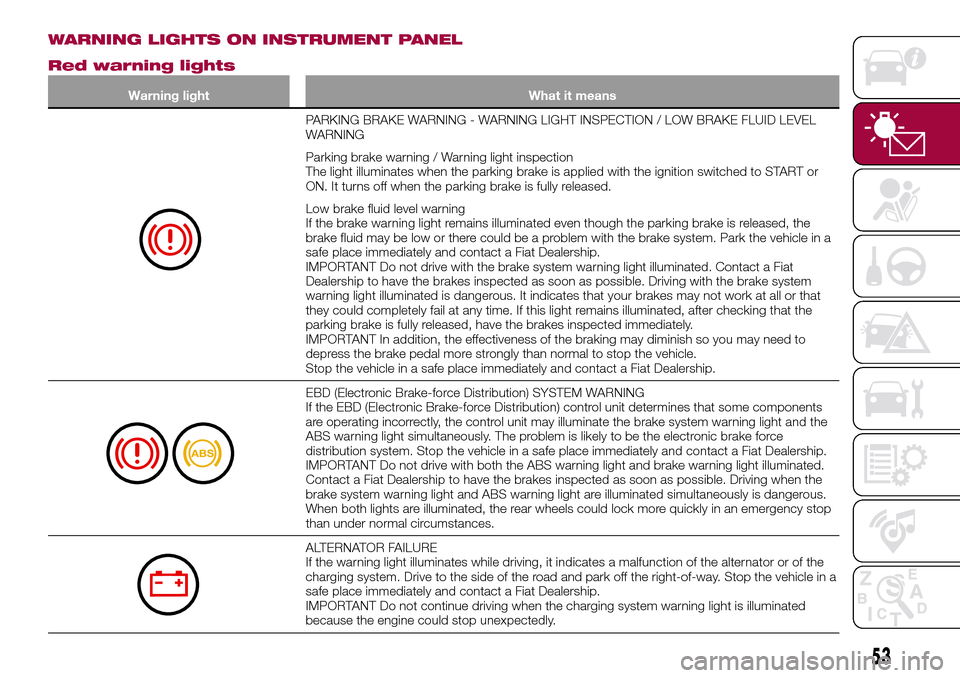
PARKING BRAKE WARNING - WARNING LIGHT INSPECTION / LOW BRAKE FLUID LEVEL
WARNING
Parking brake warning / Warning light inspection
The light illuminates when the parking brake is applied with the ignition switched to START or
ON. It turns off when the parking brake is fully released.
Low brake fluid level warning
If the brake warning light remains illuminated even though the parking brake is released, the
brake fluid may be low or there could be a problem with the brake system. Park the vehicle in a
safe place immediately and contact a Fiat Dealership.
IMPORTANT Do not drive with the brake system warning light illuminated. Contact a Fiat
Dealership to have the brakes inspected as soon as possible. Driving with the brake system
warning light illuminated is dangerous. It indicates that your brakes may not work at all or that
they could completely fail at any time. If this light remains illuminated, after checking that the
parking brake is fully released, have the brakes inspected immediately.
IMPORTANT In addition, the effectiveness of the braking may diminish so you may need to
depress the brake pedal more strongly than normal to stop the vehicle.
Stop the vehicle in a safe place immediately and contact a Fiat Dealership.
EBD (Electronic Brake-force Distribution) SYSTEM WARNING
If the EBD (Electronic Brake-force Distribution) control unit determines that some components
are operating incorrectly, the control unit may illuminate the brake system warning light and the
ABS warning light simultaneously. The problem is likely to be the electronic brake force
distribution system. Stop the vehicle in a safe place immediately and contact a Fiat Dealership.
IMPORTANT Do not drive with both the ABS warning light and brake warning light illuminated.
Contact a Fiat Dealership to have the brakes inspected as soon as possible. Driving when the
brake system warning light and ABS warning light are illuminated simultaneously is dangerous.
When both lights are illuminated, the rear wheels could lock more quickly in an emergency stop
than under normal circumstances.
ALTERNATOR FAILURE
If the warning light illuminates while driving, it indicates a malfunction of the alternator or of the
charging system. Drive to the side of the road and park off the right-of-way. Stop the vehicle in a
safe place immediately and contact a Fiat Dealership.
IMPORTANT Do not continue driving when the charging system warning light is illuminated
because the engine could stop unexpectedly.
53
Page 59 of 216
Amber warning lights
Warning light What it means
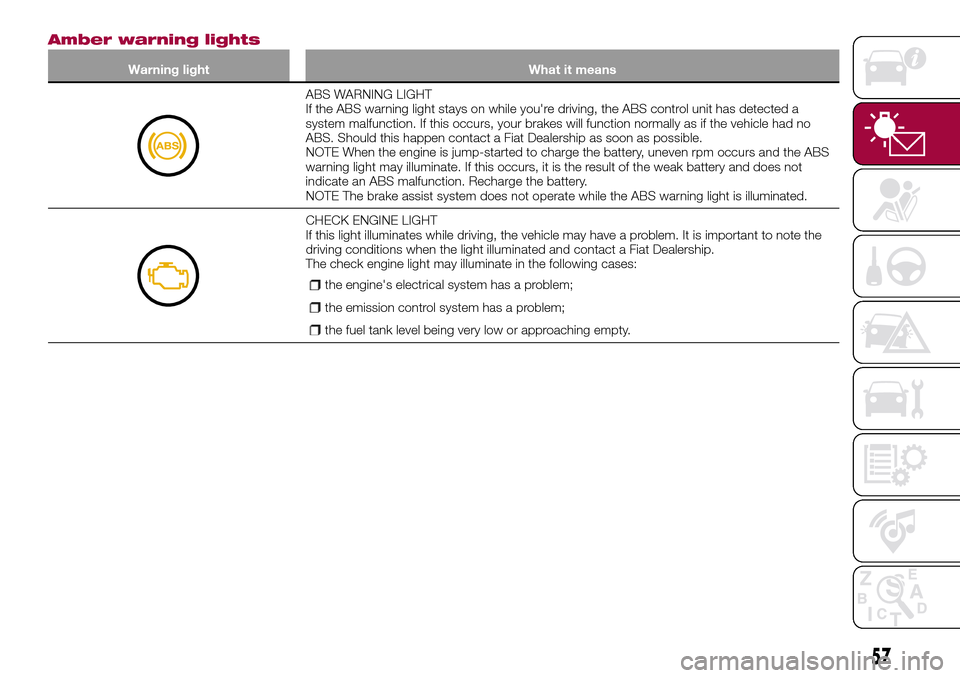
ABS WARNING LIGHT
If the ABS warning light stays on while you're driving, the ABS control unit has detected a
system malfunction. If this occurs, your brakes will function normally as if the vehicle had no
ABS. Should this happen contact a Fiat Dealership as soon as possible.
NOTE When the engine is jump-started to charge the battery, uneven rpm occurs and the ABS
warning light may illuminate. If this occurs, it is the result of the weak battery and does not
indicate an ABS malfunction. Recharge the battery.
NOTE The brake assist system does not operate while the ABS warning light is illuminated.
CHECK ENGINE LIGHT
If this light illuminates while driving, the vehicle may have a problem. It is important to note the
driving conditions when the light illuminated and contact a Fiat Dealership.
The check engine light may illuminate in the following cases:
the engine's electrical system has a problem;
the emission control system has a problem;
the fuel tank level being very low or approaching empty.
57
Page 61 of 216
Warning light What it means
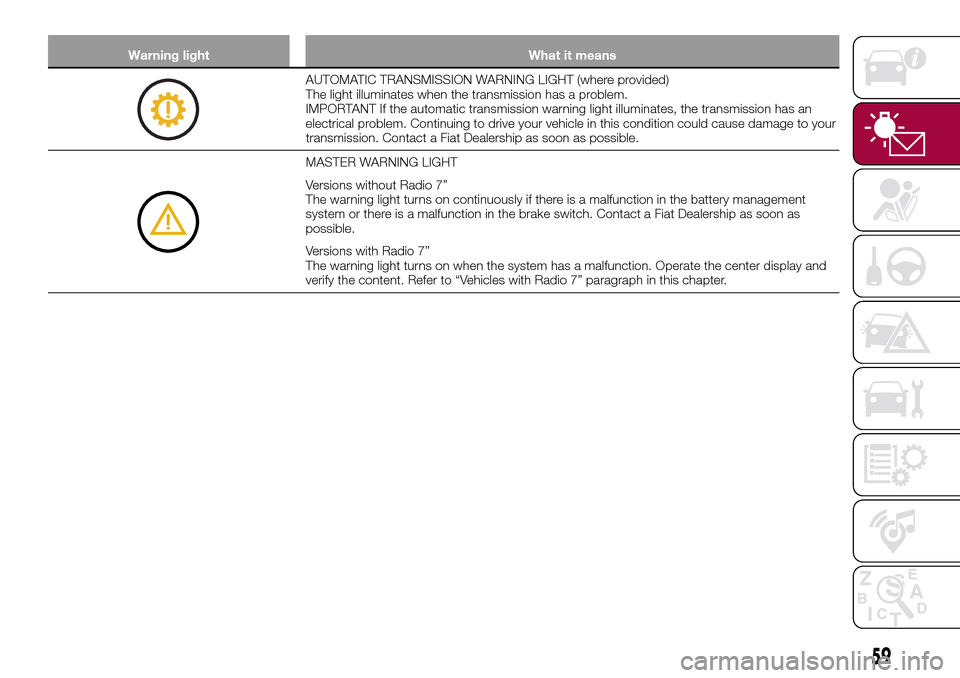
AUTOMATIC TRANSMISSION WARNING LIGHT (where provided)
The light illuminates when the transmission has a problem.
IMPORTANT If the automatic transmission warning light illuminates, the transmission has an
electrical problem. Continuing to drive your vehicle in this condition could cause damage to your
transmission. Contact a Fiat Dealership as soon as possible.
MASTER WARNING LIGHT
Versions without Radio 7”
The warning light turns on continuously if there is a malfunction in the battery management
system or there is a malfunction in the brake switch. Contact a Fiat Dealership as soon as
possible.
Versions with Radio 7”
The warning light turns on when the system has a malfunction. Operate the center display and
verify the content. Refer to “Vehicles with Radio 7” paragraph in this chapter.
59
Page 69 of 216
ACTIVE SAFETY
SYSTEMS
The vehicle has the following active
safety systems:
ABS (Anti-lock Braking System);
TCS (Traction Contol System);
DSC (Dynamic Stability Control);
Active bonnet (active pedestrian
protection).
For the operation of the systems, see
the following pages.
ABS SYSTEM (Antilock
Brake System)
65) 66) 67) 68)
The ABS control unit continuously
monitors the speed of each wheel. If
one wheel is about to lock up, the ABS
responds by automatically releasing
and reapplying that wheel's brake.
The driver will feel a slight vibration in
the brake pedal and may hear a
chattering noise from the brake system.
This is normal ABS system operation.
Continue to depress the brake pedal
without pumping the brakes.
The warning light turns on when the
system has a malfunction. Refer to
“Warning lights and messages”
paragraph in “Knowing the instrument
panel” chapter.
NOTE Braking distances may be longer
on loose surfaces (snow or gravel, forexample) which usually have a hard
foundation. A vehicle with a normal
braking system may require less
distance to stop under these conditions
because the tires will build up a wedge
of surface layer when the wheels skid.
NOTE The sound of the ABS operating
may be heard when starting the engine
or immediately after starting the vehicle,
however, it does not indicate a
malfunction.
TCS SYSTEM (Traction
Control System)
69) 70) 71)
The Traction Control System (TCS)
enhances traction and safety by
controlling engine torque and braking.
When the TCS detects driving wheel
slippage, it lowers engine torque and
operates the brakes to prevent loss of
traction.
This means that on a slick surface, the
engine adjusts automatically to provide
optimum power to the drive wheels,
limiting wheel spin and loss of traction.
The warning light turns on when the
system has a malfunction. Refer to
“Warning lights and messages”
paragraph in “Knowing the instrument
panel” chapter.TCS / DSC indicator light
The
indicator light stays on for a few
seconds when the ignition is switched
ON.
If the TCS or DSC is operating, the
indicator light flashes.
If the
light stays on, the TCS, DSC or
the brake assist system may have a
malfunction and they may not operate
correctly. Contact a Fiat Dealership.
IMPORTANT In addition to the warning
light flashing, a slight labouring sound
will come from the engine. This
indicates that the TCS/DSC is
operating properly.
IMPORTANT On slippery surfaces, such
as fresh snow, it will be impossible to
achieve high rpm when the TCS is on.
DSC SYSTEM (Dynamic
Stability Control)
72) 73) 74)
The Dynamic Stability Control (DSC)
automatically controls braking and
engine torque in conjunction with
systems such as ABS and TCS to help
control side slip when driving on
slippery surfaces, or during sudden or
evasive manoeuvring, enhancing vehicle
safety. Refer to “ABS system (Antilock
Brake System)” and “TCS system
(Traction Control System)”.
67
Page 70 of 216
DSC operation is possible at speeds
greater than 20 km/h.
The warning light turns on when the
system has a malfunction. Refer to
“Warning lights and messages”
paragraph in “Knowing the instrument
panel” chapter.
NOTE The DSC may not operate
correctly unless the following are
observed:
use tires of the correct size specified
for your vehicle on all four wheels;
use tires of the same manufacturer,
brand and tread pattern on all four
wheels;
do not mix worn tires.
IMPORTANT The DSC may not operate
correctly when tire chains are used or a
temporary spare tire is installed
because the tire diameter changes.
TCS / DSC indicator light
The
indicator light stays on for a few
seconds when the ignition is switched
ON. If the TCS or DSC is operating, the
indicator light flashes.
If the light stays on, the TCS, DSC or
the brake assist system may have a
malfunction and they may not operate
correctly. Take your vehicle to a Fiat
Dealership.DSC OFF indicator light
The
indicator light stays on for a few
seconds when the ignition is switched
ON. It also illuminates when the DSC
OFF switch is pressed and TCS/DSC is
switched off.
If the light remains illuminated and the
TCS/DSC is not switched off, contact a
Fiat Dealership. The DSC may have a
malfunction.
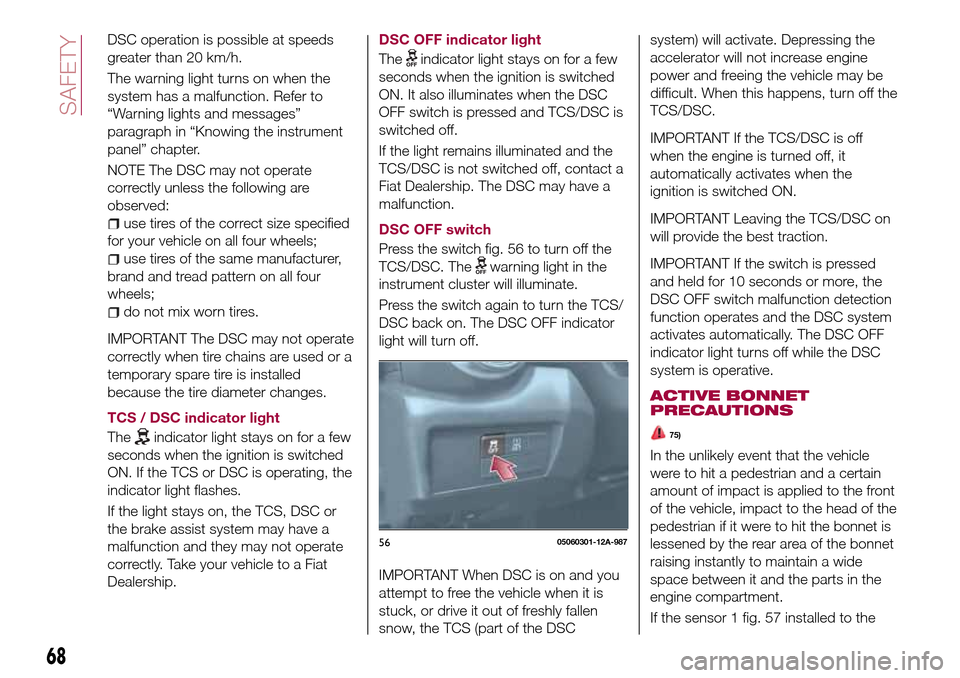
DSC OFF switch
Press the switch fig. 56 to turn off the
TCS/DSC. The
warning light in the
instrument cluster will illuminate.
Press the switch again to turn the TCS/
DSC back on. The DSC OFF indicator
light will turn off.
IMPORTANT When DSC is on and you
attempt to free the vehicle when it is
stuck, or drive it out of freshly fallen
snow, the TCS (part of the DSCsystem) will activate. Depressing the
accelerator will not increase engine
power and freeing the vehicle may be
difficult. When this happens, turn off the
TCS/DSC.
IMPORTANT If the TCS/DSC is off
when the engine is turned off, it
automatically activates when the
ignition is switched ON.
IMPORTANT Leaving the TCS/DSC on
will provide the best traction.
IMPORTANT If the switch is pressed
and held for 10 seconds or more, the
DSC OFF switch malfunction detection
function operates and the DSC system
activates automatically. The DSC OFF
indicator light turns off while the DSC
system is operative.
ACTIVE BONNET
PRECAUTIONS
75)
In the unlikely event that the vehicle
were to hit a pedestrian and a certain
amount of impact is applied to the front
of the vehicle, impact to the head of the
pedestrian if it were to hit the bonnet is
lessened by the rear area of the bonnet
raising instantly to maintain a wide
space between it and the parts in the
engine compartment.
If the sensor 1 fig. 57 installed to the
5605060301-12A-987
68
SAFETY
Page 72 of 216
front bumper. In addition, it may
activate depending on the level of
impact from even a light object, small
animal, or other small object;
the system may also activate if the
lower part of the vehicle or the front
bumper receives an impact from one of
the following situations:
– the vehicle hits a curb;
– the vehicle falls into a deep ditch or
hole;
– the vehicle bounces and hits the
ground;
– the front, bottom part of the vehicle
contacts the slope of a parking
garage, the surface of an even,
undulating road, or a protruding or
fallen object on the road.
Situations in which the active
bonnet may not activate
The active bonnet may not active in the
following situations as an impact would
be difficult to detect:
the pedestrian gets hit at an angle or
by the side areas on the left and right of
the front bumper;
the vehicle hits a pedestrian who is
carrying something such as a bag
which can absorb the impact.
Situations in which the system does
not activate
The active bonnet does not activate
under the following conditions:
the front bumper gets hit while the
vehicle is being driven at a speed
insufficient to activate the system;
the vehicle gets hit from the side or
the rear;
the vehicle rolls or turns over (the
active bonnet may operate depending
on the accident conditions).
WARNING
65)Do not rely on ABS as a substitute for
safe driving. The ABS cannot compensate
for unsafe and reckless driving, excessive
speed, tailgating (following another vehicle
too closely), driving on ice and snow, and
hydroplaning (reduced tire friction and road
contact because of water on the road
surface). You can still have an accident.
66)When the ABS intervenes and you feel
the brake pedal pulsating, do not reduce
the pressure, but hold it down firmly and
confidently; in doing so you will brake in the
shortest distance possible, depending on
the current road conditions.
67)For the correct operation of the ABS,
the tyres must of necessity be the same
make and type on all wheels, in perfect
condition and, above all, of the prescribed
type and dimensions.
68)If the ABS intervenes, this indicates
that the grip of the tyres on the road is
nearing its limit: you must slow down to a
speed compatible with the available grip.69)Do not rely on the Traction Control
System (TCS) as a substitute for safe
driving. The Traction Control System (TCS)
cannot compensate for unsafe and
reckless driving, excessive speed, tailgating
(following another vehicle too closely), and
hydroplaning (reduced tire friction and road
contact because of water on the road
surface). You can still have an accident.
70)Use snow tires or tire chains and drive
at reduced speeds when roads are
covered with ice and/or snow. Driving
without proper traction devices on snow
and/or ice-covered roads is dangerous.
The Traction Control System (TCS) alone
cannot provide adequate traction and you
could still have an accident.
71)The capability of the TCS must never
be tested irresponsibly and dangerously, in
such a way as to compromise personal
safety and the safety of others.
72)Do not rely on the DSC as a substitute
for safe driving: the Dynamic Stability
Control (DSC) cannot compensate for
unsafe and reckless driving, excessive
speed, tailgating (following another vehicle
too closely), and hydroplaning (reduced tire
friction and road contact because of water
on the road surface). You can still have an
accident.
73)For the correct operation of the DSC
system, the tyres must necessarily be of
the same make and type on all wheels, in
perfect condition and, above all, of the
prescribed type and size.
74)The capability of the DSC system must
never be tested irresponsibly and
dangerously, in such a way as to
compromise personal safety and the safety
of others.
70
SAFETY
Page 76 of 216
Tire Pressure Monitoring System
initialization
(versions with conventional tires)
In the following cases, system
initialization must be performed so that
the system operates normally:
a tire pressure is adjusted;
tire rotation is performed;
a tire or wheel is replaced;
the battery is replaced or completely
drained;
the tire pressure monitoring system
warning light is illuminated.
Initialization method
Proceed as follows:
park the car in a safe place and firmly
apply the parking brake;
let the tires cool, then adjust the tire
pressure of all four (4) tires to the
specified pressure indicated on the tire
pressure label located on the driver's
door frame (door open);
switch the ignition ON;
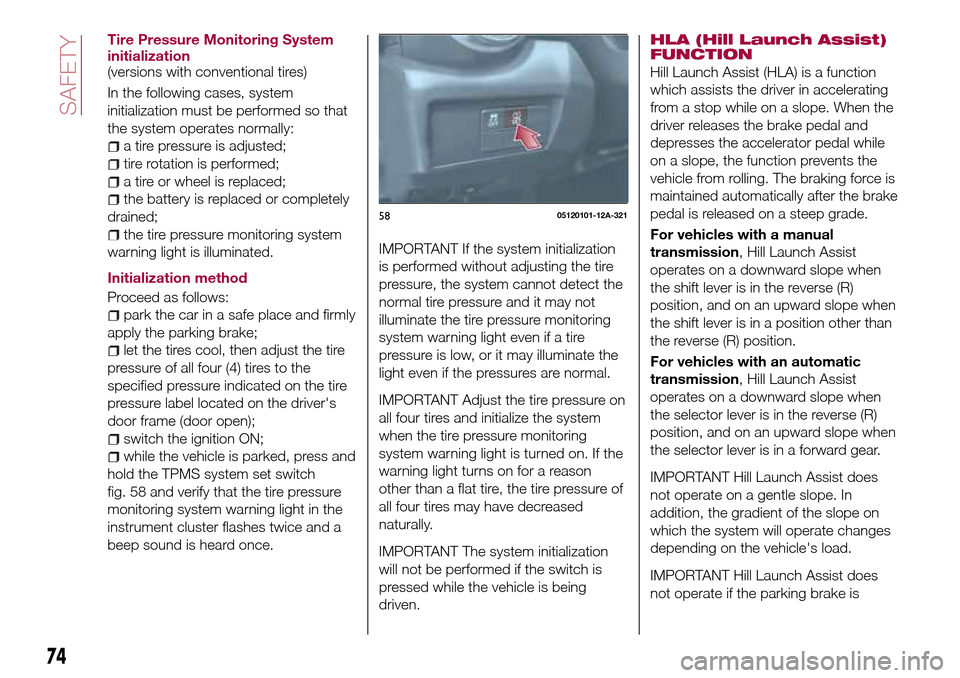
while the vehicle is parked, press and
hold the TPMS system set switch
fig. 58 and verify that the tire pressure
monitoring system warning light in the
instrument cluster flashes twice and a
beep sound is heard once.
IMPORTANT If the system initialization
is performed without adjusting the tire
pressure, the system cannot detect the
normal tire pressure and it may not
illuminate the tire pressure monitoring
system warning light even if a tire
pressure is low, or it may illuminate the
light even if the pressures are normal.
IMPORTANT Adjust the tire pressure on
all four tires and initialize the system
when the tire pressure monitoring
system warning light is turned on. If the
warning light turns on for a reason
other than a flat tire, the tire pressure of
all four tires may have decreased
naturally.
IMPORTANT The system initialization
will not be performed if the switch is
pressed while the vehicle is being
driven.HLA (Hill Launch Assist)
FUNCTION
Hill Launch Assist (HLA) is a function
which assists the driver in accelerating
from a stop while on a slope. When the
driver releases the brake pedal and
depresses the accelerator pedal while
on a slope, the function prevents the
vehicle from rolling. The braking force is
maintained automatically after the brake
pedal is released on a steep grade.
For vehicles with a manual
transmission, Hill Launch Assist
operates on a downward slope when
the shift lever is in the reverse (R)
position, and on an upward slope when
the shift lever is in a position other than
the reverse (R) position.
For vehicles with an automatic
transmission, Hill Launch Assist
operates on a downward slope when
the selector lever is in the reverse (R)
position, and on an upward slope when
the selector lever is in a forward gear.
IMPORTANT Hill Launch Assist does
not operate on a gentle slope. In
addition, the gradient of the slope on
which the system will operate changes
depending on the vehicle's load.
IMPORTANT Hill Launch Assist does
not operate if the parking brake is
5805120101-12A-321
74
SAFETY
Page 77 of 216
applied, the vehicle has not stopped
completely, or the clutch pedal is
released.
IMPORTANT While Hill Launch Assist is
operating, the brake pedal may feel stiff
and vibrate, however, this does not
indicate a malfunction.
IMPORTANT Hill Launch Assist does
not operate while the TCS/DSC
indicator light is illuminated. Refer to
“Warning lights and messages”
paragraph in “Knowing the instrument
panel” chapter.
IMPORTANT Hill Launch Assist (HLA)
does not turn off even if the DSC OFF
switch is pressed to turn off the
TCS/DSC.
IMPORTANT For vehicles with an
automatic transmission although the Hill
Launch Assist does not operate during
idling stop, the vehicle roll prevention
function operates to prevent vehicle roll.
IMPORTANT Do not rely completely on
Hill Launch Assist. Hill Launch Assist is
an auxiliary device for accelerating from
a stop on a slope. The system only
operates for about two seconds and
therefore, relying only on the system,
when accelerating from a stop is
dangerous because the vehicle may
move (roll) unexpectedly and cause anaccident. The vehicle could roll
depending on the vehicle's load or if it
is towing something. In addition, for
vehicles with a manual transmission,
the vehicle could still roll depending on
how the clutch pedal or the accelerator
pedal is operated. Always confirm the
safety around the vehicle before starting
to drive the vehicle.
WARNING
76)The presence of the TPMS does not
permit the driver to neglect regular checks
of the tire pressure, including for the spare
wheel, and correct maintenance: the
system is not used to signal a possible fault
to a tire. Tire pressure must be checked
with tires rested and cold. Should it
become necessary for whatever reason to
check pressure with warm tires, do not
reduce pressure even though it is higher
than the prescribed value. Repeat the
check when the tires are cold.
77)Replacing the normal tires with winter
tires and vice versa requires an inspection
of the TPMS, which should be carried out
only by a Fiat Dealership.
78)Changes in outside temperature may
cause tire pressures to vary. The system
may temporarily indicate insufficient
pressure. In this case check the tire
inflation pressure with the tires cold and, if
necessary top up the inflation pressure.
OCCUPANT
PROTECTION
SYSTEMS
The most important safety equipment
of the vehicle comprise the following
protection systems:
seat belts;
SBA (Seat Belt Alert) system;
head restraints;
child restraint systems;
front air bags and side air bags.
Read the information given the following
pages with the utmost care.
It is of fundamental importance that the
protection systems are used in the
correct way to guarantee the maximum
possible safety level for the driver and
the passengers.
75