brake FIAT 124 SPIDER 2016 2.G Owner's Guide
[x] Cancel search | Manufacturer: FIAT, Model Year: 2016, Model line: 124 SPIDER, Model: FIAT 124 SPIDER 2016 2.GPages: 216, PDF Size: 3.1 MB
Page 129 of 216
HAZARD WARNING
LIGHTS
CONTROL
Press button fig. 101 to switch the
lights on/off.
Depress the hazard warning flasher and
all the direction indicators will flash. The
hazard warning indicator light
and
in the instrument cluster flash
simultaneously.
EMERGENCY STOP
SIGNAL SYSTEM
The system turns off when it determines
that the brake pedal is released or that
an emergency braking situation no
longer exists based on the reduced
vehicle speed.
If the system determines that such a
situation is occurring, it flashes all thedirection indicators rapidly to caution
the driver of the vehicle following behind
your vehicle of the sudden braking
situation.
This system is designed to determine
whether you are depressing the brake
pedal with greater force than during
normal braking such as in a situation
requiring emergency braking.
If you bring your vehicle to a complete
stop while all the direction indicators are
flashing rapidly, the rapid flashing of all
the direction indicators changes back
to the normal flashing pattern.
The emergency stop signal system
does not operate at vehicle speeds
under about 60 km/h.
If the brake pedal is depressed while
driving on slippery roads, the
emergency stop signal system could
operate causing all the direction and
lane change indicators to flash.
REPLACING A BULB
GENERAL
INSTRUCTIONS
160) 161) 162) 163)
30) 31)
Before replacing a bulb check the
contacts for oxidation;
replace blown bulbs with others of
the same type and power;
after replacing a headlight bulb,
always check its alignment;
to replace the bulb, contact a Fiat
Dealership;
use the protective cover and carton
for the replacement bulb to dispose of
the old bulb promptly and out of the
reach of children;
when a light is not working, check
that the corresponding fuse is intact
before replacing the bulb. For the
location of fuses, refer to the paragraph
“If a fuse blows” in this chapter.
IMPORTANT When removing the lens
or light unit using a flathead
screwdriver, make sure that the flathead
screwdriver does not contact the
interior terminal. If the flathead
screwdriver contacts the terminal, a
short circuit may occur.
10105031100-L12A
127
Page 135 of 216
Brake lights / Tail lights
Go to a Fiat Dealership when the
replacement of this lights is necessary.
Side direction indicator lights
Proceed as follows:
make sure the ignition is switched
off, and the headlight switch is off;
if you are changing the right bulb,
start the engine, turn the steering wheel
all the way to the right, and turn off
engine. If you are changing the left bulb,
turn the steering wheel to the left;
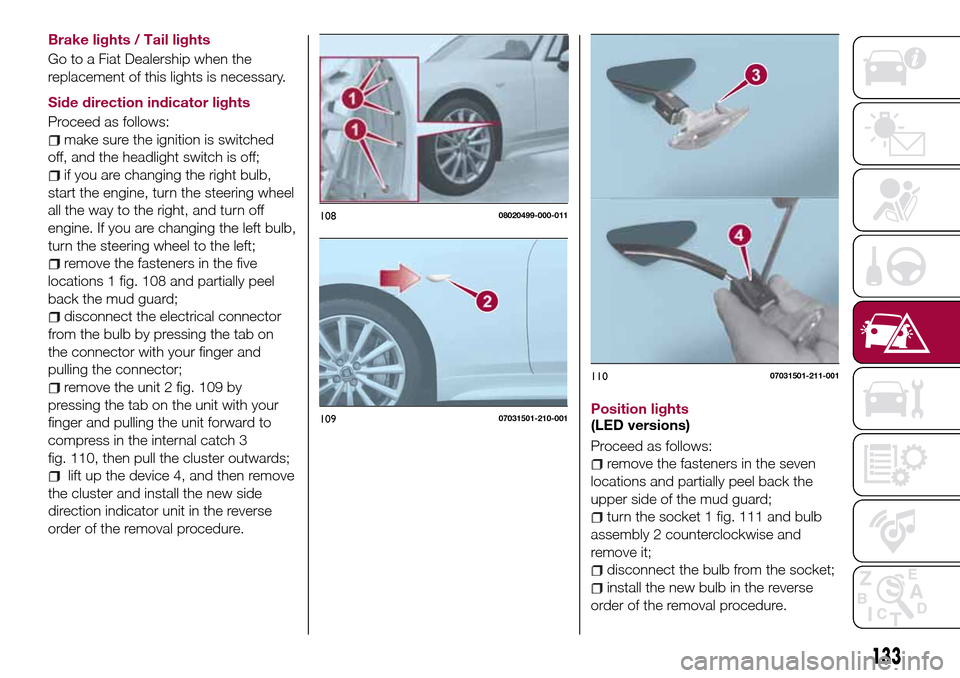
remove the fasteners in the five
locations 1 fig. 108 and partially peel
back the mud guard;
disconnect the electrical connector
from the bulb by pressing the tab on
the connector with your finger and
pulling the connector;
remove the unit 2 fig. 109 by
pressing the tab on the unit with your
finger and pulling the unit forward to
compress in the internal catch 3
fig. 110, then pull the cluster outwards;
lift up the device 4, and then remove
the cluster and install the new side
direction indicator unit in the reverse
order of the removal procedure.Position lights
(LED versions)
Proceed as follows:remove the fasteners in the seven
locations and partially peel back the
upper side of the mud guard;
turn the socket 1 fig. 111 and bulb
assembly 2 counterclockwise and
remove it;
disconnect the bulb from the socket;
install the new bulb in the reverse
order of the removal procedure.
10808020499-000-011
10907031501-210-001
11007031501-211-001
133
Page 145 of 216
WARNING
164)If the fuse blows again contact a Fiat
Dealership.
165)Never replace a fuse with another
with a higher amp rating; DANGER OF
FIRE.
166)Contact a Fiat Dealership if a safety
system (airbags, brakes), power unit
system (engine, gearbox) or steering
system general protection fuse blows.
167)Do not replace the main fuse and
multiplex slow blow fuse by yourself.
Contact a Fiat Dealership to perform the
replacement. Replacing these fuses by
yourself is dangerous because they are
high current fuses. Incorrect replacement
could cause an electrical shock or a short
circuit resulting in a fire.
168)Before replacing a fuse, make sure
that the ignition device is in OFF position
and that all the other services are switched
off and/or deactivated.
IMPORTANT
32)Never replace a fuse with metal wires
or anything else.
33)If it is necessary to wash the engine
compartment, take care not to directly hit
the junction unit and the window wiper
motors with the water jet.
TIRE SERVICE KIT
(where provided)
169) 170) 171) 172) 173) 174) 175)
3)
TOOL STORAGE
Your vehicle is not equipped with a
spare tire, jack and wheel brace. For
details, contact a Fiat Dealership.
Tools are stored in the locations
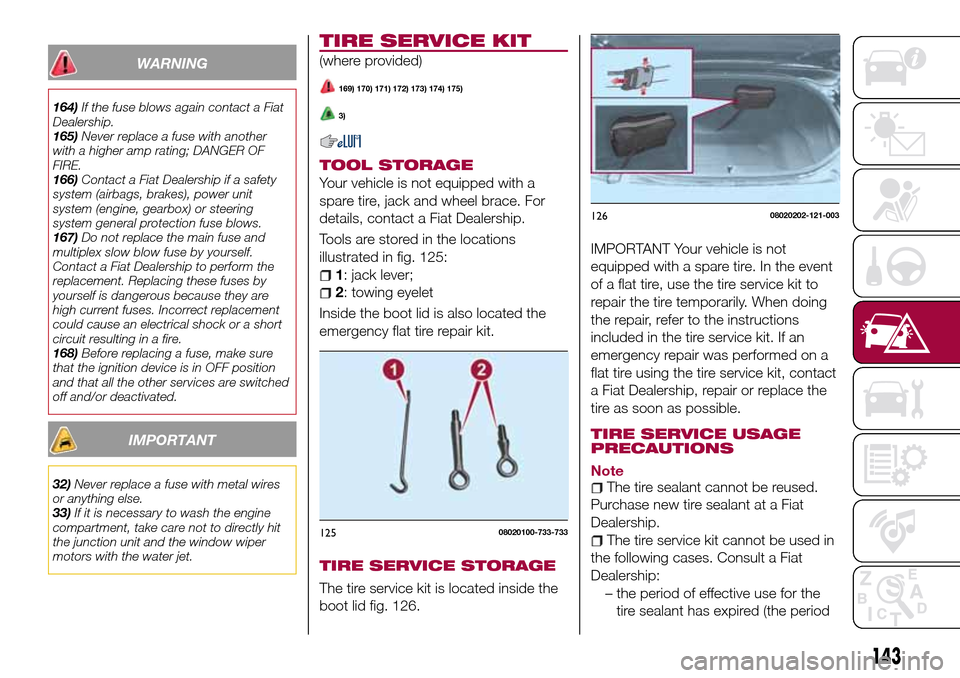
illustrated in fig. 125:
1: jack lever;
2: towing eyelet
Inside the boot lid is also located the
emergency flat tire repair kit.
TIRE SERVICE STORAGE
The tire service kit is located inside the
boot lid fig. 126.
IMPORTANT Your vehicle is not
equipped with a spare tire. In the event
of a flat tire, use the tire service kit to
repair the tire temporarily. When doing
the repair, refer to the instructions
included in the tire service kit. If an
emergency repair was performed on a
flat tire using the tire service kit, contact
a Fiat Dealership, repair or replace the
tire as soon as possible.
TIRE SERVICE USAGE
PRECAUTIONS
NoteThe tire sealant cannot be reused.
Purchase new tire sealant at a Fiat
Dealership.
The tire service kit cannot be used in
the following cases. Consult a Fiat
Dealership:
– the period of effective use for the
tire sealant has expired (the period12508020100-733-733
12608020202-121-003
143
Page 146 of 216
of effectiveness is indicated on the
bottle label);
– the tear or puncture exceeds about
4 mm;
– the damage has occurred to an
area of the tire other than the tread;
– the vehicle has been driven with
nearly no air remaining in the tire;
– the tire has come off the wheel rim;
– damage to the wheel rim has
occurred;
– the tire has two or more punctures.
SEALING A TIRE WITH
TIRE SERVICE
Proceed as follows:
move the vehicle off the right-of-way
to a safe place on a level and hard
surface where the vehicle does not
obstruct traffic;
shift the shift lever to the 1 or
Reverse (R) position (manual
transmission), and shift the selector
lever to the P position (automatic
transmission);
apply the parking brake with the
brake pedal depressed and turn off the
engine;
if necessary, flash the hazard warning
lights and set up the roadside
emergency triangle;
unload passengers and cargo and
remove the tire service kit;
shake the tire sealant well. If the
bottle is shaken after the injection hose
is screwed on, tire sealant could spray
out from the injection hose. Tire sealant
contacting clothing or other objects
may be impossible to remove. Shake
the bottle before screwing on the
injection hose;
IMPORTANT The sealant hardens easily
and injecting it will be difficult under
cold weather conditions (0°C or below).
Warm the sealant inside the vehicle to
facilitate injection.
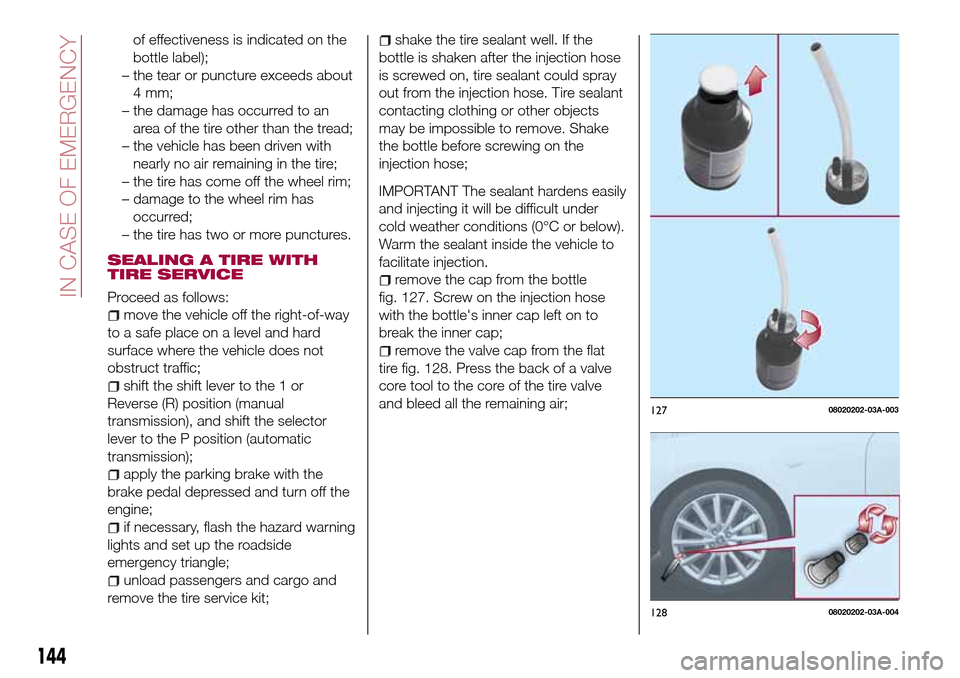
remove the cap from the bottle
fig. 127. Screw on the injection hose
with the bottle's inner cap left on to
break the inner cap;
remove the valve cap from the flat
tire fig. 128. Press the back of a valve
core tool to the core of the tire valve
and bleed all the remaining air;
12708020202-03A-003
12808020202-03A-004
144
IN CASE OF EMERGENCY
Page 154 of 216
If towing service is not available in an
emergency, the vehicle may be towed
with all four wheels on the ground using
the towing hook at the front of the
vehicle. Only tow the vehicle on paved
surfaces for short distances at low
speeds.
Follow these instructions when towing
the vehicle with all wheels on the
ground:
shift to neutral (manual transmission),
or the N position (automatic
transmission);
switch the ignition to ACC;
release the parking brake.
NOTE Remember that power assist for
the brakes and steering will not be
available when the engine is not
running.
152
IN CASE OF EMERGENCY
EMERGENCY
TOWING
TOWING DESCRIPTION
Proper lifting and towing are necessary
to prevent damage to the vehicle.
Government and local laws must be
followed.
A towed vehicle usually should have its
drive wheels (rear wheels) off the
ground. If excessive damage or other
conditions prevent this, use wheel
dollies.
When towing with the rear wheels on
the ground, release the parking brake.
IMPORTANT Do not tow the vehicle
pointed backward with driving wheels
on the ground. This may cause internal
damage to the transmission.
IMPORTANT Do not tow with sling-type
equipment. This could damage your
vehicle. Use wheel-lift or flatbed
equipment.
Page 156 of 216
INTRODUCTION
Be extremely careful and prevent injury
to yourself and others or damage to
your vehicle when using this manual for
inspection and maintenance.
If you are unsure about any procedure it
describes, we strongly urge you to have
a reliable and qualified service shop
perform the work, preferably at Fiat
Dealership.
Factory-trained FCA technicians and
genuine FCA parts are best for your
vehicle. Without this expertise and the
parts that have been designed and
made especially for your vehicle,
inadequate, incomplete, and insufficient
servicing may result in problems. This
could lead to vehicle damage or an
accident and injuries.
For expert advice and quality service,
contact a Fiat Dealership.
The owner should retain evidence that
proper maintenance has been
performed as prescribed.
A claim against a warranty will not
qualify if it results from lack of
maintenance and not from defective
material or authorised workmanship.
Claims against the warranty resulting
from lack of maintenance, as opposed
to defective materials or authorized FCA
workmanship, will not be honored.Scheduled maintenance
NOTE After the prescribed period,
continue to follow the described
maintenance at the recommended
intervals.
Emission control and related
systems
The ignition and fuel systems are highly
important to the emission control
system and to efficient engine
operation. Do not tamper with them.
All inspections and adjustments must
be made by an expert repairer, we
recommend a Fiat Dealership.
OWNER MAINTENANCE
PRECAUTIONS
186) 187) 188)
38)
Routine service
We highly recommend that these items
be inspected daily, or at least every
week:
Engine oil level
Engine coolant level
Brake and clutch fluid Level
Washer fluid level
Battery maintenance
Tire inflation pressureImproper or incomplete service may
result in problems. This section gives
instructions only for items that are easy
to perform.
As explained in the “Introduction”
paragraph, several procedures can be
done only by a qualified service
technician with special tools.
Improper do-it yourself maintenance
during the warranty period may affect
warranty coverage. For details, read the
separate Warranty statement provided
with the vehicle. If you are unsure about
any servicing or maintenance
procedure, have it done by an expert
repairer, we recommend a Fiat
Dealership.
There are strict environmental laws
regarding the disposal of waste oil and
fluids. Please dispose of your waste
properly and with due regard to the
environment.
We recommend that you entrust the oil
and fluid changes of your vehicle to a
Fiat Dealership.
154
MAINTENANCE AND CARE
Page 157 of 216
warning lights, etc.);
operation of windscreen
washer/wiper system and
positioning/wear of windscreen window
wiper blades.
Every 3,000 km, check and top up if
required: engine oil level.
HEAVY-DUTY USE OF THE
VEHICLE
If the vehicle is used under one of the
following conditions:
dusty roads;
short, repeated journeys (less than
7-8 km) at sub-zero outside
temperatures;
engine often idling or driving long
distances at low speeds or long periods
of inactivity;
the following checks must be carried
out more often than indicated in the
Scheduled Servicing Plan:
check front disc brake pad condition
and wear;
check cleanliness of bonnet and
luggage compartment locks,
cleanliness and lubrication of linkage;
visually inspect conditions of: engine,
gearbox, transmission, pipes and hoses
(exhaust/fuel system/brakes) and
rubber elements (gaiters/sleeves/
bushes, etc.);
check battery charge and battery
fluid level (electrolyte);
visually inspect conditions of the
accessory drive belts;
check and, if necessary, change
engine oil and replace oil filter;
check and, if necessary, replace
pollen filter;
check and, if necessary, replace air
cleaner.
155
PERIODIC CHECKS
Every1,000 kmor before long trips
check and, if necessary, top up:
engine coolant level;
brake fluid level;
windscreen washer fluid level;
tire inflation pressure and condition;
operation of lighting system
(headlights, direction indicators, hazard
Page 158 of 216
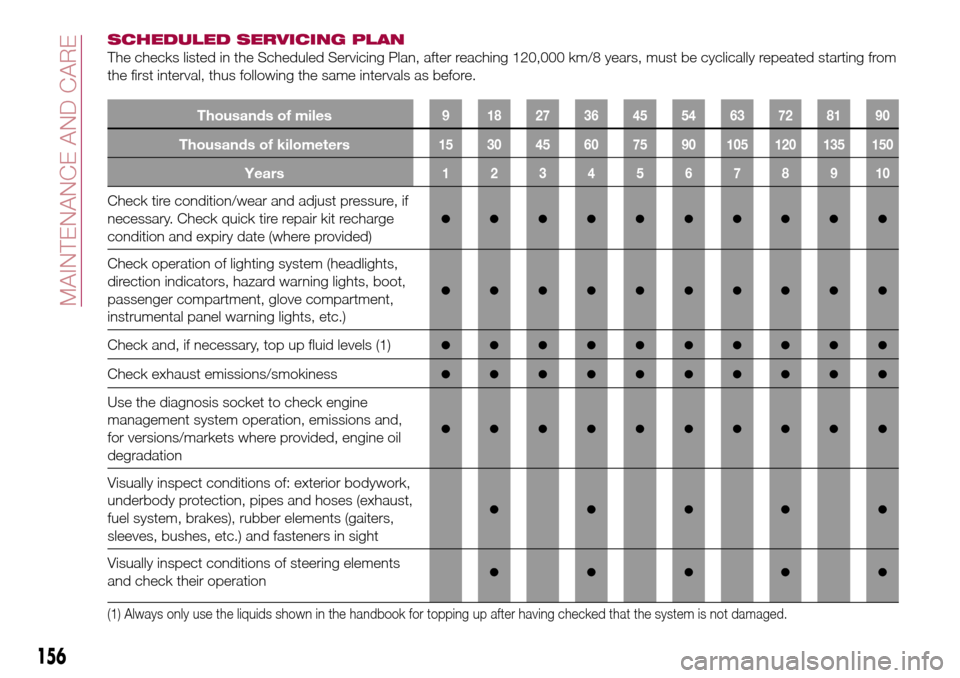
SCHEDULED SERVICING PLAN
The checks listed in the Scheduled Servicing Plan, after reaching 120,000 km/8 years, must be cyclically repeated starting from
the first interval, thus following the same intervals as before.
Thousands of miles9 182736455463728190
Thousands of kilometers15 30 45 60 75 90 105 120 135 150
Years12345678910
Check tire condition/wear and adjust pressure, if
necessary. Check quick tire repair kit recharge
condition and expiry date (where provided)
●●●●●●●●●●
Check operation of lighting system (headlights,
direction indicators, hazard warning lights, boot,
passenger compartment, glove compartment,
instrumental panel warning lights, etc.)
●●●●●●●●●●
Check and, if necessary, top up fluid levels (1)●●●●●●●●●●
Check exhaust emissions/smokiness●●●●●●●●●●
Use the diagnosis socket to check engine
management system operation, emissions and,
for versions/markets where provided, engine oil
degradation
●●●●●●●●●●
Visually inspect conditions of: exterior bodywork,
underbody protection, pipes and hoses (exhaust,
fuel system, brakes), rubber elements (gaiters,
sleeves, bushes, etc.) and fasteners in sight
●●●●●
Visually inspect conditions of steering elements
and check their operation●●●●●
(1) Always only use the liquids shown in the handbook for topping up after having checked that the system is not damaged.
156
MAINTENANCE AND CARE
Page 159 of 216
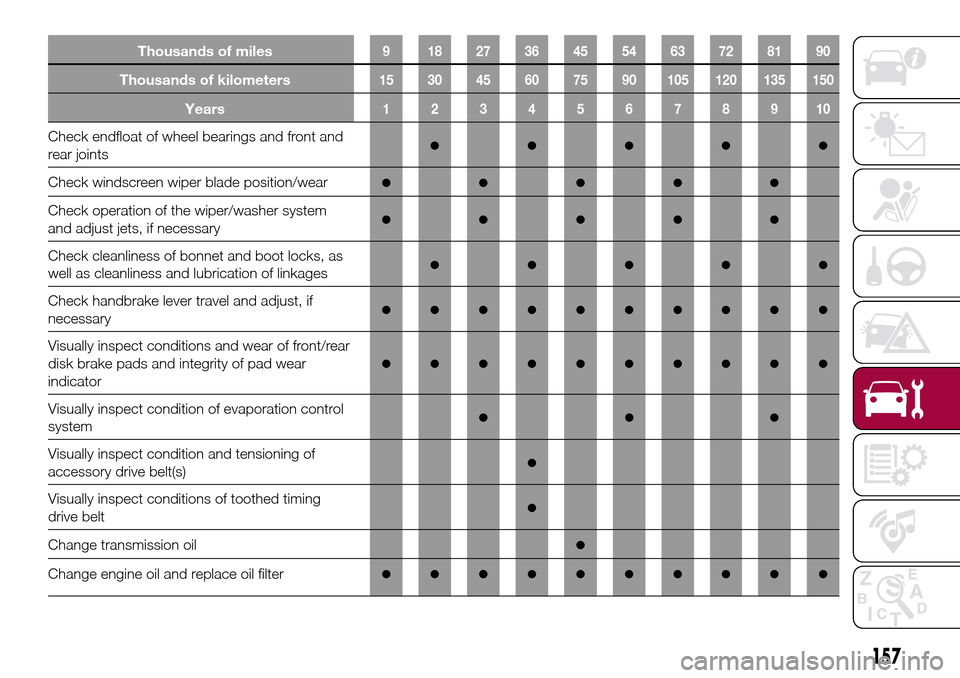
Thousands of miles9 182736455463728190
Thousands of kilometers15 30 45 60 75 90 105 120 135 150
Years12345678910
Check endfloat of wheel bearings and front and
rear joints●●●●●
Check windscreen wiper blade position/wear●●●●●
Check operation of the wiper/washer system
and adjust jets, if necessary●●●●●
Check cleanliness of bonnet and boot locks, as
well as cleanliness and lubrication of linkages●●●●●
Check handbrake lever travel and adjust, if
necessary●●●●●●●●●●
Visually inspect conditions and wear of front/rear
disk brake pads and integrity of pad wear
indicator
●●●●●●●●●●
Visually inspect condition of evaporation control
system●●●
Visually inspect condition and tensioning of
accessory drive belt(s)●
Visually inspect conditions of toothed timing
drive belt●
Change transmission oil●
Change engine oil and replace oil filter●●●●●●●●●●
157
Page 160 of 216
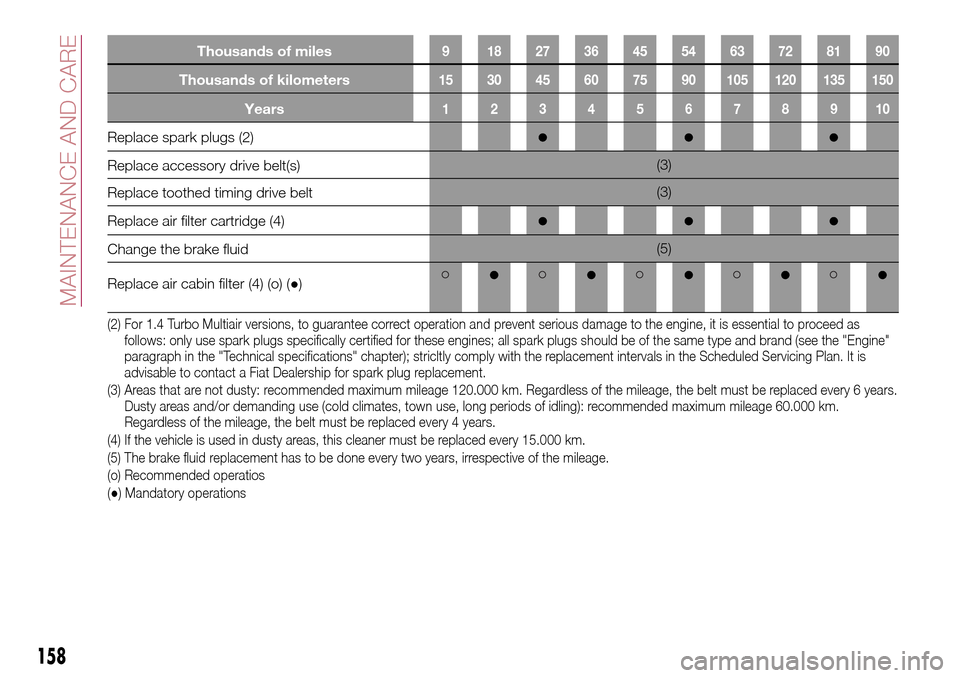
Thousands of miles9 182736455463728190
Thousands of kilometers15 30 45 60 75 90 105 120 135 150
Years12345678910
Replace spark plugs (2)●●●
Replace accessory drive belt(s)(3)
Replace toothed timing drive belt(3)
Replace air filter cartridge (4)
●●●
Change the brake fluid(5)
Replace air cabin filter (4) (o) (●)
●●●●●
(2) For 1.4 Turbo Multiair versions, to guarantee correct operation and prevent serious damage to the engine, it is essential to proceed as
follows: only use spark plugs specifically certified for these engines; all spark plugs should be of the same type and brand (see the "Engine"
paragraph in the "Technical specifications" chapter); stricltly comply with the replacement intervals in the Scheduled Servicing Plan. It is
advisable to contact a Fiat Dealership for spark plug replacement.
(3) Areas that are not dusty: recommended maximum mileage 120.000 km. Regardless of the mileage, the belt must be replaced every 6 years.
Dusty areas and/or demanding use (cold climates, town use, long periods of idling): recommended maximum mileage 60.000 km.
Regardless of the mileage, the belt must be replaced every 4 years.
(4) If the vehicle is used in dusty areas, this cleaner must be replaced every 15.000 km.
(5) The brake fluid replacement has to be done every two years, irrespective of the mileage.
(o) Recommended operatios
(●) Mandatory operations
158
MAINTENANCE AND CARE