warning FIAT 124 SPIDER 2016 2.G User Guide
[x] Cancel search | Manufacturer: FIAT, Model Year: 2016, Model line: 124 SPIDER, Model: FIAT 124 SPIDER 2016 2.GPages: 216, PDF Size: 3.1 MB
Page 20 of 216
The setting change is completed by
doing any one of the following:
– switching the ignition to ACC or
ON;
– closing the driver's door;
– opening the boot lid;
– not operating the key for
10 seconds;
– pressing any button except the
button on the key;
– pressing a request switch.
With theft-deterrent system
The hazard warning lights flash when
the theft-deterrent system is armed or
turned off (refer to “Theft-deterrent
system” in “Vehicle security alarm”
paragraph).
With double locking system
Pressing the request switch twice within
3 seconds will activate the double
locking system. The setting can be
changed so that the doors and the boot
lid, fuel filler flap are locked
automatically without pressing the
request switch.
Auto-lock function
A beep sound is heard when both
doors are closed while the advanced
key is being carried.
Both doors and the boot lid, fuel filler
flap are locked automatically after aboutthree seconds when the advanced key
is out of the operational range.
Also, the hazard warning lights flash
once (even if the driver is in the
operational range, both doors and the
boot lid, fuel filler flap are locked
automatically after about 30 seconds).
If you are out of the operational range
before the doors and the boot lid are
completely closed or another key is left
in the vehicle, the auto-lock function will
not work.
Always make sure that both doors and
the boot lid are closed and locked
before leaving the vehicle. The
auto-lock function does not close the
power windows.
Auto re-lock function
After unlocking with the request switch,
both doors and the boot lid, fuel filler
flap will automatically lock if any of the
following operations are not performed
within about 30 seconds. If your vehicle
has a theft-deterrent system, the
hazard warning lights will flash for
confirmation.
The time required for the doors and the
boot lid, fuel filler flap to lock
automatically can be changed (refer to
“Personalisation features” paragraph in
“Knowing the instrument panel”
chapter).
Opening a door or the boot lid.
Switching the ignition to any position
other than off.
LOCKING / UNLOCKING
WITH TRANSMITTER
Both doors and the boot lid, fuel filler
flap can be locked/unlocked by
operating the keyless entry system
transmitter: refer to “Keyless entry
system” in “Keys” paragraph.
WARNING
7)Always take all children and pets with
you or leave a responsible person with
them: leaving a child or a pet unattended in
a parked vehicle is dangerous. In hot
weather, temperatures inside a vehicle can
become high enough to cause brain
damage or even death.
8)Do not leave the key in your vehicle with
children and keep them in a place where
your children will not find or play with them:
leaving children in a vehicle with the key is
dangerous. This could result in someone
being badly injured or even killed.
9)Always close both the windows and
convertible top, lock the doors and take the
key with you when leaving your vehicle
unattended: leaving your vehicle unlocked
is dangerous as children could lock
themselves in a hot vehicle, which could
result in death. Also, a vehicle left unlocked
becomes an easy target for thieves and
intruders.
18
GETTING TO KNOW YOUR VEHICLE
Page 22 of 216
IMPORTANT Do not use organic
solvents to clean the seat. It may
damage the seat surface and the
heater.
NoteIf the ignition is switched off while the
seat warmer is operating (High, Mid or
Low) and then switched ON again, the
seat warmer will automatically operate
at the temperature set before switching
off the ignition.
Use the seat warmer when the
engine is running. Leaving the seat
warmer on for long periods with the
engine not running could cause the
battery power to be depleted.
The temperature of the seat warmer
cannot be adjusted beyond High, Mid
and Low because the seat warmer is
controlled by a thermostat.
WARNING
15)Make sure the adjustable components
of a seat are locked in place. Adjustable
seats and seatbacks that are not securely
locked are dangerous. In a sudden stop or
collision, the seat or seatback could move,
causing injury. Make sure the adjustable
components of the seat are locked in place
by attempting to slide the seat forward and
backward and rocking the seatback.16)Never allow children to adjust a seat.
Allowing children to adjust a seat is
dangerous as it could result in serious
injury if a child's hands or feet become
caught in the seat.
17)Do not drive with the seatback
unlocked. All of the seatbacks play an
important role in your protection in a
vehicle. Leaving the seatback unlocked is
dangerous as it can allow passengers to
be ejected or thrown around and baggage
to strike occupants in a sudden stop or
collision, resulting in severe injury. After
adjusting the seatback at any time, even
when there are no other passengers, rock
the seatback to make sure it is locked in
place.
18)Adjust the driver's seat only when the
vehicle is stopped. Adjusting the driver's
seat while the vehicle is moving is
dangerous. The driver could lose control of
the vehicle and have an accident.
19)Do not modify or replace the seats.
Modifying or replacing the seats such as
replacing the upholstery or loosening any
bolts is dangerous. The seats contain air
bag components essential to the
supplementary restraint system. Such
modifications could damage the
supplementary restraint system and result
in serious injury. Consult a Fiat Dealership if
there is any need to remove or reinstall the
seats.20)Do not drive with damaged seats.
Driving with damaged seats, such as seat
cushions torn or damaged down to the
urethane, is dangerous. A collision, even
one not strong enough to inflate the air
bags, could damage the seats which
contain essential air bag components. If
there was a subsequent collision, an air
bag may not deploy which could lead to
injuries. Always have a Fiat Dealership
inspect the seats, seat belt pretensioners
and air bags after a collision.
21)Do not drive with either seats reclined.
Sitting in a reclined position while the
vehicle is moving is dangerous because
you do not get the full protection from seat
belts. During sudden braking or a collision,
you can slide under the lap belt and suffer
serious internal injuries. For maximum
protection, sit well back and upright.
22)Do not place an object such as a
cushion between the seatback and your
back. Putting an object such as a cushion
between the seatback and your back is
dangerous because you will be unable to
maintain a safe driving posture and the
seat belt cannot function at its full capacity
in a collision, which could result in a
serious accident, injury or death.
23)Do not place objects under the seat.
The object could get stuck and cause the
seat to not be fixed securely, and result in
an accident.
24)Do not stack cargo higher than the
seatbacks. Stacking luggage or other
cargo higher than the seatbacks is
dangerous. During sudden braking or a
collision, objects can fly around and
become projectiles that may hit and injure
passengers.
20
GETTING TO KNOW YOUR VEHICLE
Page 23 of 216
25)Make sure luggage and cargo is
secured before driving. Not securing cargo
while driving is dangerous as it could move
or be crushed during sudden braking or a
collision and cause injury.
26)Always leave your vehicle locked and
keep the car keys safely away from
children. Leaving your car unlocked or the
keys in reach of children is dangerous.
Children who find their way into the boot
through an open boot can become
accidentally locked in the boot. This could
result in death or brain damage from heat
prostration, particularly in the summer.
Always lock the doors and the boot.
27)When operating a seat, be careful not
to put your hands or fingers near the
moving parts of the seat or on the side trim
to prevent injury.
28)When moving the seats, make sure
there is no cargo in the surrounding area. If
the cargo gets caught it could damage the
cargo. When moving the seats forward and
rearward or returning a rear-reclined
seatback to its upright position, make sure
you hold onto the seatback with your hand
while operating. If the seatback is not held,
the seat will move suddenly and could
cause injury.
29)Be careful when using the seat warmer.
The heat from the seat warmer may be too
hot for some people, as indicated below,
and could cause a low temperature burn.
Infants, small babies, elderly people, and
physically challenged people, people with
delicate skin, people who are excessively
fatigued, people who are intoxicated,
people who have taken sleep-inducing
medicine such as sleeping pills or cold
medicine.30)Do not use the seat warmer with
anything having high moisture retention
ability such as a blanket or cushion on the
seat. The seat may be heated excessively
and cause a low-temperature burn.
31)Do not place objects on the seat or on
the backrest that may isolate the heat,
such as a cover or a pillow. It may cause
the seat heating device to overheat. Sitting
on an overheated seat may cause severe
burns due to the increase in temperature of
the seat surface.
32)Do not place heavy objects with sharp
projections on the seat, or insert needles or
pins into it. This could cause the seat to
become excessively heated and result in
injury from a minor burn.
IMPORTANT
7)The fabric upholstery for the seats has
been designed to withstand long-term wear
deriving from normal use of the vehicle.
Nevertheless, some precautions are
required. Avoid prolonged and/or excessive
rubbing involving clothing accessories such
as metal buckles, bosses, Velcro strips and
the like, which, by applying a high pressure
on the fabric in a limited area, could cause
it to break, thereby damaging the
upholstery.
HEAD RESTRAINTS
33)
Non-Adjustable Head Restraints
Your vehicle is equipped with non
adjustable head restraints on the
driver's and passenger's seatbacks.
The non adjustable head restraints
consist of a trimmed foam covering
over the upper structure of the
seatbacks and are intended to help
protect you and the passenger from
neck injury.
Adjust the seatbacks to their upright,
on-road positions so that the head
restraint is positioned as close as
possible to the back of your head.
WARNING
33)Make sure the seatbacks are properly
adjusted to their upright, on-road positions
before the vehicle is driven. Driving with the
seatbacks not adjusted properly is
dangerous. With no support behind your
head, your neck could be seriously injured
in a collision.
21
Page 24 of 216
STEERING WHEEL
STEERING WHEEL
ADJUSTMENT
34) 35) 36)
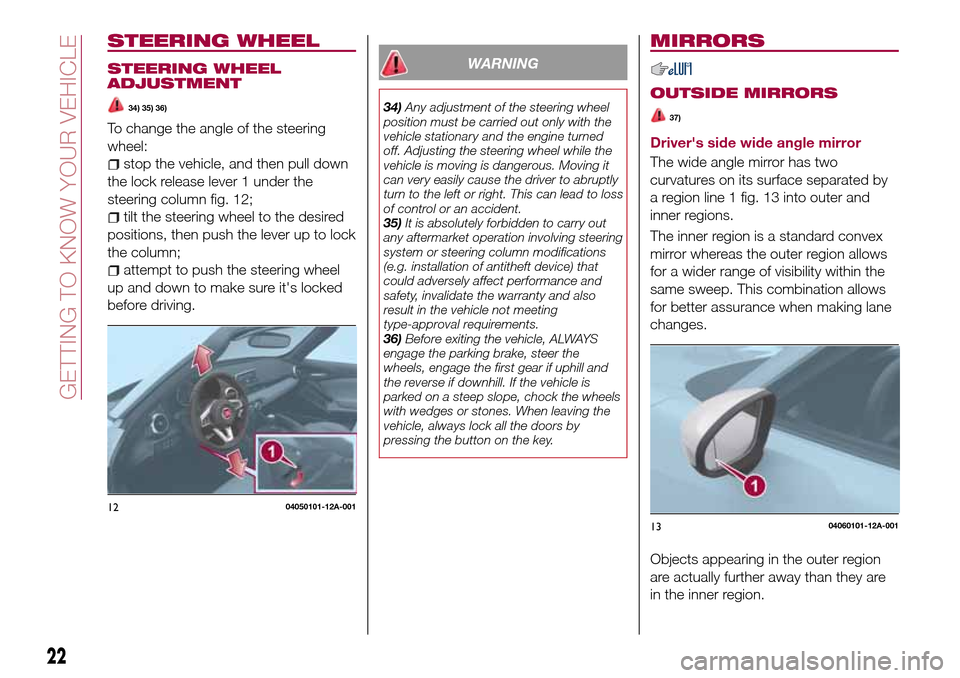
To change the angle of the steering
wheel:
stop the vehicle, and then pull down
the lock release lever 1 under the
steering column fig. 12;
tilt the steering wheel to the desired
positions, then push the lever up to lock
the column;
attempt to push the steering wheel
up and down to make sure it's locked
before driving.
WARNING
34)Any adjustment of the steering wheel
position must be carried out only with the
vehicle stationary and the engine turned
off. Adjusting the steering wheel while the
vehicle is moving is dangerous. Moving it
can very easily cause the driver to abruptly
turn to the left or right. This can lead to loss
of control or an accident.
35)It is absolutely forbidden to carry out
any aftermarket operation involving steering
system or steering column modifications
(e.g. installation of antitheft device) that
could adversely affect performance and
safety, invalidate the warranty and also
result in the vehicle not meeting
type-approval requirements.
36)Before exiting the vehicle, ALWAYS
engage the parking brake, steer the
wheels, engage the first gear if uphill and
the reverse if downhill. If the vehicle is
parked on a steep slope, chock the wheels
with wedges or stones. When leaving the
vehicle, always lock all the doors by
pressing the button on the key.
MIRRORS
OUTSIDE MIRRORS
37)
Driver's side wide angle mirror
The wide angle mirror has two
curvatures on its surface separated by
a region line 1 fig. 13 into outer and
inner regions.
The inner region is a standard convex
mirror whereas the outer region allows
for a wider range of visibility within the
same sweep. This combination allows
for better assurance when making lane
changes.
Objects appearing in the outer region
are actually further away than they are
in the inner region.
1204050101-12A-001
1304060101-12A-001
22
GETTING TO KNOW YOUR VEHICLE
Page 25 of 216
INSIDE DAY / NIGHT
MIRROR
39)
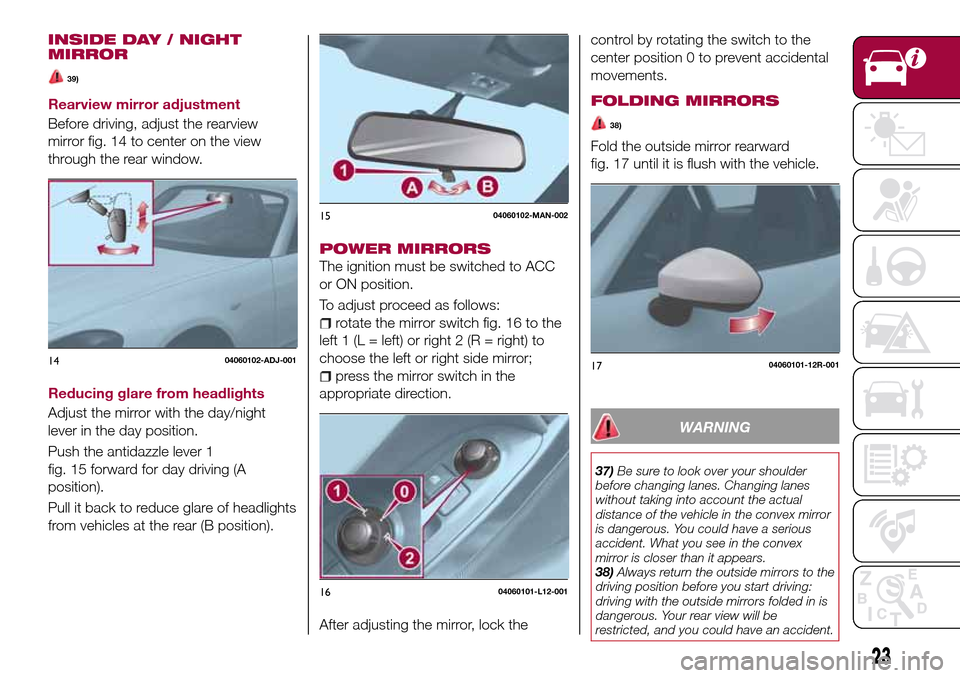
Rearview mirror adjustment
Before driving, adjust the rearview
mirror fig. 14 to center on the view
through the rear window.
Reducing glare from headlights
Adjust the mirror with the day/night
lever in the day position.
Push the antidazzle lever 1
fig. 15 forward for day driving (A
position).
Pull it back to reduce glare of headlights
from vehicles at the rear (B position).
POWER MIRRORS
The ignition must be switched to ACC
or ON position.
To adjust proceed as follows:
rotate the mirror switch fig. 16 to the
left 1 (L = left) or right 2 (R = right) to
choose the left or right side mirror;
press the mirror switch in the
appropriate direction.
After adjusting the mirror, lock thecontrol by rotating the switch to the
center position 0 to prevent accidental
movements.
FOLDING MIRRORS
38)
Fold the outside mirror rearward
fig. 17 until it is flush with the vehicle.
WARNING
37)Be sure to look over your shoulder
before changing lanes. Changing lanes
without taking into account the actual
distance of the vehicle in the convex mirror
is dangerous. You could have a serious
accident. What you see in the convex
mirror is closer than it appears.
38)Always return the outside mirrors to the
driving position before you start driving:
driving with the outside mirrors folded in is
dangerous. Your rear view will be
restricted, and you could have an accident.
1404060102-ADJ-001
1504060102-MAN-002
1604060101-L12-001
1704060101-12R-001
23
Page 27 of 216
HIGH BEAMS
The headlights switch between high
and low beams by moving the lever
forward or backward.
When the headlight high-beams are on,
the
warning light is turned on.
FLASH TO PASS
Can be used when the ignition is
switched ON.
To flash the headlights, pull the lever
fully towards you (the headlight switch
does not need to be on).
The
warning light in the instrument
cluster illuminates simultaneously.
The lever will return to the normal
position when released.
AUTOMATIC LIGHTING(where provided)
Light sensor
When the headlight switch is in the
AUTOposition and the ignition is
switched ON, the light sensor senses
the surrounding lightness or darkness
and automatically turns the headlights,
other exterior lights and dashboard
illumination on or off.
IMPORTANT The light sensor also
works as a rain sensor for the
auto-wiper control. Keep hands and
scrapers clear of the windshield when
the wiper lever is in the AUTO positionand the ignition is switched ON as
fingers could be pinched or the wipers
and wiper blades damaged when the
wipers activate automatically. If you are
going to clean the windshield, be sure
the wipers are turned off completely
(this is particularly important when
clearing ice and snow) when it is
particularly tempting to leave the engine
running.
COMING HOME LIGHT
SYSTEM
The coming me home light system
turns on the headlights (low beams)
when the lever is operated.
System activation
When the lever is pulled with the ignition
switched to ACC or OFF, the low beam
headlights turn on.
The headlights turn off after a certain
period of time has elapsed after the
doors are closed.
The time until the headlights turn off
after all of the doors are closed can be
changed. If no operations are done for
3 minutes after the lever is pulled, the
headlights turn off.
The headlights turn off if the lever is
pulled again while the headlights are on.
FRONT FOG LIGHTS
The front fog light can be used when
the ignition is switched to ON.
The front fog lights improve visibility at
night and in presence of fog.
Activation
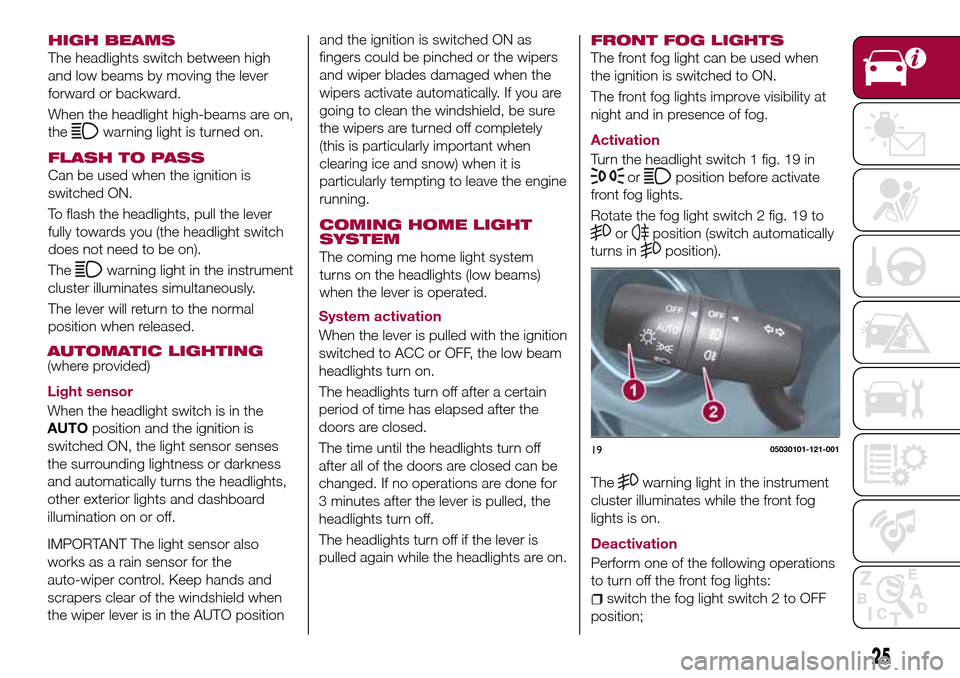
Turn the headlight switch 1 fig. 19 in
orposition before activate
front fog lights.
Rotate the fog light switch 2 fig. 19 to
orposition (switch automatically
turns in
position).
25
Thewarning light in the instrument
cluster illuminates while the front fog
lights is on.
Deactivation
Perform one of the following operations
to turn off the front fog lights:
switch the fog light switch 2 to OFF
position;
1905030101-121-001
Page 28 of 216
turn the headlight switch 1 to OFF
position;
switch the ignition to a position other
than ON.
The
warning light in the instrument
cluster goes off when the front fog
lighst is turned off.
With auto-light control
When the fog light switch 2 is in
or
position and the headlight switch is
in AUTO position, the front fog lights will
light up together with the headlights,
the exterior lights and the dashboard.
If the fog light switch 2 is turned to
position (the front fog light switch
2 returns to
position automatically),
the rear fog light and the respective
indicator on the instrument panel will
also light up.
REAR FOG LIGHTS
The rear fog lights can be used when
the ignition is switched ON.
The rear fog light helps your vehicle to
be seen. When the lights are turned on,
the rear fog lights indicator light in the
instrument cluster turns on.
Versions with front fog lights
Activation
The headlight switch 1 must be put in
orposition before turning on
the rear fog lights.To turn the rear fog light on, rotate the
fog light switch 2 to the
position (the
fog light switch automatically returns to
position).
The
warning light in the instrument
cluster illuminates while the rear fog
light is on.
Deactivation
To turn the rear fog light off, do any of
the following:
rotate the fog light switch 2 to the
position again (the fog light switch
automatically returns to the
position);
turn the headlight switch 1 to the
OFF position;
switch the ignition to a position other
than ON.
The
warning light in the instrument
cluster goes off when the rear fog light
is turned off.
When you turn on the rear fog light, the
front fog lights will also turn on.
If the fog light switch 2 is rotated to the
position (the fog light switch
automatically returns to the
position) the front fog light indicator
lamp on the instrument cluster will also
illuminate.
With auto-light control
When the headlight switch is in the
AUTOposition, the rear fog light willturn on once the headlights, the exterior
lights and instrument panel illumination
are on.
Versions without front fog lights
The headlights must be turned on to
turn on the rear fog light.
Activation
To turn on the rear fog light on, rotate
the fog light switch 2 to the
position
(the fog light switch returns to its
original position automatically).
The rear fog light indicator light in the
instrument cluster illuminates while the
rear fog light is on.
26
GETTING TO KNOW YOUR VEHICLE
Deactivation
To turn the rear fog light off, do any of
the following:
rotate the fog light switch 2 to the
position again (the fog light switch
automatically returns to the
position);
rotate the fog light switch 2 to the
OFF position;
turn the headlight switch 1 to the
OFF position.
TURN SIGNALS
The ignition must be switched ON to
use the turn and lane-change signals.
Move the signal lever down (for a left
turn) or up (for a right turn) to the stop
position. The signal will self-cancel after
the turn is completed.
Page 29 of 216
If the indicator light continues to flash
after a turn, manually return the lever to
its original position.
The turn signal indicators (green)
in the instrument cluster flash
according to the operation of the turn
signal lever to show which signal is
working.
If an indicator light stays on without
flashing or if it flashes abnormally, one
of the turn signal bulbs may be burned
out.
LANE CHANGE SIGNALS
Move the lever halfway toward the
direction of the lane change (until the
indicator flashes) and hold it there. It will
return to the off position when released.
Three-flash turn signal
After releasing the turn signal lever, the
turn signal indicator flashes three times.
The operation can be cancelled by
moving the lever in the direction
opposite to which it was operated.
Adaptive Front Lighting
System (AFS)
(where provided)
The adaptive front lighting system (AFS)
automatically adjusts the headlight
beams to the left or right in conjunction
with the operation of the steering wheel
after the headlights have been turned
on.A system malfunction or operation
conditions are indicated by a warning.
Refer to “Warning lights on instrument
panel” paragraph in “Knowing the
instrument panel” chapter.
NOTE
Headlights are equipped which do
not blind drivers approaching in the
opposite direction no matter what side
of the road you must drive your vehicle
(left-hand or right-hand traffic).
Therefore, it is not necessary to adjust
the optical axis of the headlights when
switching temporarily to driving on the
opposite side of the road (left-hand or
right-hand traffic).
The Adaptive Front Lighting System
(AFS) function can be switched to
operable/ inoperable using the
personalisation function. Refer to
“Personalisation features” paragraph in
“Knowing the instrument panel”
chapter.
27
HEADLAMP LEVELLING
The number of passengers and weight
of cargo in the luggage compartment
change the angle of the headlights.
Auto type
The angle of the headlights will be
automatically adjusted when turning on
the headlights.Manual type
The headlight levelling switch is used to
adjust the angle of the headlights
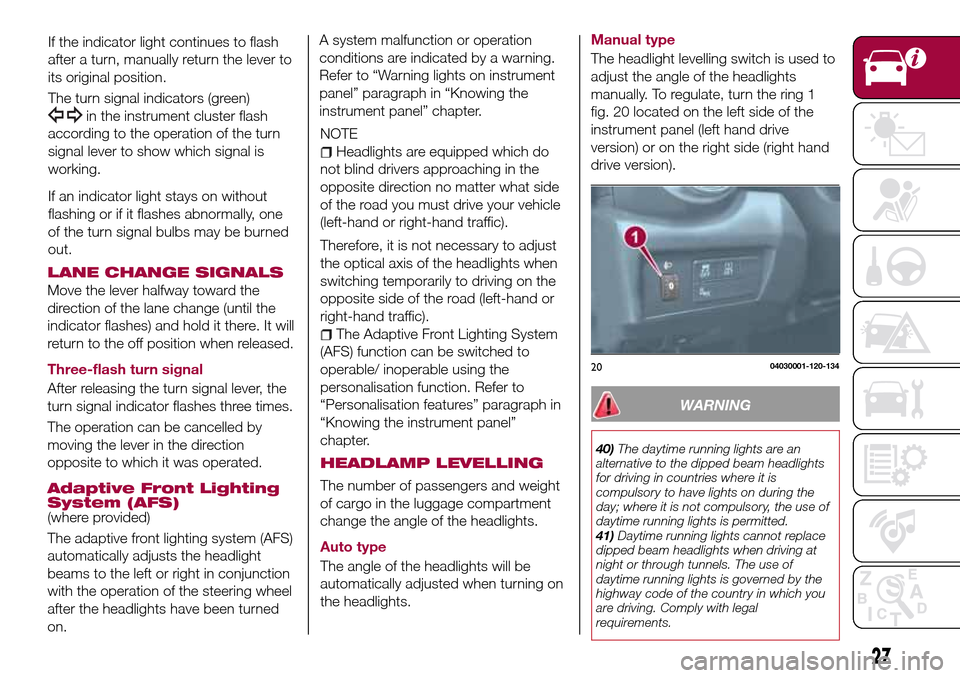
manually. To regulate, turn the ring 1
fig. 20 located on the left side of the
instrument panel (left hand drive
version) or on the right side (right hand
drive version).
2004030001-120-134
WARNING
40)The daytime running lights are an
alternative to the dipped beam headlights
for driving in countries where it is
compulsory to have lights on during the
day; where it is not compulsory, the use of
daytime running lights is permitted.
41)Daytime running lights cannot replace
dipped beam headlights when driving at
night or through tunnels. The use of
daytime running lights is governed by the
highway code of the country in which you
are driving. Comply with legal
requirements.
Page 32 of 216
30
GETTING TO KNOW YOUR VEHICLE
IMPORTANT Because heavy ice and
snow can jam the wiper blades, the
wiper motor is protected from motor
breakdown, overheating and possible
fire by a circuit breaker. This
mechanism will automatically stop
operation of the blades, but only for
about 5 minutes. If this happens, turn
off the wiper switch and park off the
right-of-way, and remove the snow and
ice. After 5 minutes, turn on the switch
and the blades should operate
normally. If they do not resume
functioning, contact a Fiat Dealership
as soon as possible. Drive to the side of
the road and park off the right-of-way.
Wait until the weather clears before
trying to drive with the wipers
inoperative.
WINDSCREEN WASHER
Pull the lever toward you and hold it to
spray washer fluid.
With the wiper lever in theOFFor
intermittent position/AUTOposition,
the wipers will operate continuously
until the lever is released.
If the washer does not work, inspect
the fluid level. If the fluid level is normal,
contact a Fiat Dealership.With headlight washers
When the headlights are on, the
headlight washers operate
automatically once every fifth time the
windshield washer operates.
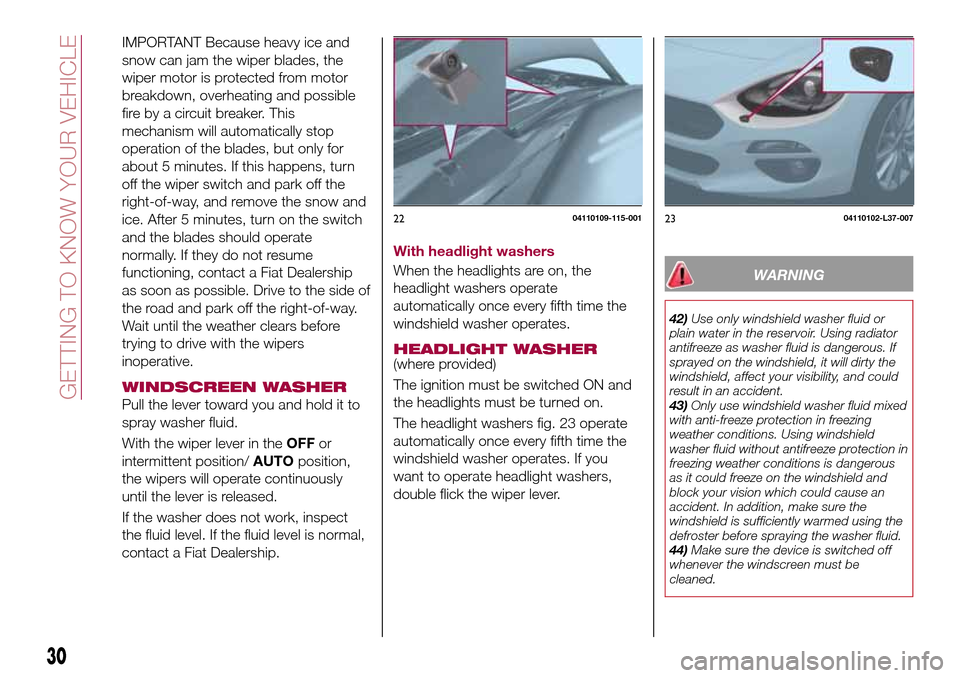
HEADLIGHT WASHER(where provided)
The ignition must be switched ON and
the headlights must be turned on.
The headlight washers fig. 23 operate
automatically once every fifth time the
windshield washer operates. If you
want to operate headlight washers,
double flick the wiper lever.
WARNING
42)Use only windshield washer fluid or
plain water in the reservoir. Using radiator
antifreeze as washer fluid is dangerous. If
sprayed on the windshield, it will dirty the
windshield, affect your visibility, and could
result in an accident.
43)Only use windshield washer fluid mixed
with anti-freeze protection in freezing
weather conditions. Using windshield
washer fluid without antifreeze protection in
freezing weather conditions is dangerous
as it could freeze on the windshield and
block your vision which could cause an
accident. In addition, make sure the
windshield is sufficiently warmed using the
defroster before spraying the washer fluid.
44)Make sure the device is switched off
whenever the windscreen must be
cleaned.
2204110109-115-0012304110102-L37-007
Page 38 of 216
36
GETTING TO KNOW YOUR VEHICLE
procedure can be done on both door
switches. The power window auto
function will only resume on the power
window that has been reset:
close the doors and the convertible
top;
switch the ignition ON;
make sure that the power window
lock switch located on the driver's door
is not depressed;
press the switch and fully open the
window;
pull up the switch to fully close the
window and continue holding the
switch for about 2 seconds after the
window fully closed;
repeat steps 4-5 for the passenger
power window while seated in the
passenger seat;
make sure that the power windows
operate correctly using the door
switches.
After the system has been re-initialized,
passenger window can be fully opened
automatically using the master control
switches. If the automatic power
window operation does not operate
normally while the doors or convertible
top are opened/closed, reset it using
the above procedures.
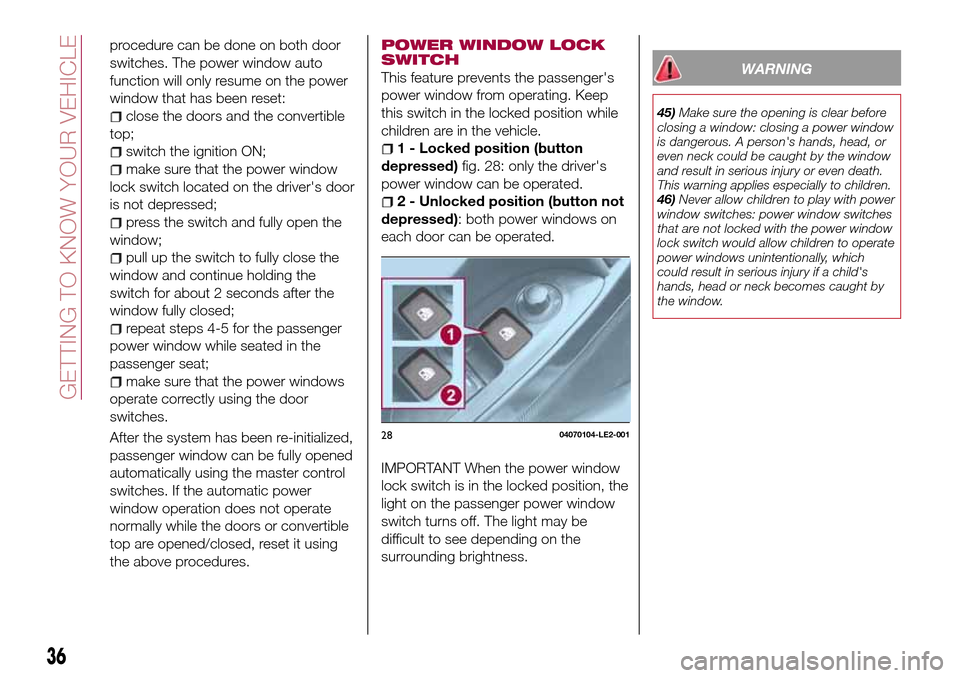
POWER WINDOW LOCK
SWITCH
This feature prevents the passenger's
power window from operating. Keep
this switch in the locked position while
children are in the vehicle.
1 - Locked position (button
depressed)fig. 28: only the driver's
power window can be operated.
2 - Unlocked position (button not
depressed): both power windows on
each door can be operated.
IMPORTANT When the power window
lock switch is in the locked position, the
light on the passenger power window
switch turns off. The light may be
difficult to see depending on the
surrounding brightness.
WARNING
45)Make sure the opening is clear before
closing a window: closing a power window
is dangerous. A person's hands, head, or
even neck could be caught by the window
and result in serious injury or even death.
This warning applies especially to children.
46)Never allow children to play with power
window switches: power window switches
that are not locked with the power window
lock switch would allow children to operate
power windows unintentionally, which
could result in serious injury if a child's
hands, head or neck becomes caught by
the window.
2804070104-LE2-001