warning light FIAT 124 SPIDER 2016 2.G Service Manual
[x] Cancel search | Manufacturer: FIAT, Model Year: 2016, Model line: 124 SPIDER, Model: FIAT 124 SPIDER 2016 2.GPages: 216, PDF Size: 3.1 MB
Page 76 of 216
Tire Pressure Monitoring System
initialization
(versions with conventional tires)
In the following cases, system
initialization must be performed so that
the system operates normally:
a tire pressure is adjusted;
tire rotation is performed;
a tire or wheel is replaced;
the battery is replaced or completely
drained;
the tire pressure monitoring system
warning light is illuminated.
Initialization method
Proceed as follows:
park the car in a safe place and firmly
apply the parking brake;
let the tires cool, then adjust the tire
pressure of all four (4) tires to the
specified pressure indicated on the tire
pressure label located on the driver's
door frame (door open);
switch the ignition ON;
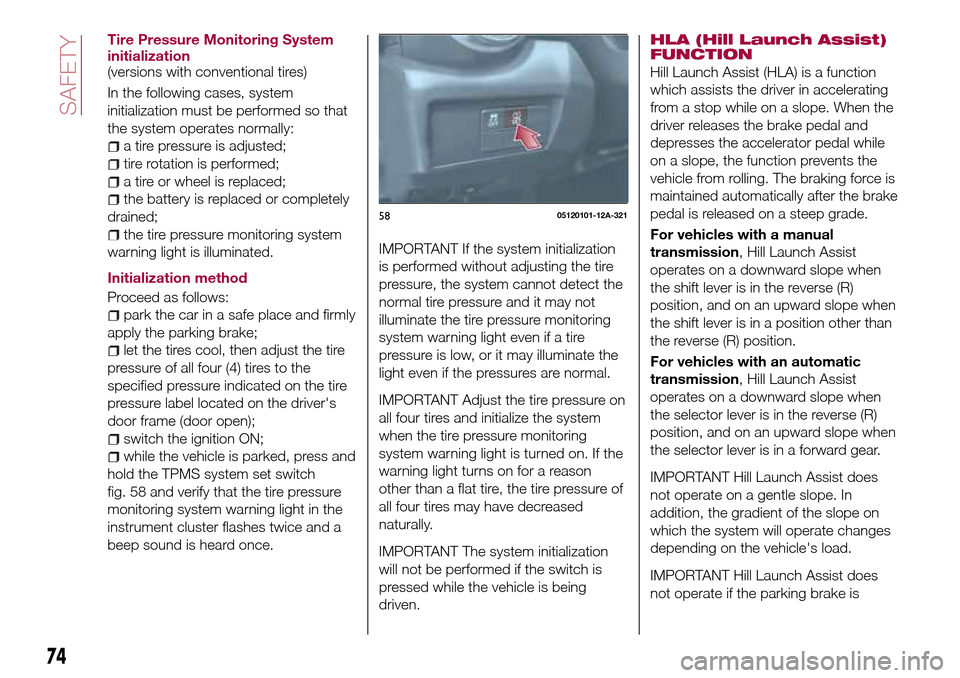
while the vehicle is parked, press and
hold the TPMS system set switch
fig. 58 and verify that the tire pressure
monitoring system warning light in the
instrument cluster flashes twice and a
beep sound is heard once.
IMPORTANT If the system initialization
is performed without adjusting the tire
pressure, the system cannot detect the
normal tire pressure and it may not
illuminate the tire pressure monitoring
system warning light even if a tire
pressure is low, or it may illuminate the
light even if the pressures are normal.
IMPORTANT Adjust the tire pressure on
all four tires and initialize the system
when the tire pressure monitoring
system warning light is turned on. If the
warning light turns on for a reason
other than a flat tire, the tire pressure of
all four tires may have decreased
naturally.
IMPORTANT The system initialization
will not be performed if the switch is
pressed while the vehicle is being
driven.HLA (Hill Launch Assist)
FUNCTION
Hill Launch Assist (HLA) is a function
which assists the driver in accelerating
from a stop while on a slope. When the
driver releases the brake pedal and
depresses the accelerator pedal while
on a slope, the function prevents the
vehicle from rolling. The braking force is
maintained automatically after the brake
pedal is released on a steep grade.
For vehicles with a manual
transmission, Hill Launch Assist
operates on a downward slope when
the shift lever is in the reverse (R)
position, and on an upward slope when
the shift lever is in a position other than
the reverse (R) position.
For vehicles with an automatic
transmission, Hill Launch Assist
operates on a downward slope when
the selector lever is in the reverse (R)
position, and on an upward slope when
the selector lever is in a forward gear.
IMPORTANT Hill Launch Assist does
not operate on a gentle slope. In
addition, the gradient of the slope on
which the system will operate changes
depending on the vehicle's load.
IMPORTANT Hill Launch Assist does
not operate if the parking brake is
5805120101-12A-321
74
SAFETY
Page 77 of 216
applied, the vehicle has not stopped
completely, or the clutch pedal is
released.
IMPORTANT While Hill Launch Assist is
operating, the brake pedal may feel stiff
and vibrate, however, this does not
indicate a malfunction.
IMPORTANT Hill Launch Assist does
not operate while the TCS/DSC
indicator light is illuminated. Refer to
“Warning lights and messages”
paragraph in “Knowing the instrument
panel” chapter.
IMPORTANT Hill Launch Assist (HLA)
does not turn off even if the DSC OFF
switch is pressed to turn off the
TCS/DSC.
IMPORTANT For vehicles with an
automatic transmission although the Hill
Launch Assist does not operate during
idling stop, the vehicle roll prevention
function operates to prevent vehicle roll.
IMPORTANT Do not rely completely on
Hill Launch Assist. Hill Launch Assist is
an auxiliary device for accelerating from
a stop on a slope. The system only
operates for about two seconds and
therefore, relying only on the system,
when accelerating from a stop is
dangerous because the vehicle may
move (roll) unexpectedly and cause anaccident. The vehicle could roll
depending on the vehicle's load or if it
is towing something. In addition, for
vehicles with a manual transmission,
the vehicle could still roll depending on
how the clutch pedal or the accelerator
pedal is operated. Always confirm the
safety around the vehicle before starting
to drive the vehicle.
WARNING
76)The presence of the TPMS does not
permit the driver to neglect regular checks
of the tire pressure, including for the spare
wheel, and correct maintenance: the
system is not used to signal a possible fault
to a tire. Tire pressure must be checked
with tires rested and cold. Should it
become necessary for whatever reason to
check pressure with warm tires, do not
reduce pressure even though it is higher
than the prescribed value. Repeat the
check when the tires are cold.
77)Replacing the normal tires with winter
tires and vice versa requires an inspection
of the TPMS, which should be carried out
only by a Fiat Dealership.
78)Changes in outside temperature may
cause tire pressures to vary. The system
may temporarily indicate insufficient
pressure. In this case check the tire
inflation pressure with the tires cold and, if
necessary top up the inflation pressure.
OCCUPANT
PROTECTION
SYSTEMS
The most important safety equipment
of the vehicle comprise the following
protection systems:
seat belts;
SBA (Seat Belt Alert) system;
head restraints;
child restraint systems;
front air bags and side air bags.
Read the information given the following
pages with the utmost care.
It is of fundamental importance that the
protection systems are used in the
correct way to guarantee the maximum
possible safety level for the driver and
the passengers.
75
Page 79 of 216
USING THE SEAT BELTS
81) 82) 83) 84) 85)
Fastening the seat belt
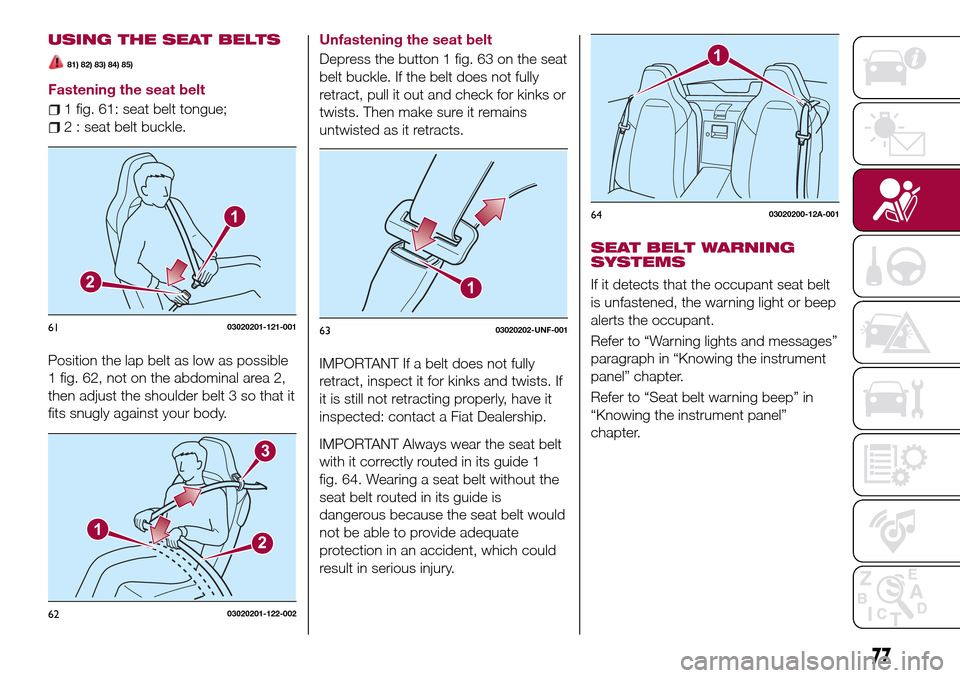
1 fig. 61: seat belt tongue;
2 : seat belt buckle.
Position the lap belt as low as possible
1 fig. 62, not on the abdominal area 2,
then adjust the shoulder belt 3 so that it
fits snugly against your body.Unfastening the seat belt
Depress the button 1 fig. 63 on the seat
belt buckle. If the belt does not fully
retract, pull it out and check for kinks or
twists. Then make sure it remains
untwisted as it retracts.
IMPORTANT If a belt does not fully
retract, inspect it for kinks and twists. If
it is still not retracting properly, have it
inspected: contact a Fiat Dealership.
IMPORTANT Always wear the seat belt
with it correctly routed in its guide 1
fig. 64. Wearing a seat belt without the
seat belt routed in its guide is
dangerous because the seat belt would
not be able to provide adequate
protection in an accident, which could
result in serious injury.SEAT BELT WARNING
SYSTEMS
If it detects that the occupant seat belt
is unfastened, the warning light or beep
alerts the occupant.
Refer to “Warning lights and messages”
paragraph in “Knowing the instrument
panel” chapter.
Refer to “Seat belt warning beep” in
“Knowing the instrument panel”
chapter.
1
2
6103020201-121-001
1
3
2
6203020201-122-002
1
6303020202-UNF-001
1
6403020200-12A-001
77
Page 81 of 216
SBA SYSTEM
(Seat Belt Alert)
SEAT BELT WARNING
LIGHT
The LED on dashboard trim turns on if
the driver or passenger's seat is
occupied and the seat belt is not
fastened with the ignition switched ON.
If the driver or passenger's seat belt is
unfastened (only when the passenger
seat is occupied) and the vehicle is
driven at a speed faster than about
20 km/h, the
LED flashes. After a
short time, the LED stops flashing, but
remains illuminated.
If a seat belt remains unfastened, the
LED flashes again for a given period of
time. In this case, fasten the seat belt.
If the driver or passenger's seat belt is
unfastened after the LED turns on, and
the vehicle speed exceeds 20 km/h, the
LED flashes again.
SEAT BELT
PRETENSIONER AND
LOAD LIMITING
SYSTEMS
PRETENSIONERS
88) 89) 90) 91)
For optimum protection, the driver and
passenger seat belts are equipped with
pretensioner and load limiting systems.
For both these systems to work
properly you must wear the seat belt
properly.
When a collision is detected, the
pretensioners deploy simultaneously
with the air bags. For deployment
details, refer to the “SRS air bag
deployment criteria” paragraph in this
chapter.
The seat belt retractors remove slack
quickly as the air bags are expanding.
Any time the air bags and seat belt
pretensioners have fired they must be
replaced.
A system malfunction or operation
conditions are indicated by a warning.
Refer to “Warning lights and messages”
and “Warning sound is activated”
paragraph in “Knowing the instrument
panel” chapter.
In addition, the pretensioner system for
the passenger, like the front and side
passenger air bag, is designed to onlydeploy when the passenger occupant
classification sensor detects a
passenger sitting on the passenger's
seat. For details, refer to the passenger
occupant classification sensor.
IMPORTANT The pretensioner system
may not operate depending on the type
of the collision. For details, refer to the
“SRS Air Bag deployment criteria”
paragraph.
IMPORTANT Some smoke (non-toxic
gas) will be released when the air bags
and pretensioners deploy. This does
not indicate a fire. This gas normally
has no effect on occupants, however,
those with sensitive skin may
experience slight skin irritation. If
residue from the deployment of the air
bags or the pretensioner system gets
on the skin or in the eyes, wash it off as
soon as possible.
LOAD LIMITER
The load limiting system releases belt
webbing in a controlled manner to
reduce belt force on the occupant's
chest.
While the most severe load on a seat
belt occurs in frontal collisions, the load
limiter has an automatic mechanical
function and can activate in any
accident mode with sufficient occupant
movement.
79
Page 92 of 216
held, the seat will move suddenly and
could cause injury.
Proceed as follows:
open the convertible top;
make sure the ignition is switched
off;
slide the passenger seat as far back
as possible. You may need to move the
seat forward slightly and recline the
back of the seat, in order to assist in
the fittment of some child-restraint
systems;
make sure the seatback is securely
latched by pushing it back until it is fully
locked;
expand the area between the seat
bottom and the seatback slightly to
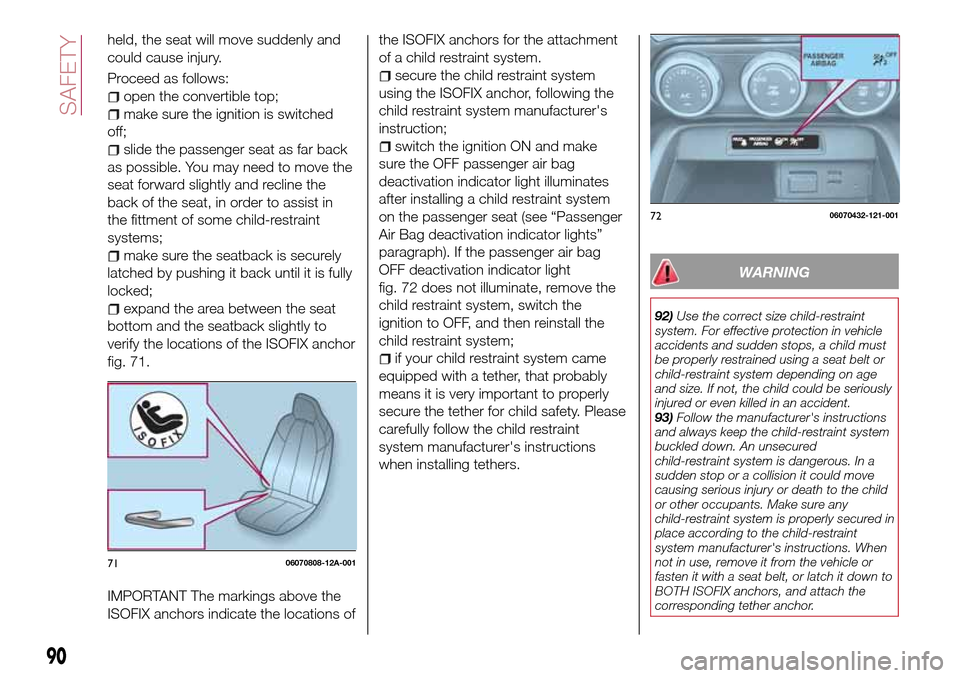
verify the locations of the ISOFIX anchor
fig. 71.
IMPORTANT The markings above the
ISOFIX anchors indicate the locations ofthe ISOFIX anchors for the attachment
of a child restraint system.
secure the child restraint system
using the ISOFIX anchor, following the
child restraint system manufacturer's
instruction;
switch the ignition ON and make
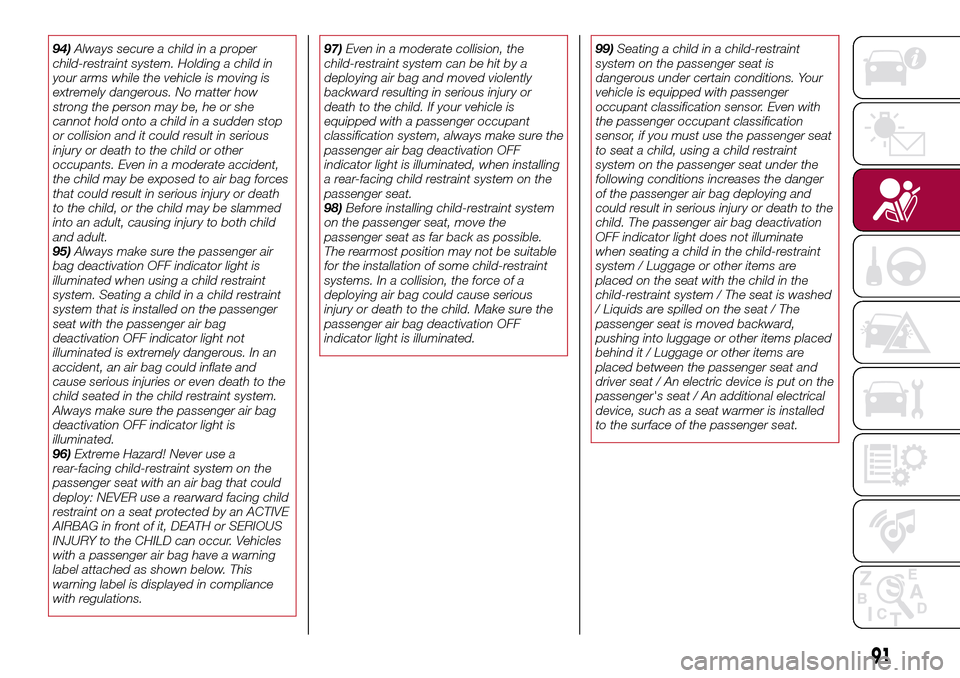
sure the OFF passenger air bag
deactivation indicator light illuminates
after installing a child restraint system
on the passenger seat (see “Passenger
Air Bag deactivation indicator lights”
paragraph). If the passenger air bag
OFF deactivation indicator light
fig. 72 does not illuminate, remove the
child restraint system, switch the
ignition to OFF, and then reinstall the
child restraint system;
if your child restraint system came
equipped with a tether, that probably
means it is very important to properly
secure the tether for child safety. Please
carefully follow the child restraint
system manufacturer's instructions
when installing tethers.
WARNING
92)Use the correct size child-restraint
system. For effective protection in vehicle
accidents and sudden stops, a child must
be properly restrained using a seat belt or
child-restraint system depending on age
and size. If not, the child could be seriously
injured or even killed in an accident.
93)Follow the manufacturer's instructions
and always keep the child-restraint system
buckled down. An unsecured
child-restraint system is dangerous. In a
sudden stop or a collision it could move
causing serious injury or death to the child
or other occupants. Make sure any
child-restraint system is properly secured in
place according to the child-restraint
system manufacturer's instructions. When
not in use, remove it from the vehicle or
fasten it with a seat belt, or latch it down to
BOTH ISOFIX anchors, and attach the
corresponding tether anchor.
7106070808-12A-001
7206070432-121-001
90
SAFETY
Page 93 of 216
94)Always secure a child in a proper
child-restraint system. Holding a child in
your arms while the vehicle is moving is
extremely dangerous. No matter how
strong the person may be, he or she
cannot hold onto a child in a sudden stop
or collision and it could result in serious
injury or death to the child or other
occupants. Even in a moderate accident,
the child may be exposed to air bag forces
that could result in serious injury or death
to the child, or the child may be slammed
into an adult, causing injury to both child
and adult.
95)Always make sure the passenger air
bag deactivation OFF indicator light is
illuminated when using a child restraint
system. Seating a child in a child restraint
system that is installed on the passenger
seat with the passenger air bag
deactivation OFF indicator light not
illuminated is extremely dangerous. In an
accident, an air bag could inflate and
cause serious injuries or even death to the
child seated in the child restraint system.
Always make sure the passenger air bag
deactivation OFF indicator light is
illuminated.
96)Extreme Hazard! Never use a
rear-facing child-restraint system on the
passenger seat with an air bag that could
deploy: NEVER use a rearward facing child
restraint on a seat protected by an ACTIVE
AIRBAG in front of it, DEATH or SERIOUS
INJURY to the CHILD can occur. Vehicles
with a passenger air bag have a warning
label attached as shown below. This
warning label is displayed in compliance
with regulations.97)Even in a moderate collision, the
child-restraint system can be hit by a
deploying air bag and moved violently
backward resulting in serious injury or
death to the child. If your vehicle is
equipped with a passenger occupant
classification system, always make sure the
passenger air bag deactivation OFF
indicator light is illuminated, when installing
a rear-facing child restraint system on the
passenger seat.
98)Before installing child-restraint system
on the passenger seat, move the
passenger seat as far back as possible.
The rearmost position may not be suitable
for the installation of some child-restraint
systems. In a collision, the force of a
deploying air bag could cause serious
injury or death to the child. Make sure the
passenger air bag deactivation OFF
indicator light is illuminated.99)Seating a child in a child-restraint
system on the passenger seat is
dangerous under certain conditions. Your
vehicle is equipped with passenger
occupant classification sensor. Even with
the passenger occupant classification
sensor, if you must use the passenger seat
to seat a child, using a child restraint
system on the passenger seat under the
following conditions increases the danger
of the passenger air bag deploying and
could result in serious injury or death to the
child. The passenger air bag deactivation
OFF indicator light does not illuminate
when seating a child in the child-restraint
system / Luggage or other items are
placed on the seat with the child in the
child-restraint system / The seat is washed
/ Liquids are spilled on the seat / The
passenger seat is moved backward,
pushing into luggage or other items placed
behind it / Luggage or other items are
placed between the passenger seat and
driver seat / An electric device is put on the
passenger's seat / An additional electrical
device, such as a seat warmer is installed
to the surface of the passenger seat.
91
Page 96 of 216
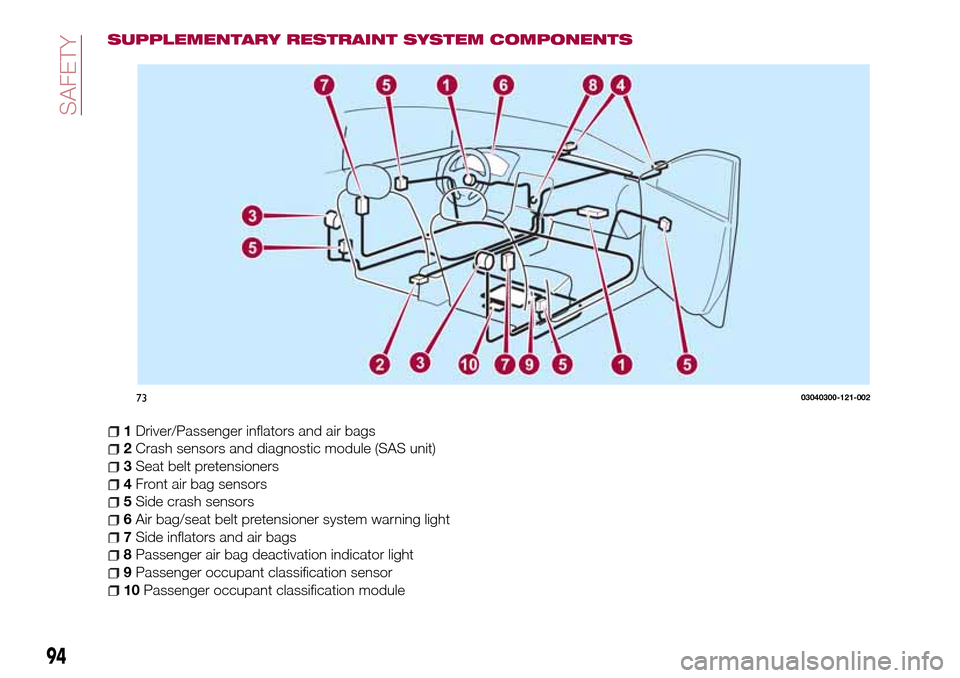
SUPPLEMENTARY RESTRAINT SYSTEM COMPONENTS
1Driver/Passenger inflators and air bags
2Crash sensors and diagnostic module (SAS unit)
3Seat belt pretensioners
4Front air bag sensors
5Side crash sensors
6Air bag/seat belt pretensioner system warning light
7Side inflators and air bags
8Passenger air bag deactivation indicator light
9Passenger occupant classification sensor
10Passenger occupant classification module
7303040300-121-002
94
SAFETY
Page 98 of 216
bag only on the side in which the
vehicle was hit.
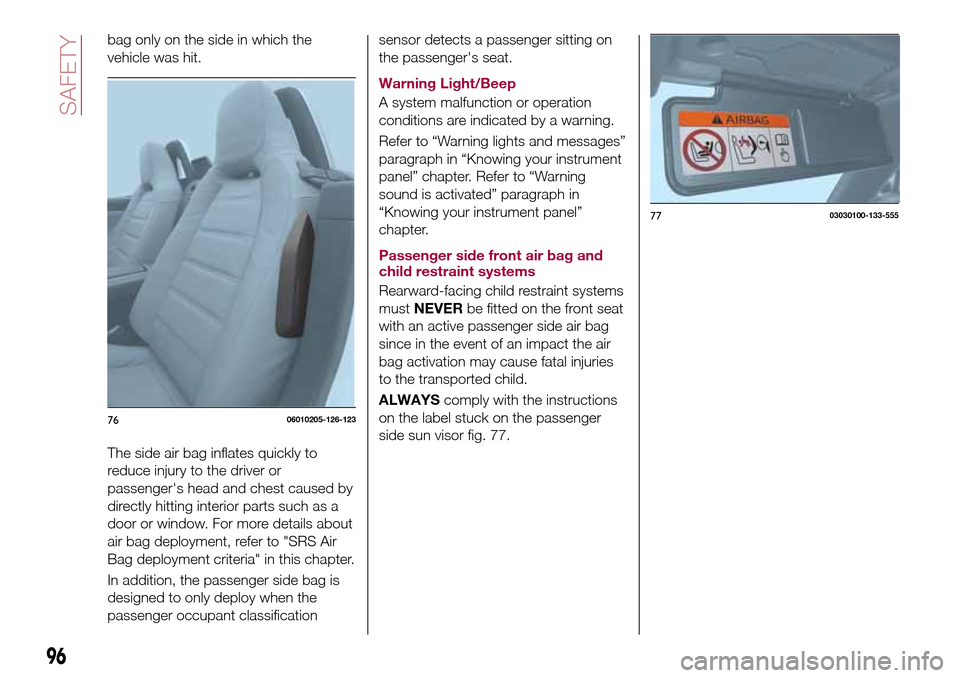
The side air bag inflates quickly to
reduce injury to the driver or
passenger's head and chest caused by
directly hitting interior parts such as a
door or window. For more details about
air bag deployment, refer to "SRS Air
Bag deployment criteria" in this chapter.
In addition, the passenger side bag is
designed to only deploy when the
passenger occupant classificationsensor detects a passenger sitting on
the passenger's seat.
Warning Light/Beep
A system malfunction or operation
conditions are indicated by a warning.
Refer to “Warning lights and messages”
paragraph in “Knowing your instrument
panel” chapter. Refer to “Warning
sound is activated” paragraph in
“Knowing your instrument panel”
chapter.
Passenger side front air bag and
child restraint systems
Rearward-facing child restraint systems
mustNEVERbe fitted on the front seat
with an active passenger side air bag
since in the event of an impact the air
bag activation may cause fatal injuries
to the transported child.
ALWAYScomply with the instructions
on the label stuck on the passenger
side sun visor fig. 77.
7606010205-126-123
7703030100-133-555
96
SAFETY
Page 102 of 216
PASSENGER OCCUPANT
CLASSIFICATION
SYSTEM
128) 129)
First, please read "Supplemental
Restraint System (SRS) Precautions"
carefully.
Passenger occupant classification
sensor
Your vehicle is equipped with a
passenger occupant classification
sensor as a part of the supplementary
restraint system. This sensor is
equipped in the passenger's seat
cushion. This sensor measures the
electrostatic capacity of the
passenger's seat.
The SAS unit is designed to prevent the
passenger front and side air bags and
seat belt pretensioner system fromdeploying if the passenger air bag
deactivation indicator light turns on.
To reduce the chance of injuries caused
by deployment of the passenger air
bag, the system deactivates the
passenger front and side air bags and
also the seat belt pretensioner system
when the passenger air bag
deactivation indicator light turns on.
This system shuts off the passenger
front and side air bags and seat belt
pretensioner system, so make sure the
passenger air bag deactivation indicator
light turns on.
The air bag/seat belt pretensioner
system warning light flashes and the
passenger air bag deactivation indicator
light illuminates if the sensors have a
possible malfunction. If this happens,
the passenger front and side air bags
and seat belt pretensioner system will
not deploy.
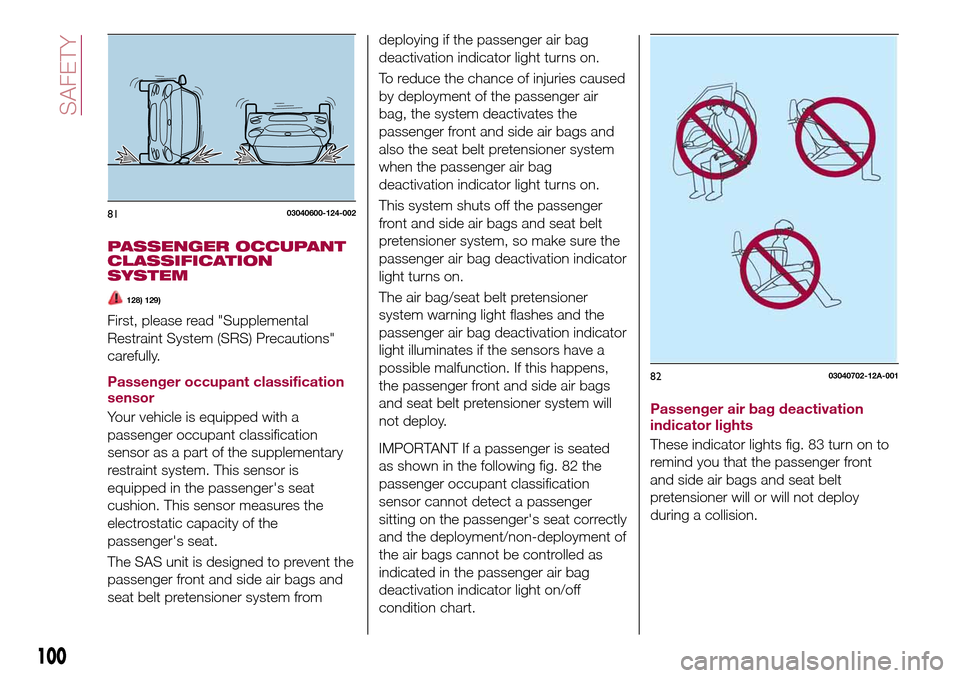
IMPORTANT If a passenger is seated
as shown in the following fig. 82 the
passenger occupant classification
sensor cannot detect a passenger
sitting on the passenger's seat correctly
and the deployment/non-deployment of
the air bags cannot be controlled as
indicated in the passenger air bag
deactivation indicator light on/off
condition chart.
Passenger air bag deactivation
indicator lights
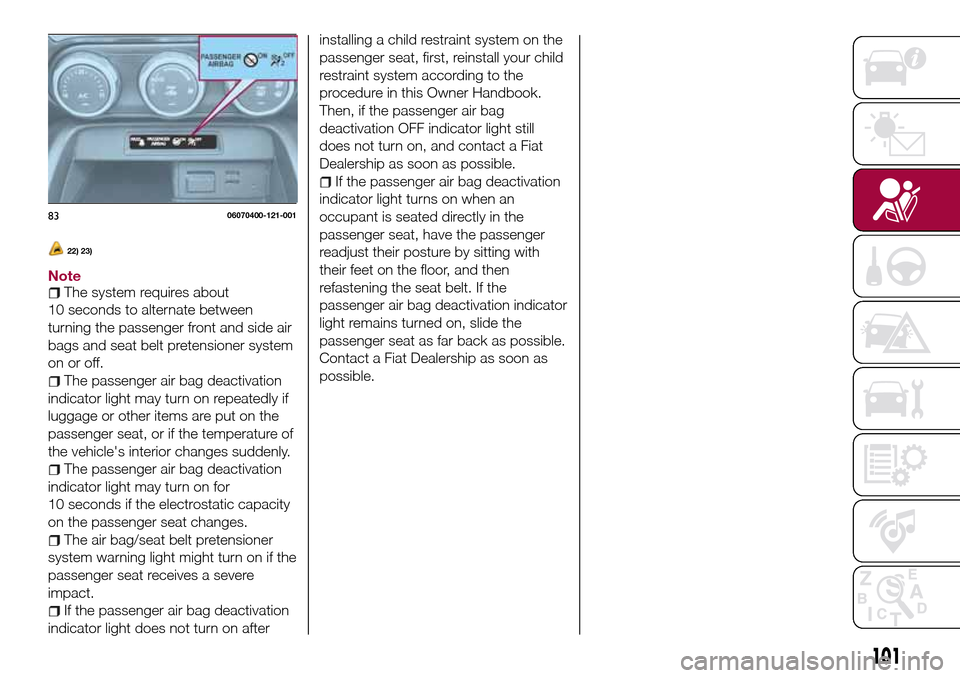
These indicator lights fig. 83 turn on to
remind you that the passenger front
and side air bags and seat belt
pretensioner will or will not deploy
during a collision.
8103040600-124-002
8203040702-12A-001
100
SAFETY
Page 103 of 216
22) 23)
NoteThe system requires about
10 seconds to alternate between
turning the passenger front and side air
bags and seat belt pretensioner system
on or off.
The passenger air bag deactivation
indicator light may turn on repeatedly if
luggage or other items are put on the
passenger seat, or if the temperature of
the vehicle's interior changes suddenly.
The passenger air bag deactivation
indicator light may turn on for
10 seconds if the electrostatic capacity
on the passenger seat changes.
The air bag/seat belt pretensioner
system warning light might turn on if the
passenger seat receives a severe
impact.
If the passenger air bag deactivation
indicator light does not turn on afterinstalling a child restraint system on the
passenger seat, first, reinstall your child
restraint system according to the
procedure in this Owner Handbook.
Then, if the passenger air bag
deactivation OFF indicator light still
does not turn on, and contact a Fiat
Dealership as soon as possible.
If the passenger air bag deactivation
indicator light turns on when an
occupant is seated directly in the
passenger seat, have the passenger
readjust their posture by sitting with
their feet on the floor, and then
refastening the seat belt. If the
passenger air bag deactivation indicator
light remains turned on, slide the
passenger seat as far back as possible.
Contact a Fiat Dealership as soon as
possible.
8306070400-121-001
101