ESP FIAT 124 SPIDER 2017 2.G User Guide
[x] Cancel search | Manufacturer: FIAT, Model Year: 2017, Model line: 124 SPIDER, Model: FIAT 124 SPIDER 2017 2.GPages: 300, PDF Size: 121.24 MB
Page 38 of 300
MIRRORS
Outside Mirrors
Before driving, adjust the inside and
outside mirrors.
Mirror Type
Flat Type (Driver Side): flat surface
mirror.
Convex Type (Passenger Side): this
mirror has a slight curve.
Note:
The passenger side convex outside
mirror will give a much wider view to the
rear, and especially of the lane next to
your vehicle.
The outside mirrors may be equipped
with a heated mirror system. Refer to
“Climate Controls” for more information.
The perceived distance of objects in the
outer and inner regions of the wide
angle mirror is different.
Warning!
Vehicles and other objects seen in the
passenger side convex mirror will look
smaller and farther away than they really
are. Relying too much on your passenger
side mirror could cause you to collide with
another vehicle or other object. Use your
inside mirror when judging the size or
distance of a vehicle seen in the passenger
side mirror.
Inside Day / Night Mirror
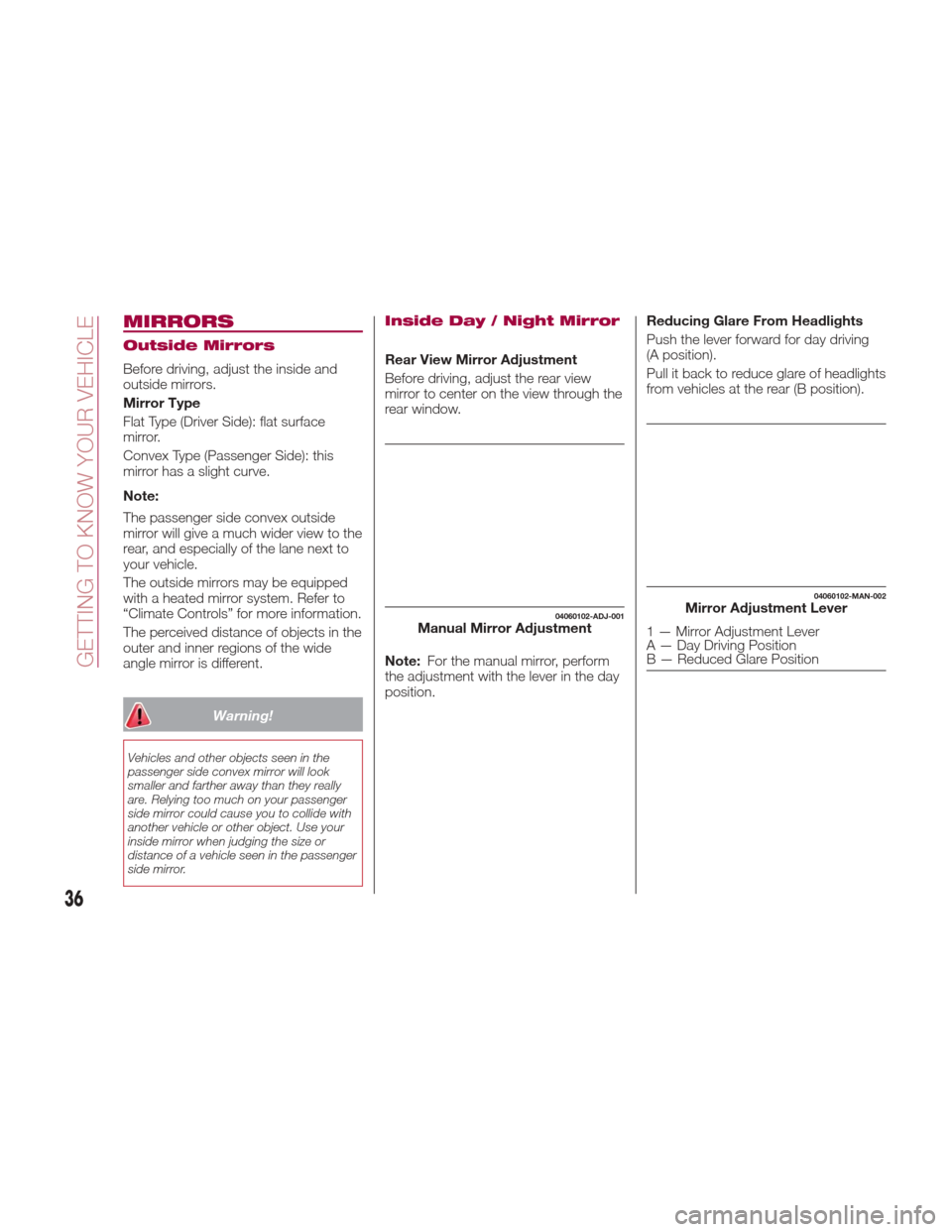
Rear View Mirror Adjustment
Before driving, adjust the rear view
mirror to center on the view through the
rear window.
Note:For the manual mirror, perform
the adjustment with the lever in the day
position. Reducing Glare From Headlights
Push the lever forward for day driving
(A position).
Pull it back to reduce glare of headlights
from vehicles at the rear (B position).
04060102-ADJ-001Manual Mirror Adjustment
04060102-MAN-002Mirror Adjustment Lever
1 — Mirror Adjustment Lever
A — Day Driving Position
B — Reduced Glare Position
36
GETTING TO KNOW YOUR VEHICLE
Page 45 of 300
—orLO: low speed operation
=or HI: high speed operation
Variable-speed intermittent wipers
Set the lever to the intermittent position
and choose the interval timing by
rotating the switch.
With auto-wiper control
Switch positions:
or MIST: operation while
pulling up lever
OFF: stop
AUTO: auto control operation
— orLO: low speed operation
=or HI: high speed operation
Auto-wiper control
When the wiper lever is in the AUTO
position, the rain sensor will sense the
amount of rainfall on the windshield and
turns the wipers on or off automatically
(off/intermittent/low speed/high speed).
Adjusting rain sensor sensitivity
The sensitivity of the rain sensor can be
adjusted by rotating the switch on the
wiper lever.
From the center position (normal),
rotate the switch downward for higher
sensitivity (+) (faster response) or rotate
it upward for less sensitivity (-) (slower
response). Note:
Do not shade the rain sensor by
placing a sticker or a label on the
windshield. Otherwise the rain sensor
will not operate correctly.
When the wiper lever is in the AUTO
position and the ignition is switched
ON, the wipers may move automatically
in the following cases:
If the windshield above the rain
sensor is touched or wiped with a cloth.
If the windshield is struck with a hand
or other object from either outside or
inside the vehicle.
Warning!
Keep hands and scrapers clear of the
windshield when the wiper lever is in the
AUTO position and the ignition is switched
ON as fingers could be pinched or the
wipers and wiper blades damaged when
the wipers activate automatically.
If you are going to clean the windshield,
be sure the wipers are turned off. This
is important when clearing ice and
snow.
Switching the auto-wiper lever from the
OFF to the AUTO position while driving
activates the windshield wipers once,
after which they operate according to
the rainfall amount. The auto-wiper control may not operate
when the rain sensor temperature is
about 14 °F (–10 °C) or lower, or
about185°F(85°C)orhigher.
If the windshield is coated with water
repellent, the rain sensor may not be
able to sense the amount of rainfall
correctly and auto-wiper control may
not operate properly.
If dirt or debris (such as ice or debris
containing salt water) adheres to the
windshield above the rain sensor or if
the windshield is iced, it could cause
the wipers to move automatically.
However, if the wipers cannot remove
this ice, dirt or debris, the auto-wiper
control will stop operation. In this case,
set the wiper lever to the low speed
position or high speed position for
manual operation, or remove the ice,
dirt or debris by hand to restore the
auto-wiper operation.
If the auto-wiper lever is left in the
AUTO
position, the wipers could
operate automatically from the effect of
strong light sources, electromagnetic
waves, or infrared light because the rain
sensor uses an optical sensor.
It is recommended that the auto-wiper
lever be switched to the OFFposition
other than when driving the vehicle
under rainy conditions.
The auto-wiper control functions can be
turned off.
43
Page 69 of 300
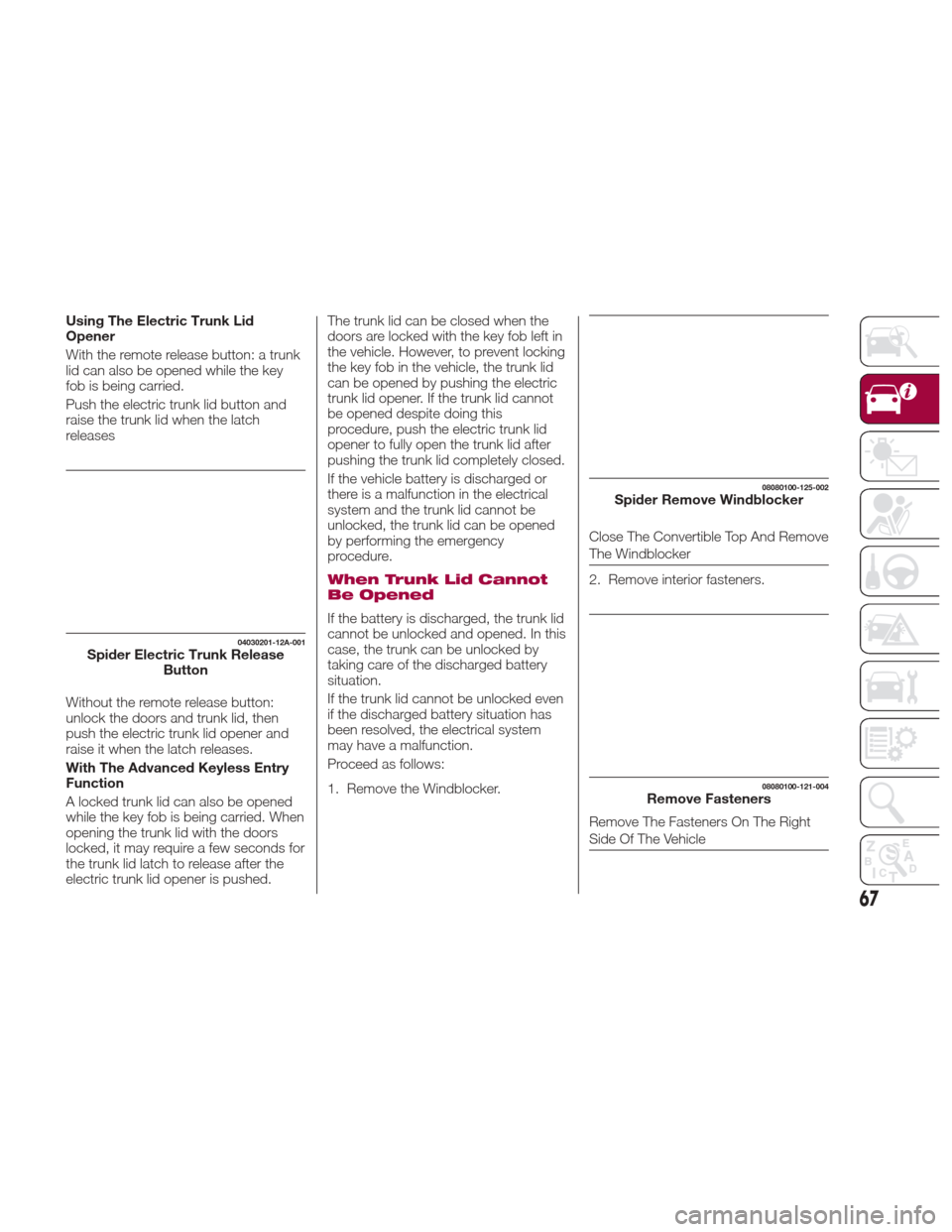
Using The Electric Trunk Lid
Opener
With the remote release button: a trunk
lid can also be opened while the key
fob is being carried.
Push the electric trunk lid button and
raise the trunk lid when the latch
releases
Without the remote release button:
unlock the doors and trunk lid, then
push the electric trunk lid opener and
raise it when the latch releases.
With The Advanced Keyless Entry
Function
A locked trunk lid can also be opened
while the key fob is being carried. When
opening the trunk lid with the doors
locked, it may require a few seconds for
the trunk lid latch to release after the
electric trunk lid opener is pushed.The trunk lid can be closed when the
doors are locked with the key fob left in
the vehicle. However, to prevent locking
the key fob in the vehicle, the trunk lid
can be opened by pushing the electric
trunk lid opener. If the trunk lid cannot
be opened despite doing this
procedure, push the electric trunk lid
opener to fully open the trunk lid after
pushing the trunk lid completely closed.
If the vehicle battery is discharged or
there is a malfunction in the electrical
system and the trunk lid cannot be
unlocked, the trunk lid can be opened
by performing the emergency
procedure.
When Trunk Lid Cannot
Be Opened
If the battery is discharged, the trunk lid
cannot be unlocked and opened. In this
case, the trunk can be unlocked by
taking care of the discharged battery
situation.
If the trunk lid cannot be unlocked even
if the discharged battery situation has
been resolved, the electrical system
may have a malfunction.
Proceed as follows:
1. Remove the Windblocker.
Close The Convertible Top And Remove
The Windblocker
2. Remove interior fasteners.
04030201-12A-001Spider Electric Trunk Release
Button
08080100-125-002Spider Remove Windblocker
08080100-121-004Remove Fasteners
Remove The Fasteners On The Right
Side Of The Vehicle
67
Page 86 of 300
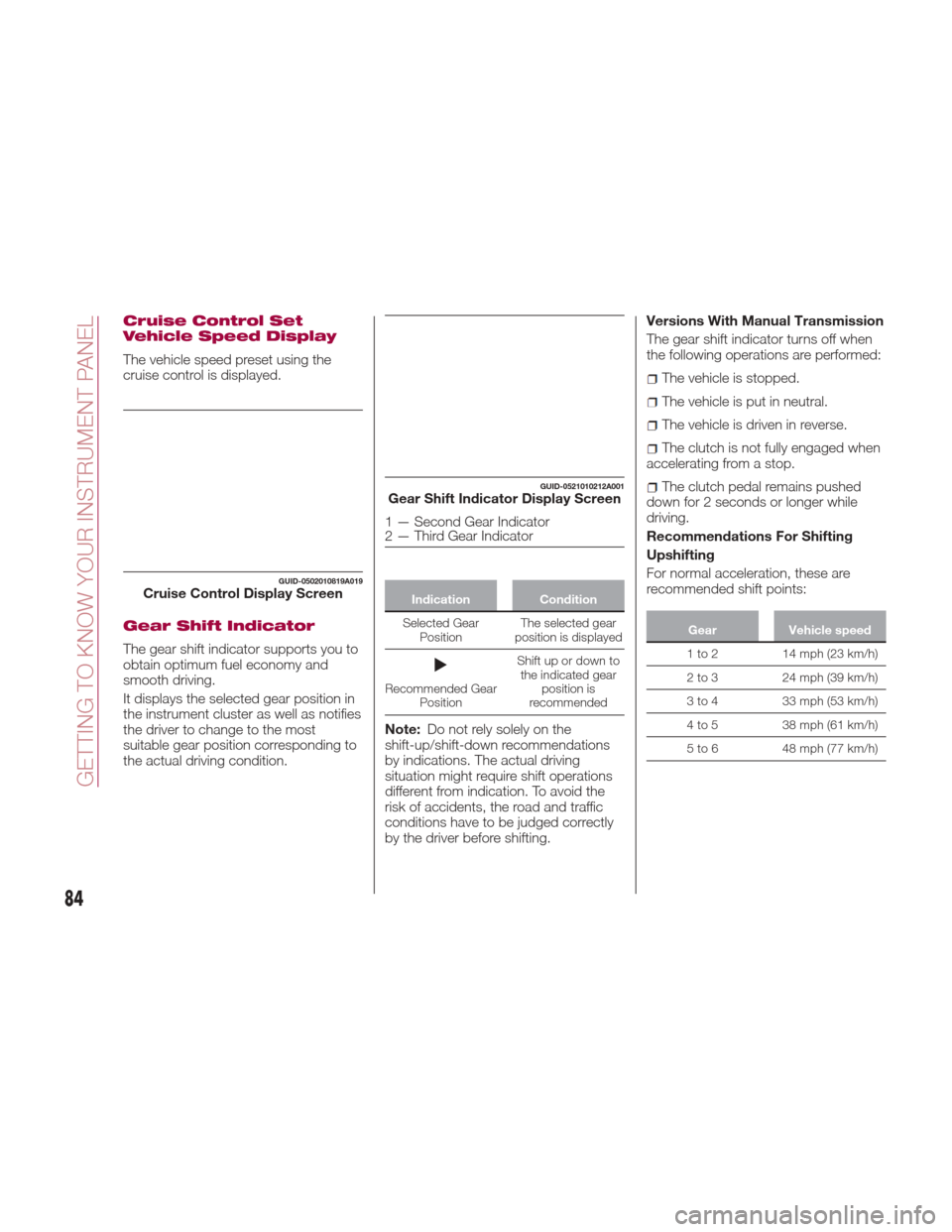
Cruise Control Set
Vehicle Speed Display
The vehicle speed preset using the
cruise control is displayed.
Gear Shift Indicator
The gear shift indicator supports you to
obtain optimum fuel economy and
smooth driving.
It displays the selected gear position in
the instrument cluster as well as notifies
the driver to change to the most
suitable gear position corresponding to
the actual driving condition.
IndicationCondition
Selected Gear Position The
selected gear
position is displayed
Recommended Gear Position Shift up or down to
the indicated gear position is
recommended
Note: Do not rely solely on the
shift-up/shift-down recommendations
by indications. The actual driving
situation might require shift operations
different from indication. To avoid the
risk of accidents, the road and traffic
conditions have to be judged correctly
by the driver before shifting. Versions With Manual Transmission
The gear shift indicator turns off when
the following operations are performed:
The vehicle is stopped.
The vehicle is put in neutral.
The vehicle is driven in reverse.
The clutch is not fully engaged when
accelerating from a stop.
The clutch pedal remains pushed
down for 2 seconds or longer while
driving.
Recommendations For Shifting
Upshifting
For normal acceleration, these are
recommended shift points:
Gear Vehicle speed
1 to 2 14 mph (23 km/h)
2
to 3 24 mph (39 km/h)
3 to 4 33 mph (53 km/h)
4 to 5 38 mph (61 km/h)
5 to 6 48 mph (77 km/h)
GUID-0502010819A019Cruise Control Display Screen
GUID-0521010212A001Gear Shift Indicator Display Screen
1 — Second Gear Indicator
2 — Third Gear Indicator
84
GETTING TO KNOW YOUR INSTRUMENT PANEL
Page 99 of 300
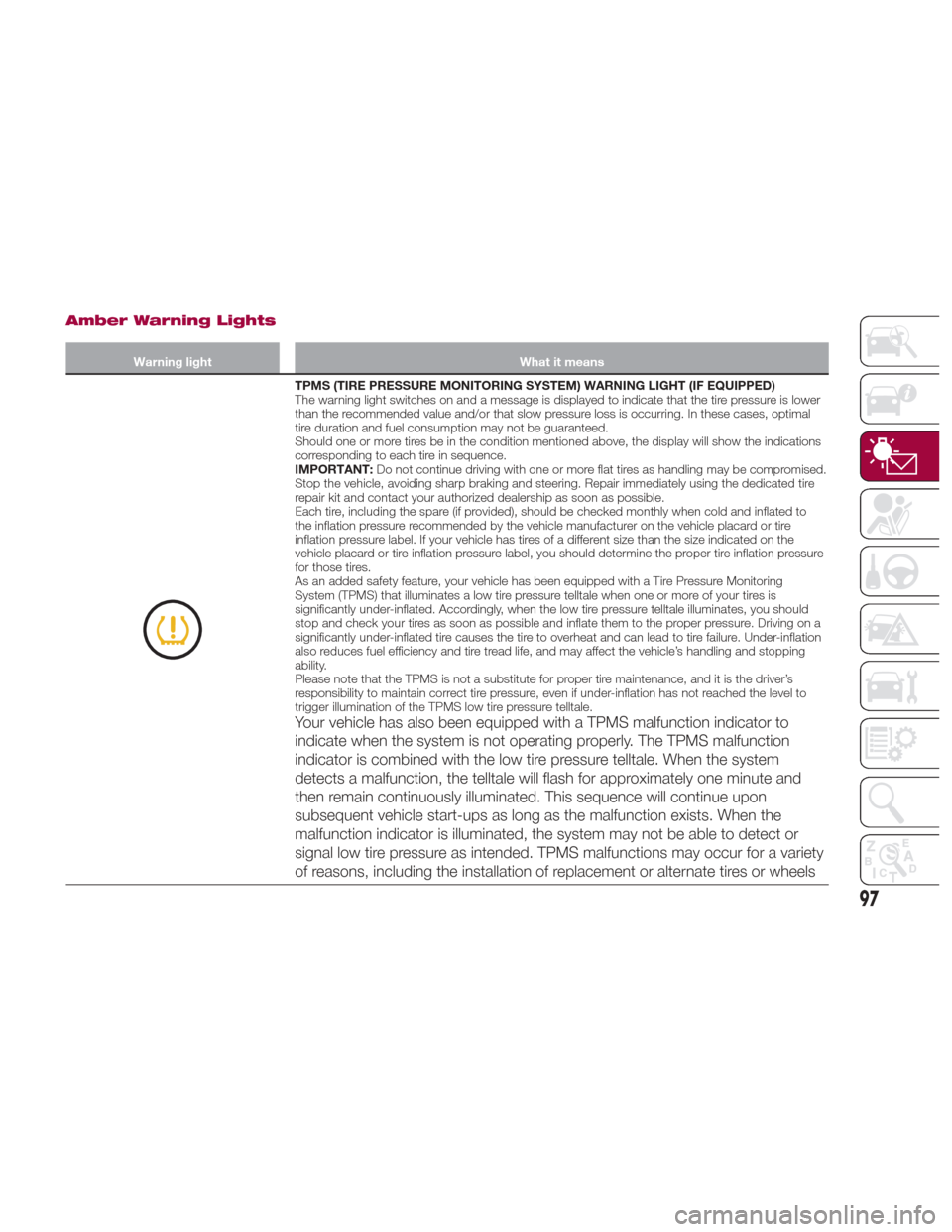
Amber Warning Lights
Warning lightWhat it means
TPMS (TIRE PRESSURE MONITORING SYSTEM) WARNING LIGHT (IF EQUIPPED)
The warning light switches on and a message is displayed to indicate that the tire pressure is lower
than the recommended value and/or that slow pressure loss is occurring. In these cases, optimal
tire duration and fuel consumption may not be guaranteed.
Should one or more tires be in the condition mentioned above, the display will show the indications
corresponding to each tire in sequence.
IMPORTANT:Do not continue driving with one or more flat tires as handling may be compromised.
Stop the vehicle, avoiding sharp braking and steering. Repair immediately using the dedicated tire
repair kit and contact your authorized dealership as soon as possible.
Each tire, including the spare (if provided), should be checked monthly when cold and inflated to
the inflation pressure recommended by the vehicle manufacturer on the vehicle placard or tire
inflation pressure label. If your vehicle has tires of a different size than the size indicated on the
vehicle placard or tire inflation pressure label, you should determine the proper tire inflation pressure
for those tires.
As an added safety feature, your vehicle has been equipped with a Tire Pressure Monitoring
System (TPMS) that illuminates a low tire pressure telltale when one or more of your tires is
significantly under-inflated. Accordingly, when the low tire pressure telltale illuminates, you should
stop and check your tires as soon as possible and inflate them to the proper pressure. Driving on a
significantly under-inflated tire causes the tire to overheat and can lead to tire failure. Under-inflation
also reduces fuel efficiency and tire tread life, and may affect the vehicle’s handling and stopping
ability.
Please note that the TPMS is not a substitute for proper tire maintenance, and it is the driver’s
responsibility to maintain correct tire pressure, even if under-inflation has not reached the level to
trigger illumination of the TPMS low tire pressure telltale.
Your vehicle has also been equipped with a TPMS malfunction indicator to
indicate when the system is not operating properly. The TPMS malfunction
indicator is combined with the low tire pressure telltale. When the system
detects a malfunction, the telltale will flash for approximately one minute and
then remain continuously illuminated. This sequence will continue upon
subsequent vehicle start-ups as long as the malfunction exists. When the
malfunction indicator is illuminated, the system may not be able to detect or
signal low tire pressure as intended. TPMS malfunctions may occur for a variety
of reasons, including the installation of replacement or alternate tires or wheels
97
Page 114 of 300
SAFETY SYSTEMS
Safety Systems
The vehicle has the following safety
systems:
Anti-lock Braking System (ABS)
Traction Contol System (TCS)
Dynamic Stability Control (DSC)
For the operation of the systems, see
the following pages.
ABS System (Anti-lock
Braking System)
The ABS control unit continuously
monitors the speed of each wheel. If
one wheel is about to lock up, the ABS
responds by automatically releasing
and reapplying that wheel's brake. The
driver will feel a slight vibration in the
brake pedal and may hear a chattering
noise from the brake system. This is
normal ABS system operation.
Continue to depress the brake pedal
without pumping the brakes. The
warning light turns on when the system
has a malfunction. Refer to “Warning
Lights And Messages” paragraph in
“Getting To Know Your Instrument
Panel” chapter. Note:
Braking distances may be longer on
loose surfaces (snow or gravel, for
example) which usually have a hard
foundation. A vehicle with a normal
braking system may require less
distance to stop under these
conditions because the tires will build
up a wedge of surface layer when the
wheels skid.
The sound of the ABS operating
may be heard when starting the engine
or immediately after starting the
vehicle, however, it does not indicate a
malfunction
Warning!
The ABS contains sophisticated
electronic equipment that may be
susceptible to interference caused by
improperly installed or high output radio
transmitting equipment. This interference
can cause possible loss of anti-lock braking
capability. Installation of such equipment
should be performed by qualified
professionals.
Pumping of the Anti-Lock Brakes will
diminish their effectiveness and may lead to
a collision. Pumping makes the stopping
distance longer. Just press firmly on your
brake pedal when you need to slow down
or stop.
The ABS cannot prevent the natural
laws of physics from acting on the vehicle,
nor can it increase braking or steering
efficiency beyond that afforded by the
condition of the vehicle brakes and tires or
the traction afforded.
The ABS cannot prevent collisions,
including those resulting from excessive
speed in turns, following another vehicle
too closely, or hydroplaning.
The capabilities of an ABS equipped
vehicle must never be exploited in a
reckless or dangerous manner that could
jeopardize the user’s safety or the safety of
others.
TCS System (Traction
Control System)
Warning!
The capability of the TCS must never be
tested irresponsibly and dangerously, in
such a way as to compromise personal
safety and the safety of others.
The Traction Control System (TCS)
enhances traction and safety by
controlling engine torque and braking.
When the TCS detects driving wheel
slippage, it lowers engine torque and
operates the brakes to prevent loss of
traction. This means that on a slick
surface, the engine adjusts
automatically to provide optimum
112
SAFETY
Page 123 of 300
Tire Pressure Monitoring System —
Sport Grade
The TPMS system monitors the
pressure for each tire.
If tire pressure is too low in one or more
tires, the system will inform the driver
via the
warning light in the
instrument cluster and by the warning
beep sound.
The tire pressure sensors installed on
each wheel send tire pressure data by
radio signal to the receiver unit in the
vehicle.
TPMS does not alleviate your need to
check the pressure and condition of all
four tires regularly.
Each tire, including the spare (if
provided), should be checked monthly
when cold and inflated to the inflation
pressure recommended by the vehicle
manufacturer on the vehicle placard or
tire inflation pressure label. (If your
vehicle has tires of a different size than
the size indicated on the vehicle placard
or tire inflation pressure label, you
should determine the proper tire
inflation pressure for those tires.)
As an added safety feature, your vehicle
has been equipped with a tire pressure
monitoring system (TPMS) that
illuminates a low tire pressure telltale
when one or more of your tires is
significantly under-inflated. Accordingly,
when the low tire pressure telltale
illuminates, you should stop and check
your tires as soon as possible, and inflate them to the proper pressure.
Driving on a significantly under-inflated
tire causes the tire to overheat and can
lead to tire failure. Under-inflation also
reduces fuel efficiency and tire tread life,
and may affect the vehicle's handling
and stopping ability. Please note that
the TPMS is not a substitute for proper
tire maintenance, and it is the driver's
responsibility to maintain correct tire
pressure, even if under-inflation has not
reached the level to trigger illumination
of the TPMS low tire pressure telltale.
Your vehicle has also been equipped
with a TPMS malfunction indicator to
indicate when the system is not
operating properly. [For vehicles with a
dedicated MIL telltale, add the following
statement: The TPMS malfunction
indicator is provided by a separate
telltale, which displays the symbol
“TPMS” when illuminated.] [For vehicles
with a combined low tire pressure/MIL
telltale, add the following statement:
The TPMS malfunction indicator is
combined with the low tire pressure
telltale. When the system detects a
malfunction, the telltale will flash for
approximately one minute and then
remain continuously illuminated. This
sequence will continue upon
subsequent vehicle start-ups as long as
the malfunction exists.] When the
malfunction indicator is illuminated, the
system may not be able to detect or
signal low tire pressure as intended.
TPMS malfunctions may occur for a
variety of reasons, including the
installation of replacement or alternate
tires or wheels on the vehicle that
prevent the TPMS from functioning
properly. Always check the TPMS
malfunction telltale after replacing one
or more tires or wheels on your vehicle
to ensure that the replacement or
alternate tires and wheels allow the
TPMS to continue to function properly.
System Error Activation
When the
warning light flashes,
there may be a system malfunction.
Contact your Authorized Dealer.
A system error activation may occur in
the following cases:
When there is equipment or a device
near the vehicle using the same radio
frequency as that of the tire pressure
sensors.
When a metallic device such as a
non-genuine navigation system is
equipped near the center of the
dashboard, which may block radio
signals from the tire pressure sensor to
the receiver unit.
When using the following devices in
the vehicle that may cause radio
interference with the receiver unit.
A digital device such as a personal
computer.
A current converter device such as a
DC-AC converter.
121
Page 124 of 300
When excess snow or ice adheres to
the vehicle, especially around the
wheels.
When the tire pressure sensor
batteries are discharged.
When using a wheel with no tire
pressure sensor installed.
When using tires with steel wire
reinforcement in the side walls.
When using tire chains.
Tires And Wheels
Note: When inspecting or adjusting the
tire air pressures, do not apply
excessive force to the stem portion of
the wheel unit. The stem portion could
be damaged.
Changing Tires And Wheels
The following procedure allows the
TPMS to recognize a tire pressure
sensor's unique ID signal code
whenever tires or wheels are changed,
such as changing to and from winter
tires.
Note:
Each tire pressure sensor has a
unique ID signal code. The signal code
must be registered with the TPMS
before it can work. The easiest way to
do it is to have your Authorized Dealer
change your tire and complete ID
signal code registration.
When your Authorized Dealer
changes your vehicle's tires, they will
complete the tire pressure sensor ID
signal code registration.
If you or someone else changes tires,
you or someone else can also
undertake the steps for the TPMS to
complete the ID signal code
registration:
After tires have been changed, place
the ignition in the ON mode, then back
to ACC or OFF modes.
Wait for about 15 minutes.
After about 15 minutes, drive the
vehicle at a speed of at least 16 mph
(25 km/h) for 10 minutes and the tire
pressure sensor ID signal code will be
registered automatically.
Note: If the vehicle is driven within
about 15 minutes of changing tires, the
warning light will flash because the
sensor ID signal code would not have
been registered. If this happens, park
the vehicle for about 15 minutes, after
which the sensor ID signal code will
register upon driving the vehicle for
10 minutes. Replacing Tires And Wheels
Note:
When replacing/repairing the tires or
wheels or both, have the work done by
your Authorized Dealer, or the tire
pressure sensors may be damaged.
The wheels equipped on your
vehicle are specially designed for
installation of the tire pressure sensors.
Do not use non-genuine wheels,
otherwise it may not be possible to
install the tire pressure sensors.
Be sure to have the tire pressure
sensors installed whenever tires or
wheels are replaced.
When having a tire or wheel or both
replaced, the following types of tire
pressure sensor installations are
possible:
The tire pressure sensor is removed
from the old wheel and installed to the
new one.
The same tire pressure sensor is
used with the same wheel. Only the tire
is replaced.
A new tire pressure sensor is
installed to a new wheel.
122
SAFETY
Page 125 of 300
Note:
The tire pressure sensor ID signal
code must be registered when a new
tire pressure sensor is purchased. For
purchase of a tire pressure sensor and
registration of the tire pressure sensor
ID signal code, consult your Authorized
Dealer.
When reinstalling a previously
removed tire pressure sensor to a
wheel, replace the grommet (seal
between valve body/sensor and wheel)
for the tire pressure sensor.
Caution!
The TPMS has been optimized for the
original equipment tires and wheels.
TPMS pressures and warning have been
established for the tire size equipped on
your vehicle. Undesirable system operation
or sensor damage may result when using
replacement equipment that is not of the
same size, type, and/or style. Aftermarket
wheels can cause sensor damage.
Using aftermarket tire sealants may
cause the Tire Pressure Monitoring System
(TPMS) sensor to become inoperable.
After using an aftermarket tire sealant it is
recommended that you take your vehicle to
an Authorized Dealership to have your
sensor function checked.
After inspecting or adjusting the tire
pressure always reinstall the valve stem
cap. This will prevent moisture and dirt
from entering the valve stem, which could
damage the TPMS sensor.
The following regulatory statement
applies to all radio frequency (RF)
devices equipped in this vehicle:
This device complies with Part 15 of the
FCC Rules and with Industry Canada
license-exempt RSS standard(s).
Operation is subject to the following
two conditions:
(1) This device may not cause harmful
interference, and
(2) This device must accept any
interference received, including
interference that may cause undesired
operation.
Note:
Changes or modifications not expressly
approved by the party responsible for
compliance could void the user’s
authority to operate the equipment.
OCCUPANT
RESTRAINT
SYSTEMS
The most important safety equipment
of the vehicle comprise the following
protection systems:
Seat Belts
SBA (Seat Belt Alert) System
Head Restraints
Child Restraint Systems
Front Air Bags And Side Air Bags
Read the information given in the
following pages with the utmost care.
It is of fundamental importance that the
protection systems are used in the
correct way to guarantee the maximum
possible safety level for the driver and
the passengers.
123
Page 154 of 300
should be replaced. When you hear this
noise contact your Authorized Dealer as
soon as possible.
Brake Assist
During emergency braking situations
when it is necessary to depress the
brake pedal with greater force, the
brake assist system provides braking
assistance, thus enhancing braking
performance. When the brake pedal is
depressed hard or depressed more
quickly, the brakes apply more firmly.
Note:
When the brake pedal is depressed
hard or depressed more quickly, the
pedal will feel softer but the brakes will
apply more firmly. This is a normal
effect of the brake assist operation and
does not indicate a malfunction.
When the brake pedal is depressed
hard or depressed more quickly, a
motor/pump operation noise may be
heard. This is a normal effect of the
brake assist and does not indicate a
malfunction.
The brake assist equipment does
not supersede the functionality of the
vehicle's main braking system.
MANUAL
TRANSMISSION
Manual Transmission
Warning!
You or others could be injured if you leave
the vehicle unattended without having the
park brake fully applied. The park brake
should always be applied when the driver
is not in the vehicle, especially on an
incline.
Caution!
Never drive with your foot resting on the
clutch pedal, or attempt to hold the vehicle
on a hill with the clutch pedal partially
engaged, as this will cause abnormal wear
on the clutch.
To engage the gears, press the clutch
pedal fully and put the gear selector
into the required position. The diagram
for gear engagement is shown on the
knob. Depress the clutch pedal all the way
down while shifting, then release it
slowly.
Your vehicle is equipped with a device
to prevent shifting to REVERSE (R) by
mistake. Push the gear selector
downward and shift to REVERSE (R).
A natural driving posture can be
achieved by lightly gripping the gear
selector from the side without having to
rest your elbow on the center console.
If shifting to REVERSE (R) is difficult,
shift back into neutral, release the
clutch pedal, and try again.
With Parking Sensor System
When the gear selector is shifted to the
REVERSE (R) position with the ignition
placed in the ON mode, the parking
sensor system is activated an audible
sound is heard.
05210101-12A-001Gear Selector
152
STARTING AND OPERATING