ESP FIAT 124 SPIDER 2017 2.G Owner's Guide
[x] Cancel search | Manufacturer: FIAT, Model Year: 2017, Model line: 124 SPIDER, Model: FIAT 124 SPIDER 2017 2.GPages: 300, PDF Size: 121.24 MB
Page 225 of 300
4. Hook the towing rope to the tow
eye.
Caution!
Tow hooks are for emergency use only, to
rescue a vehicle stranded off road. Do not
use tow hooks for tow truck hookup or
highway towing. You could damage your
vehicle.
When using the tow eyes, always pull
the lead or chain in a straight direction
with respect to the eyelet. Never apply
a sideways force.
Note:Be careful not to damage the
towing eyelet and towing hook, vehicle
body, or transmission system when
towing under the following conditions:
Do not tow a vehicle heavier than
yours.
Do not suddenly accelerate your
vehicle as it will apply a severe shock
to the tow eye and towing hook or
rope.
Do not attach any rope other than
to the tow eye and towing hook.
EMERGENCY TOWING
TOWING DESCRIPTION
Proper lifting and towing are necessary
to prevent damage to the vehicle.
Government and local laws must be
followed.
A towed vehicle usually should have its
drive wheels (rear wheels) off the ground.
If excessive damage or other conditions
prevent this, use wheel dollies.
When towing with the rear wheels on the
ground, release the parking brake.
Caution!
DO NOT use sling-type equipment when
towing. When securing the vehicle to a
flatbed truck, do not attach to front or rear
suspension components. Damage to your
vehicle may result from improper towing.
If towing service is not available in an
emergency, the vehicle may be towed
with all four wheels on the ground using
the towing hook at the front of the
vehicle. Only tow the vehicle on paved
surfaces for short distances at low
speeds.
Follow these instructions when towing
the vehicle with all wheels on the
ground:
1. Shift to neutral (manual
transmission), or the N position
(automatic transmission).
2. Place the ignition to ACC.
3. Release the parking brake.
Note:
Remember that power assist for the
brakes and steering will not be available
when the engine is not running.
08060201-121-001Installing Front Towing Eye
08060201-122-001Installing Rear Tow Eye
223
Page 227 of 300
INTRODUCTION
Be extremely careful and prevent injury
to yourself and others or damage to
your vehicle when using this Owner’s
Manual for inspection and maintenance.
If you are unsure about any procedure it
describes, we strongly urge you to have
a reliable and qualified service shop
perform the work, preferably at your
Authorized Dealer.
Factory-trained FCA technicians and
genuine FCA parts are best for your
vehicle. Without this expertise and the
parts that have been designed and
made especially for your vehicle,
inadequate, incomplete, and insufficient
servicing may result in problems. This
could lead to vehicle damage or an
accident and injuries.
For expert advice and quality service,
contact your Authorized Dealer.
To continue New Vehicle Limited
Warranty eligibility and to protect your
investment, it is your responsibility to
properly maintain your vehicle
according to factory recommended
schedules outlined in this Owner’s
Manual. As part of this you must keep
your maintenance records, receipts,
repair orders and any other documents
as evidence this maintenance was
performed. You must present these
documents, should any New Vehicle
Limited Warranty coverage
disagreement occur. Failure to do so
can result in your New Vehicle LimitedWarranty being voided either in whole
or in part.
This evidence may consist of the
following:
The FCA Scheduled Maintenance
Record, refer to the Warranty Booklet,
must be completely filled out showing
mileage, repair order number, date for
each service, and signed by a qualified
automotive service technician who
service vehicles.
Original copies of repair orders or
other receipts that include the mileage
and date the vehicle was serviced.
Each receipt should be signed by a
qualified automotive service technician.
For self maintenance, a statement
that you completed the maintenance
yourself, displaying mileage and the
date the work was performed. Also,
receipts for the replacement parts (fluid,
filters, etc.) indicating the date and
mileage must accompany this
statement.
Note:
If you elect to perform maintenance
yourself or have your vehicle serviced at
a location other than an Authorized
Dealer, FCA requires that all fluids, parts
and materials must meet FCA
standards for durability and
performance as described in this
Owner’s Manual. Claims against the warranty resulting
from lack of maintenance, as opposed
to defective materials or authorized FCA
workmanship, will not be honored.
Any auto repair shop using parts
equivalent to your vehicle's original
equipment may perform maintenance.
But we recommend that it always be
done by an Authorized Dealer using
genuine FCA parts. Selecting
“Maintenance Monitor” enables the
system to notify you of your vehicle's
approaching inspection/servicing
period.
Owner Maintenance
Precautions
The owner or a qualified service
technician should make these vehicle
inspections at the indicated intervals to
ensure safe and dependable operation.
Bring any problem to the attention of an
Authorized Dealer or qualified service
technician as soon as possible.
When refueling perform inspection
of:
Brake and clutch fluid level
Engine coolant level
Engine oil level
Washer fluid level
At least monthly perform inspection
of:
Tire inflation pressures
225
Page 246 of 300
Warning!
Overloading of your tires is dangerous.
Overloading can cause tire failure, affect
vehicle handling, and increase your
stopping distance. Use tires of the
recommended load capacity for your
vehicle. Never overload them.
Tires — General
Information
Tire Pressure
Proper tire inflation pressure is essential
to the safe and satisfactory operation of
your vehicle. Four primary areas are
affected by improper tire pressure:
Safety and Vehicle Stability
Economy
Tread Wear
Ride Comfort
Safety
Warning!
Improperly inflated tires are dangerous
and can cause collisions.
Underinflation increases tire flexing and
can result in overheating and tire failure.
Overinflation reduces a tire's ability to
cushion shock. Objects on the road and
chuckholes can cause damage that result
in tire failure.
Overinflated or underinflated tires can
affect vehicle handling and can fail
suddenly, resulting in loss of vehicle
control.
Unequal tire pressures can cause
steering problems. You could lose control
of your vehicle.
Unequal tire pressures from one side of
the vehicle to the other can cause the
vehicle to drift to the right or left.
Always drive with each tire inflated to the
recommended cold tire inflation pressure.
Both under-inflation and over-inflation
affect the stability of the vehicle and can
produce a feeling of sluggish response
or over responsiveness in the steering.
Note:
Unequal tire pressures from side to
side may cause erratic and
unpredictable steering response.
Unequal tire pressure from side to
side may cause the vehicle to drift left
or right.
Fuel Economy
Underinflated tires will increase tire
rolling resistance resulting in higher fuel
consumption. Tread Wear
Improper cold tire inflation pressures
can cause abnormal wear patterns and
reduced tread life, resulting in the need
for earlier tire replacement.
Ride Comfort And Vehicle Stability
Proper tire inflation contributes to a
comfortable ride. Over-inflation
produces a jarring and uncomfortable
ride.
Tire Inflation Pressures
The proper cold tire inflation pressure is
listed on the driver's side B-Pillar or rear
edge of the driver's side door.
At least once a month:
Check and adjust tire pressure with a
good quality pocket-type pressure
gauge. Do not make a visual judgement
when determining proper inflation. Tires
may look properly inflated even when
they are under-inflated.
Inspect tires for signs of tire wear or
visible damage.
Caution!
After inspecting or adjusting the tire
pressure, always reinstall the valve stem
cap. This will prevent moisture and dirt
from entering the valve stem, which could
damage the valve stem.
244
SERVICING AND MAINTENANCE
Page 247 of 300
Inflation pressures specified on the
placard are always “cold tire inflation
pressure”. Cold tire inflation pressure is
defined as the tire pressure after the
vehicle has not been driven for at least
three hours, or driven less than 1 mile
(1.6 km) after sitting for a minimum of
three hours. The cold tire inflation
pressure must not exceed the
maximum inflation pressure molded into
the tire sidewall.
Check tire pressures more often if
subject to a wide range of outdoor
temperatures, as tire pressures vary
with temperature changes.
Tire pressures change by approximately
1 psi (7 kPa) per 12°F (7°C) of air
temperature change. Keep this in mind
when checking tire pressure inside a
garage, especially in the Winter.
Example: If garage temperature = 68°F
(20°C) and the outside temperature =
32°F (0°C) then the cold tire inflation
pressure should be increased by 3 psi
(21 kPa), which equals 1 psi (7 kPa) for
every 12°F (7°C) for this outside
temperature condition.
Tire pressure may increase from 2 to
6 psi (13 to 40 kPa) during operation.
DO NOT reduce this normal pressure
build up or your tire pressure will be too
low.Tire Pressures For High Speed
Operation
The manufacturer advocates driving at
safe speeds and within posted speed
limits. Where speed limits or conditions
are such that the vehicle can be driven
at high speeds, maintaining correct tire
inflation pressure is very important.
Increased tire pressure and reduced
vehicle loading may be required for
high-speed vehicle operation. Refer to
your authorized tire dealer or original
equipment vehicle dealer for
recommended safe operating speeds,
loading and cold tire inflation pressures.
Warning!
High speed driving with your vehicle under
maximum load is dangerous. The added
strain on your tires could cause them to
fail. You could have a serious collision. Do
not drive a vehicle loaded to the maximum
capacity at continuous speeds above
75 mph (120 km/h).
Radial Ply Tires
Warning!
Combining radial ply tires with other types
of tires on your vehicle will cause your
vehicle to handle poorly. The instability
could cause a collision. Always use radial
ply tires in sets of four. Never combine
them with other types of tires.
Tire Repair
If your tire becomes damaged, it may
be repaired if it meets the following
criteria:
The tire has not been driven on when
flat.
Thedamageisonlyonthetread
section of your tire (sidewall damage is
not repairable).
The puncture is no greater than a ¼
of an inch (6 mm).
Consult an authorized tire dealer for tire
repairs and additional information.
Damaged Run Flat tires, or Run Flat
tires that have experienced a loss of
pressure should be replaced
immediately with another Run Flat tire
of identical size and service description
(Load Index and Speed Symbol).
245
Page 252 of 300
Limited Use Spare — If
Equipped
The limited use spare tire is for
temporary emergency use only. This tire
is identified by a label located on the
limited use spare wheel. This label
contains the driving limitations for this
spare. This tire may look like the original
equipped tire on the front or rear axle of
your vehicle, but it is not. Installation of
this limited use spare tire affects vehicle
handling. Since it is not the same as
your original equipment tire, replace (or
repair) the original equipment tire and
reinstall on the vehicle at the first
opportunity.
Warning!
Limited use spares are for emergency use
only. Installation of this limited use spare
tire affects vehicle handling. With this tire,
do not drive more than the speed listed on
the limited use spare wheel. Keep inflated
to the cold tire inflation pressures listed on
your Tire and Loading Information Placard
located on the driver’s side B-Pillar or the
rear edge of the driver’s side door. Replace
(or repair) the original equipment tire at the
first opportunity and reinstall it on your
vehicle. Failure to do so could result in loss
of vehicle control.
Snow Chains
The use of snow chains should be in
compliance with local regulations of
each country. In certain countries, tires
marked with code M+S (Mud and
Snow) are considered as winter
equipment; therefore their use is
equivalent to that of the snow chains.
The snow chains may be applied only
to the front wheel tires. Check the
tension of the snow chains after the first
few feet have been driven.
Warning!
Using tires of different size and type (M+S,
Snow) between front and rear axles can
cause unpredictable handling. You could
lose control and have a collision.
Caution!
To avoid damage to your vehicle or tires,
observe the following precautions:
Because of restricted traction device
clearance between tires and other
suspension components, it is important
that only traction devices in good condition
are used. Broken devices can cause
serious damage. Stop the vehicle
immediately if noise occurs that could
indicate device breakage. Remove the
damaged parts of the device before further
use.
Install device as tightly as possible and
then retighten after driving about ½ mile
(0.8 km).
Do not exceed 30 mph (48 km/h).
Drive cautiously and avoid severe turns
and large bumps, especially with a loaded
vehicle.
Do not drive for a prolonged period on
dry pavement.
Observe the traction device
manufacturer’s instructions on the method
of installation, operating speed, and
conditions for use. Always use the
suggested operating speed of the device
manufacturer’s if it is less than 30 mph
(48 km/h).
Do not use traction devices on a
compact spare tire.
Caution!
Using snow chains with tires with
non-original dimensions may damage the
vehicle.
Using different size or type (M+S, snow,
etc.) tires between front and rear axle may
adversely affect vehicle driveability, with the
risk of losing control of the vehicle and
resulting accidents.
250
SERVICING AND MAINTENANCE
Page 253 of 300
Tire Rotation
Recommendations
The front and rear tires are subject to
different loads and stress due to
steering, maneuver and braking. For
this reason they are subject to uneven
wear. To resolve this problem, tires
should be rotated at the appropriate
time.
The following rotation methods must
NOT be used with one-way
unidirectional tires! This type of tires can
only be switched from the front axle to
the rear axle and vice versa, keeping
them on the same side of the vehicle.
Rotate one-way unidirectional tires
and radial tires that have an
asymmetrical tread pattern only from
front to rear, not from side to side. Tire
performance will be reduced if rotated
from side to side.
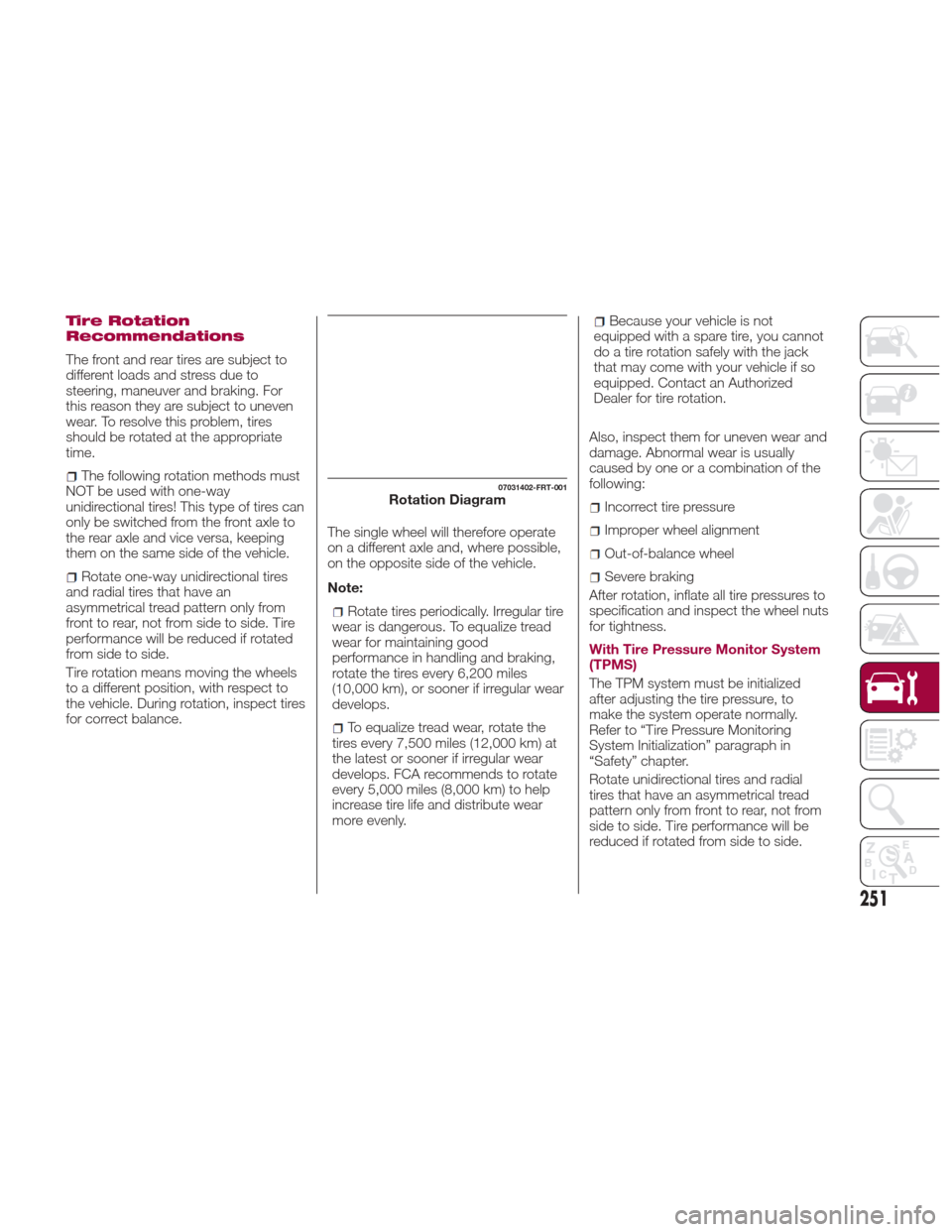
Tire rotation means moving the wheels
to a different position, with respect to
the vehicle. During rotation, inspect tires
for correct balance. The single wheel will therefore operate
on a different axle and, where possible,
on the opposite side of the vehicle.
Note:
Rotate tires periodically. Irregular tire
wear is dangerous. To equalize tread
wear for maintaining good
performance in handling and braking,
rotate the tires every 6,200 miles
(10,000 km), or sooner if irregular wear
develops.
To equalize tread wear, rotate the
tires every 7,500 miles (12,000 km) at
the latest or sooner if irregular wear
develops. FCA recommends to rotate
every 5,000 miles (8,000 km) to help
increase tire life and distribute wear
more evenly.
Because your vehicle is not
equipped with a spare tire, you cannot
do a tire rotation safely with the jack
that may come with your vehicle if so
equipped. Contact an Authorized
Dealer for tire rotation.
Also, inspect them for uneven wear and
damage. Abnormal wear is usually
caused by one or a combination of the
following:
Incorrect tire pressure
Improper wheel alignment
Out-of-balance wheel
Severe braking
After rotation, inflate all tire pressures to
specification and inspect the wheel nuts
for tightness.
With Tire Pressure Monitor System
(TPMS)
The TPM system must be initialized
after adjusting the tire pressure, to
make the system operate normally.
Refer to “Tire Pressure Monitoring
System Initialization” paragraph in
“Safety” chapter.
Rotate unidirectional tires and radial
tires that have an asymmetrical tread
pattern only from front to rear, not from
side to side. Tire performance will be
reduced if rotated from side to side.
07031402-FRT-001Rotation Diagram
251
Page 254 of 300
DEPARTMENT OF
TRANSPORTATION
UNIFORM TIRE
QUALITY GRADES
The following tire grading categories
were established by the National
Highway Traffic Safety Administration.
The specific grade rating assigned by
the tire's manufacturer in each category
is shown on the sidewall of the tires on
your vehicle.
All passenger vehicle tires must
conform to Federal safety requirements
in addition to these grades.
Treadwear
The Treadwear grade is a comparative
rating, based on the wear rate of the
tire when tested under controlled
conditions on a specified government
test course. For example, a tire graded
150 would wear one and one-half times
as well on the government course as a
tire graded 100. The relative
performance of tires depends upon the
actual conditions of their use, however,
and may depart significantly from the
norm due to variations in driving habits,
service practices, and differences in
road characteristics and climate.
Traction Grades
The Traction grades, from highest to
lowest, are AA, A, B, and C. These
grades represent the tire's ability to
stop on wet pavement, as measured
under controlled conditions on specified
government test surfaces of asphalt
and concrete. A tire marked C may
have poor traction performance.
Warning!
The traction grade assigned to this tire is
based on straight-ahead braking traction
tests, and does not include acceleration,
cornering, hydroplaning, or peak traction
characteristics.
Temperature Grades
The temperature grades are A (the
highest), B, and C, representing the
tire's resistance to the generation of
heat and its ability to dissipate heat,
when tested under controlled
conditions on a specified indoor
laboratory test wheel.Sustained high temperature can cause
the material of the tire to degenerate
and reduce tire life, and excessive
temperature can lead to sudden tire
failure. The grade C corresponds to a
level of performance, which all
passenger vehicle tires must meet
under the Federal Motor Vehicle Safety
Standard No. 109. Grades B and A
represent higher levels of performance
on the laboratory test wheel, than the
minimum required by law.
Warning!
The temperature grade for this tire is
established for a tire that is properly
inflated and not overloaded. Excessive
speed, under-inflation, or excessive
loading, either separately or in
combination, can cause heat buildup and
possible tire failure.
252
SERVICING AND MAINTENANCE
Page 257 of 300
Another method is to cover the affected
area with dampened newspaper for one
to two hours. After removing the
newspaper, rinse off the loosened
debris with water.
Water marks
Problem:
Rain, fog, dew, and even tap water can
contain harmful minerals such as salt
and lime. If moisture containing these
minerals settles on the vehicle and
evaporates, the minerals will
concentrate and harden to form white
rings. The rings can damage your
vehicle's finish.
Prevention:
It is necessary to wash and wax your
vehicle to preserve its finish according
to the instructions in this section. These
steps should be taken immediately after
you find water marks on your vehicle's
finish.
Paint chipping
Problem:
Paint chipping occurs when gravel
thrown in the air by another vehicle's
tires hits your vehicle.
How to avoid paint chipping:
Keeping a safe distance between you
and the vehicle ahead reduces the
chances of having your paint chipped
by flying gravel.Note:
The paint chipping zone varies with
the speed of the vehicle. For example,
when travelling at 55 mph (90 km/h),
the paint chipping zone is 164 ft
(50 m).
In low temperatures a vehicle's
finish hardens. This increases the
chance of paint chipping.
Chipped paint can lead to rust
forming on your vehicle. Before this
happens, repair the damage by using
FCA touch-up paint according to the
instructions in this section. Failure to
repair the affected area could lead to
serious rusting and expensive repairs.
Follow all label and container directions
when using a chemical cleaner or
polish. Read all warnings and cautions.
Maintaining The Finish
Washing
To help protect the finish from rust and
deterioration, wash your vehicle
thoroughly and frequently, at least once
a month, with lukewarm or cold water.
If the vehicle is washed improperly, the
paint surface could be scratched. Here
are some examples of how scratching
could occur:
The vehicle is washed without first
rinsing off dirt and other foreign matter.
The vehicle is washed with a rough,
dry, or dirty cloth.
The vehicle is washed at a car wash
that uses brushes that are dirty or too
stiff.
Cleansers or wax containing
abrasives are used.
Note: FCA is not responsible for
scratches caused by automatic car
washes or improper washing.
Scratches are more noticeable on
vehicles with darker paint finishes.
When the wiper lever is in the AUTO
position and the ignition is placed in the
ON mode, the wipers may move
automatically in the following cases:
If the windshield above the rain
sensor is touched or wiped with a cloth.
If the windshield is struck with a hand
or other object from either outside or
inside the vehicle.
Note:
Keep hands and scrapers clear of
the windshield when the wiper lever is
in the AUTO position and the ignition is
placed in the ON mode as fingers
could be pinched or the wipers and
wiper blades damaged when the
wipers activate automatically. If you are
going to clean the windshield, be sure
the wipers are turned off completely
(when it is most likely that the engine is
255
Page 261 of 300
4. Reinstall the drain filter in the reverse
order of the removal procedure.
Note:Make sure that the drain filter is
securely attached to its designated
position by pushing it until the tab
locks. Water may enter the vehicle if the
drain filter is not secured to its
designated position. For this operation
go to an Authorized Dealer.
Plastic Part
Maintenance
When cleaning the plastic lenses of the
lights, do not use gasoline, paraffin,
rectified spirit, paint, thinner, highly
acidic detergents, or strongly alkaline
detergents.
Otherwise, these chemical agents can
discolor or damage the surfaces
resulting in a significant loss in
functionality. If plastic parts become
inadvertently exposed to any of these
chemical agents, flush with water
immediately.
If plastic parts such as the bumpers
become inadvertently exposed to
chemical agents or fluids such as
gasoline, oil, engine coolant, or battery
fluid, it could cause discoloration,
staining, or paint peeling. Wipe off any
such chemical agents or fluids using a
soft cloth immediately.
Caution!
High water temperature and high water
pressure car washers are available
depending on the type of high pressure car
washer device. If the car washer nozzle is
put too close to the vehicle or aimed at one
area for an extended period of time, it
could deform plastic parts or damage the
paint.
Do not use wax containing compounds
(polish). Otherwise, it could result in paint
damage.
In addition, do not use an electrical or air
tool to apply wax. Otherwise, the frictional
heat generated could result in deformation
of plastic parts or paint damage.
INTERIORS
Seats And Fabric Parts
Warning!
Do not use volatile solvents for cleaning
purposes. Many are potentially flammable,
and if used in closed areas they may cause
respiratory harm.
Do not keep aerosol cans in the car: they
might explode. Aerosol cans must not be
exposed to a temperature exceeding
122°F (50°C). When the vehicle is exposed
to sunlight the internal temperature can
greatly exceed this value.
Caution!
Direct contact of air fresheners, insect
repellents,suntan lotions, or hand sanitizers
to the plastic, painted, or
decoratedsurfaces of the interior may
cause permanent damage. Wipe away
immediately.
Damage caused by these type of
products may notbe covered by your New
Vehicle Limited Warranty.
259
Page 269 of 300
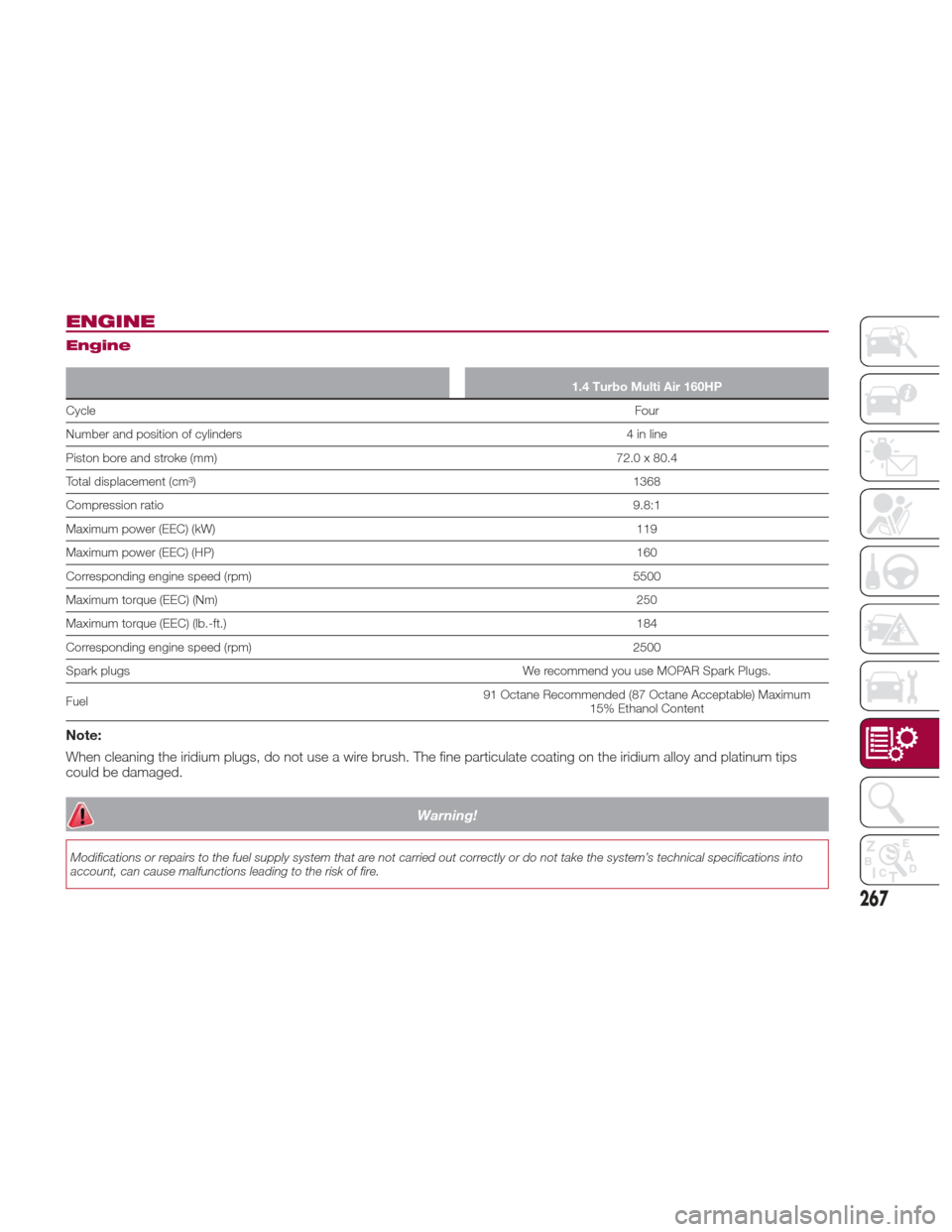
ENGINE
Engine
1.4 Turbo Multi Air 160HP
Cycle Four
Number
and position of cylinders 4 in line
Piston bore and stroke (mm) 72.0 x 80.4
Total displacement (cm³) 1368
Compression ratio 9.8:1
Maximum power (EEC) (kW) 119
Maximum power (EEC) (HP) 160
Corresponding engine speed (rpm) 5500
Maximum torque (EEC) (Nm) 250
Maximum torque (EEC) (lb.-ft.) 184
Corresponding engine speed (rpm) 2500
Spark plugs We recommend you use MOPAR Spark Plugs.
Fuel 91 Octane Recommended (87 Octane Acceptable) Maximum
15% Ethanol Content
Note:
When cleaning the iridium plugs, do not use a wire brush. The fine particulate coating on the iridium alloy and platinum tips
could be damaged.
Warning!
Modifications or repairs to the fuel supply system that are not carried out correctly or do not take the system’s technical specifications into
account, can cause malfunctions leading to the risk of fire.
267