air condition FIAT 124 SPIDER 2017 2.G User Guide
[x] Cancel search | Manufacturer: FIAT, Model Year: 2017, Model line: 124 SPIDER, Model: FIAT 124 SPIDER 2017 2.GPages: 300, PDF Size: 121.24 MB
Page 99 of 300
Amber Warning Lights
Warning lightWhat it means
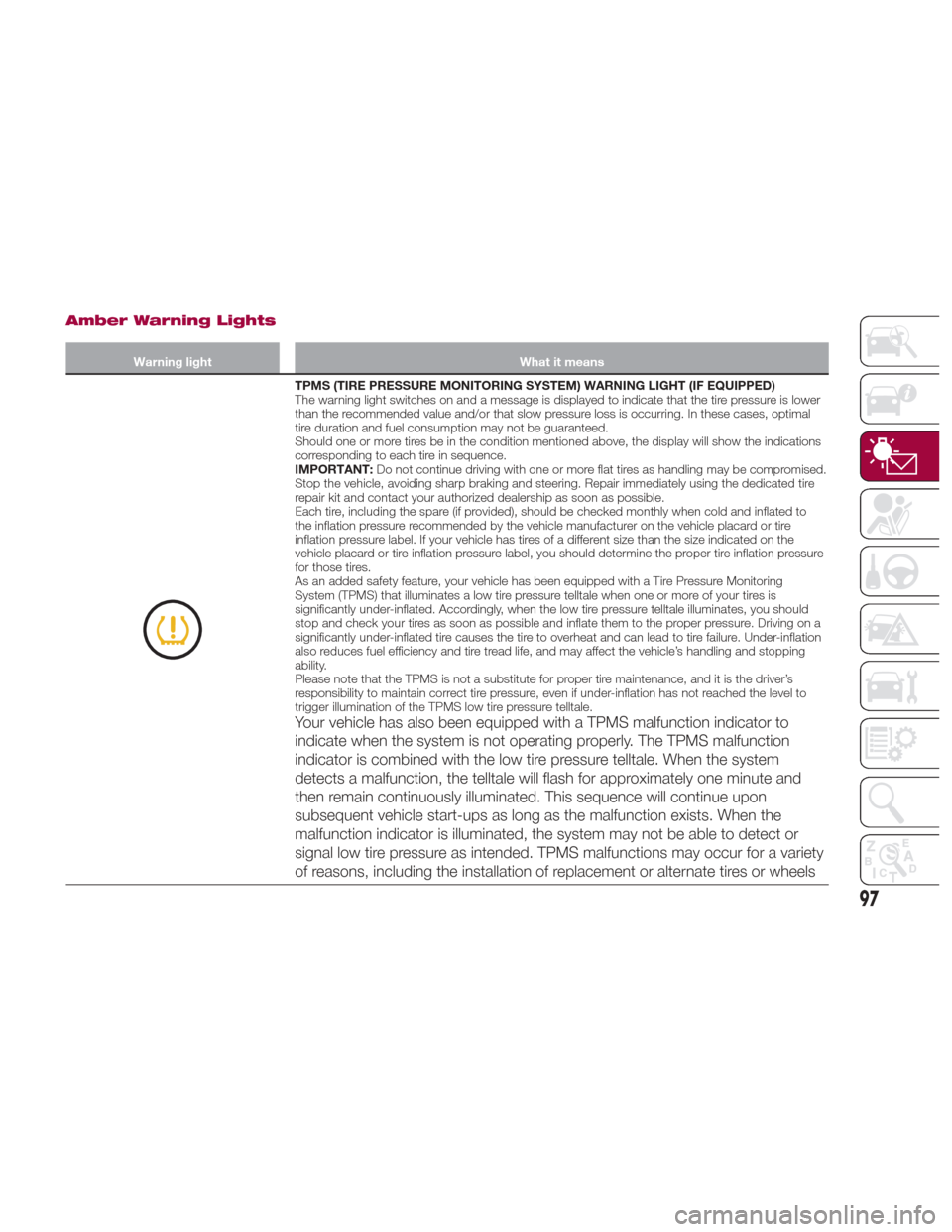
TPMS (TIRE PRESSURE MONITORING SYSTEM) WARNING LIGHT (IF EQUIPPED)
The warning light switches on and a message is displayed to indicate that the tire pressure is lower
than the recommended value and/or that slow pressure loss is occurring. In these cases, optimal
tire duration and fuel consumption may not be guaranteed.
Should one or more tires be in the condition mentioned above, the display will show the indications
corresponding to each tire in sequence.
IMPORTANT:Do not continue driving with one or more flat tires as handling may be compromised.
Stop the vehicle, avoiding sharp braking and steering. Repair immediately using the dedicated tire
repair kit and contact your authorized dealership as soon as possible.
Each tire, including the spare (if provided), should be checked monthly when cold and inflated to
the inflation pressure recommended by the vehicle manufacturer on the vehicle placard or tire
inflation pressure label. If your vehicle has tires of a different size than the size indicated on the
vehicle placard or tire inflation pressure label, you should determine the proper tire inflation pressure
for those tires.
As an added safety feature, your vehicle has been equipped with a Tire Pressure Monitoring
System (TPMS) that illuminates a low tire pressure telltale when one or more of your tires is
significantly under-inflated. Accordingly, when the low tire pressure telltale illuminates, you should
stop and check your tires as soon as possible and inflate them to the proper pressure. Driving on a
significantly under-inflated tire causes the tire to overheat and can lead to tire failure. Under-inflation
also reduces fuel efficiency and tire tread life, and may affect the vehicle’s handling and stopping
ability.
Please note that the TPMS is not a substitute for proper tire maintenance, and it is the driver’s
responsibility to maintain correct tire pressure, even if under-inflation has not reached the level to
trigger illumination of the TPMS low tire pressure telltale.
Your vehicle has also been equipped with a TPMS malfunction indicator to
indicate when the system is not operating properly. The TPMS malfunction
indicator is combined with the low tire pressure telltale. When the system
detects a malfunction, the telltale will flash for approximately one minute and
then remain continuously illuminated. This sequence will continue upon
subsequent vehicle start-ups as long as the malfunction exists. When the
malfunction indicator is illuminated, the system may not be able to detect or
signal low tire pressure as intended. TPMS malfunctions may occur for a variety
of reasons, including the installation of replacement or alternate tires or wheels
97
Page 121 of 300
In the following cases, it may be difficult
to view the illumination/flashing of the
BSM warning lights equipped on the
door mirrors:
Snow or ice adheres to the door
mirrors.
The door glass is fogged or covered
in snow, frost or dirt.
Turn off the RCTA system while pulling
a trailer or while an accessory such as a
bicycle carrier is installed to the rear of
the vehicle.
Otherwise, the sound system waves
emitted by the radar will be blocked
causing the system to not operate
normally.
TPMS (Tire Pressure
Monitoring System)
Tire Pressure Monitoring System —
Lo/Hi Grade
The TPMS (Tire Pressure Monitoring
System) monitors the air pressure of all
four tires.
If the air pressure of one or more tires is
too low, the system warns the driver by
indicating the
warning light in the
instrument cluster and operating a
beep.
The system monitors the tire pressures
indirectly using the data sent from the
ABS wheel speed sensors.
To allow the system to operate
correctly, the system needs to be
initialized with the specified tire pressure
(value on the tire placard label). Follow
the procedure and perform the
initialization (refer to “Tire Pressure
Monitoring System Initialization”
paragraph).
The
warning light flashes when the
system has a malfunction.
Because this system detects slight
changes in tire conditions, the timing of
the warning may be faster or slower in
the following cases:
The size, manufacturer, or the type of
tires is different from the specification.
The size, manufacturer, or the type of
a tire is different from the others, or the
level of tire wear is excessively different
between them.
05281200-03A-004Another Vehicle Approaching In Direct Rear Of Your Vehicle
05281200-03A-005Your Vehicle Parked On A Slant
119
Page 125 of 300
Note:
The tire pressure sensor ID signal
code must be registered when a new
tire pressure sensor is purchased. For
purchase of a tire pressure sensor and
registration of the tire pressure sensor
ID signal code, consult your Authorized
Dealer.
When reinstalling a previously
removed tire pressure sensor to a
wheel, replace the grommet (seal
between valve body/sensor and wheel)
for the tire pressure sensor.
Caution!
The TPMS has been optimized for the
original equipment tires and wheels.
TPMS pressures and warning have been
established for the tire size equipped on
your vehicle. Undesirable system operation
or sensor damage may result when using
replacement equipment that is not of the
same size, type, and/or style. Aftermarket
wheels can cause sensor damage.
Using aftermarket tire sealants may
cause the Tire Pressure Monitoring System
(TPMS) sensor to become inoperable.
After using an aftermarket tire sealant it is
recommended that you take your vehicle to
an Authorized Dealership to have your
sensor function checked.
After inspecting or adjusting the tire
pressure always reinstall the valve stem
cap. This will prevent moisture and dirt
from entering the valve stem, which could
damage the TPMS sensor.
The following regulatory statement
applies to all radio frequency (RF)
devices equipped in this vehicle:
This device complies with Part 15 of the
FCC Rules and with Industry Canada
license-exempt RSS standard(s).
Operation is subject to the following
two conditions:
(1) This device may not cause harmful
interference, and
(2) This device must accept any
interference received, including
interference that may cause undesired
operation.
Note:
Changes or modifications not expressly
approved by the party responsible for
compliance could void the user’s
authority to operate the equipment.
OCCUPANT
RESTRAINT
SYSTEMS
The most important safety equipment
of the vehicle comprise the following
protection systems:
Seat Belts
SBA (Seat Belt Alert) System
Head Restraints
Child Restraint Systems
Front Air Bags And Side Air Bags
Read the information given in the
following pages with the utmost care.
It is of fundamental importance that the
protection systems are used in the
correct way to guarantee the maximum
possible safety level for the driver and
the passengers.
123
Page 127 of 300
Do not allow people to ride in any area
of your vehicle that is not equipped with
seats and seat belts.
Be sure everyone in your vehicle is in a
seat and using a seat belt properly.
Occupants, including the driver, should
always wear their seat belt whether or not
an air bag is also provided at their seating
position to minimize the risk of severe injury
or death in the event of a crash.
Occupants, including the driver, should
always wear their seat belt whether or not
an air bag is also provided at their seating
position to minimize the risk of severe injury
or death in the event of a crash.
Wearing your seat belt incorrectly could
make your injuries in a collision much
worse. You might suffer internal injuries, or
you could even slide out of the seat belt.
Follow these instructions to wear your seat
belt safely and to keep your passengers
safe, too.
Two people should never be belted into
a single seat belt. People belted together
can crash into one another in a collision,
hurting one another badly. Never use a
lap/shoulder belt or a lap belt for more than
one person, no matter what their size.
A lap belt worn too high can increase
the risk of injury in a collision. The seat belt
forces won’t be at the strong hip and pelvic
bones, but across your abdomen. Always
wear the lap part of your seat belt as low
as possible and keep it snug.
A twisted seat belt may not protect you
properly. In a collision, it could even cut into you. Be sure the seat belt is flat against
your body, without twists. If you can’t
straighten a seat belt in your vehicle, take it
to your authorized dealer immediately and
have it fixed.
A seat belt that is buckled into the
wrong buckle will not protect you properly.
The lap portion could ride too high on your
body, possibly causing internal injuries.
Always buckle your seat belt into the
buckle nearest you.
A seat belt that is too loose will not
protect you properly. In a sudden stop, you
could move too far forward, increasing the
possibility of injury. Wear your seat belt
snugly.
A seat belt that is worn under your arm
is dangerous. Your body could strike the
inside surfaces of the vehicle in a collision,
increasing head and neck injury. A seat belt
worn under the arm can cause internal
injuries. Ribs aren’t as strong as shoulder
bones. Wear the seat belt over your
shoulder so that your strongest bones will
take the force in a collision.
A shoulder belt placed behind you will
not protect you from injury during a
collision. You are more likely to hit your
head in a collision if you do not wear your
shoulder belt. The lap and shoulder belt are
meant to be used together.
A frayed or torn seat belt could rip apart
in a collision and leave you with no
protection. Inspect the seat belt system
periodically, checking for cuts, frays, or
loose parts. Damaged parts must be
replaced immediately. Do not disassemble or modify the seat belt system. Seat belt
assemblies must be replaced after a
collision.
Seat Belts And Pregnant
Women
Pregnant Women And Persons With
Serious Medical Conditions
Pregnant women should always wear
seat belts. Ask your doctor for specific
recommendations.
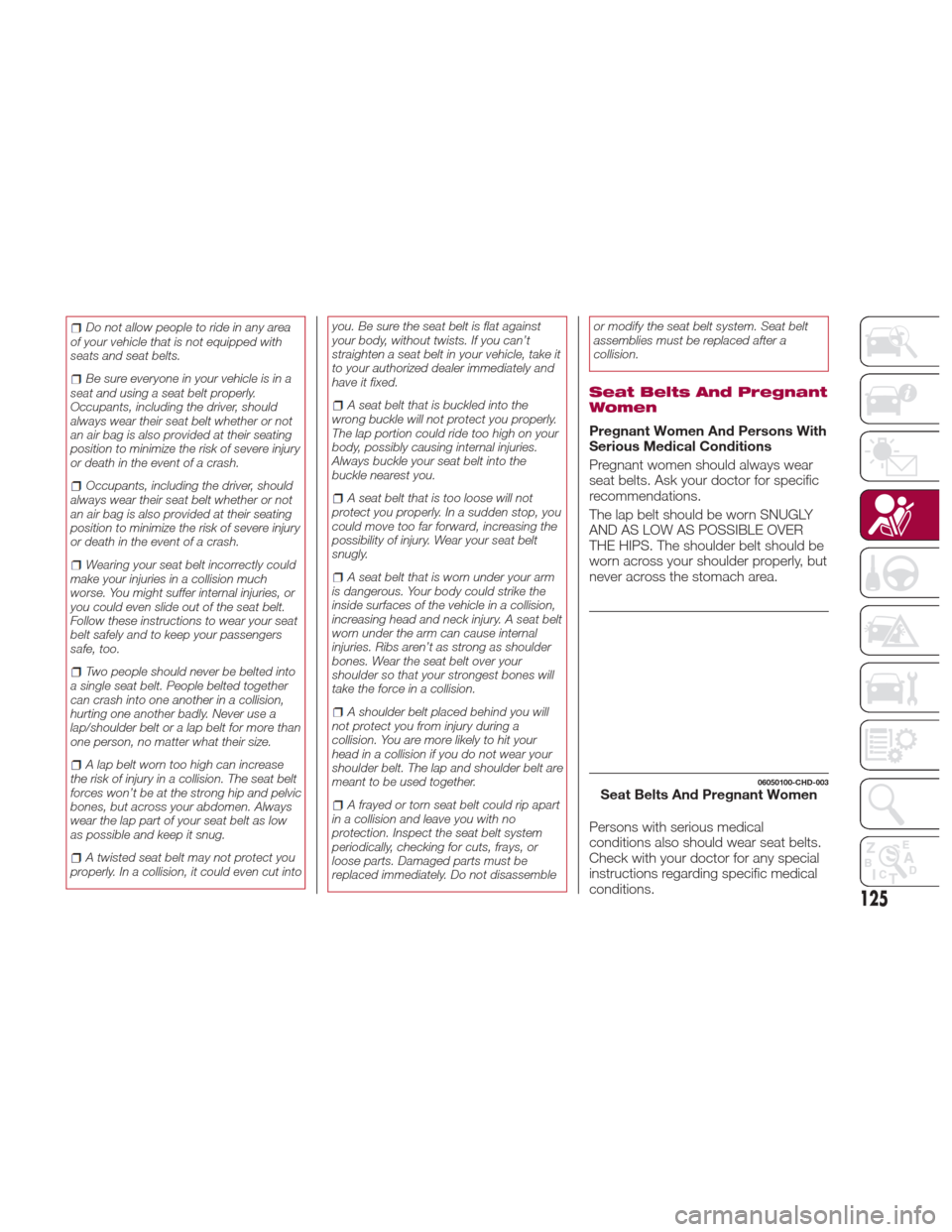
The lap belt should be worn SNUGLY
AND AS LOW AS POSSIBLE OVER
THE HIPS. The shoulder belt should be
worn across your shoulder properly, but
never across the stomach area.
Persons with serious medical
conditions also should wear seat belts.
Check with your doctor for any special
instructions regarding specific medical
conditions.
06050100-CHD-003Seat Belts And Pregnant Women
125
Page 130 of 300
may not hold in the critical moment
of a crash.
When ordering an extender, only order
one that provides the necessary
additional length to fasten the seat belt
properly. Please contact Authorized
Dealership for more information.
When not in use, remove the seat belt
extender and store it in the vehicle. If
the seat belt extender is left connected,
the seat belt extender might get
damaged as it will not retract with the
rest of the seat belt and can easily fall
out of the door when not in use and be
damaged.
In addition, the seat belt warning light
will not illuminate and function properly.
Warning!
Do not use a seat belt extender unless it
is necessary. Using a seat belt extender
when not necessary is dangerous. The
seat belt will be too long and not fit
properly. In an accident, the seat belt will
not provide adequate protection and you
could be seriously injured. Only use the
extender when it is required to fasten the
seat belt properly.
Do not use an improper extender. Using
a seat belt extender that is for another
person or a different vehicle or seat is
dangerous. The seat belt will not provide
adequate protection and the user could be
seriously injured in an accident. Only use the extender provided for you and for the
particular vehicle and seat.
NEVER use the extender in a different
vehicle or seat. If you sell your vehicle, do
not leave your seat belt extender in the
vehicle. It could be used accidentally by the
new owner of the vehicle. After removing
the seat belt extender, discard it. Never use
the seat belt extender in any other vehicle
you may own in the future.
Do not use an extender that is too long.
Using an extender that is too long is
dangerous. The seat belt will not fit
properly. In an accident, the seat belt will
not provide adequate protection and you
could be seriously injured. Do not use the
extender or choose one shorter in length if
the distance between the extender's
buckle and the center of the user's body is
less than 6 inches (15 cm).
Do not leave a seat belt extender
connected to the buckle. Leaving a seat
belt extender connected to the buckle
without using the seat belt is dangerous.
When the seat belt extender is connected
to the driver's seat belt buckle (or
passenger) seat, the SRS driver's (or
passenger's) air bag system will determine
that the driver (or passenger) is wearing the
seat belt even if the driver (or passenger)
isnot wearing it. This condition could cause
the driver's (or passenger's) air bag to not
activate correctly and result in death or
serious injury in the event of collision.
Always wear the seat belt with the seat belt
extender.
Do not use the seat belt extender when
installing a child restraint system on the passenger seat. Using a seat belt extender
to fasten a child restraint system on any
seat is dangerous. Always follow the child
restraint system manufacturer's installation
instructions and never use a seat belt
extender.
Driver And Passenger
BeltAlert (If Equipped)
Seat Belt Warning Systems
The LED on dashboard trim turns on if
the driver or passenger's seat is
occupied and the seat belt is not
fastened with the ignition switched ON.
If the driver or passenger's seat belt is
unfastened (only when the passenger
seat is occupied) and the vehicle is
driven at a speed faster than about
12 MPH (20 km/h), the
LED flashes.
After a short time, the LED stops
flashing, but remains illuminated.
If a seat belt remains unfastened, the
LED flashes again for a given period of
time. In this case, fasten the seat belt.
Seat Belt Pretensioner
For optimum protection, the driver and
passenger seat belts are equipped with
pretensioner and load limiting systems.
For both these systems to work
properly you must wear the seat belt
properly.
The seat belt pretensioners are
designed to deploy in moderate or
severe frontal, near frontal collisions. In
addition, during a side collision, the
128
SAFETY
Page 131 of 300
pretensioner operates on the side in
which the collision occurs. The
pretensioners operate differently
depending on what types of air bags
are equipped. For details on the seat
belt pretensioner operation, refer to the
“SRS Air Bag Deployment Criteria”
paragraph in this chapter.
When a collision is detected, the
pretensioners deploy simultaneously
with the air bags. For deployment
details, refer to the “SRS Air Bag
Deployment Criteria” paragraph in this
chapter.
The seat belt retractors remove slack
quickly as the air bags are expanding.
Any time the air bags and seat belt
pretensioners have fired they must be
replaced.
A system malfunction or operation
conditions are indicated by a warning.
Referto“WarningLightsAnd
Messages” and “Warning Sound Is
Activated” paragraph in “Knowing The
Instrument Panel” chapter.
With Passenger Occupant
Classification System
In addition, the pretensioner system for
the passenger, like the front and side
passenger Air Bag, is designed to only
deploy when the passenger occupant
classification sensor detects a
passenger sitting on the passenger's
seat.Note:
These devices are not a substitute
for proper seat belt placement by the
occupant. The seat belt still must be
worn snugly and positioned properly.
The pretensioners are triggered by
the Occupant Restraint Controller
(ORC). Like the air bags, the
pretensioners are single use items. A
deployed pretensioner or a deployed
air bag must be replaced immediately.
Load Limiter
The load limiting system releases belt
webbing in a controlled manner to
reduce belt force on the occupant's
chest.
While the most severe load on a seat
belt occurs in frontal collisions, the load
limiter has an automatic mechanical
function and can activate in any
accident mode with sufficient occupant
movement.
Even if the pretensioners have not fired,
the load limiting function must be
checked by an authorized dealer.
CHILD RESTRAINT
PRECAUTIONS
Child Restraints
FCA strongly urges the use of
child-restraint systems for children small
enough to use them.
FCA recommends use of a genuine
child-restraint system or one that
complies with regulation. If you would
like to purchase a FCA genuine
child-restraint system, please contact a
Authorized Dealership.
Check your local and state or provincial
laws for specific requirements regarding
the safety of children riding in your
vehicle.
Whatever child-restraint system you
consider, please pick the appropriate
one for the age and size of the child,
obey the law and follow the instructions
that come with the individual
child-restraint system.
A child who has outgrown
child-restraint systems should use seat
belts, both lap and shoulder. If the
shoulder belt crosses the neck or face,
move the child closer to the centre of
the vehicle.
A rear-facing child-restraint system
should NEVER be used on the
passenger seat with the Air Bag system
activated. In the event of an impact the
Air Bag activation may cause fatal
injuries to the transported child.
129
Page 141 of 300
Warning Light/Beep
A system malfunction or operation
conditions are indicated by a warning.
Refer to “Warning lights and messages”
paragraph in “Knowing your instrument
panel” chapter for further information.
Passenger Side Front Air Bag And
Child Restraint Systems
Rearward-facing child restraint systems
mustNEVER be fitted on the front seat
with an active passenger side air bag
since in the event of an impact the air
bag activation may cause fatal injuries
to the transported child.
ALWAYS comply with the instructions
on the label stuck on the passenger
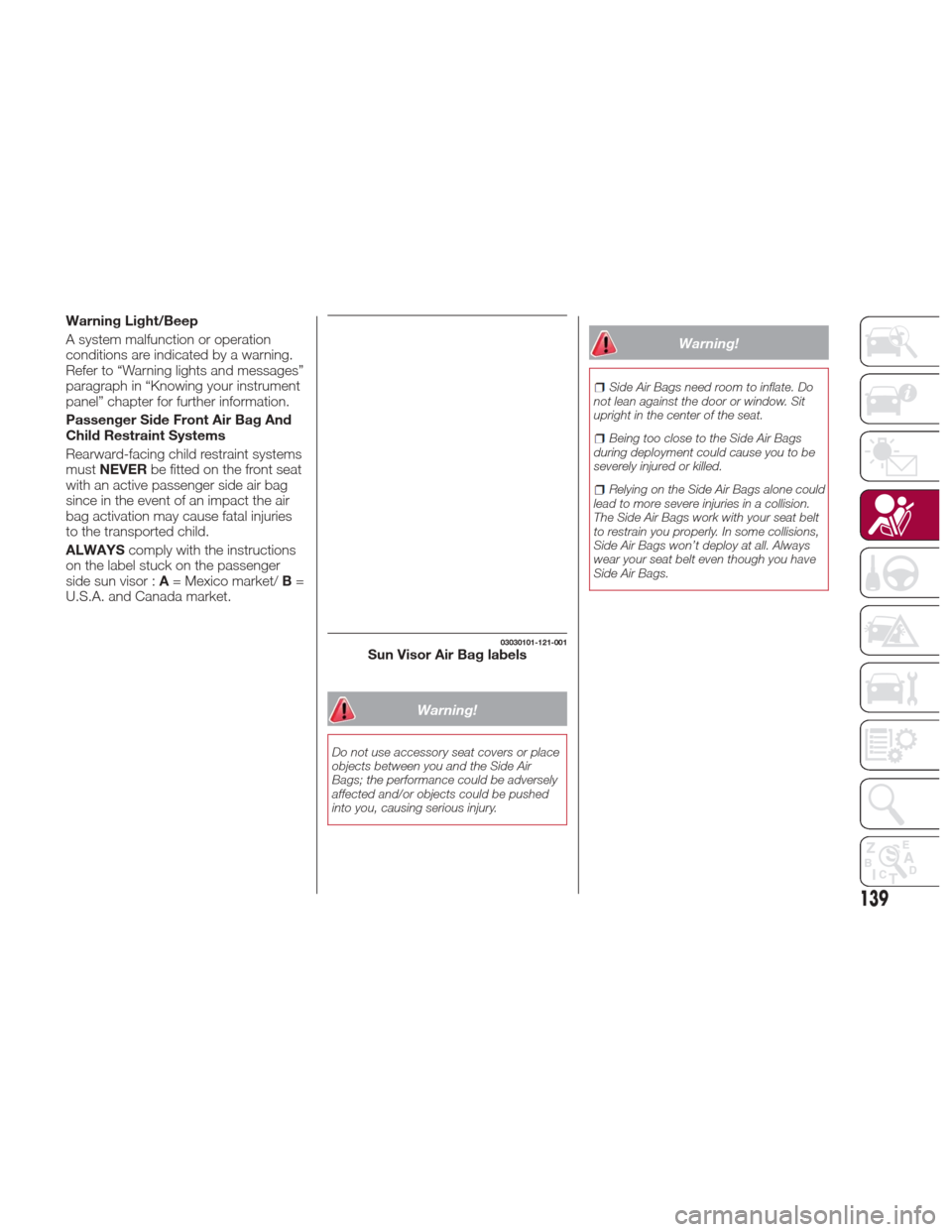
side sun visor : A= Mexico market/ B=
U.S.A. and Canada market.
Warning!
Do not use accessory seat covers or place
objects between you and the Side Air
Bags; the performance could be adversely
affected and/or objects could be pushed
into you, causing serious injury.
Warning!
Side Air Bags need room to inflate. Do
not lean against the door or window. Sit
upright in the center of the seat.
Being too close to the Side Air Bags
during deployment could cause you to be
severely injured or killed.
Relying on the Side Air Bags alone could
lead to more severe injuries in a collision.
The Side Air Bags work with your seat belt
to restrain you properly. In some collisions,
Side Air Bags won’t deploy at all. Always
wear your seat belt even though you have
Side Air Bags.
03030101-121-001Sun Visor Air Bag labels
139
Page 145 of 300
This system shuts off the passenger
front and side Air Bags and seat belt
pretensioner system, so make sure the
passenger Air Bag deactivation
indicator light turns on.
The air bag/seat belt pretensioner
system warning light flashes and the
passenger Air Bag deactivation
indicator light illuminates if the sensors
have a possible malfunction. If this
happens, the passenger front and side
Air Bags and seat belt pretensioner
system will not deploy.
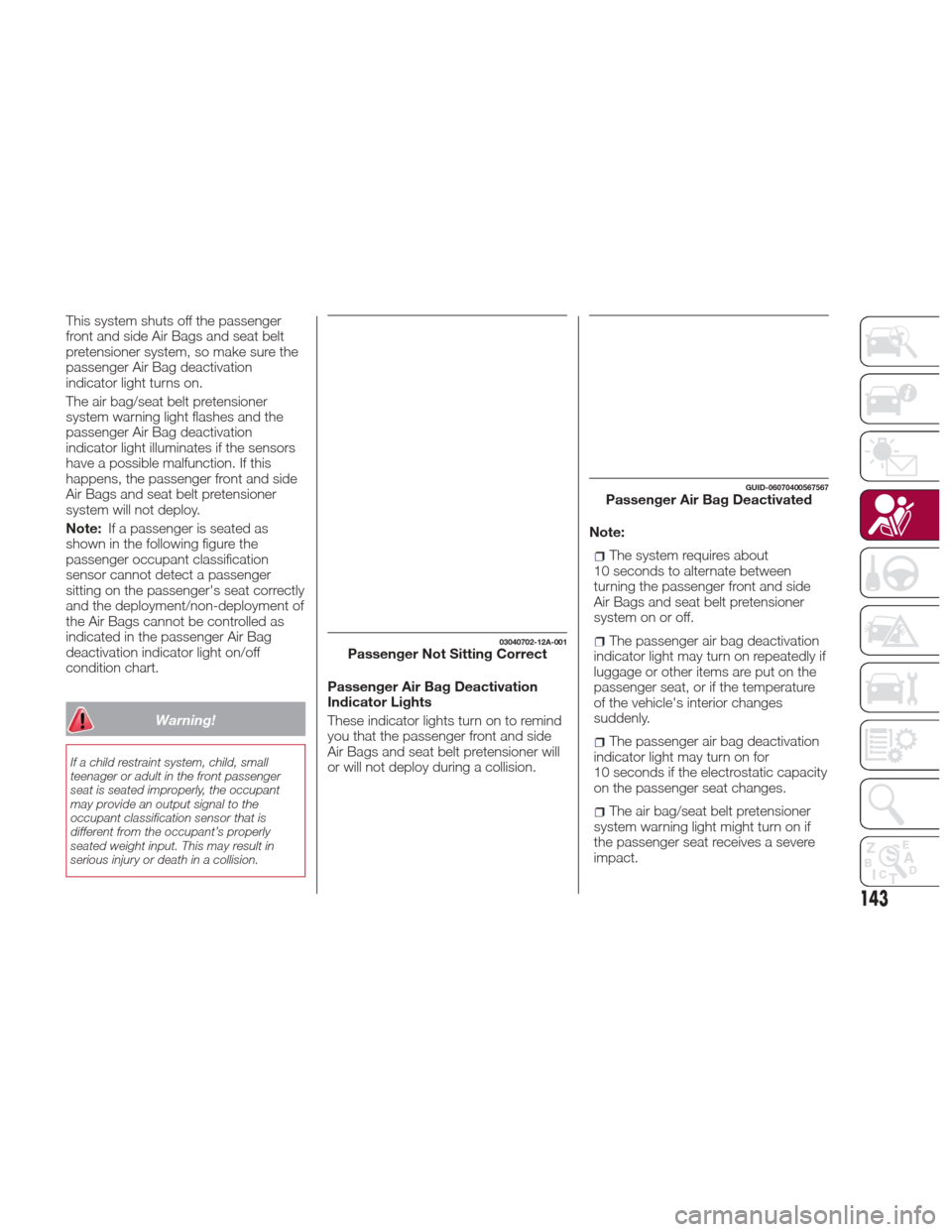
Note:If a passenger is seated as
shown in the following figure the
passenger occupant classification
sensor cannot detect a passenger
sitting on the passenger's seat correctly
and the deployment/non-deployment of
the Air Bags cannot be controlled as
indicated in the passenger Air Bag
deactivation indicator light on/off
condition chart.
Warning!
If a child restraint system, child, small
teenager or adult in the front passenger
seat is seated improperly, the occupant
may provide an output signal to the
occupant classification sensor that is
different from the occupant’s properly
seated weight input. This may result in
serious injury or death in a collision.
Passenger Air Bag Deactivation
Indicator Lights
These indicator lights turn on to remind
you that the passenger front and side
Air Bags and seat belt pretensioner will
or will not deploy during a collision. Note:
The system requires about
10 seconds to alternate between
turning the passenger front and side
Air Bags and seat belt pretensioner
system on or off.
The passenger air bag deactivation
indicator light may turn on repeatedly if
luggage or other items are put on the
passenger seat, or if the temperature
of the vehicle's interior changes
suddenly.
The passenger air bag deactivation
indicator light may turn on for
10 seconds if the electrostatic capacity
on the passenger seat changes.
The air bag/seat belt pretensioner
system warning light might turn on if
the passenger seat receives a severe
impact.
03040702-12A-001Passenger Not Sitting Correct
GUID-06070400567567Passenger Air Bag Deactivated
143
Page 146 of 300
If the passenger Air Bag
deactivation indicator light does not
turn on after installing a child restraint
system on the passenger seat, first,
reinstall your child restraint system
according to the procedure in this
Owner Handbook. Then, if the
passenger Air Bag deactivation OFF
indicator light still does not turn on,
and contact an Authorized Dealership
as soon as possible.If the passenger Air Bag
deactivation indicator light turns on
when an occupant is seated directly in
the passenger seat, have the
passenger readjust their posture by
sitting with their feet on the floor, and
then refastening the seat belt. If the
passenger Air Bag deactivation
indicator light remains turned on, slide
the passenger seat as far back as
possible. Contact an Authorized
Dealership as soon as possible. Passenger Air Bag Deactivation
Indicator Light On/Off Condition
Chart
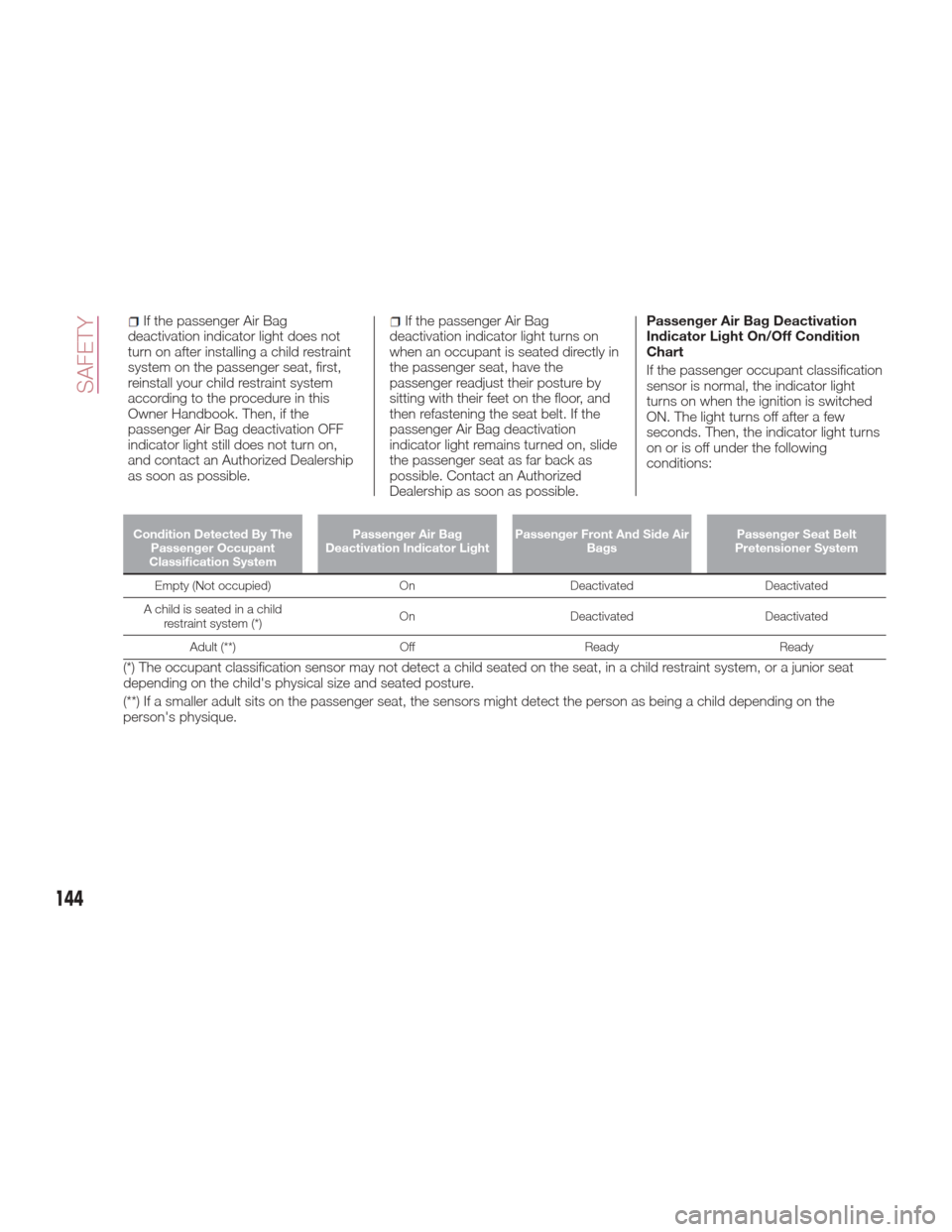
If the passenger occupant classification
sensor is normal, the indicator light
turns on when the ignition is switched
ON. The light turns off after a few
seconds. Then, the indicator light turns
on or is off under the following
conditions:
Condition Detected By The
Passenger Occupant
Classification System Passenger Air Bag
Deactivation Indicator Light Passenger Front And Side Air
Bags Passenger Seat Belt
Pretensioner System
Empty (Not occupied) OnDeactivated Deactivated
A
child is seated in a child restraint system (*) On
Deactivated Deactivated
Adult (**) OffReady Ready
(*) The occupant classification sensor may not detect a child seated on the seat, in a child restraint system, or a junior seat
depending on the child's physical size and seated posture.
(**) If a smaller adult sits on the passenger seat, the sensors might detect the person as being a child depending on the
person's physique.
144
SAFETY
Page 147 of 300
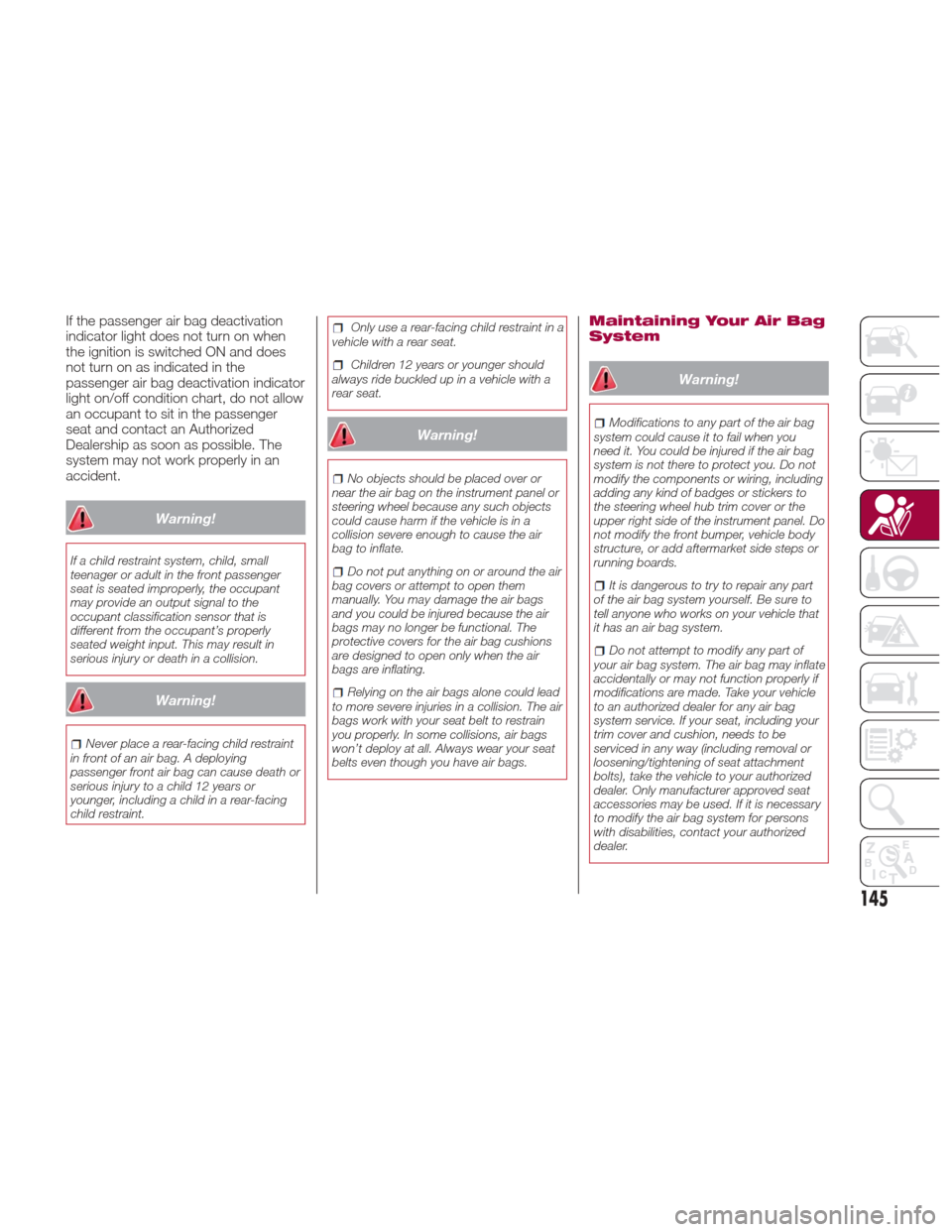
If the passenger air bag deactivation
indicator light does not turn on when
the ignition is switched ON and does
not turn on as indicated in the
passenger air bag deactivation indicator
light on/off condition chart, do not allow
an occupant to sit in the passenger
seat and contact an Authorized
Dealership as soon as possible. The
system may not work properly in an
accident.
Warning!
If a child restraint system, child, small
teenager or adult in the front passenger
seat is seated improperly, the occupant
may provide an output signal to the
occupant classification sensor that is
different from the occupant’s properly
seated weight input. This may result in
serious injury or death in a collision.
Warning!
Never place a rear-facing child restraint
in front of an air bag. A deploying
passenger front air bag can cause death or
serious injury to a child 12 years or
younger, including a child in a rear-facing
child restraint.
Only use a rear-facing child restraint in a
vehicle with a rear seat.
Children 12 years or younger should
always ride buckled up in a vehicle with a
rear seat.
Warning!
No objects should be placed over or
near the air bag on the instrument panel or
steering wheel because any such objects
could cause harm if the vehicle is in a
collision severe enough to cause the air
bag to inflate.
Do not put anything on or around the air
bag covers or attempt to open them
manually. You may damage the air bags
and you could be injured because the air
bags may no longer be functional. The
protective covers for the air bag cushions
are designed to open only when the air
bags are inflating.
Relying on the air bags alone could lead
to more severe injuries in a collision. The air
bags work with your seat belt to restrain
you properly. In some collisions, air bags
won’t deploy at all. Always wear your seat
belts even though you have air bags.
Maintaining Your Air Bag
System
Warning!
Modifications to any part of the air bag
system could cause it to fail when you
need it. You could be injured if the air bag
system is not there to protect you. Do not
modify the components or wiring, including
adding any kind of badges or stickers to
the steering wheel hub trim cover or the
upper right side of the instrument panel. Do
not modify the front bumper, vehicle body
structure, or add aftermarket side steps or
running boards.
It is dangerous to try to repair any part
of the air bag system yourself. Be sure to
tell anyone who works on your vehicle that
it has an air bag system.
Do not attempt to modify any part of
your air bag system. The air bag may inflate
accidentally or may not function properly if
modifications are made. Take your vehicle
to an authorized dealer for any air bag
system service. If your seat, including your
trim cover and cushion, needs to be
serviced in any way (including removal or
loosening/tightening of seat attachment
bolts), take the vehicle to your authorized
dealer. Only manufacturer approved seat
accessories may be used. If it is necessary
to modify the air bag system for persons
with disabilities, contact your authorized
dealer.
145