change time FIAT 124 SPIDER 2017 2.G Owner's Manual
[x] Cancel search | Manufacturer: FIAT, Model Year: 2017, Model line: 124 SPIDER, Model: FIAT 124 SPIDER 2017 2.GPages: 300, PDF Size: 121.24 MB
Page 168 of 300
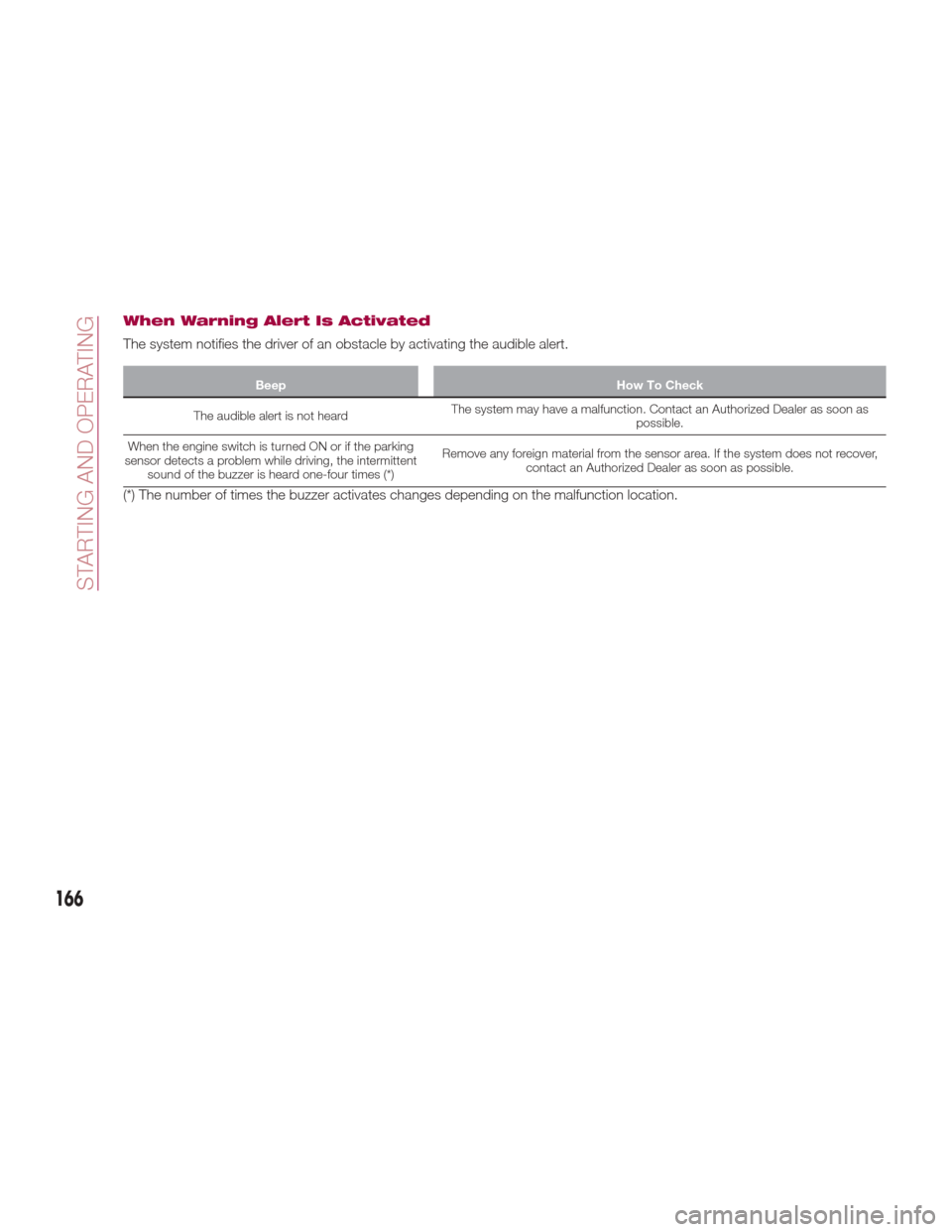
When Warning Alert Is Activated
The system notifies the driver of an obstacle by activating the audible alert.
BeepHow To Check
The audible alert is not heard The
system may have a malfunction. Contact an Authorized Dealer as soon as
possible.
When the engine switch is turned ON or if the parking
sensor detects a problem while driving, the intermittent sound of the buzzer is heard one-four times (*) Remove any foreign material from the sensor area. If the system does not recover,
contact an Authorized Dealer as soon as possible.
(*) The number of times the buzzer activates changes depending on the malfunction location.
166
STARTING AND OPERATING
Page 180 of 300
Improper weight distributions can have
an adverse effect on the way your
vehicle steers and handles and the way
the brakes operate.
Caution!
Do not load your vehicle any heavier than
the GVWR or the maximum front and rear
GAWR. If you do, parts on your vehicle can
break, or it can change the way your
vehicle handles. This could cause you to
lose control. Also overloading can shorten
the life of your vehicle.
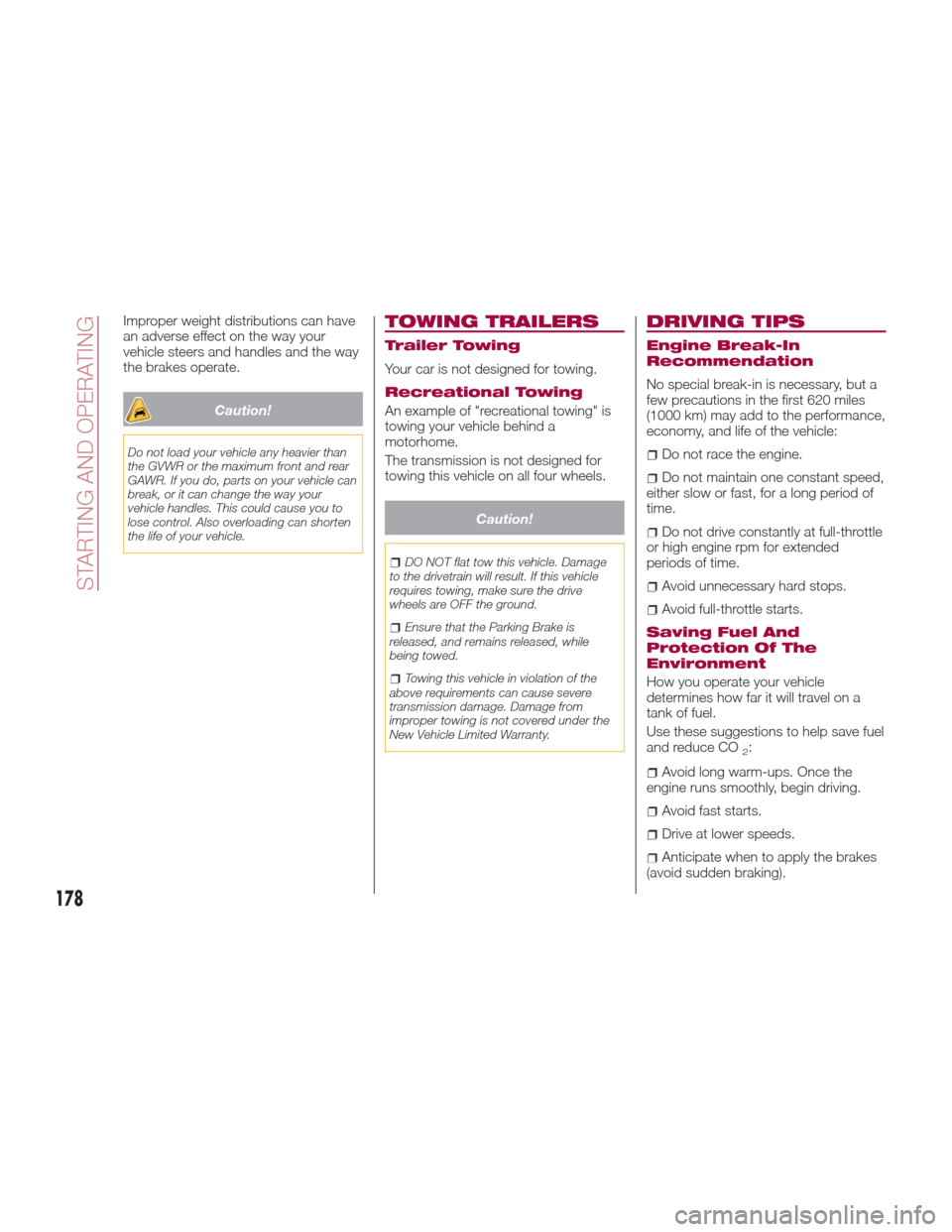
TOWING TRAILERS
Trailer Towing
Your car is not designed for towing.
Recreational Towing
An example of "recreational towing" is
towing your vehicle behind a
motorhome.
The transmission is not designed for
towing this vehicle on all four wheels.
Caution!
DO NOT flat tow this vehicle. Damage
to the drivetrain will result. If this vehicle
requires towing, make sure the drive
wheels are OFF the ground.
Ensure that the Parking Brake is
released, and remains released, while
being towed.
Towing this vehicle in violation of the
above requirements can cause severe
transmission damage. Damage from
improper towing is not covered under the
New Vehicle Limited Warranty.
DRIVING TIPS
Engine Break-In
Recommendation
No special break-in is necessary, but a
few precautions in the first 620 miles
(1000 km) may add to the performance,
economy, and life of the vehicle:
Do not race the engine.
Do not maintain one constant speed,
either slow or fast, for a long period of
time.
Do not drive constantly at full-throttle
or high engine rpm for extended
periods of time.
Avoid unnecessary hard stops.
Avoid full-throttle starts.
Saving Fuel And
Protection Of The
Environment
How you operate your vehicle
determines how far it will travel on a
tank of fuel.
Use these suggestions to help save fuel
andreduceCO
2:
Avoid long warm-ups. Once the
engine runs smoothly, begin driving.
Avoid fast starts.
Drive at lower speeds.
Anticipate when to apply the brakes
(avoid sudden braking).
178
STARTING AND OPERATING
Page 187 of 300
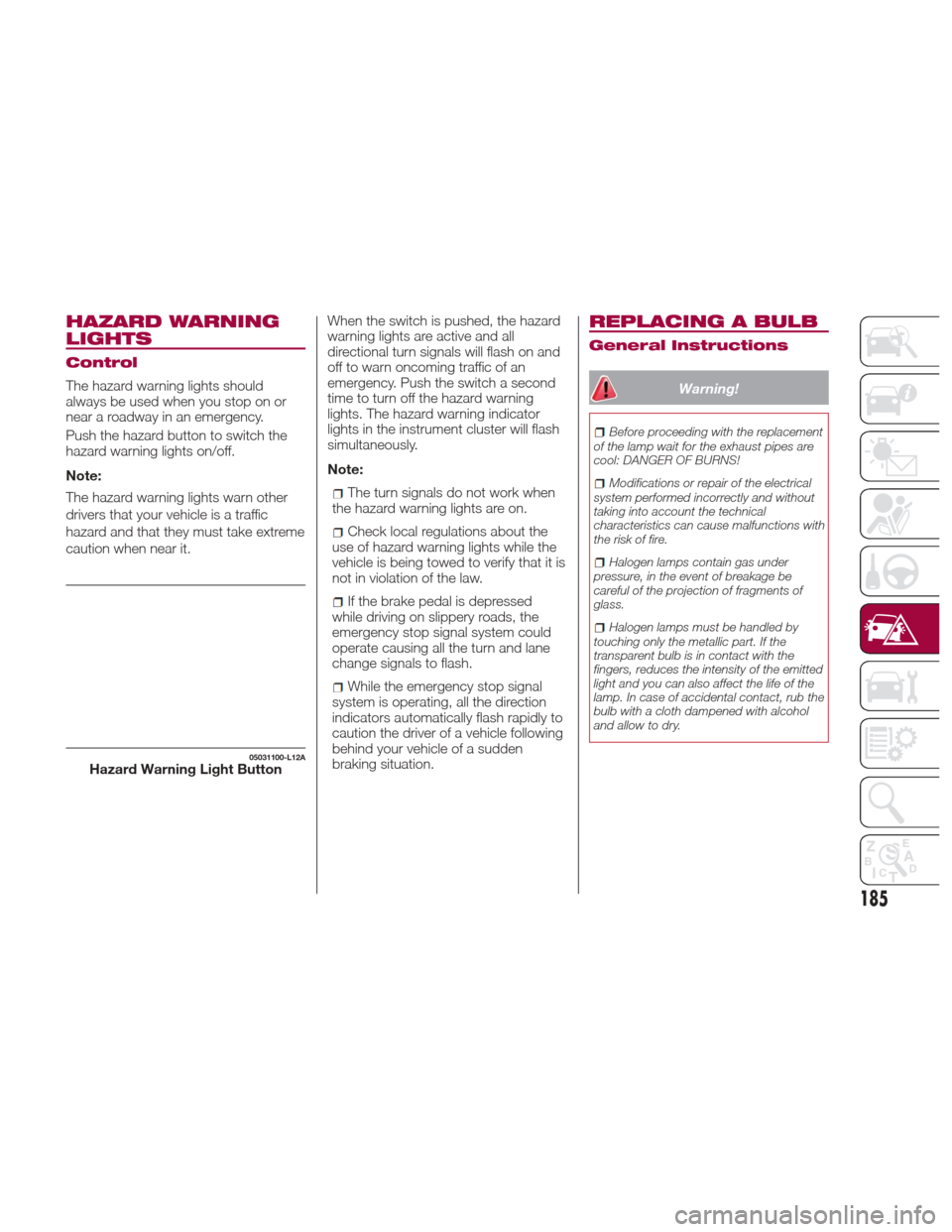
HAZARD WARNING
LIGHTS
Control
The hazard warning lights should
alwaysbeusedwhenyoustoponor
near a roadway in an emergency.
Push the hazard button to switch the
hazard warning lights on/off.
Note:
The hazard warning lights warn other
drivers that your vehicle is a traffic
hazard and that they must take extreme
caution when near it.When the switch is pushed, the hazard
warning lights are active and all
directional turn signals will flash on and
off to warn oncoming traffic of an
emergency. Push the switch a second
time to turn off the hazard warning
lights. The hazard warning indicator
lights in the instrument cluster will flash
simultaneously.
Note:
The turn signals do not work when
the hazard warning lights are on.
Check local regulations about the
use of hazard warning lights while the
vehicle is being towed to verify that it is
not in violation of the law.
If the brake pedal is depressed
while driving on slippery roads, the
emergency stop signal system could
operate causing all the turn and lane
change signals to flash.
While the emergency stop signal
system is operating, all the direction
indicators automatically flash rapidly to
caution the driver of a vehicle following
behind your vehicle of a sudden
braking situation.
REPLACING A BULB
General Instructions
Warning!
Before proceeding with the replacement
of the lamp wait for the exhaust pipes are
cool: DANGER OF BURNS!
Modifications or repair of the electrical
system performed incorrectly and without
taking into account the technical
characteristics can cause malfunctions with
the risk of fire.
Halogen lamps contain gas under
pressure, in the event of breakage be
careful of the projection of fragments of
glass.
Halogen lamps must be handled by
touching only the metallic part. If the
transparent bulb is in contact with the
fingers, reduces the intensity of the emitted
light and you can also affect the life of the
lamp. In case of accidental contact, rub the
bulb with a cloth dampened with alcohol
and allow to dry.
05031100-L12AHazard Warning Light Button
185
Page 228 of 300
At least twice a year (for example,
every spring and fall) perform
inspection of:
Engine coolant
Engine oil
As explained in the “Introduction”
paragraph, several procedures can be
done only by a qualified service
technician with special tools.
For details, read the separate Warranty
Booklet provided with the vehicle. If you
are unsure about any servicing or
maintenance procedure, have it done
by an Authorized Dealer.
There are strict environmental laws
regarding the disposal of waste oil and
fluids. Please dispose of your waste
properly and with due regard to the
environment.
We recommend that you entrust the oil
and fluid changes of your vehicle to an
Authorized Dealer.
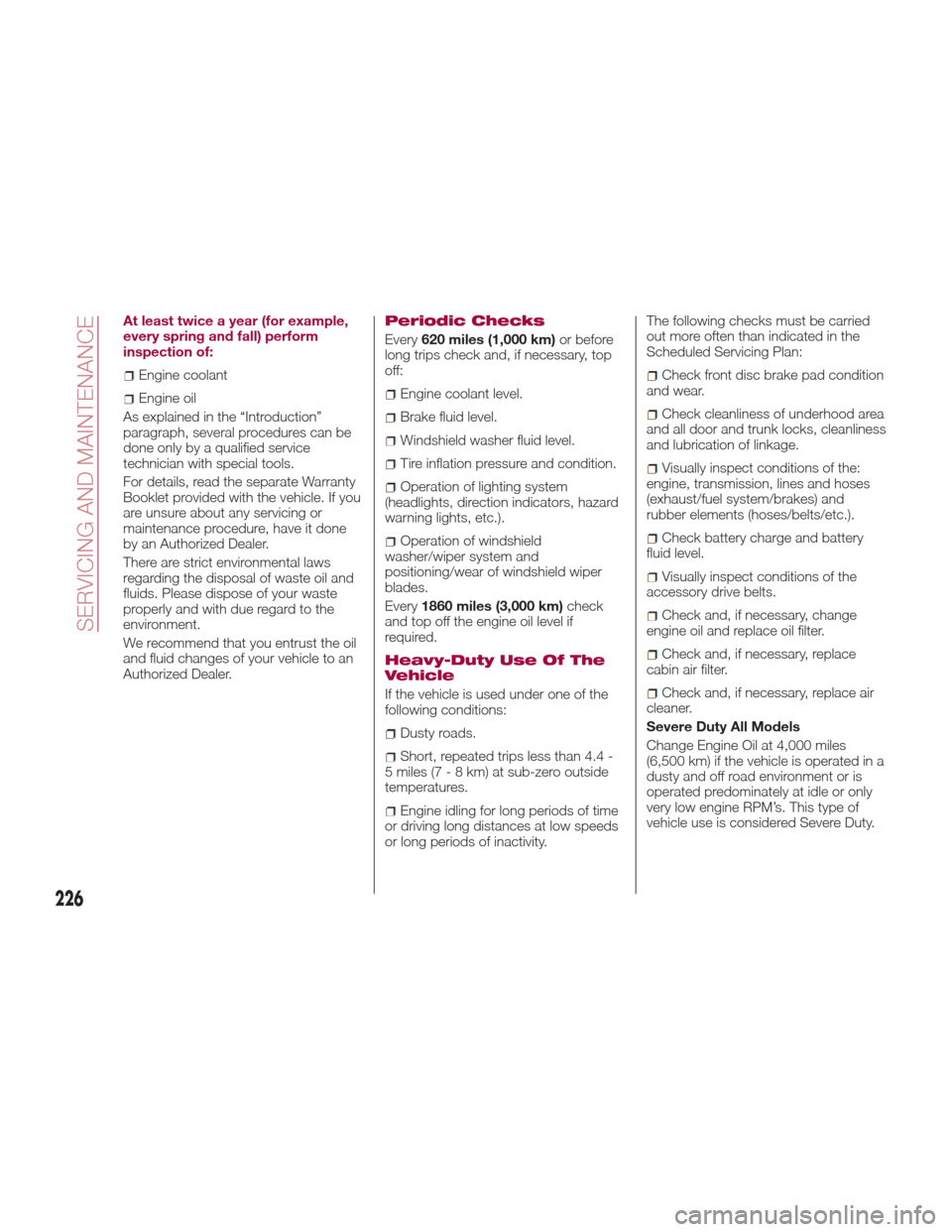
Periodic Checks
Every 620 miles (1,000 km) or before
long trips check and, if necessary, top
off:
Engine coolant level.
Brake fluid level.
Windshield washer fluid level.
Tire inflation pressure and condition.
Operation of lighting system
(headlights, direction indicators, hazard
warning lights, etc.).
Operation of windshield
washer/wiper system and
positioning/wear of windshield wiper
blades.
Every 1860 miles (3,000 km) check
and top off the engine oil level if
required.
Heavy-Duty Use Of The
Vehicle
If the vehicle is used under one of the
following conditions:
Dusty roads.
Short, repeated trips less than 4.4 -
5 miles (7-8km)atsub -zero outside
temperatures.
Engine idling for long periods of time
or driving long distances at low speeds
or long periods of inactivity. The following checks must be carried
out more often than indicated in the
Scheduled Servicing Plan:
Check front disc brake pad condition
and wear.
Check cleanliness of underhood area
and all door and trunk locks, cleanliness
and lubrication of linkage.
Visually inspect conditions of the:
engine, transmission, lines and hoses
(exhaust/fuel system/brakes) and
rubber elements (hoses/belts/etc.).
Check battery charge and battery
fluid level.
Visually inspect conditions of the
accessory drive belts.
Check and, if necessary, change
engine oil and replace oil filter.
Check and, if necessary, replace
cabin air filter.
Check and, if necessary, replace air
cleaner.
Severe Duty All Models
Change Engine Oil at 4,000 miles
(6,500 km) if the vehicle is operated in a
dusty and off road environment or is
operated predominately at idle or only
very low engine RPM’s. This type of
vehicle use is considered Severe Duty.
226
SERVICING AND MAINTENANCE
Page 232 of 300
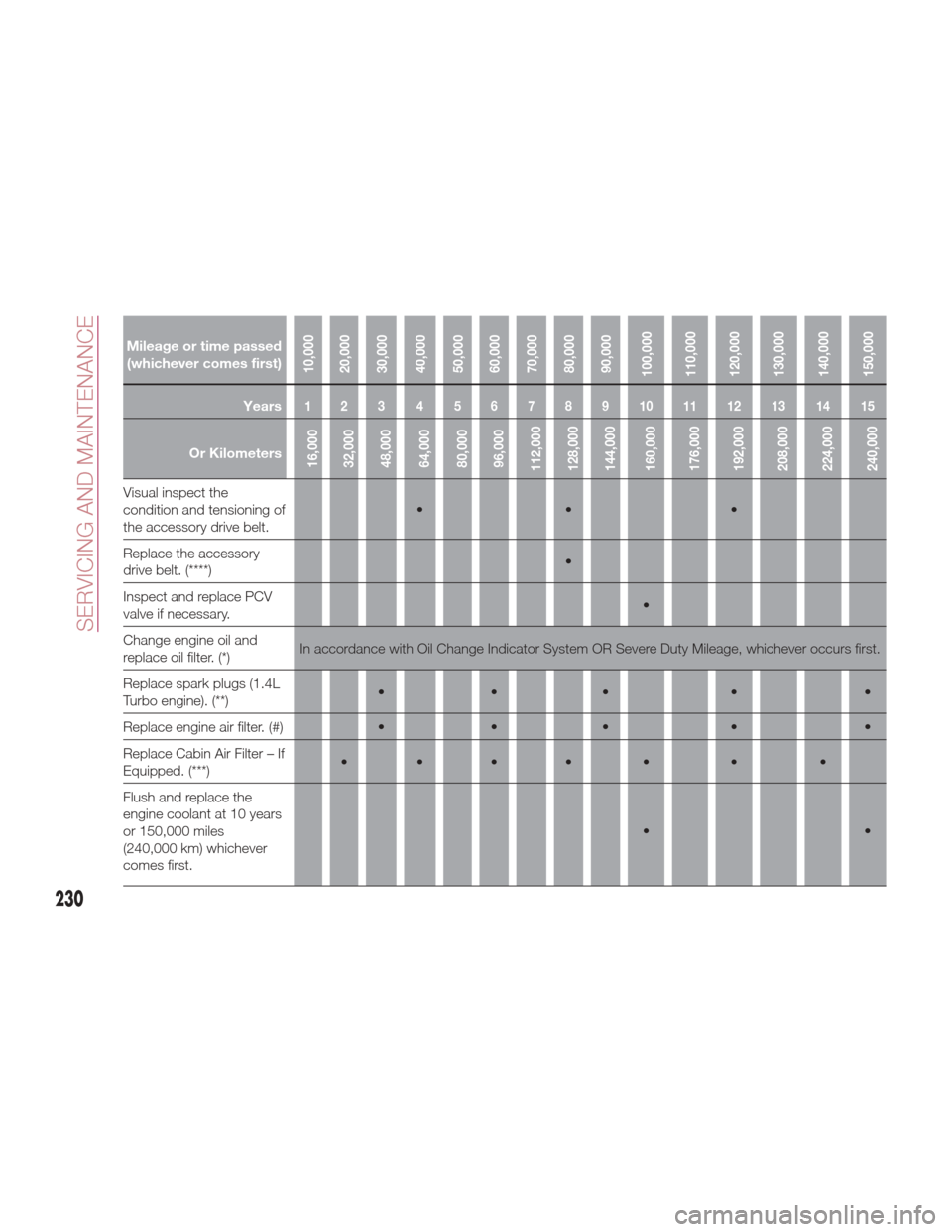
Mileage or time passed(whichever comes first)
10,000
20,000
30,000
40,000
50,000
60,000
70,000
80,000
90,000
100,000
110,000
120,000
130,000
140,000
150,000
Years123 456789101112131415
Or Kilometers16,000
32,000
48,000
64,000
80,000
96,000
112,000
128,000
144,000
160,000
176,000
192,000
208,000
224,000
240,000
Visual inspect the
condition and tensioning of
the accessory drive belt. •• •
Replace the accessory
drive belt. (****) •
Inspect and replace PCV
valve if necessary. •
Change engine oil and
replace oil filter. (*) In accordance with Oil Change Indicator System OR Severe Duty Mileage, whichever occurs first.
Replace spark plugs (1.4L
Turbo engine). (**) ••• • •
Replace engine air filter. (#) • • • • •
Replace Cabin Air Filter – If
Equipped. (***) •••• • • •
Flush and replace the
engine coolant at 10 years
or 150,000 miles
(240,000 km) whichever
comes first. ••
230
SERVICING AND MAINTENANCE
Page 233 of 300
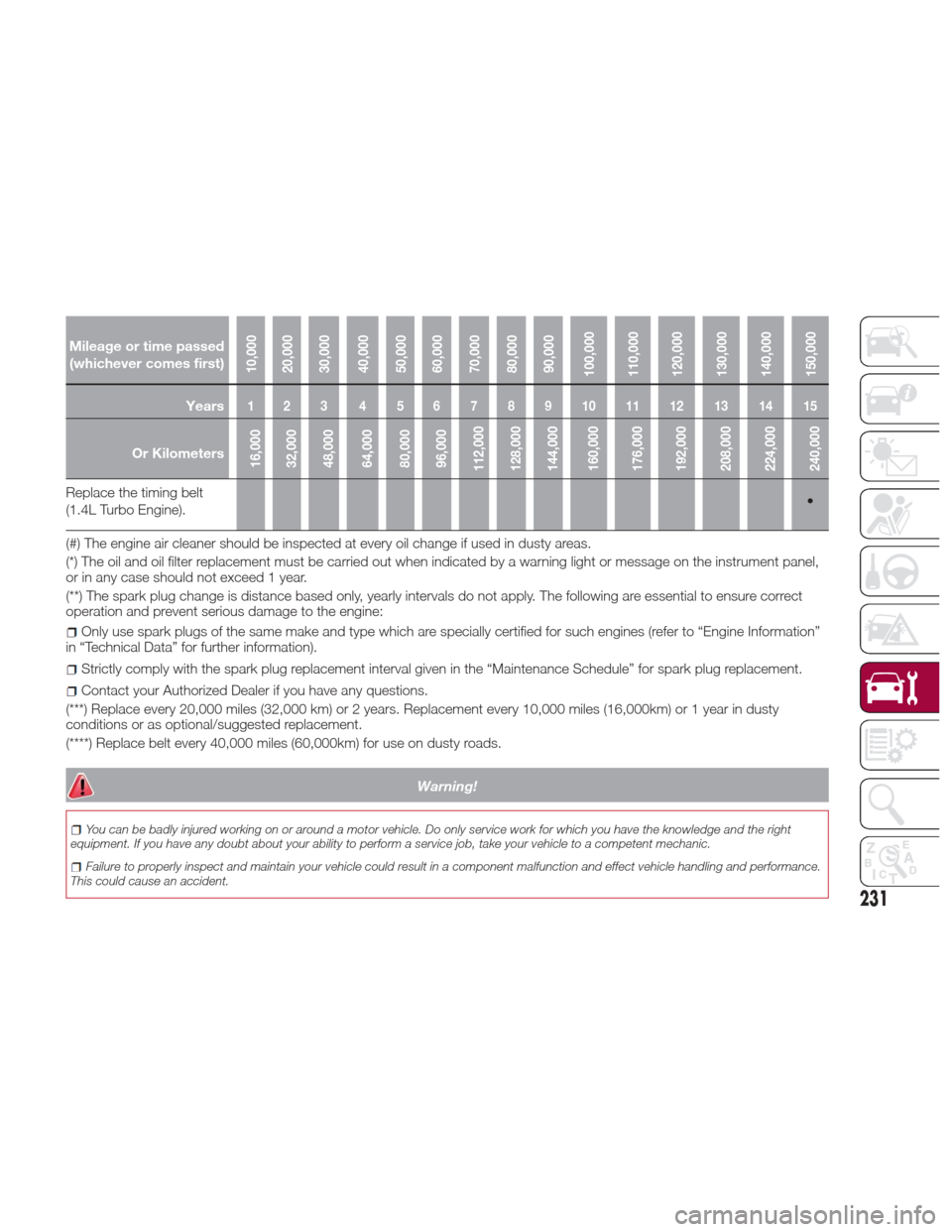
Mileage or time passed(whichever comes first)
10,000
20,000
30,000
40,000
50,000
60,000
70,000
80,000
90,000
100,000
110,000
120,000
130,000
140,000
150,000
Years123 456789101112131415
Or Kilometers16,000
32,000
48,000
64,000
80,000
96,000
112,000
128,000
144,000
160,000
176,000
192,000
208,000
224,000
240,000
Replace the timing belt
(1.4L Turbo Engine). •
(#) The engine air cleaner should be inspected at every oil change if used in dusty areas.
(*) The oil and oil filter replacement must be carried out when indicated by a warning light or message on the instrument panel,
or in any case should not exceed 1 year.
(**) The spark plug change is distance based only, yearly intervals do not apply. The following are essential to ensure correct
operation and prevent serious damage to the engine:
Only use spark plugs of the same make and type which are specially certified for such engines (refer to “Engine Information”
in “Technical Data” for further information).
Strictly comply with the spark plug replacement interval given in the “Maintenance Schedule” for spark plug replacement.
Contact your Authorized Dealer if you have any questions.
(***) Replace every 20,000 miles (32,000 km) or 2 years. Replacement every 10,000 miles (16,000km) or 1 year in dusty
conditions or as optional/suggested replacement.
(****) Replace belt every 40,000 miles (60,000km) for use on dusty roads.
Warning!
You can be badly injured working on or around a motor vehicle. Do only service work for which you have the knowledge and the right
equipment. If you have any doubt about your ability to perform a service job, take your vehicle to a competent mechanic.
Failure to properly inspect and maintain your vehicle could result in a component malfunction and effect vehicle handling and performance.
This could cause an accident.
231
Page 290 of 300
Programming Additional Key
Fobs...................24
Key-In Reminder ..............21
Keyless Entry System...........15
Lane Change And Turn Signals ....41
Lane Change Assist ............41
Lap/Shoulder Belts ........124,126
Leaving Home Light System ......42
Life Of Tires ............... .246
Lights Daytime Running ...........40
Fog ...................41
Hazard Warning Flasher ......185
Passing .................40
Turn Signal ...............41
Loading Vehicle .............177
Tires ................. .241
Locks PowerDoor ........... .26,31
Maintaining the finish.........255
Maintenance Monitor ...........85
Maintenance procedures ........236
Manual Climate Control System ....48
Heating .................50
Manual transmission ..........152
Manual Transmission ..........152
Manual, Service .............284
Methanol ................. .173
Mirrors....................36 Automatic Dimming
.........37
Electric Remote ............38
Exterior Folding ............38
Outside .................36
Rearview ................36
Occupant Restraints ..........123
Onboard Diagnostic System ......77
Operating Precautions ..........77
Outside Rearview Mirrors ........36
Overhead light (bulb replacement) . .195
Overheating, Engine ...........220
Overloading ............... .182
Owner's Manual (Operator Manual) ..........284
Paint damage touch-up ........256
Parking Brake ...............151
Passing Light ................40
Performance ...............277
Periodic checks (scheduled servicing) ............... .226
Personal Settings ............108
Personalization Features ........108
Placard, Tire And Loading Information ...............241
Plastic part maintenance ........259
Power Brakes ................ .150
Door Locks ............26,31
Mirrors .................38 Pregnant Women And Seat Belts . .125
Pretensioners
Seat Belts ..............128
Protection from atmospheric agents (bodywork) ..........253
Radar Sensors.............162
Radial Ply Tires ..............245
Radio Frequency General Information ........20,23
Radio transmitter and mobile phones ...................5
Rear Camera ...............167
Rear lights (light bulbs) .........188
Rear Park Assist System ........163
Rear View ..................10
Rearview Mirrors ..............36
Recommended Tire Inflation Pressure ............... .265
Recorder, Event Data ..........146
Recreational towing ...........178
Reformulated Gasoline .........173
Refueling procedure ...........175
Refueling the vehicle ..........173
Reminder, Seat Belt ...........128
Replacement Tires ............247
Replacing a bulb .............185
Replacing exterior light bulbs .....188
Replacing fuses .............196
Replacing interior light bulbs .....195
Reporting Safety Defects .......283
INDEX