tire pressure FIAT 124 SPIDER 2017 2.G Owner's Guide
[x] Cancel search | Manufacturer: FIAT, Model Year: 2017, Model line: 124 SPIDER, Model: FIAT 124 SPIDER 2017 2.GPages: 300, PDF Size: 121.24 MB
Page 252 of 300
Limited Use Spare — If
Equipped
The limited use spare tire is for
temporary emergency use only. This tire
is identified by a label located on the
limited use spare wheel. This label
contains the driving limitations for this
spare. This tire may look like the original
equipped tire on the front or rear axle of
your vehicle, but it is not. Installation of
this limited use spare tire affects vehicle
handling. Since it is not the same as
your original equipment tire, replace (or
repair) the original equipment tire and
reinstall on the vehicle at the first
opportunity.
Warning!
Limited use spares are for emergency use
only. Installation of this limited use spare
tire affects vehicle handling. With this tire,
do not drive more than the speed listed on
the limited use spare wheel. Keep inflated
to the cold tire inflation pressures listed on
your Tire and Loading Information Placard
located on the driver’s side B-Pillar or the
rear edge of the driver’s side door. Replace
(or repair) the original equipment tire at the
first opportunity and reinstall it on your
vehicle. Failure to do so could result in loss
of vehicle control.
Snow Chains
The use of snow chains should be in
compliance with local regulations of
each country. In certain countries, tires
marked with code M+S (Mud and
Snow) are considered as winter
equipment; therefore their use is
equivalent to that of the snow chains.
The snow chains may be applied only
to the front wheel tires. Check the
tension of the snow chains after the first
few feet have been driven.
Warning!
Using tires of different size and type (M+S,
Snow) between front and rear axles can
cause unpredictable handling. You could
lose control and have a collision.
Caution!
To avoid damage to your vehicle or tires,
observe the following precautions:
Because of restricted traction device
clearance between tires and other
suspension components, it is important
that only traction devices in good condition
are used. Broken devices can cause
serious damage. Stop the vehicle
immediately if noise occurs that could
indicate device breakage. Remove the
damaged parts of the device before further
use.
Install device as tightly as possible and
then retighten after driving about ½ mile
(0.8 km).
Do not exceed 30 mph (48 km/h).
Drive cautiously and avoid severe turns
and large bumps, especially with a loaded
vehicle.
Do not drive for a prolonged period on
dry pavement.
Observe the traction device
manufacturer’s instructions on the method
of installation, operating speed, and
conditions for use. Always use the
suggested operating speed of the device
manufacturer’s if it is less than 30 mph
(48 km/h).
Do not use traction devices on a
compact spare tire.
Caution!
Using snow chains with tires with
non-original dimensions may damage the
vehicle.
Using different size or type (M+S, snow,
etc.) tires between front and rear axle may
adversely affect vehicle driveability, with the
risk of losing control of the vehicle and
resulting accidents.
250
SERVICING AND MAINTENANCE
Page 253 of 300
Tire Rotation
Recommendations
The front and rear tires are subject to
different loads and stress due to
steering, maneuver and braking. For
this reason they are subject to uneven
wear. To resolve this problem, tires
should be rotated at the appropriate
time.
The following rotation methods must
NOT be used with one-way
unidirectional tires! This type of tires can
only be switched from the front axle to
the rear axle and vice versa, keeping
them on the same side of the vehicle.
Rotate one-way unidirectional tires
and radial tires that have an
asymmetrical tread pattern only from
front to rear, not from side to side. Tire
performance will be reduced if rotated
from side to side.
Tire rotation means moving the wheels
to a different position, with respect to
the vehicle. During rotation, inspect tires
for correct balance. The single wheel will therefore operate
on a different axle and, where possible,
on the opposite side of the vehicle.
Note:
Rotate tires periodically. Irregular tire
wear is dangerous. To equalize tread
wear for maintaining good
performance in handling and braking,
rotate the tires every 6,200 miles
(10,000 km), or sooner if irregular wear
develops.
To equalize tread wear, rotate the
tires every 7,500 miles (12,000 km) at
the latest or sooner if irregular wear
develops. FCA recommends to rotate
every 5,000 miles (8,000 km) to help
increase tire life and distribute wear
more evenly.
Because your vehicle is not
equipped with a spare tire, you cannot
do a tire rotation safely with the jack
that may come with your vehicle if so
equipped. Contact an Authorized
Dealer for tire rotation.
Also, inspect them for uneven wear and
damage. Abnormal wear is usually
caused by one or a combination of the
following:
Incorrect tire pressure
Improper wheel alignment
Out-of-balance wheel
Severe braking
After rotation, inflate all tire pressures to
specification and inspect the wheel nuts
for tightness.
With Tire Pressure Monitor System
(TPMS)
The TPM system must be initialized
after adjusting the tire pressure, to
make the system operate normally.
Refer to “Tire Pressure Monitoring
System Initialization” paragraph in
“Safety” chapter.
Rotate unidirectional tires and radial
tires that have an asymmetrical tread
pattern only from front to rear, not from
side to side. Tire performance will be
reduced if rotated from side to side.
07031402-FRT-001Rotation Diagram
251
Page 255 of 300
STORING THE
VEHICLE
If the vehicle is left inactive for longer
than a month, the following precautions
should be observed:
Park the vehicle in covered, dry and if
possible well-ventilated premises and
slightly open the windows.
Check that the parking brake is not
activated.
Disconnect the negative battery
terminal and check the battery charge.
Repeat this check once every three
months during storage.
If the battery is not disconnected
from the electrical system, check its
state of charge every thirty days.
Clean and protect the painted parts
using protective wax.
Clean and protect the shiny metal
parts using special compounds
available commercially.
Sprinkle talcum powder on the
windshield and rear window wiper
rubber blades and lift them off the
glass.
Cover the vehicle with a fabric or
perforated plastic sheet, paying
particular care not to damage the
painted surface by dragging any dust
that may have accumulated on it. Do not use compact plastic sheets
which do not allow humidity to
evaporate from the surface of the
vehicle.
Inflate the tires at a pressure of
+7.25 psi (+0.5 bar) higher than
recommended on the tire placard and
check it periodically.
Do not drain the engine cooling
system.
Any time the vehicle is left inactive for
two weeks or more, operate the air
conditioning system with engine idling
for at least five minutes, setting external
air and with fan set to maximum speed.
This operation will ensure appropriate
lubrication for the system, thus
minimizing the possibility of damage to
the compressor when the system is
operated again.
Note: After placing the ignition in the
OFF mode and having closed the driver
side door, wait at least one minute
before disconnecting the electrical
supply from the battery. When
reconnecting the electrical supply to the
battery, make sure that the ignition in
the OFF mode and the driver side door
is closed.
BODYWORK
Protection From
Atmospheric Agents
The vehicle is equipped with the best
available technological solutions to
protect the bodywork against corrosion.
These include:
Painting products and systems
which give the vehicle resistance to
corrosion and abrasion.
Use of galvanized (or pre-treated)
steel sheets, with high resistance to
corrosion.
Spraying of plastic parts, with a
protective function in the more exposed
points: underdoor, inner fender, edges,
etc.
Use of “open” boxed sections to
prevent condensation and pockets of
moisture which could favour the
formation of rust inside.
Use of special films to protect
against abrasion in exposed areas (e.g.
rear fender, doors, etc.).
Corrosion Warranty
Your vehicle is covered by Corrosion
Warranty against perforation due to rust
of any original element of the structure
or bodywork. For the general terms of
this Corrosion Warranty, refer to the
Warranty Booklet.
253
Page 265 of 300
TECHNICAL SPECIFICATIONS
IDENTIFICATION DATA........264
RECOMMENDED TIRE INFLATION
PRESSURE ...............265
ENGINE..................267
TRANSMISSION ............268
BRAKES ................ .269
SUSPENSIONS .............270
STEERING ............... .271
DIMENSIONS ..............272
FLUID CAPACITIES ..........274
FLUIDS AND LUBRICANTS .....275
PERFORMANCE ............277
ELECTROMAGNETIC
COMPATIBILITY ............278
263
Page 267 of 300
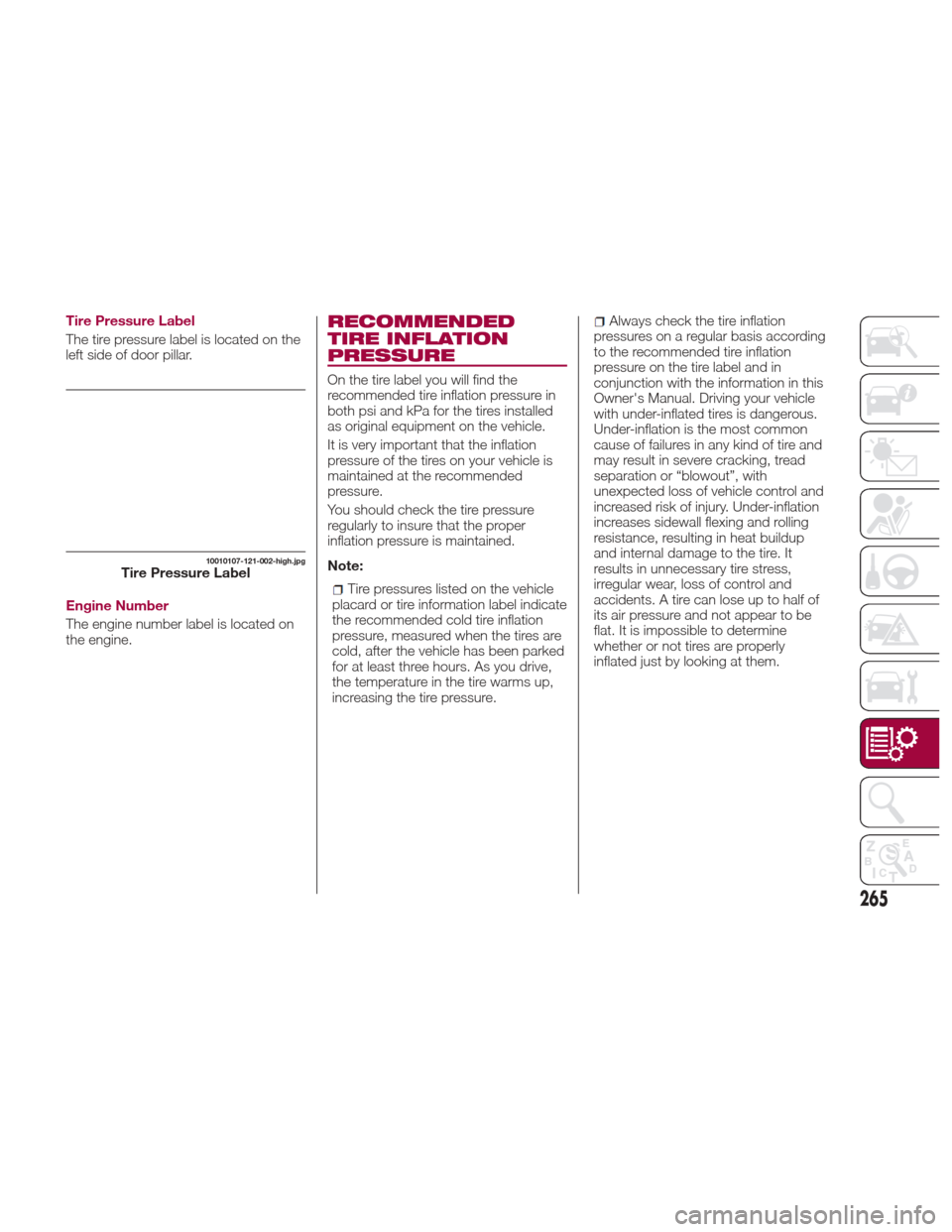
Tire Pressure Label
The tire pressure label is located on the
left side of door pillar.
Engine Number
The engine number label is located on
the engine.RECOMMENDED
TIRE INFLATION
PRESSURE
On the tire label you will find the
recommended tire inflation pressure in
both psi and kPa for the tires installed
as original equipment on the vehicle.
It is very important that the inflation
pressure of the tires on your vehicle is
maintained at the recommended
pressure.
You should check the tire pressure
regularly to insure that the proper
inflation pressure is maintained.
Note:
Tire pressures listed on the vehicle
placard or tire information label indicate
the recommended cold tire inflation
pressure, measured when the tires are
cold, after the vehicle has been parked
for at least three hours. As you drive,
the temperature in the tire warms up,
increasing the tire pressure.
Always check the tire inflation
pressures on a regular basis according
to the recommended tire inflation
pressure on the tire label and in
conjunction with the information in this
Owner's Manual. Driving your vehicle
with under-inflated tires is dangerous.
Under-inflation is the most common
cause of failures in any kind of tire and
may result in severe cracking, tread
separation or “blowout”, with
unexpected loss of vehicle control and
increased risk of injury. Under-inflation
increases sidewall flexing and rolling
resistance, resulting in heat buildup
and internal damage to the tire. It
results in unnecessary tire stress,
irregular wear, loss of control and
accidents. A tire can lose up to half of
its air pressure and not appear to be
flat. It is impossible to determine
whether or not tires are properly
inflated just by looking at them.
10010107-121-002-high.jpgTire Pressure Label
265
Page 268 of 300
Checking Tire Pressure
Proceed as follows:
1. When you check the air pressure,
make sure the tires are cold - meaning
they are not hot from driving even a
mile.
2. Remove the cap from the valve on
one tire.
3. Firmly press a tire gauge onto the
valve.
4. Add air to achieve recommended air
pressure.
5. If you overfill the tire, release air by
pushing on the metal stem in the center
of the valve. Then recheck the pressure
with your tire gauge.
6. Replace the valve cap.
7. Visually inspect the tires to make
sure there are no nails or other objects
embedded that could poke a hole in the
tire and cause an air leak.
8. Check the sidewalls to make sure
there are no gouges, cuts, bulges,
cracks or other irregularities.
Glossary Of Terms
Tire Placard
A label indicating the OE (Original
Equipment) tire sizes, recommended
inflation pressure, and the maximum
weight the vehicle can carry.
Tire Identification Number (TIN)
A number on the sidewall of each tire
providing information about the tire
brand and manufacturing plant, tire
size, and date of manufacture.
Inflation Pressure
A measure of the amount of air in a tire.
kPa
Kilopascal, the metric unit for air
pressure.
psi
Pounds per square inch, the English
unit for air pressure.B-pillar
The structural member at the side of
the vehicle behind the front door.
Original Equipment (OE)
Describes components originally
equipped on the vehicle.
Vehicle Load Limit
The maximum value of the combination
weight of occupants and cargo.
Bead Area of the Tire
Area of the tire next to the rim.
Sidewall Area of the Tire
Area between the bead area and the
tread.
Tread Area of the Tire
Area on the perimeter of the tire that
contacts the road when it's mounted
on the vehicle.
266
TECHNICAL SPECIFICATIONS
Page 288 of 300
INDEX
About Your Brakes...........150
ABS system ............... .112
Active Adaptive Shift (AAS) ......155
Adaptive Front Lighting System (AFS) ...................42
Additives, Fuel ..............174
Advanced Keyless Entry System Key Left In Trunk ............22
Key left In Vehicle ...........22
Locking Doors .............22
Passive Entry ..............22
Request Switch ............22
Unlocking Doors ............22
AirBag............... .133,137
Advance Front Air Bag . . . .133,137
Air Bag Warning Light .......147
Event Data Recorder (EDR) . . . .146
FrontAirBag ............ .147
Maintaining Your Air Bag
System ............... .145
Air Bag Maintenance ..........145
Air Pressure, Tires ............244
Alarm Vehicle Security Alarm ......24,25
Alarm (Security Alarm) ........24,25
Aluminium wheel maintenance . . . .257
Automatic Dimming Mirror ........37
Automatic Headlights ...........40Automatic Temperature Control
(ATC) ...................52
Automatic Transmission ........153
Auxiliary Power Outlet ..........63
B-Pillar Location.............241
Battery (maintenance) ..........235
Battery charging procedure ......236
Battery recharging ............236
Blind Spot Monitoring ..........114
Body and underbody warranty . . . .253
Body lubrication .............236
Bodywork (care and maintenance). .253
Boot, Convertible Top Lowering ....70
Boot, Convertible Top Precautions . .73
Boot, Convertible Top Raising .....72
Brake System ...............150
Brake/clutch fluid (level check) . . . .234
Brakes ............... .150,269
Bright-metal maintenance .......257
Camera, Rear..............167
Carbon Monoxide Warning ......175
Center Seat Storage Compartment. .61
Certification Label ............177
Changing A Flat Tire .....204,205,238
Checking levels ..............232
Child Restraint ..............129
Child Restraints Child Restraints ...........129
Clean Air Gasoline ............173 Climate Control
..............44
Close The Hood ..............69
Compact Spare Tire ...........249
Contract, Service ............282
Convertible Top ..............70
Convertible top maintenance .....257
Cooling Air Conditioning ............50
Cupholders .................64
Customer Assistance ..........281
Data Recorder, Event.........146
Daytime Running Lights .........40
Diagnostic System, Onboard ......77
Dimensions ............... .272
Disabled Vehicle Towing .....221,223
Driver's Seat Back Tilt ..........33
Driving in flooded area .........182
Driving tips ............... .178
Electric power steering.........74
Electric Remote Mirrors .........38
Electromagnetic Compatibility . . . .278
Electronic Brake Control System Traction Control System ......112
Electronic Speed Control (Cruise Control) ................ .158
Electronic Vehicle Information Center (EVIC)
Electronic Vehicle Information
Center (EVIC) ..............78
INDEX
Page 290 of 300
Programming Additional Key
Fobs...................24
Key-In Reminder ..............21
Keyless Entry System...........15
Lane Change And Turn Signals ....41
Lane Change Assist ............41
Lap/Shoulder Belts ........124,126
Leaving Home Light System ......42
Life Of Tires ............... .246
Lights Daytime Running ...........40
Fog ...................41
Hazard Warning Flasher ......185
Passing .................40
Turn Signal ...............41
Loading Vehicle .............177
Tires ................. .241
Locks PowerDoor ........... .26,31
Maintaining the finish.........255
Maintenance Monitor ...........85
Maintenance procedures ........236
Manual Climate Control System ....48
Heating .................50
Manual transmission ..........152
Manual Transmission ..........152
Manual, Service .............284
Methanol ................. .173
Mirrors....................36 Automatic Dimming
.........37
Electric Remote ............38
Exterior Folding ............38
Outside .................36
Rearview ................36
Occupant Restraints ..........123
Onboard Diagnostic System ......77
Operating Precautions ..........77
Outside Rearview Mirrors ........36
Overhead light (bulb replacement) . .195
Overheating, Engine ...........220
Overloading ............... .182
Owner's Manual (Operator Manual) ..........284
Paint damage touch-up ........256
Parking Brake ...............151
Passing Light ................40
Performance ...............277
Periodic checks (scheduled servicing) ............... .226
Personal Settings ............108
Personalization Features ........108
Placard, Tire And Loading Information ...............241
Plastic part maintenance ........259
Power Brakes ................ .150
Door Locks ............26,31
Mirrors .................38 Pregnant Women And Seat Belts . .125
Pretensioners
Seat Belts ..............128
Protection from atmospheric agents (bodywork) ..........253
Radar Sensors.............162
Radial Ply Tires ..............245
Radio Frequency General Information ........20,23
Radio transmitter and mobile phones ...................5
Rear Camera ...............167
Rear lights (light bulbs) .........188
Rear Park Assist System ........163
Rear View ..................10
Rearview Mirrors ..............36
Recommended Tire Inflation Pressure ............... .265
Recorder, Event Data ..........146
Recreational towing ...........178
Reformulated Gasoline .........173
Refueling procedure ...........175
Refueling the vehicle ..........173
Reminder, Seat Belt ...........128
Replacement Tires ............247
Replacing a bulb .............185
Replacing exterior light bulbs .....188
Replacing fuses .............196
Replacing interior light bulbs .....195
Reporting Safety Defects .......283
INDEX
Page 291 of 300
Restraint, Head..............34
Restraints, Child .............129
Safety Defects, Reporting .......283
Safety Information, Tire .........239
safety systems ..............112
Saving fuel and protection of the environment ..............178
Scheduled servicing ...........225
Seat Belt Energy Management Feature . . .129
Lap/Shoulder Belts ......124,126
Pregnant Women ..........125
Seat Belt Extender .........127
Seat Belt Pretensioner .......128
Seat Belt Reminder .........128
Seat Belt Reminder ...........128
Seat Belts ................ .124
Child Restraint ............129
Extender ...............127
Front Seat ..............124
Pregnant Women ..........125
Pretensioners ............128
Rear Seat ...............124
Seats .....................33
Adjustment ...............33
Heated .................33
Seatback Release ..........33
Tilting ..................33
Seats and fabric parts (cleaning) . . .259 Security Alarm
Security Alarm ...........24,25
SENTRY KEY Key Programming ..........24
Service Assistance ...........281
Service Contract .............282
Service Manuals .............284
Shift Lever Override ...........156
Shift position indication .........154
Shoulder Belts ...........124,126
Signals, Turn ................41
Snow chains ...............250
Snow Tires ............... .248
Spare Tire ........204,248,249,250
Starting ............... .21,220
Engine
Fails To Start ........220
Starting And Operating .......21,220
Starting Procedures .........21,220
Starting the engine ...........149
Steering ................. .271
Column Lock .............35
Tilt Column ...............35
Wheel, Tilt ...............35
Storage ...................61
Storing the vehicle ............253
Sun Visor ..................62
Supplemental Restraint System - AirBag ............. .133,137Suspensions
...............270
Symbols ....................3
Tilt Steering Column ...........35
Tire And Loading Information Placard ................ .241
Tire chains ................ .181
Tire Markings ...............239
Tire Rotation ...............251
Tire Safety Information .........239
Tire Service Kit ..............209
Tires............244,248,252,284 Aging (Life Of Tires) .........246
Air Pressure .............244
Changing .........204,205,238
Compact Spare ...........249
Flat Changing ............209
General Information ......244,248
High Speed .............245
Inflation Pressures .........244
Jacking ..........204,205,238
Life Of Tires .............246
Load Capacity ............241
Pressure Monitor System
(TPMS) ............... .114
Quality Grading ........252,284
Radial ................ .245
Replacement .............247
Safety ..............239,244
Page 292 of 300
Snow Tires..............248
Spare Tire ......204,248,249,250
Spinning ...............246
Tread Wear Indicators .......246
ToOpenDeckLid.............66
ToOpenHood...............69
Towing Disabled Vehicle ........221,223
Towing Eyes ............... .221
Towing trailers ..............178
TPMS (Tire Pressure Monitoring System) ................ .119
Transmission ...............268
Tread Wear Indicators ..........246
Trunk Lid Closing ..................68
Opening .................66
Trunk light (bulb replacement) .....195
Turn Signals .................41Undercoating ..............257
Uniform Tire Quality Grades . . .252,284
Vehicle Loading ..........177,241
Vehicle modifications/alterations .....4
Vent Operation ...............45
Warning Flasher, Hazard .......185
Warranty Information ..........283
Washer Operation ...........42,44
Washers, Windshield ...........42
Wheels and tires .............239
Window and headlight washer fluid (level check) ..............235
Window interiors (cleaning) ......261
Windows Driver/Passenger Window
Controls .................56
Power Windows ...........56
Window Lockout ...........58
Windshield wiper blades (replacing) ...............237 Windshield Wipers
............42
Windstop ..................66
Winter driving ...............180
Wiper blades ...............237
Wrecker Towing ..........221,223
INDEX