wheel FIAT 124 SPIDER 2017 2.G Owners Manual
[x] Cancel search | Manufacturer: FIAT, Model Year: 2017, Model line: 124 SPIDER, Model: FIAT 124 SPIDER 2017 2.GPages: 300, PDF Size: 121.24 MB
Page 5 of 300
How To Use This Manual
ESSENTIAL INFORMATION
Each time directions (left/right or forward/backwards) are listed, they are determined by facing forward from the rear of the
vehicle or as from the point of view of being seated inside the car. Special cases not complying with this rule will be properly
specified in the text.
The figures in the Owner’s Manual are provided by way of example only: this might imply that some details of the image do not
correspond to the actual arrangement of your vehicle. In addition, the Owner’s Manual has been conceived considering vehicles
with steering wheel on the left side; it is therefore possible that on vehicles with steering wheel on the right side, the position of
some controls or elements is not exactly mirror-like with respect to the figure.
To identify the chapter with the information needed you can consult the index at the end of this Owner’s Manual.
Chapters can be rapidly identified by graphic tabs, at the side of each odd page. A key showing the order of the chapter and
the corresponding tab symbols appears on another page.
SYMBOLS
While reading this Owner’s Manual you will find a series ofWARNINGSto prevent procedures that could damage your vehicle.
There are also CAUTIONSthat must be carefully followed to prevent incorrect use of the components of the vehicle, which
could cause accidents or injuries.
Therefore, all WARNINGS andCAUTIONS must always be carefully followed.
WARNINGS andCAUTIONS are recalled in the text with the following symbols:
personal safety
vehicle safety
environmental protection
Page 11 of 300
GRAPHICAL TABLE OF CONTENTS
FRONT VIEW
Front View
1 — Engine Compartment3 — Doors5 — Exterior Lights
2 — Windshield Wiper Blades 4 — Wheels and Tires
01020304-000-100Spider Front View
9
Page 14 of 300
INTERIOR OVERVIEW
INTERIOR OVERVIEW
1 — Steering Wheel4 — Climate Control System7 — Radio Control
2 — Inside Mirror 5 — Transmission8 — Seats
3 — Radio Systems 6 — Parking Break
01020304-002-100Interior Overview
12
Page 15 of 300
GETTING TO KNOW YOUR VEHICLE
KEYS....................14
IGNITION SWITCH ............21
ADVANCED KEYLESS ENTRY
SYSTEM — IF EQUIPPED .......22
VEHICLE SECURITY ALARM
SYSTEM — IF EQUIPPED .......24
DOORS...................26
SEATS ...................33
NON-ADJUSTABLE HEAD
RESTRAINTS ...............34
STEERING WHEEL ...........35
MIRRORS .................36
EXTERIOR LIGHTS ...........38
WINDSHEILD WIPERS / WASHER . .42
CLIMATE CONTROL SYSTEM ....44
POWER WINDOWS ...........56
HOMELINK — IF EQUIPPED .....58
INTERNAL EQUIPMENT ........61
TRUNKLID ................66
TRUNK EMERGENCY RELEASE . . .68
HOOD ...................69
CONVERTIBLE TOP (SOFT TOP) . .70
ELECTRIC POWER STEERING ....74
ENVIRONMENT PROTECTION
SYSTEMS .................74
13
Page 23 of 300
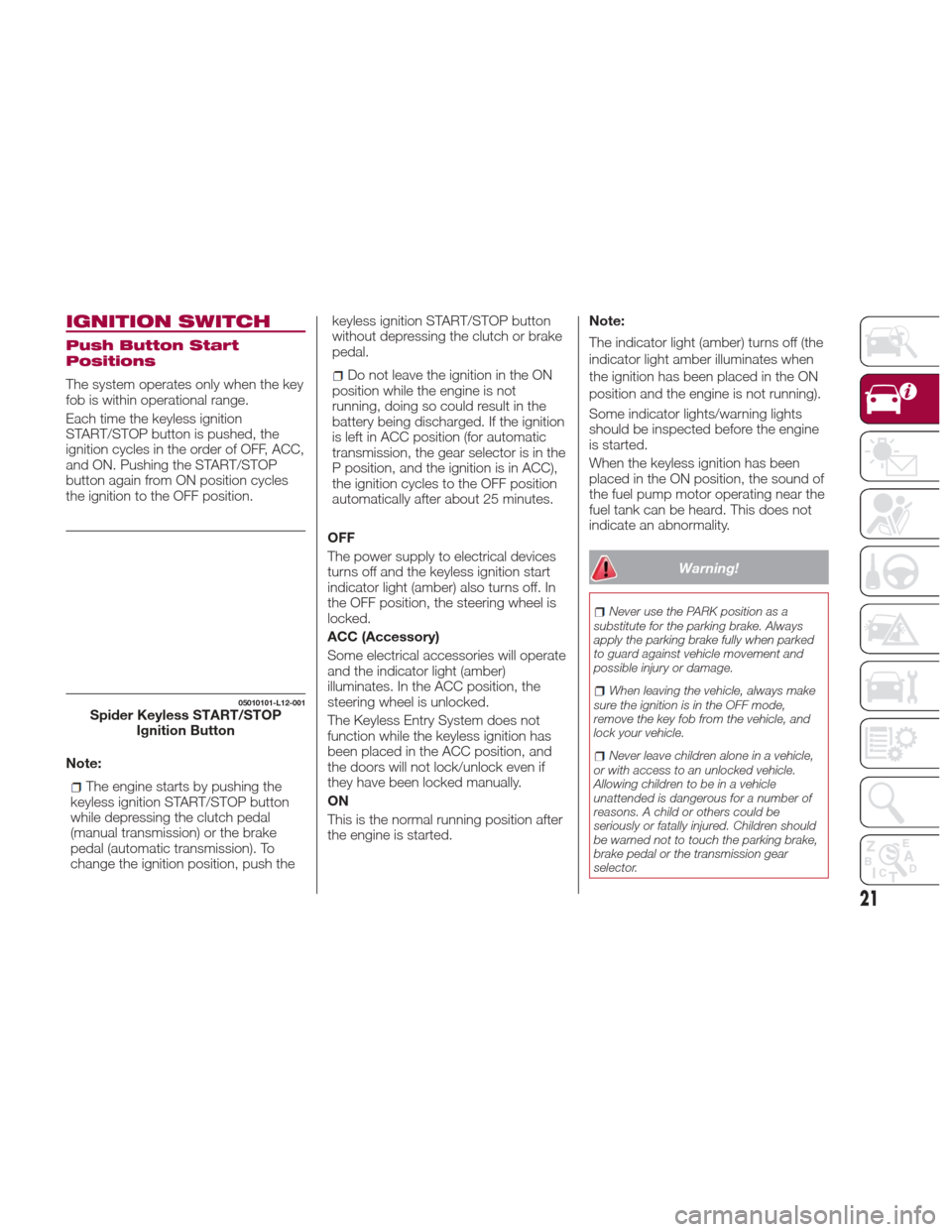
IGNITION SWITCH
Push Button Start
Positions
The system operates only when the key
fob is within operational range.
Each time the keyless ignition
START/STOP button is pushed, the
ignition cycles in the order of OFF, ACC,
and ON. Pushing the START/STOP
button again from ON position cycles
the ignition to the OFF position.
Note:
The engine starts by pushing the
keyless ignition START/STOP button
while depressing the clutch pedal
(manual transmission) or the brake
pedal (automatic transmission). To
change the ignition position, push the keyless ignition START/STOP button
without depressing the clutch or brake
pedal.
Do not leave the ignition in the ON
position while the engine is not
running, doing so could result in the
battery being discharged. If the ignition
is left in ACC position (for automatic
transmission, the gear selector is in the
P position, and the ignition is in ACC),
the ignition cycles to the OFF position
automatically after about 25 minutes.
OFF
The power supply to electrical devices
turns off and the keyless ignition start
indicator light (amber) also turns off. In
the OFF position, the steering wheel is
locked.
ACC (Accessory)
Some electrical accessories will operate
and the indicator light (amber)
illuminates. In the ACC position, the
steering wheel is unlocked.
The Keyless Entry System does not
function while the keyless ignition has
been placed in the ACC position, and
the doors will not lock/unlock even if
they have been locked manually.
ON
This is the normal running position after
the engine is started. Note:
The indicator light (amber) turns off (the
indicator light amber illuminates when
the ignition has been placed in the ON
position and the engine is not running).
Some indicator lights/warning lights
should be inspected before the engine
is started.
When the keyless ignition has been
placed in the ON position, the sound of
the fuel pump motor operating near the
fuel tank can be heard. This does not
indicate an abnormality.
Warning!
Never use the PARK position as a
substitute for the parking brake. Always
apply the parking brake fully when parked
to guard against vehicle movement and
possible injury or damage.
When leaving the vehicle, always make
sure the ignition is in the OFF mode,
remove the key fob from the vehicle, and
lock your vehicle.
Never leave children alone in a vehicle,
or with access to an unlocked vehicle.
Allowing children to be in a vehicle
unattended is dangerous for a number of
reasons. A child or others could be
seriously or fatally injured. Children should
be warned not to touch the parking brake,
brake pedal or the transmission gear
selector.
05010101-L12-001Spider Keyless START/STOP Ignition Button
21
Page 37 of 300
Driver And Passenger
Head Restraints
Your vehicle is equipped with
non-adjustable head restraints on the
driver's and passenger's seatbacks.
The non-adjustable head restraints
consist of a trimmed foam covering
over the upper structure of the
seatbacks and are intended to help
protect you and the passenger from
neck injury.
Adjust the seatbacks to their upright,
on-road positions so that the head
restraint is positioned as close as
possible to the back of your head.
Warning!
Be certain that the seatback is locked
securely into position. Otherwise, the seat
will not provide the proper stability for
passengers. An improperly latched
seatback could cause serious injury.
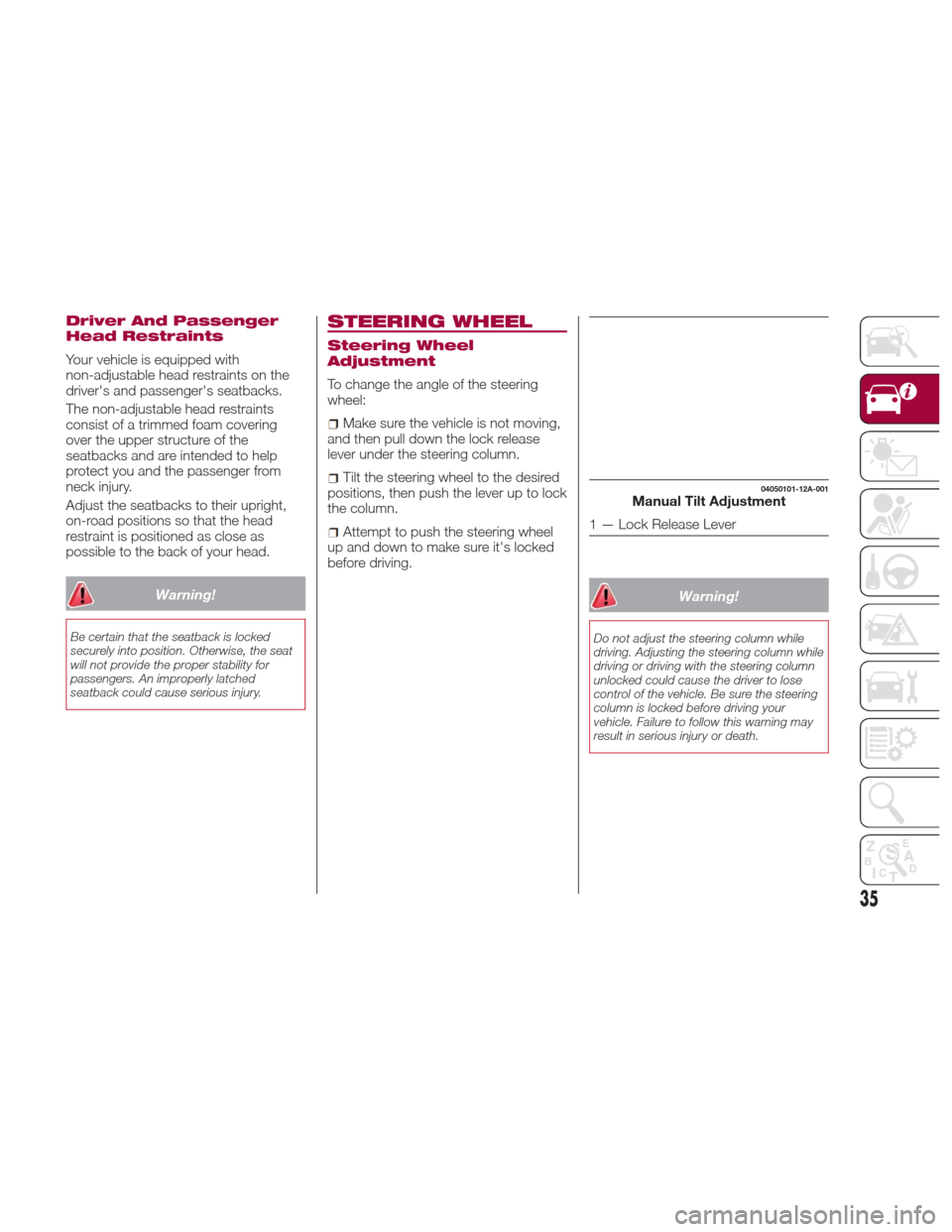
STEERING WHEEL
Steering Wheel
Adjustment
To change the angle of the steering
wheel:
Make sure the vehicle is not moving,
and then pull down the lock release
lever under the steering column.
Tilt the steering wheel to the desired
positions, then push the lever up to lock
the column.
Attempt to push the steering wheel
up and down to make sure it's locked
before driving.
Warning!
Do not adjust the steering column while
driving. Adjusting the steering column while
driving or driving with the steering column
unlocked could cause the driver to lose
control of the vehicle. Be sure the steering
column is locked before driving your
vehicle. Failure to follow this warning may
result in serious injury or death.
04050101-12A-001Manual Tilt Adjustment
1 — Lock Release Lever
35
Page 42 of 300
Daytime Running Lights
(DRL)
The daytime running lights turn on
automatically when the vehicle starts
moving.
They turn off when the parking brake is
engaged or the gear selector is shifted
to the Park (P) position (if equipped with
automatic transmission).
Note:In some markets, the daytime
running lights can be deactivated. For
markets that allow deactivation, refer to
“Personalization Features” in “Knowing
Your Instrument Panel” for further
information.
High Beams
The headlights can be switched
between high and low beams by
moving the lever forward or backward.
When the headlight high-beams are on,
the
high beam indicator is
illuminated.
Flash To Pass
You can signal another vehicle with your
headlights by partially pulling the
headlight lever toward the steering
wheel. This will cause the high beam
headlights to turn on until the lever is
released.
The
high beam indicator in the
instrument cluster illuminates
simultaneously.
Automatic Lighting
When the headlight switch is in the
AUTO position and the ignition is
switched ON, the light will sense the
surrounding lightness or darkness and
automatically turns the headlights, other
exterior lights and dashboard
illumination on or off.
Note: Do not shade the light sensor by
placing a sticker or a label on the
windshield. Otherwise the light sensor
will not operate correctly.
The light sensor also works as a rain
sensor for the auto-wiper control. Keep
hands and scrapers clear of the
windshield when the wiper lever is in
the AUTO position and the ignition is
switched ON as fingers could be
pinched or the wipers and wiper blades
damaged when the wipers activate
automatically. If you are going to clean the windshield, be sure the wipers are
turned off completely when the engine
is running.
Note:
The headlights, other exterior lights
and dashboard lights may not turn off
immediately even if the surrounding
area becomes well-lit because the light
sensor determines that it is night time if
the surrounding area is continuously
dark for several minutes such as inside
long tunnels, traffic jams inside tunnels,
or in indoor parking lots. In this case,
the lights turn off if the light switch is
turned to the OFF position.
When the headlight switch is in the
AUTO position and the ignition is
switched to ACC or the ignition is
switched off, the headlights, other
exterior lights and dashboard
illumination will turn off.
The dashboard lights can be
adjusted by rotating the knob in the
instrument cluster. The day/night mode
can be changed by rotating the knob
until a beep sound is heard.
The sensitivity of the automatic
lightsmaybechangedbyan
Authorized Dealer.
05030101-12A-003Light Sensor
40
GETTING TO KNOW YOUR VEHICLE
Page 76 of 300
Caution!
Before opening the convertible top,
make sure the rear window defroster
switch is turned off. Otherwise the heat
generated from the window defroster
could damage the convertible top and the
internal material.
Make sure nothing is on the convertible
top or near the back window when raising
or lowering the convertible top. Even small
objects may interfere and cause damage.
Do not drive through an automatic car
wash; it may damage the convertible top.
Do not raise or lower the convertible top
when the temperature is below 41 °F
(5 °C); this will damage the convertible top
material.
Do not lower the convertible top when
it's wet. If the convertible top dries while
folded, it will deteriorate and mold.
Do not raise or lower the convertible top
in a strong wind as it could damage the
convertible top or cause an unexpected
accident.
ELECTRIC POWER
STEERING
Power Steering
Electric power steering is only operable
when the engine is running.
If the engine is off or if the power
steering system is inoperable, you can
still steer, but it requires more physical
effort.
If the steering feels stiffer than usual
during normal driving or the steering
vibrates, contact your Authorized
Dealer.
The
warning light notifies the driver
of system abnormalities and operation
conditions.
Note: Never hold the steering wheel to
the extreme left or right for more than
five seconds with the engine running.
This could damage the power steering
system.
ENVIRONMENT
PROTECTION
SYSTEMS
Emission Control System
This vehicle is equipped with an
emission control system (the catalytic
converter is part of this system) that
enables the vehicle to comply with
existing exhaust emissions
requirements.
Ignoring the following precautions could
cause lead to accumulate on the
catalyst inside the converter or cause
the converter to get very hot. Either
condition will damage the converter and
cause poor performance:
USE ONLY UNLEADED FUEL.
Do not drive your vehicle with any
sign of engine malfunction.
Do not coast with the ignition off.
Do not descend steep grades in gear
with the ignition off.
Do not operate the engine at high
idle for more than two minutes.
74
GETTING TO KNOW YOUR VEHICLE
Page 93 of 300
Red Warning Lights
Warning LightWhat It Means
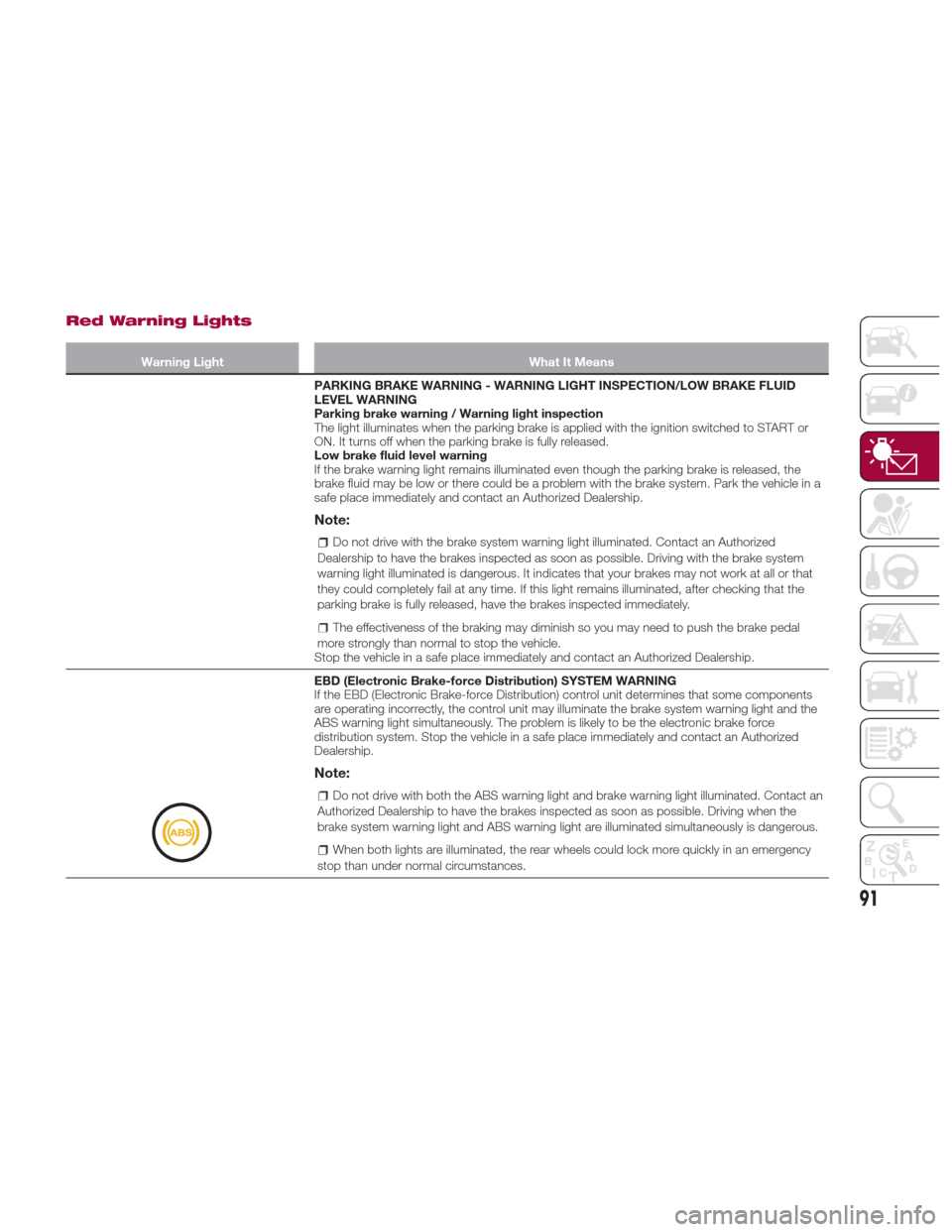
PARKING BRAKE WARNING - WARNING LIGHT INSPECTION/LOW BRAKE FLUID
LEVEL WARNING
Parking brake warning / Warning light inspection
The light illuminates when the parking brake is applied with the ignition switched to START or
ON. It turns off when the parking brake is fully released.
Low brake fluid level warning
If the brake warning light remains illuminated even though the parking brake is released, the
brake fluid may be low or there could be a problem with the brake system. Park the vehicle in a
safe place immediately and contact an Authorized Dealership.
Note:
Do not drive with the brake system warning light illuminated. Contact an Authorized
Dealership to have the brakes inspected as soon as possible. Driving with the brake system
warning light illuminated is dangerous. It indicates that your brakes may not work at all or that
they could completely fail at any time. If this light remains illuminated, after checking that the
parking brake is fully released, have the brakes inspected immediately.
The effectiveness of the braking may diminish so you may need to push the brake pedal
more strongly than normal to stop the vehicle.
Stop the vehicle in a safe place immediately and contact an Authorized Dealership.
EBD (Electronic Brake-force Distribution) SYSTEM WARNING
If the EBD (Electronic Brake-force Distribution) control unit determines that some components
are operating incorrectly, the control unit may illuminate the brake system warning light and the
ABS warning light simultaneously. The problem is likely to be the electronic brake force
distribution system. Stop the vehicle in a safe place immediately and contact an Authorized
Dealership.
Note:
Do not drive with both the ABS warning light and brake warning light illuminated. Contact an
Authorized Dealership to have the brakes inspected as soon as possible. Driving when the
brake system warning light and ABS warning light are illuminated simultaneously is dangerous.
When both lights are illuminated, the rear wheels could lock more quickly in an emergency
stop than under normal circumstances.
91
Page 99 of 300
Amber Warning Lights
Warning lightWhat it means
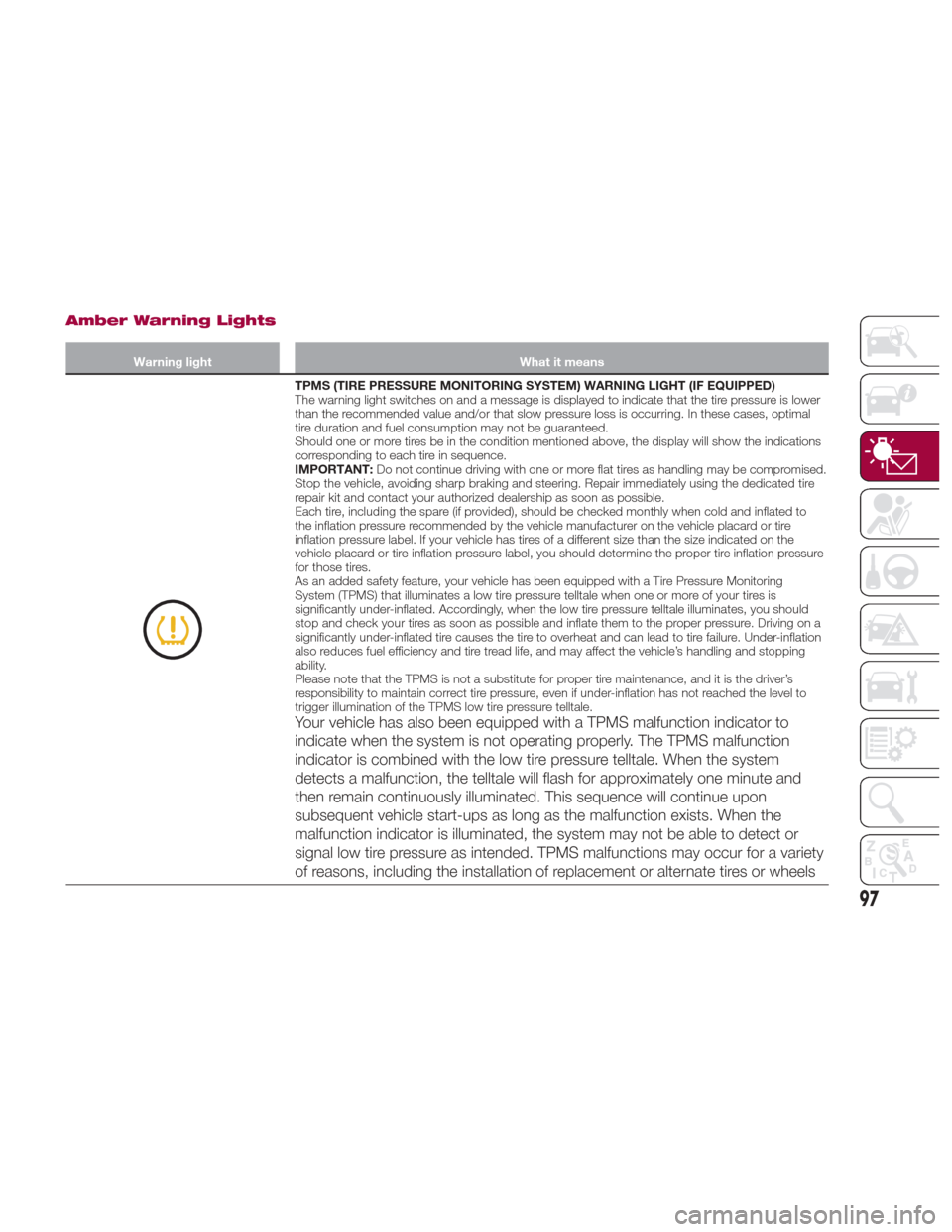
TPMS (TIRE PRESSURE MONITORING SYSTEM) WARNING LIGHT (IF EQUIPPED)
The warning light switches on and a message is displayed to indicate that the tire pressure is lower
than the recommended value and/or that slow pressure loss is occurring. In these cases, optimal
tire duration and fuel consumption may not be guaranteed.
Should one or more tires be in the condition mentioned above, the display will show the indications
corresponding to each tire in sequence.
IMPORTANT:Do not continue driving with one or more flat tires as handling may be compromised.
Stop the vehicle, avoiding sharp braking and steering. Repair immediately using the dedicated tire
repair kit and contact your authorized dealership as soon as possible.
Each tire, including the spare (if provided), should be checked monthly when cold and inflated to
the inflation pressure recommended by the vehicle manufacturer on the vehicle placard or tire
inflation pressure label. If your vehicle has tires of a different size than the size indicated on the
vehicle placard or tire inflation pressure label, you should determine the proper tire inflation pressure
for those tires.
As an added safety feature, your vehicle has been equipped with a Tire Pressure Monitoring
System (TPMS) that illuminates a low tire pressure telltale when one or more of your tires is
significantly under-inflated. Accordingly, when the low tire pressure telltale illuminates, you should
stop and check your tires as soon as possible and inflate them to the proper pressure. Driving on a
significantly under-inflated tire causes the tire to overheat and can lead to tire failure. Under-inflation
also reduces fuel efficiency and tire tread life, and may affect the vehicle’s handling and stopping
ability.
Please note that the TPMS is not a substitute for proper tire maintenance, and it is the driver’s
responsibility to maintain correct tire pressure, even if under-inflation has not reached the level to
trigger illumination of the TPMS low tire pressure telltale.
Your vehicle has also been equipped with a TPMS malfunction indicator to
indicate when the system is not operating properly. The TPMS malfunction
indicator is combined with the low tire pressure telltale. When the system
detects a malfunction, the telltale will flash for approximately one minute and
then remain continuously illuminated. This sequence will continue upon
subsequent vehicle start-ups as long as the malfunction exists. When the
malfunction indicator is illuminated, the system may not be able to detect or
signal low tire pressure as intended. TPMS malfunctions may occur for a variety
of reasons, including the installation of replacement or alternate tires or wheels
97