check engine FIAT 124 SPIDER 2018 Owner handbook (in English)
[x] Cancel search | Manufacturer: FIAT, Model Year: 2018, Model line: 124 SPIDER, Model: FIAT 124 SPIDER 2018Pages: 220, PDF Size: 3.18 MB
Page 69 of 220
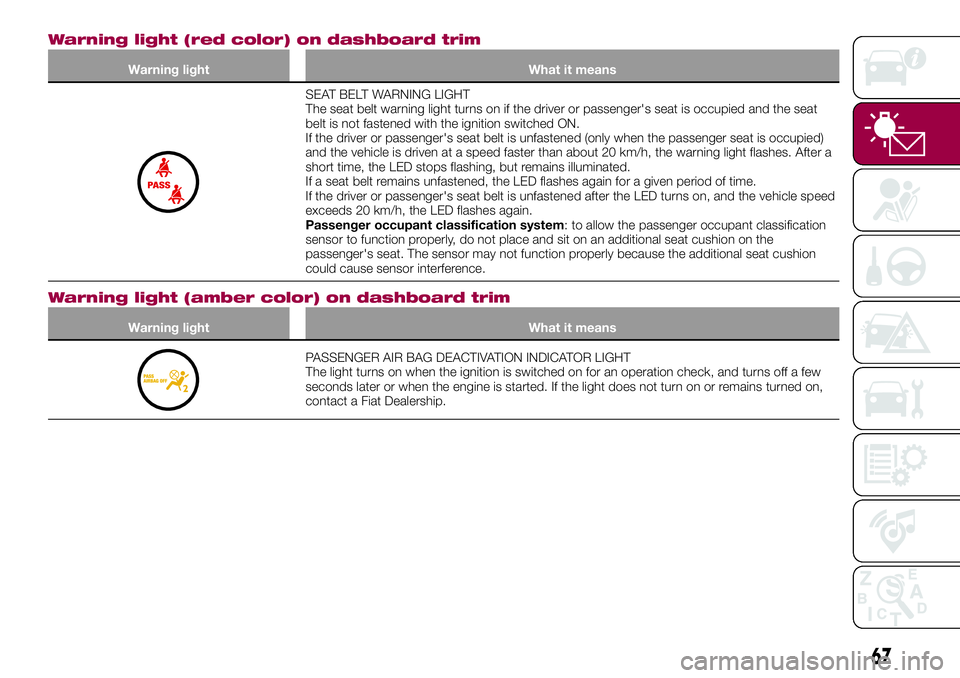
Warning light (red color) on dashboard trim
Warning light What it means
SEAT BELT WARNING LIGHT
The seat belt warning light turns on if the driver or passenger's seat is occupied and the seat
belt is not fastened with the ignition switched ON.
If the driver or passenger's seat belt is unfastened (only when the passenger seat is occupied)
and the vehicle is driven at a speed faster than about 20 km/h, the warning light flashes. After a
short time, the LED stops flashing, but remains illuminated.
If a seat belt remains unfastened, the LED flashes again for a given period of time.
If the driver or passenger's seat belt is unfastened after the LED turns on, and the vehicle speed
exceeds 20 km/h, the LED flashes again.
Passenger occupant classification system: to allow the passenger occupant classification
sensor to function properly, do not place and sit on an additional seat cushion on the
passenger's seat. The sensor may not function properly because the additional seat cushion
could cause sensor interference.
Warning light (amber color) on dashboard trim
Warning light What it means
PASSENGER AIR BAG DEACTIVATION INDICATOR LIGHT
The light turns on when the ignition is switched on for an operation check, and turns off a few
seconds later or when the engine is started. If the light does not turn on or remains turned on,
contact a Fiat Dealership.
67
Page 70 of 220
MESSAGE INDICATED ON
DISPLAY
(versions with Radio 7”)
If a message is displayed in the center
display, take appropriate action (in a
calm manner) according to the
displayed message.
If the following messages are displayed
in the centre display, a vehicle system
may be malfunctioning:
Engine Coolant Temperature
High: displays if the engine coolant
temperature has increased excessively.
Changing System Malfunction:
displays if the charging system has a
malfunction.
Temperature Warning: the
following message is displayed when
the temperature around the centre
display is high. Lowering the
temperature in the cabin or the
temperature around the centre display
by avoiding direct sunlight is
recommended.
Stop the vehicle in a safe place and
contact a Fiat Dealership.
WARNING SOUND IS
ACTIVATED
A warning sound is activated in
following cases:
Lights-on reminder;
Air Bag/seat belt pretensioner
system;
Active bonnet (where provided);
Ignition not switched off (STOP);
Key removed from vehicle;
"Door locking" switch inoperable
(versions with advanced keyless function);
Key left-in-boot compartment
(versions with advanced keyless
function);
Key left-in-vehicle (versions with
advanced keyless function);
Vehicle speed alarm (where
provided);
Tire inflation pressure warning beep
(where provided);
Outside temperature (where
provided);
Electronic steering lock;
Speed limiter (where provided);
120 km/h warning (where provided).
WARNING
61)Never tamper with the air
bag/pretensioner systems and always
contact a Fiat Dealership perform all
servicing and repairs. Self-servicing or
tampering with the systems is dangerous.
An air bag/pretensioner could accidentally
activate or become disabled causing
serious injury or death.62)Do not drive the vehicle with the active
bonnet warning light turned on or flashing.
Driving the vehicle with the active hood
warning light turned on or flashing is
dangerous as the active hood mechanism
may not activate normally and function as
intended in the event the vehicle were to
contact a pedestrian.
63)If the TPMS warning light illuminates or
flashes, or the tire pressure warning beep
sound is heard, decrease vehicle speed
immediately and avoid sudden
maneuvering and braking. If the warning
light illuminates or flashes, or the tire
pressure warning beep sound is heard, it is
dangerous to drive the vehicle at high
speeds, or perform sudden maneuvering
or braking. Vehicle drivability could worsen
and result in an accident. To determine if
you have a slow leak or a flat, pull over to a
safe position where you can check the
visual condition of the tire and determine if
you have enough air to proceed to a place
where air may be added and the system
monitored again by Fiat Dealership or a tire
repair station.
64)Do not ignore the TPMS warning light.
Ignoring the TPMS warning light is
dangerous, even if you know why it is
illuminated. Have the problem taken care of
as soon as possible before it develops into
a more serious situation that could lead to
tire failure and a dangerous accident.
68
KNOWING THE INSTRUMENT PANEL
Page 126 of 220
WARNING
152)When removing the fuel filler cap,
loosen the cap slightly and wait for any
hissing to stop, then remove it: fuel spray is
dangerous. Fuel can burn skin and eyes
and cause illness if ingested. Fuel spray is
released when there is pressure in the fuel
tank and the fuel filler cap is removed too
quickly.
153)Before refuelling, stop the engine, and
always keep sparks and flames away from
the filler neck: fuel vapour is dangerous. It
could be ignited by sparks or flames
causing serious burns and injuries.
Additionally, use of the incorrect fuel filler
cap or not using a fuel filler cap may result
in a fuel leak, which could result in serious
burns or death in an accident.
154)Do not continue refuelling after the
fuel pump nozzle shuts off automatically:
continuing to add fuel after the fuel pump
nozzle has shut off automatically is
dangerous because overfilling the fuel tank
may cause fuel overflow or leakage. Fuel
overflow and leakage could damage the
vehicle and if the fuel ignites it could cause
a fire and explosion resulting in serious
injury or death.
155)Do not apply any object/plug to the
end of the filler which is not provided for
the car. The use of non-compliant
objects/plugs could cause a pressure
increase inside the tank, resulting in
dangerous situations.
156)Do not bring naked flames or lit
cigarettes near to the fuel filler: fire risk.
Keep your face away from the fuel filler to
prevent breathing in harmful vapours.
157)Do not use a mobile phone near the
refuelling pump: risk of fire.
9708100100-122-001
124
STARTING AND OPERATING
Fuels - identification of
vehicle compatibility
Symbol for consumer
information in accordance
with theEN16942
specification
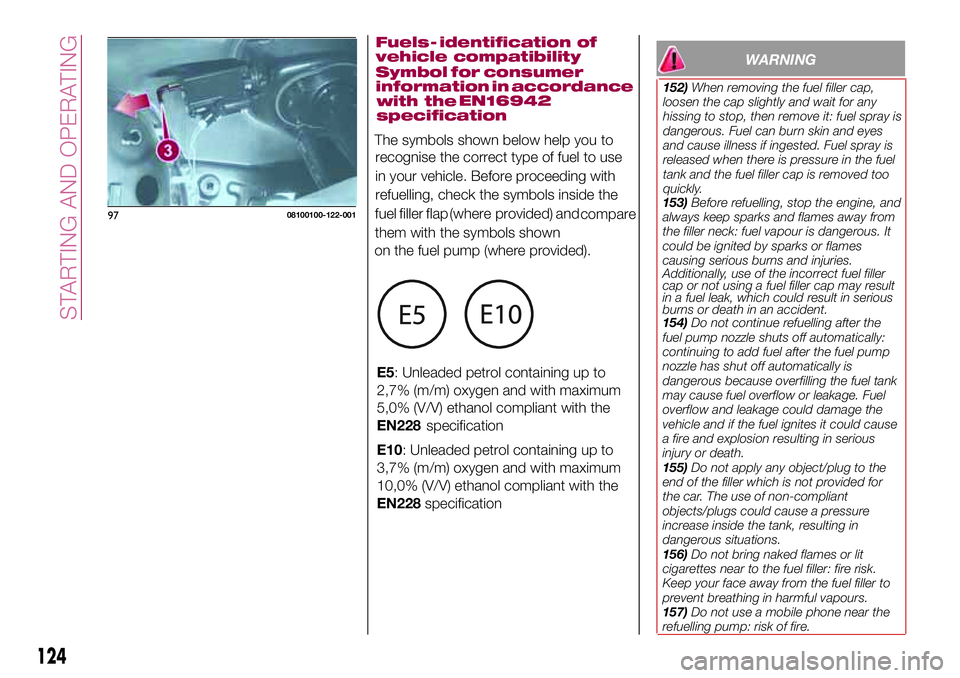
The symbols shown below help you to
recognise the correct type of fuel to use
in your vehicle. Before proceeding with
refuelling, check the symbols inside the
fuel filler flap (where provided) and
compare
them
with
the
symbols
shown
on the fuel pump (where provided).
E5: Unleaded petrol containing up to
2,7% (m/m) oxygen and with maximum
5,0% (V/V) ethanol compliant with the
EN228
E10: Unleaded petrol containing up to
3,7% (m/m) oxygen and with maximum
10,0% (V/V) ethanol compliant with the
EN228
specification
specification
Page 160 of 220
regarding the disposal of waste oil and
fluids. Please dispose of your waste
properly and with due regard to the
environment.
We recommend that you entrust the oil
and fluid changes of your vehicle to a
Fiat Dealership.
PERIODIC CHECKS
Every1,000 kmor before long trips
check and, if necessary, top up:
engine coolant level;
brake fluid level;
windscreen washer fluid level;
tire inflation pressure and condition;
operation of lighting system
(headlights, direction indicators, hazard
warning lights, etc.);
operation of windscreen
washer/wiper system and
positioning/wear of windscreen window
wiper blades.
Every 3,000 km, check and top up if
required: engine oil level.
HEAVY-DUTY USE OF THE
VEHICLE
If the vehicle is used under one of the
following conditions:
dusty roads;
short, repeated journeys (less than
7-8 km) at sub-zero outside
temperatures;
engine often idling or driving long
distances at low speeds or long periods
of inactivity;
the following checks must be carried
out more often than indicated in the
Scheduled Servicing Plan:
check front disc brake pad condition
and wear;
check cleanliness of bonnet and
luggage compartment locks,
cleanliness and lubrication of linkage;
visually inspect conditions of: engine,
gearbox, transmission, pipes and hoses
(exhaust/fuel system/brakes) and
rubber elements (gaiters/sleeves/
bushes, etc.);
check battery charge and battery
fluid level (electrolyte);
visually inspect conditions of the
accessory drive belts;
check and, if necessary, change
engine oil and replace oil filter;
check and, if necessary, replace
pollen filter;
check and, if necessary, replace air
cleaner.
158
MAINTENANCE AND CARE
Page 161 of 220
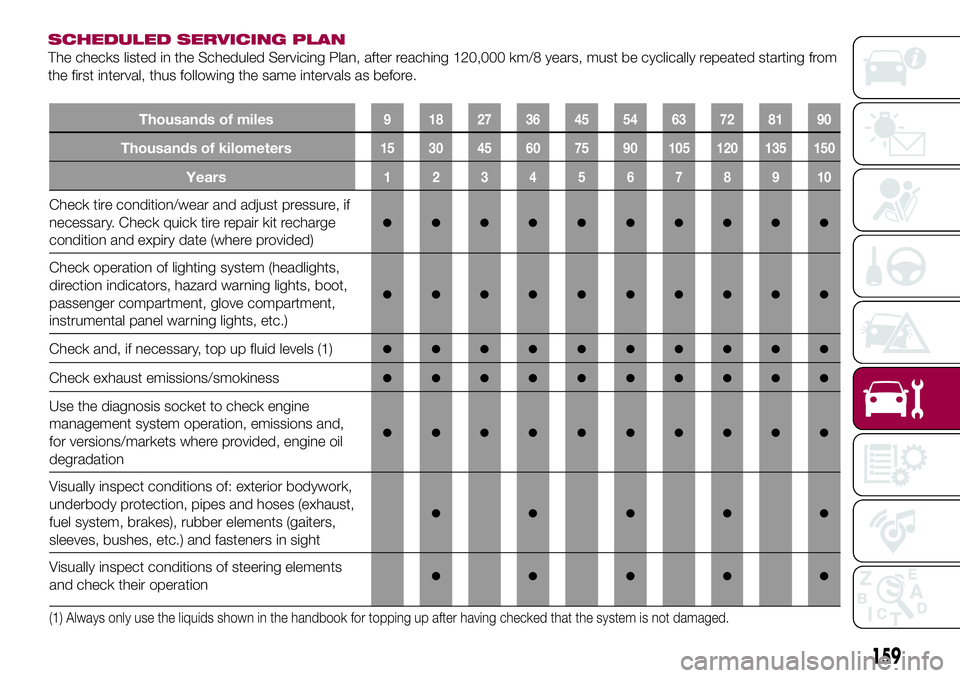
SCHEDULED SERVICING PLAN
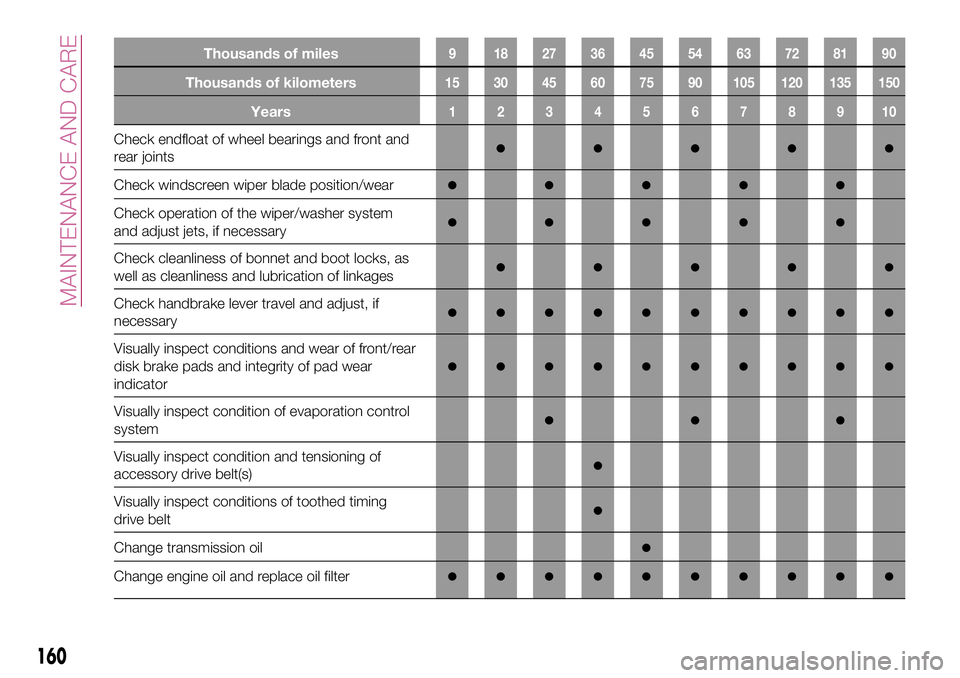
The checks listed in the Scheduled Servicing Plan, after reaching 120,000 km/8 years, must be cyclically repeated starting from
the first interval, thus following the same intervals as before.
159
Thousands of miles9 182736455463728190
Thousands of kilometers15 30 45 60 75 90 105 120 135 150
Years12345678910
Check tire condition/wear and adjust pressure, if
necessary. Check quick tire repair kit recharge
condition and expiry date (where provided)
●●●●●●●●●●
Check operation of lighting system (headlights,
direction indicators, hazard warning lights, boot,
passenger compartment, glove compartment,
instrumental panel warning lights, etc.)
●●●●●●●●●●
Check and, if necessary, top up fluid levels (1)●●●●●●●●●●
Check exhaust emissions/smokiness●●●●●●●●●●
Use the diagnosis socket to check engine
management system operation, emissions and,
for versions/markets where provided, engine oil
degradation
●●●●●●●●●●
Visually inspect conditions of: exterior bodywork,
underbody protection, pipes and hoses (exhaust,
fuel system, brakes), rubber elements (gaiters,
sleeves, bushes, etc.) and fasteners in sight
●●●●●
Visually inspect conditions of steering elements
and check their operation●●●●●
(1) Always only use the liquids shown in the handbook for topping up after having checked that the system is not damaged.
Page 162 of 220
160
MAINTENANCE AND CARE
Thousands of miles9 182736455463728190
Thousands of kilometers15 30 45 60 75 90 105 120 135 150
Years12345678910
Check endfloat of wheel bearings and front and
rear joints●●●●●
Check windscreen wiper blade position/wear●●●●●
Check operation of the wiper/washer system
and adjust jets, if necessary●●●●●
Check cleanliness of bonnet and boot locks, as
well as cleanliness and lubrication of linkages●●●●●
Check handbrake lever travel and adjust, if
necessary●●●●●●●●●●
Visually inspect conditions and wear of front/rear
disk brake pads and integrity of pad wear
indicator
●●●●●●●●●●
Visually inspect condition of evaporation control
system●●●
Visually inspect condition and tensioning of
accessory drive belt(s)●
Visually inspect conditions of toothed timing
drive belt●
Change transmission oil●
Change engine oil and replace oil filter●●●●●●●●●●
Page 164 of 220
WARNING
186)Do not perform maintenance work if
you lack sufficient knowledge and
experience or the proper tools and
equipment to do the work. Have
maintenance work done by a qualified
technician. Performing maintenance work
on a vehicle is dangerous if not done
properly. You can be seriously injured while
performing some maintenance procedures.
187)If you must run the engine while
working under the bonnet, make certain
that you remove all jewelry (especially
rings, bracelets, watches, and necklaces)
and all neckties, scarves, and similar loose
clothing before getting near the engine or
cooling fan which may turn on
unexpectedly. Either can become
entangled in moving parts and result in
injury.
188)Switch the ignition to off and make
sure the fan is not running before
attempting to work near the cooling fan.
Working near the cooling fan when it is
running is dangerous. The fan could
continue running indefinitely even if the
engine has stopped and the engine
compartment temperature is high. You
could be hit by the fan and seriously
injured.
IMPORTANT
38)Do not leave items in the engine
compartment. After you have finished
checking or doing servicing in the engine
compartment, do not forget and leave
items such as tools or rags in the engine
compartment. Tools or other items left in
the engine compartment could cause
engine damage or a fire leading to an
unexpected accident.
162
MAINTENANCE AND CARE
Page 165 of 220
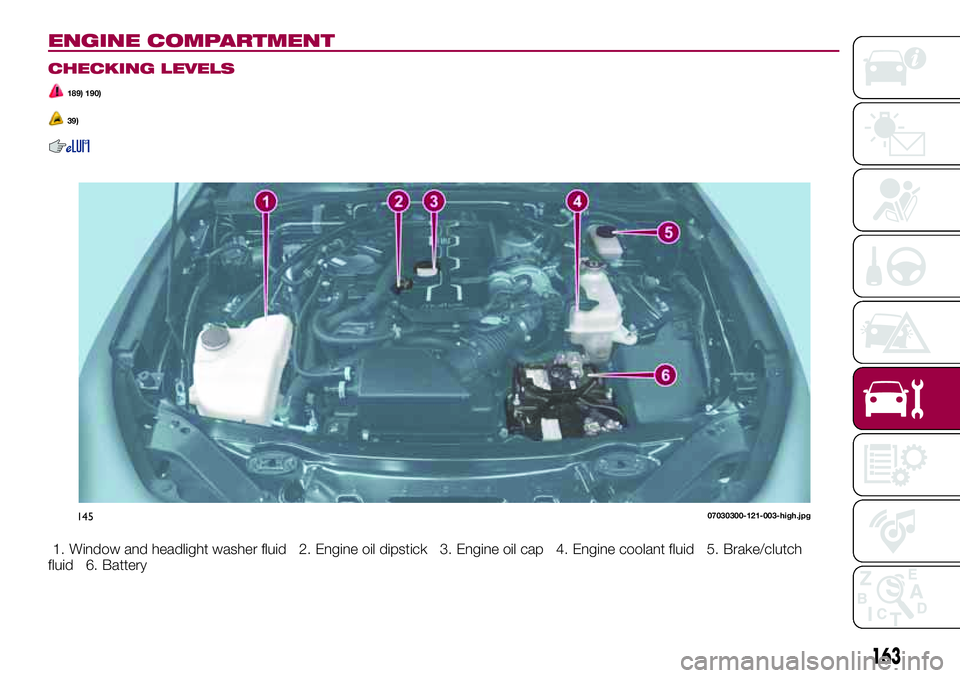
ENGINE COMPARTMENT
CHECKING LEVELS
189) 190)
39)
1. Window and headlight washer fluid 2. Engine oil dipstick 3. Engine oil cap 4. Engine coolant fluid 5. Brake/clutch
fluid 6. Battery
14507030300-121-003-high.jpg
163
Page 167 of 220
If the coolant reservoir is empty or new
coolant is required frequently, contact a
Fiat Dealership.
BRAKE / CLUTCH FLUID
197)
47)
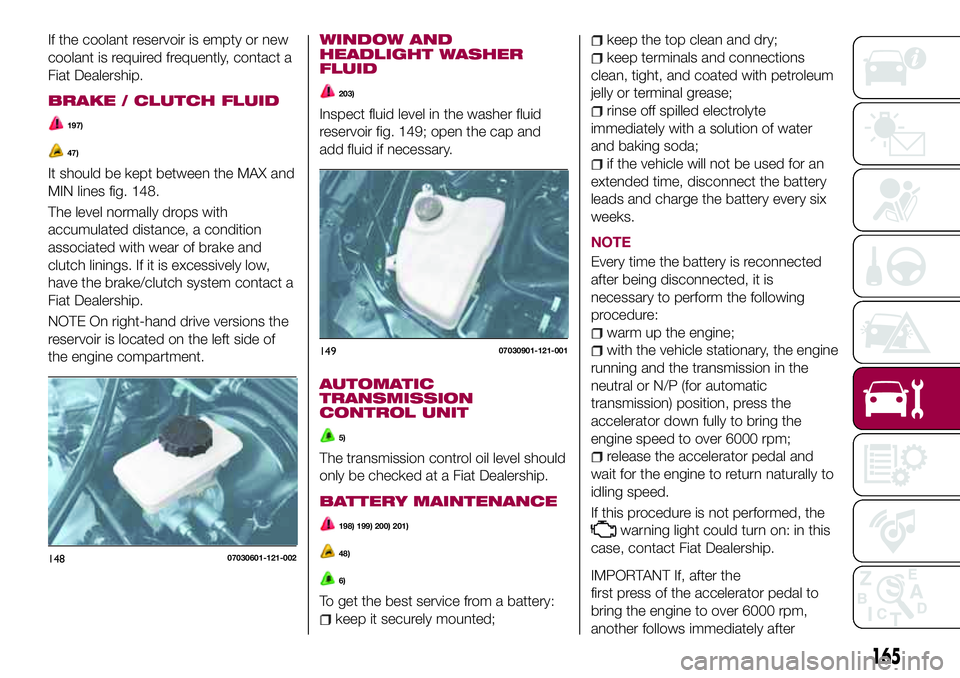
It should be kept between the MAX and
MIN lines fig. 148.
The level normally drops with
accumulated distance, a condition
associated with wear of brake and
clutch linings. If it is excessively low,
have the brake/clutch system contact a
Fiat Dealership.
NOTE On right-hand drive versions the
reservoir is located on the left side of
the engine compartment.
WINDOW AND
HEADLIGHT WASHER
FLUID
203)
Inspect fluid level in the washer fluid
reservoir fig. 149; open the cap and
add fluid if necessary.
AUTOMATIC
TRANSMISSION
CONTROL UNIT
5)
The transmission control oil level should
only be checked at a Fiat Dealership.
BATTERY MAINTENANCE
198) 199) 200) 201)
48)
6)
To get the best service from a battery:
keep it securely mounted;
keep the top clean and dry;
keep terminals and connections
clean, tight, and coated with petroleum
jelly or terminal grease;
rinse off spilled electrolyte
immediately with a solution of water
and baking soda;
if the vehicle will not be used for an
extended time, disconnect the battery
leads and charge the battery every six
weeks.
NOTE
Every time the battery is reconnected
after being disconnected, it is
necessary to perform the following
procedure:
warm up the engine;
with the vehicle stationary, the engine
running and the transmission in the
neutral or N/P (for automatic
transmission) position, press the
accelerator down fully to bring the
engine speed to over 6000 rpm;
release the accelerator pedal and
wait for the engine to return naturally to
idling speed.
If this procedure is not performed, the
warning light could turn on: in this
case, contact Fiat Dealership.
IMPORTANT If, after the
first press of the accelerator pedal to
bring the engine to over 6000 rpm,
another follows immediately after
14807030601-121-002
14907030901-121-001
165
Page 177 of 220
IDENTIFICATION
DATA
MODEL PLATE
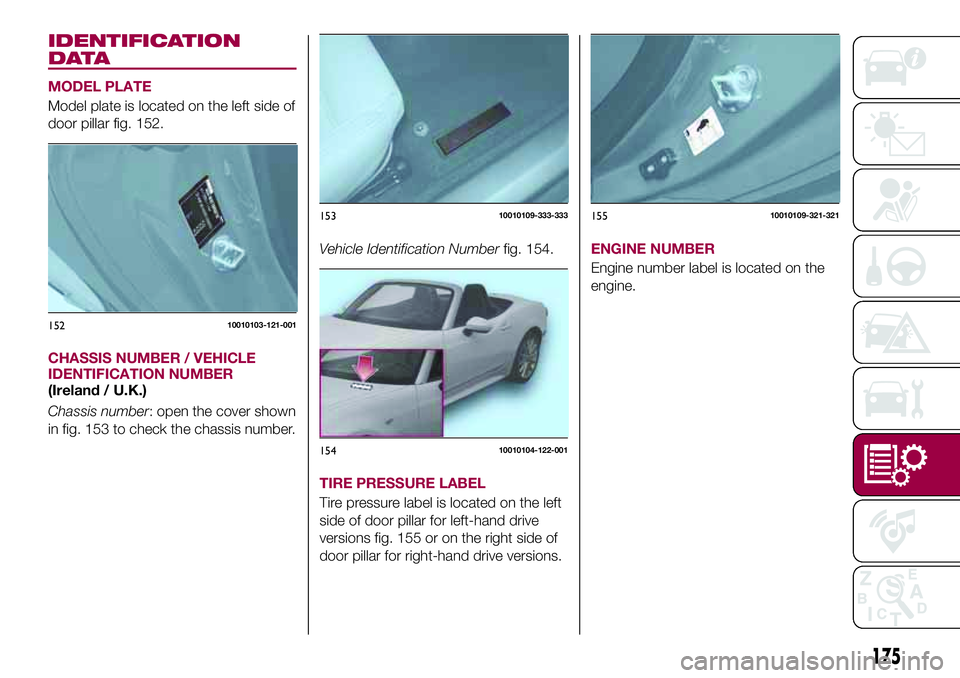
Model plate is located on the left side of
door pillar fig. 152.
CHASSIS NUMBER / VEHICLE
IDENTIFICATION NUMBER
(Ireland / U.K.)
Chassis number: open the cover shown
in fig. 153 to check the chassis number.Vehicle Identification Numberfig. 154.
TIRE PRESSURE LABEL
Tire pressure label is located on the left
side of door pillar for left-hand drive
versions fig. 155 or on the right side of
door pillar for right-hand drive versions.ENGINE NUMBER
Engine number label is located on the
engine.
15210010103-121-001
15310010109-333-333
15410010104-122-001
15510010109-321-321
175