door lock FIAT 124 SPIDER 2019 Owner handbook (in English)
[x] Cancel search | Manufacturer: FIAT, Model Year: 2019, Model line: 124 SPIDER, Model: FIAT 124 SPIDER 2019Pages: 228, PDF Size: 5.08 MB
Page 40 of 228
POWER WINDOWS
CONTROLS
46) 47)
The windows can be opened/closed by
operating the power window switches.
Opening / closing windows
The window opens while the switch is
pressed and it closes while the switch is
pulled up with the ignition switched ON.
Do not open or close both windows at
the same time.
The passenger window can be
opened/closed when the power
window lock switch on the driver's door
is in the unlock position. Keep this
switch in the locked position while
children are in the vehicle.
If the power window does not
open/close, wait a moment and then
operate the switch again.
Passenger control switches
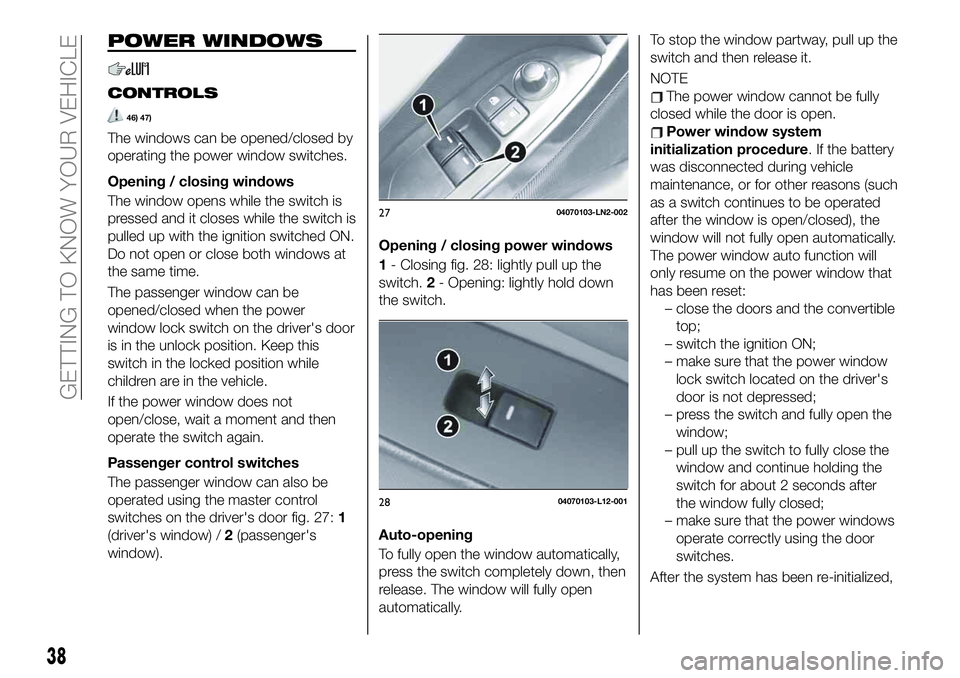
The passenger window can also be
operated using the master control
switches on the driver's door fig. 27:1
(driver's window) /2(passenger's
window).Opening / closing power windows
1- Closing fig. 28: lightly pull up the
switch.2- Opening: lightly hold down
the switch.
Auto-opening
To fully open the window automatically,
press the switch completely down, then
release. The window will fully open
automatically.To stop the window partway, pull up the
switch and then release it.
NOTE
The power window cannot be fully
closed while the door is open.
Power window system
initialization procedure. If the battery
was disconnected during vehicle
maintenance, or for other reasons (such
as a switch continues to be operated
after the window is open/closed), the
window will not fully open automatically.
The power window auto function will
only resume on the power window that
has been reset:
– close the doors and the convertible
top;
– switch the ignition ON;
– make sure that the power window
lock switch located on the driver's
door is not depressed;
– press the switch and fully open the
window;
– pull up the switch to fully close the
window and continue holding the
switch for about 2 seconds after
the window fully closed;
– make sure that the power windows
operate correctly using the door
switches.
After the system has been re-initialized,
2704070103-LN2-002
2804070103-L12-001
38
GETTING TO KNOW YOUR VEHICLE
Page 41 of 228
passenger window can be fully opened
automatically using the master control
switches.
If the automatic power window
operation does not operate normally
while the doors or convertible top are
opened/closed, reset it using the
previous procedures.
POWER WINDOW LOCK
SWITCH
This feature prevents the passenger's
power window from operating. Keep
this switch in the locked position while
children are in the vehicle.
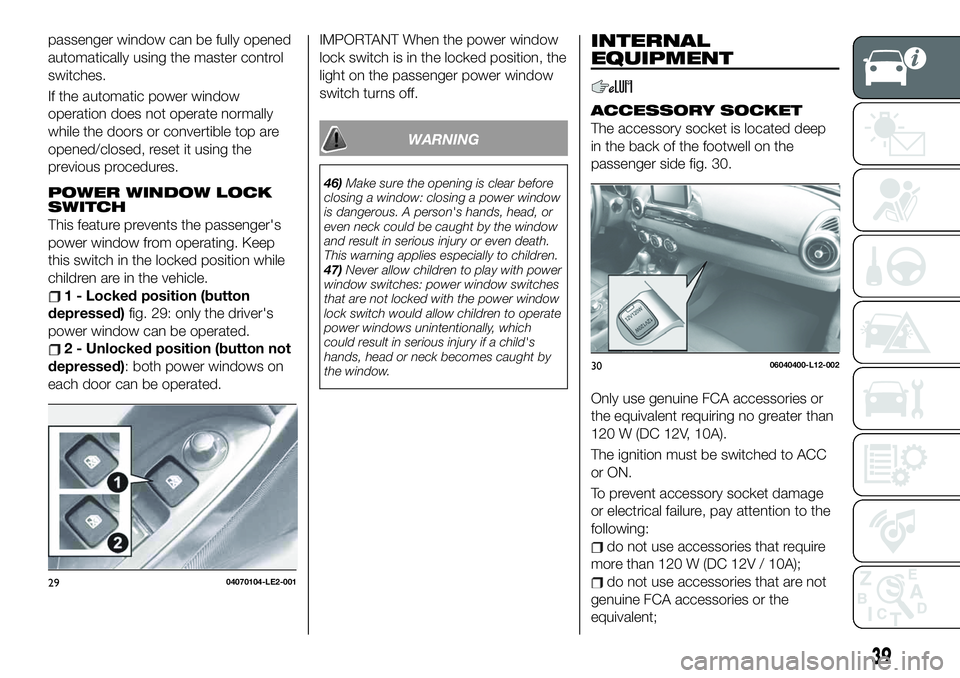
1 - Locked position (button
depressed)fig. 29: only the driver's
power window can be operated.
2 - Unlocked position (button not
depressed): both power windows on
each door can be operated.
IMPORTANT When the power window
lock switch is in the locked position, the
light on the passenger power window
switch turns off.
WARNING
46)Make sure the opening is clear before
closing a window: closing a power window
is dangerous. A person's hands, head, or
even neck could be caught by the window
and result in serious injury or even death.
This warning applies especially to children.
47)Never allow children to play with power
window switches: power window switches
that are not locked with the power window
lock switch would allow children to operate
power windows unintentionally, which
could result in serious injury if a child's
hands, head or neck becomes caught by
the window.
INTERNAL
EQUIPMENT
ACCESSORY SOCKET
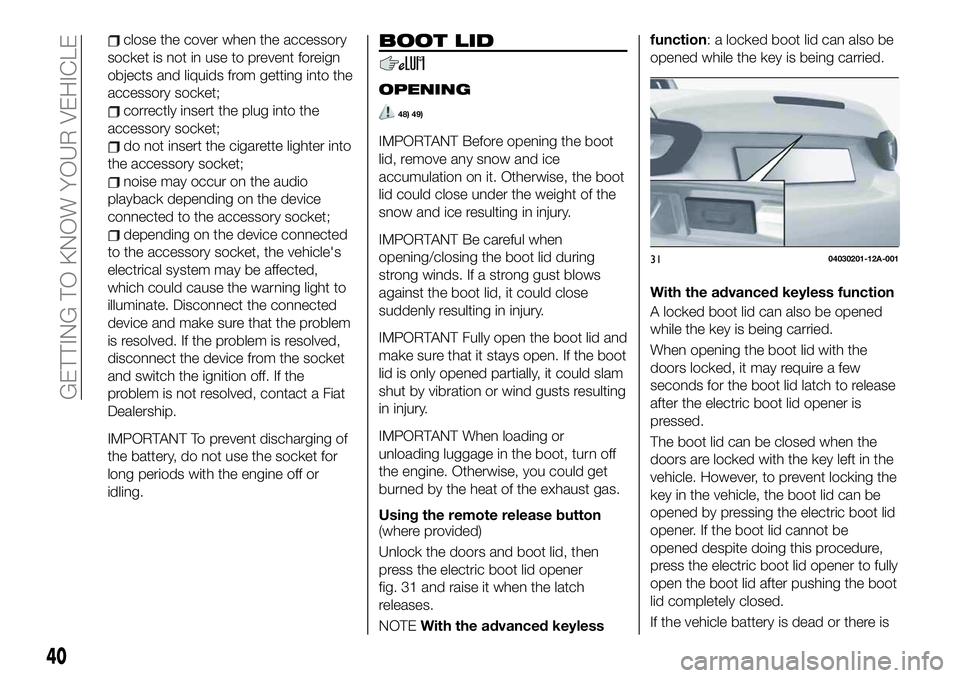
The accessory socket is located deep
in the back of the footwell on the
passenger side fig. 30.
Only use genuine FCA accessories or
the equivalent requiring no greater than
120 W (DC 12V, 10A).
The ignition must be switched to ACC
or ON.
To prevent accessory socket damage
or electrical failure, pay attention to the
following:
do not use accessories that require
more than 120 W (DC 12V / 10A);
do not use accessories that are not
genuine FCA accessories or the
equivalent;2904070104-LE2-001
3006040400-L12-002
39
Page 42 of 228
close the cover when the accessory
socket is not in use to prevent foreign
objects and liquids from getting into the
accessory socket;
correctly insert the plug into the
accessory socket;
do not insert the cigarette lighter into
the accessory socket;
noise may occur on the audio
playback depending on the device
connected to the accessory socket;
depending on the device connected
to the accessory socket, the vehicle's
electrical system may be affected,
which could cause the warning light to
illuminate. Disconnect the connected
device and make sure that the problem
is resolved. If the problem is resolved,
disconnect the device from the socket
and switch the ignition off. If the
problem is not resolved, contact a Fiat
Dealership.
IMPORTANT To prevent discharging of
the battery, do not use the socket for
long periods with the engine off or
idling.
BOOT LID
OPENING
48) 49)
IMPORTANT Before opening the boot
lid, remove any snow and ice
accumulation on it. Otherwise, the boot
lid could close under the weight of the
snow and ice resulting in injury.
IMPORTANT Be careful when
opening/closing the boot lid during
strong winds. If a strong gust blows
against the boot lid, it could close
suddenly resulting in injury.
IMPORTANT Fully open the boot lid and
make sure that it stays open. If the boot
lid is only opened partially, it could slam
shut by vibration or wind gusts resulting
in injury.
IMPORTANT When loading or
unloading luggage in the boot, turn off
the engine. Otherwise, you could get
burned by the heat of the exhaust gas.
Using the remote release button
(where provided)
Unlock the doors and boot lid, then
press the electric boot lid opener
fig. 31 and raise it when the latch
releases.
NOTEWith the advanced keylessfunction: a locked boot lid can also be
opened while the key is being carried.
With the advanced keyless function
A locked boot lid can also be opened
while the key is being carried.
When opening the boot lid with the
doors locked, it may require a few
seconds for the boot lid latch to release
after the electric boot lid opener is
pressed.
The boot lid can be closed when the
doors are locked with the key left in the
vehicle. However, to prevent locking the
key in the vehicle, the boot lid can be
opened by pressing the electric boot lid
opener. If the boot lid cannot be
opened despite doing this procedure,
press the electric boot lid opener to fully
open the boot lid after pushing the boot
lid completely closed.
If the vehicle battery is dead or there is
3104030201-12A-001
40
GETTING TO KNOW YOUR VEHICLE
Page 44 of 228
CLOSING
50) 51)
Use both hands to push the boot lid
down until the lock snaps shut. Do not
slam it.
Pull up on the boot lid to make sure it is
secure.
WARNING
48)Never allow a person to ride in the
boot: allowing a person to ride in the boot
is dangerous. The person in the boot could
be seriously injured or killed during sudden
braking or a collision.
49)Do not drive with the boot lid open:
exhaust gas in the cabin of a vehicle is
dangerous. An open boot lid in a moving
vehicle will cause exhaust gas to be drawn
into the cabin. This gas contains CO
(carbon monoxide), which is colourless,
odourless, and highly poisonous, and it
can cause loss of consciousness and
death. Moreover, an open boot lid could
cause occupants to fall out in an accident.
50)Close the boot lid, do not allow
children to play inside the boot lid. Leaving
the trunk lid open or leaving children in the
vehicle with the keys is dangerous.
Children could open the boot lid and climb
inside resulting in possible injury or death
from heat exposure.51)Always keep the car from being a
tempting place to play by latching the
doors and the boot lid, and keeping the
keys where children can not play with
them. Leaving children or animals
unattended in a parked vehicle is
dangerous. Babies left sleeping and
children who lock themselves in cars or
trunks can die very quickly from heat
prostration. Do not leave your children or
pets alone in a car at any time. Do not
leave the car, the boot lid unlocked.
BONNET
OPENING
52) 53) 54) 56)
Proceed as follows:
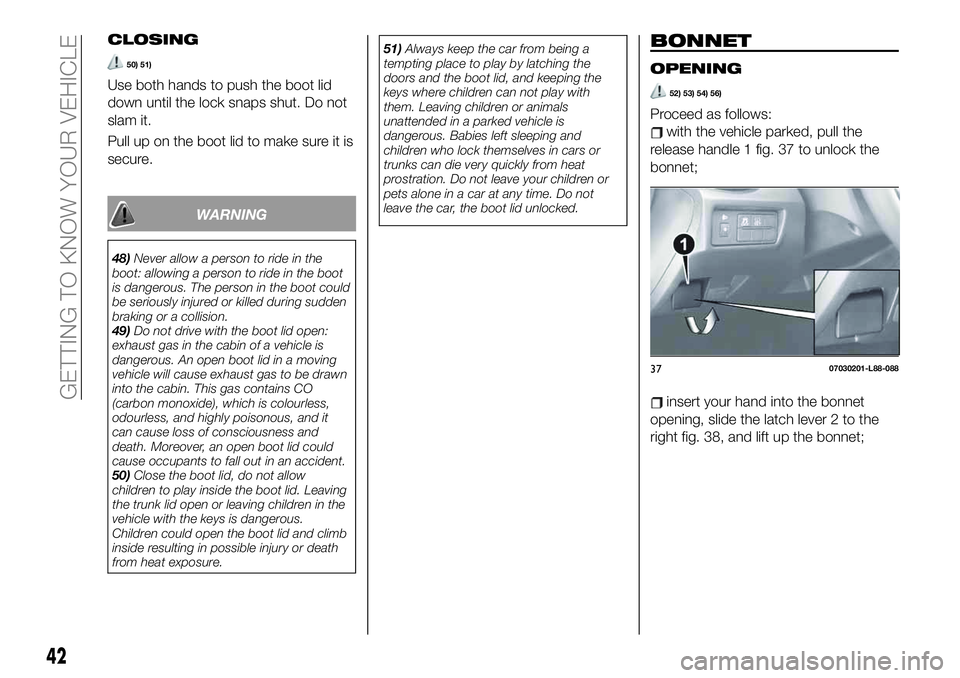
with the vehicle parked, pull the
release handle 1 fig. 37 to unlock the
bonnet;
insert your hand into the bonnet
opening, slide the latch lever 2 to the
right fig. 38, and lift up the bonnet;
3707030201-L88-088
42
GETTING TO KNOW YOUR VEHICLE
Page 47 of 228
RAISING THE
CONVERTIBLE TOP
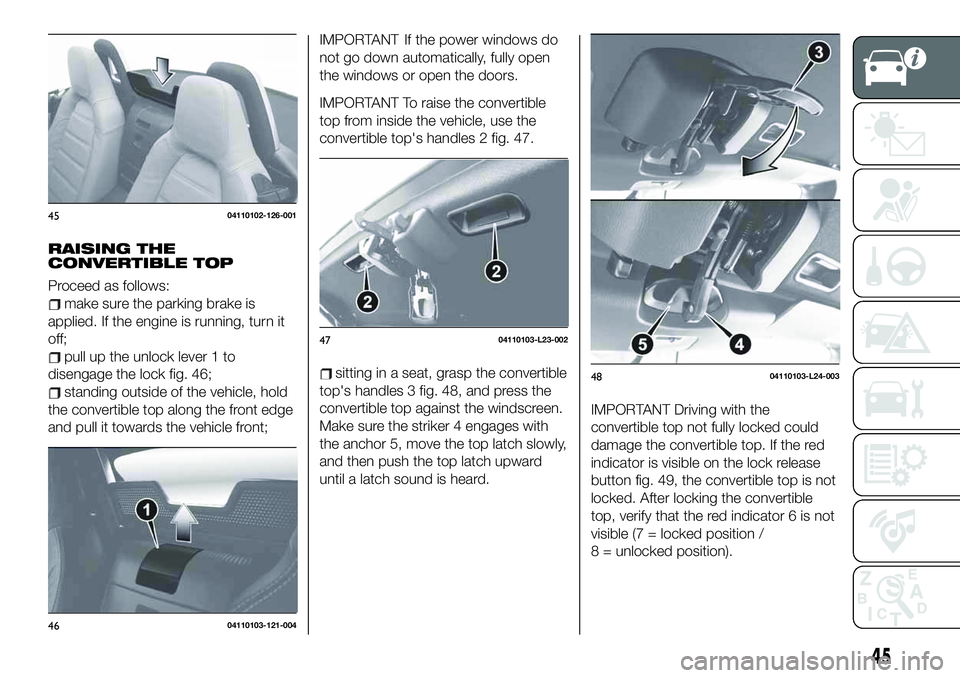
Proceed as follows:
make sure the parking brake is
applied. If the engine is running, turn it
off;
pull up the unlock lever 1 to
disengage the lock fig. 46;
standing outside of the vehicle, hold
the convertible top along the front edge
and pull it towards the vehicle front;
IMPORTANTIf the power windows do
not go down automatically, fully open
the windows or open the doors.
IMPORTANT To raise the convertible
top from inside the vehicle, use the
convertible top's handles 2 fig. 47.
sitting in a seat, grasp the convertible
top's handles 3 fig. 48, and press the
convertible top against the windscreen.
Make sure the striker 4 engages with
the anchor 5, move the top latch slowly,
and then push the top latch upward
until a latch sound is heard.
IMPORTANT Driving with the
convertible top not fully locked could
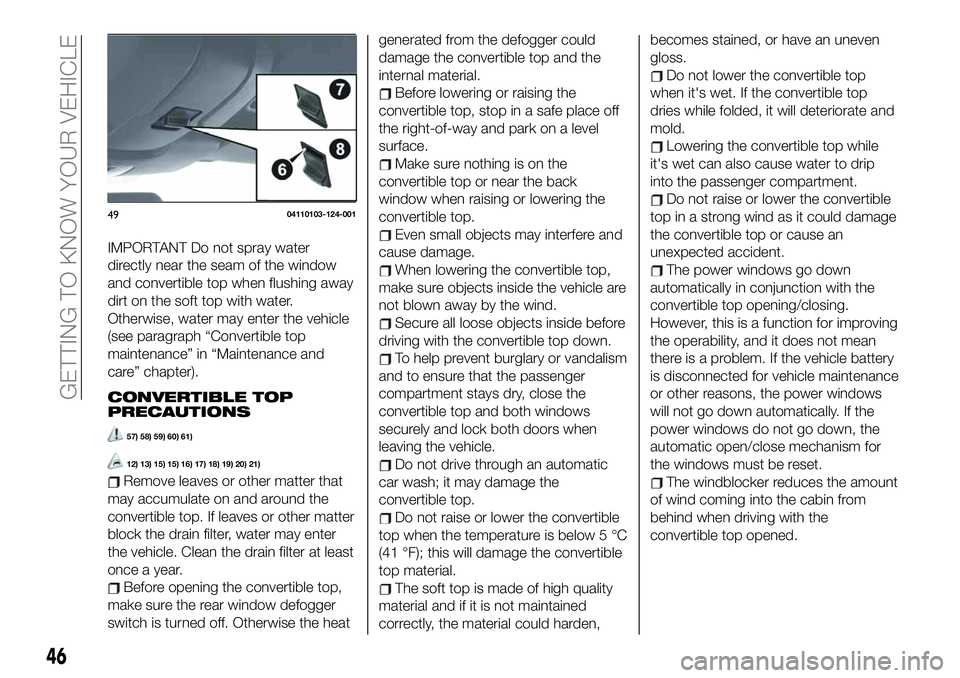
damage the convertible top. If the red
indicator is visible on the lock release
button fig. 49, the convertible top is not
locked. After locking the convertible
top, verify that the red indicator 6 is not
visible (7 = locked position /
8 = unlocked position).
4504110102-126-001
4604110103-121-004
4704110103-L23-002
4804110103-L24-003
45
Page 48 of 228
IMPORTANT Do not spray water
directly near the seam of the window
and convertible top when flushing away
dirt on the soft top with water.
Otherwise, water may enter the vehicle
(see paragraph “Convertible top
maintenance” in “Maintenance and
care” chapter).
CONVERTIBLE TOP
PRECAUTIONS
57) 58) 59) 60) 61)
12) 13) 15) 15) 16) 17) 18) 19) 20) 21)
Remove leaves or other matter that
may accumulate on and around the
convertible top. If leaves or other matter
block the drain filter, water may enter
the vehicle. Clean the drain filter at least
once a year.
Before opening the convertible top,
make sure the rear window defogger
switch is turned off. Otherwise the heatgenerated from the defogger could
damage the convertible top and the
internal material.
Before lowering or raising the
convertible top, stop in a safe place off
the right-of-way and park on a level
surface.
Make sure nothing is on the
convertible top or near the back
window when raising or lowering the
convertible top.
Even small objects may interfere and
cause damage.
When lowering the convertible top,
make sure objects inside the vehicle are
not blown away by the wind.
Secure all loose objects inside before
driving with the convertible top down.
To help prevent burglary or vandalism
and to ensure that the passenger
compartment stays dry, close the
convertible top and both windows
securely and lock both doors when
leaving the vehicle.
Do not drive through an automatic
car wash; it may damage the
convertible top.
Do not raise or lower the convertible
top when the temperature is below 5 °C
(41 °F); this will damage the convertible
top material.
The soft top is made of high quality
material and if it is not maintained
correctly, the material could harden,becomes stained, or have an uneven
gloss.
Do not lower the convertible top
when it's wet. If the convertible top
dries while folded, it will deteriorate and
mold.
Lowering the convertible top while
it's wet can also cause water to drip
into the passenger compartment.
Do not raise or lower the convertible
top in a strong wind as it could damage
the convertible top or cause an
unexpected accident.
The power windows go down
automatically in conjunction with the
convertible top opening/closing.
However, this is a function for improving
the operability, and it does not mean
there is a problem. If the vehicle battery
is disconnected for vehicle maintenance
or other reasons, the power windows
will not go down automatically. If the
power windows do not go down, the
automatic open/close mechanism for
the windows must be reset.
The windblocker reduces the amount
of wind coming into the cabin from
behind when driving with the
convertible top opened.
4904110103-124-001
46
GETTING TO KNOW YOUR VEHICLE
Page 58 of 228
Warning light What it means What to do
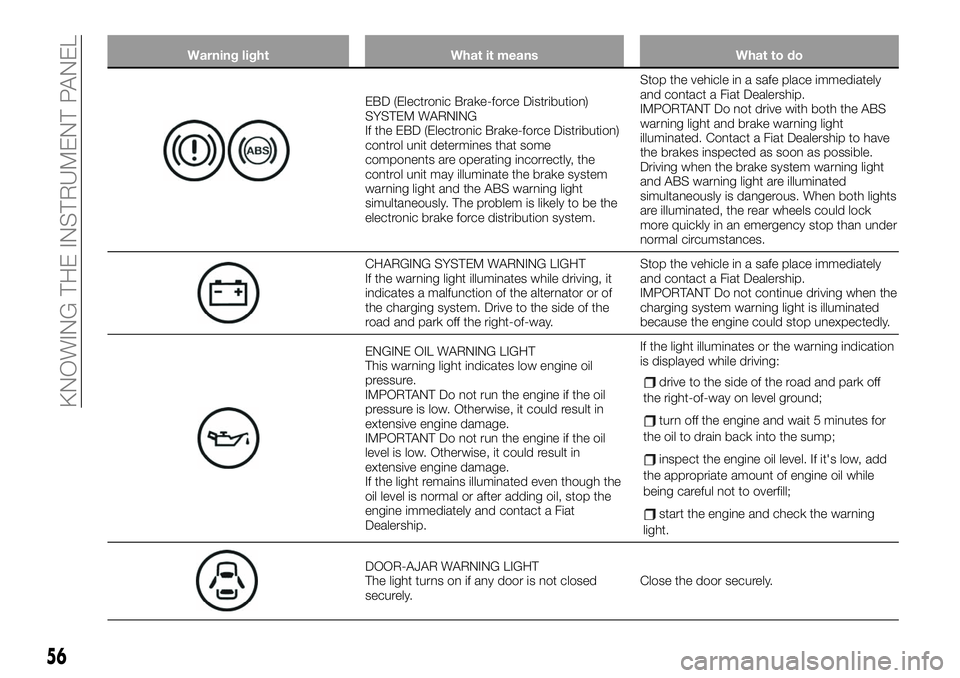
EBD (Electronic Brake-force Distribution)
SYSTEM WARNING
If the EBD (Electronic Brake-force Distribution)
control unit determines that some
components are operating incorrectly, the
control unit may illuminate the brake system
warning light and the ABS warning light
simultaneously. The problem is likely to be the
electronic brake force distribution system.Stop the vehicle in a safe place immediately
and contact a Fiat Dealership.
IMPORTANT Do not drive with both the ABS
warning light and brake warning light
illuminated. Contact a Fiat Dealership to have
the brakes inspected as soon as possible.
Driving when the brake system warning light
and ABS warning light are illuminated
simultaneously is dangerous. When both lights
are illuminated, the rear wheels could lock
more quickly in an emergency stop than under
normal circumstances.
CHARGING SYSTEM WARNING LIGHT
If the warning light illuminates while driving, it
indicates a malfunction of the alternator or of
the charging system. Drive to the side of the
road and park off the right-of-way.Stop the vehicle in a safe place immediately
and contact a Fiat Dealership.
IMPORTANT Do not continue driving when the
charging system warning light is illuminated
because the engine could stop unexpectedly.
ENGINE OIL WARNING LIGHT
This warning light indicates low engine oil
pressure.
IMPORTANT Do not run the engine if the oil
pressure is low. Otherwise, it could result in
extensive engine damage.
IMPORTANT Do not run the engine if the oil
level is low. Otherwise, it could result in
extensive engine damage.
If the light remains illuminated even though the
oil level is normal or after adding oil, stop the
engine immediately and contact a Fiat
Dealership.If the light illuminates or the warning indication
is displayed while driving:
drive to the side of the road and park off
the right-of-way on level ground;
turn off the engine and wait 5 minutes for
the oil to drain back into the sump;
inspect the engine oil level. If it's low, add
the appropriate amount of engine oil while
being careful not to overfill;
start the engine and check the warning
light.
DOOR-AJAR WARNING LIGHT
The light turns on if any door is not closed
securely.Close the door securely.
56
KNOWING THE INSTRUMENT PANEL
Page 100 of 228
104)Do not allow a child or anyone to lean
over or against the side window of a
vehicle with side air bags. It is dangerous
to allow anyone to lean over or against the
side window, the area of the passenger
seat from which the side air bags deploy,
even if a child-restraint system is used. The
impact of inflation from a side air bag could
cause serious injury or death to an out of
position child. Furthermore, leaning over or
against the door could block the side air
bags and eliminate the advantages of
supplementary protection. Because the
side air bag deploys from the outer
shoulder of the seat, do not allow the child
to lean over or against the side window,
even if the child is seated in a
child-restraint system.
105)Never use one seat belt on more than
one person at a time. Using one seat belt
for more than one person at a time is
dangerous. A seat belt used in this way
cannot spread the impact forces properly
and the two passengers could be crushed
together and seriously injured or even
killed. Never use one belt for more than
one person at a time and always operate
the vehicle with each occupant properly
restrained.
106)Use the tether and tether anchor only
for a child-restraint system. Child-restraint
system anchorages are designed to
withstand only those loads imposed by
correctly installed child-restraint systems.
Under no circumstances are they to be
used for adult seat belts, harnesses, or for
attaching other items or equipment to the
vehicle.107)Always install a rear-facing child seat
in the correct seat position. Installing a
rear-facing child seat without first
consulting the table “Child-restraint system
suitability for various seat positions” is
dangerous. A rear-facing child seat
installed on the wrong seat position cannot
be properly secured. In a collision, the child
could hit something or someone in the
vehicle and be seriously injured or even
killed.
108)Always install a junior seat in the
correct seat position. Installing a junior seat
without first consulting the table
“Child-restraint system suitability for
various seat positions” is dangerous. A
junior seat installed on the wrong seat
position cannot be properly secured. In a
collision, the child could hit something or
someone in the vehicle and be seriously
injured or even killed.
109)Always install a baby seat in the
correct seat position. Installing a baby seat
without first consulting the table
“Child-restraint system suitability for
various seat positions” is dangerous. A
baby seat installed on the wrong seat
position cannot be properly secured. In a
collision, the child could hit something or
someone in the vehicle and be seriously
injured or even killed.110)Never use a rear-facing child-restraint
system on the passenger seat protected
by an air bag. Extreme Hazard! Do not use
a rearward facing child-restraint on a seat
protected by an airbag in front of it! The
child-restraint system can be hit by the
deploying air bag and knocked out of
position. A child in the child-restraint
system could be seriously injured or killed.
If your vehicle is equipped with a
passenger occupant classification system,
always make sure the passenger air bag
deactivation OFF indicator light is
illuminated, if installing a rear-facing
child-restraint system on the passenger
seat is unavoidable.
111)Never install a front-facing child seat
in the wrong seat position: Installing a
front-facing child seat without first
consulting the table “Child-restraint system
suitability for various seat positions” is
dangerous. A front-facing child seat
installed in the wrong seat position cannot
be properly secured. In a collision, the child
could hit something or someone in the
vehicle and be seriously injured or even
killed. Make sure the passenger air bag
deactivation OFF indicator light is
illuminated.
112)Before installing child-restraint system
on the passenger seat, move the
passenger seat as far back as possible: In
a collision, the force of a deploying air bag
could cause serious injury or death to the
child. Make sure the passenger air bag
deactivation OFF indicator light is
illuminated.
98
SAFETY
Page 112 of 228
WARNING
118)Seat belts must be worn in air bag
equipped vehicles. Depending only on the
air bags for protection during an accident
is dangerous. Alone, air bags may not
prevent serious injuries. The appropriate air
bags can be expected to inflate only in the
first accident, such as frontal, near frontal
or side collisions that are at least
moderate. Vehicle occupants should
always wear seat belts.
119)Always make sure the passenger air
bag deactivation OFF indicator light is
illuminated when using a child restraint
system. Seating a child in a child-restraint
system that is installed on the passenger
seat with the passenger air bag
deactivation OFF indicator light not
illuminated is extremely dangerous. In an
accident, an air bag could inflate and
cause serious injuries or even death to the
child seated in the child restraint system.
Always make sure the passenger air bag
deactivation OFF indicator light is
illuminated.120)EXTREME HAZARD! Never use a
rear-facing child-restraint system on the
passenger seat with an air bag that could
deploy. NEVER use a rearward facing child
restraint on a seat protected by an ACTIVE
AIR BAG in front of it, DEATH or SERIOUS
INJURY to the CHILD can occur. Even in a
moderate collision, the child-restraint
system can be hit by a deploying air bag
and moved violently backward resulting in
serious injury or death to the child. If your
vehicle is equipped with on passenger
occupant classification system, always
make sure the passenger air bag
deactivation OFF indicator light is
illuminated.
121)Do not sit too close to the driver and
passenger air bags. Sitting too close to the
driver and passenger air bag modules or
placing hands or feet on them is extremely
dangerous. The driver and passenger air
bags inflate with great force and speed.
Serious injuries could occur if someone is
too close. The driver should always hold
onto only the rim of the steering wheel. The
passenger should keep both feet on the
floor. Seat occupants should adjust their
seats as far back as possible and always
sit upright against the seat backs with seat
belts worn properly.122)Do not sit too close to a door or lean
against doors in vehicles with side air bags.
Sitting too close to the side air bag
modules or placing hands on them is
extremely dangerous. A side air bag
inflates with great force and speed directly
out of the outer shoulder of the seat and
expands along the door on the side the car
is hit. Serious injury could occur if someone
is sitting too close to the door or leaning
against a window in the seats.
Furthermore, sleeping up against the door
or hanging out the driver-side window while
driving could block the side air bag and
eliminate the advantages of supplementary
protection. Give the side air bags room to
work by sitting in the center of the seat
while the vehicle is moving with seat belts
worn properly.
123)Sit in the center of the seat and wear
seat belts properly. Sitting too close to the
side air bag modules or placing hands on
them, or sleeping up against the door or
hanging out the windows is extremely
dangerous. The side air bags inflate with
great force and speed directly expanding
along the door on the side the car is hit.
Serious injury could occur if someone is
sitting too close to the door. Give the side
air bags room to work by sitting in the
center of the seat while the vehicle is
moving with seat belts worn properly.
124)Do not attach objects on or around
the area where driver and passenger air
bags deploy. Attaching an object to the
driver and passenger air bag modules or
placing something in front of them is
dangerous. In an accident, an object could
interfere with air bag inflation and injure the
occupants.
110
SAFETY
Page 118 of 228
STARTING THE
ENGINE
140) 141) 142)
24)
Before starting the engine, adjust the
seat, the interior rear view mirrors, the
door mirrors and fasten the seat belt
correctly.
Never press the accelerator pedal for
starting the engine.
For starting procedure see “Starting the
engine” in “Getting to know your
vehicle” chapter.
STOPPING THE ENGINE
Proceed as follows:
park the car in a position that is not
dangerous for oncoming traffic; engage
a gear (versions with manual
transmission) or position the gear lever
to P (Parking) (versions with automatic
transmission);
turn the ignition device to STOP with
the engine idling.
WARNING
140)It is dangerous to run the engine in
enclosed areas. The engine takes in
oxygen and releases carbon dioxide,
carbon monoxide and other toxic gases.
141)The brake servo is not active until the
engine is started, so you would need to
apply much more force than usual to the
brake pedal.
142)Do not start the engine by pushing,
towing or driving downhill. These
manoeuvres may damage the catalytic
converter.
IMPORTANT
24)A quick burst on the accelerator before
turning off the engine serves absolutely no
practical purpose; it wastes fuel and is
damaging for the engine.
PARKING
Keep away the key when leaving the
vehicle and take it with you.
When parking and leaving the vehicle,
proceed as follows:
engage a gear (first gear if facing
uphill or reverse if facing downhill) and
leave the wheels turned;
stop the engine and engage the
handbrake.
Block the wheels with a wedge or a
stone if the car is parked on a steep
slope.
On versions equipped with automatic
transmission, before releasing the brake
pedal, wait for letter P to be displayed.
IMPORTANT NEVER leave the vehicle
with the gearbox in neutral (or, on
versions equipped with automatic
transmission, before placing the gear
lever at P).
116
STARTING AND OPERATING