instrument panel FIAT 124 SPIDER ABARTH 2017 2.G Owner's Guide
[x] Cancel search | Manufacturer: FIAT, Model Year: 2017, Model line: 124 SPIDER ABARTH, Model: FIAT 124 SPIDER ABARTH 2017 2.GPages: 292, PDF Size: 121.25 MB
Page 110 of 292
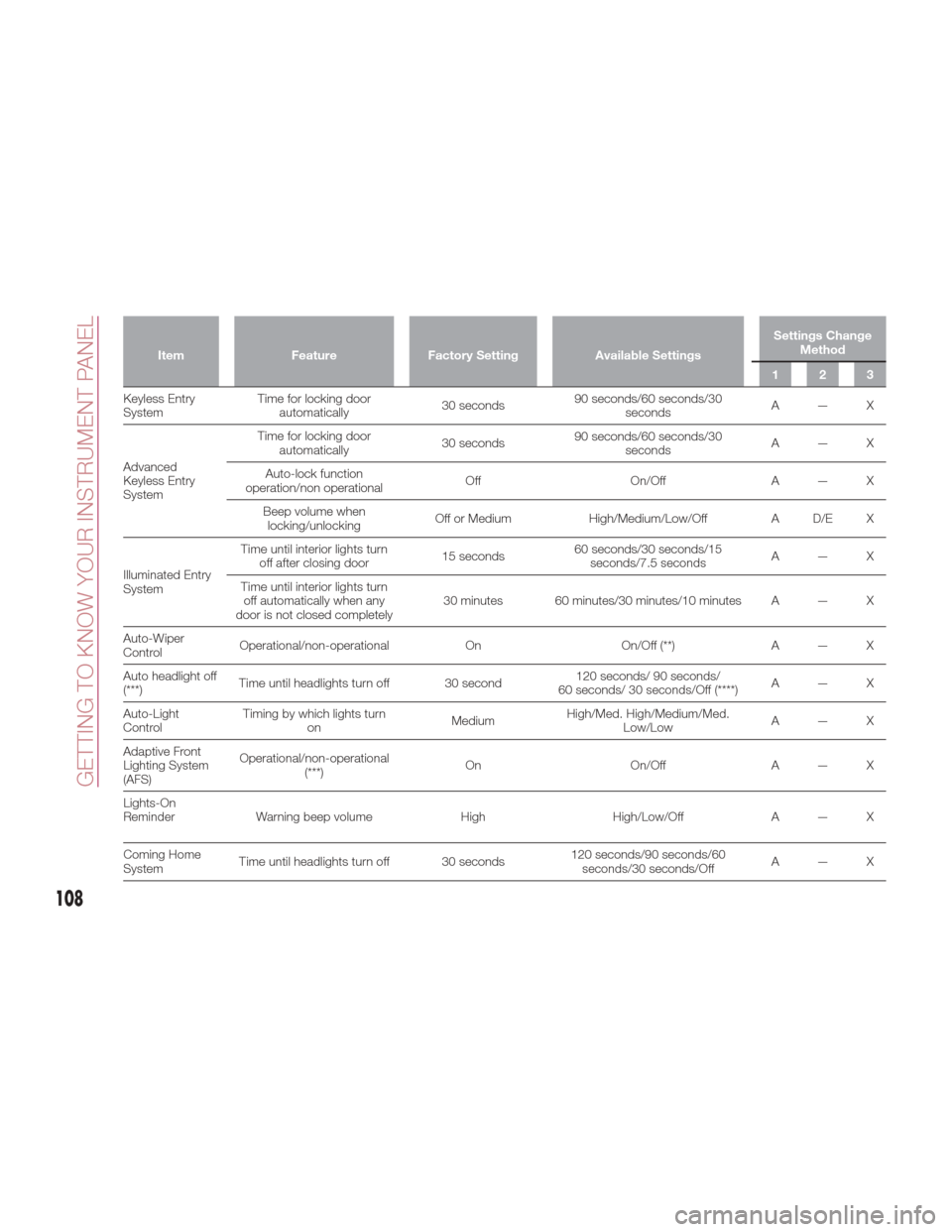
ItemFeature Factory Setting Available Settings Settings Change
Method
123
Keyless Entry
System T
ime for locking door
automatically 30 seconds90 seconds/60 seconds/30
seconds A—X
Advanced
Keyless Entry
System Time for locking door
automatically 30 seconds90 seconds/60 seconds/30
seconds A—X
Auto-lock function
operation/non operational Off
On/OffA — X
Beep volume when locking/unlocking Off or Medium
High/Medium/Low/Off A D/E X
Illuminated Entry
System Time until interior lights turn
off after closing door 15 seconds60 seconds/30 seconds/15
seconds/7.5 seconds A—X
Time until interior lights turn off automatically when any
door is not closed completely 30 minutes 60 minutes/30 minutes/10 minutes A — X
Auto-Wiper
Control Operational/non-operational
OnOn/Off (**)A — X
Auto headlight off
(***) Time until headlights turn off 30 second 120 seconds/ 90 seconds/
60 seconds/ 30 seconds/Off (****) A—X
Auto-Light
Control Timing by which lights turn
on MediumHigh/Med. High/Medium/Med.
Low/Low A—X
Adaptive Front
Lighting System
(AFS) Operational/non-operational
(***) On
On/OffA — X
Lights-On
Reminder Warning beep volume HighHigh/Low/Off A — X
Coming Home
System Time until headlights turn off 30 seconds 120 seconds/90 seconds/60
seconds/30 seconds/Off A—X
108
GETTING TO KNOW YOUR INSTRUMENT PANEL
Page 113 of 292
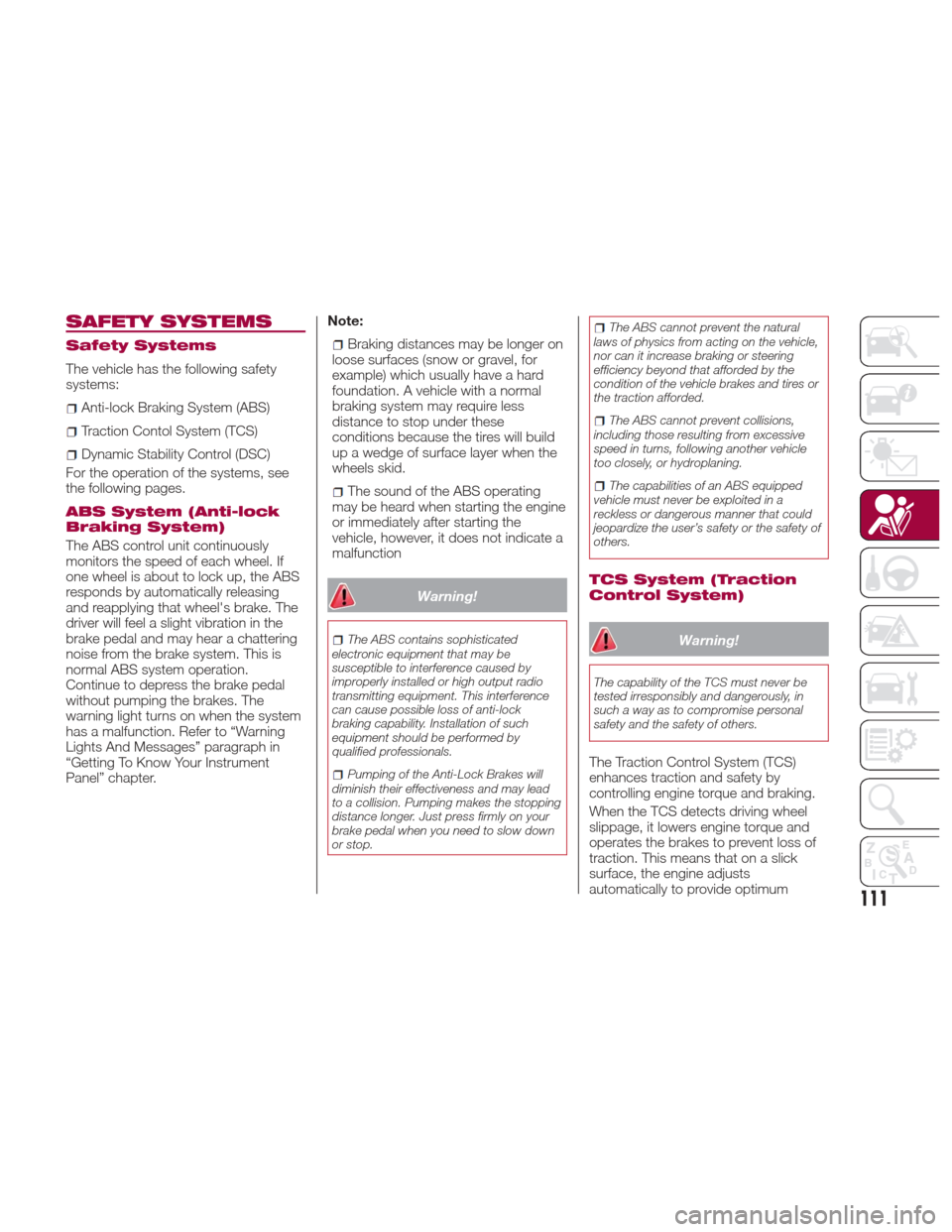
SAFETY SYSTEMS
Safety Systems
The vehicle has the following safety
systems:
Anti-lock Braking System (ABS)
Traction Contol System (TCS)
Dynamic Stability Control (DSC)
For the operation of the systems, see
the following pages.
ABS System (Anti-lock
Braking System)
The ABS control unit continuously
monitors the speed of each wheel. If
one wheel is about to lock up, the ABS
responds by automatically releasing
and reapplying that wheel's brake. The
driver will feel a slight vibration in the
brake pedal and may hear a chattering
noise from the brake system. This is
normal ABS system operation.
Continue to depress the brake pedal
without pumping the brakes. The
warning light turns on when the system
has a malfunction. Refer to “Warning
Lights And Messages” paragraph in
“Getting To Know Your Instrument
Panel” chapter. Note:
Braking distances may be longer on
loose surfaces (snow or gravel, for
example) which usually have a hard
foundation. A vehicle with a normal
braking system may require less
distance to stop under these
conditions because the tires will build
up a wedge of surface layer when the
wheels skid.
The sound of the ABS operating
may be heard when starting the engine
or immediately after starting the
vehicle, however, it does not indicate a
malfunction
Warning!
The ABS contains sophisticated
electronic equipment that may be
susceptible to interference caused by
improperly installed or high output radio
transmitting equipment. This interference
can cause possible loss of anti-lock
braking capability. Installation of such
equipment should be performed by
qualified professionals.
Pumping of the Anti-Lock Brakes will
diminish their effectiveness and may lead
to a collision. Pumping makes the stopping
distance longer. Just press firmly on your
brake pedal when you need to slow down
or stop.
The ABS cannot prevent the natural
laws of physics from acting on the vehicle,
nor can it increase braking or steering
efficiency beyond that afforded by the
condition of the vehicle brakes and tires or
the traction afforded.
The ABS cannot prevent collisions,
including those resulting from excessive
speed in turns, following another vehicle
too closely, or hydroplaning.
The capabilities of an ABS equipped
vehicle must never be exploited in a
reckless or dangerous manner that could
jeopardize the user’s safety or the safety of
others.
TCS System (Traction
Control System)
Warning!
The capability of the TCS must never be
tested irresponsibly and dangerously, in
such a way as to compromise personal
safety and the safety of others.
The Traction Control System (TCS)
enhances traction and safety by
controlling engine torque and braking.
When the TCS detects driving wheel
slippage, it lowers engine torque and
operates the brakes to prevent loss of
traction. This means that on a slick
surface, the engine adjusts
automatically to provide optimum
111
Page 114 of 292
power to the drive wheels, limiting
wheel spin and loss of traction.
The indicator light turns on when the
system has a malfunction. Refer to
“Warning Lights And Messages”
paragraph in “Getting To Know Your
Instrument Panel” chapter.
TCS / DSC Indicator Light
The
indicator light stays on for a few
seconds when the ignition is placed in
the ON mode.
If the TCS or DSC is operating, the
indicator light flashes.
If the
indicator light stays on, the
TCS, DSC or the brake assist system
may have a malfunction and they may
not operate correctly. Contact an
Authorized Dealer.
Note:
In addition to the indicator light
flashing, a slight sound will come from
the engine. This indicates that the
TCS/DSC is operating properly.
On slippery surfaces, such as fresh
snow, it will be impossible to achieve
high rpm when the TCS is on.
DSC System (Dynamic
Stability Control)
The Dynamic Stability Control (DSC)
automatically controls braking and
engine torque in conjunction with
systems such as ABS and TCS to help control side slip when driving on
slippery surfaces, or during sudden or
evasive maneuvering, enhancing vehicle
safety. Refer to “ABS System (Antilock
Brake System)” and “TCS System
(Traction Control System)”.
DSC operation is possible at speeds
greater than 12 mph (20 km/h).
The indicator light turns on when the
system has a malfunction. Refer to
“Warning Lights And Messages”
paragraph in “Getting To Know Your
Instrument Panel” chapter.
Note:
The DSC may not operate correctly
unless the following are observed:
Use tires of the correct size
specified for your vehicle on all four
wheels.
Use tires of the same manufacturer,
brand and tread pattern on all four
wheels.
Do not mix worn tires.
Note:
The DSC may not operate correctly
when tire chains are used.
TCS / DSC Indicator Light
The
indicator light stays on for a few
seconds when the ignition is placed in
the ON mode. It also illuminates when
the DSC OFF switch is pressed and
TCS/DSC is switched off. If the light stays on, the TCS, DSC or
the brake assist system may have a
malfunction and they may not operate
correctly. Take your vehicle to an
Authorized Dealer.
DSC OFF Indicator Light
The
indicator light stays on for a few
seconds when the ignition is placed in
the ON mode. It also illuminates when
the DSC OFF switch is pressed and
TCS/DSC is switched off.
If the light remains illuminated and the
TCS/DSC is not switched off, contact
an Authorized Dealer. The DSC may
have a malfunction.
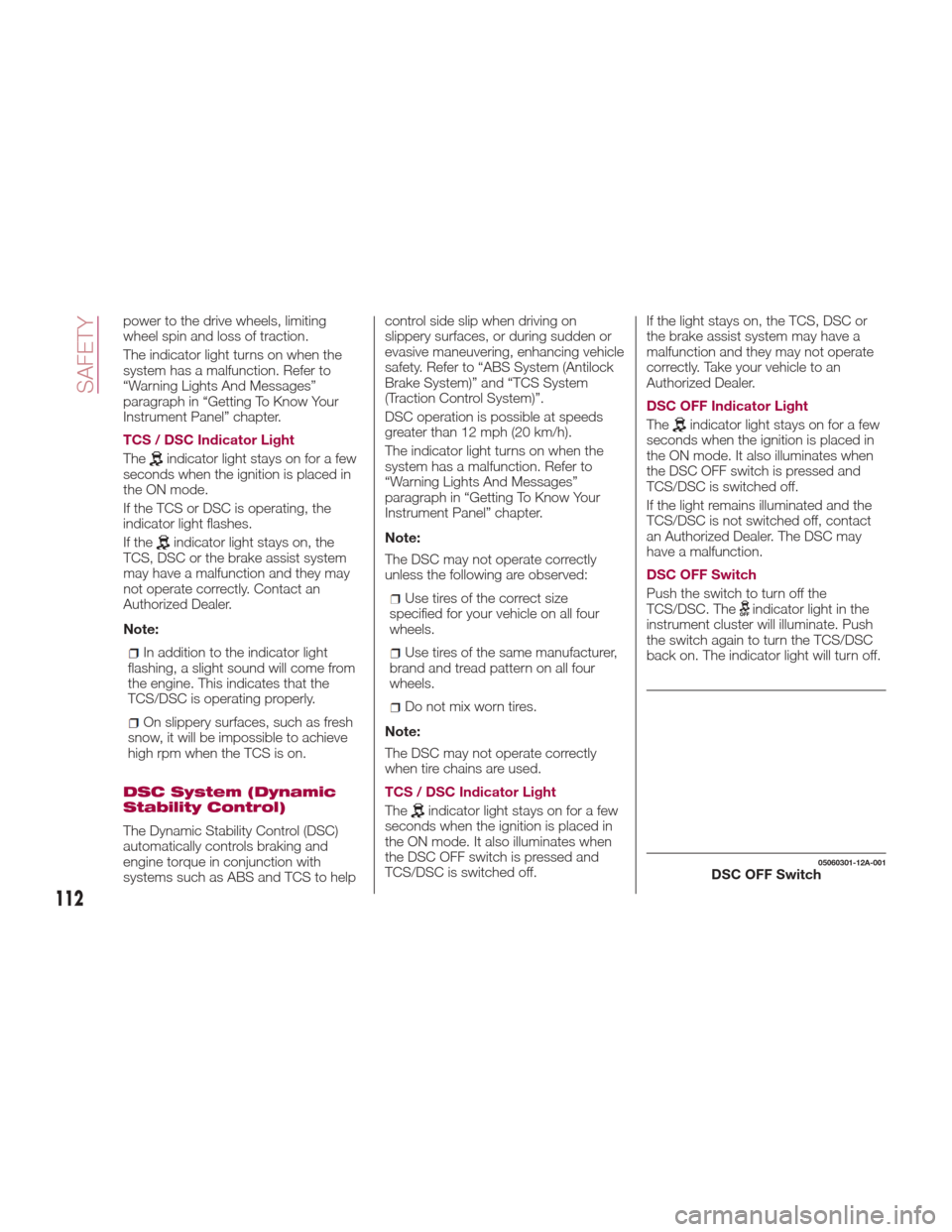
DSC OFF Switch
Pushtheswitchtoturnoffthe
TCS/DSC. The
indicator light in the
instrument cluster will illuminate. Push
the switch again to turn the TCS/DSC
back on. The indicator light will turn off.
05060301-12A-001DSC OFF Switch
112
SAFETY
Page 118 of 292
dimmer and increase the brightness of
Blind Spot Monitoring (BSM) warning
lights when they turn on.
Refer to “Instrument Panel Illumination”
in “Knowing The Instrument Panel”
chapter.
BSM Warning Beep
The BSM warning beep is activated
simultaneously with the flashing of a
BSM warning light.
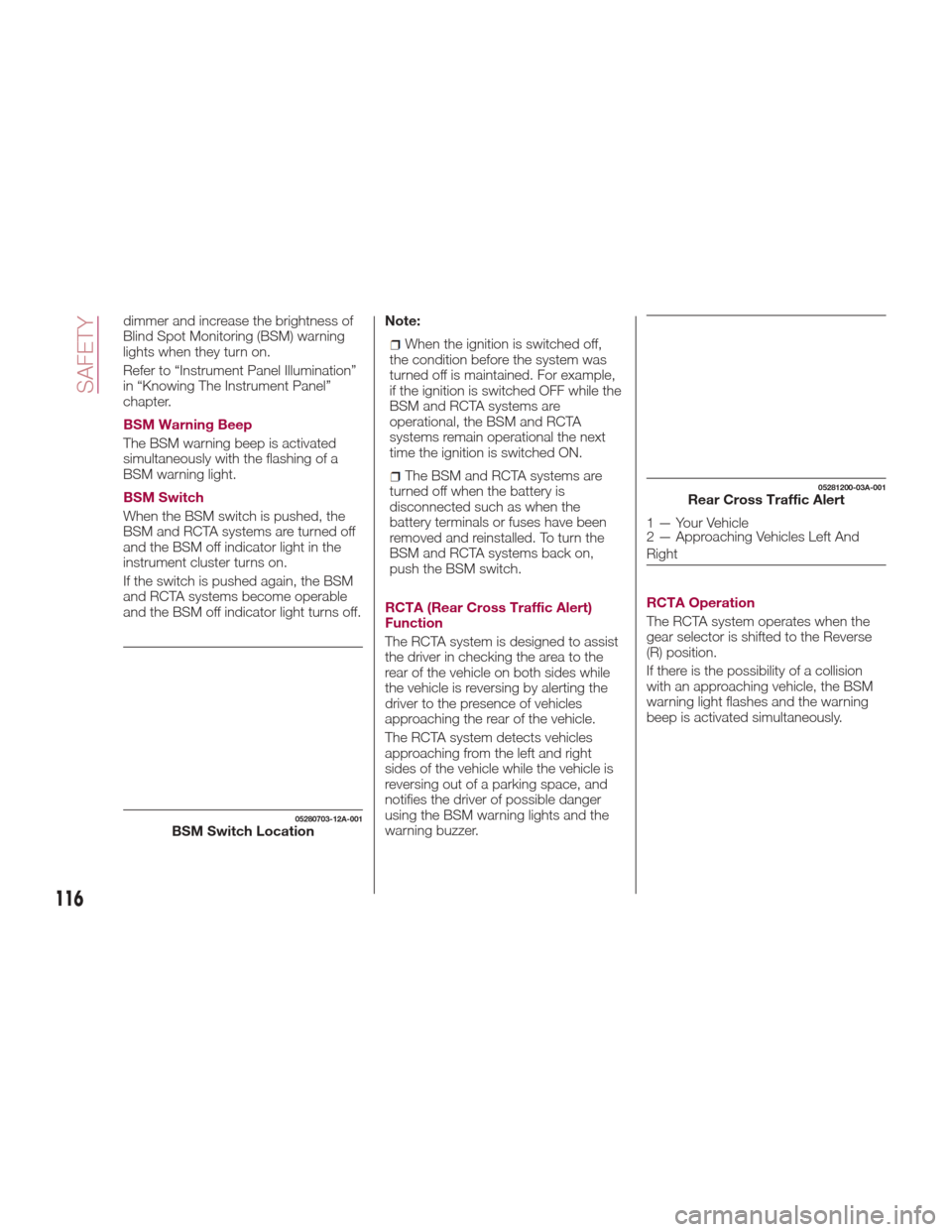
BSM Switch
When the BSM switch is pushed, the
BSM and RCTA systems are turned off
and the BSM off indicator light in the
instrument cluster turns on.
If the switch is pushed again, the BSM
and RCTA systems become operable
and the BSM off indicator light turns off.Note:
When the ignition is switched off,
the condition before the system was
turned off is maintained. For example,
if the ignition is switched OFF while the
BSM and RCTA systems are
operational, the BSM and RCTA
systems remain operational the next
time the ignition is switched ON.
The BSM and RCTA systems are
turned off when the battery is
disconnected such as when the
battery terminals or fuses have been
removed and reinstalled. To turn the
BSM and RCTA systems back on,
push the BSM switch.
RCTA (Rear Cross Traffic Alert)
Function
The RCTA system is designed to assist
the driver in checking the area to the
rear of the vehicle on both sides while
the vehicle is reversing by alerting the
driver to the presence of vehicles
approaching the rear of the vehicle.
The RCTA system detects vehicles
approaching from the left and right
sides of the vehicle while the vehicle is
reversing out of a parking space, and
notifies the driver of possible danger
using the BSM warning lights and the
warning buzzer. RCTA Operation
The RCTA system operates when the
gear selector is shifted to the Reverse
(R) position.
If there is the possibility of a collision
with an approaching vehicle, the BSM
warning light flashes and the warning
beep is activated simultaneously.
05280703-12A-001BSM Switch Location
05281200-03A-001Rear Cross Traffic Alert
1 — Your Vehicle
2 — Approaching Vehicles Left And
Right
116
SAFETY
Page 128 of 292
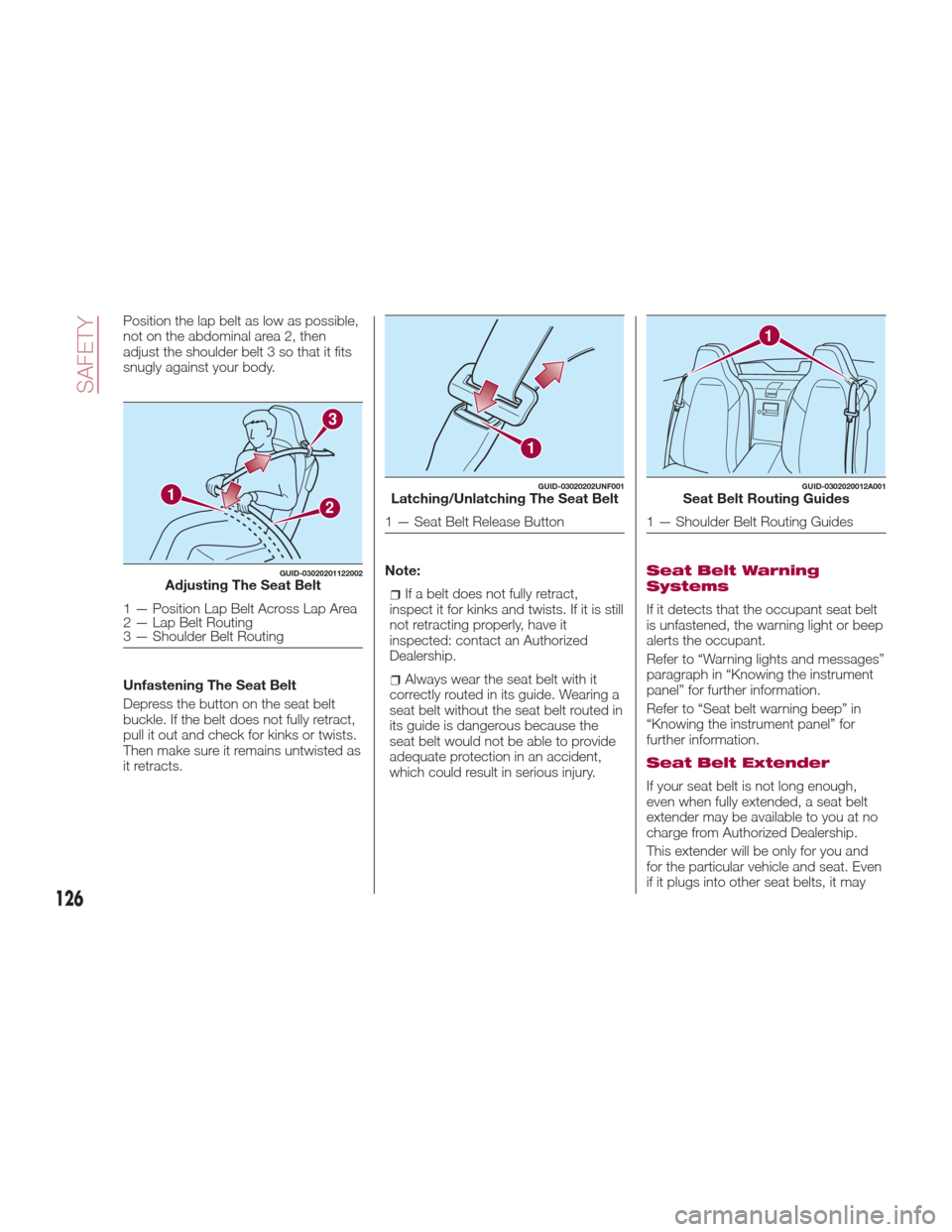
Position the lap belt as low as possible,
not on the abdominal area 2, then
adjust the shoulder belt 3 so that it fits
snugly against your body.
Unfastening The Seat Belt
Depress the button on the seat belt
buckle. If the belt does not fully retract,
pull it out and check for kinks or twists.
Then make sure it remains untwisted as
it retracts.Note:
If a belt does not fully retract,
inspect it for kinks and twists. If it is still
not retracting properly, have it
inspected: contact an Authorized
Dealership.
Always wear the seat belt with it
correctly routed in its guide. Wearing a
seat belt without the seat belt routed in
its guide is dangerous because the
seat belt would not be able to provide
adequate protection in an accident,
which could result in serious injury.
Seat Belt Warning
Systems
If it detects that the occupant seat belt
is unfastened, the warning light or beep
alerts the occupant.
Refer to “Warning lights and messages”
paragraph in “Knowing the instrument
panel” for further information.
Refer to “Seat belt warning beep” in
“Knowing the instrument panel” for
further information.
Seat Belt Extender
If your seat belt is not long enough,
even when fully extended, a seat belt
extender may be available to you at no
charge from Authorized Dealership.
This extender will be only for you and
for the particular vehicle and seat. Even
if it plugs into other seat belts, it may
1
3
2
GUID-03020201122002Adjusting The Seat Belt
1 — Position Lap Belt Across Lap Area
2 — Lap Belt Routing
3 — Shoulder Belt Routing
1
GUID-03020202UNF001Latching/Unlatching The Seat Belt
1 — Seat Belt Release Button
1
GUID-0302020012A001Seat Belt Routing Guides
1 — Shoulder Belt Routing Guides
126
SAFETY
Page 130 of 292
severe frontal, near frontal collisions. In
addition, during a side collision, the
pretensioner operates on the side in
which the collision occurs. The
pretensioners operate differently
depending on what types of air bags
are equipped. For details on the seat
belt pretensioner operation, refer to the
“SRS Air Bag Deployment Criteria”
paragraph in this chapter.
When a collision is detected, the
pretensioners deploy simultaneously
with the air bags. For deployment
details, refer to the “SRS Air Bag
Deployment Criteria” paragraph in this
chapter.
The seat belt retractors remove slack
quickly as the air bags are expanding.
Any time the air bags and seat belt
pretensioners have fired they must be
replaced.
A system malfunction or operation
conditions are indicated by a warning.
Refer to “Warning Lights And
Messages” and “Warning Sound Is
Activated” paragraph in “Knowing The
Instrument Panel” chapter.
With Passenger Occupant
Classification System
In addition, the pretensioner system for
the passenger, like the front and side
passenger Air Bag, is designed to only
deploy when the passenger occupant
classification sensor detects a
passenger sitting on the passenger's
seat.Note:
These devices are not a substitute
for proper seat belt placement by the
occupant. The seat belt still must be
worn snugly and positioned properly.
The pretensioners are triggered by
the Occupant Restraint Controller
(ORC). Like the air bags, the
pretensioners are single use items. A
deployed pretensioner or a deployed
air bag must be replaced immediately.
Load Limiter
The load limiting system releases belt
webbing in a controlled manner to
reduce belt force on the occupant's
chest.
While the most severe load on a seat
belt occurs in frontal collisions, the load
limiter has an automatic mechanical
function and can activate in any
accident mode with sufficient occupant
movement.
Even if the pretensioners have not fired,
the load limiting function must be
checked by an authorized dealer.
CHILD RESTRAINT
PRECAUTIONS
Child Restraints
FCA strongly urges the use of
child-restraint systems for children small
enough to use them.
FCA recommends use of a genuine
child-restraint system or one that
complies with regulation. If you would
like to purchase a FCA genuine
child-restraint system, please contact a
Authorized Dealership.
Check your local and state or provincial
laws for specific requirements regarding
the safety of children riding in your
vehicle.
Whatever child-restraint system you
consider, please pick the appropriate
one for the age and size of the child,
obey the law and follow the instructions
that come with the individual
child-restraint system.
A child who has outgrown
child-restraint systems should use seat
belts, both lap and shoulder. If the
shoulder belt crosses the neck or face,
move the child closer to the centre of
the vehicle.
A rear-facing child-restraint system
should NEVER be used on the
passenger seat with the Air Bag system
activated. In the event of an impact the
Air Bag activation may cause fatal
injuries to the transported child.
128
SAFETY
Page 135 of 292
Small children must be protected by a
child-restraint system as stipulated by
law in every state and province. In
certain states and provinces, larger
children must use a child-restraint
system. Carefully consider which
child-restraint system is necessary for
your child and follow the installation
directions in this Owner's Manual as
well as the child-restraint system
manufacturer's instructions.
Do not use a child-restraint system
which employs an upper tether
because there is no appropriate means
to anchor the tether.
Warning!
No objects should be placed over or
near the air bag on the instrument panel or
steering wheel because any such objects
could cause harm if the vehicle is in a
collision severe enough to cause the air
bag to inflate.
Do not put anything on or around the air
bag covers or attempt to open them
manually. You may damage the air bags
and you could be injured because the air
bags may no longer be functional. The
protective covers for the air bag cushions
are designed to open only when the air
bags are inflating.
Relying on the air bags alone could lead
to more severe injuries in a collision. The air
bags work with your seat belt to restrain
you properly. In some collisions, air bags
won’t deploy at all. Always wear your seat
belts even though you have air bags.
Warning!
Unapproved modifications or service
procedures to the passenger seat
assembly, its related components, seat
cover or cushion may inadvertently change
the air bag deployment in case of a frontal
collision. This could result in death or
serious injury to the front passenger if the
vehicle is involved in a collision. A modified
vehicle may not comply with required
Federal Motor Vehicle Safety Standards
(FMVSS) and/or Canadian Motor Vehicle
Safety Standards (CMVSS).
If it is necessary to modify the air bag
system for persons with disabilities,
contact your authorized dealer.
133
Page 140 of 292
Warning Light/Beep
A system malfunction or operation
conditions are indicated by a warning.
Refer to “Warning lights and messages”
paragraph in “Knowing your instrument
panel” chapter for further information.
Passenger Side Front Air Bag And
Child Restraint Systems
Rearward-facing child restraint systems
mustNEVER be fitted on the front seat
with an active passenger side air bag
since in the event of an impact the air
bag activation may cause fatal injuries
to the transported child.
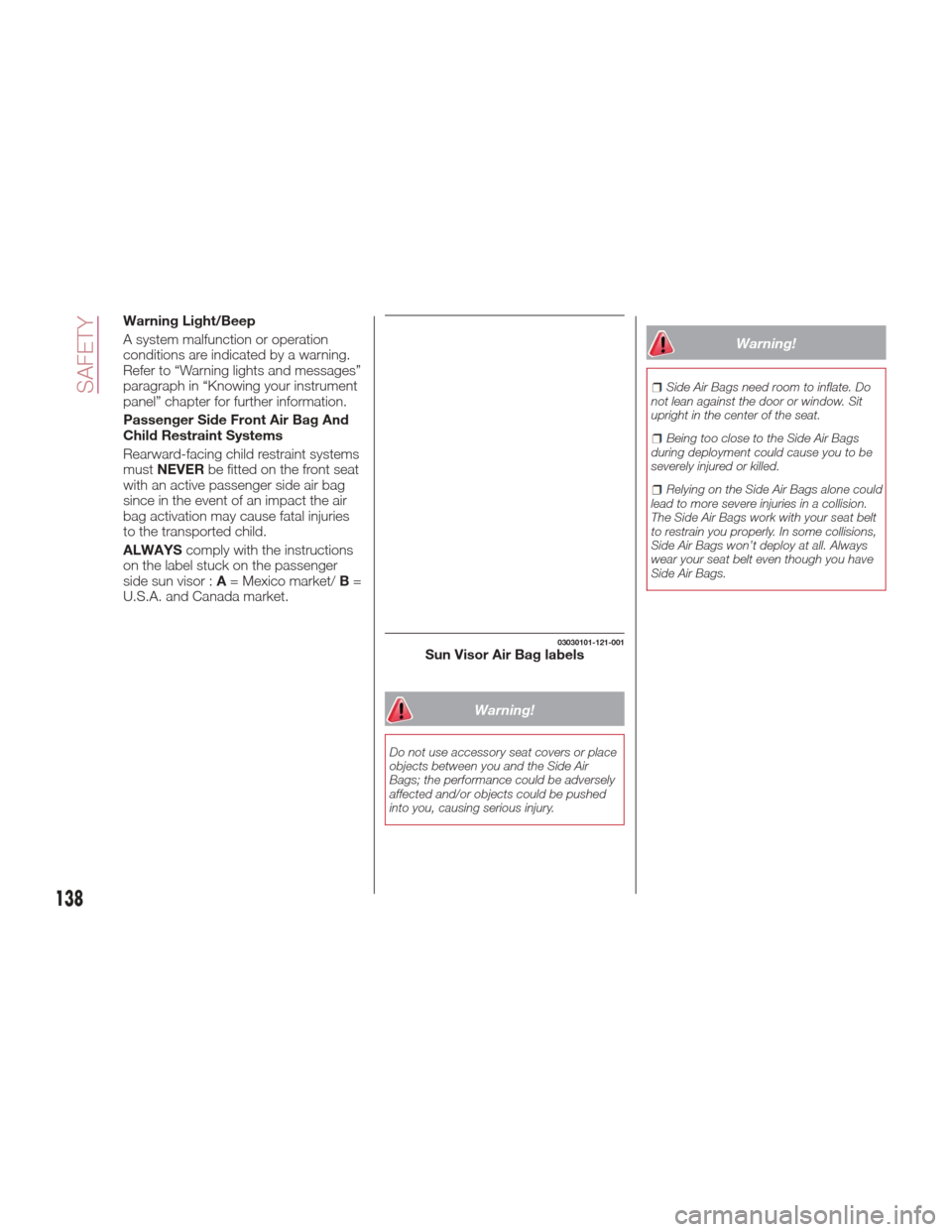
ALWAYS comply with the instructions
on the label stuck on the passenger
side sun visor : A= Mexico market/ B=
U.S.A. and Canada market.
Warning!
Do not use accessory seat covers or place
objects between you and the Side Air
Bags; the performance could be adversely
affected and/or objects could be pushed
into you, causing serious injury.
Warning!
Side Air Bags need room to inflate. Do
not lean against the door or window. Sit
upright in the center of the seat.
Being too close to the Side Air Bags
during deployment could cause you to be
severely injured or killed.
Relying on the Side Air Bags alone could
lead to more severe injuries in a collision.
The Side Air Bags work with your seat belt
to restrain you properly. In some collisions,
Side Air Bags won’t deploy at all. Always
wear your seat belt even though you have
Side Air Bags.
03030101-121-001Sun Visor Air Bag labels
138
SAFETY
Page 142 of 292
Warning!
Unapproved modifications or service
procedures to the passenger seat
assembly, its related components, seat
cover, or cushion may inadvertently change
the air bag deployment in case of a frontal
collision. This could result in death or
serious injury to the front passenger if the
vehicle is involved in a collision. A modified
vehicle may not comply with required
Federal Motor Vehicle Safety Standards
(FMVSS) and/or Canadian Motor Vehicle
Safety Standards (CMVSS).
If it is necessary to modify the air bag
system for persons with disabilities, contact
your authorized dealer.
Warning!
Deployed air bags and seat belt
pretensioners cannot protect you in
another collision. Have the air bags, seat
belt pretensioners, and the seat belt
retractor assemblies replaced by an
authorized dealer immediately. Also, have
the Occupant Restraint Controller System
serviced as well.
Warning!
Ignoring the Air Bag Warning Light in
your instrument panel could mean you
won’t have the air bags to protect you in a
collision. If the light does not come on as a
bulb check when the ignition is first turned
on, stays on after you start the vehicle, or if
it comes on as you drive, have an
authorized dealer service the air bag
system immediately.
Placing an object on the floor under the
front passenger seat may prevent the
occupant classification sensor from
working properly, which may result in
serious injury or death in a collision. Do not
place any objects on the floor under the
front passenger seat.
If there is a fault present in the occupant
classification sensor, both the Indicator
Light and the Air Bag Warning Light will
illuminate to show that the Passenger
Advanced Front Air Bag is deactivated.
Should this occur, the Passenger
Advanced Front Air Bag will remain
deactivated until the fault is cleared. This
indicates that you should take the vehicle
to an authorized dealer for service
immediately.
Limitations To SRS Air
Bag
In severe collisions such as those
described in "SRS Air Bag Deployment
Criteria" paragraph, the applicable SRS
air bag equipment will deploy.
However, in some accidents, the
equipment may not deploy depending
on the type of collision and its severity.
Limitations To Front / Near Front
Collision Detection
Front/near front collisions may not be
detected as severe enough to deploy
the SRS air bag equipment:
Impacts involving trees or poles A.
Frontal offset impact to the vehicle B.
Rear-ending or running under a
truck's tail gate.
140
SAFETY
Page 146 of 292
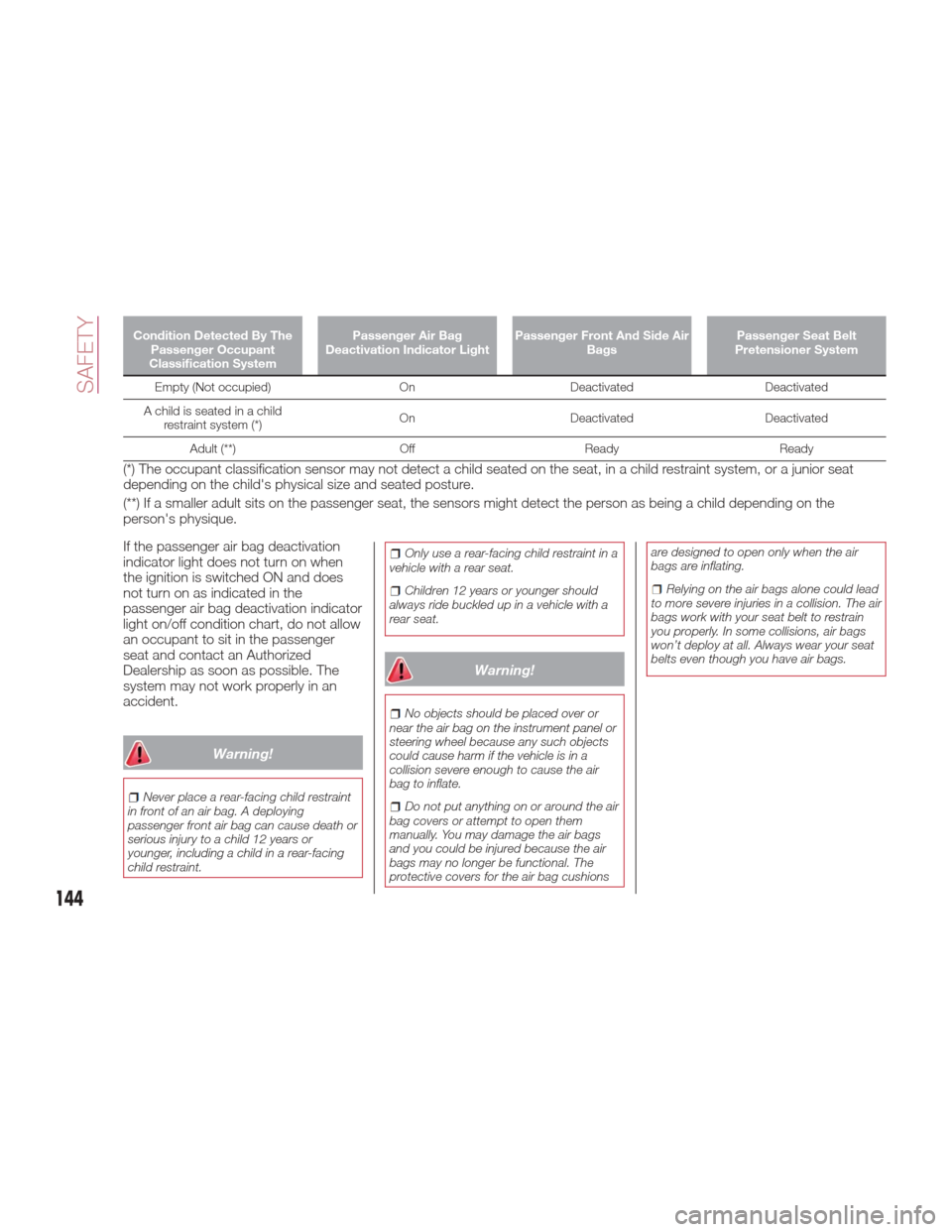
Condition Detected By ThePassenger Occupant
Classification System Passenger Air Bag
Deactivation Indicator Light Passenger Front And Side Air
Bags Passenger Seat Belt
Pretensioner System
Empty (Not occupied) OnDeactivated Deactivated
A
child is seated in a child restraint system (*) On
Deactivated Deactivated
Adult (**) OffReady Ready
(*) The occupant classification sensor may not detect a child seated on the seat, in a child restraint system, or a junior seat
depending on the child's physical size and seated posture.
(**) If a smaller adult sits on the passenger seat, the sensors might detect the person as being a child depending on the
person's physique.
If the passenger air bag deactivation
indicator light does not turn on when
the ignition is switched ON and does
not turn on as indicated in the
passenger air bag deactivation indicator
light on/off condition chart, do not allow
an occupant to sit in the passenger
seat and contact an Authorized
Dealership as soon as possible. The
system may not work properly in an
accident.
Warning!
Never place a rear-facing child restraint
in front of an air bag. A deploying
passenger front air bag can cause death or
serious injury to a child 12 years or
younger, including a child in a rear-facing
child restraint.
Only use a rear-facing child restraint in a
vehicle with a rear seat.
Children 12 years or younger should
always ride buckled up in a vehicle with a
rear seat.
Warning!
No objects should be placed over or
near the air bag on the instrument panel or
steering wheel because any such objects
could cause harm if the vehicle is in a
collision severe enough to cause the air
bag to inflate.
Do not put anything on or around the air
bag covers or attempt to open them
manually. You may damage the air bags
and you could be injured because the air
bags may no longer be functional. The
protective covers for the air bag cushions are designed to open only when the air
bags are inflating.
Relying on the air bags alone could lead
to more severe injuries in a collision. The air
bags work with your seat belt to restrain
you properly. In some collisions, air bags
won’t deploy at all. Always wear your seat
belts even though you have air bags.
144
SAFETY