service FIAT 124 SPIDER ABARTH 2017 2.G Owner's Guide
[x] Cancel search | Manufacturer: FIAT, Model Year: 2017, Model line: 124 SPIDER ABARTH, Model: FIAT 124 SPIDER ABARTH 2017 2.GPages: 292, PDF Size: 121.25 MB
Page 235 of 292
Overfilling the brake fluid reservoir can
result in spilling brake fluid on hot engine
parts, causing the brake fluid to catch fire.
Brake fluid can also damage painted and
vinyl surfaces, care should be taken to
avoid its contact with these surfaces.
Do not allow petroleum based fluid to
contaminate the brake fluid. Brake seal
components could be damaged, causing
partial or complete brake failure. This could
result in a collision.
Windshield And
Headlight Washer Fluid
Inspecting Washer Fluid Level
Inspect fluid level in the washer fluid
reservoir, open the cap and add fluid if
necessary.
Use plain water if washer fluid is
unavailable. But use only washer fluid in
cold weather to prevent it from freezing.
Automatic Transmission
Control Unit
The transmission oil level should only be
checked at your Authorized Dealer.
Battery Maintenance
To get the best service from a battery:
Keep it securely mounted.
Keep the top clean and dry.
Keep terminals and connections
clean, tight, and coated with petroleum
jelly or terminal grease.
Rinse off spilled electrolyte
immediately with a solution of water
and baking soda.
If the vehicle will not be used for an
extended time, disconnect the battery
leads and charge the battery every six
weeks.
Battery Replacement
Contact your Authorized Dealer to
purchase a replacement battery.
Warning!
Battery fluid is a corrosive acid solution
and can burn or even blind you. Do not
allow battery fluid to contact your eyes,
skin, or clothing. Do not lean over a battery
when attaching clamps. If acid splashes in
eyes or on skin, flush the area immediately
with large amounts of water. Refer to
“Jump-Starting” in “In Case Of Emergency”
for further information.
Battery gas is flammable and explosive.
Keep flame or sparks away from the
battery. Do not use a booster battery or
any other booster source with an output
greater than 12 Volts. Do not allow cable
clamps to touch each other.
Battery posts, terminals, and related
accessories contain lead and lead
compounds. Wash hands after handling.
07030901-121-001Windshield Washer Fluid Reservoir
233
Page 239 of 292
RAISING THE
VEHICLE
If the vehicle needs to be raised, see an
authorized dealer which is equipped
with arm hoists or workshop lifts.
The vehicle’s lifting points are marked
on the side skirts with the
symbols.
WHEELS AND TIRES
Tire Safety Information
Tire safety information will cover
aspects of the following information:
Tire Markings, Tire Identification
Numbers, Tire Terminology and
Definitions, Tire Pressures and Tire
Loading.
Tire Markings
Note:
P (Passenger) — Metric tire sizing is
based on U.S. design standards.
P-Metric tires have the letter “P”
molded into the sidewall preceding the
size designation. Example:
P215/65R15 95H.
European — Metric tire sizing is
based on European design standards.
Tires designed to this standard have
the tire size molded into the sidewall
beginning with the section width. The
letter "P" is absent from this tire size
designation. Example: 215/
65R15 96H.
LT (Light Truck) — Metric tire sizing
is based on U.S. design standards.
The size designation for LT-Metric tires
is the same as for P-Metric tires except
for the letters “LT” that are molded into
the sidewall preceding the size
designation. Example: LT235/85R16.
Temporary spare tires are designed
for temporary emergency use only.
Temporary high pressure compact
spare tires have the letter “T” or “S”
molded into the sidewall preceding the
size designation. Example:
T145/80D18 103M.
High flotation tire sizing is based on
U.S. design standards and it begins
with the tire diameter molded into the
sidewall. Example: 31x10.5 R15 LT.
GUID-0601085395US
1 — U.S. DOT Sa-
fety Standards
Code (TIN) 4 — Maximum
Load
2 — Size Designa-
tion 5 — Maximum
Pressure
3 — Service De-
scription 6 — Treadwear,
Traction and Tem-
perature Grades
237
Page 246 of 292
Check tire pressures more often if
subject to a wide range of outdoor
temperatures, as tire pressures vary
with temperature changes.
Tire pressures change by approximately
1 psi (7 kPa) per 12°F (7°C) of air
temperature change. Keep this in mind
when checking tire pressure inside a
garage, especially in the Winter.
Example: If garage temperature = 68°F
(20°C) and the outside temperature =
32°F (0°C) then the cold tire inflation
pressure should be increased by 3 psi
(21 kPa), which equals 1 psi (7 kPa) for
every 12°F (7°C) for this outside
temperature condition.
Tire pressure may increase from 2 to
6 psi (13 to 40 kPa) during operation.
DO NOT reduce this normal pressure
build up or your tire pressure will be too
low.
Tire Pressures For High Speed
Operation
The manufacturer advocates driving at
safe speeds and within posted speed
limits. Where speed limits or conditions
are such that the vehicle can be driven
at high speeds, maintaining correct tire
inflation pressure is very important.
Increased tire pressure and reduced
vehicle loading may be required for
high-speed vehicle operation. Refer to
your authorized tire dealer or original
equipment vehicle dealer forrecommended safe operating speeds,
loading and cold tire inflation pressures.
Warning!
High speed driving with your vehicle under
maximum load is dangerous. The added
strain on your tires could cause them to
fail. You could have a serious collision. Do
not drive a vehicle loaded to the maximum
capacity at continuous speeds above
75 mph (120 km/h).
Radial Ply Tires
Warning!
Combining radial ply tires with other types
of tires on your vehicle will cause your
vehicle to handle poorly. The instability
could cause a collision. Always use radial
ply tires in sets of four. Never combine
them with other types of tires.
Tire Repair
If your tire becomes damaged, it may
be repaired if it meets the following
criteria:
The tire has not been driven on when
flat.
The damage is only on the tread
section of your tire (sidewall damage is
not repairable).
The puncture is no greater than a ¼
of an inch (6 mm).
Consult an authorized tire dealer for tire
repairs and additional information.
Damaged Run Flat tires, or Run Flat
tires that have experienced a loss of
pressure should be replaced
immediately with another Run Flat tire
of identical size and service description
(Load Index and Speed Symbol).
Run Flat Tires — If Equipped
Run Flat tires allow you the capability to
drive 50 miles (80 km) at 50 mph
(80 km/h) after a rapid loss of inflation
pressure. This rapid loss of inflation is
referred to as the Run Flat mode. A Run
Flat mode occurs when the tire inflation
pressure is of/or below 14 psi (96 kPa).
Once a Run Flat tire reaches the run flat
mode it has limited driving capabilities
and needs to be replaced immediately.
A Run Flat tire is not repairable.
It is not recommended driving a vehicle
loaded at full capacity or to tow a trailer
while a tire is in the run flat mode.
See the tire pressure monitoring section
for more information.
Tire Spinning
When stuck in mud, sand, snow, or ice
conditions, do not spin your vehicle's
wheels above 30 mph (48 km/h) or for
longer than 30 seconds continuously
without stopping.
244
SERVICING AND MAINTENANCE
Page 247 of 292
Refer to “Freeing A Stuck Vehicle” in “In
Case Of Emergency” for further
information.
Warning!
Fast spinning tires can be dangerous.
Forces generated by excessive wheel
speeds may cause tire damage or failure. A
tire could explode and injure someone. Do
not spin your vehicle's wheels faster than
30 mph (48 km/h) for more than
30 seconds continuously when you are
stuck, and do not let anyone near a
spinning wheel, no matter what the speed.
Tread Wear Indicators
Tread wear indicators are in the original
equipment tires to help you in
determining when your tires should be
replaced.These indicators are molded into the
bottom of the tread grooves. They will
appear as bands when the tread depth
becomesa1/16ofaninch(1.6mm).
When the tread is worn to the tread
wear indicators, the tire should be
replaced. Refer to “Replacement Tires”
in this section for further information.
Life Of Tire
The service life of a tire is dependent
upon varying factors including, but not
limited to:
Driving style.
Tire pressure - Improper cold tire
inflation pressures can cause uneven
wear patterns to develop across the tire
tread. These abnormal wear patterns
will reduce tread life, resulting in the
need for earlier tire replacement.
Distance driven.
Performance tires, tires with a speed
rating of V or higher, and Summer tires
typically have a reduced tread life.
Rotation of these tires per the vehicle
maintenance schedule is highly
recommended.
Warning!
Tires and the spare tire should be replaced
after six years, regardless of the remaining
tread. Failure to follow this warning can
result in sudden tire failure. You could lose
control and have a collision resulting in
serious injury or death.
Keep dismounted tires in a cool, dry
place with as little exposure to light as
possible. Protect tires from contact with
oil, grease, and gasoline.
GUID-0806104865NATire Tread
1—WornTire
2—NewTire
245
Page 249 of 292
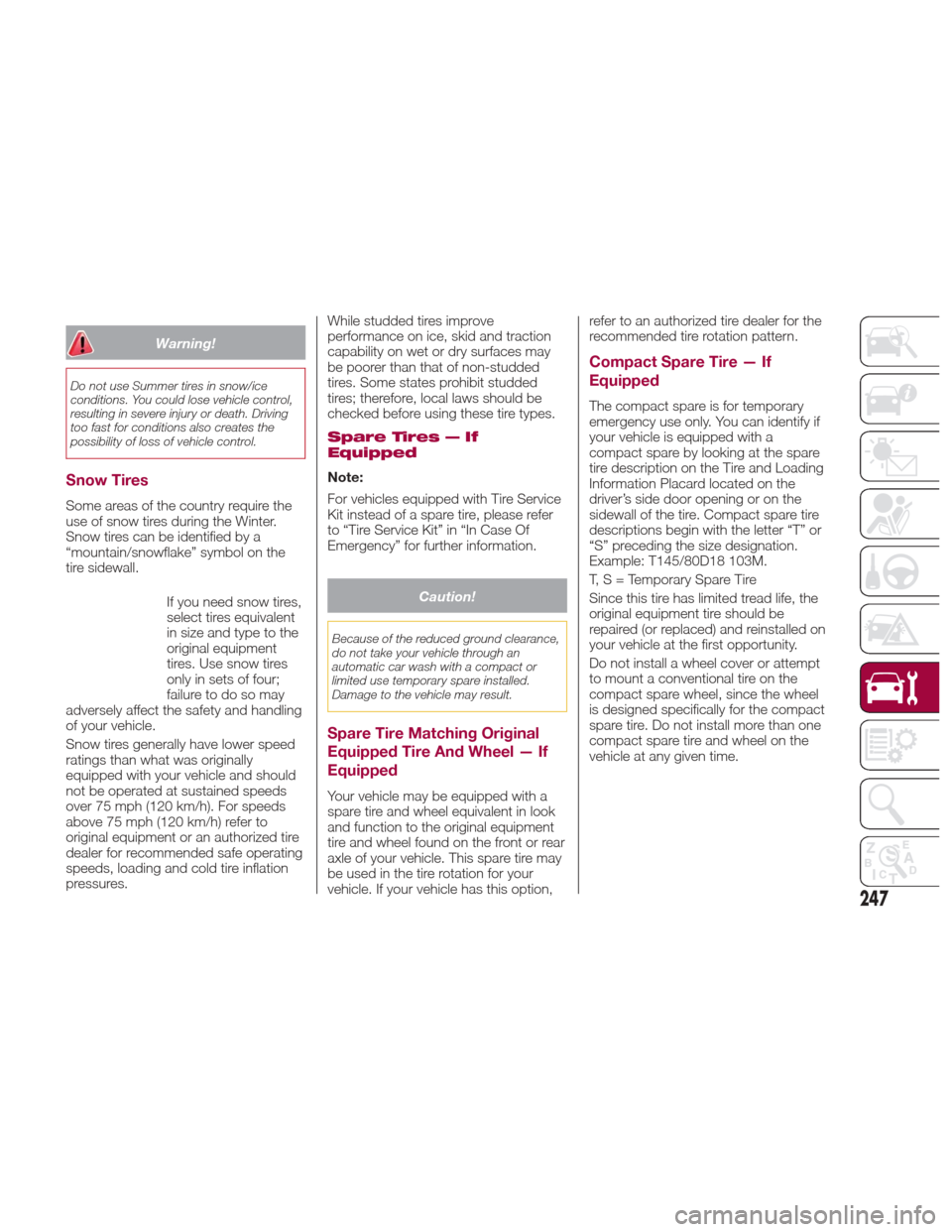
Warning!
Do not use Summer tires in snow/ice
conditions. You could lose vehicle control,
resulting in severe injury or death. Driving
too fast for conditions also creates the
possibility of loss of vehicle control.
Snow Tires
Some areas of the country require the
use of snow tires during the Winter.
Snow tires can be identified by a
“mountain/snowflake” symbol on the
tire sidewall.If you need snow tires,
select tires equivalent
in size and type to the
original equipment
tires. Use snow tires
only in sets of four;
failure to do so may
adversely affect the safety and handling
of your vehicle.
Snow tires generally have lower speed
ratings than what was originally
equipped with your vehicle and should
not be operated at sustained speeds
over 75 mph (120 km/h). For speeds
above 75 mph (120 km/h) refer to
original equipment or an authorized tire
dealer for recommended safe operating
speeds, loading and cold tire inflation
pressures. While studded tires improve
performance on ice, skid and traction
capability on wet or dry surfaces may
be poorer than that of non-studded
tires. Some states prohibit studded
tires; therefore, local laws should be
checked before using these tire types.
Spare Tires — If
Equipped
Note:
For vehicles equipped with Tire Service
Kit instead of a spare tire, please refer
to “Tire Service Kit” in “In Case Of
Emergency” for further information.
Caution!
Because of the reduced ground clearance,
do not take your vehicle through an
automatic car wash with a compact or
limited use temporary spare installed.
Damage to the vehicle may result.
Spare Tire Matching Original
Equipped Tire And Wheel — If
Equipped
Your vehicle may be equipped with a
spare tire and wheel equivalent in look
and function to the original equipment
tire and wheel found on the front or rear
axle of your vehicle. This spare tire may
be used in the tire rotation for your
vehicle. If your vehicle has this option,refer to an authorized tire dealer for the
recommended tire rotation pattern.
Compact Spare Tire — If
Equipped
The compact spare is for temporary
emergency use only. You can identify if
your vehicle is equipped with a
compact spare by looking at the spare
tire description on the Tire and Loading
Information Placard located on the
driver’s side door opening or on the
sidewall of the tire. Compact spare tire
descriptions begin with the letter “T” or
“S” preceding the size designation.
Example: T145/80D18 103M.
T,S=Tempo
rary Spare Tire
Since this tire has limited tread life, the
original equipment tire should be
repaired (or replaced) and reinstalled on
your vehicle at the first opportunity.
Do not install a wheel cover or attempt
to mount a conventional tire on the
compact spare wheel, since the wheel
is designed specifically for the compact
spare tire. Do not install more than one
compact spare tire and wheel on the
vehicle at any given time.
247
Page 253 of 292
DEPARTMENT OF
TRANSPORTATION
UNIFORM TIRE
QUALITY GRADES
The following tire grading categories
were established by the National
Highway Traffic Safety Administration.
The specific grade rating assigned by
the tire's manufacturer in each category
is shown on the sidewall of the tires on
your vehicle.
All passenger vehicle tires must
conform to Federal safety requirements
in addition to these grades.
Treadwear
The Treadwear grade is a comparative
rating, based on the wear rate of the
tire when tested under controlled
conditions on a specified government
test course. For example, a tire graded
150 would wear one and one-half times
as well on the government course as a
tire graded 100. The relative
performance of tires depends upon the
actual conditions of their use, however,
and may depart significantly from the
norm due to variations in driving habits,
service practices, and differences in
road characteristics and climate.
Traction Grades
The Traction grades, from highest to
lowest, are AA, A, B, and C. These
grades represent the tire's ability to
stop on wet pavement, as measured
under controlled conditions on specified
government test surfaces of asphalt
and concrete. A tire marked C may
have poor traction performance.
Warning!
The traction grade assigned to this tire is
based on straight-ahead braking traction
tests, and does not include acceleration,
cornering, hydroplaning, or peak traction
characteristics.
Temperature Grades
The temperature grades are A (the
highest), B, and C, representing the
tire's resistance to the generation of
heat and its ability to dissipate heat,
when tested under controlled
conditions on a specified indoor
laboratory test wheel.Sustained high temperature can cause
the material of the tire to degenerate
and reduce tire life, and excessive
temperature can lead to sudden tire
failure. The grade C corresponds to a
level of performance, which all
passenger vehicle tires must meet
under the Federal Motor Vehicle Safety
Standard No. 109. Grades B and A
represent higher levels of performance
on the laboratory test wheel, than the
minimum required by law.
Warning!
The temperature grade for this tire is
established for a tire that is properly
inflated and not overloaded. Excessive
speed, under-inflation, or excessive
loading, either separately or in
combination, can cause heat buildup and
possible tire failure.
251
Page 281 of 292
CUSTOMER ASSISTANCE
SUGGESTIONS FOR OBTAINING
SERVICE FOR YOUR VEHICLE . . .280
IF YOU NEED ASSISTANCE.....280
WARRANTYINFORMATION.....282
REPORTING SAFETY DEFECTS . .282
PUBLICATION ORDER FORMS . . .283
279
Page 282 of 292
SUGGESTIONS FOR
OBTAINING SERVICE
FOR YOUR VEHICLE
Prepare For The
Appointment
If you are having warranty work done,
be sure to have the right papers with
you. Take your warranty folder. All work
to be performed may not be covered by
the warranty. Discuss additional
charges with the service manager. Keep
a maintenance log of your vehicle's
service history. This can often provide a
clue to the current problem.
Prepare A List
Make a written list of your vehicle's
problems or the specific work you want
done. If you've had an accident or work
done that is not on your maintenance
log, let the service advisor know.
Be Reasonable With
Requests
If you list a number of items and you
must have your vehicle by the end of
the day, discuss the situation with the
service advisor and list the items in
order of priority. At many authorized
dealers, you may obtain a rental vehicle
at a minimal daily charge. If you need a
rental, it is advisable to make these
arrangements when you call for an
appointment.
IF YOU NEED
ASSISTANCE
The manufacturer and its authorized
dealer are vitally interested in your
satisfaction. We want you to be happy
with our products and services.
Warranty service must be done by an
authorized dealer. We strongly
recommend that you take the vehicle to
an authorized dealer. They know your
vehicle the best, and are most
concerned that you get prompt and
high quality service. The manufacturer's
authorized dealer have the facilities,
factory-trained technicians, special
tools, and the latest information to
ensure the vehicle is fixed correctly and
in a timely manner.
This is why you should always talk to an
authorized dealer service manager first.
Most matters can be resolved with this
process.
If for some reason you are still not
satisfied, talk to the general manager or
owner of the authorized dealer. They
want to know if you need assistance.
If an authorized dealer is unable to
resolve the concern, you may contact
the manufacturer's customer center.
Any communication to the
manufacturer's customer center should
include the following information:
Owner's name and address
Owner's telephone number (home
and office)
Authorized dealer name
Vehicle Identification Number (VIN)
Vehicle delivery date and mileage
FIAT Customer Center
P.O. Box 21–8004 Auburn Hills, MI
48321–8004 Phone: 1-888-242-6342
FIAT Canada Customer
Center
P.O. Box 1621 Windsor, Ontario N9A 4H6
Phone: 1-800-465-2001 (English) Phone:
1-800-387-9983 (French)
In Mexico Contact
Av. Prolongacion Paseo de la Reforma,
1240
Sante Fe C.P. 05109
Mexico, D. F.
In Mexico City: 5081-7568
Outside Mexico City: 1-800-505-1300
Puerto Rico And U.S.
Virgin Islands
Customer Service Chrysler International
Services LLC
P.O. Box 191857
San Juan 00919-1857
Tel.: (787) 782-5757
Fax: (787) 782-3345
280
CUSTOMER ASSISTANCE
Page 283 of 292
Customer Assistance
For The Hearing Or
Speech Impaired
(TDD/TTY)
To assist customers who have hearing
difficulties, the manufacturer has
installed special TDD
(Telecommunication Devices for the
Deaf) equipment at its customer center.
Any hearing or speech impaired
customer, who has access to a TDD or
a conventional teletypewriter (TTY) in
the United States, can communicate
with the manufacturer by dialing
1-800-380-CHRY.
Canadian residents with hearing
difficulties that require assistance can
use the special needs relay service
offered by Bell Canada. For TTY
teletypewriter users, dial 711 and for
Voice callers, dial 1-800-855-0511 to
connect with a Bell Relay Service
operator.
Service Contract
You may have purchased a service
contract for a vehicle to help protect
you from the high cost of unexpected
repairs after the manufacturer's New
Vehicle Limited Warranty expires. The
manufacturer stands behind only the
manufacturer's service contracts. If you
purchased a manufacturer's service
contract, you will receive Plan
Provisions and an Owner Identification
Card in the mail within three weeks of
the vehicle delivery date. If you have
any questions about the service
contract, call the manufacturer's
Service Contract National Customer
Hotline at 1-800-521-9922 (Canadian
residents, call (800) 465-2001 English /
(800) 387-9983 French).
The manufacturer will not stand behind
any service contract that is not the
manufacturer's service contract. It is
not responsible for any service contract
other than the manufacturer's service
contract. If you purchased a service
contract that is not a manufacturer's
service contract, and you requireservice after the manufacturer's New
Vehicle Limited Warranty expires,
please refer to the contract documents,
and contact the person listed in those
documents.
We appreciate that you have made a
major investment when you purchased
the vehicle. An authorized dealer has
also made a major investment in
facilities, tools, and training to assure
that you are absolutely delighted with
the ownership experience. You will be
pleased with their sincere efforts to
resolve any warranty issues or related
concerns.
Warning!
Engine exhaust (internal combustion
engines only), some of its constituents, and
certain vehicle components contain, or
emit, chemicals known to the State of
California to cause cancer and birth
defects, or other reproductive harm. In
addition, certain fluids contained in vehicles
and certain products of component wear
contain, or emit, chemicals known to the
State of California to cause cancer and
birth defects, or other reproductive harm.
281
Page 284 of 292
WARRANTY
INFORMATION
See the Warranty Information Booklet,
located on the DVD, for the terms and
provisions of FCA US LLC warranties
applicable to this vehicle and market.
REPORTING SAFETY
DEFECTS
In The 50 United States
And Washington, D.C.
If you believe that your vehicle has a
defect that could cause a crash or
cause injury or death, you should
immediately inform the National
Highway Traffic Safety Administration
(NHTSA) in addition to notifying FCA US
LLC.
If NHTSA receives similar complaints, it
may open an investigation, and if it finds
that a safety defect exists in a group of
vehicles, it may order a recall and
remedy campaign. However, NHTSA
cannot become involved in individual
problems between you, your authorized
dealer or FCA US LLC.
To contact NHTSA, you may call the
Vehicle Safety Hotline toll free at
1-888-327-4236 (TTY: 1-800-424-9153);
or go to http://www.safercar.gov
;or
write to: Administrator, NHTSA,
1200 New Jersey Avenue, SE., West
Building, Washington, D.C. 20590.
You can also obtain other information
about motor vehicle safety from
http://www.safercar.gov .
In Canada
If you believe that your vehicle has a
safety defect, you should contact the
Customer Service Department
immediately. Canadian customers who
wish to report a safety defect to the
Canadian government should contact
Transport Canada, Motor Vehicle
Defect Investigations and Recalls
at 1-800-333-0510 or go to
http://www.tc.gc.ca/roadsafety/
282
CUSTOMER ASSISTANCE