tail FIAT 500 1957 1.G Owner's Manual
[x] Cancel search | Manufacturer: FIAT, Model Year: 1957, Model line: 500, Model: FIAT 500 1957 1.GPages: 128, PDF Size: 9.01 MB
Page 77 of 128
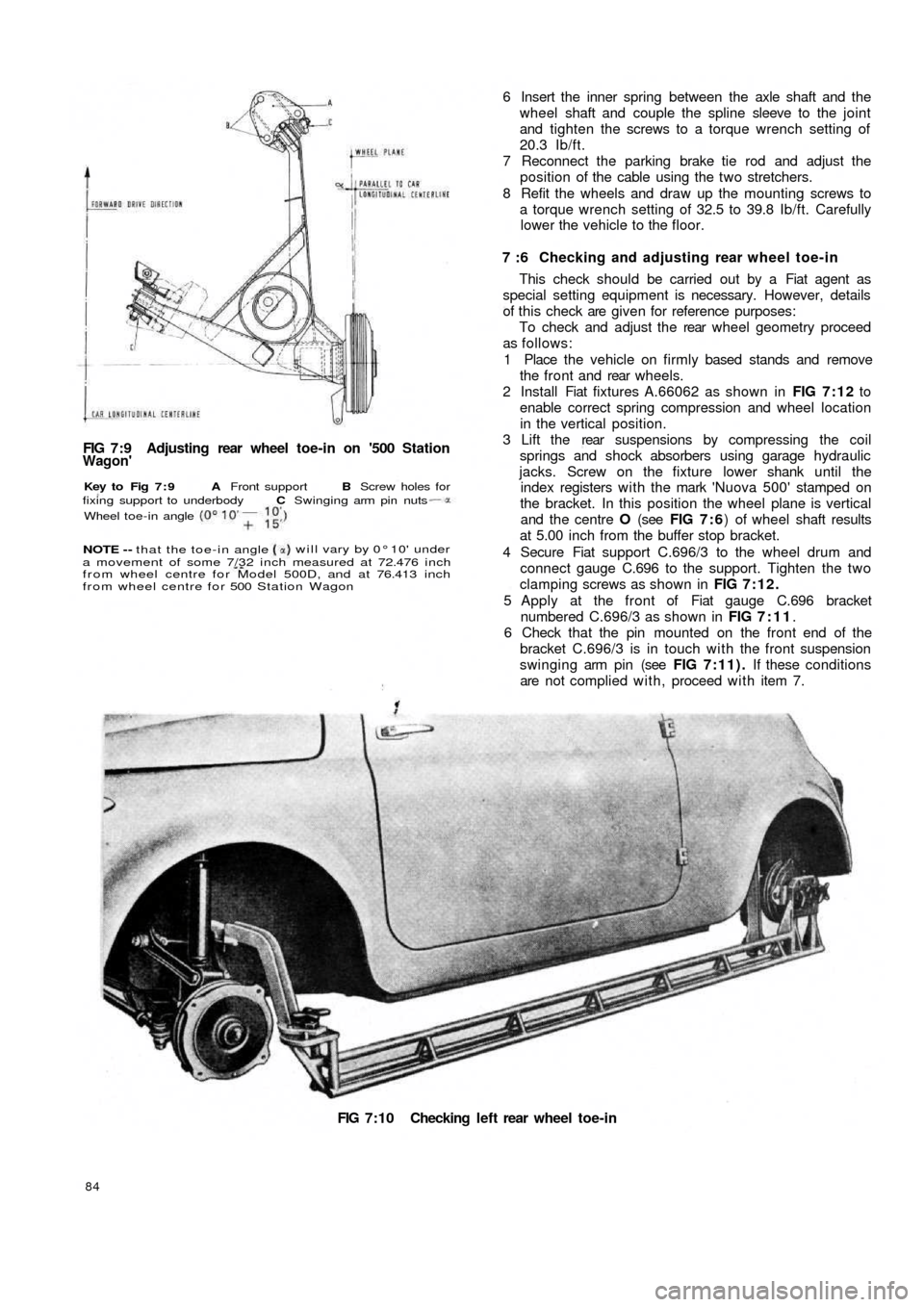
FIG 7:9 Adjusting rear wheel toe-in on '500 StationWagon'
FIG 7:10 Checking left rear wheel toe-in
84
6 Insert the inner spring between the axle shaft and the
wheel shaft and couple the spline sleeve to the joint
and tighten the screws to a torque wrench setting of
20.3 Ib/ft.
7 Reconnect the parking brake tie rod and adjust the
position of the cable using the two stretchers.
8 Refit the wheels and draw up the mounting screws to
a torque wrench setting of 32.5 to 39.8 Ib/ft. Carefully
lower the vehicle to the floor.
7 :6 Checking and adjusting rear wheel toe-in
This check should be carried out by a Fiat agent as
special setting equipment is necessary. However, details
of this check are given for reference purposes:
To check and adjust the rear wheel geometry proceed
as follows:
1 Place the vehicle on firmly based stands and remove
the front and rear wheels.
2 Install Fiat fixtures A.66062 as shown in FIG 7:12 to
enable correct spring compression and wheel location
in the vertical position.
3 Lift the rear suspensions by compressing the coil
springs and shock absorbers using garage hydraulic
jacks. Screw on the fixture lower shank until the
index registers with the mark 'Nuova 500' stamped on
the bracket. In this position the wheel plane is vertical
and the centre O (see FIG 7 : 6) of wheel shaft results
at 5.00 inch from the buffer stop bracket.
4 Secure Fiat support C.696/3 to the wheel drum and
connect gauge C.696 to the support. Tighten the two
clamping screws as shown in FIG 7:12.
5 Apply at the front of Fiat gauge C.696 bracket
numbered C.696/3 as shown in FIG 7:11.
6 Check that the pin mounted on the front end of the
bracket C.696/3 is in touch with the front suspension
swinging arm pin (see FIG 7:11). If these conditions
are not complied with, proceed with item 7.
Wheel toe-in angle
will vary by 0° 10' under
a movement of some 7/32 inch measured at 72.476 inch
from wheel centre for Model 500D, and at 76.413 inch
from wheel centre for 500 Station Wagon NOTE - - that the toe-in angle
Key to Fig 7 : 9 A Front support B Screw holes for
fixing support to underbody C Swinging arm pin nuts
Page 79 of 128
A tolerance of —10'.+ 15' is permitted providing
that the value is the same for both rear wheels. It is
important that both rear wheels are set to the same
angle otherwise uneven tyre wear and adverse handl-
ing conditions will result. When the wheel is parallel to
the centre line of the vehicle the pin of bracket
C.696/3 will be .216 inch apart from the pin of the
front suspension swinging arm.
7 Release the swinging arm outer support to body
mounting screws and position arm in such a way as to
obtain the condition as described in Number 6 above.
After the adjustment has been completed tighten
the outer support mounting screws to a torque wrench
setting of 28.9 to 36.2 Ib/ft. Also tighten the two
swinging arm pin nuts C (see FIG 7 : 7) to a torque
wrench setting of 43.4 to 50.6 Ib/ft. Take off the gauge
C.696 w i t h bracket and support C.696/3, and repeat
the check and adjustment operations on the other
wheel. Care must be taken to ensure that bracket
C.696/3 is reversed from the position previously used.
New 500 type 500D, 110F and 110L sedan and
station wagon:
After the rear suspension has been replaced, check
and, if necessary adjust the rear wheel geometry.
1 Inflate the tyres to the normal operating pressures.
2 Lower the car body so that the rear wheels are set at
90 deg. to the floor. This condition is obtained when
the lowermost portion of the sump is 6.61 inches from
the floor level for the new 500D model or the centre
rear bracket for jacking up the rear of t h e vehicle
8.9 inches from the floor level for the 500 Station
Wagon.
3 With the vehicle set to the above conditions check the
wheel geometry. The wheel plane must converge w i t h
the centre line of the vehicle by an angle of 0 deg. 10'
(—10', +15') toeing in at the front.
4 The wheel plane must be 22.343 ± .059 inches from
the centre line of the vehicle for the 500D model.
Whereas for the 500 Station Wagon the distance must
be 22.264 ± .059 inches.
5 To adjust the rear wheel toe-in adjust the positions of
the mounting screws A and B as shown in FIG 7:7.
86
7:7 Modifications
The new 500 Sedan (110F) and late 500 Station
Wagon are fitted with modified wheels side flexible
joints and rear control arm as shown in FIG 7:13.
Together w i t h these modifications a new design rear
coil spring has been fitted details of which are given in
Technical Data.
7 : 8 Fault diagnosis
(a) Irregular or abnormal tyre wear
1 Incorrect tyre pressure
2 Wheels out of balance
3 Wheels off centre
4 Misadjusted brakes
5 Weak or broken coil springs
6 Excessive load
7 Incorrect wheel alignment
(b) Sag on one wheel
1 Incorrect tyre pressure
2 Weak or broken coil spring
3 Wear of shock absorber causing poor dampening
action
(c) Squeaks, thumps or rattles
1 Wheels out of balance
2 Wheels off centre
3 Misadjusted brakes
4 Weak or broken coil springs or spring seats dislodged
5 Wear of shock absorbers causing poor dampening
action
6 Worn rubber bushings in control arms
7 Poor lubrication of wheel bearings
(d) Pull to one side
1 Incorrect tyre pressure
2 Misadjusted brakes
3 Distorted suspension arm
Page 87 of 128
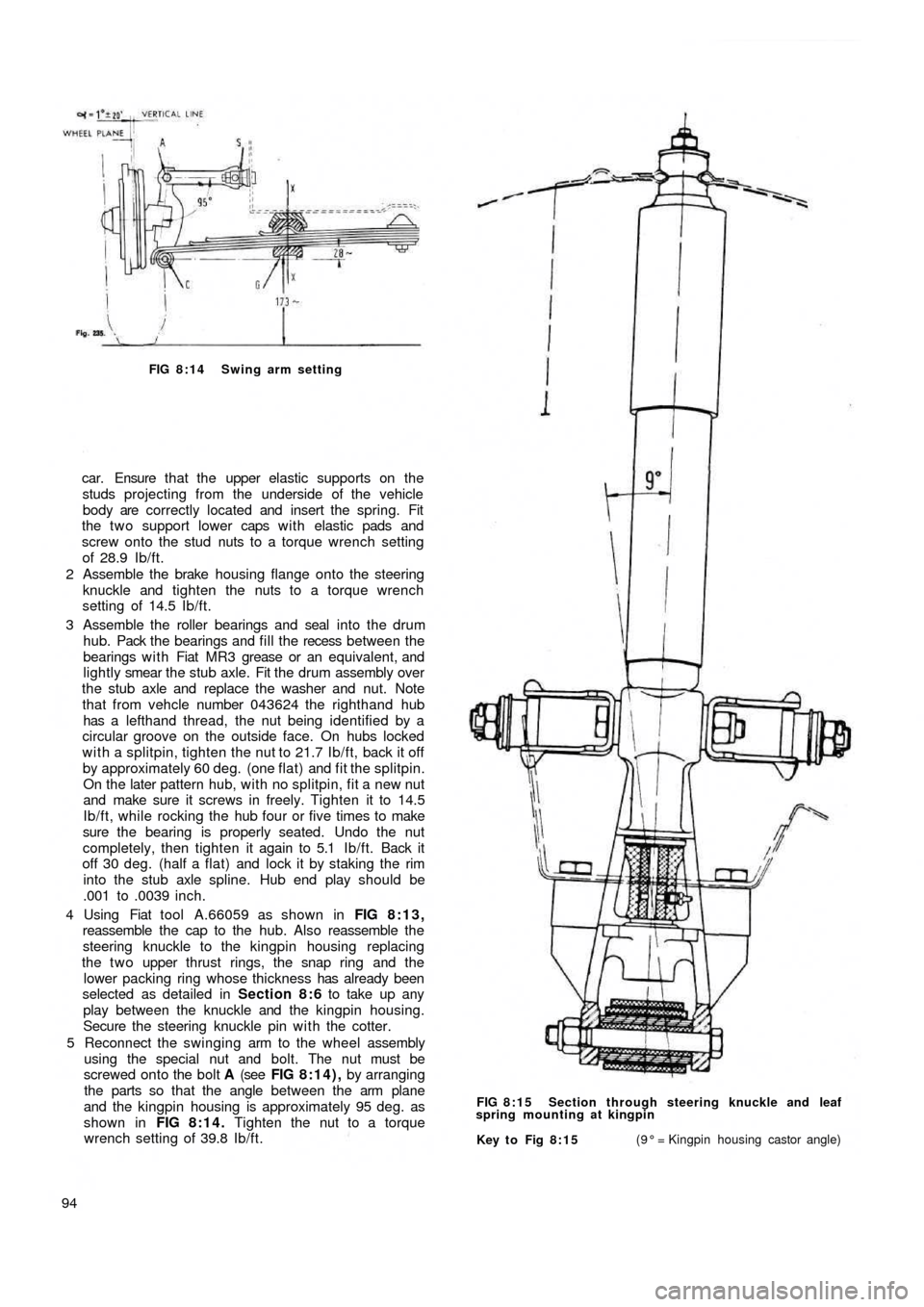
FIG 8:14 Swing arm setting
car. Ensure t h a t the upper elastic supports on the
studs projecting from the underside of the vehicle
body are correctly located and insert the spring. Fit
the two support lower caps w i t h elastic pads and
screw onto the stud nuts to a torque wrench setting
of 28.9 Ib/ft.
2 Assemble the brake housing flange onto the steering
knuckle and tighten the nuts to a torque wrench
setting of 14.5 Ib/ft.
3 Assemble the roller bearings and seal into the drum
hub. Pack the bearings and fill the recess between the
bearings w i t h Fiat MR3 grease or an equivalent, and
lightly smear the stub axle. Fit the drum assembly over
the stub axle and replace the washer and nut. Note
that from vehcle number 043624 the righthand hub
has a lefthand thread, the nut being identified by a
circular groove on the outside face. On hubs locked
with a splitpin, tighten the nut to 21.7 Ib/ft, back it off
by approximately 60 deg. (one flat) and fit the splitpin.
On the later pattern hub, with no splitpin, fit a new nut
and make sure it screws in freely. Tighten it to 14.5
Ib/ft, while rocking the hub four or five times to make
sure the bearing is properly seated. Undo the nut
completely, then tighten it again to 5.1 Ib/ft. Back it
off 30 deg. (half a flat) and lock it by staking the rim
into the stub axle spline. Hub end play should be
.001 to .0039 inch.
4 Using Fiat tool A.66059 as shown in FIG 8:13,
reassemble the cap to the hub. Also reassemble the
steering knuckle to the kingpin housing replacing
the t w o upper
thrust rings, the snap ring and the
lower packing ring whose thickness has already been
selected as detailed in Section 8:6 to take up any
play between the knuckle and the kingpin housing.
Secure the steering knuckle pin with the cotter.
5 Reconnect the swinging arm to the wheel assembly
using the special nut and bolt. The nut must be
screwed onto the bolt A (see FIG 8:14), by arranging
the parts so that the angle between the arm plane
and the kingpin housing is approximately 95 deg. as
shown in FIG 8:14. Tighten the nut to a torque
wrench setting of 39.8 Ib/ft.
94
Key to Fig 8:15(9° = Kingpin housing castor angle) FIG 8:15 Section through steering knuckle and leaf
spring mounting at kingpin
Page 104 of 128
CHAPTER 11
THE ELECTRICAL EQUIPMENT
11:1 Description
11:2 Battery
11:3 The generator
11:4 The starter
11:5 The control box
1 1 : 6 Fuses
1 1 : 7 Flasher unit
11:1 Description
All models covered by this manual have 12 volts
electrical systems in which the negative battery terminal
is earthed. There are three units in the regulator box to
control the charging circuit; a cut-out, a current regulator
and a voltage regulator. These are adjustable but it must
be stressed that accurate moving coil meters are required
when checking or altering the settings. Cheap and
unreliable instruments will make accurate adjustments
impossible.
There are wiring diagrams in Technical Data at the end
of this manual to enable those with electrical experience
to trace and correct wiring faults.
For t h e U.K. Market the headlamps are of the double
filament dipping renewable bulb type with adjustments
for individual beam settings.
The battery is located in the front compartment
forward of the petrol tank and the fuses to the rear o f the
petrol tank.
Detailed instructions for servicing the electrical equip-
ment will be found in this chapter, but it must be pointed
out that it is not sensible to try to repair that which is
seriously defective, electrically or mechanically. Such
equipment should be replaced by new units which can
be obtained on an exchange basis.
F500111
11 :8 Windscreen wipers
1 1 : 9 The lighting system
11:10 Panel and warning lights
11:11 The horn
11:12 Lighting and flasher switch
1 1 : 1 3 Fault diagnosis
11.2 The battery
This of the 12-volt lead/acid type and has to meet
heavy demands for current particularly in the winter. To
maintain the performance of the battery at its maximum
it is essential to carry out the following operations.
Keep the top of the battery and surrounding parts dry
and clean, as dampness can cause leakage between the
securing clamps and the battery terminals. Clean off any
corrosion from the metal parts of the battery mounting
with diluted ammonia and paint them with an anti-
sulphuric paint. If the terminal posts are corroded,
remove the cables and clean w i t h diluted ammonia.
Smear the posts w i t h petroleum jelly before remaking the
connections and fit the terminals securely. High electrical
resistance due to corrosion at the terminal posts is often
responsible for lack of sufficient current to operate the
starter motor.
Ensure t h a t the filler plugs are in good condition and
show no signs of cracks. This may cause leakage of
electrolyte and consequent corrosion. Test the condition
of the cells after topping-up the electrolyte level with
distilled water to just above the tops of the separators as
shown in FIG 11 :2 . Never add neat acid. If it is
necessary to make a new electrolyte due to loss by
spillage add sulphuric acid to the
distilled water.
It is highly dangerous to add water to acid.
Page 115 of 128
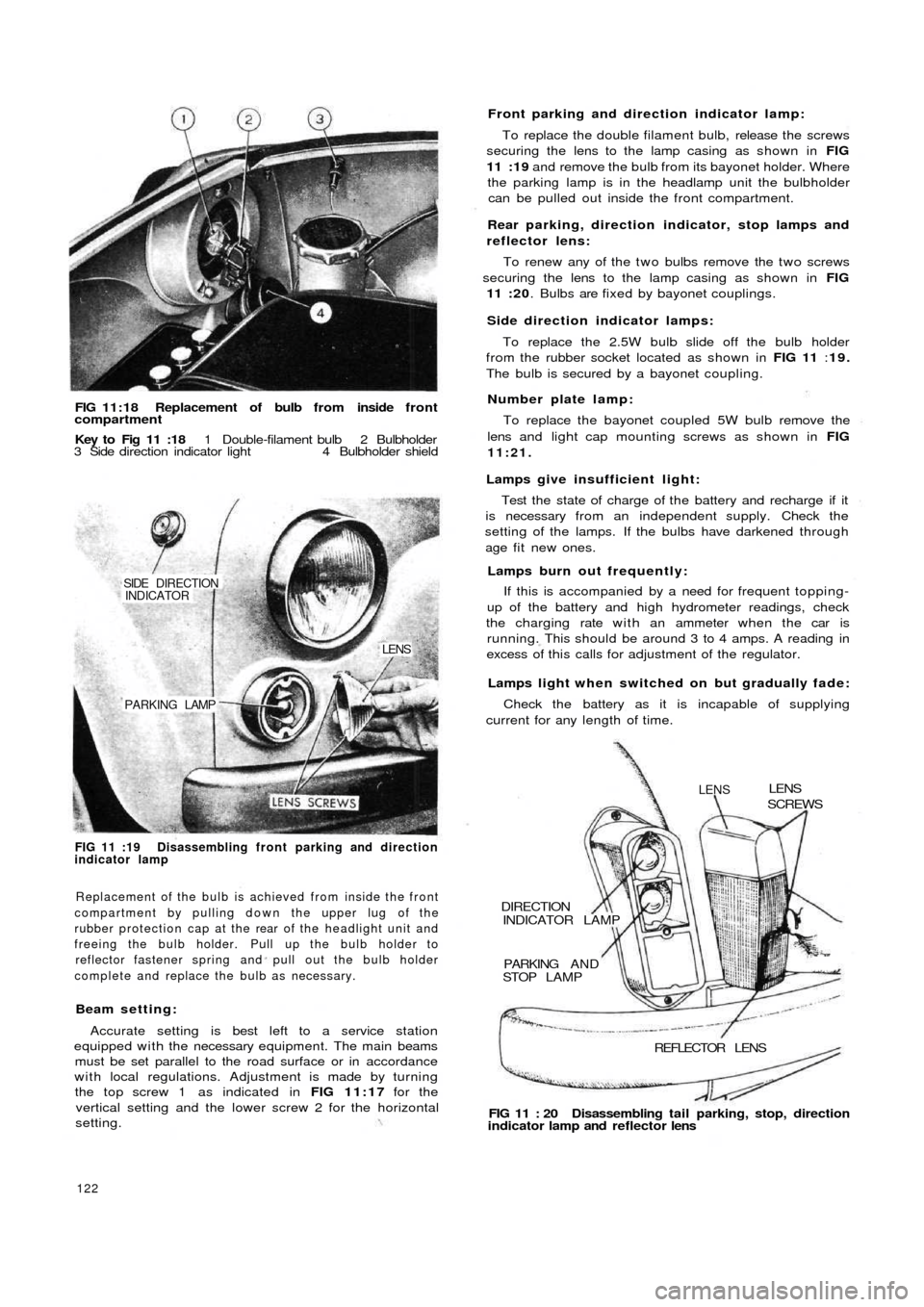
FIG 11:18 Replacement of bulb from inside f r o n tcompartment
Key to Fig 11 :18 1 Double-filament bulb 2 Bulbholder
3 Side direction indicator light 4 Bulbholder shield
PARKING LAMP
LENS
SIDE DIRECTIONINDICATOR
FIG 11 :19 Disassembling front parking and direction
indicator lamp
Replacement of the bulb is achieved from inside the front
compartment by pulling down the upper lug of the
rubber protection cap at the rear of t h e headlight unit and
freeing the bulb holder. Pull up the bulb holder to
reflector fastener spring and pull out the bulb holder
complete and replace the bulb as necessary.
Beam setting:
Accurate setting is best left to a service station
equipped with the necessary equipment. The main beams
must be set parallel to the road surface or in accordance
with local regulations. Adjustment is made by turning
the top screw 1 as indicated in FIG 11:17 for the
vertical setting and the lower screw 2 for the horizontal
setting.
122
FIG 11 : 20 Disassembling tail parking, stop, direction
indicator lamp and reflector lens REFLECTOR LENS PARKING A N D
STOP LAMP INDICATOR LAMP
DIRECTION
LENSLENS
SCREWS
Lamps light when switched on but gradually fade:
Check the battery as it is incapable of supplying
current for any length of time. Front parking and direction indicator lamp:
To replace the double filament bulb, release the screws
securing the lens to the lamp casing as shown in FIG
11 :19 and remove the bulb from its bayonet holder. Where
the parking lamp is in the headlamp unit the bulbholder
can be pulled out inside the front compartment.
Rear parking, direction indicator, stop lamps and
reflector lens:
To renew any of the t w o bulbs remove the t w o screws
securing the lens to the lamp casing as shown in FIG
11 : 2 0. Bulbs are fixed by bayonet couplings.
Side direction indicator lamps:
To replace the 2.5W bulb slide off the bulb holder
from the rubber socket located as shown in FIG 11 :19.
The bulb is secured by a bayonet coupling.
Number plate lamp:
To replace the bayonet coupled 5W bulb remove the
lens and light cap mounting screws as shown in FIG
11:21.
Lamps give insufficient light:
Test the state of charge of the battery and recharge if it
is necessary from an independent supply. Check the
setting of the lamps. If the bulbs have darkened through
age fit new ones.
Lamps burn out frequently:
If this is accompanied by a need for frequent topping-
up of the battery and high hydrometer readings, check
the charging rate with an ammeter when the car is
running. This should be around 3 to 4 amps. A reading in
excess of this calls for adjustment of the regulator.
Page 121 of 128
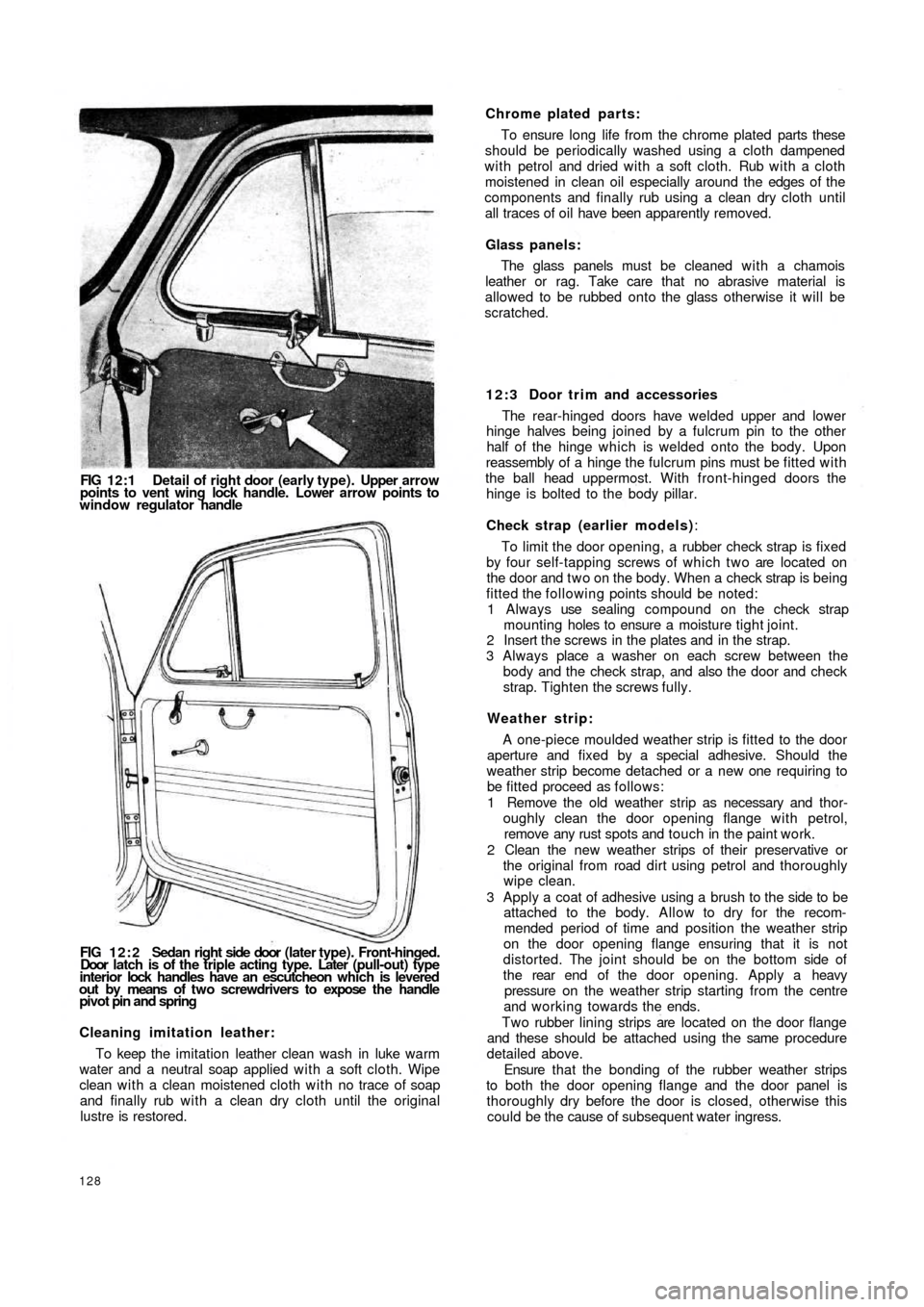
FIG 12:1 Detail of right door (early type). Upper arrow
points to vent wing lock handle. Lower arrow points to
window regulator handle
FIG 1 2 : 2 Sedan right side door (later type). Front-hinged.
Door latch is of the triple acting type. Later (pull-out) type
interior lock handles have an escutcheon which is levered
out by means of t w o screwdrivers to expose the handle
pivot pin and spring
Cleaning imitation leather:
To keep the imitation leather clean wash in luke warm
water and a neutral soap applied with a soft cloth. Wipe
clean with a clean moistened cloth with no trace of soap
and finally rub with a clean dry cloth until the original
lustre is restored.
128
Chrome plated parts:
To ensure long life from the chrome plated parts these
should be periodically washed using a cloth dampened
with petrol and dried with a soft cloth. Rub with a cloth
moistened in clean oil especially around the edges of the
components and finally rub using a clean dry cloth until
all traces of oil have been apparently removed.
Glass panels:
The glass panels must be cleaned w i t h a chamois
leather or rag. Take care that no abrasive material is
allowed to be rubbed onto the glass otherwise it will be
scratched.
12:3 Door trim and accessories
The rear-hinged doors have welded upper and lower
hinge halves being joined by a fulcrum pin to the other
half of the hinge which is welded onto the body. Upon
reassembly of a hinge the fulcrum pins must be fitted with
the ball head uppermost. With front-hinged doors the
hinge is bolted to the body pillar.
Check strap (earlier models):
To limit the door opening, a rubber check strap is fixed
by four self-tapping screws of which two are located on
the door and t w o on the body. When a check strap is being
fitted the following points should be noted:
1 Always use sealing compound on the check strap
mounting holes to ensure a moisture t i g h t j o i n t .
2 Insert the screws in the plates and in the strap.
3 Always place a washer on each screw between the
body and the check strap, and also the door and check
strap. Tighten the screws fully.
Weather strip:
A one-piece moulded weather strip is fitted to the door
aperture and fixed by a special adhesive. Should the
weather strip become detached or a new one requiring to
be fitted proceed as follows:
1 Remove the old weather strip as necessary and thor-
oughly clean the door opening flange with petrol,
remove any rust spots and touch in the paint work.
2 Clean the new weather strips of their preservative or
the original from road dirt using petrol and thoroughly
wipe
clean.
3 Apply a coat of adhesive using a brush to the side to be
attached to the body. Allow to dry for the recom-
mended period of time and position the weather strip
on the door opening flange ensuring that it is not
distorted. The joint should be on the bottom side of
the rear end of the door opening. Apply a heavy
pressure on the weather strip starting from the centre
and working towards the ends.
Two rubber lining strips are located on the door flange
and these should be attached using the same procedure
detailed above.
Ensure that the bonding of the rubber weather strips
to both the door opening flange and the door panel is
thoroughly dry before the door is closed, otherwise this
could be the cause of subsequent water ingress.