speci FIAT 500 1961 1.G Owner's Guide
[x] Cancel search | Manufacturer: FIAT, Model Year: 1961, Model line: 500, Model: FIAT 500 1961 1.GPages: 128, PDF Size: 9.01 MB
Page 81 of 128
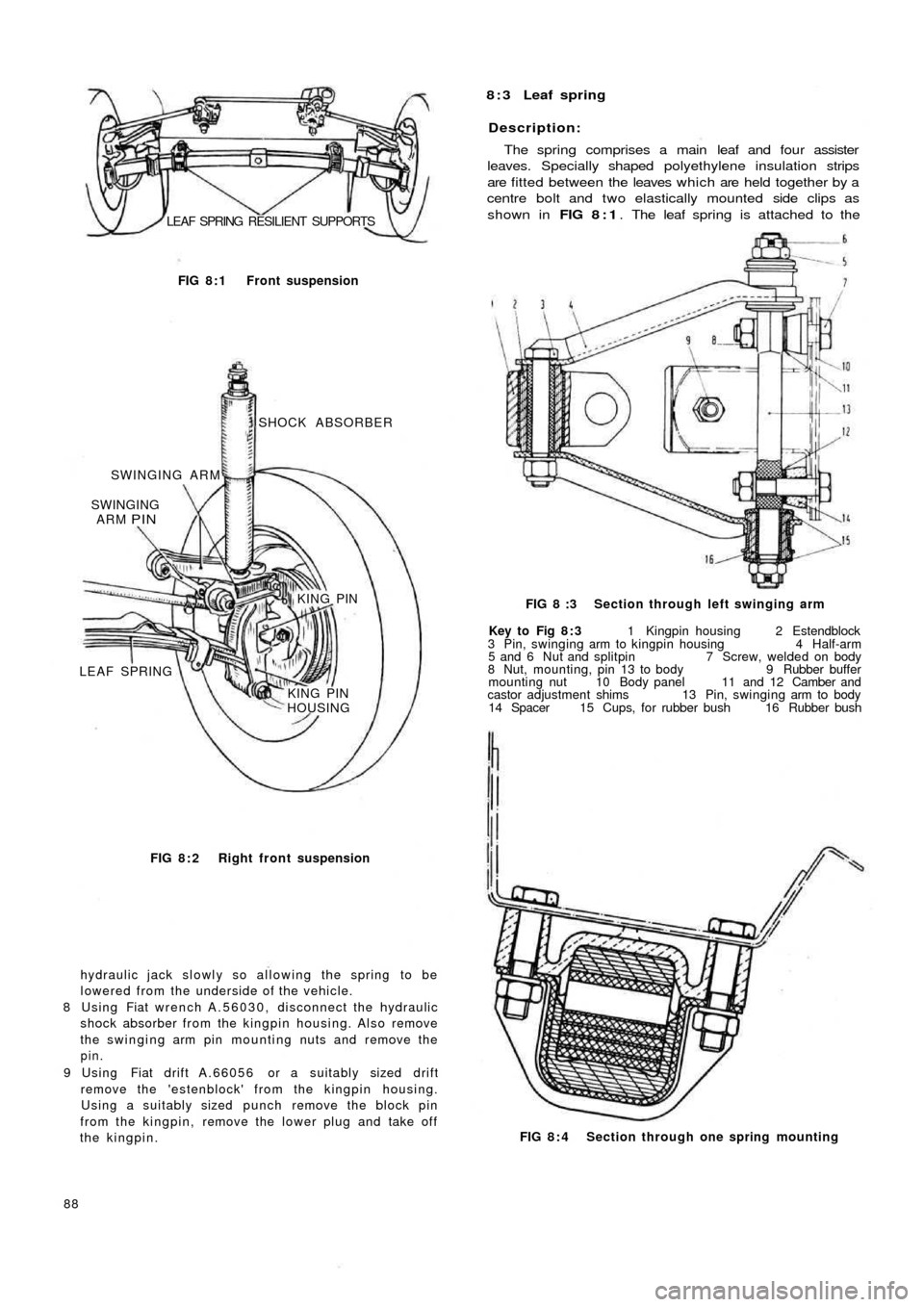
LEAF SPRING RESILIENT SUPPORTS
FIG 8 : 1 Front suspension
SHOCK ABSORBER
SWINGING ARM
SWINGING
ARM
PIN
KING PIN
LEAF SPRING
KING PIN
HOUSING
FIG 8 : 2 Right front suspension
hydraulic jack slowly so allowing the spring to be
lowered from the underside of the vehicle.
8 Using Fiat wrench A.56030, disconnect the hydraulic
shock absorber from the kingpin housing. Also remove
the swinging arm pin mounting nuts and remove the
pin.
9 Using Fiat drift A.66056 or a suitably sized drift
remove the 'estenblock' from the kingpin housing.
Using a suitably sized punch remove the block pin
from the kingpin, remove the lower plug and take off
the kingpin.
88FIG 8 : 4 Section through one spring mounting Key to Fig 8 : 3 1 Kingpin housing 2 Estendblock
3 Pin, swinging arm to kingpin housing 4 Half-arm
5 and 6 Nut and splitpin 7 Screw, welded on body
8 Nut, mounting, pin 13 to body 9 Rubber buffer
mounting nut 10 Body panel 11 and 12 Camber and
castor adjustment shims 13 Pin, swinging arm to body
14 Spacer 15 Cups, for rubber bush 16 Rubber bush FIG 8 :3 Section through left swinging arm
Description:
The spring comprises a main leaf and four assister
leaves. Specially shaped polyethylene insulation strips
are fitted between the leaves which are held together by a
centre bolt and two elastically mounted side clips as
shown in FIG 8 : 1. The leaf spring is attached to the 8 : 3 Leaf spring
Page 82 of 128
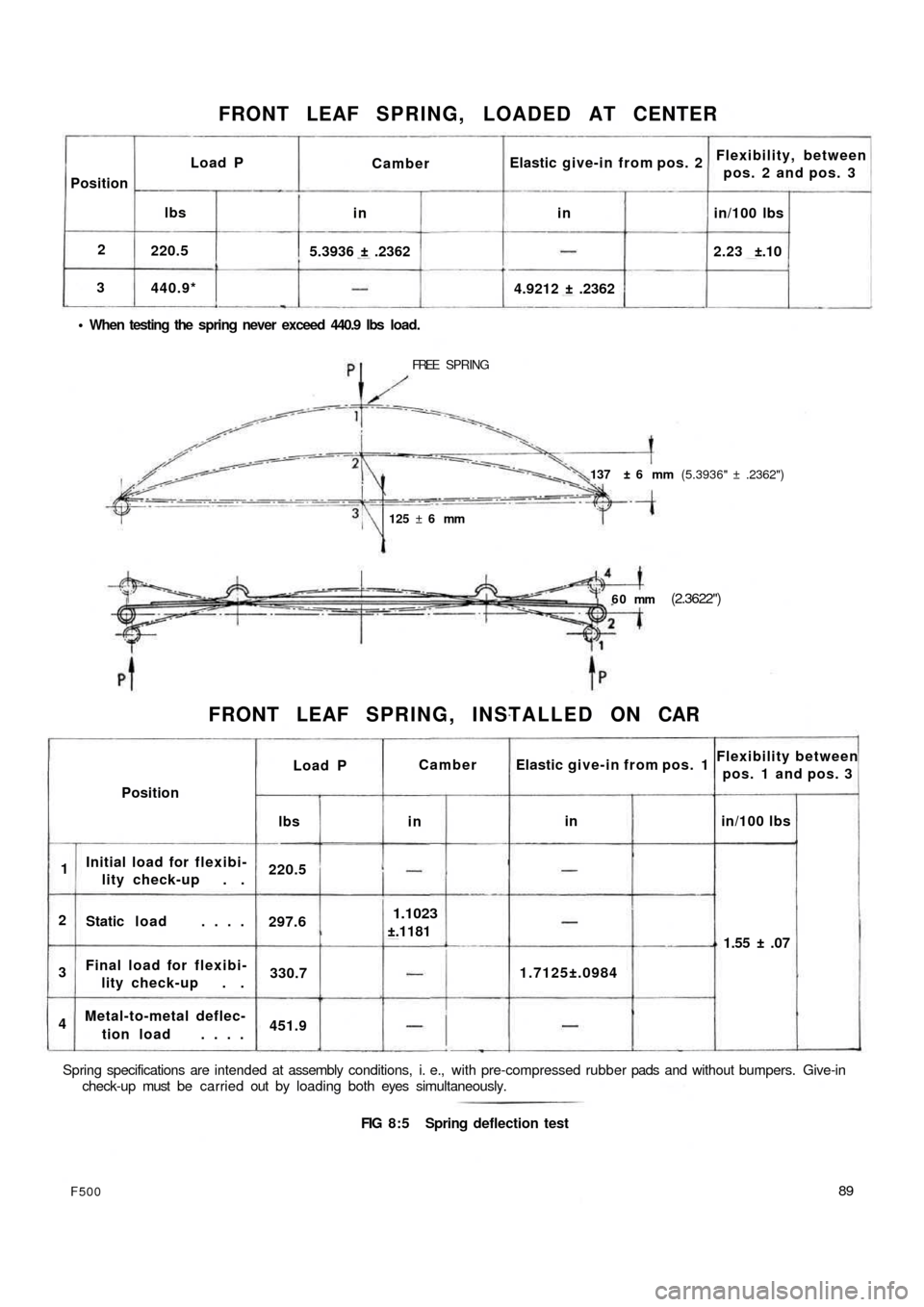
3
440.9* 2
220.5
5.3936 ± .2362
When testing the spring never exceed 440.9 lbs load.4.9212 ± .23622.23 ±.10in/100 lbs inFlexibility, between
pos. 2 and pos. 3 Elastic give-in from pos. 2
Camber
in lbs PositionLoad P
FRONT LEAF SPRING, LOADED AT CENTER
125 ± 6 mm FREE SPRING
60 mm
(2.3622")
137 ± 6 mm (5.3936" ± .2362")
FRONT LEAF SPRING, INSTALLED ON CAR
Flexibility between
pos. 1 and pos. 3 Elastic give-in from pos. 1 Camber
Load P
Position
lbs in
1Initial load for flexibi-
lity check-up . .220.5in in/100 lbs
2
Static l o a d ....
297.6
1.1023
±.1181
1.55 ± .07
1.7125±.0984
330.7 Final load for flexibi-
lity check-up . . 3
4Metal-to-metal deflec-
tion load ....451.9
Spring specifications are intended at assembly conditions, i. e., with pre-compressed rubber pads and without bumpers. Give-in
check-up must be c arried out by loading both eyes simultaneously.
FIG 8 : 5 Spring deflection test
F50089
Page 83 of 128
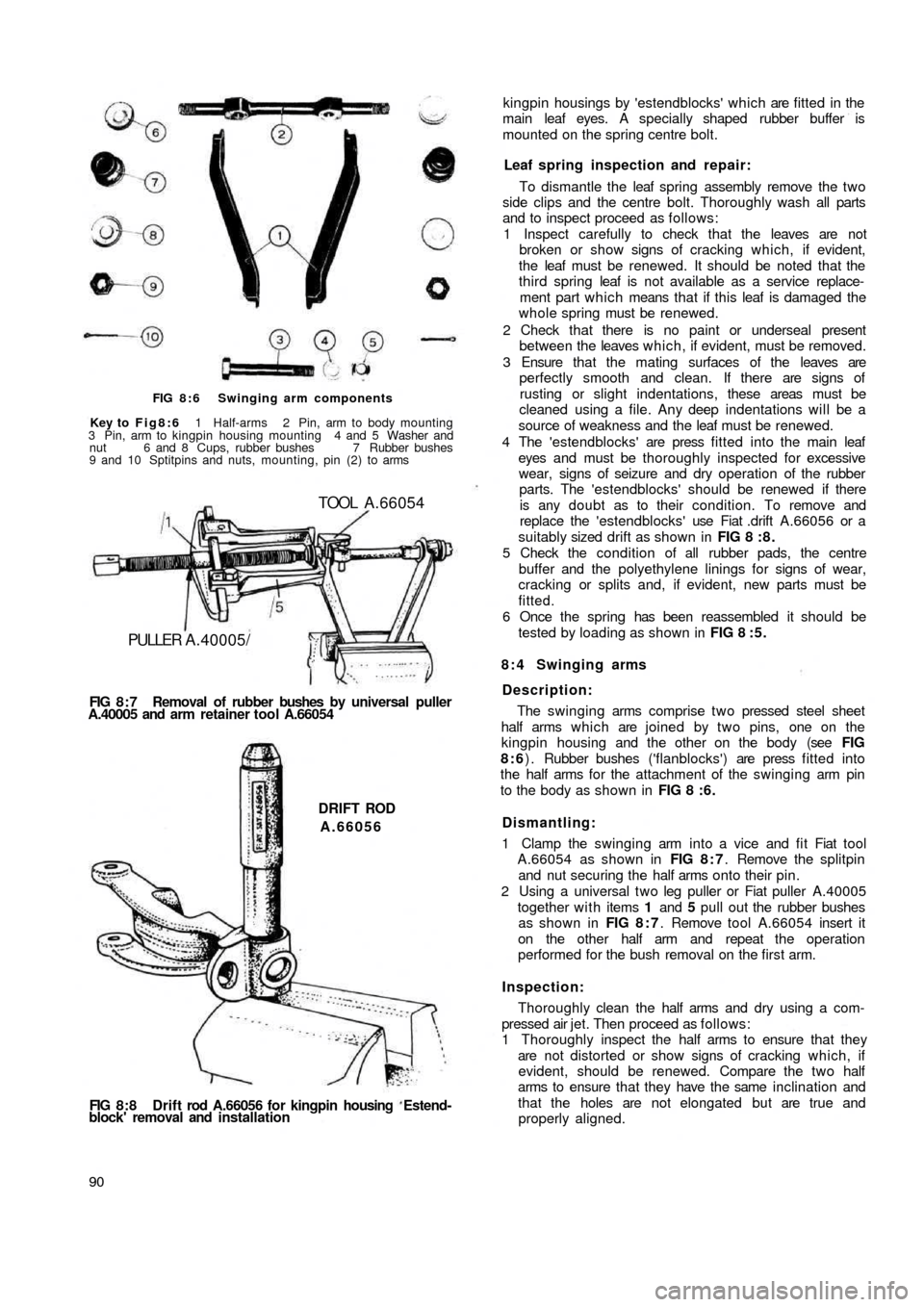
FIG 8:6 Swinging arm components
Key to Fig8:6 1 Half-arms 2 Pin, arm to body mounting
3 Pin, arm to kingpin housing mounting 4 and 5 Washer and
nut 6 and 8 Cups, rubber bushes 7 Rubber bushes
9 and 10 Sptitpins and nuts, mounting, pin (2) to arms
TOOL A.66054
PULLER A.40005/
FIG 8 : 7 Removal of rubber bushes by universal puller
A.40005 and arm retainer tool A.66054
DRIFT ROD
A.66056
FIG 8:8 Drift rod A.66056 for kingpin housing Estend-
block' removal and installation
90Inspection:
Thoroughly clean the half arms and dry using a com-
pressed air jet. Then proceed as follows:
1 Thoroughly inspect the half arms to ensure that they
are not distorted or show signs of cracking which, if
evident, should be renewed. Compare the t w o half
arms to ensure that they have the same inclination and
that the holes are not elongated but are true and
properly aligned. kingpin housings by 'estendblocks' which are fitted in the
main leaf eyes. A specially shaped rubber buffer is
mounted on the spring centre bolt.
Leaf spring inspection and repair:
To dismantle the leaf spring assembly remove the t w o
side clips and the centre bolt. Thoroughly wash all parts
and to inspect proceed as follows:
1 Inspect carefully to check that the leaves are not
broken or show signs of cracking which, if evident,
the leaf must be renewed. It should be noted that the
third spring leaf is not available as a service replace-
ment part which means that if this leaf is damaged the
whole spring must be renewed.
2 Check that there is no paint or underseal present
between the leaves which, if evident, must be removed.
3 Ensure that the mating surfaces of the leaves are
perfectly smooth and clean. If there are signs of
rusting or slight indentations, these areas must be
cleaned using a file. Any deep indentations will be a
source of weakness and the leaf must be renewed.
4 The 'estendblocks' are press fitted into the main leaf
eyes and must be thoroughly inspected for excessive
wear, signs of seizure and dry operation of the rubber
parts. The 'estendblocks' should be renewed if there
is any doubt as to their condition. To remove and
replace the 'estendblocks' use Fiat .drift A.66056 or a
suitably sized drift as shown in FIG 8 : 8 .
5 Check the condition of all rubber pads, the centre
buffer and the polyethylene linings for signs of wear,
cracking or splits and, if evident, new parts must be
fitted.
6 Once the spring has been reassembled it should be
tested by loading as shown in FIG 8 : 5 .
8:4 Swinging arms
Description:
The swinging arms comprise t w o pressed steel sheet
half arms which are joined by two pins, one on the
kingpin housing and the other on the body (see FIG
8:6) . Rubber bushes ('flanblocks') are press fitted into
the half arms for the attachment of the swinging arm pin
to the body as shown in FIG 8 : 6 .
Dismantling:
1 Clamp the swinging arm into a vice and fit Fiat tool
A.66054 as shown in FIG 8 : 7. Remove the splitpin
and nut securing the half arms onto their pin.
2 Using a universal t w o leg puller or Fiat puller A.40005
together with items 1 and 5 pull out the rubber bushes
as shown in FIG 8 : 7. Remove tool A.66054 insert it
on the other half arm and repeat the operation
performed for the bush removal on the first arm.
Page 86 of 128
8 : 7 Hydraulic damper:
Description:
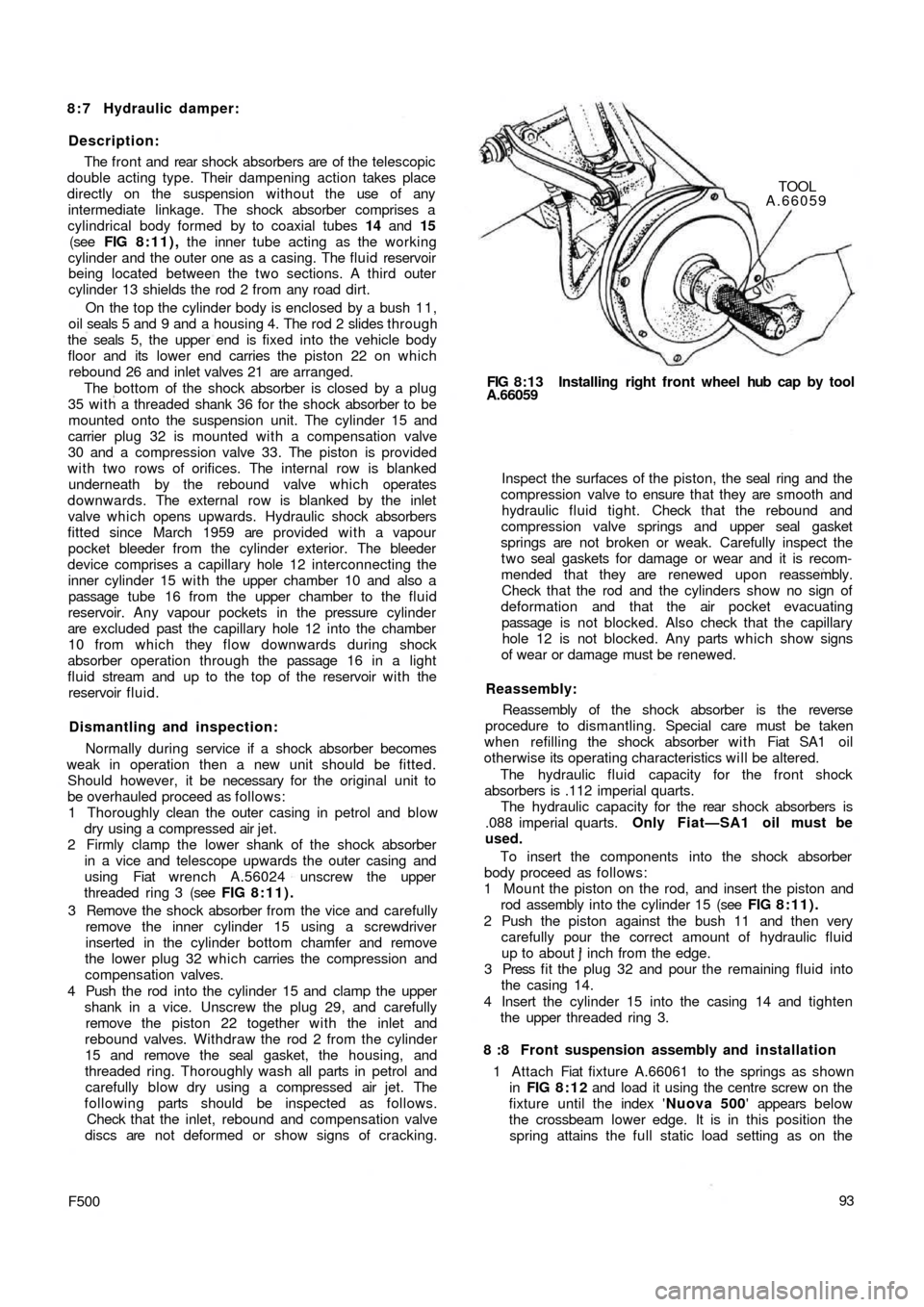
The front and rear shock absorbers are of the telescopic
double acting type. Their dampening action takes place
directly on the suspension without the use of any
intermediate linkage. The shock absorber comprises a
cylindrical body formed by to coaxial tubes 14 and 15
(see FIG 8:11), the inner tube acting as the working
cylinder and the outer one as a casing. The fluid reservoir
being located between the two sections. A third outer
cylinder 13 shields the rod 2 from any road dirt.
On the top the cylinder body is enclosed by a bush 1 1 ,
oil seals 5 and 9 and a housing 4. The rod 2 slides through
the seals 5, the upper end is fixed into the vehicle body
floor and its lower end carries the piston 22 on which
rebound 26 and inlet valves 21 are arranged.
The bottom of the shock absorber is closed by a plug
35 with a threaded shank 36 for the shock absorber to be
mounted onto the suspension unit. The cylinder 15 and
carrier plug 32 is mounted with a compensation valve
30 and a compression valve 33. The piston is provided
with two rows of orifices. The internal row is blanked
underneath by the rebound valve which operates
downwards. The external row is blanked by the inlet
valve which opens upwards. Hydraulic shock absorbers
fitted since March 1959 are provided w i t h a vapour
pocket bleeder from the cylinder exterior. The bleeder
device comprises a capillary
hole 12 interconnecting the
inner cylinder 15 with the upper chamber 10 and also a
passage tube 16 from the upper chamber to the fluid
reservoir. Any vapour pockets in the pressure cylinder
are excluded past the capillary hole 12 into the chamber
10 from which they flow downwards during shock
absorber operation through the passage 16 in a light
fluid stream and up to the top of the reservoir with the
reservoir fluid.
Dismantling and inspection:
Normally during service if a shock absorber becomes
weak in operation then a new unit should be fitted.
Should however, it be necessary for the original unit to
be overhauled proceed as follows:
1 Thoroughly clean the outer casing in petrol and blow
dry using a compressed air jet.
2 Firmly clamp the lower shank of the shock absorber
in a vice and telescope upwards the outer casing and
using Fiat wrench A.56024 unscrew the upper
threaded ring 3 (see FIG 8:11).
3 Remove the shock absorber from the vice and carefully
remove the inner cylinder 15 using a screwdriver
inserted in the cylinder bottom chamfer and remove
the lower plug 32 which carries the compression and
compensation valves.
4 Push the rod i n t o the cylinder 15 and clamp the upper
shank in a vice. Unscrew the plug 29, and carefully
remove the piston 22 together with the inlet and
rebound valves. Withdraw the rod 2 from the cylinder
15 and remove the seal gasket, the housing, and
threaded ring. Thoroughly wash all parts in petrol and
carefully blow dry using a c
ompressed air jet. The
following parts should be inspected as follows.
Check that the inlet, rebound and compensation valve
discs are not deformed or show signs of cracking.
F50093 Inspect the surfaces of the piston, the seal ring and the
compression valve to ensure that they are smooth and
hydraulic fluid tight. Check that the rebound and
compression valve springs and upper seal gasket
springs are not broken or weak. Carefully inspect the
t w o seal gaskets for damage or wear and it is recom-
mended that they are renewed upon reassembly.
Check that the rod and the cylinders show no sign of
deformation and that the air pocket evacuating
passage is not blocked. Also check that the capillary
hole 12 is not blocked. Any parts which show signs
of wear or damage must be renewed.
Reassembly:
Reassembly of the shock absorber is the reverse
procedure to dismantling. Special care must be taken
when refilling the shock absorber w i t h Fiat SA1 oil
otherwise its operating characteristics will be altered.
The hydraulic fluid capacity for the front shock
absorbers is .112 imperial quarts.
The hydraulic capacity for the rear shock absorbers is
.088 imperial quarts. Only Fiat—SA1 oil must be
used.
To insert the components into the shock absorber
body proceed as follows:
1 Mount the piston on the rod, and insert the piston and
rod assembly into the cylinder 15 (see FIG 8:11).
2 Push the piston against the bush 11 and then very
carefully pour the correct amount of hydraulic fluid
up to about j inch from the edge.
3 Press f i t t h e plug 32 and pour the remaining fluid into
the casing 14.
4 Insert the cylinder 15 into the casing 14 and tighten
the upper threaded ring 3.
8 :8 Front suspension assembly and installation
1 Attach Fiat fixture A.66061 to the springs as shown
in FIG 8:12 and load it using the centre screw on the
fixture until the index 'Nuova 500' appears below
the crossbeam lower edge. It is in this position the
spring attains the full static load setting as on the FIG 8:13 Installing right front wheel hub cap by tool
A.66059TOOL
A.66059
Page 87 of 128
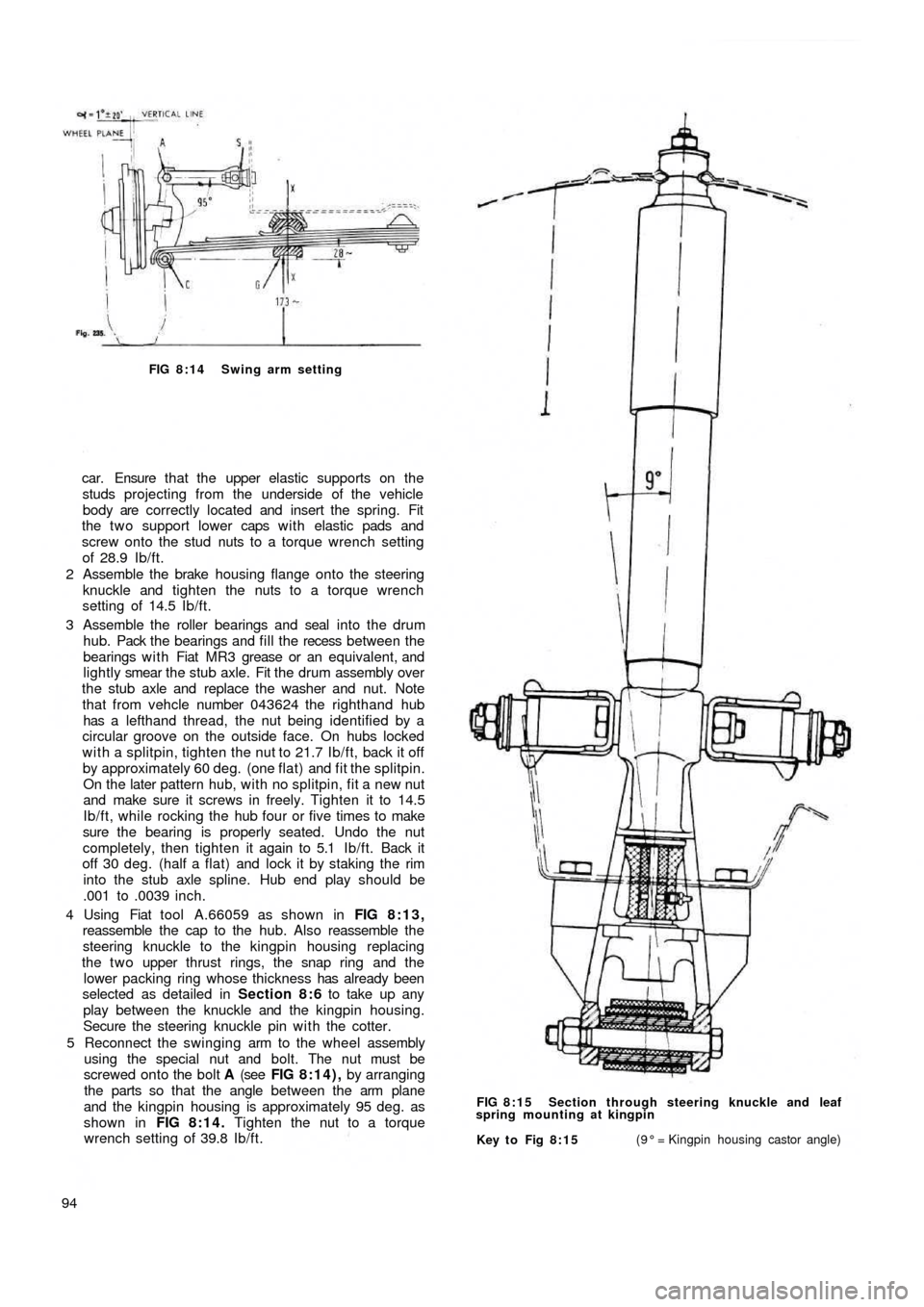
FIG 8:14 Swing arm setting
car. Ensure t h a t the upper elastic supports on the
studs projecting from the underside of the vehicle
body are correctly located and insert the spring. Fit
the two support lower caps w i t h elastic pads and
screw onto the stud nuts to a torque wrench setting
of 28.9 Ib/ft.
2 Assemble the brake housing flange onto the steering
knuckle and tighten the nuts to a torque wrench
setting of 14.5 Ib/ft.
3 Assemble the roller bearings and seal into the drum
hub. Pack the bearings and fill the recess between the
bearings w i t h Fiat MR3 grease or an equivalent, and
lightly smear the stub axle. Fit the drum assembly over
the stub axle and replace the washer and nut. Note
that from vehcle number 043624 the righthand hub
has a lefthand thread, the nut being identified by a
circular groove on the outside face. On hubs locked
with a splitpin, tighten the nut to 21.7 Ib/ft, back it off
by approximately 60 deg. (one flat) and fit the splitpin.
On the later pattern hub, with no splitpin, fit a new nut
and make sure it screws in freely. Tighten it to 14.5
Ib/ft, while rocking the hub four or five times to make
sure the bearing is properly seated. Undo the nut
completely, then tighten it again to 5.1 Ib/ft. Back it
off 30 deg. (half a flat) and lock it by staking the rim
into the stub axle spline. Hub end play should be
.001 to .0039 inch.
4 Using Fiat tool A.66059 as shown in FIG 8:13,
reassemble the cap to the hub. Also reassemble the
steering knuckle to the kingpin housing replacing
the t w o upper
thrust rings, the snap ring and the
lower packing ring whose thickness has already been
selected as detailed in Section 8:6 to take up any
play between the knuckle and the kingpin housing.
Secure the steering knuckle pin with the cotter.
5 Reconnect the swinging arm to the wheel assembly
using the special nut and bolt. The nut must be
screwed onto the bolt A (see FIG 8:14), by arranging
the parts so that the angle between the arm plane
and the kingpin housing is approximately 95 deg. as
shown in FIG 8:14. Tighten the nut to a torque
wrench setting of 39.8 Ib/ft.
94
Key to Fig 8:15(9° = Kingpin housing castor angle) FIG 8:15 Section through steering knuckle and leaf
spring mounting at kingpin
Page 88 of 128
VERTICAL LINE DB
S
EB
OIL SUMPF
GF
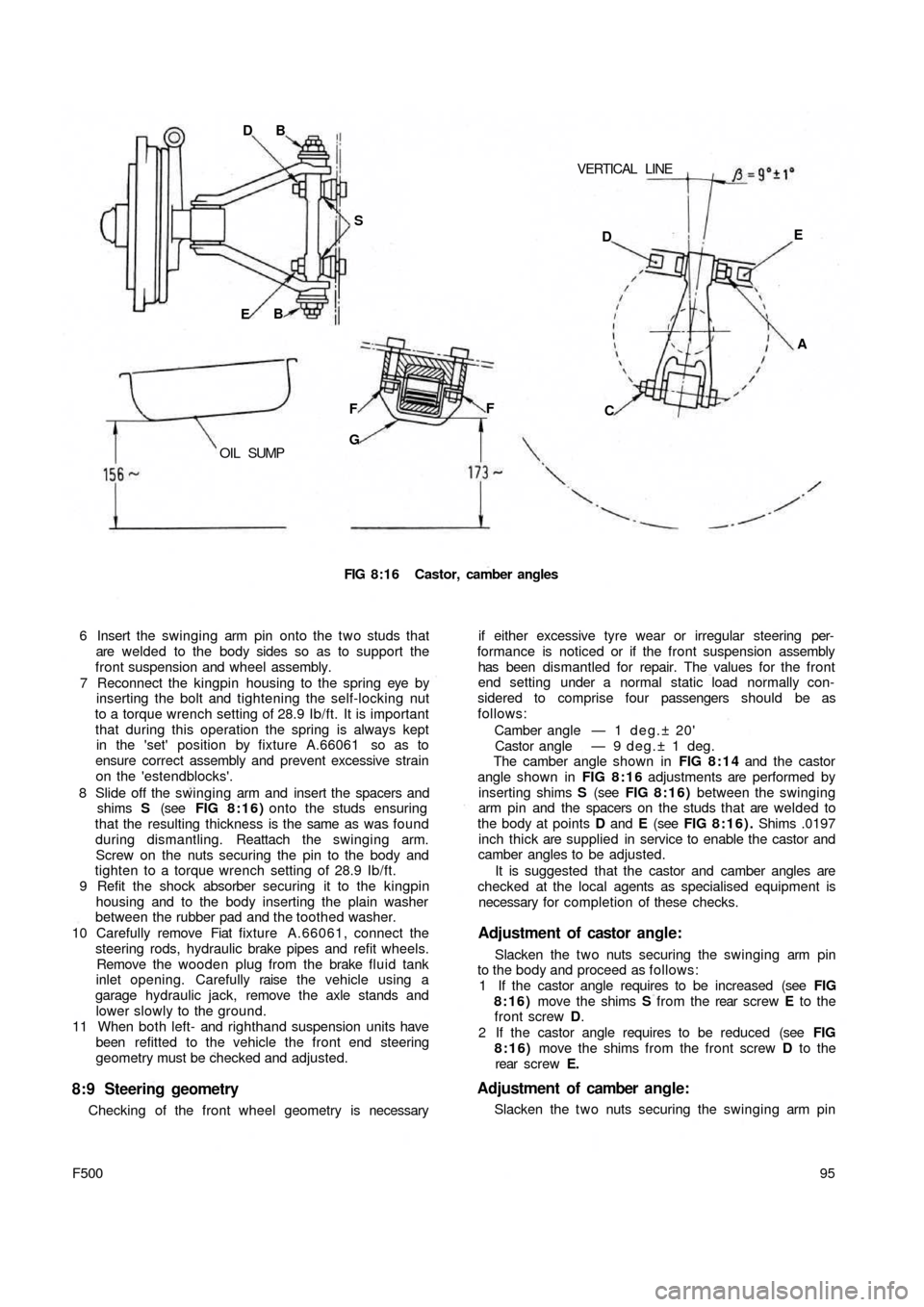
FIG 8:16 Castor, camber angles
6 Insert the swinging arm pin onto the two studs that
are welded to the body sides so as to support the
front suspension and wheel assembly.
7 Reconnect the kingpin housing to the spring eye by
inserting the bolt and tightening the self-locking nut
to a torque wrench setting of 28.9 Ib/ft. It is important
that during this operation the spring is always kept
in the 'set' position by fixture A.66061 so as to
ensure correct assembly and prevent excessive strain
on the 'estendblocks'.
8 Slide off the swinging arm and insert the spacers and
shims S (see FIG 8:16) onto the studs ensuring
that the resulting thickness is the same as was found
during dismantling. Reattach the swinging arm.
Screw on the nuts securing the pin to the body and
tighten to a torque wrench setting of 28.9 Ib/ft.
9 Refit the shock absorber securing it to the kingpin
housing and to the body inserting the plain washer
between the rubber pad and the toothed washer.
10 Carefully remove Fiat fixture A.66061, connect the
steering rods, hydraulic brake pipes and refit wheels.
Remove the wooden plug from the brake fluid tank
inlet opening. Carefully raise the vehicle using a
garage hydraulic jack, remove the axle stands and
lower slowly to the ground.
11 When both left- and righthand suspension units have
been refitted to the vehicle the front end steering
geometry must be checked and adjusted.
8:9 Steering geometry
Checking of the front wheel geometry is necessary
95
F500
if either excessive tyre wear or irregular steering per-
formance is noticed or if the front suspension assembly
has been dismantled for repair. The values for the front
end setting under a normal static load normally con-
sidered to comprise four passengers should be as
follows:
Camber angle — 1 d e g . ± 20'
Castor angle — 9 deg.± 1 deg.
The camber angle shown in FIG 8:14 and the castor
angle shown in FIG 8 : 1 6 adjustments are performed by
inserting shims S (see FIG 8 : 1 6 ) between the swinging
arm pin and the spacers on the studs that are welded to
the body at points D and E (see FIG 8:16). Shims .0197
inch thick are supplied in service to enable the castor and
camber angles to be adjusted.
It is suggested that the castor and camber angles are
checked at the local agents as specialised equipment is
necessary for completion of these checks.
Adjustment of castor angle:
Slacken the t w o nuts securing the swinging arm pin
to the body and proceed as follows:
1 If the castor angle requires to be increased (see FIG
8:16) move the shims S from the rear screw E to the
front screw D.
2 If the castor angle requires to be reduced (see FIG
8:16) move the shims from the front screw D to the
rear screw E.
Adjustment of camber angle:
Slacken the t w o nuts securing the swinging arm pin DE
A
C
Page 89 of 128
to the body and proceed as follows:
1 If the camber angle requires to be increased (see FIG
8:16) add the same number of shims S on both
screws D and E.
2 If the camber angle requires to be reduced (see FIG
8:16) remove the same number of shims from both
screws D and E.
The addition or removal of shims at the t w o points D
and E permits camber adjustment to be made without
any disturbing of the castor angle.
8:10 Modifications
Checking and adjusting castor and camber angles:
When checking the castor and camber angle the
static loading should be such that the distance between
the semi-elliptic spring mountings G (see FIG 8:16)
and the floor level to be approximately 6.81 inches, also a
distance between the lowermost portion of the sump and
the floor level of approximately 6.14 inch for the Model
500D. For the 500 Station Wagon version the distance
between centre rear bracket for jacking-up the vehicle
and the floor level should be approximately 8.90 inches.
All other front wheel alignment specifications are the
same as for the remaining 500 saloon models.
8:11 Fault diagnosis
(a) Wheel bounce
1 Tyre casing faulty
2 Uneven tyre pressures
3 Wheels out of balance
4 Semi-elliptic mounting spring worn5 Weak or seized shock absorber
6 Wheel rim or tyre misaligned
(b) Suspension noise
1 Lack of lubrication
2 Noisy or inoperative shock absorbers
3 Worn or loose wheel bearings
(c) Pull to one side
1 Low or uneven tyre pressures
2 Incorrect front wheel alignment
3 Suspension arms distorted
4 Inoperative shock absorbers
5 Brakes binding
(d) Excessive t y r e wear
1 Incorrect tyre rotation during servicing periods
2 Incorrect camber angle
3 Incorrect toe-in
4 Incorrect tyre inflation
5 Excessive play at wheel bearings
6 Wheel wobble
7 Stiff suspension arms
8 Brakes out of adjustment
(e) Wheel wobble
1 Uneven tyre pressures
2 Loose or worn wheel bearings
3 Inoperative shock absorbers
4 Loose steering knuckle or kingpin housing
5 Incorrect front wheel alignment
6 Control arm rubber bushings, or kingpin housing and
semi-elliptic spring 'estendblock' worn
96
Page 96 of 128
CHAPTER 10
THE BRAKING SYSTEM
10:1 Description
10:2 Maintenance
10:3 Front brakes
10:4 Rear brakes
10:5 Master cylinder
10:6 Wheel cylinder10:7 Self-adjusting device
10:8 Removing a flexible hose
10:9 Brake fluid reservoir
10:10 Bleeding the system
10:11 Hand parking brake
10:12 Fault diagnosis
10:1 Description
All four drum brake units are hydraulically operated by
the brake pedal and the handbrake lever operates the rear
brakes only through a mechanical linkage which normally
requires no separate adjustment (see FIG 10:1).
The brake units are of the internal expanding type with
one leading and one trailing shoe to each brake. A double
ended wheel cylinder expands both shoes into contact
with the drum under hydraulic pressure from the master
cylinder. When the brake pedal pressure is released the
shoes are retracted by means of springs.
The brake pedal is directly coupled to the hydraulic
master cylinder where pressure on the fluid is generated.
This is transmitted to the brakes by a system of metal and
flexible pipes.
The braking units fitted to the new 500 Sedan models
are equipped with a specially designed brake shoe
clearance self-adjustment device which eliminates the
need for manual adjustment of the brake shoe to drum
clearance as is normal practice w i t h a conventional
braking system. Every time the brake pedal is depressed
the self-adjustment device automatically takes up the
excess clearance which may have developed between
the lining and the drum due to normal service wear.
The brake units fitted to the 500 Station wagon model
have a normal brake adjuster which should be used when
F500103 the brake pedal travel becomes excessive. The adjuster
is shown in FIG 10:3.
On later models a dual circuit system is used. It is
described in Section 10:12
10:2 Maintenance
Brake adjustment {Station Wagon)
Jack each wheel in turn after first chocking the remain-
ing three wheels and releasing the handbrake. Depress
the brake pedal so as to force the brake shoes against the
drum and keeping the shoes in this position turn the
adjuster nuts until they contact the shoes and then back
the nuts 20 deg. This will correctly set the shoe to drum
clearance which should be checked for binding by
releasing the brake pedal and ensuring that the road wheel
revolves freely. The operation should then be repeated
on the other wheels. This adjustment will automatically
set the handbrake.
Preventative maintenance:
1 Thoroughly inspect the metal hydraulic fluid lines for
rusting, cracking or flattening and that they are
located away from any sharp edges which could cause
a failure.
Page 97 of 128
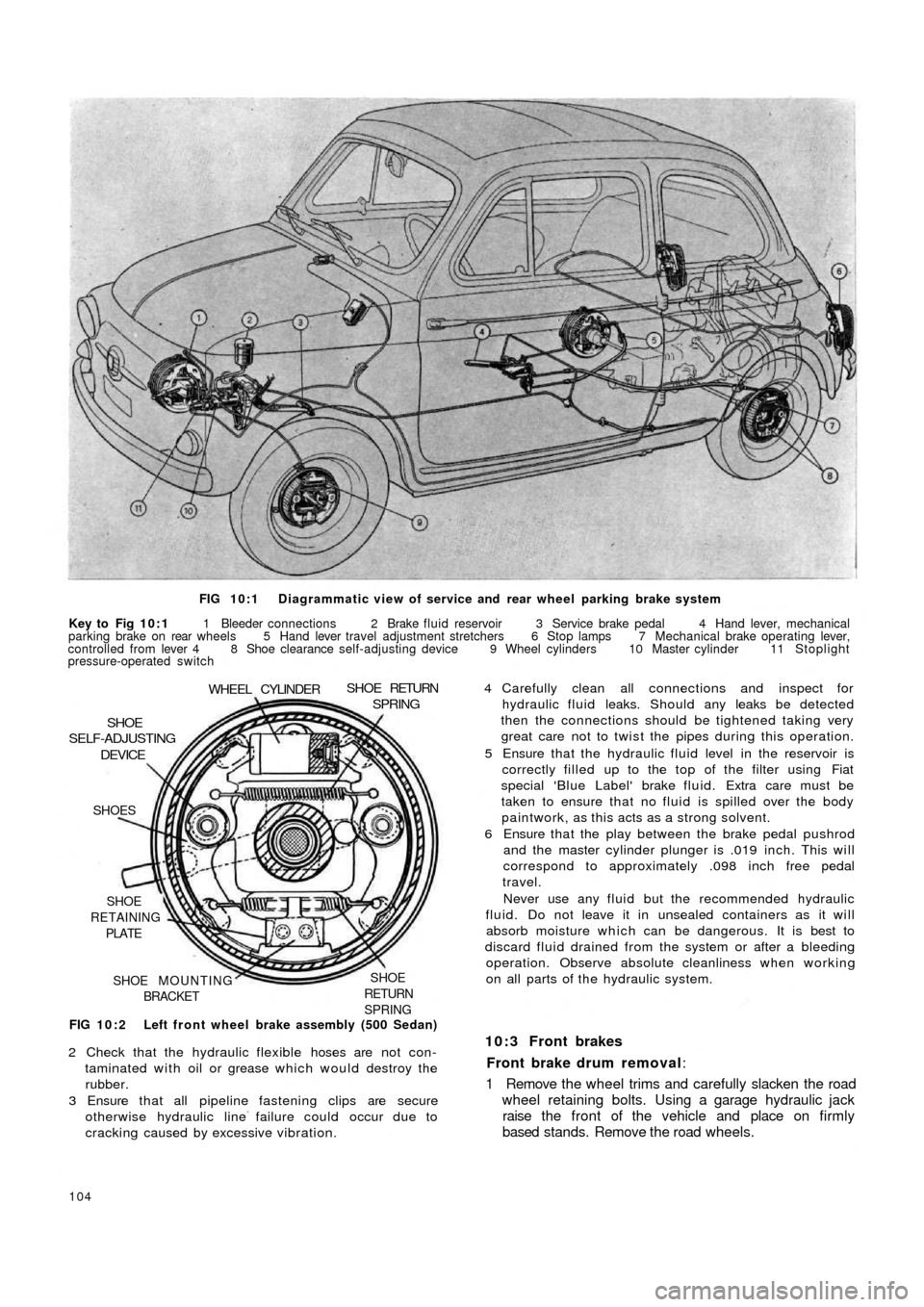
FIG 10:1 Diagrammatic view of service and rear wheel parking brake system
Key to Fig 10:1 1 Bleeder connections 2 Brake fluid reservoir 3 Service brake pedal 4 Hand lever, mechanical
parking brake on rear wheels 5 Hand lever travel adjustment stretchers 6 Stop lamps 7 Mechanical brake operating lever,
controlled from lever 4 8 Shoe clearance self-adjusting device 9 Wheel cylinders 10 Master cylinder 11 Stoplight
pressure-operated switch
FIG 10:2 Left front wheel brake assembly (500 Sedan)
SHOE
RETURN
SPRINGSHOE MOUNTING
BRACKET SHOE
RETAINING
PLATE SHOES
DEVICESHOE
SELF-ADJUSTING
WHEEL CYLINDERSHOE RETURNSPRING
2 Check that the hydraulic flexible hoses are not con-
taminated with oil or grease which would destroy the
rubber.
3 Ensure that all pipeline fastening clips are secure
otherwise hydraulic line failure could occur due to
cracking caused by excessive vibration.
104
4 Carefully clean all connections and inspect for
hydraulic fluid leaks. Should any leaks be detected
then the connections should be tightened taking very
great care not to twist the pipes during this operation.
5 Ensure that the hydraulic fluid level in the reservoir is
correctly filled up to the top of the filter using Fiat
special 'Blue Label' brake fluid. Extra care must be
taken to ensure that no fluid is spilled over the body
paintwork, as this acts as a strong solvent.
6 Ensure that the play between the brake pedal pushrod
and the master cylinder plunger is .019 inch. This will
correspond to approximately .098 inch free pedal
travel.
Never use any fluid but the recommended hydraulic
fluid. Do not leave it in unsealed containers as it will
absorb moisture which can be dangerous. It is best to
discard fluid drained from the system or after a bleeding
operation. Observe absolute cleanliness when working
on all parts of the hydraulic system.
10:3 Front brakes
Front brake drum removal:
1 Remove the wheel trims and carefully slacken the road
wheel retaining bolts. Using a garage hydraulic jack
raise the front of the vehicle and place on firmly
based stands. Remove the road wheels.
Page 101 of 128
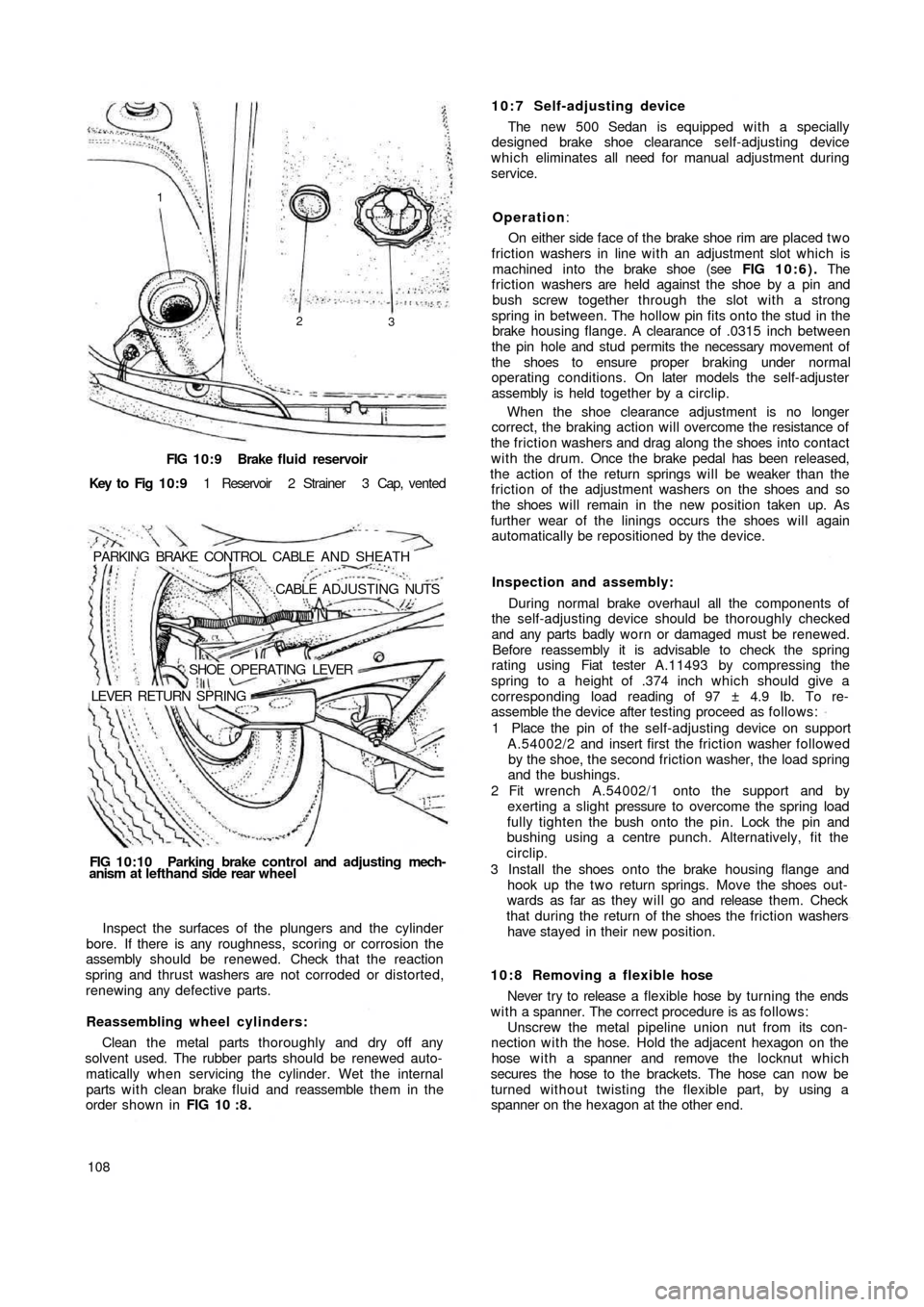
FIG 10:9 Brake fluid reservoir
Key to Fig 1 0 : 9 1 Reservoir 2 Strainer 3 Cap, vented
PARKING BRAKE CONTROL CABLE AND SHEATH
.CABLE ADJUSTING NUTS
SHOE OPERATING LEVER
LEVER RETURN SPRING
FIG 10:10 Parking brake control and adjusting mech-
anism at lefthand side rear wheel
Inspect the surfaces of the plungers and the cylinder
bore. If there is any roughness, scoring or corrosion the
assembly should be renewed. Check that the reaction
spring and thrust washers are not corroded or distorted,
renewing any defective parts.
Reassembling wheel cylinders:
Clean the metal parts thoroughly and dry off any
solvent used. The rubber parts should be renewed auto-
matically when servicing the cylinder. Wet the internal
parts w i t h clean brake f l u i d and reassemble them in the
order shown in FIG 10 : 8 .
10810:7 Self-adjusting device
The new 500 Sedan is equipped with a specially
designed brake shoe clearance self-adjusting device
which eliminates all need for manual adjustment during
service.
Operation:
On either side face of the brake shoe rim are placed t w o
friction washers in line with an adjustment slot which is
machined into the brake shoe (see FIG 10:6). The
friction washers are held against the shoe by a pin and
bush screw together through the slot with a strong
spring in between. The hollow pin fits onto the stud in the
brake housing flange. A clearance of .0315 inch between
the pin hole and stud permits the necessary movement of
the shoes to ensure proper braking under normal
operating conditions. On later models the self-adjuster
assembly is held together by a circlip.
When the shoe clearance adjustment is no longer
correct, the braking action will overcome the resistance of
the friction washers and drag along the shoes into contact
with the drum. Once the brake pedal has been released,
the action of the return springs will be weaker than the
friction of the adjustment washers on the shoes and so
the shoes will remain in the new position taken up. As
further wear of the linings occurs the shoes will again
automatically be repositioned by the device.
Inspection and assembly:
During normal brake overhaul all the components of
the self-adjusting device should be thoroughly checked
and any parts badly worn or damaged must be renewed.
Before reassembly it is advisable to check the spring
rating using Fiat tester A.11493 by
compressing the
spring to a height of .374 inch which should give a
corresponding load reading of 97 ± 4.9 Ib. To re-
assemble the device after testing proceed as follows:
1 Place the pin of the self-adjusting device on support
A.54002/2 and insert first the friction washer followed
by the shoe, the second friction washer, the load spring
and the bushings.
2 Fit wrench A.54002/1 onto the support and by
exerting a slight pressure to overcome the spring load
fully tighten the bush onto the pin. Lock the pin and
bushing using a centre punch. Alternatively, fit the
circlip.
3 Install the shoes onto the brake housing flange and
hook up the t w o return springs. Move the shoes out-
wards as far as they will go and release them. Check
that during the return of the shoes the friction washers
have stayed in their new position.
10:8 Removing a flexible hose
Never try to release a flexible hose by turning the ends
w i t h a spanner. The correct procedure is as follows:
Unscrew the metal pipeline union nut from its con-
nection with the hose. Hold the adjacent hexagon on the
hose w i t h a spanner and remove the locknut which
secures the hose to the brackets. The hose can now be
turned without twisting the flexible part, by using a
spanner on the hexagon at the other end.
1
2
3