Seat FIAT 500 1964 1.G Service Manual
[x] Cancel search | Manufacturer: FIAT, Model Year: 1964, Model line: 500, Model: FIAT 500 1964 1.GPages: 128, PDF Size: 9.01 MB
Page 100 of 128
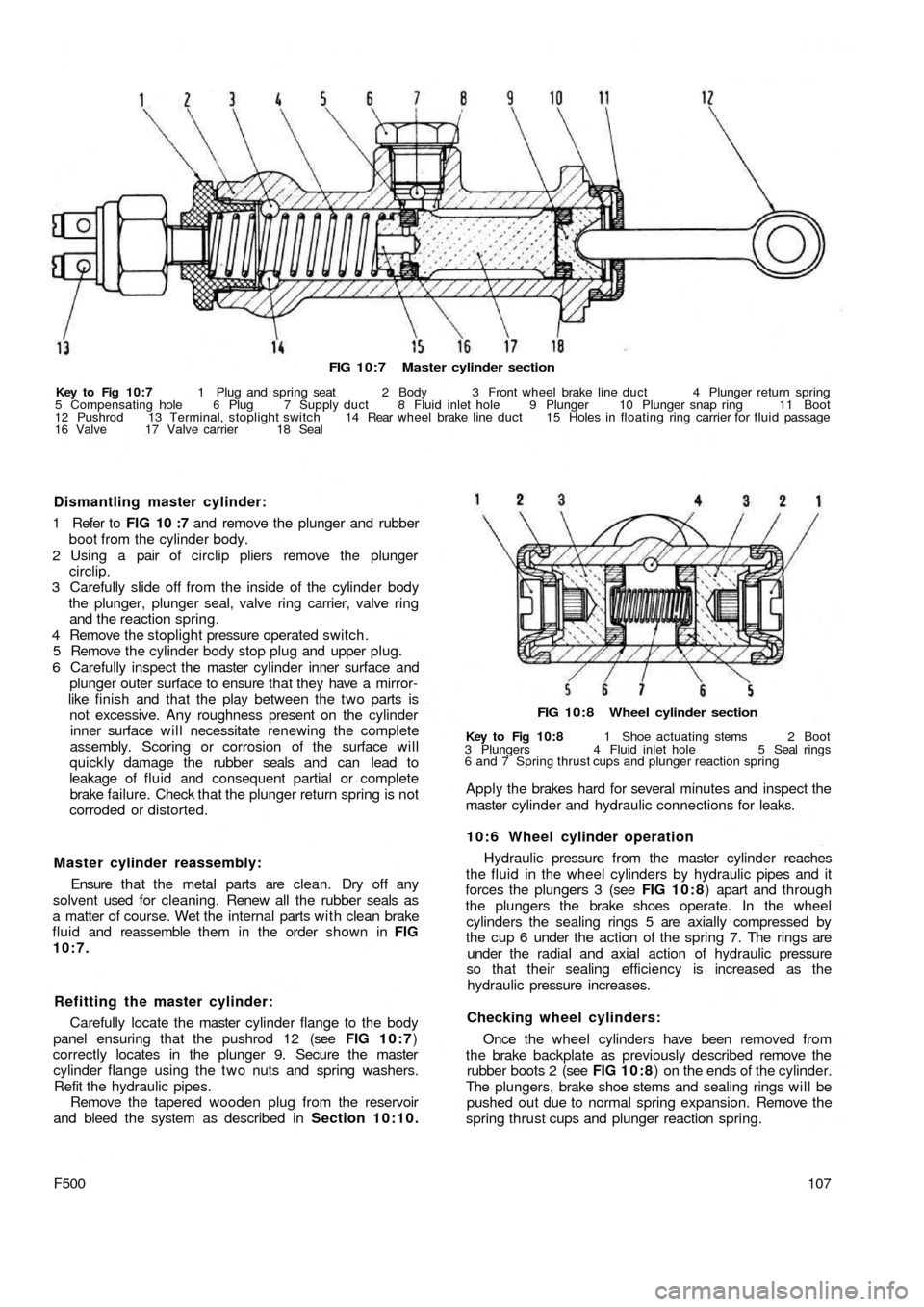
FIG 10:7 Master cylinder section
Key to Fig 10:7 1 Plug and spring seat 2 Body 3 Front wheel brake line duct 4 Plunger return spring
5 Compensating hole 6 Plug 7 Supply duct 8 Fluid inlet hole 9 Plunger 10 Plunger snap ring 11 Boot
12 Pushrod 13 Terminal, stoplight switch 14 Rear wheel brake line duct 15 Holes in floating ring carrier for fluid passage
16 Valve 17 Valve carrier 18 Seal
FIG 10:8 Wheel cylinder section
Key to Fig 10:8 1 Shoe actuating stems 2 Boot
3 Plungers 4 Fluid inlet hole 5 Seal rings
6 and 7 Spring thrust cups and plunger reaction spring
Apply the brakes hard for several minutes and inspect the
master cylinder and hydraulic connections for leaks.
10:6 Wheel cylinder operation
Hydraulic pressure from the master cylinder reaches
the fluid in the wheel cylinders by hydraulic pipes and it
forces the plungers 3 (see FIG 1 0 : 8) apart and through
the plungers the brake shoes operate. In the wheel
cylinders the sealing rings 5 are axially compressed by
the cup 6 under the action of the spring 7. The rings are
under the radial and axial action of hydraulic pressure
so that their sealing efficiency is increased as the
hydraulic pressure increases.
Checking wheel cylinders:
Once the wheel cylinders have been removed from
the brake backplate as previously described remove the
rubber boots 2 (see FIG 10:8) on the ends of the cylinder.
The plungers, brake shoe stems and sealing rings will be
pushed out due to normal spring expansion. Remove the
spring thrust cups and plunger reaction spring.
107F500
Master cylinder reassembly:
Ensure that the metal parts are clean. Dry off any
solvent used for cleaning. Renew all the rubber seals as
a matter of course. Wet the internal parts w i t h clean brake
fluid and reassemble them in the order shown in FIG
10:7.
Refitting the master cylinder:
Carefully locate the master cylinder flange to the body
panel ensuring that the pushrod 12 (see FIG 10:7)
correctly locates in the plunger 9. Secure the master
cylinder flange using the t w o nuts and spring washers.
Refit the hydraulic pipes.
Remove the tapered wooden plug from the reservoir
and bleed the system as described in Section 10:10. Dismantling master cylinder:
1 Refer to FIG 10 :7 and remove the plunger and rubber
boot from the cylinder body.
2 Using a pair of circlip pliers remove the plunger
circlip.
3 Carefully slide off from the inside of the cylinder body
the plunger, plunger seal, valve ring carrier, valve ring
and the reaction spring.
4 Remove the stoplight pressure operated switch.
5 Remove the cylinder body stop plug and upper plug.
6 Carefully inspect the master cylinder inner surface and
plunger outer surface to ensure that they have a mirror-
like finish and that the play between the two parts is
not excessive. Any roughness present on the cylinder
inner surface will necessitate renewing the complete
assembly. Scoring or corrosion of the surface will
quickly damage the rubber seals and can lead to
leakage of fluid and consequent partial or complete
brake failure. Check that the plunger return spring is not
corroded or distorted.
Page 102 of 128
10:9 Brake fluid reservoir
The reservoir is located in the front compartment to the
side of the fuel tank as shown in FIG 10:9. Should it be
necessary to detach the fluid outlet line from the reservoir
the outlet hole must be blanked off using a tapered
wooden peg of suitable length so that the cap may be
replaced to prevent the ingress of foreign matter into
the reservoir and the absorbtion of moisture, oil or petrol
vapours which would alter the properties of the hydraulic
fluid.
A special filter is fitted into the top of the reservoir
through which all fluid used for topping-up the reservoir
must pass to ensure utmost inner cleanliness of the
hydraulic system.
10:10 Bleeding the system
This is not a routine maintenance operation and is only
necessary if air has entered the hydraulic system because
parts have been dismantled or because the f l u i d level in
the reservoir has dropped so low that air has been drawn
into the main feed pipe to the master cylinders.
1 Fill the reservoir w i t h Fiat 'Blue Label' hydraulic fluid.
During the bleeding operation fluid will be used and
constant topping-up of the supply reservoir will be
needed. If this is not done it is possible for air to enter
the master cylinder main feed pipe which will nullify
the operation and necessitate a fresh start.
2 Attach a length of rubber or plastic tubing to the
bleeder screw on the rear wheel cylinder furthermost
from the master cylinder. Immerse the free end of the
tube in a small volume of hydraulic brake fluid in a
clean jar.
3 Open the bleed screw one turn and get a second
operator to press down slowly on the brake pedal. After
a full stroke let the pedal return without assistance,
pause a moment and repeat the d o w n stroke. At first
there will be air bubbles issuing from the bleed tube,
but when fluid alone is ejected, hold the pedal firmly
down on the floor panel and tighten the bleed screw.
Repeat this operation on the other rear brake and then
repeat the operation on the two front brakes.
4 On completion, top-up the fluid in the reservoir to the
correct level. Discard all dirty fluid. If fluid is perfectly
clean, let it stand for twenty four hours to become
clear of air bubbles before using it again.
10:11 Hand parking brake
Normally with the new 500 Sedan model automatic
brake adjusting device, adjustment of the rear brakes
will take up excessive handbrake travel.
If there is excessive travel on the handbrake of the
Sedan model at any time, or in the case of Station Wagon
model even after the rear brakes have been manually
adjusted, suspect worn brake shoe linings or stretched
handbrake cables. Examine the linings and fit replace-
ment shoes if necessary. Check the action of the hand
parking brake again and if there is still too much travel
before the brakes are applied it is permissible to take up as
follows:
1 It is essential to ensure that the rear shoes are correctly
adjusted as described in Section 10:2.
2 Apply the hand parking brake lever until the pawl
engages with the ratchet at the second notch.
F500
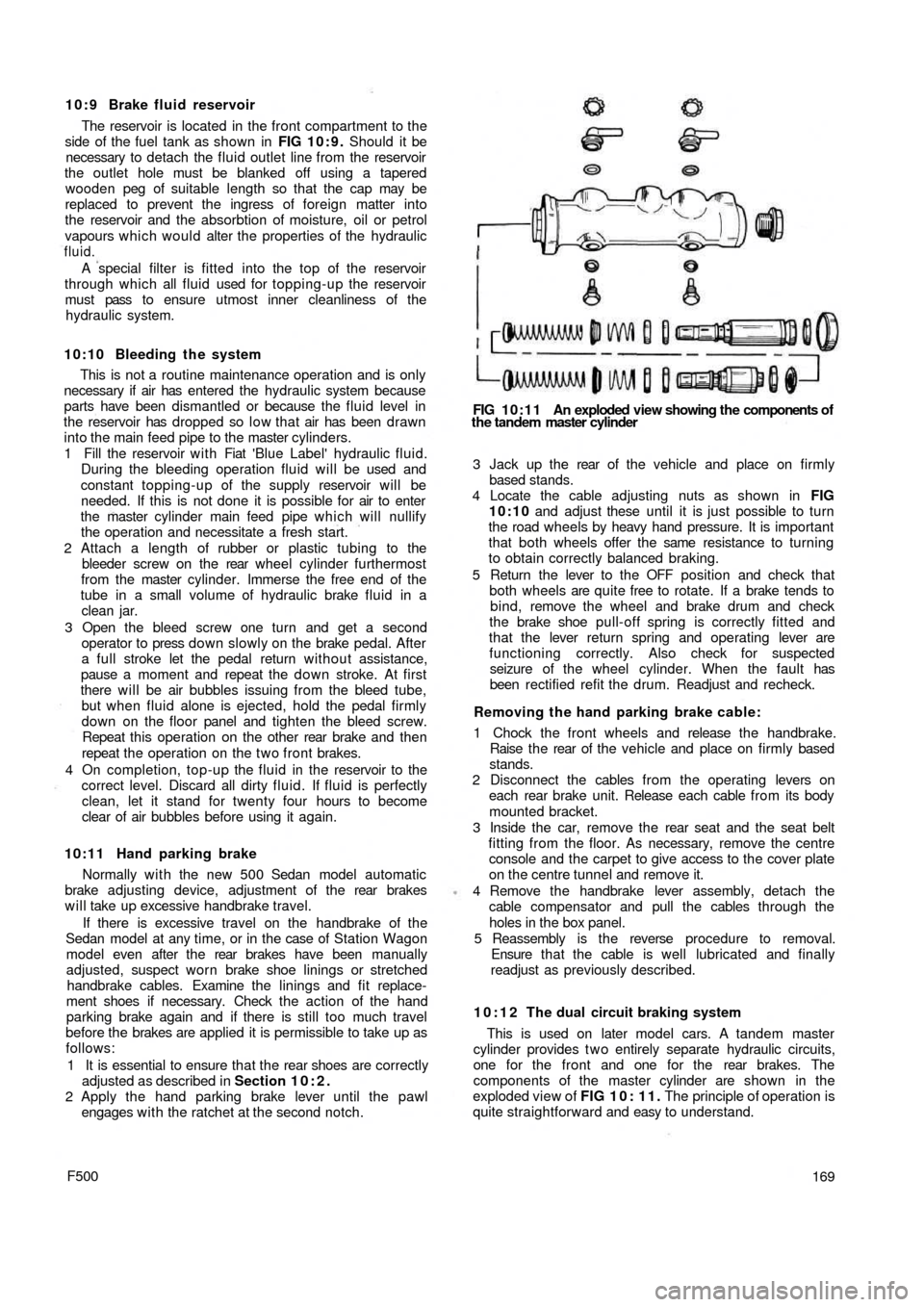
FIG 10:11 An exploded view showing the components of
the tandem master cylinder
3 Jack up the rear of t h e vehicle and place on firmly
based stands.
4 Locate the cable adjusting nuts as shown in FIG
10:10 and adjust these until it is just possible to turn
the road wheels by heavy hand pressure. It is important
that both wheels offer the same resistance to turning
to obtain correctly balanced braking.
5 Return the lever to the OFF position and check that
both wheels are quite free to rotate. If a brake tends to
bind, remove the wheel and brake drum and check
the brake shoe pull-off spring is correctly fitted and
that the lever return spring and operating lever are
functioning correctly. Also check for suspected
seizure of the wheel cylinder. When the fault has
been rectified refit the drum. Readjust and recheck.
Removing the hand parking brake cable:
1 Chock the front wheels and release the handbrake.
Raise t h e rear of the vehicle and place on firmly based
stands.
2 Disconnect the cables from the operating levers on
each rear brake unit. Release each cable from its body
mounted bracket.
3 Inside the car, remove the rear seat and the seat belt
fitting from the floor. As necessary, remove the centre
console and the carpet to give access to the cover plate
on the centre tunnel and remove it.
4 Remove the handbrake lever assembly, detach the
cable compensator and pull the cables through the
holes in the box panel.
5 Reassembly is the reverse procedure to removal.
Ensure t h a t the cable is well lubricated and finally
readjust as previously described.
10:12 The dual circuit braking system
This is used on later model cars. A tandem master
cylinder provides t w o entirely separate hydraulic circuits,
one for the front and one for the rear brakes. The
components of the master cylinder are shown in the
exploded view of FIG 1 0 : 1 1 . The principle of operation is
quite straightforward and easy to understand.
169
Page 106 of 128
indicates a break in the cable from the generator to
regulator. Repeat the test on terminal 67. Finally,
remove the temporary link from the generator. If the
readings are correct, test the regulator as described in
Section 11:5.
Removing generator:
1 Disconnect the leads from the generator.
2 Remove the drive belt as previously described.
3 Release t h e rear mounting bracket at the side of the
power unit.
4 Remove the air cooling ducting from around the fan
and generator area and lift away the unit.
5 Release the blower from the end of the armature shaft
and finally, the mounting bolts from the air ducting.
Dismantling generator:
1 Release the pulley self-locking nut and slide the pulley
off the armature shaft.
2 Remove the t w o Woodruff keys on armature shaft.
3 Unscrew the t w o through bolt nuts and pull out the
bolts.
4 Partially remove the commutator end head to the point
where the brushes are. s t i l l seating on the commutator.
Using a piece of hooked wire relieve the load of the
springs on the brushes by arranging the spring ends
on the brush sides. The brushes will be locked in their
holders and cannot be chipped by striking against the
armature shaft during the commutator end head
removal.
5 Gently ease the commutator and fan end heads apart
and, slide out the armature.
Servicing brushes:
Lift the brushes up in the boxes and hold them in that
position by letting each brush spring bear on the side of
its brush. Fit the commutator end bracket over the
commutator end of the armature shaft and release the
brushes by hooking up the springs using a thin screw
driver. Hold back each spring in turn and move the brush
by pulling gently on the flexible connector. If the brush
moves sluggishly remove it and polish the sides using a
smooth file. Before this operation is actually carried out it
is suggested that the brush is marked before removal so
that it is replaced in its original working position.
inch,The minimum permissible length of a brush is
so renew any t h a t are less than this figure. Test the brush
springs using a spring tension scale. New springs should
have a tension of 1.3 to 1.6 Ib. In service this value could
fall slightly before performance is affected. Always bed in
new brushes by wrapping fine sandpaper round the
commutator, pressing down on the brush and rotating
the commutator under it, or draw the paper t o o and f r o .
If new brushes are fitted always fit genuine Fiat replace-
ments.
Servicing the commutator:
A commutator in good condition should be smooth and
free from pitting or signs of the segments burning. Clean
with a rag moistened in petrol. If necessary, polish using
a fine glasspaper whilst rotating the armature. Never use
emerycloth.
If the commutator is badly worn it may be skimmed
using a centre lathe. Use a high rotational speed and take
F500113
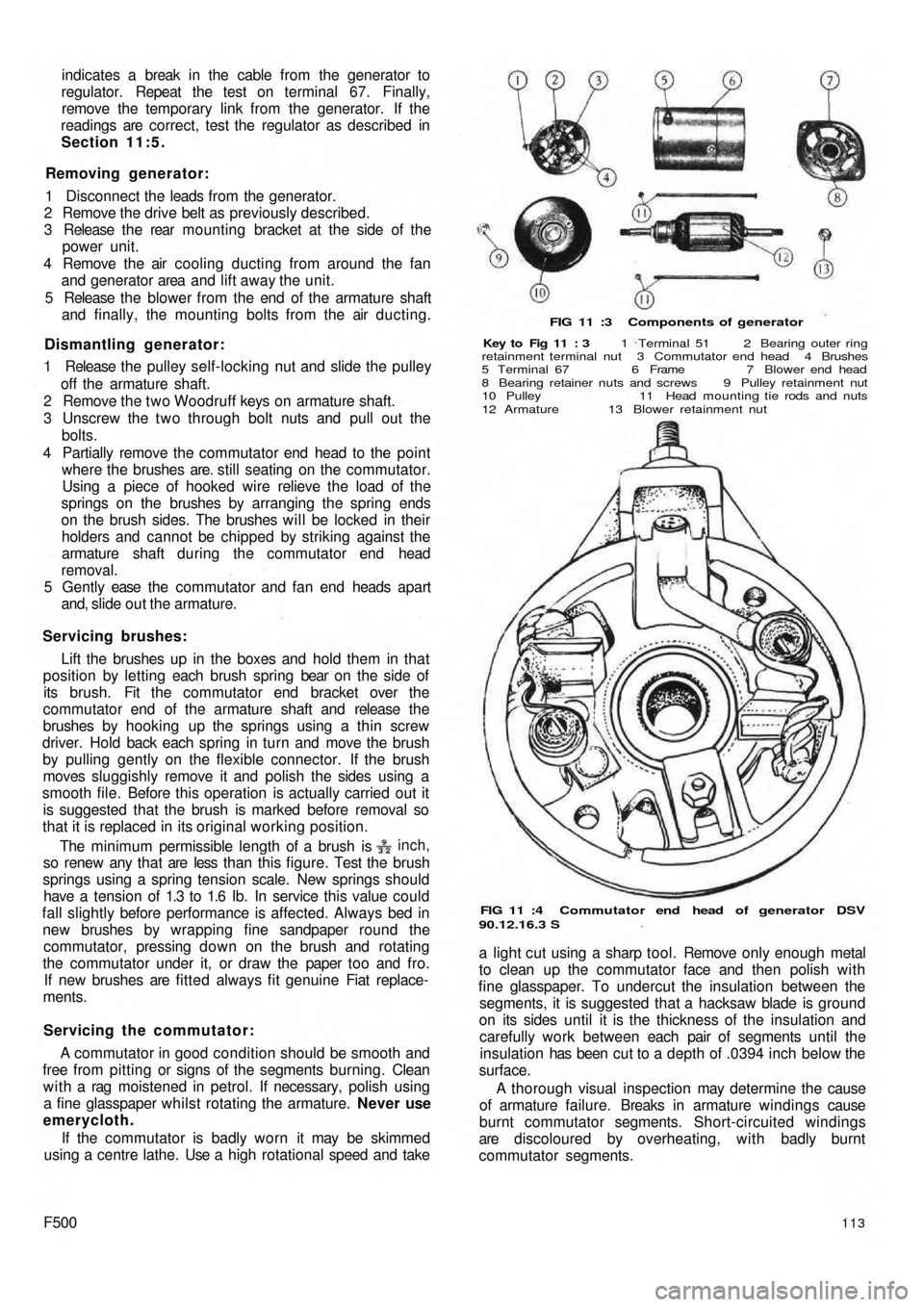
FIG 11 :3 Components of generator
Key to Fig 11 : 3 1 Terminal 51 2 Bearing outer ring
retainment terminal nut 3 Commutator end head 4 Brushes
5 Terminal 67 6 Frame 7 Blower end head
8 Bearing retainer nuts and screws 9 Pulley retainment nut
10 Pulley 11 Head mounting tie rods and nuts
12 Armature 13 Blower retainment nut
FIG 11 :4 Commutator end head of generator DSV
90.12.16.3 S
a light cut using a sharp tool. Remove only enough metal
to clean up the commutator face and then polish with
fine glasspaper. To undercut the insulation between the
segments, it is suggested that a hacksaw blade is ground
on its sides until it is the thickness of the insulation and
carefully work between each pair of segments until the
insulation has been cut to a depth of .0394 inch below the
surface.
A thorough visual inspection may determine the cause
of armature failure. Breaks in armature windings cause
burnt commutator segments. Short-circuited windings
are discoloured by overheating, with badly burnt
commutator segments.
Page 120 of 128
CHAPTER 12
THE BODYWORK
12:1
12:2
12:3
12:4
12:5
12:6
12:7Bodywork finish
Interior and chrome cleaning
Door trim and accessories
Door handles and locks
Removing regulator and door glass
Removing windshield glass
Removing rear side windows12:8
12:9
12:10
12:11
12:12
12:13
12:14Removing rear window glass
Front compartment lid
Engine compartment lid
Folding top
Sun roof
Seats
Interior heater
12:1 Bodywork finish
Large scale repairs to body panels are best left to
expert panel beaters. Even small dents can be tricky, as too
much hammering will stretch the metal and make things
worse instead of better. Filling minor dents and scratches
is probably the best method of restoring the surface. The
touching up of paintwork is well within the powers of
most car owners, particularly as self-spraying cans of
paint in the correct colours are now readily available. It
must be remembered, however, that paint changes colour
w i t h age and it is better to spray a whole wing rather than
try to touch up a small area.
Before spraying it is essential to remove all traces of
wax polish with white spirit. More drastic treatment is
required if silicone polishes have been applied. Use a
primer surfacer or paste stopper according to the amount
of filling required, and when it is dry, rub it down with
400 grade Wet or Dry paper until the surface is smooth
and flush with the surrounding area. Spend time on
getting the best finish as this will control the final effect.
Apply the retouching paint, keeping it wet in the centre
and light and dry round the edges. After a few hours of
drying, use a cutting compound to remove the dry spray
and finish with liquid polish.
F500127
12:2 Interior and chrome cleaning
The cloth upholstery of the seating and the rear
compartment lining must be regularly cleaned to ensure
long life and preserve its attractive appearance. Any dust
or dirt that is blown into the car will settle on the uphol-
stery and will tend to wear the cloth causing an unsightly
appearance. It is recommended that the dust is wiped off
using either a vacuum cleaner or a stiff brush. To remove
ordinary soiling of the upholstery cloth proceed as
follows:
1 Using luke warm water and a neutral soap and a piece
of clean cloth wipe over the upholstery in the direction
of the nap.
2 Repeat the operation using a clean damp cloth and
warm water but no soap.
3 Allow the upholstery cloth to dry, use a stiff brush
against the direction of the upholstery nap to restore
its original fluffy look.
To obtain best results, any stains must be removed as
soon as possible otherwise as time passes they will
become more difficult, if not impossible to remove.
Certain stains require specific solvents and the instruc-
tions must be strictly adhered to.
Page 122 of 128
Inner panels:
Imitation leather-lined masonite trim panels are fitted
to all versions of the new 500' models. The panels are
secured in the housing below the door window by means
of four stiff clips located at the top and seven spring clips
located at the bottom equally spaced around the panel
border. The fasteners are located in holes in the door
framework inner flange. The door framework has a plate
which should be bent downwards onto the trim panel
once it has been installed. This will ensure correct seating
of the trim panel in the door housing.
When the door trim panel is being reassembled ensure
that the tarred felt pad is cemented correctly on the door
inner flange so that any water that may seep in through to
the door interior from the window rubber weather strips
may be kept away from the trim panel which would
otherwise cause distortion and rapid deterioration.
12:4 Door handles and locks
The doors are provided with locks which are operated
by handles either from inside or outside the vehicle.
Removal of the lock is a straightforward operation but
upon reassembly the following procedure should be
followed:
1 Mount the handle assembly from the outside and
insert the washer onto the stud. Screw in the nut several
turns to allow correct handle-to-lock mating on final
fitting.
2 Arrange the locking handle dog so that it is horizontally
positioned and tighten the mounting nut.
3 Mount the lock to the door panel and secure w i t h three
screws and washers.
4 Fit the plate w i t h the t w o rubber guide blocks fastening
by the t w o screws.
Striker plates are fitted with shim adjustment to the
door pillars and are secured by three screws.
12:5 Removing window regulator and door glass
Window regulator:
Description:
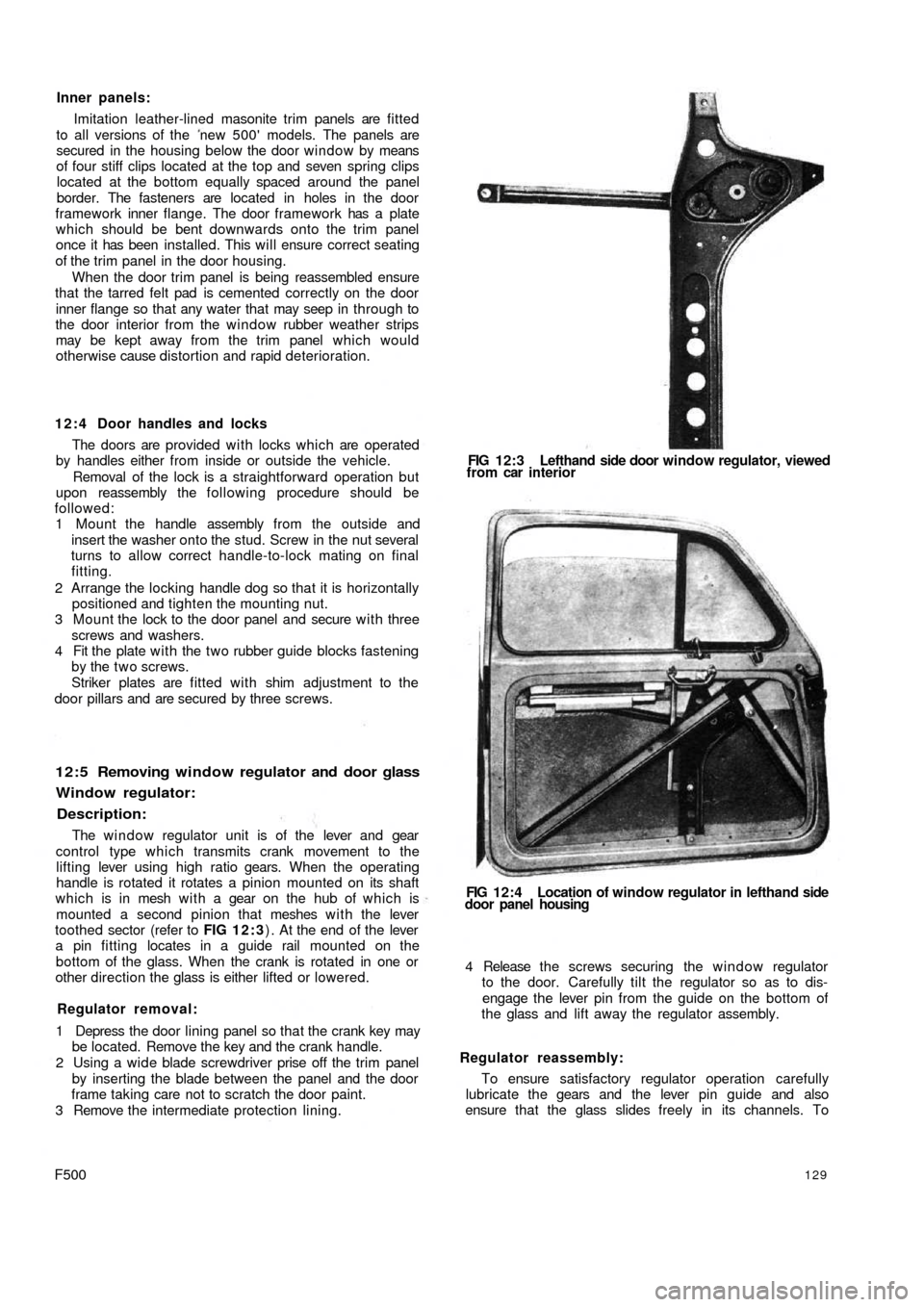
The window regulator unit is of the lever and gear
control type which transmits crank movement to the
lifting lever using high ratio gears. When the operating
handle is rotated it rotates a pinion mounted on its shaft
which is in mesh w i t h a gear on the hub of which is
mounted a second pinion that meshes with the lever
toothed sector (refer to FIG 1 2 : 3) . At the end of the lever
a pin fitting locates in a guide rail mounted on the
bottom of the glass. When the crank is rotated in one or
other direction the glass is either lifted or lowered.
Regulator removal:
1 Depress the door lining panel so that the crank key may
be located. Remove the key and the crank handle.
2 Using a wide blade screwdriver prise off the trim panel
by inserting the blade between the panel and the door
frame taking care not to scratch the door paint.
3 Remove the intermediate protection lining.
F500129
FIG 12:3 Lefthand side door window regulator, viewed
from car interior
FIG 12:4 Location of window regulator in lefthand side
door panel housing
4 Release the screws securing the window regulator
to the door. Carefully tilt the regulator so as to dis-
engage the lever pin from the guide on the bottom of
the glass and lift away the regulator assembly.
Regulator reassembly:
To ensure satisfactory regulator operation carefully
lubricate the gears and the lever pin guide and also
ensure that the glass slides freely in its channels. To
Page 124 of 128
8 Refit the intermediate protection lining ensuring that
it is properly located and well glued. Refit the door
lining panel, key and crank handle.
Door ventilator:
The door ventilator comprises the glass, weather strip
placed between the glass and chromium plated frame,
the chromium plated frame together with pin and bracket
for upper and lower hinging, frame control handle and
lining.
To remove the ventilator glass first drill the upper pivot
pin using a portable electric drill and release the nut and
locknut from the lower pivot bracket. Carefully lift away
the glass.
Reassembly:
To reassemble the ventilator glass proceed as follows:
1 Coat the outer edge of the glass on which the chrome
plated frame must be installed with a 50% solution of
petrol and oil to ensure that the glass can be easily
inserted into the frame.
2 Install the lock handle which is secured to the frame
by means of a screw sunk into the handle body and
t w o corrugated spring washers placed between the
frame and the handle.
3 Before installing the ventilator pane on the door panel
ensure that the metal channels in the front post flanges
at the pane base are firmly located in place and f i t the
rubber weather strip arranging it carefully in its
seating. The weather strip is secured by clips located
on the metal channels.
4 Refit the handle striker plate and secure it to the door
channel by means of t w o self-tapping screws.
5 Insert the lower ventilator swivel on the door panel to
welded bracket. Fit the spring and secure ventilator
assembly through the nut, locknut and plain washer so
that it can, be freely adjusted to any position without
undue effort (see FIG 12:5).
6 Fit the chrome cover on the lower ventilator swivel.
Refit the upper ventilator swivel in the door panel
brackets and clench it using a hammer and a suitably
sized drift against a firm metal block. This will ensure
correct ventilator movement.
FIG 12:8 Adapting windshield weatherstrip. Simply
pull the draw-cord
F500
131 RUBBER BUFFER-HOOD LID LINING
BUMPER
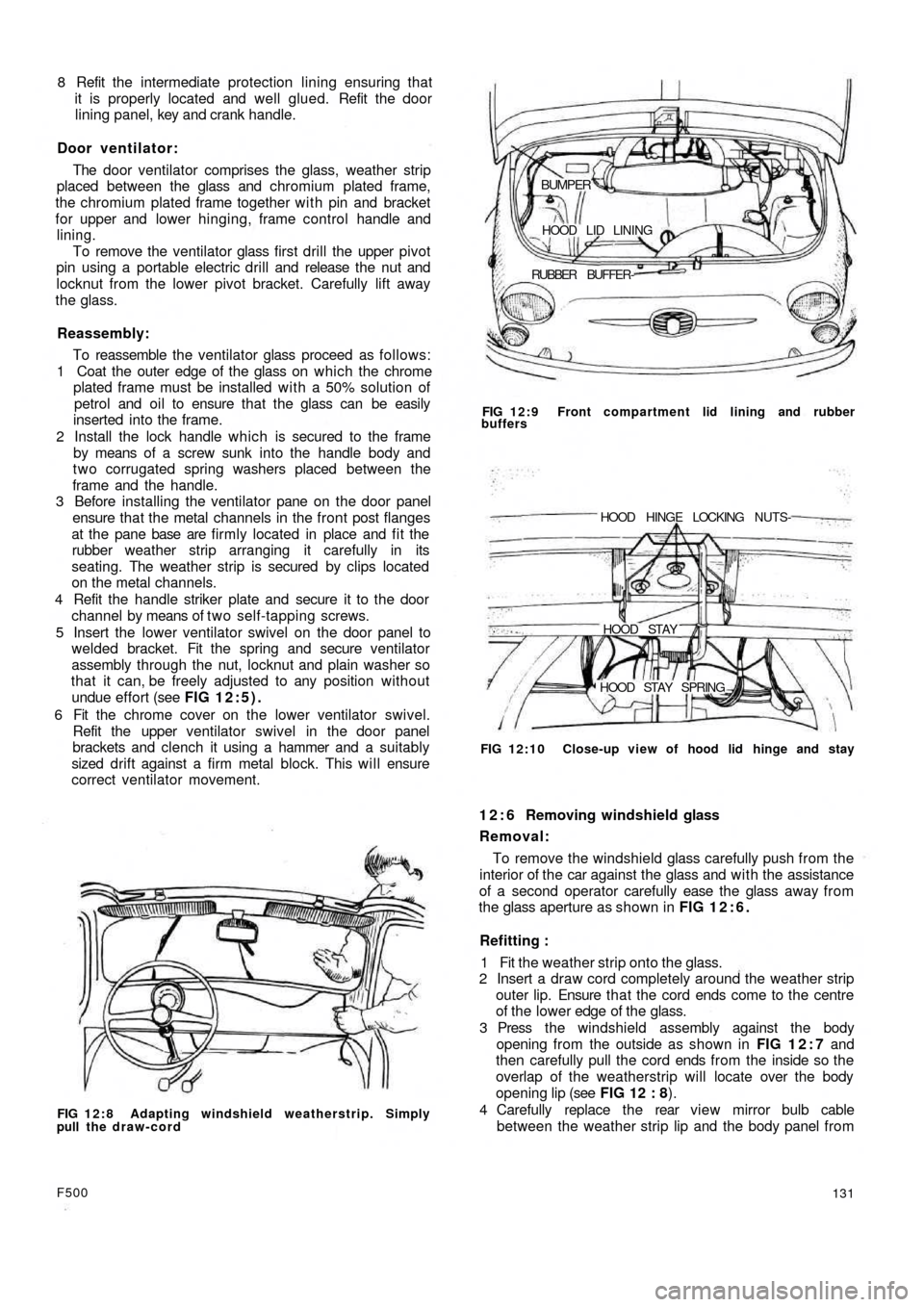
FIG 12:9 Front compartment lid lining and rubber
buffers
HOOD STAY SPRING HOOD STAY HOOD HINGE LOCKING NUTS-
FIG 12:10 Close-up view of hood lid hinge and stay
1 2 : 6 Removing windshield glass
Removal:
To remove the windshield glass carefully push from the
interior of the car against the glass and with the assistance
of a second operator carefully ease the glass away f r o m
the glass aperture as shown in FIG 12:6.
Refitting :
1 Fit the weather strip onto the glass.
2 Insert a draw cord completely around the weather strip
outer lip. Ensure t h a t the cord ends come to the centre
of the lower edge of the glass.
3 Press t h e windshield assembly against the body
opening from the outside as shown in FIG 1 2 : 7 and
then carefully pull the cord ends from the inside so the
overlap of the weatherstrip will locate over the body
opening lip (see FIG 12 : 8).
4 Carefully replace the rear view mirror bulb cable
between the weather strip lip and the body panel from
Page 125 of 128
SEAT RUBBER PAD
SEAT ARTICULATION SUPPORT
SEAT MECHANISM
CONTROL LEVER
SEAT SLIDING GUIDE
SEAT FIXED GUIDE
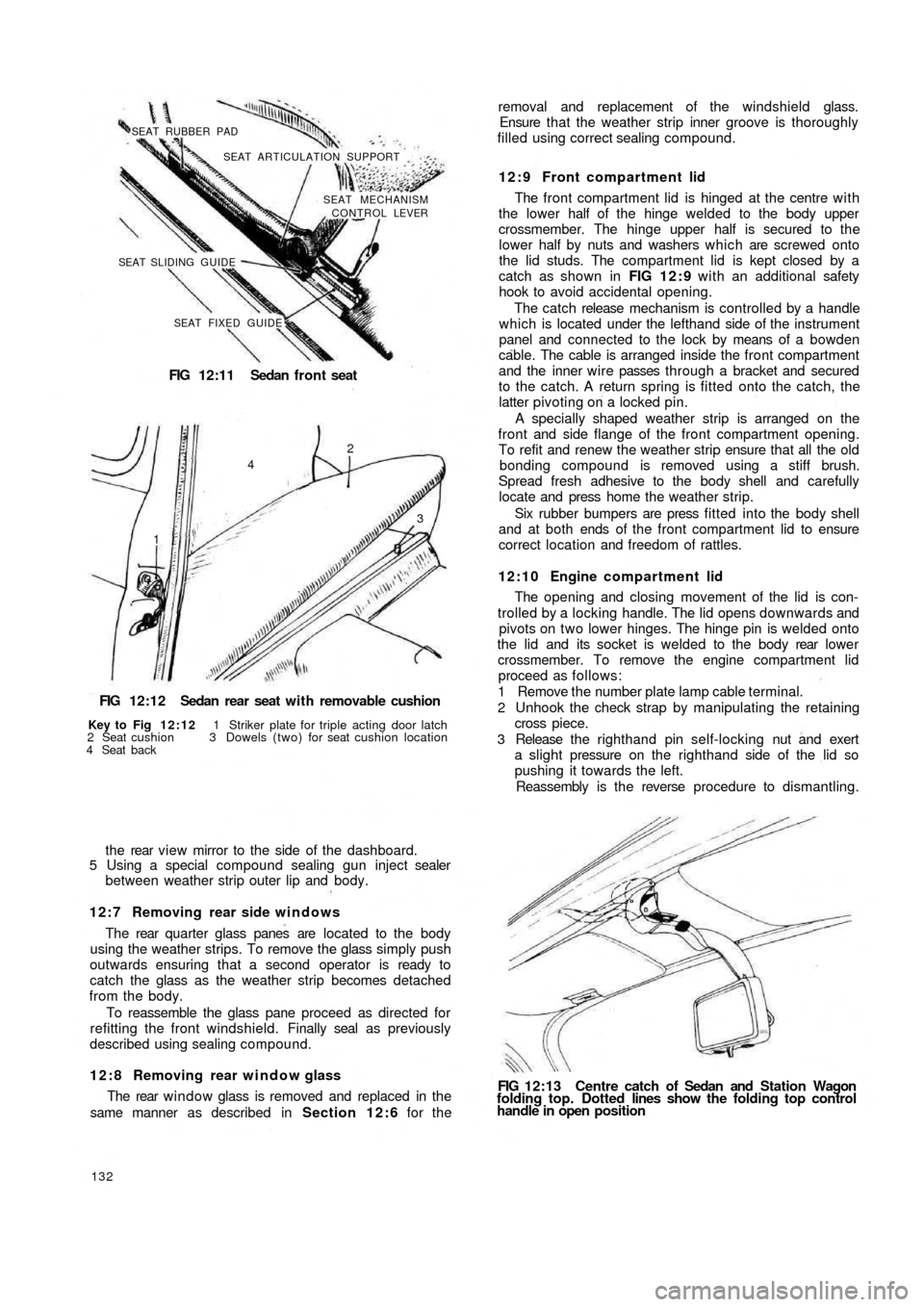
FIG 12:11 Sedan front seat
42
3
1
FIG 12:12 Sedan rear seat w i t h removable cushion
Key to Fig 12:12 1 Striker plate for triple acting door latch
2 Seat cushion 3 Dowels (two) for seat cushion location
4 Seat back
t h e rear v i e w mirror to the side of the dashboard.
5 Using a special compound sealing gun inject sealer
between weather strip outer lip and body.
12:7 Removing rear side windows
The rear quarter glass panes are located to the body
using the weather strips. To remove the glass simply push
outwards ensuring that a second operator is ready to
catch the glass as the weather strip becomes detached
from the body.
To reassemble the glass pane proceed as directed for
refitting the front windshield. Finally seal as previously
described using sealing compound.
12:8 Removing rear window glass
The rear window glass is removed and replaced in the
same manner as described in Section 12:6 for the
132
FIG 12:13 Centre catch of Sedan and Station Wagon
folding top. Dotted lines show the folding top control
handle in open position removal and replacement of the windshield glass.
Ensure t h a t the weather strip inner groove is thoroughly
filled using correct sealing compound.
1 2 : 9 Front compartment lid
The front compartment lid is hinged at the centre w i t h
the lower half of the hinge welded to the body upper
crossmember. The hinge upper half is secured to the
lower half by nuts and washers which are screwed onto
the lid studs. The compartment lid is kept closed by a
catch as shown in FIG 1 2 : 9 with an additional safety
hook to avoid accidental opening.
The catch release mechanism is controlled by a handle
which is located under the lefthand side of the instrument
panel and connected to the lock by means of a bowden
cable. The cable is arranged inside the front compartment
and the inner wire passes through a bracket and secured
to the catch. A return spring is fitted onto the catch, the
latter pivoting on a locked pin.
A specially shaped weather strip is arranged on the
front and side flange of the front compartment opening.
To refit and renew the weather strip ensure that all the old
bonding compound is removed using a stiff brush.
Spread fresh adhesive to the body shell and carefully
locate and press home the weather strip.
Six rubber bumpers are press fitted into the body shell
and at both ends of the front compartment lid to ensure
correct location and freedom of rattles.
12:10 Engine compartment lid
The opening and closing movement of the lid is con-
trolled by a locking handle. The lid opens downwards and
pivots on two lower hinges. The hinge pin is welded onto
the lid and its socket is welded to the body rear lower
crossmember. To remove the engine compartment lid
proceed as follows:
1 Remove the number plate lamp cable terminal.
2 Unhook the check strap by manipulating the retaining
cross piece.
3 Release the righthand pin self-locking nut and exert
a slight pressure on the righthand side of the lid so
pushing it towards the left.
Reassembly is the reverse procedure to dismantling.
Page 127 of 128
BOW
FIG 12:17 Sun Roof top in unlatched position
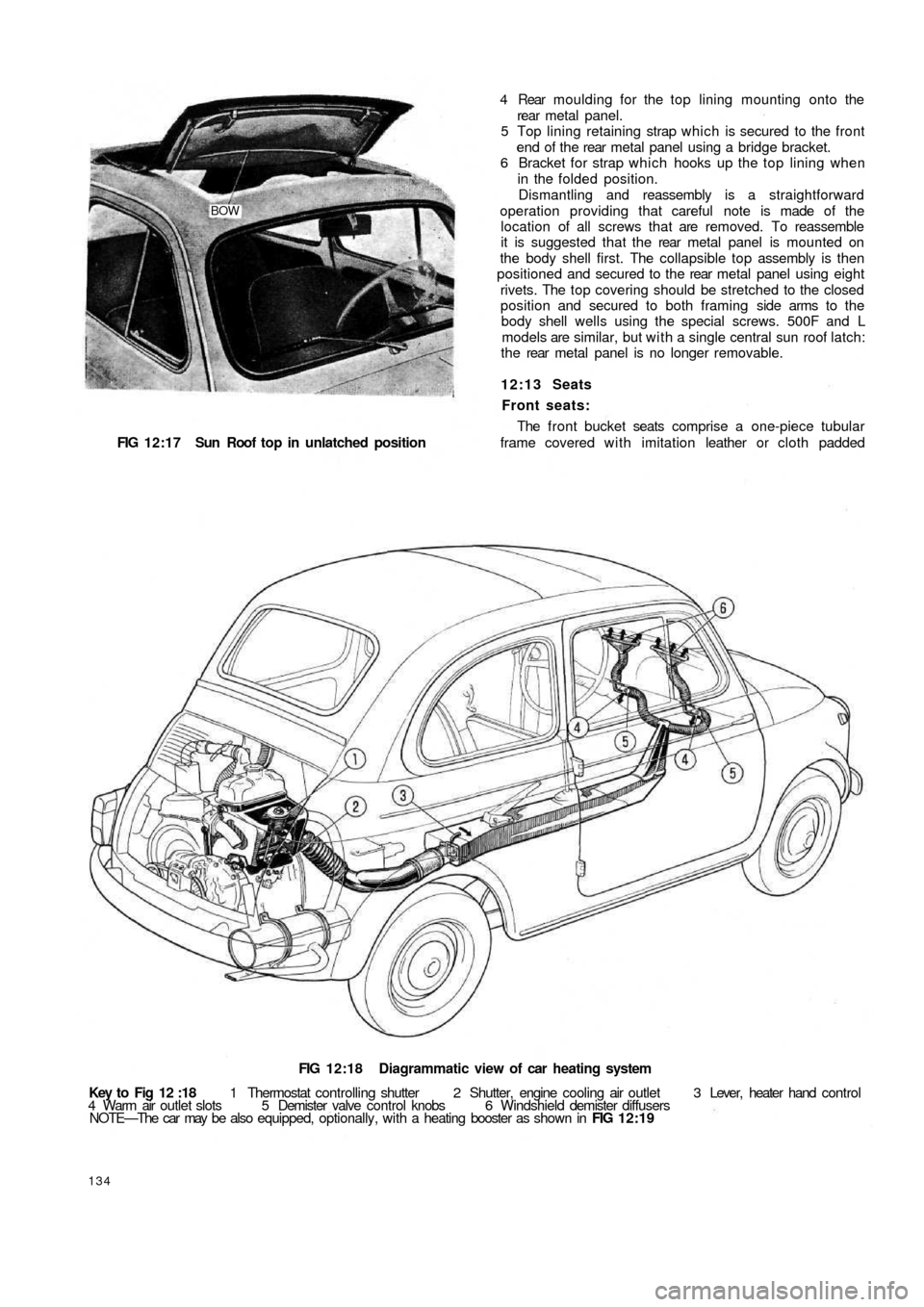
FIG 12:18 Diagrammatic view of car heating system
Key to Fig 12 :18 1 Thermostat controlling shutter 2 Shutter, engine cooling air outlet 3 Lever, heater hand control
4 Warm air outlet slots 5 Demister valve control knobs 6 Windshield demister diffusers
NOTE—The car may be also equipped, optionally, with a heating booster as shown in FIG 12:19
134
4 Rear moulding for the top lining mounting onto the
rear metal panel.
5 Top lining retaining strap which is secured to the front
end of t h e rear metal panel using a bridge bracket.
6 Bracket for strap which hooks up the top lining when
in the folded position.
Dismantling and reassembly is a straightforward
operation providing that careful note is made of the
location of all screws that are removed. To reassemble
it is suggested that the rear metal panel is mounted on
the body shell first. The collapsible top assembly is then
positioned and secured to the rear metal panel using eight
rivets. The top covering should be stretched to the closed
position and secured to both framing side arms to t h e
body shell wells using the special screws. 500F and L
models are similar, but with a single central sun roof latch:
t h e rear metal panel is no longer removable.
12:13 Seats
Front seats:
The front bucket seats comprise a one-piece tubular
frame covered with imitation leather or cloth padded
Page 128 of 128
cushion and back rest. A number of rubber straps are
hooked across the frame under the cushion and in a
sheath covering on the seat back.
The bottom of the front seat frame ends are provided
with sliding guides which run in guide rails attached to
the floor. The sliding guides are pivoted on the frame
tubes to allow for forward tilting of the seats giving better
access to the rear compartment. Two rubber pads
provide cushioning of the seat frame on the guide rails
as shown in FIG 12:11. The control lever for seat
adjustment is fitted in the frame righthand tube to permit
unlocking of the seats so that they may be adjusted to
individual drivers requirements.
Rear seats (Sedan):
The rear seat comprises of a foam rubber cushion and
back. The seat back is cemented to the rear floor and
body shell bulkhead. The rear seat lining is of fabric and
imitation leather. The seat lining is held in place by four
self-tapping screws, t w o of which secure the floor below
the back window and two the lining at the base of t h e
back rest. Included with the seat assembly is a masonite
floor which is fitted below the rear window.
Rear Seat (Station Wagon):
The rear seat back rest is pivoted at the base of its
frame so that it can be folded down to form a load plat-
form surface. In the upright position it is retained in place
by t w o brackets mounted on either side of the body below
the side
windows.
12:14 Interior heater
Description:
Interior heating is accomplished by recirculation of
warm air from the engine cooling system through engine
cowling. Referring to FIG 12:18 a hose conveys warmed
air from the engine cowling to the centre tunnel floor
where warm air flows out through two slots being cut on
the windshield delivery hoses. Air admission can be
adjusted by turning the control lever to the right which
operates the tunnel throttle valve at the rear seat.
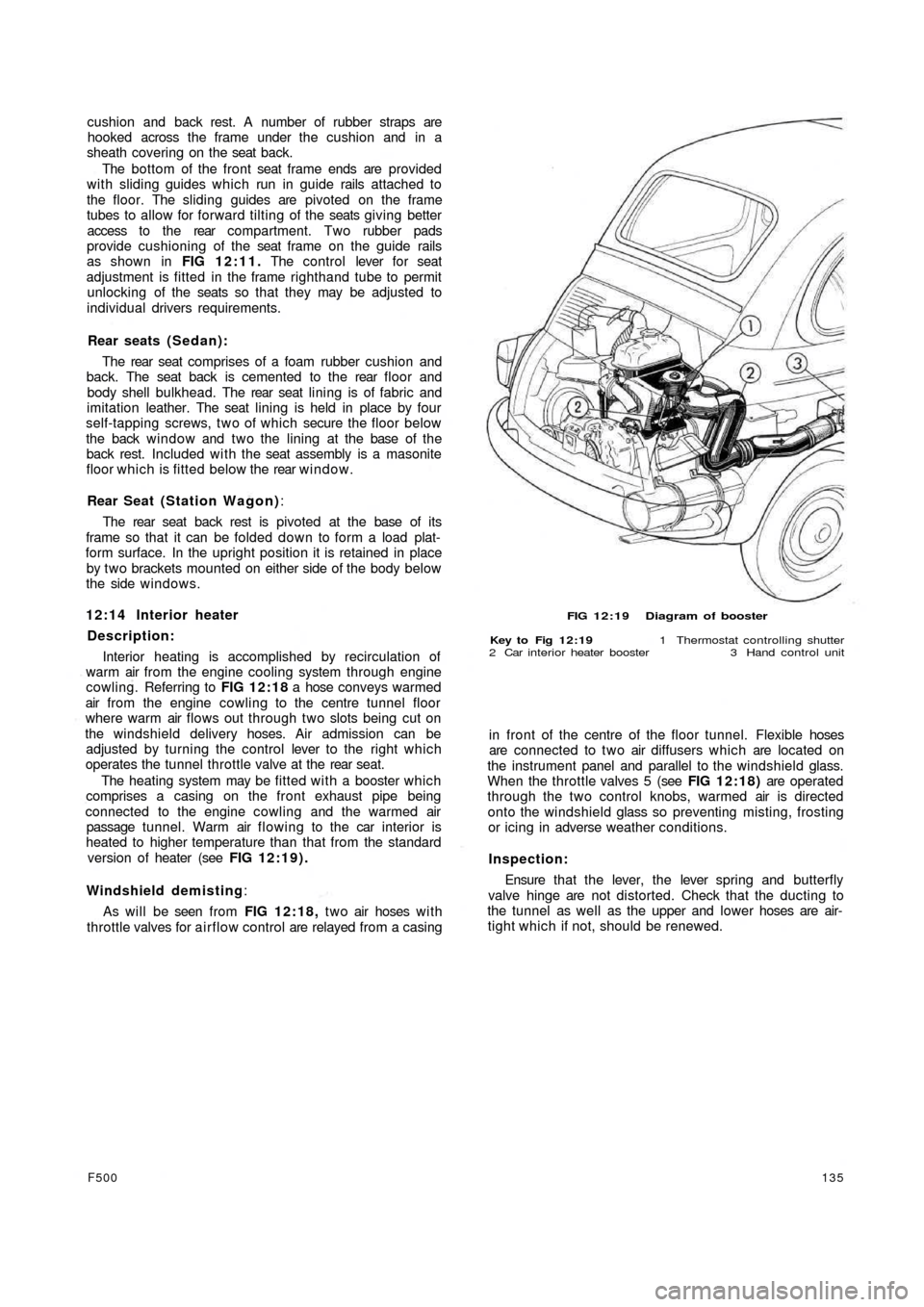
The heating system may be fitted with a booster which
comprises a casing on the front exhaust pipe being
connected to the engine cowling and the warmed air
passage tunnel. Warm air flowing to the car interior is
heated to higher temperature than that from the standard
version of heater (see FIG 12:19).
Windshield demisting:
As will be seen from FIG 12:18, t w o air hoses w i t h
throttle valves for airflow control are relayed from a casing
F500135
FIG 12:19 Diagram of booster
Key to Fig 12:19 1 Thermostat controlling shutter
2 Car interior heater booster 3 Hand control unit
in front of the centre of the floor tunnel. Flexible hoses
are connected to two air diffusers which are located on
the instrument panel and parallel to the windshield glass.
When the throttle valves 5 (see FIG 12:18) are operated
through the two control knobs, warmed air is directed
onto the windshield glass so preventing misting, frosting
or icing in adverse weather conditions.
Inspection:
Ensure that t h e lever, the lever spring and butterfly
valve hinge are not distorted. Check that the ducting to
the tunnel as well as the upper and lower hoses are air-
tight which if not, should be renewed.