Lubrication FIAT 500 1970 1.G Workshop Manual
[x] Cancel search | Manufacturer: FIAT, Model Year: 1970, Model line: 500, Model: FIAT 500 1970 1.GPages: 128, PDF Size: 9.01 MB
Page 2 of 128
CHAPTER 1
THE ENGINE
1 :1
1 :2
1 :3
1 :4
1 :5
1 :6
1 :7
1 :8
1:9
1 :10
1 :11Description
Engine removal (sedan—all versions)
Engine removal (station wagon)
Engine disassembly (sedan—all versions)
Engine disassembly (station wagon)
Cylinder head removal, servicing and
replacement
Timing gear overhaul
Crankcase and cylinders
Piston assembly
Connecting rods
Crankshaft and main bearings
1 :1 Description
The 'New 500' two-cylinder aircooled engine operates
on the four-stroke 'Otto Cycle' and is fitted directly to
the transmission unit which incorporates the rear drive
assembly as shown in FIG 1 :1 and FIG 1 :2.
With the power unit fitted at the rear several advantages
are obtained including better load distribution to the
wheels when the vehicle is loaded, elimination of propeller
shaft reducing the size of centre tunnel and better use of
available space.
The cylinder block comprises t w o cast iron cylinder
barrels w i t h cooling fins. The bottom of the cylinders fit
into machined seats in the aluminium crankcase.
The aluminium crankcase carries eight studs on which
are located the t w o cylinder barrels w i t h the aluminium
cylinder head on the top.
A two bush crankshaft of special cast iron is fitted into
the lower half of the crankcase. The crankshaft is
F5009 provided with a counterweight and is hollow to allow for
lubrication.
The steel connecting rods have thin wall bearing halves
on the big-end, and bronze bushes in the small-end. The
offset piston pin is of steel and retained in the piston by
two circlips.
Light alloy pistons are used and are of the taper-oval-
shaped type with a maximum diameter at the base of the
skirt, along an axis perpendicular to the piston pin. Pistons
are fitted with four rings as follows, one compression at
the top, two standard oil scraper rings and one side slotted
oil scraper ring.
The one-piece aluminium cylinder head is finned to
provide a larger cooling surface and carries the inlet and
exhaust manifolds.
The inlet passages merge into a single centralized
flange onto which is mounted the carburetter. The exhaust
passages run almost parallel to the axis of the engine. 1 :12
1 :13
1 :14
1 :15
1 :16
1 :17
1 :18
1 :19
1 :20
1 :21
1 :22Flywheel and starter ring gear
The oil pump
Lubrication, oil filter, relief valve
Valve timing
Valve stem to rocker clearance
Engine assembly (sedan—all versions)
Engine assembly (station wagon)
Power plant mounting
Adjustment of generator and fan belt drive
Modifications
Fault diagnosis
Page 3 of 128
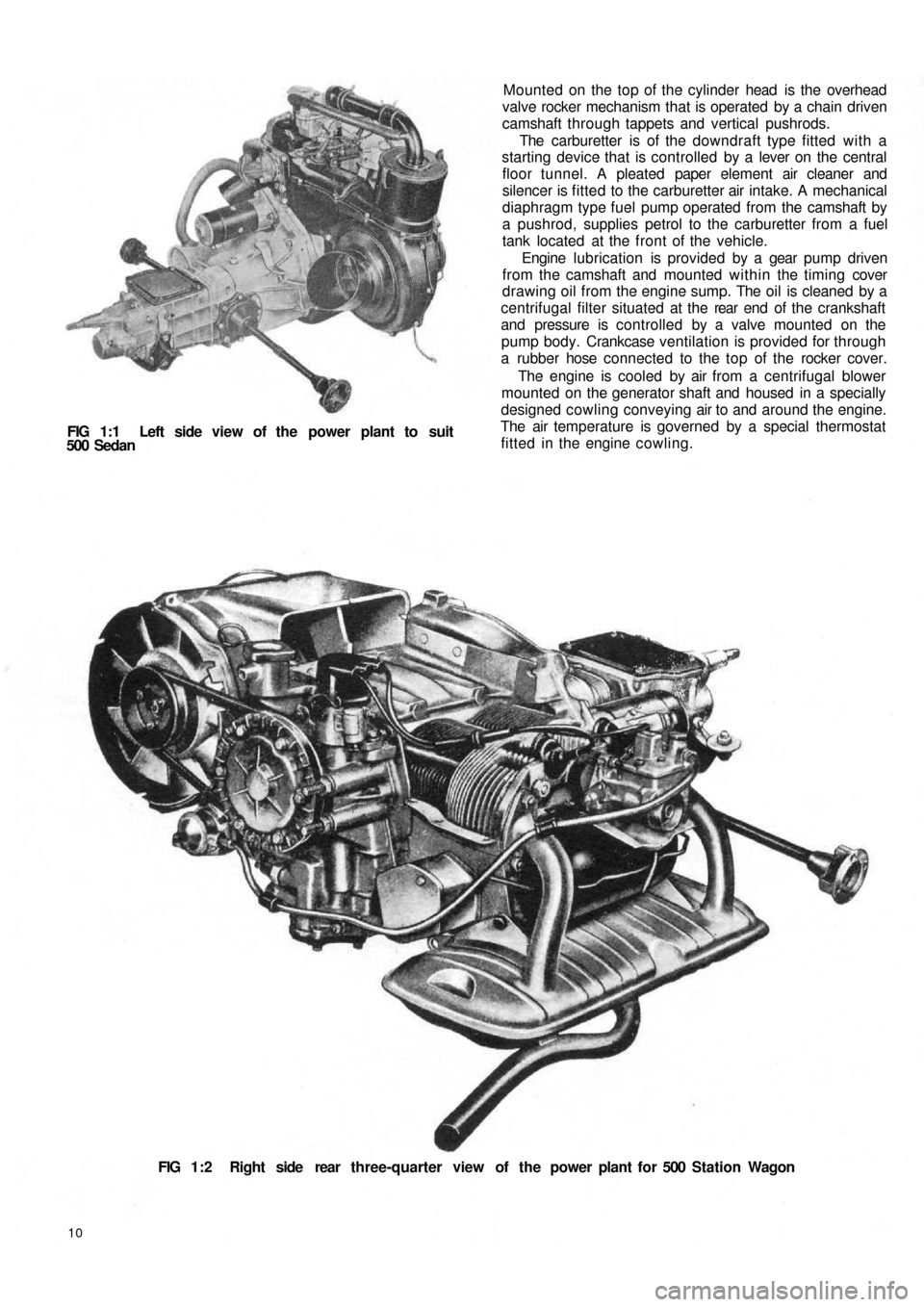
FIG 1:1 Left side view of the power plant to suit
500 Sedan
10
FIG 1:2 Right side rear three-quarter view of the power plant for 500 Station Wagon Mounted on the top of the cylinder head is the overhead
valve rocker mechanism that is operated by a chain driven
camshaft through tappets and vertical pushrods.
The carburetter is of the downdraft type fitted with a
starting device that is controlled by a lever on the central
floor tunnel. A pleated paper element air cleaner and
silencer is fitted to the carburetter air intake. A mechanical
diaphragm type fuel pump operated from the camshaft by
a pushrod, supplies petrol to the carburetter from a fuel
tank located at the front of the vehicle.
Engine lubrication is provided by a gear pump driven
from the camshaft and mounted within the timing cover
drawing oil from the engine sump. The oil is cleaned by a
centrifugal filter situated at the rear end of t h e crankshaft
and pressure is controlled by a valve mounted on the
pump body. Crankcase ventilation is provided for through
a rubber hose connected to the top of the rocker cover.
The engine is cooled by air from a centrifugal blower
mounted on the generator shaft and housed in a specially
designed cowling conveying air to and around the engine.
The air temperature is governed by a special thermostat
fitted in the engine cowling.
Page 9 of 128
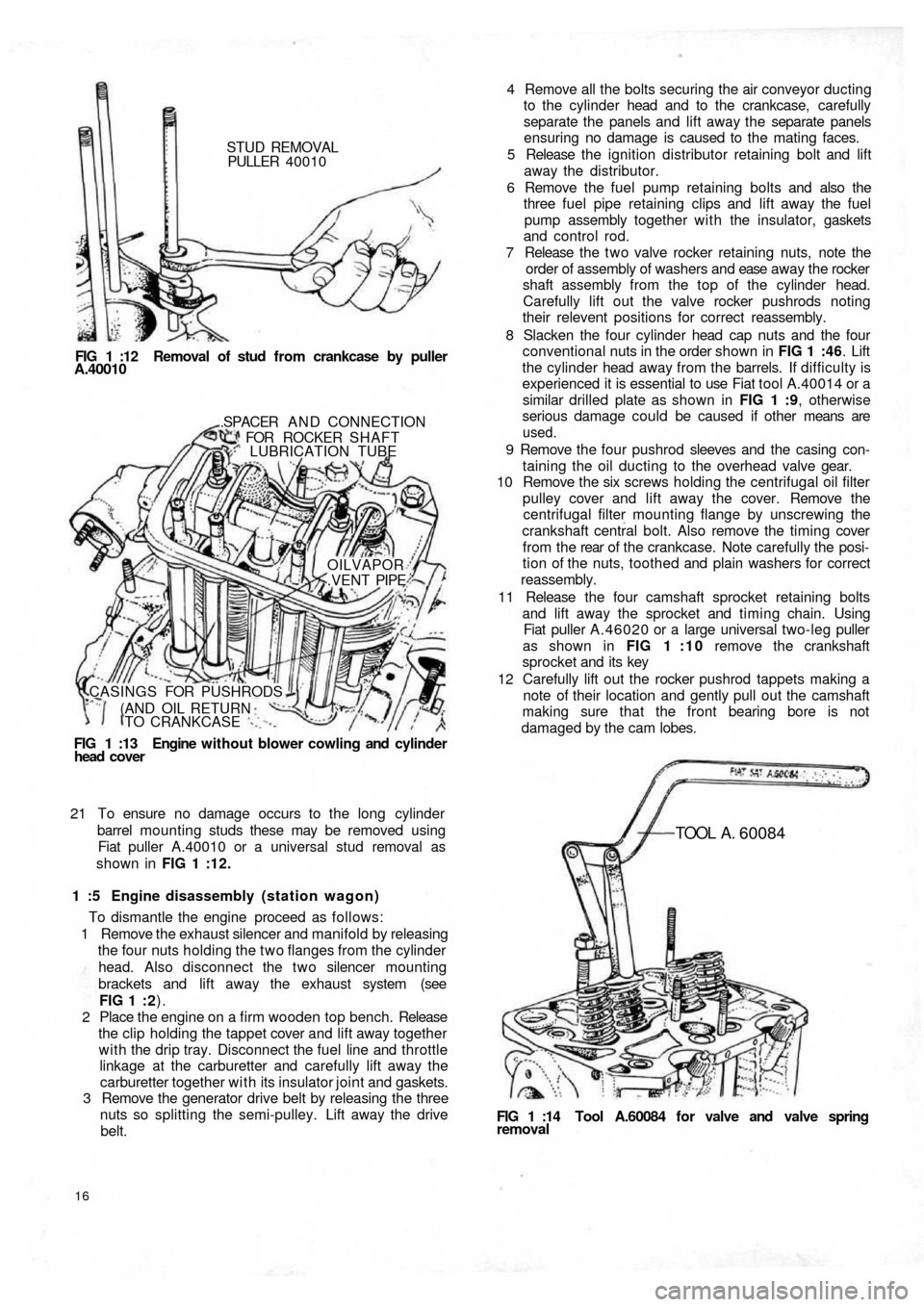
STUD REMOVAL
PULLER 40010
FIG 1 :12 Removal of stud from crankcase by puller
A.40010
FIG 1 :13 Engine without blower cowling and cylinder
head cover.SPACER A N D CONNECTION
FOR ROCKER SHAFT
LUBRICATION TUBE
OILVAPOR
.VENT PIPE
CASINGS FOR PUSHRODS
(AND OIL RETURN
TO CRANKCASE
21 To ensure no damage occurs to the long cylinder
barrel mounting studs these may be removed using
Fiat puller A.40010 or a universal stud removal as
shown in FIG 1 :12.
1 :5 Engine disassembly (station wagon)
To dismantle the engine proceed as follows:
1 Remove the exhaust silencer and manifold by releasing
the four nuts holding the two flanges from the cylinder
head. Also disconnect the two silencer mounting
brackets and lift away the exhaust system (see
FIG 1 : 2).
2 Place the engine on a firm wooden top bench. Release
the clip holding the tappet cover and lift away together
with the drip tray. Disconnect the fuel line and throttle
linkage at the carburetter and carefully lift away the
carburetter together with its insulator joint and gaskets.
3 Remove the generator drive belt by releasing the three
nuts so splitting the semi-pulley. Lift away the drive
belt.
16
FIG 1 :14 Tool A.60084 for valve and valve springremoval
TOOL A . 60084
4 Remove all the bolts securing the air conveyor ducting
to the cylinder head and to the crankcase, carefully
separate the panels and lift away the separate panels
ensuring no damage is caused to the mating faces.
5 Release the ignition distributor retaining bolt and lift
away the distributor.
6 Remove the fuel pump retaining bolts and also the
three fuel pipe retaining clips and lift away the fuel
pump assembly together with the insulator, gaskets
and control rod.
7 Release the t w o valve rocker retaining nuts, note the
order of assembly of washers and ease away the rocker
shaft assembly from the top of the cylinder head.
Carefully lift out the valve rocker pushrods noting
their relevent positions for correct reassembly.
8 Slacken the four cylinder head cap nuts and the four
conventional nuts in the order shown in FIG 1 :46. Lift
the cylinder head away from the barrels. If difficulty is
experienced it is essential to use Fiat tool A.40014 or a
similar drilled plate as shown in FIG 1 :9, otherwise
serious damage could be caused if other means are
used.
9 Remove the four pushrod sleeves and the casing con-
taining the oil ducting to the overhead valve gear.
10 Remove the six screws holding the centrifugal oil filter
pulley cover and lift away the cover. Remove the
centrifugal filter mounting flange by unscrewing the
crankshaft central bolt. Also remove the timing cover
f r o m t h e rear of t h e crankcase. Note carefully the posi-
tion of the nuts, toothed and plain washers for correct
reassembly.
11 Release the four camshaft sprocket retaining bolts
and lift away the sprocket and timing chain. Using
Fiat puller A.46020 or a large universal two-leg puller
as shown in FIG 1 : 1 0 remove the crankshaft
sprocket and its key
12 Carefully lift out the rocker pushrod tappets making a
note of their location and gently pull out the camshaft
making sure that the front bearing bore is not
damaged by the cam lobes.
Page 12 of 128
Cylinder head installation:
To refit the cylinder head proceed as follows:
Place a new cylinder head joint on the cleaned faces of
the cylinder barrels. Insert the rocker pushrod and
lubrication pipe sleeves together with the relevant
gaskets and rings.
Fit the washers and nuts to the studs and tighten to
fingertight.
Tighten the nuts in the order shown in FIG 1 :44 and
FIG 1 :46 to a torque wrench setting of 18.1 Ibft. Reset
the torque wrench to a new setting of 23.9 Ibft and
tighten the nuts once more in the recommended order.
Replace the pushrods in the correct order.
Refit the rocker shaft ensuring correct location of the
lubrication tube to the rocker shaft and replace the
plain and lockwashers. Tighten the nuts to a torque
wrench setting of 15.2 Ibft. Reset the tappet to rocker
clearance adjustment.
Connect the t w o exhaust side manifolds to the cylinder
head. Using new gasket refit the spark plugs and HT
cables. Replace the rocker cover fitted with a new cork
gasket and blower conveyor to the cylinder head
securing screws. Refit the carburetter and reconnect its
fuel line and controls. Refit the air cleaner and elbow
and connect the rocker cover breather pipe (if fitted).
1
2
3
4
5
1 :7 Timing gear overhaul
Camshaft:
The cast iron camshaft is located in the crankcase and is
supported at either end in sets machined directly in the
crankcase. No bushes are used. The camshaft is driven by
a chain from the crankshaft at half engine speed and
operates the overhead valves through tappets, pushrods
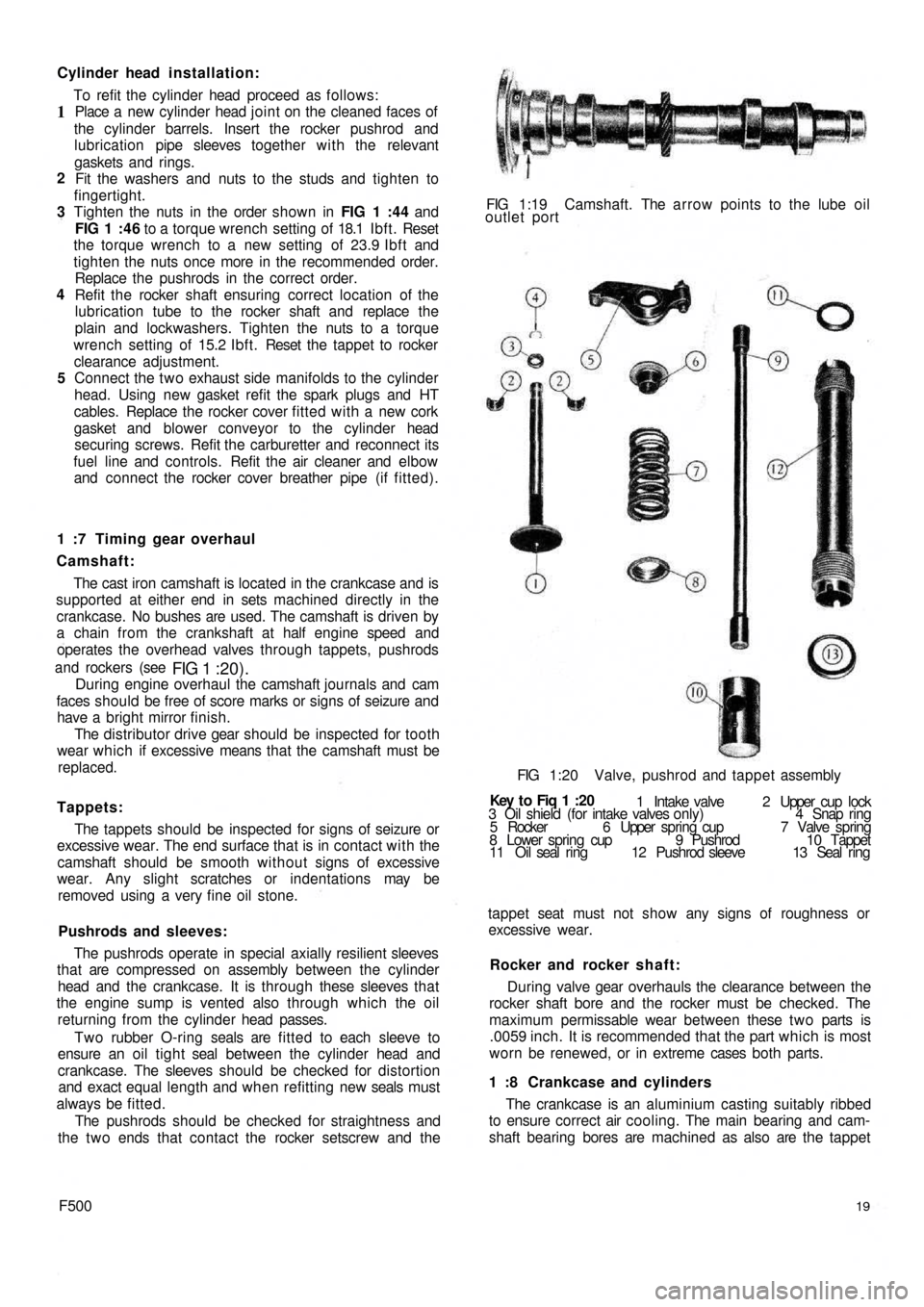
and rockers (see
FIG 1 :20).During engine overhaul the camshaft journals and cam
faces should be free of score marks or signs of seizure and
have a bright mirror finish.
The distributor drive gear should be inspected for tooth
wear which if excessive means that the camshaft must be
replaced.
Tappets:
The tappets should be inspected for signs of seizure or
excessive wear. The end surface that is in contact with the
camshaft should be smooth without signs of excessive
wear. Any slight scratches or indentations may be
removed using a very fine oil stone.
Pushrods and sleeves:
The pushrods operate in special axially resilient sleeves
that are compressed on assembly between the cylinder
head and the crankcase. It is through these sleeves that
the engine sump is vented also through which the oil
returning from the cylinder head passes.
Two rubber O-ring seals are fitted to each sleeve to
ensure an oil t i g h t seal between the cylinder head and
crankcase. The sleeves should be checked for distortion
and exact equal length and when refitting new seals must
always be fitted.
The pushrods should be checked for straightness and
the t w o ends that contact the rocker setscrew and the
F50019
The crankcase is an aluminium casting suitably ribbed
to ensure correct air cooling. The main bearing and cam-
shaft bearing bores are machined as also are the tappet 1 :8 Crankcase and cylinders During valve gear overhauls the clearance between the
rocker shaft bore and the rocker must be checked. The
maximum permissable wear between these t w o parts is
.0059 inch. It is recommended that the part which is most
worn be renewed, or in extreme cases both parts. Rocker and rocker shaft: tappet seat must not show any signs of roughness or
excessive wear. 3 Oil shield (for intake valves only) 4 Snap ring
5 Rocker 6 Upper spring cup 7 Valve spring
8 Lower spring cup 9 Pushrod 10 Tappet
11 Oil seal ring 12 Pushrod sleeve 13 Seal ring 1 Intake valve 2 Upper cup lock Key t o Fiq
1 :20 FIG 1:20 Valve, pushrod and tappet assembly FIG 1:19 Camshaft. The arrow points to the lube oil
outlet port
Page 16 of 128
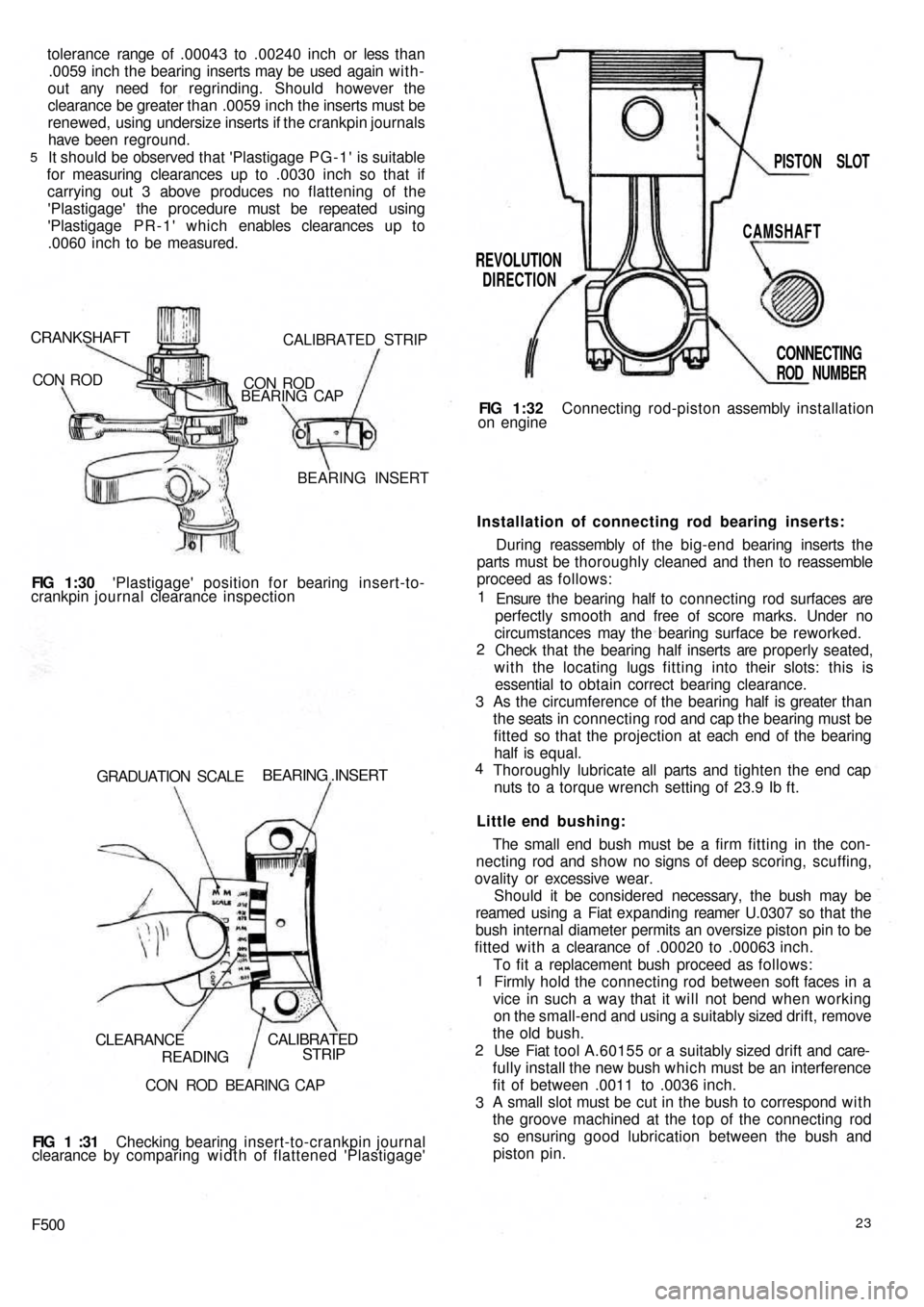
tolerance range of .00043 to .00240 inch or less than
.0059 inch the bearing inserts may be used again with-
out any need for regrinding. Should however the
clearance be greater than .0059 inch the inserts must be
renewed, using undersize inserts if the crankpin journals
have been reground.
It should be observed that 'Plastigage PG-1' is suitable
for measuring clearances up to .0030 inch so that if
carrying out 3 above produces no flattening of the
'Plastigage' the procedure must be repeated using
'Plastigage PR-1' which enables clearances up to
.0060 inch to be measured.
5
CRANKSHAFT
CON RODCALIBRATED STRIP
CON ROD
BEARING CAP
BEARING INSERT
FIG 1:30 'Plastigage' position for bearing insert-to-
crankpin journal clearance inspection
GRADUATION SCALE
BEARING .INSERT
CLEARANCE
READINGCALIBRATED
STRIP
CON ROD BEARING CAP
FIG 1 :31 Checking bearing insert-to-crankpin journal
clearance by comparing width of flattened 'Plastigage'
F50023
To fit a replacement bush proceed as follows:
Firmly hold the connecting rod between soft faces in a
vice in such a way that it will not bend when working
on the small-end and using a suitably sized drift, remove
the old bush.
Use Fiat tool A.60155 or a suitably sized drift and care-
fully install the new bush which must be an interference
fit of between .0011 to .0036 inch.
A small slot must be cut in the bush to correspond w i t h
the groove machined at the top of the connecting rod
so ensuring good lubrication between the bush and
piston pin. 1
2
3The small end bush must be a firm fitting in the con-
necting rod and show no signs of deep scoring, scuffing,
ovality or excessive wear.
Should it be considered necessary, the bush may be
reamed using a Fiat expanding reamer U.0307 so that the
bush internal diameter permits an oversize piston pin to be
fitted with a clearance of .00020 to .00063 inch. Little end bushing:Installation of connecting rod bearing inserts:
During reassembly of the big-end bearing inserts the
parts must be thoroughly cleaned and then to reassemble
proceed as follows:
Ensure the bearing half to connecting rod surfaces are
perfectly smooth and free of score marks. Under no
circumstances may the bearing surface be reworked.
Check that the bearing half inserts are properly seated,
with the locating lugs fitting into their slots: this is
essential to obtain
correct bearing clearance.
As the circumference of the bearing half is greater than
the seats in connecting rod and cap the bearing must be
fitted so that the projection at each end of the bearing
half is equal.
Thoroughly lubricate all parts and tighten the end cap
nuts to a torque wrench setting of 23.9 Ib ft. 1
2
3
4FIG 1:32 Connecting rod-piston assembly installation
on engine
REVOLUTION
DIRECTIONPISTON SLOT
CAMSHAFT
CONNECTING
ROD NUMBER
Page 17 of 128
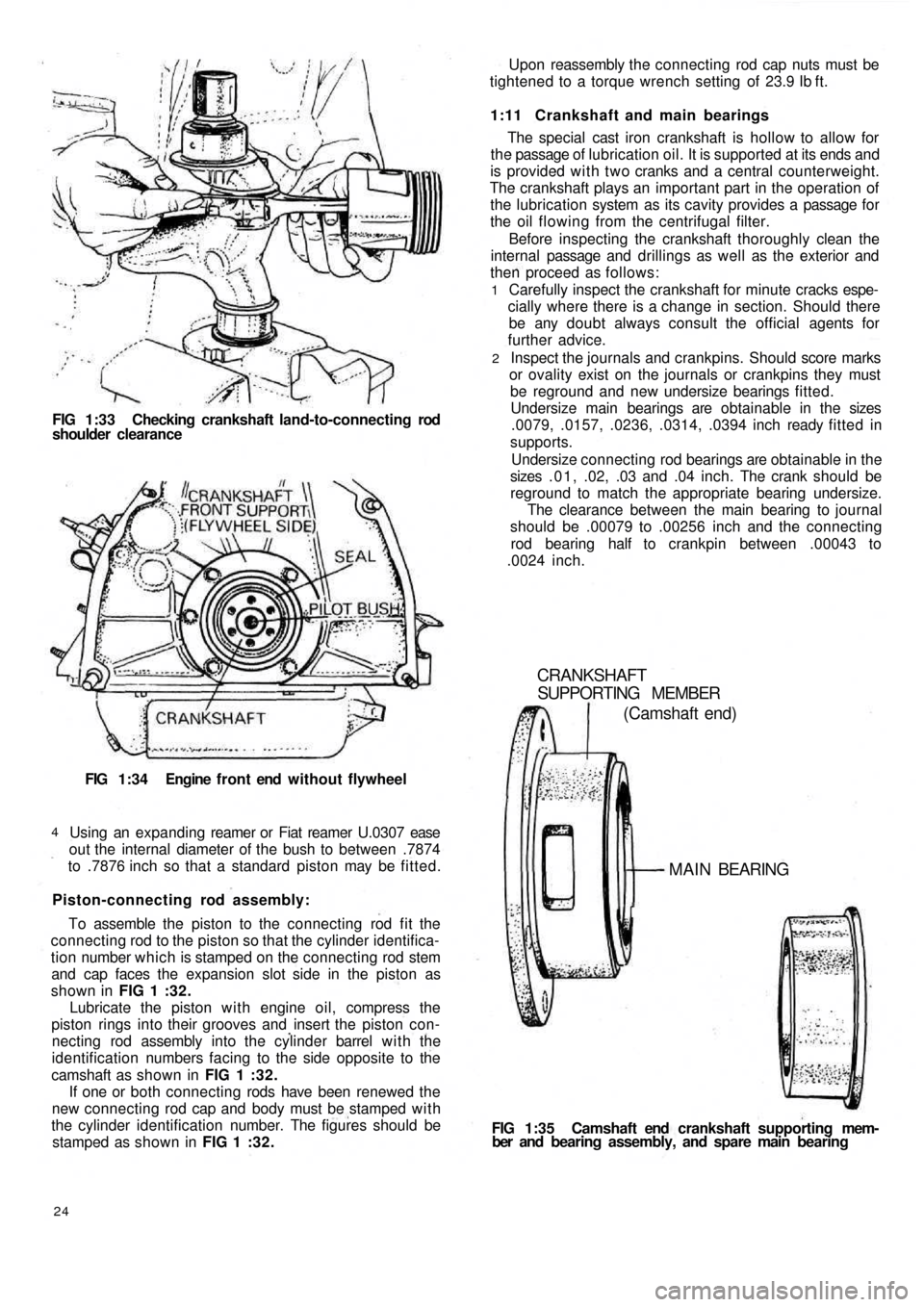
FIG 1:33 Checking crankshaft land-to-connecting rod
shoulder clearance
FIG 1:34 Engine f r o n t end without flywheel
Using an expanding reamer or Fiat reamer U.0307 ease
out the internal diameter of the bush to between .7874
to .7876 inch so that a standard piston may be fitted.
4
Piston-connecting rod assembly:
To assemble the piston to the connecting rod fit the
connecting rod to the piston so that the cylinder identifica-
tion number which is stamped on the connecting rod stem
and cap faces the expansion slot side in the piston as
shown in FIG 1 :32.
Lubricate the piston with engine oil, compress the
piston rings into their grooves and insert the piston con-
necting rod assembly into the cylinder barrel w i t h the
identification numbers facing to the side opposite to the
camshaft as shown in FIG 1 :32.
If one or both connecting rods have been renewed the
new connecting rod cap and body must be stamped w i t h
the cylinder identification number. The figures should be
stamped as shown in FIG 1 :32.
24
FIG 1:35 Camshaft end crankshaft supporting mem-
ber and bearing assembly, and spare main bearing
CRANKSHAFT
SUPPORTING MEMBER
(Camshaft end)
MAIN BEARING
Carefully inspect the crankshaft for minute cracks espe-
cially where there is a change in section. Should there
be any doubt always consult the official agents for
further advice.
Inspect the journals and crankpins. Should score marks
or ovality exist on the journals or crankpins they must
be reground and new undersize bearings fitted.
Undersize main bearings are obtainable in the sizes
.0079, .0157, .0236, .0314, .0394 inch ready fitted in
supports.
Undersize connecting rod bearings are obtainable in the
sizes .01, .02, .03 and .04 inch. The crank should be
reground to match the appropriate bearing undersize.
The clearance between the main bearing to journal
should be .00079 to .00256 inch and the connecting
rod bearing half to crankpin between .00043 to
.0024 inch.
2 1
The special cast iron crankshaft is hollow to allow for
the passage of lubrication oil. It is supported at its ends and
is provided with two cranks and a central counterweight.
The crankshaft plays an important part in the operation of
the lubrication system as its cavity provides a passage for
the oil flowing from the centrifugal filter.
Before inspecting the crankshaft thoroughly clean the
internal passage and drillings as well as the exterior and
then proceed as follows: 1:11 Crankshaft and main bearings Upon reassembly the connecting rod cap nuts must be
tightened to a torque wrench setting of 23.9 Ib ft.
Page 18 of 128
After the crankshaft has been reground it is important
that all traces of swarf are removed by constant washing
and then drying with a non-fluffy rag.
The clearance between the main bearings and journals
must be checked before installing the crankshaft in the
engine. It should also serve as a recheck after the
crankshaft has been reground.
Measure the maximum main bearing internal
diameter and the minimum journal diameter using
accurate measuring equipment. The clearance must not
exceed .0039 inch otherwise the journals must be
reground and undersize bearings fitted.
Undersize bearings w i t h .0394 inch stock on the
internal diameter are also supplied unmounted. They
must be press fitted in the supports, the recommended
interference fit being .00039 to .00197 inch. After
pressing the bearing into the support, a hole is drilled in
the bearing in line with the location dowel hole in the
support. The hole is finished with a suitable expanding
reamer, such as Fiat U.0334, and the dowel pressed i n ,
noting that the hollow dowel fits in the flywheel end
support.
The next stage is to heat the assembly in an oven or
oil bath for a period of one hour at 150°C (302°F).
When the assembly has cooled to room temperature,
the bearing is reamed in a lathe to match the crankshaft
journal size.
3
Crankshaft oil seals:
Two inner spring rubber oil seals are located, one in a
special seat in the timing gear cover and the other in the
flywheel end of the crankshaft support and provide oil
tightness. These seals are shown in FIGS 1 :3 and 1 :34.
Whenever the engine is dismantled for overhaul these
seals should be carefully inspected for correct seating and
that the inner seal surface is not worn and that the contact
area is perfect both on the crankshaft and on the fan and
generator drive pulley hub.
Clutch shaft pilot bushing:
A self-lubricating bronze bush is fitted in the end of the
crankshaft as shown in FIG 1 :34 and provides a bearing
for the clutch shaft. Should the bush be worn use Fiat
puller A.40006/1 /2 to remove the worn bush. A new bush
should be fitted using a suitably sized drift.
1:12 Flywheel and starter ring gear
The flywheel should be inspected for wear at the clutch
driven plate contact area. It should be flat and have a
smooth finish.
The ring gear teeth should be cheeked for damage
which if evident, the ring gear must be replaced. To facili-
tate the fitting of a new ring gear on the flywheel, the new
ring gear should be heated in an oil bath to a temperature
of 80°C (176°F). Using a press gently ease the
expanded
ring gear over the flywheel and press fully home.
1:13 The oil pump
Sedan :
A helical-spur gear type oil pump is driven by the cam-
shaft through a front dog drive coupling. The gears are
F50025 To remove the pump from the engine proceed as
follows:Pump removal and reassembly:
Remove the engine rear central support from the timing
gear casing. Remove the filter cover pulley and lift
away the drive belt.
Release the hollow screw attaching the slinger and the
mounting flange of the filter on the crankshaft. Also
release the nuts fixing the timing gear cover to the
crankcase.
Remove the timing gear cover together with the oil
pump assembly and the pressure relief valve.
Lift out the oil pump suction scoop with the filter
screen attached from the sump.
Reassembly of the pump to the engine is the reverse
procedure to dismantling. 1
2
3
4
5 located in a special housing in the timing gear cover and
held in place by a cover plate. The oil pressure relief valve
is mounted on the drive gear shaft guide.
A pump suction scoop fitted with a filter screen is
secured in the crankcase and connects to a duct in the
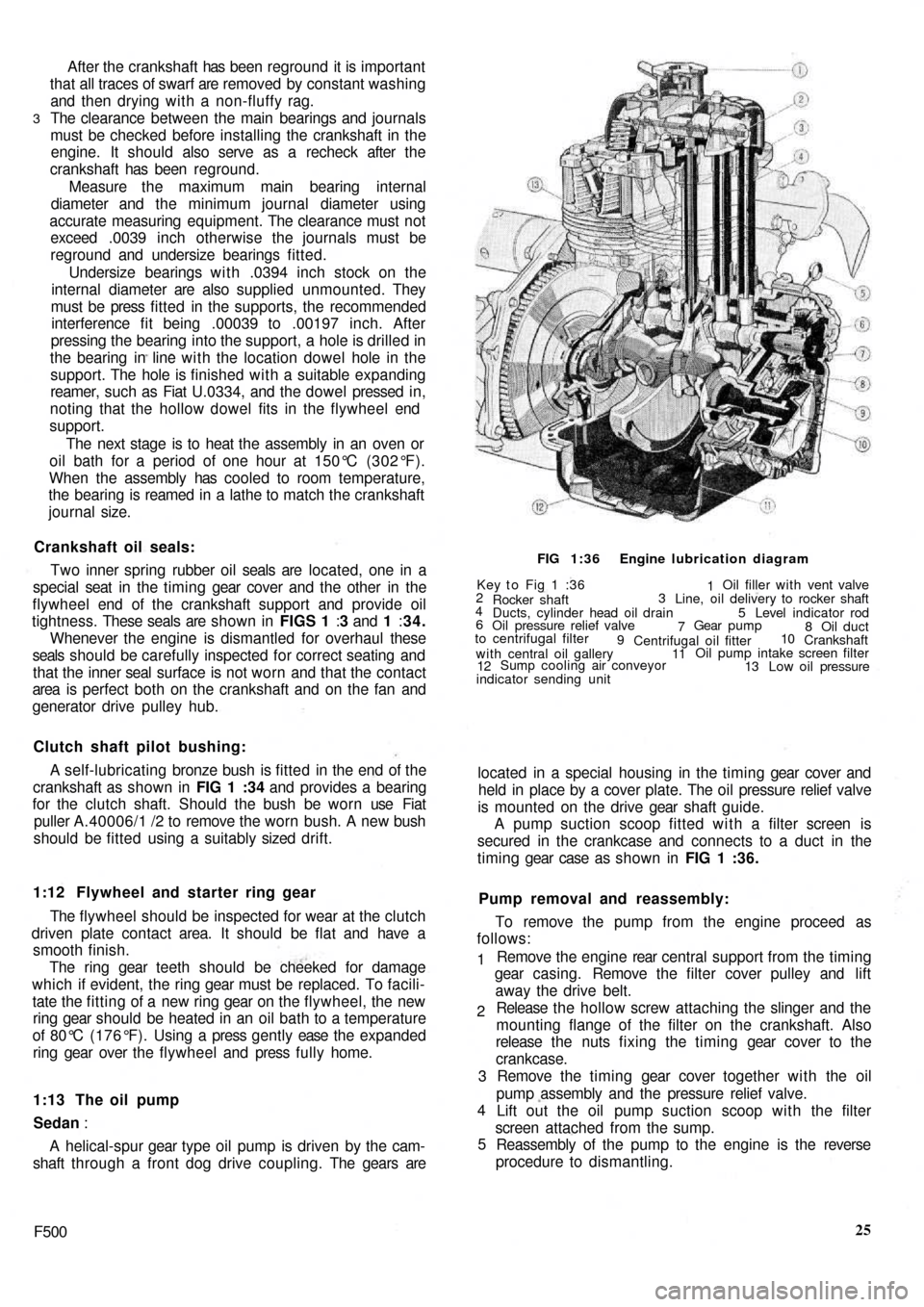
timing gear case as s h o w n in FIG 1 :36.
2
4
6Key t o Fig 1 :36
Rocker shaft
Ducts, cylinder head oil drain
Oil pressure relief valve
to centrifugal filter
9
with central oil gallery
12Sump cooling air conveyor
indicator sending unitOil filler with vent valve
Line, oil delivery to rocker shaft
Level indicator rod 31
5
7Gear pump
8 Oil duct
Centrifugal oil fitter
1110
Crankshaft
Oil pump intake screen filter
13 Low oil pressure FIG 1:36 Engine lubrication diagram
Page 19 of 128
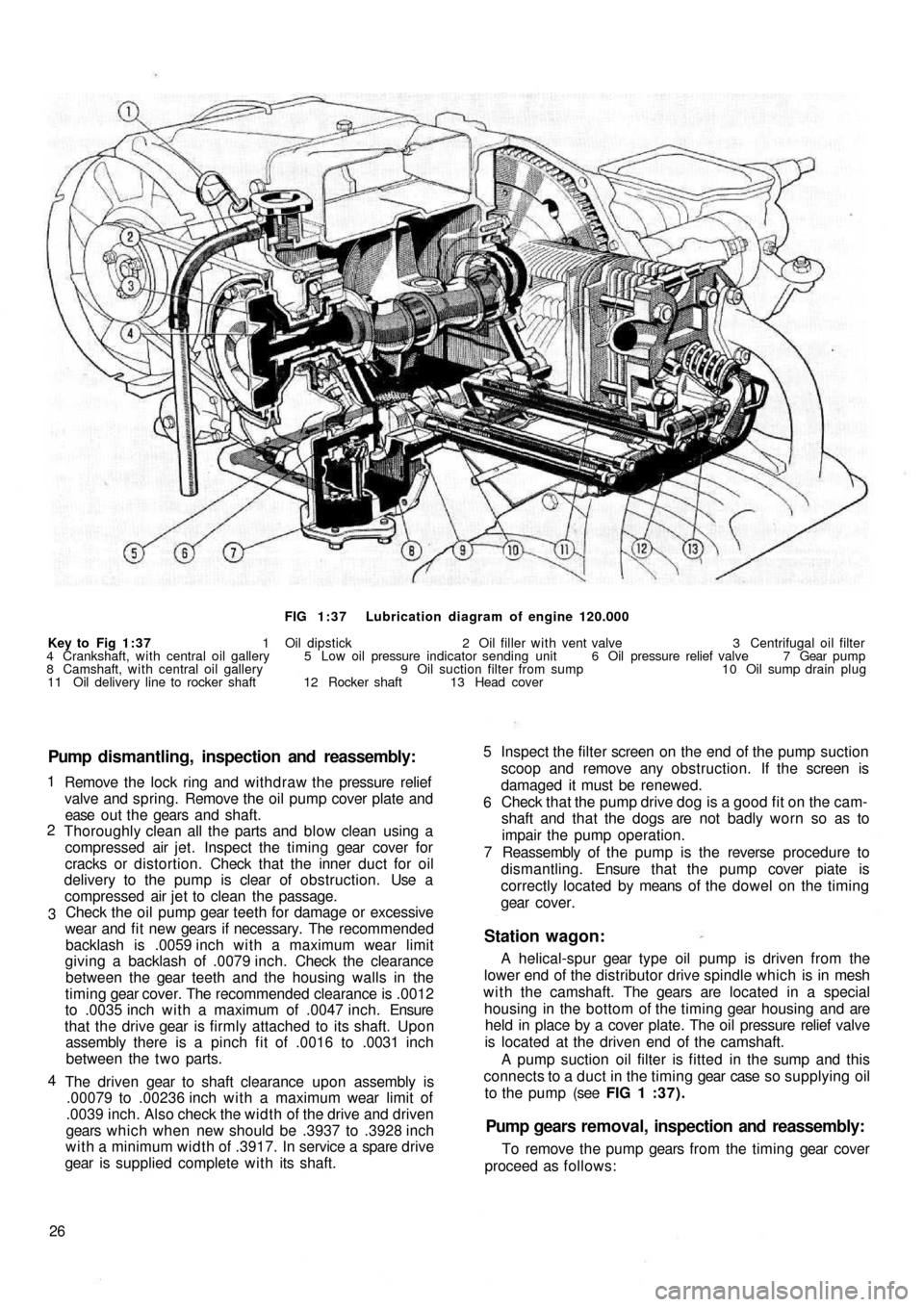
FIG 1:37 Lubrication diagram of engine 120.000
Key to Fig 1:37 1 Oil dipstick 2 Oil filler with vent valve 3 Centrifugal oil filter
4 Crankshaft, with central oil gallery 5 Low oil pressure indicator sending unit 6 Oil pressure relief valve 7 Gear pump
8 Camshaft, with central oil gallery 9 Oil suction filter from sump 10 Oil sump drain plug
11 Oil delivery line to rocker shaft 12 Rocker shaft 13 Head cover
Pump dismantling, inspection and reassembly:
Remove the lock ring and withdraw the pressure relief
valve and spring. Remove the oil pump cover plate and
ease o u t t h e gears and shaft.
Thoroughly clean all the parts and blow clean using a
compressed air jet. Inspect the timing gear cover for
cracks or distortion. Check that the inner duct for oil
delivery to the pump is clear of obstruction. Use a
compressed air jet to clean the passage.
Check the oil pump gear teeth for damage or excessive
wear and fit new gears if necessary. The recommended
backlash is .0059 inch w i t h a maximum wear limit
giving a backlash of .0079 inch. Check the clearance
between the gear teeth and the housing walls in the
timing gear cover. The recommended clearance is .0012
to .0035 inch w i t h a maximum of .0047 inch. Ensure
that the drive gear is firmly attached to its shaft. Upon
assembly there is a pinch fit of .0016 to .0031 inch
between the t w o parts.
The driven gear to shaft clearance upon assembly is
.00079 to .00236 inch with a maximum wear limit of
.0039 inch. Also check the width of the drive and driven
gears which when new should be .3937 to .3928 inch
with a minimum width of .3917. In service a spare drive
gear is supplied complete with its shaft.
26 4 3 2 1
Station wagon:
A helical-spur gear type oil pump is driven from the
lower end of the distributor drive spindle which is in mesh
w i t h the camshaft. The gears are located in a special
housing in the bottom of the timing gear housing and are
held in place by a cover plate. The oil pressure relief valve
is located at the driven end of the camshaft.
A pump suction oil filter is fitted in the sump and this
connects to a duct in the timing gear case so supplying oil
to the pump (see FIG 1 : 3 7 ) .
Pump gears removal, inspection and reassembly:
To remove the pump gears from the timing gear cover
proceed as follows:Inspect the filter screen on the end of the pump suction
scoop and remove any obstruction. If the screen is
damaged it must be renewed.
Check that the pump drive dog is a good fit on the cam-
shaft and that the dogs are not badly worn so as to
impair the pump operation.
Reassembly of the pump is the reverse procedure to
dismantling. Ensure that the pump cover piate is
correctly located by means of the dowel on the timing
gear cover. 5
6
7
Page 20 of 128
Drain the oil sump to ensure that the oil does not syphon
out. Thoroughly clean the area around the pump body
(see FIG 1 :37).
Remove the end cover plate by releasing the retaining
bolts and washers. Carefully ease t h e driven gear down-
wards followed by the driving gear and shaft
Clean all parts removed and blow clean using a com-
pressed air jet. Inspect the timing gear cover pump area
for cracks or distortion. Check that the inner duct for oil
delivery to the pump is clear of obstruction. If in doubt
remove the drain plug and filler cap and use a com-
pressed air j e t to clean the passage.
Check the gear teeth for damage or excessive wear,
ensure that the drive gear is firmly attached to its spindle
and that the end cover plate is not badly scored or pitted.
Fit new parts as necessary.
Reassembly is the reverse procedure to dismantling,
taking care that all parts are assembled clean and the
end cover plate seating correctly with a new gasket. 5 43 21
1:14 Lubrication, oil filter, relief valve
Description :
The engine is pressure lubricated through a gear type
pump which is incorporated in the timing gear cover and
driven from the camshaft by dogs or gears. The lubrication
circuits are shown in FIGS 1 :36 and 1 : 37.
The pump draws oil from the sump through a suction
horn fitted with a filter screen which is fixed to the crank-
case by a d u c t in t h e timing gear cover. This
supplies oil
to the pump.
Oil passes f r o m the camshaft rear seat o n t o t h e crank-
shaft rear support where it flows into an adjacent chamber.
From here the o i l flows through ducts in the crankshaft
from end to the centrifugal oil filter. The centrifugal filter,
which also acts as a pulley for the generator and blower
drive, rotates w i t h the crankshaft.
Oil from the filter enters a passage in the crankshaft,
where it lubricates the main and connecting rod bearings
and passes f r o m a special groove in the front main
bearing and ducting in the crankcase into which is
inserted the oil pressure warning sender unit, and also
the delivery pipe for oil to the overhead valve gear.
The pushrod sleeves provide the return path for the oil
from the cylinder head and delivers oil to the tappet gear
and the camshaft cams. The tappets are suitably drilled
to allow correct circulation of the oil. The tappets are
located in t w o casting cavities, one of which com-
municates w i t h the timing gear housing and the other
one to the crankshaft front drain support drain.
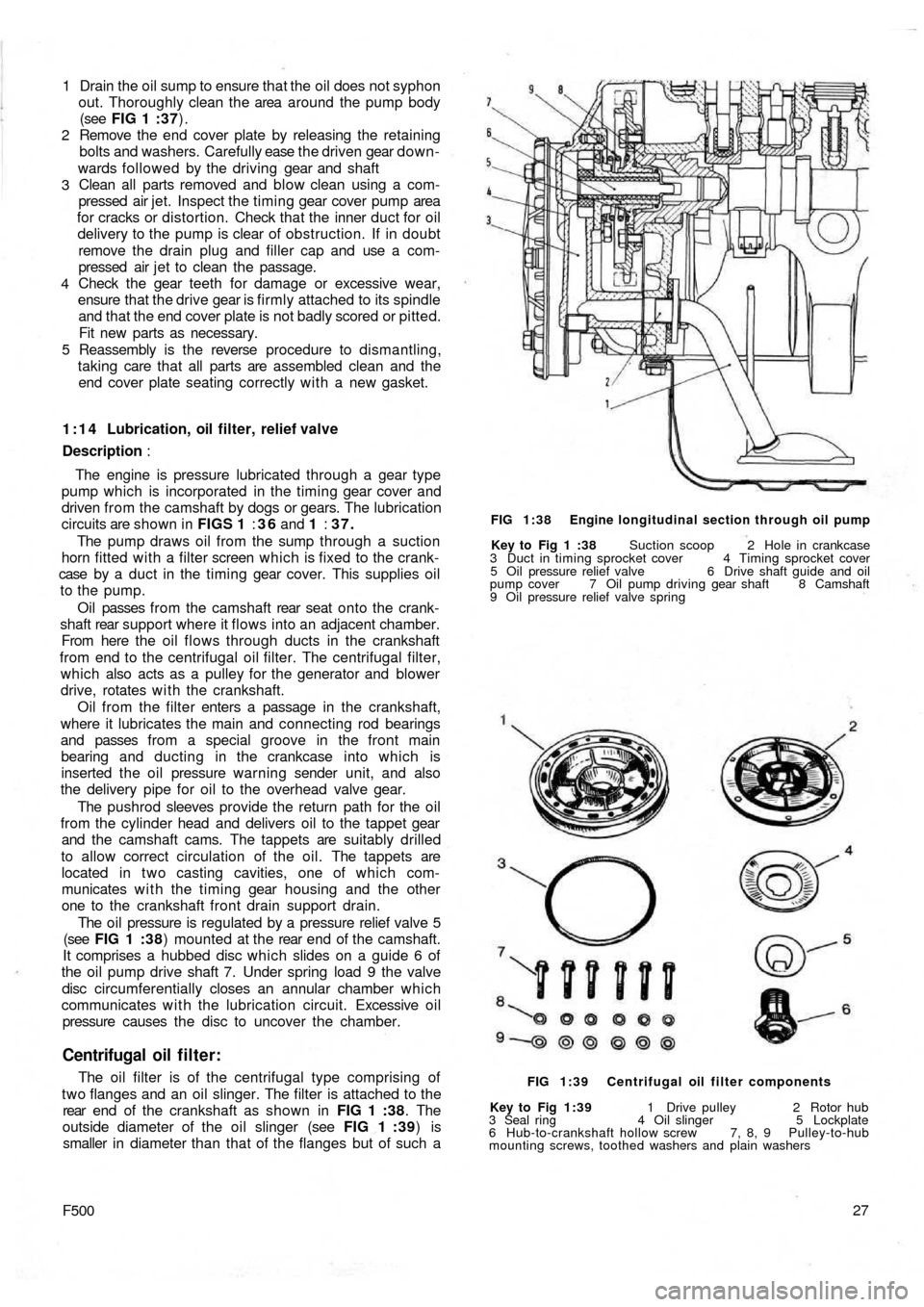
The oil pressure is regulated by a pressure relief valve 5
(see FIG 1 : 3 8) mounted at the rear end of t h e camshaft.
It comprises a hubbed disc which slides on a guide 6 of
the oil pump drive shaft 7. Under spring load 9 the valve
disc circumferentially closes an annular chamber which
communicates w i t h the lubrication circuit. Excessive o i l
pressure causes the disc to uncover the chamber.
Centrifugal oil filter:
The oil filter is of the centrifugal type comprising of
two flanges and an oil slinger. The filter is attached to the
rear end o f t h e c r a n k s h a f t a s s h o w n i n FIG 1 :38. The
outside diameter of the oil slinger (see FIG 1 :39) is
smaller in diameter than that of the flanges but of such a
F50027
Key to Fig 1:39 1 Drive pulley 2 Rotor hub
3 Seal ring 4 Oil slinger 5 Lockplate
6 Hub-to-crankshaft hollow screw 7, 8, 9 Pulley-to-hub
mounting screws, toothed washers and plain washers FIG 1:39 Centrifugal oil filter components Key to Fig 1 :38 Suction scoop 2 Hole in crankcase
3 Duct in timing sprocket cover 4 Timing sprocket cover
5 Oil pressure relief valve 6 Drive shaft guide and oil
pump cover 7 Oil pump driving gear shaft 8 Camshaft
9 Oil pressure relief valve spring FIG 1:38 Engine longitudinal section through oil pump
Page 21 of 128
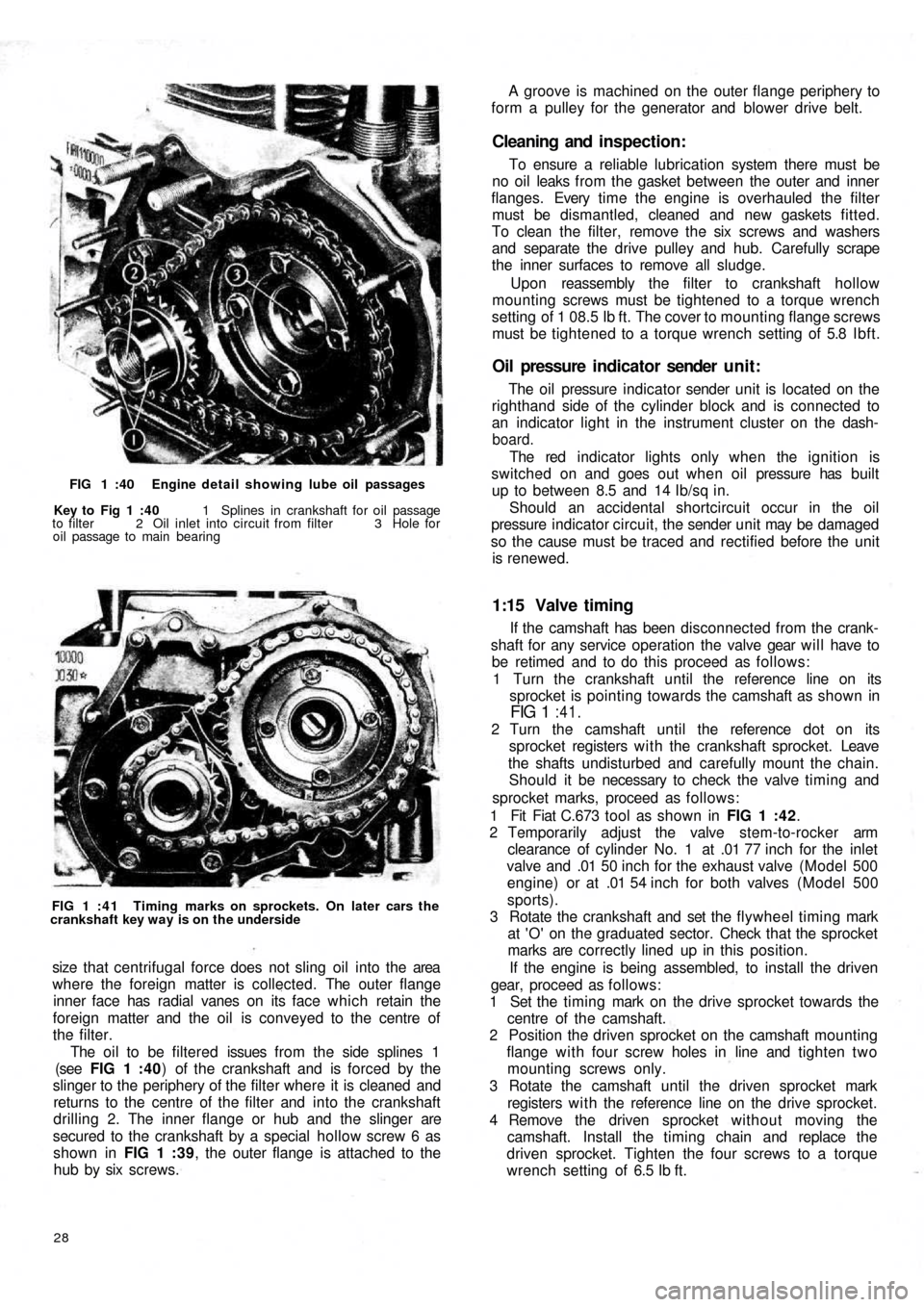
FIG 1 :40 Engine detail showing lube oil passages
Key to Fig 1 :40 1 Splines in crankshaft for oil passage
to filter 2 Oil inlet into circuit from filter 3 Hole for
oil passage to main bearing
FIG 1 : 4 1 Timing marks on sprockets. On later cars the
crankshaft key way is on the underside
size that centrifugal force does not sling oil into the area
where the foreign matter is collected. The outer flange
inner face has radial vanes on its face which retain the
foreign matter and the oil is conveyed to the centre of
the filter.
The oil to be filtered issues from the side splines 1
(see FIG 1 :40) of the crankshaft and is forced by the
slinger to the periphery of the filter where it is cleaned and
returns to the centre of the filter and into the crankshaft
drilling 2. The inner flange or hub and the slinger are
secured to the crankshaft by a special hollow screw 6 as
shown in FIG 1 :39, the outer flange is attached to the
hub by six screws.
28
If the camshaft has been disconnected from the crank-
shaft for any service operation the valve gear will have to
be retimed and to do this proceed as follows:
1 Turn the crankshaft until the reference line on its
sprocket is pointing towards the camshaft as shown in
FIG 1 :41.
2 Turn the camshaft until the reference dot on its
sprocket registers w i t h the crankshaft sprocket. Leave
the shafts undisturbed and carefully mount the chain.
Should it be necessary to check the valve timing and
sprocket marks, proceed as follows:
1 Fit Fiat C.673 tool as shown in FIG 1 :42.
2 Temporarily adjust the valve stem-to-rocker arm
clearance of cylinder No. 1 at .01 77 inch for the inlet
valve and .01 50 inch for the exhaust valve (Model 500
engine) or at .01 54 inch for both valves (Model 500
sports).
3 Rotate the crankshaft and set the flywheel timing mark
at 'O' on the graduated sector. Check that the sprocket
marks are correctly lined up in this position.
If the engine is being assembled, to install the driven
gear, proceed as follows:
1 Set the timing mark on the drive sprocket towards the
centre of the camshaft.
2 Position the driven sprocket on the camshaft mounting
flange with four screw holes in line and tighten two
mounting screws only.
3 Rotate the camshaft until the driven sprocket mark
registers w i t h the reference line on the drive sprocket.
4 Remove the driven sprocket without moving the
camshaft. Install the timing chain and replace the
driven sprocket. Tighten the four screws to a torque
wrench setting of 6.5 Ib ft.
1:15 Valve timing
The oil pressure indicator sender unit is located on the
righthand side of the cylinder block and is connected to
an indicator light in the instrument cluster on the dash-
board.
The red indicator lights only when the ignition is
switched on and goes out when o i l pressure has built
up to between 8.5 and 14 Ib/sq in.
Should an accidental shortcircuit occur in the oil
pressure indicator circuit, the sender unit may be damaged
so the cause must be traced and rectified before the unit
is renewed.
Oil pressure indicator sender unit:
To ensure a reliable lubrication system there must be
no oil leaks from the gasket between the outer and inner
flanges. Every t i m e t h e engine is overhauled the filter
must be dismantled, cleaned and new gaskets fitted.
To clean the filter, remove the six screws and washers
and separate the drive pulley and hub. Carefully scrape
the inner surfaces to remove all sludge.
Upon reassembly the filter to crankshaft hollow
mounting screws must be tightened to a torque wrench
setting of 1 08.5 Ib ft. The cover to mounting flange screws
must be tightened to a torque wrench setting of 5.8 Ibft.
Cleaning and inspection:
A groove is machined on the outer flange periphery to
form a pulley for the generator and blower drive belt.