engine coolant FIAT 500 2013 2.G User Guide
[x] Cancel search | Manufacturer: FIAT, Model Year: 2013, Model line: 500, Model: FIAT 500 2013 2.GPages: 423, PDF Size: 9.86 MB
Page 359 of 423
Refer to the “Maintenance Schedule” for the proper
maintenance intervals.
Selection Of Coolant
Refer to “Fluids, Lubricants, and Genuine Parts” in
“Maintaining Your Vehicle” for further information.
CAUTION!
•Mixing of engine coolant (antifreeze) other than
specified Organic Additive Technology (OAT) en-
gine coolant (antifreeze), may result in engine
damage and may decrease corrosion protection.
Organic Additive Technology (OAT) engine cool-
ant is different and should not be mixed with
Hybrid Organic Additive Technology (HOAT) en-
gine coolant (antifreeze) or any “globally compat-
ible” coolant (antifreeze). If a non-OAT engine
coolant (antifreeze) is introduced into the cooling
system in an emergency, it should be flushed with
OAT coolant and replaced with the specified OAT
engine coolant (antifreeze) as soon as possible.
(Continued)
7
MAINTAINING YOUR VEHICLE 357
Page 360 of 423
CAUTION!(Continued)
•Do not use water alone or alcohol-based engine
coolant (antifreeze) products. Do not use additional
rust inhibitors or antirust products, as they may not
be compatible with the radiator engine coolant and
may plug the radiator.
•This vehicle has not been designed for use with
propylene glycol-based engine coolant (antifreeze).
Use of propylene glycol-based engine coolant (an-
tifreeze) is not recommended.
Adding Coolant
Your vehicle has been built with an improved engine
coolant (OAT coolant conforming to MS-12106) that
allows extended maintenance intervals. This engine cool-
ant (antifreeze) can be used up to ten years or
150,000 miles (240,000 km) before replacement. To pre-
vent reducing this extended maintenance period, it is
important that you use the same engine coolant (OAT
coolant conforming to MS-12106) throughout the life of
your vehicle.
Please review these recommendations for using Organic
Additive Technology (OAT) engine coolant (antifreeze)
that meets the requirements of Chrysler Material Stan-
dard MS-12106. When adding engine coolant (antifreeze):
•We recommend using MOPAR® Antifreeze/Coolant
10 Year/150,000 Mile Formula OAT (Organic Additive
Technology) that meets the requirements of Chrysler
Material Standard MS-12106.
•Mix a minimum solution of 50% OAT engine coolant
that meets the requirements of Chrysler Material Stan-
dard MS-12106 and distilled water. Use higher concen-
trations (not to exceed 70%) if temperatures below
−34° F (−37° C) are anticipated.
358 MAINTAINING YOUR VEHICLE
Page 361 of 423
•Use only high purity water such as distilled or deion-
ized water when mixing the water/engine coolant
(antifreeze) solution. The use of lower quality water
will reduce the amount of corrosion protection in the
engine cooling system.
Please note that it is the owner’s responsibility to main-
tain the proper level of protection against freezing ac-
cording to the temperatures occurring in the area where
the vehicle is operated.
NOTE:Mixing engine coolant (antifreeze) types is not
recommended and can result in cooling system damage.
Drain, flush, and refill as soon as possible to avoid
damage if coolant types are mixed in an emergency.
Cooling System Pressure Cap
The cap must be fully tightened to prevent loss of engine
coolant (antifreeze) and to ensure that engine coolant
(antifreeze) will return to the radiator from the coolant
recovery tank.
The cap should be inspected and cleaned if there is any
accumulation of foreign material on the sealing surfaces.
WARNING!
•The warning words “DO NOT OPEN HOT” on the
cooling system pressure cap are a safety precaution.
Never add engine coolant (antifreeze) when the
engine is overheated. Do not loosen or remove the
cap to cool an overheated engine. Heat causes pres-
sure to build up in the cooling system. To prevent
scalding or injury, do not remove the pressure cap
while the system is hot or under pressure.
(Continued)
7
MAINTAINING YOUR VEHICLE 359
Page 362 of 423
WARNING!(Continued)
•Do not use a pressure cap other than the one
specified for your vehicle. Personal injury or en-
gine damage may result.
Disposal Of Used Engine Coolant
Used ethylene glycol-based engine coolant (antifreeze) is
a regulated substance requiring proper disposal. Check
with your local authorities to determine the disposal
rules for your community. To prevent ingestion by ani-
mals or children, do not store ethylene glycol-based
engine coolant in open containers or allow it to remain in
puddles on the ground. If ingested by a child or pet, seek
emergency assistance immediately. Clean up any ground
spills immediately.
Coolant Level
The coolant expansion bottle provides a quick visual
method for determining that the coolant level is ad-
equate. With the engine off and cold, the level of the
engine coolant (antifreeze) in the bottle should be be-
tween the bottom and top lines marked “COLD FILL
RANGE”.
As long as the engine operating temperature is satisfac-
tory, the coolant bottle need only be checked once a
month.
When additional engine coolant (antifreeze) is needed to
maintain the proper level, it should be added to the
coolant bottle. Do not overfill.
360 MAINTAINING YOUR VEHICLE
Page 363 of 423
Points To Remember
NOTE:When the vehicle is stopped after a few miles/
kilometers of operation, you may observe vapor coming
from the front of the engine compartment. This is nor-
mally a result of moisture from rain, snow, or high
humidity accumulating on the radiator and being vapor-
ized when the thermostat opens, allowing hot engine
coolant (antifreeze) to enter the radiator.
If an examination of your engine compartment shows no
evidence of radiator or hose leaks, the vehicle may be
safely driven. The vapor will soon dissipate.
•Do not overfill the coolant expansion bottle.
•Check the coolant freeze point in the radiator and in the
coolant expansion bottle. If engine coolant (antifreeze)
needs to be added, the contents of the coolant expansion
bottle must also be protected against freezing.
•If frequent engine coolant (antifreeze) additions are
required, the cooling system should be pressure tested
for leaks.
•Maintain engine coolant (antifreeze) concentration at a
minimum of 50% OAT coolant (conforming to MS-12106)
and distilled water for proper corrosion protection of
your engine which contains aluminum components.
•Make sure that the coolant expansion bottle overflow
hoses are not kinked or obstructed.
•Keep the front of the radiator clean. If your vehicle is
equipped with air conditioning, keep the front of the
condenser clean.
•Do not change the thermostat for Summer or Winter
operation. If replacement is ever necessary, install ONLY
the correct type thermostat. Other designs may result in
unsatisfactory engine coolant (antifreeze) performance,
poor gas mileage, and increased emissions.
7
MAINTAINING YOUR VEHICLE 361
Page 387 of 423
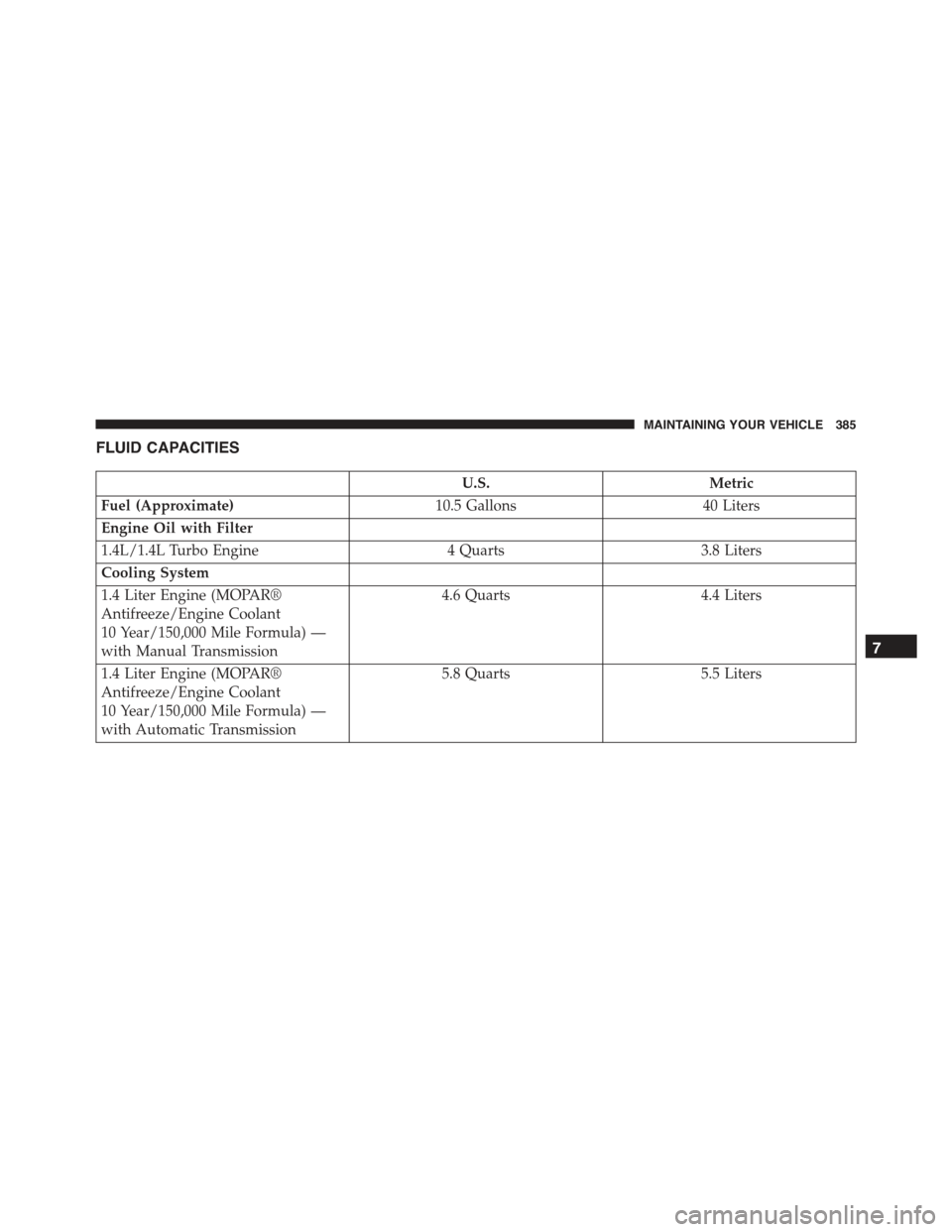
FLUID CAPACITIES
U.S.Metric
Fuel (Approximate)10.5 Gallons40 Liters
Engine Oil with Filter
1.4L/1.4L Turbo Engine4 Quarts3.8 Liters
Cooling System
1.4 Liter Engine (MOPAR®
Antifreeze/Engine Coolant
10 Year/150,000 Mile Formula) —
with Manual Transmission
4.6 Quarts4.4 Liters
1.4 Liter Engine (MOPAR®
Antifreeze/Engine Coolant
10 Year/150,000 Mile Formula) —
with Automatic Transmission
5.8 Quarts5.5 Liters
7
MAINTAINING YOUR VEHICLE 385
Page 388 of 423
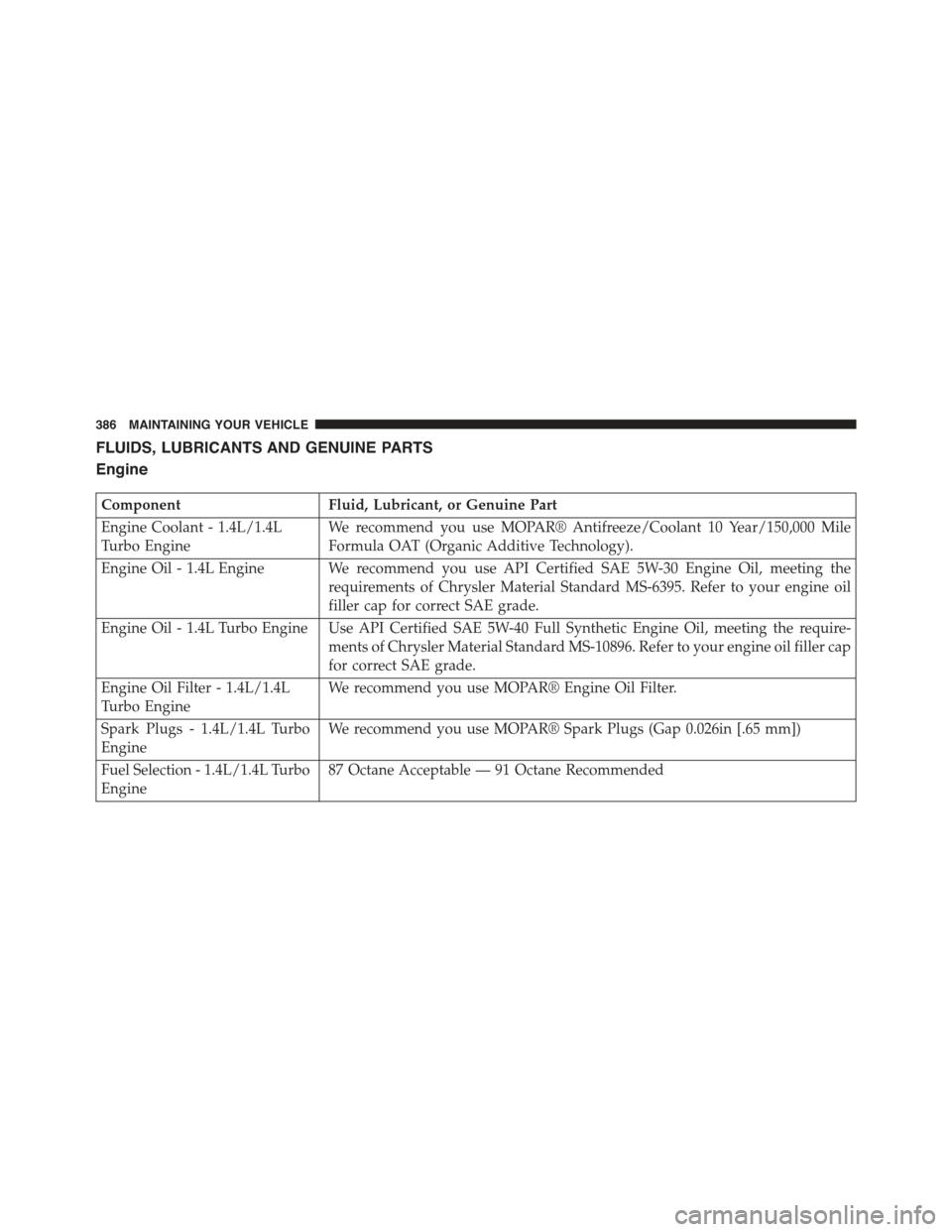
FLUIDS, LUBRICANTS AND GENUINE PARTS
Engine
ComponentFluid, Lubricant, or Genuine Part
Engine Coolant - 1.4L/1.4L
Turbo Engine
We recommend you use MOPAR® Antifreeze/Coolant 10 Year/150,000 Mile
Formula OAT (Organic Additive Technology).
Engine Oil - 1.4L Engine We recommend you use API Certified SAE 5W-30 Engine Oil, meeting the
requirements of Chrysler Material Standard MS-6395. Refer to your engine oil
filler cap for correct SAE grade.
Engine Oil - 1.4L Turbo Engine Use API Certified SAE 5W-40 Full Synthetic Engine Oil, meeting the require-
ments of Chrysler Material Standard MS-10896. Refer to your engine oil filler cap
for correct SAE grade.
Engine Oil Filter - 1.4L/1.4L
Turbo Engine
We recommend you use MOPAR® Engine Oil Filter.
Spark Plugs - 1.4L/1.4L Turbo
Engine
We recommend you use MOPAR® Spark Plugs (Gap 0.026in [.65 mm])
Fuel Selection - 1.4L/1.4L Turbo
Engine
87 Octane Acceptable — 91 Octane Recommended
386 MAINTAINING YOUR VEHICLE
Page 392 of 423
MAINTENANCE SCHEDULE
Your vehicle is equipped with an automatic oil change
indicator system. The oil change indicator system will
remind you that it is time to take your vehicle in for
scheduled maintenance.
Based on engine operation conditions, the oil change
indicator message will illuminate. This means that ser-
vice is required for your vehicle. Operating conditions
such as frequent short-trips, trailer tow, extremely hot or
cold ambient temperatures, and E85 fuel usage will
influence when the “Change Oil” or “Oil Change Re-
quired” message is displayed. Severe Operating Condi-
tions can cause the change oil message to illuminate as
early as 3,500 miles (5,600 km) since last reset. Have your
vehicle serviced as soon as possible, within the next
500 miles (805 km).
NOTE:Under no circumstances should oil change inter-
vals exceed 10,000 miles (16,000 km) or twelve months,
whichever comes first.
Once A Month Or Before A Long Trip:
•Check engine oil level
•Check windshield washer fluid level
•Check the tire inflation pressures and look for unusual
wear or damage
•Check the fluid levels of the coolant reservoir, brake
master cylinder, and transmission as needed
•Check function of all interior and exterior lights
390 MAINTENANCE SCHEDULES
Page 395 of 423
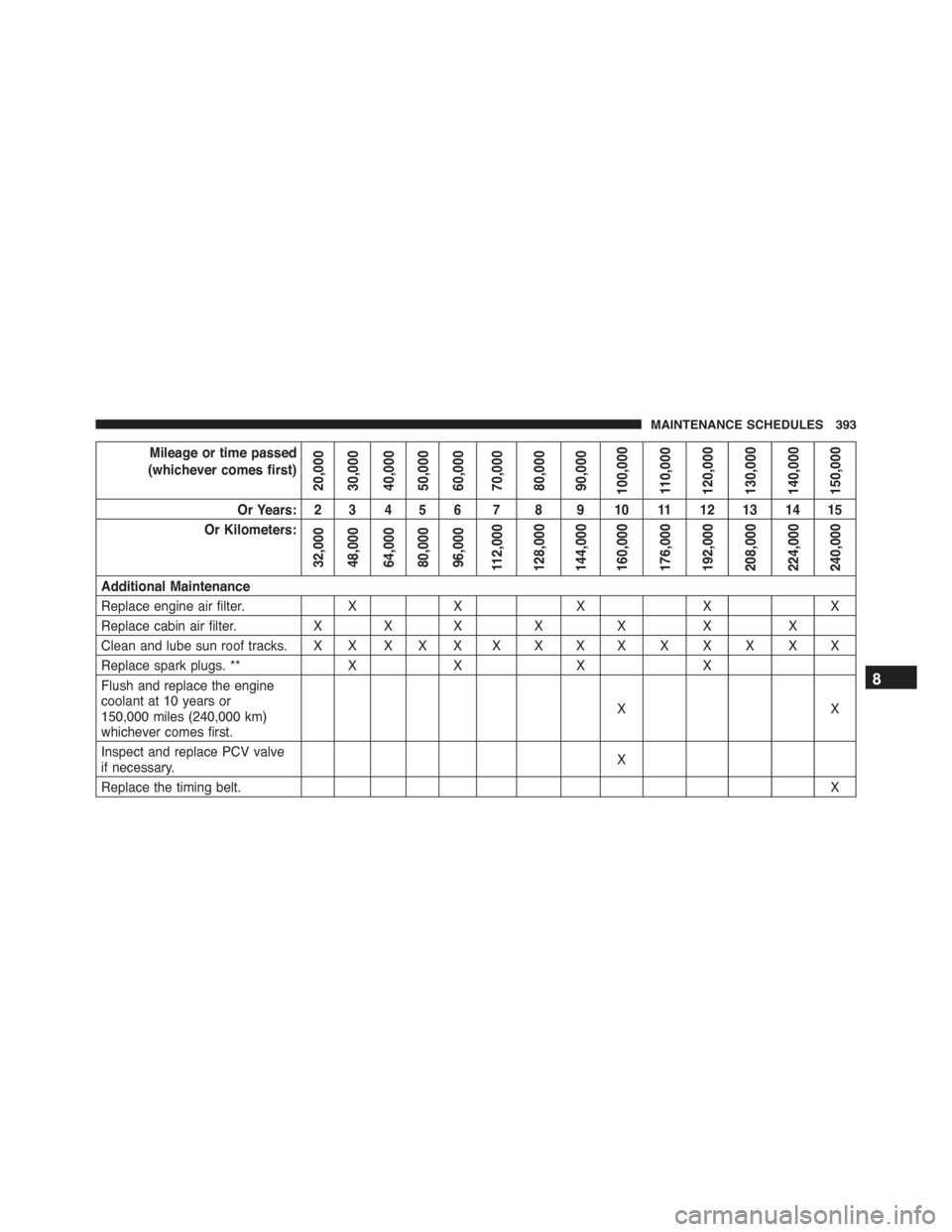
Mileage or time passed
(whichever comes first)
20,00030,00040,00050,00060,00070,00080,00090,000100,000110,000120,000130,000140,000150,000
Or Years: 2 3 4 5 6 7 8 9 10 11 12 13 14 15
Or Kilometers:
32,00048,00064,00080,00096,000112,000128,000144,000160,000176,000192,000208,000224,000240,000
Additional Maintenance
Replace engine air filter.XXXXX
Replace cabin air filter.XXXXXXX
Clean and lube sun roof tracks. X X X X X X X X X X X X X X
Replace spark plugs. **XXXX
Flush and replace the enginecoolant at 10 years or150,000 miles (240,000 km)whichever comes first.
XX
Inspect and replace PCV valveif necessary.X
Replace the timing belt.X
8
MAINTENANCE SCHEDULES 393
Page 408 of 423
Adding Engine Coolant (Antifreeze)............358
Adding Fuel.............................291
Adding Washer Fluid......................353
Additives, Fuel...........................288
Airbag..................................42
Airbag Deployment........................55
Airbag Light.............................50
Airbag Maintenance........................56
Airbag, Side..............................45
Airbag, Window (Side Curtain)................46
Air Cleaner, Engine (Engine Air Cleaner Filter) . . . .344
Air Conditioner Maintenance.................346
Air Conditioning..........................208
Air Conditioning Controls...................208
Air Conditioning Filter.....................347
Air Conditioning Refrigerant.................346
Air Conditioning System....................208
Air Pressure, Tires.........................269
Alterations/Modifications, Vehicle...............8
Antifreeze (Engine Coolant)..................357
Capacities............................385
Disposal..............................360
Anti-Lock Brake System (ABS)................248
Anti-Lock Warning Light....................156
Appearance Care.........................367
Automatic Dimming Mirror...................93
Automatic Door Locks......................26
Automatic Temperature Control (ATC)..........210
Automatic Transaxle........................11
Automatic Transmission....................229
Adding Fluid..........................366
Fluid and Filter Changes..................367
Fluid Level Check.......................366
Fluid Type............................365
Gear Ranges...........................232
Special Additives.......................366
Autostick...............................237
406 INDEX