automatic transmission FIAT 500 2013 2.G Owner's Manual
[x] Cancel search | Manufacturer: FIAT, Model Year: 2013, Model line: 500, Model: FIAT 500 2013 2.GPages: 423, PDF Size: 9.86 MB
Page 326 of 423
CAUTION!
Accessories plugged into the vehicle power outlets
draw power from the vehicle’s battery, even when not
in use (i.e., cellular phones, etc.). Eventually, if
plugged in long enough without engine operation,
the vehicle’s battery will discharge sufficiently to
degrade battery life and/or prevent the engine from
starting.
FREEING A STUCK VEHICLE
If your vehicle becomes stuck in mud, sand or snow, it can
often be moved using a rocking motion. Turn the steering
wheel right and left to clear the area around the front
wheels. Then shift back and forth between DRIVE and
REVERSE (with automatic transmission) or 2nd gear and
REVERSE (with manual transmission), while gently press-
ing the accelerator. Use the least amount of accelerator pedal
pressure that will maintain the rocking motion, without
spinning the wheels, or racing the engine.
CAUTION!
Racing the engine or spinning the wheels may lead to
transmission overheating and failure. Allow the en-
gine to idle with the transmission in NEUTRAL for at
least one minute after every five rocking-motion
cycles. This will minimize overheating and reduce
the risk of transmission failure during prolonged
efforts to free a stuck vehicle.
NOTE:Press the#ESC Off#switch, to place the Electronic
Stability Control (ESC) system in#Partial Off#mode,
before rocking the vehicle. Refer to “Electronic Brake
Control” in “Starting And Operating” for further infor-
mation. Once the vehicle has been freed, press the#ESC
Off#switch again to restore#ESC On#mode.
324 WHAT TO DO IN EMERGENCIES
Page 329 of 423
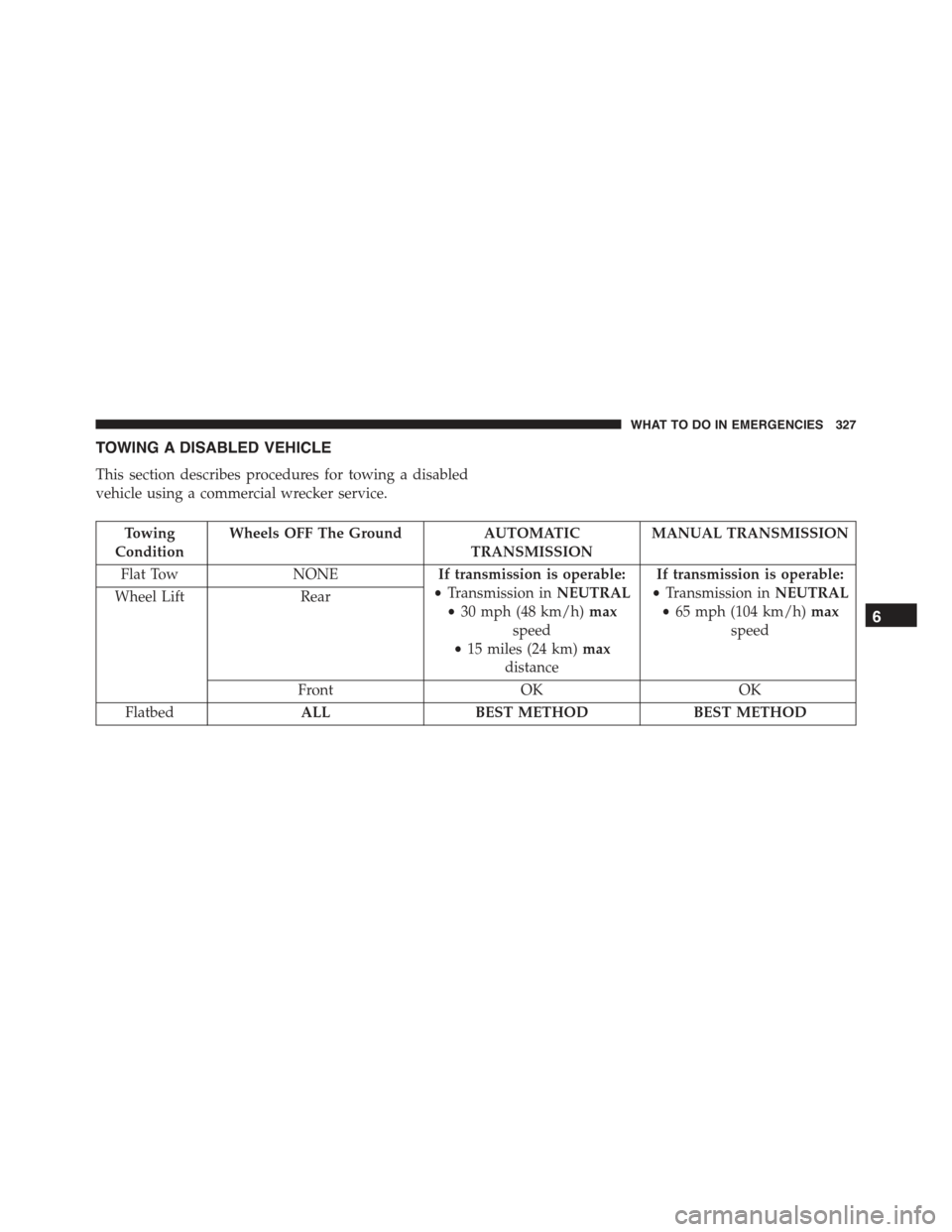
TOWING A DISABLED VEHICLE
This section describes procedures for towing a disabled
vehicle using a commercial wrecker service.
Towing
Condition
Wheels OFF The Ground AUTOMATIC
TRANSMISSION
MANUAL TRANSMISSION
Flat TowNONEIf transmission is operable:
•Transmission inNEUTRAL
•30 mph (48 km/h)max
speed
•15 miles (24 km)max
distance
If transmission is operable:
•Transmission inNEUTRAL
•65 mph (104 km/h)max
speed
Wheel LiftRear
FrontOKOK
FlatbedALLBEST METHODBEST METHOD
6
WHAT TO DO IN EMERGENCIES 327
Page 330 of 423
Proper towing or lifting equipment is required to prevent
damage to your vehicle. Use only tow bars and other
equipment designed for this purpose, following equip-
ment manufacturer ’s instructions. Use of safety chains is
mandatory. Attach a tow bar or other towing device to
main structural members of the vehicle, not to bumpers
or associated brackets. State and local laws regarding
vehicles under tow must be observed.
If you must use the accessories (wipers, defrosters, etc.)
while being towed, the ignition must be in the ON/RUN
position.
If the ignition key is unavailable, or the battery is
discharged, see “Shift Lever Override” in “What To Do In
Emergencies” for instructions on shifting the automatic
transmission out of PARK for towing.
CAUTION!
DO NOT use sling-type equipment when towing.
When securing the vehicle to a flatbed truck, do not
attach to front or rear suspension components. Dam-
age to your vehicle may result from improper towing.
Automatic Transmission
•Vehicle can be towed with the front wheels elevated.
•Vehicle can be towed on a flatbed truck (all wheels off
the ground).
CAUTION!
•DO NOT flat tow any vehicle equipped with an
automatic transmission. Damage to the drivetrain
will result.
(Continued)
328 WHAT TO DO IN EMERGENCIES
Page 336 of 423
▫Automatic Transmission – If Equipped......365
▫Appearance Care And Protection From
Corrosion...........................367
▫Convertible Top Care – If Equipped........373
!FUSES..............................375
▫Interior Fuses........................375
▫Underhood Fuses......................376
!VEHICLE STORAGE....................380
!REPLACEMENT BULBS.................380
!BULB REPLACEMENT..................381
▫Headlamps..........................381
▫Front Turn Signal, Parking And Daytime
Running Lamps.......................382
▫Front Fog Lamps......................382
▫Front/Rear Side Marker Lamps............382
▫Rear Tail, Stop, Backup And Turn Signal
Lamps.............................383
▫Center High Mounted Stop Lamp (CHMSL) . . .384
!FLUID CAPACITIES.....................385
!FLUIDS, LUBRICANTS AND GENUINE PARTS . . . .386
▫Engine.............................386
▫Chassis............................387
334 MAINTAINING YOUR VEHICLE
Page 339 of 423
ONBOARD DIAGNOSTIC SYSTEM — OBD II
Your vehicle is equipped with a sophisticated onboard
diagnostic system called OBD II. This system monitors
the performance of the emissions, engine, and automatic
transmission control systems. When these systems are
operating properly, your vehicle will provide excellent
performance and fuel economy, as well as engine emis-
sions well within current government regulations.
If any of these systems require service, the OBD II system
will turn on the “Malfunction Indicator Light (MIL).” It
will also store diagnostic codes and other information to
assist your service technician in making repairs. Al-
though your vehicle will usually be drivable and not
need towing, see your authorized studio for service as
soon as possible.
CAUTION!
•Prolonged driving with the MIL on could cause
further damage to the emission control system. It
could also affect fuel economy and drivability. The
vehicle must be serviced before any emissions tests
can be performed.
•If the MIL is flashing while the engine is running,
severe catalytic converter damage and power loss
will soon occur. Immediate service is required.
EMISSIONS INSPECTION AND MAINTENANCE
PROGRAMS
In some localities, it may be a legal requirement to pass
an inspection of your vehicle’s emissions control system.
Failure to pass could prevent vehicle registration.
For states that require an Inspection and Mainte-
nance (I/M), this check verifies the “Malfunction
7
MAINTAINING YOUR VEHICLE 337
Page 367 of 423
Manual Transmission – If Equipped
Lubricant Selection
Use only the manufacturers recommended transmission
fluid. Refer to “Fluids, Lubricants, and Genuine Parts” in
“Maintaining Your Vehicle” for further information.
Fluid Level Check
Check the fluid level by removing the fill plug. The fluid
level should be between the bottom of the fill hole and a
point not more than 3/16 in (4.7 mm) below the bottom
of the hole.
Add fluid, if necessary, to maintain the proper level.
Frequency Of Fluid Change
Under normal operating conditions, the fluid installed at
the factory will give satisfactory lubrication for the life of
the vehicle. Fluid changes are not necessary unless lubri-
cant has become contaminated with water.
NOTE:If contaminated with water, the fluid should be
changed immediately.
Automatic Transmission – If Equipped
Selection Of Lubricant
It is important to use the proper transmission fluid to
ensure optimum transmission performance and life. Use
only the manufacturer ’s recommended transmission
fluid. Refer to “Fluids, Lubricants, and Genuine Parts” in
“Maintaining Your Vehicle” for fluid specifications. It is
important to maintain the transmission fluid at the
correct level using the recommended fluid. No chemical
flushes should be used in any transmission; only the
approved lubricant should be used.
7
MAINTAINING YOUR VEHICLE 365
Page 368 of 423
CAUTION!
Using a transmission fluid other than the manufac-
turer ’s recommended fluid may cause deterioration
in transmission shift quality and/or torque converter
shudder. Refer to “Fluids, Lubricants, and Genuine
Parts” in “Maintaining Your Vehicle” for fluid speci-
fications.
Special Additives
The manufacturer strongly recommends against using
any special additives in the transmission.
Automatic Transmission Fluid (ATF) is an engineered
product and its performance may be impaired by supple-
mental additives. Therefore, do not add any fluid addi-
tives to the transmission. The only exception to this
policy is the use of special dyes for diagnosing fluid
leaks. Avoid using transmission sealers as they may
adversely affect seals.
CAUTION!
Do not use chemical flushes in your transmission as
the chemicals can damage your transmission compo-
nents. Such damage is not covered by the New
Vehicle Limited Warranty.
Fluid Level Check
The fluid level is preset at the factory and does not
require adjustment under normal operating conditions.
Routine fluid level checks are not required, therefore the
transmission has no dipstick. Your authorized studio can
check your transmission fluid level using special service
tools. If you notice fluid leakage or transmission malfunc-
tion, visit your authorized studio immediately to have
366 MAINTAINING YOUR VEHICLE
Page 387 of 423
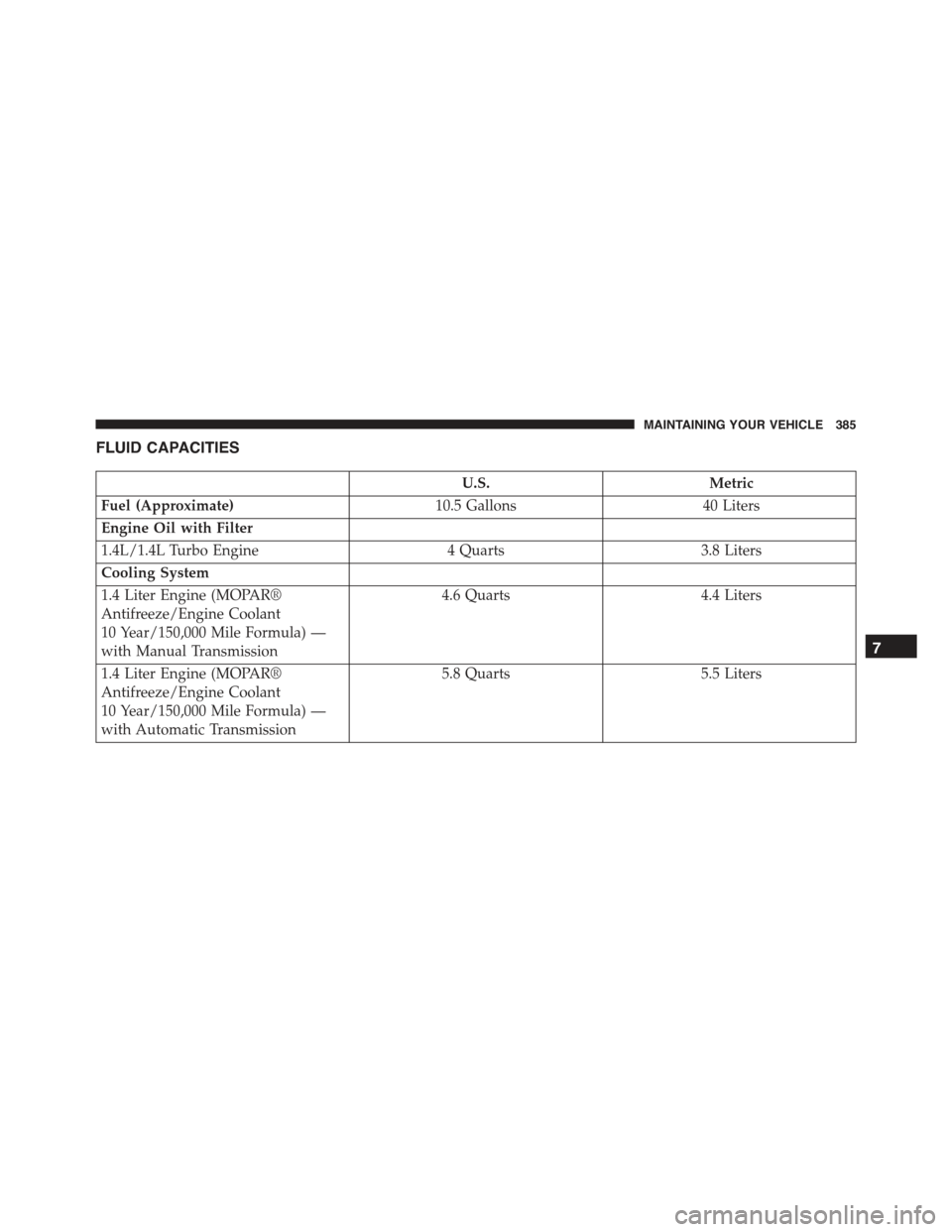
FLUID CAPACITIES
U.S.Metric
Fuel (Approximate)10.5 Gallons40 Liters
Engine Oil with Filter
1.4L/1.4L Turbo Engine4 Quarts3.8 Liters
Cooling System
1.4 Liter Engine (MOPAR®
Antifreeze/Engine Coolant
10 Year/150,000 Mile Formula) —
with Manual Transmission
4.6 Quarts4.4 Liters
1.4 Liter Engine (MOPAR®
Antifreeze/Engine Coolant
10 Year/150,000 Mile Formula) —
with Automatic Transmission
5.8 Quarts5.5 Liters
7
MAINTAINING YOUR VEHICLE 385
Page 389 of 423
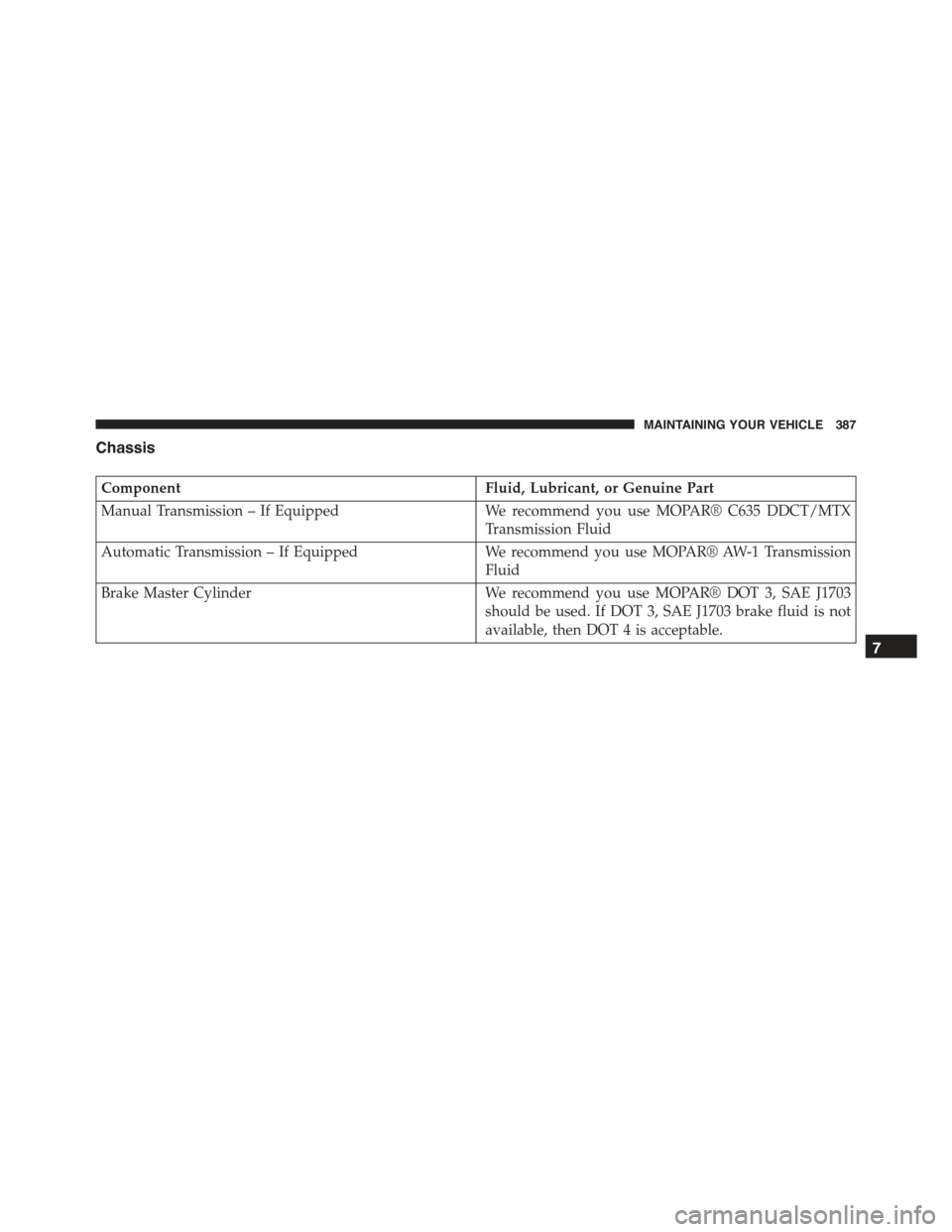
Chassis
ComponentFluid, Lubricant, or Genuine Part
Manual Transmission – If EquippedWe recommend you use MOPAR® C635 DDCT/MTX
Transmission Fluid
Automatic Transmission – If EquippedWe recommend you use MOPAR® AW-1 Transmission
Fluid
Brake Master CylinderWe recommend you use MOPAR® DOT 3, SAE J1703
should be used. If DOT 3, SAE J1703 brake fluid is not
available, then DOT 4 is acceptable.
7
MAINTAINING YOUR VEHICLE 387
Page 392 of 423
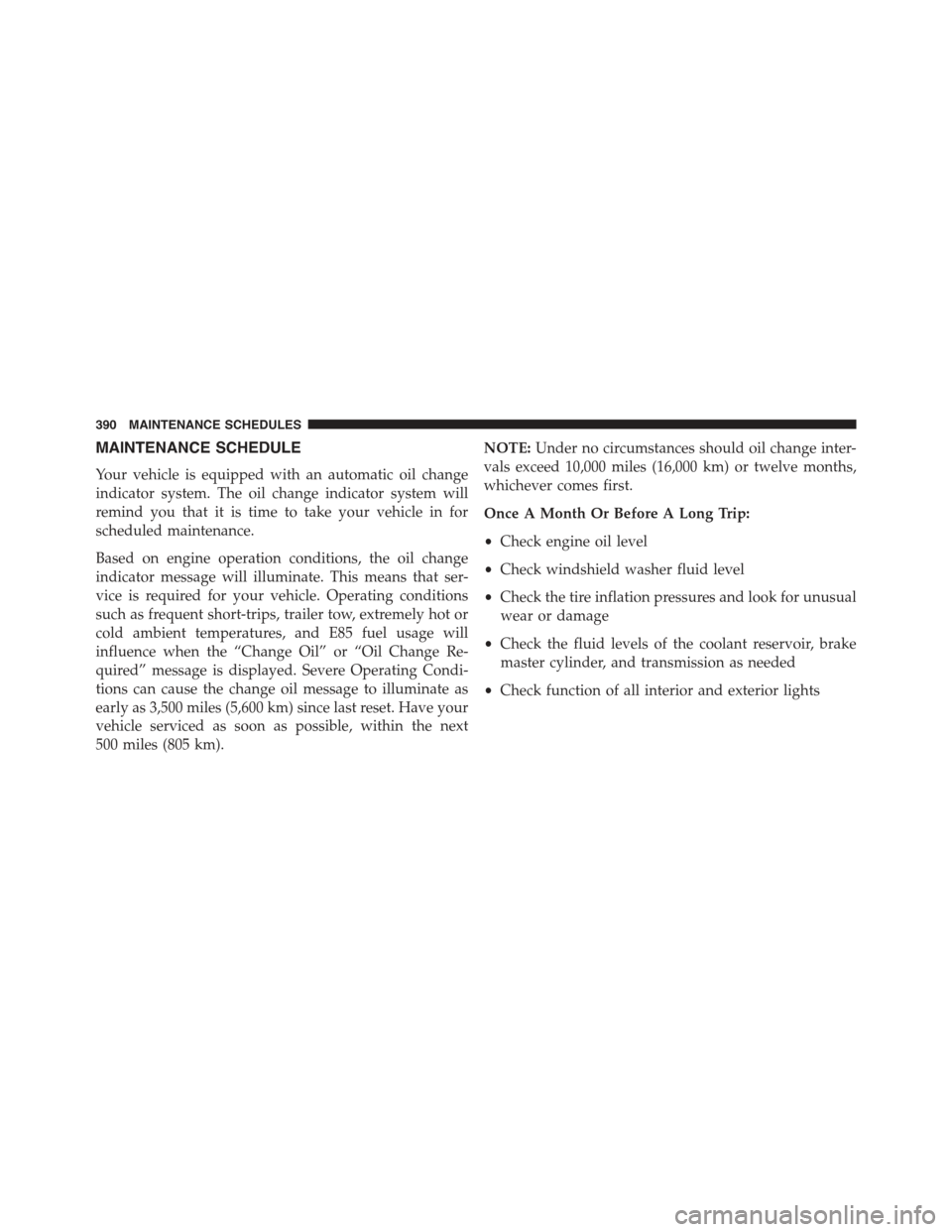
MAINTENANCE SCHEDULE
Your vehicle is equipped with an automatic oil change
indicator system. The oil change indicator system will
remind you that it is time to take your vehicle in for
scheduled maintenance.
Based on engine operation conditions, the oil change
indicator message will illuminate. This means that ser-
vice is required for your vehicle. Operating conditions
such as frequent short-trips, trailer tow, extremely hot or
cold ambient temperatures, and E85 fuel usage will
influence when the “Change Oil” or “Oil Change Re-
quired” message is displayed. Severe Operating Condi-
tions can cause the change oil message to illuminate as
early as 3,500 miles (5,600 km) since last reset. Have your
vehicle serviced as soon as possible, within the next
500 miles (805 km).
NOTE:Under no circumstances should oil change inter-
vals exceed 10,000 miles (16,000 km) or twelve months,
whichever comes first.
Once A Month Or Before A Long Trip:
•Check engine oil level
•Check windshield washer fluid level
•Check the tire inflation pressures and look for unusual
wear or damage
•Check the fluid levels of the coolant reservoir, brake
master cylinder, and transmission as needed
•Check function of all interior and exterior lights
390 MAINTENANCE SCHEDULES