automatic transmission FIAT 500 2013 2.G User Guide
[x] Cancel search | Manufacturer: FIAT, Model Year: 2013, Model line: 500, Model: FIAT 500 2013 2.GPages: 423, PDF Size: 9.86 MB
Page 240 of 423
NOTE:In AutoStick® mode, the transmission will only
shift up or down when the driver moves the shift lever
rearward (+) or forward (-), except as described below.
•The transmission will automatically downshift as the
vehicle slows (to prevent engine lugging) and will
display the current gear.
•The transmission will automatically downshift to first
gear when coming to a stop. After a stop, the driver
should manually upshift (+) the transmission as the
vehicle is accelerated.
•Starting out in second or third gear can be helpful in
snow or icy conditions. To select second or third gear
after the vehicle is brought to a stop, tap the shift lever
rearward (+) once or twice.
•The transmission will automatically upshift when nec-
essary to prevent engine over-speed.
•The system will ignore shift commands that would
cause engine lugging or overspeed. An audible beep
will sound if an inappropriate gear is requested.
•Avoid using speed control when AutoStick® is en-
gaged because the transmission will not shift auto-
matically.
•Transmission shifting will be more noticeable when
AutoStick® is engaged.
•If the system detects powertrain overheating, the
transmission will revert to a automatic shift mode and
remain in that mode until the powertrain cools off.
•If the system detects a problem, it will disable
AutoStick® mode and the transmission will return to
automatic mode until the problem is corrected.
•To disengage AutoStick® mode, return the shift lever
to the DRIVE position. You can shift in or out of the
238 STARTING AND OPERATING
Page 249 of 423
Automatic Transmission – If Equipped
The Sport mode increases steering feedback to the driver
with slight increase in effort and changes the transmis-
sion shift schedules for more aggressive shifting. This
driving mode is useful while driving on twisty roads
where more steering precision is desired in spirited
cornering.
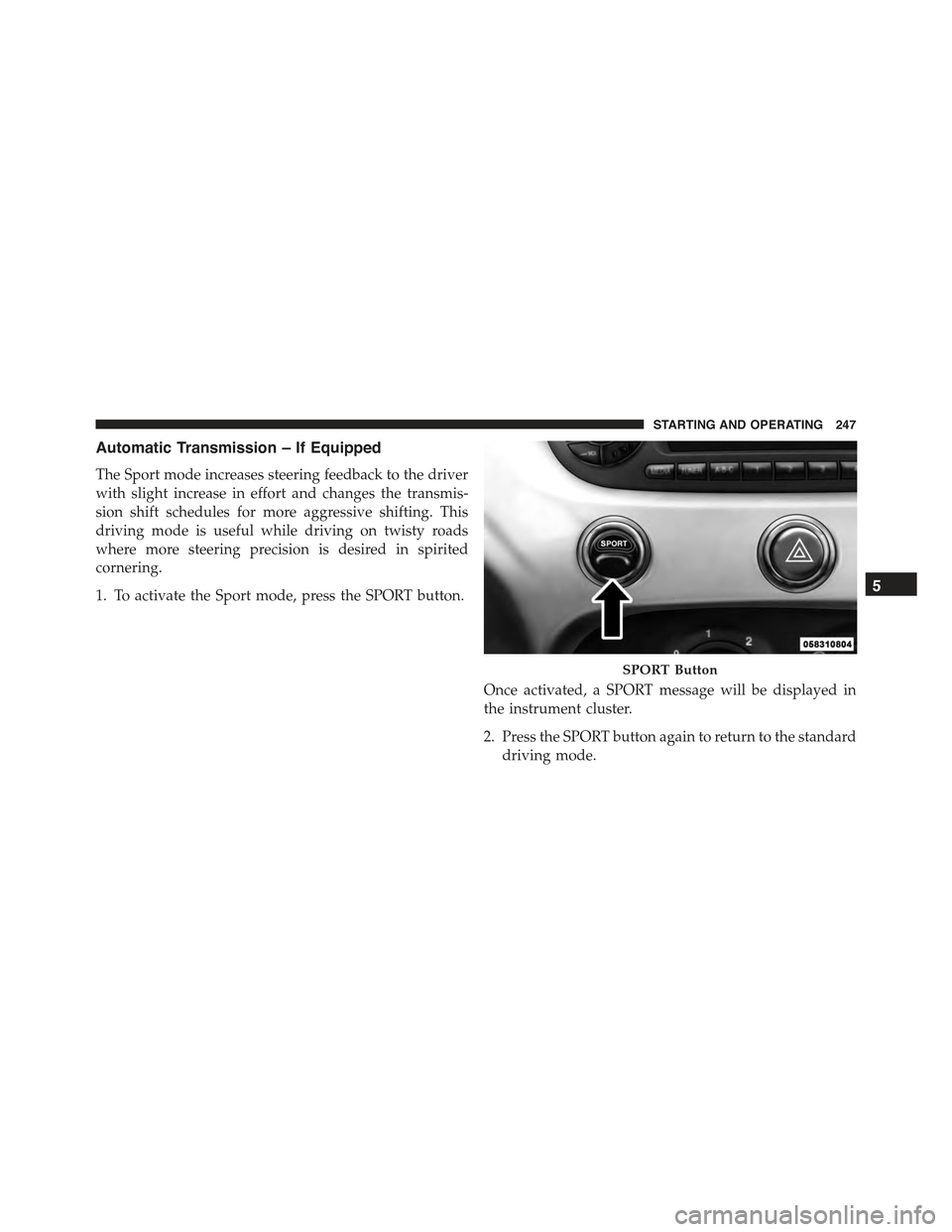
1. To activate the Sport mode, press the SPORT button.
Once activated, a SPORT message will be displayed in
the instrument cluster.
2. Press the SPORT button again to return to the standard
driving mode.
SPORT Button
5
STARTING AND OPERATING 247
Page 253 of 423
Traction Control System (TCS)
This system monitors the amount of wheel spin of each of
the driven wheels. If wheel spin is detected, brake
pressure is applied to the slipping wheel(s) and engine
power is reduced to provide enhanced acceleration and
stability. A feature of the TCS system functions similar to
a limited-slip differential and controls the wheel spin
across a driven axle. If one wheel on a driven axle is
spinning faster than the other, the system will apply the
brake of the spinning wheel. This will allow more engine
torque to be applied to the wheel that is not spinning.
This feature remains active even if TCS and ESC are in
the Partial Off mode. Refer to “Electronic Stability Con-
trol (ESC)” in this section for further information.
Hill Start Assist (HSA)
The HSA system is designed to assist the driver when
starting a vehicle from a stop on a hill. HSA will maintain the
level of brake pressure the driver applied for a short period
of time after the driver takes his foot off the brake pedal. If
the driver does not apply the throttle during this short
period of time, the system will release brake pressure and
the vehicle will roll down the hill. The system will release
brake pressure in proportion to the amount of throttle
applied as the vehicle starts to move in the intended
direction of travel.
HSA Activation Criteria
The following criteria must be met in order for HSA to
activate:
•Vehicle must be stopped.
•Vehicle must be on a 2.5% (manual transmission) or 7%
grade or greater (automatic transmission) hill.
•Gear selection matches vehicle uphill direction (i.e., ve-
hicle in NEUTRAL (manual transmission), vehicle facing
uphill is in forward gear; vehicle backing uphill is in
REVERSE gear).
5
STARTING AND OPERATING 251
Page 255 of 423
•Understeer - when the vehicle is turning less than
appropriate for the steering wheel position.
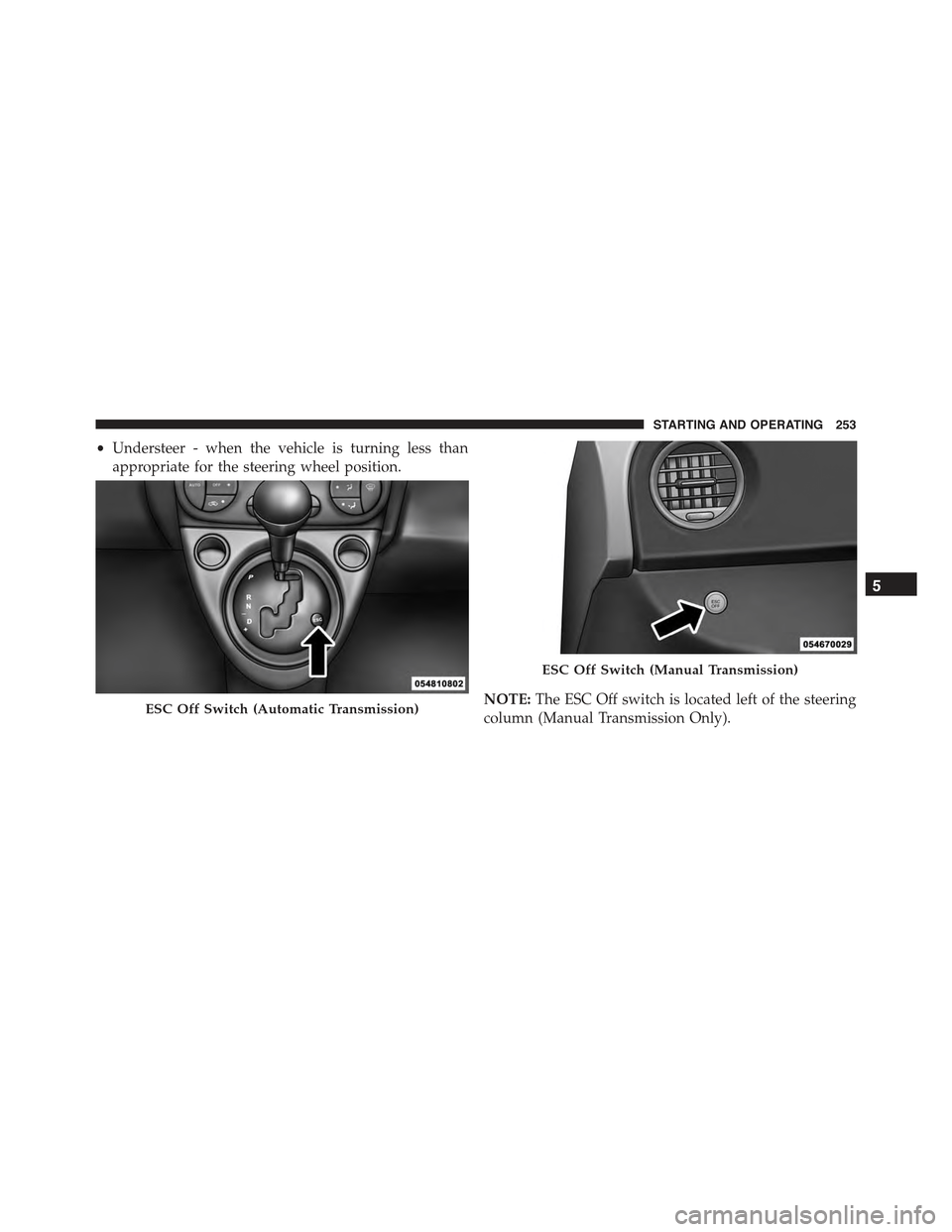
NOTE:The ESC Off switch is located left of the steering
column (Manual Transmission Only).ESC Off Switch (Automatic Transmission)
ESC Off Switch (Manual Transmission)
5
STARTING AND OPERATING 253
Page 295 of 423
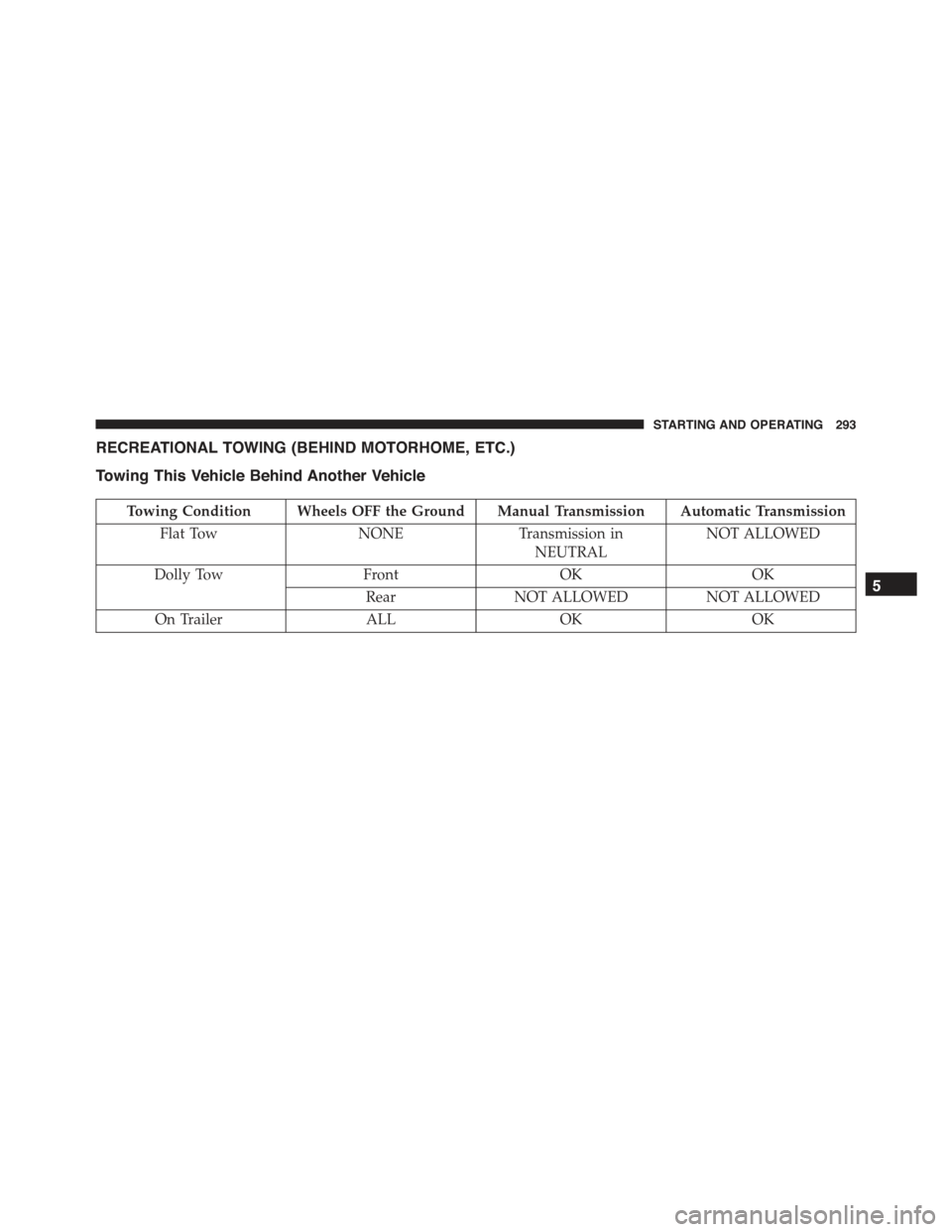
RECREATIONAL TOWING (BEHIND MOTORHOME, ETC.)
Towing This Vehicle Behind Another Vehicle
Towing Condition Wheels OFF the Ground Manual Transmission Automatic Transmission
Flat TowNONETransmission in
NEUTRAL
NOT ALLOWED
Dolly TowFrontOKOK
RearNOT ALLOWEDNOT ALLOWED
On TrailerALLOKOK
5
STARTING AND OPERATING 293
Page 296 of 423
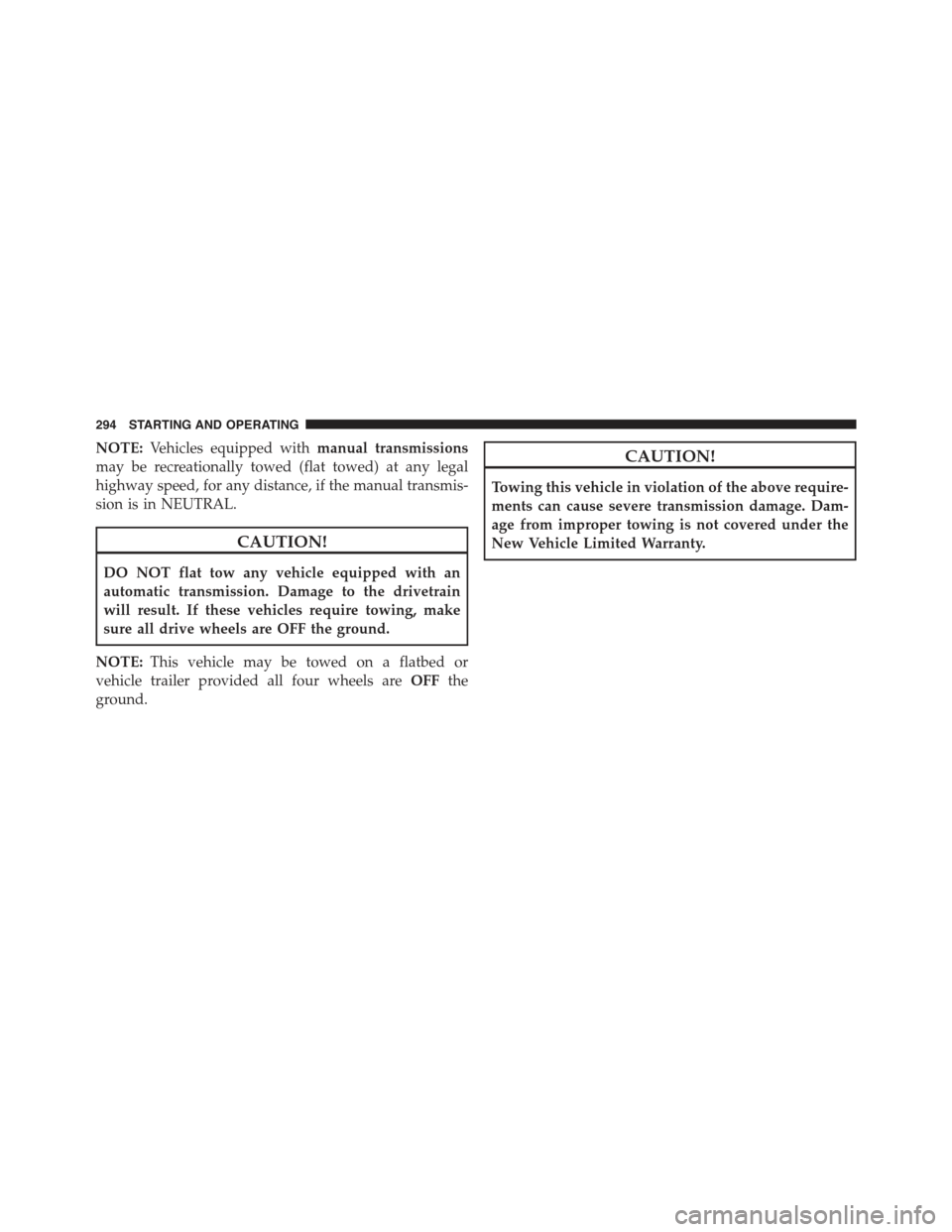
NOTE:Vehicles equipped withmanual transmissions
may be recreationally towed (flat towed) at any legal
highway speed, for any distance, if the manual transmis-
sion is in NEUTRAL.
CAUTION!
DO NOT flat tow any vehicle equipped with an
automatic transmission. Damage to the drivetrain
will result. If these vehicles require towing, make
sure all drive wheels are OFF the ground.
NOTE:This vehicle may be towed on a flatbed or
vehicle trailer provided all four wheels areOFFthe
ground.
CAUTION!
Towing this vehicle in violation of the above require-
ments can cause severe transmission damage. Dam-
age from improper towing is not covered under the
New Vehicle Limited Warranty.
294 STARTING AND OPERATING
Page 298 of 423
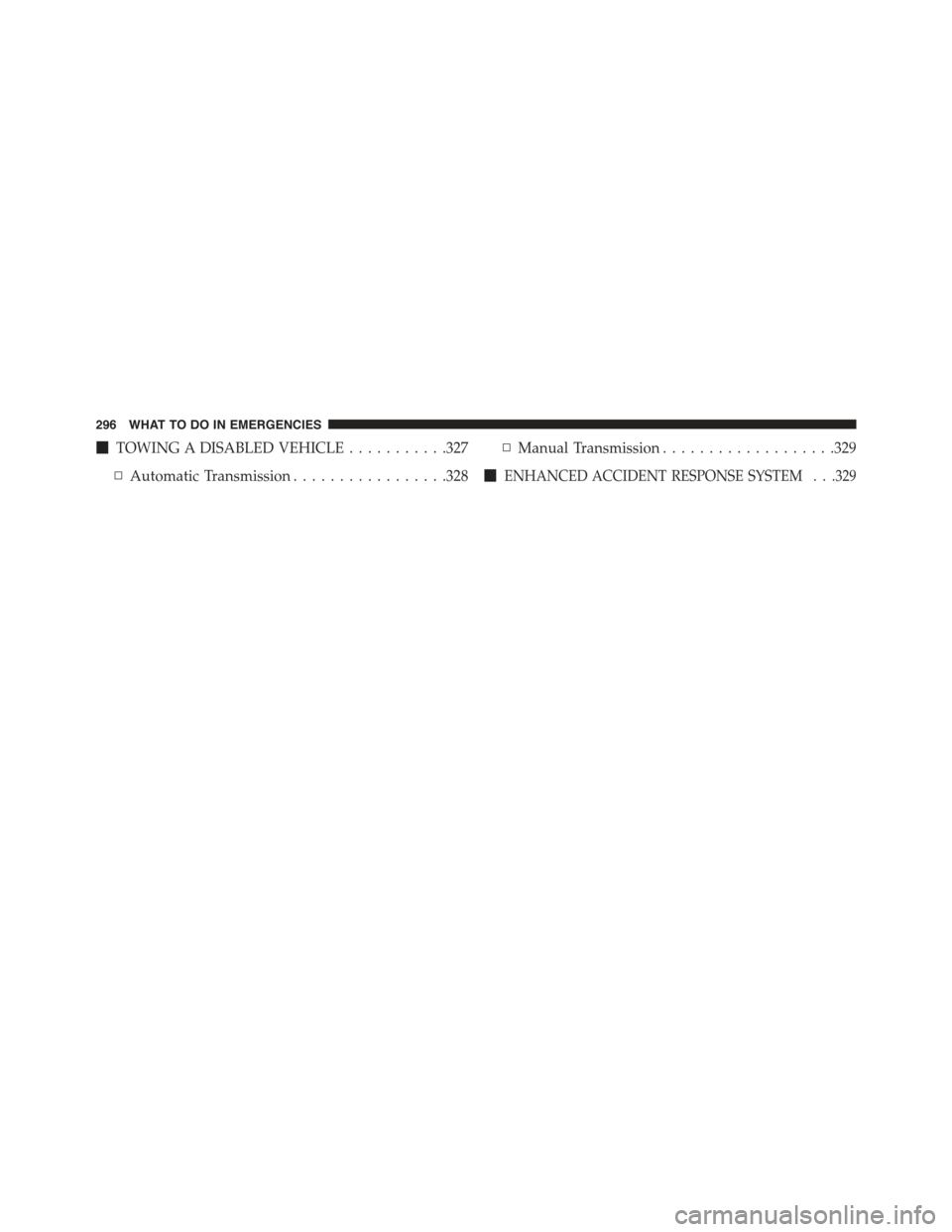
!TOWING A DISABLED VEHICLE...........327
▫Automatic Transmission.................328
▫Manual Transmission...................329
!ENHANCED ACCIDENT RESPONSE SYSTEM . . .329
296 WHAT TO DO IN EMERGENCIES
Page 314 of 423
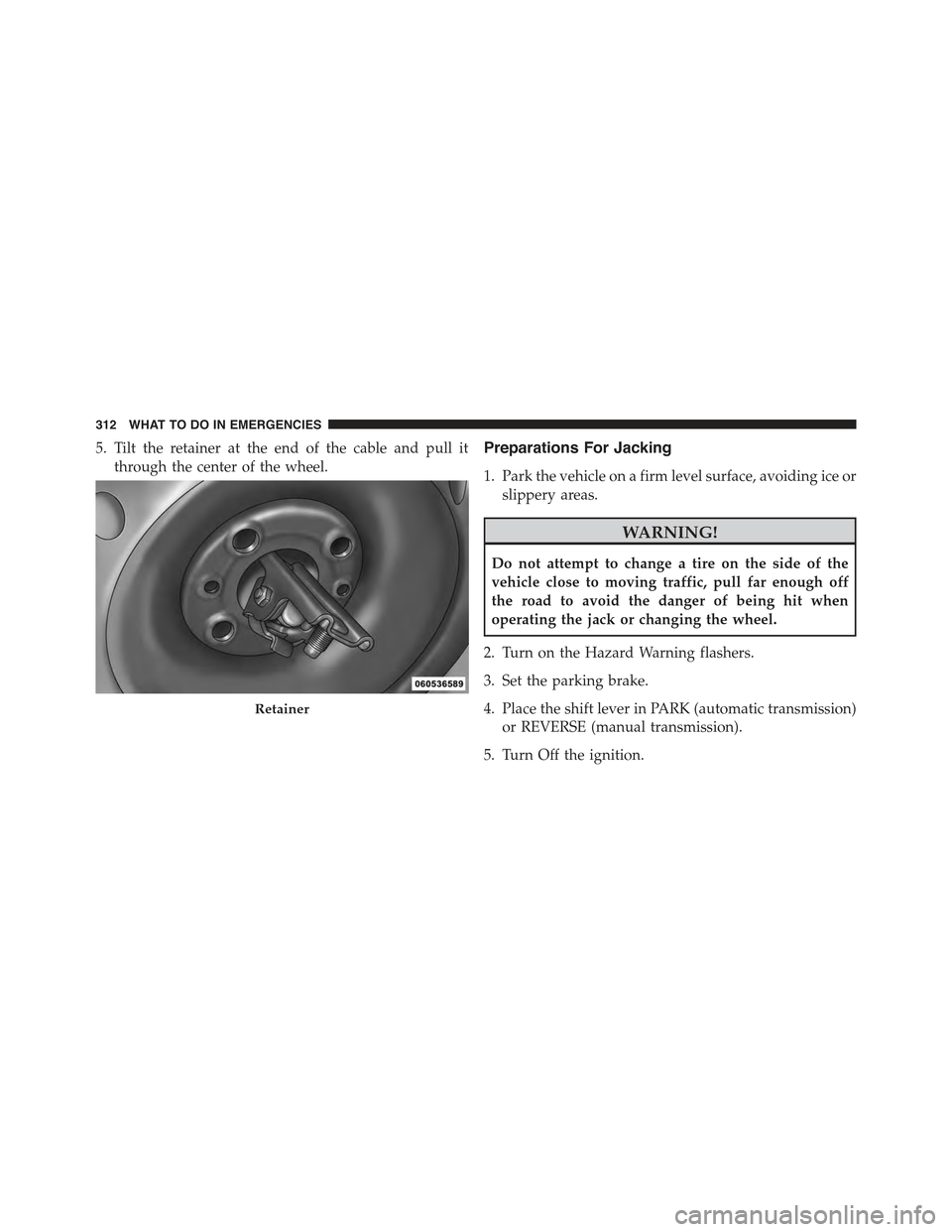
5. Tilt the retainer at the end of the cable and pull it
through the center of the wheel.
Preparations For Jacking
1. Park the vehicle on a firm level surface, avoiding ice or
slippery areas.
WARNING!
Do not attempt to change a tire on the side of the
vehicle close to moving traffic, pull far enough off
the road to avoid the danger of being hit when
operating the jack or changing the wheel.
2. Turn on the Hazard Warning flashers.
3. Set the parking brake.
4. Place the shift lever in PARK (automatic transmission)
or REVERSE (manual transmission).
5. Turn Off the ignition.
Retainer
312 WHAT TO DO IN EMERGENCIES
Page 315 of 423
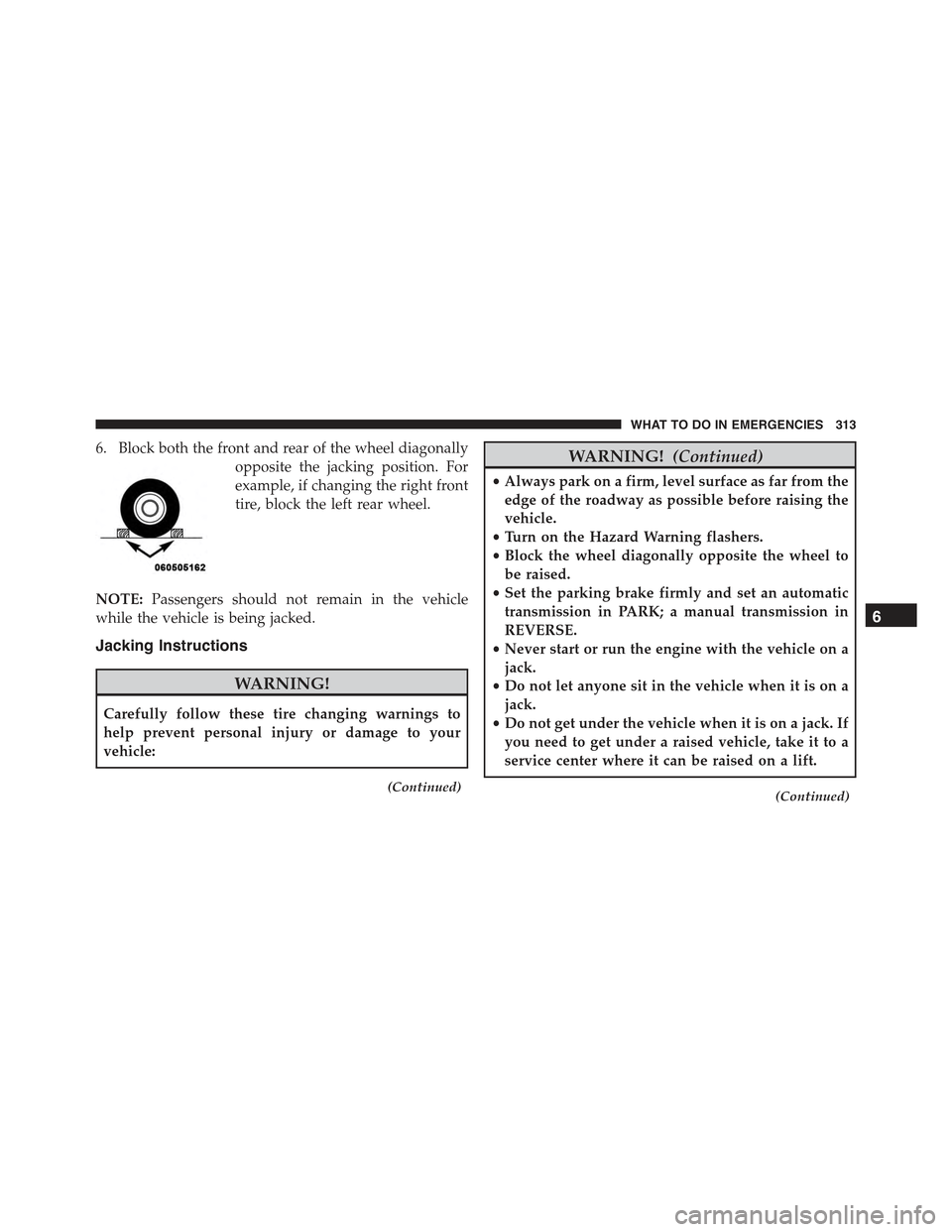
6. Block both the front and rear of the wheel diagonally
opposite the jacking position. For
example, if changing the right front
tire, block the left rear wheel.
NOTE:Passengers should not remain in the vehicle
while the vehicle is being jacked.
Jacking Instructions
WARNING!
Carefully follow these tire changing warnings to
help prevent personal injury or damage to your
vehicle:
(Continued)
WARNING!(Continued)
•Always park on a firm, level surface as far from the
edge of the roadway as possible before raising the
vehicle.
•Turn on the Hazard Warning flashers.
•Block the wheel diagonally opposite the wheel to
be raised.
•Set the parking brake firmly and set an automatic
transmission in PARK; a manual transmission in
REVERSE.
•Never start or run the engine with the vehicle on a
jack.
•Do not let anyone sit in the vehicle when it is on a
jack.
•Do not get under the vehicle when it is on a jack. If
you need to get under a raised vehicle, take it to a
service center where it can be raised on a lift.
(Continued)
6
WHAT TO DO IN EMERGENCIES 313
Page 323 of 423

WARNING!
•Take care to avoid the radiator cooling fan when-
ever the hood is raised. It can start anytime the
ignition switch is ON. You can be injured by
moving fan blades.
•Remove any metal jewelry such as rings, watch
bands and bracelets that could make an inadvertent
electrical contact. You could be seriously injured.
•Batteries contain sulfuric acid that can burn your
skin or eyes and generate hydrogen gas which is
flammable and explosive. Keep open flames or
sparks away from the battery.
1. Set the parking brake, shift the automatic transmission
into PARK and turn the ignition to LOCK.
2. Turn off the heater, radio, and all unnecessary electri-
cal accessories.
Battery Posts
1—Positive(+)Post(CoveredWithProtectiveCap)2 — Negative (-) Post
6
WHAT TO DO IN EMERGENCIES 321