check engine FIAT 500 2013 2.G Owner's Manual
[x] Cancel search | Manufacturer: FIAT, Model Year: 2013, Model line: 500, Model: FIAT 500 2013 2.GPages: 423, PDF Size: 9.86 MB
Page 358 of 423

Cooling System
WARNING!
•When working near the radiator cooling fan,
disconnect the fan motor lead or turn the ignition
switch to the OFF position. The fan is temperature
controlled and can start at any time the ignition
switch is in the ON position.
•You or others can be badly burned by hot engine
coolant (antifreeze) or steam from your radiator. If
you see or hear steam coming from under the hood,
do not open the hood until the radiator has had
time to cool. Never try to open a cooling system
pressure cap when the radiator is hot.
Coolant Checks
Check engine coolant (antifreeze) protection every
12 months (before the onset of freezing weather, where
applicable). If the engine coolant (antifreeze) is dirty or
rusty in appearance, the system should be drained,
flushed and refilled with fresh engine coolant (anti-
freeze). Check the front of the A/C condenser for any
accumulation of bugs, leaves, etc. If dirty, clean by gently
spraying water from a garden hose vertically down the
face of the condenser.
Cooling System – Drain, Flush, And Refill
If the engine coolant (antifreeze) is dirty or contains
visible sediment, clean and flush with OAT coolant
(antifreeze) that meets the requirements of Chrysler
Material Standard MS-12106.
356 MAINTAINING YOUR VEHICLE
Page 362 of 423
WARNING!(Continued)
•Do not use a pressure cap other than the one
specified for your vehicle. Personal injury or en-
gine damage may result.
Disposal Of Used Engine Coolant
Used ethylene glycol-based engine coolant (antifreeze) is
a regulated substance requiring proper disposal. Check
with your local authorities to determine the disposal
rules for your community. To prevent ingestion by ani-
mals or children, do not store ethylene glycol-based
engine coolant in open containers or allow it to remain in
puddles on the ground. If ingested by a child or pet, seek
emergency assistance immediately. Clean up any ground
spills immediately.
Coolant Level
The coolant expansion bottle provides a quick visual
method for determining that the coolant level is ad-
equate. With the engine off and cold, the level of the
engine coolant (antifreeze) in the bottle should be be-
tween the bottom and top lines marked “COLD FILL
RANGE”.
As long as the engine operating temperature is satisfac-
tory, the coolant bottle need only be checked once a
month.
When additional engine coolant (antifreeze) is needed to
maintain the proper level, it should be added to the
coolant bottle. Do not overfill.
360 MAINTAINING YOUR VEHICLE
Page 363 of 423
Points To Remember
NOTE:When the vehicle is stopped after a few miles/
kilometers of operation, you may observe vapor coming
from the front of the engine compartment. This is nor-
mally a result of moisture from rain, snow, or high
humidity accumulating on the radiator and being vapor-
ized when the thermostat opens, allowing hot engine
coolant (antifreeze) to enter the radiator.
If an examination of your engine compartment shows no
evidence of radiator or hose leaks, the vehicle may be
safely driven. The vapor will soon dissipate.
•Do not overfill the coolant expansion bottle.
•Check the coolant freeze point in the radiator and in the
coolant expansion bottle. If engine coolant (antifreeze)
needs to be added, the contents of the coolant expansion
bottle must also be protected against freezing.
•If frequent engine coolant (antifreeze) additions are
required, the cooling system should be pressure tested
for leaks.
•Maintain engine coolant (antifreeze) concentration at a
minimum of 50% OAT coolant (conforming to MS-12106)
and distilled water for proper corrosion protection of
your engine which contains aluminum components.
•Make sure that the coolant expansion bottle overflow
hoses are not kinked or obstructed.
•Keep the front of the radiator clean. If your vehicle is
equipped with air conditioning, keep the front of the
condenser clean.
•Do not change the thermostat for Summer or Winter
operation. If replacement is ever necessary, install ONLY
the correct type thermostat. Other designs may result in
unsatisfactory engine coolant (antifreeze) performance,
poor gas mileage, and increased emissions.
7
MAINTAINING YOUR VEHICLE 361
Page 368 of 423
CAUTION!
Using a transmission fluid other than the manufac-
turer ’s recommended fluid may cause deterioration
in transmission shift quality and/or torque converter
shudder. Refer to “Fluids, Lubricants, and Genuine
Parts” in “Maintaining Your Vehicle” for fluid speci-
fications.
Special Additives
The manufacturer strongly recommends against using
any special additives in the transmission.
Automatic Transmission Fluid (ATF) is an engineered
product and its performance may be impaired by supple-
mental additives. Therefore, do not add any fluid addi-
tives to the transmission. The only exception to this
policy is the use of special dyes for diagnosing fluid
leaks. Avoid using transmission sealers as they may
adversely affect seals.
CAUTION!
Do not use chemical flushes in your transmission as
the chemicals can damage your transmission compo-
nents. Such damage is not covered by the New
Vehicle Limited Warranty.
Fluid Level Check
The fluid level is preset at the factory and does not
require adjustment under normal operating conditions.
Routine fluid level checks are not required, therefore the
transmission has no dipstick. Your authorized studio can
check your transmission fluid level using special service
tools. If you notice fluid leakage or transmission malfunc-
tion, visit your authorized studio immediately to have
366 MAINTAINING YOUR VEHICLE
Page 392 of 423
MAINTENANCE SCHEDULE
Your vehicle is equipped with an automatic oil change
indicator system. The oil change indicator system will
remind you that it is time to take your vehicle in for
scheduled maintenance.
Based on engine operation conditions, the oil change
indicator message will illuminate. This means that ser-
vice is required for your vehicle. Operating conditions
such as frequent short-trips, trailer tow, extremely hot or
cold ambient temperatures, and E85 fuel usage will
influence when the “Change Oil” or “Oil Change Re-
quired” message is displayed. Severe Operating Condi-
tions can cause the change oil message to illuminate as
early as 3,500 miles (5,600 km) since last reset. Have your
vehicle serviced as soon as possible, within the next
500 miles (805 km).
NOTE:Under no circumstances should oil change inter-
vals exceed 10,000 miles (16,000 km) or twelve months,
whichever comes first.
Once A Month Or Before A Long Trip:
•Check engine oil level
•Check windshield washer fluid level
•Check the tire inflation pressures and look for unusual
wear or damage
•Check the fluid levels of the coolant reservoir, brake
master cylinder, and transmission as needed
•Check function of all interior and exterior lights
390 MAINTENANCE SCHEDULES
Page 393 of 423
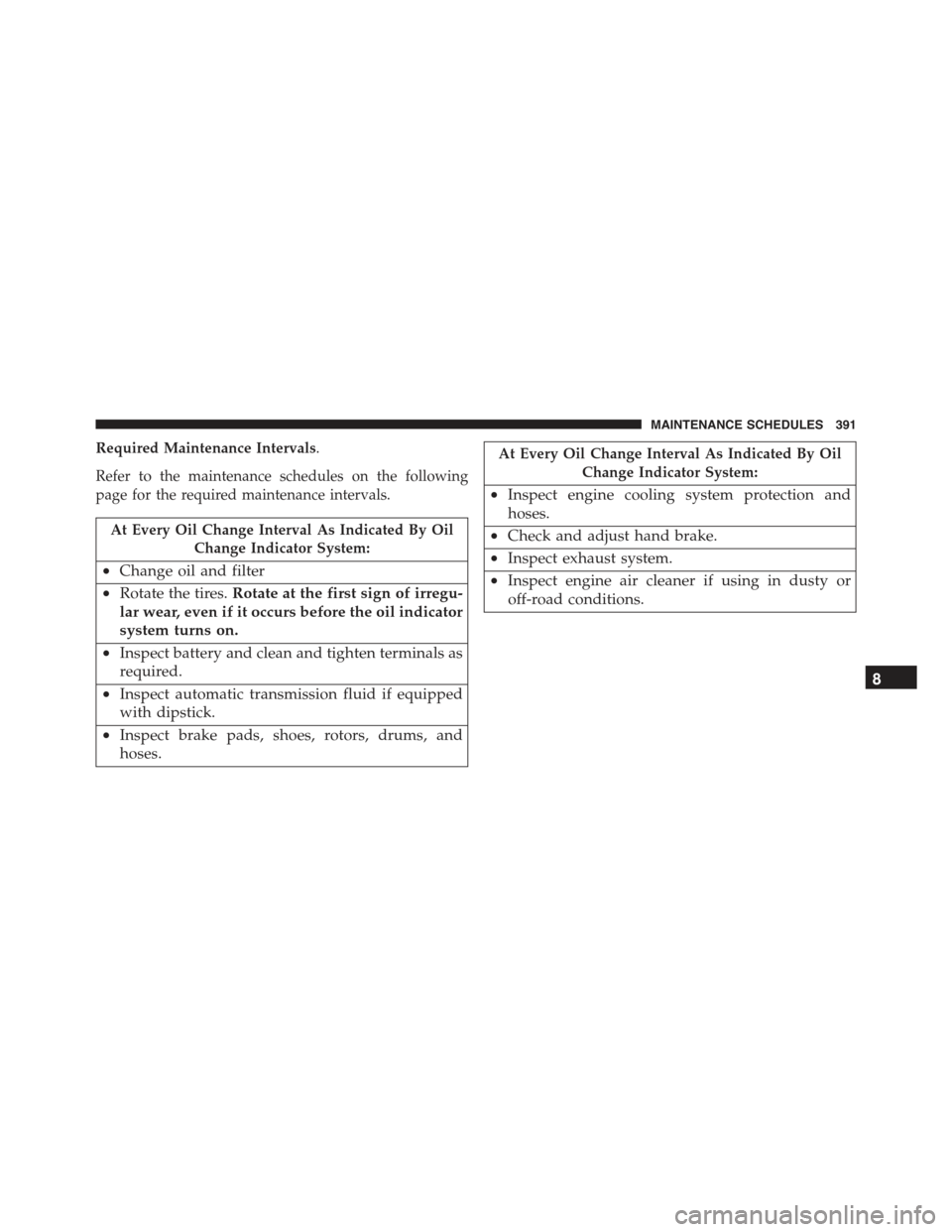
Required Maintenance Intervals.
Refer to the maintenance schedules on the following
page for the required maintenance intervals.
At Every Oil Change Interval As Indicated By Oil
Change Indicator System:
•Change oil and filter
•Rotate the tires.Rotate at the first sign of irregu-
lar wear, even if it occurs before the oil indicator
system turns on.
•Inspect battery and clean and tighten terminals as
required.
•Inspect automatic transmission fluid if equipped
with dipstick.
•Inspect brake pads, shoes, rotors, drums, and
hoses.
At Every Oil Change Interval As Indicated By Oil
Change Indicator System:
•Inspect engine cooling system protection and
hoses.
•Check and adjust hand brake.
•Inspect exhaust system.
•Inspect engine air cleaner if using in dusty or
off-road conditions.
8
MAINTENANCE SCHEDULES 391
Page 408 of 423
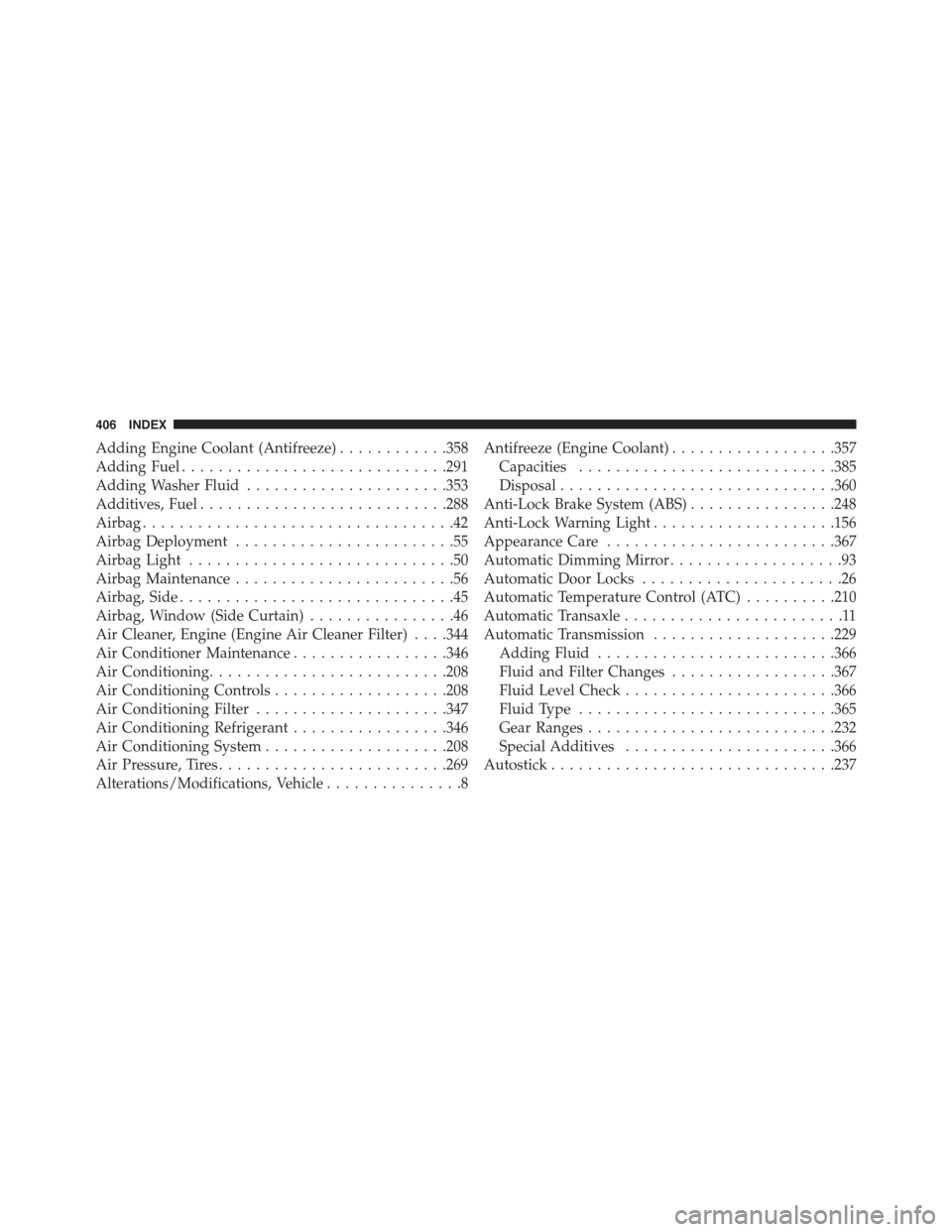
Adding Engine Coolant (Antifreeze)............358
Adding Fuel.............................291
Adding Washer Fluid......................353
Additives, Fuel...........................288
Airbag..................................42
Airbag Deployment........................55
Airbag Light.............................50
Airbag Maintenance........................56
Airbag, Side..............................45
Airbag, Window (Side Curtain)................46
Air Cleaner, Engine (Engine Air Cleaner Filter) . . . .344
Air Conditioner Maintenance.................346
Air Conditioning..........................208
Air Conditioning Controls...................208
Air Conditioning Filter.....................347
Air Conditioning Refrigerant.................346
Air Conditioning System....................208
Air Pressure, Tires.........................269
Alterations/Modifications, Vehicle...............8
Antifreeze (Engine Coolant)..................357
Capacities............................385
Disposal..............................360
Anti-Lock Brake System (ABS)................248
Anti-Lock Warning Light....................156
Appearance Care.........................367
Automatic Dimming Mirror...................93
Automatic Door Locks......................26
Automatic Temperature Control (ATC)..........210
Automatic Transaxle........................11
Automatic Transmission....................229
Adding Fluid..........................366
Fluid and Filter Changes..................367
Fluid Level Check.......................366
Fluid Type............................365
Gear Ranges...........................232
Special Additives.......................366
Autostick...............................237
406 INDEX
Page 409 of 423
Battery.................................345
Jump Starting..........................320
Keyless Transmitter Replacement (RKE)........20
Belts, Seat...............................81
Body Mechanism Lubrication.................350
B-Pillar Location..........................263
Brake Assist System.......................250
Brake Fluid.............................387
Brake, Parking...........................244
Brakes.................................362
Brake System............................248
Anti-Lock (ABS)........................248
Master Cylinder........................362
Parking..............................244
Warning Light.........................155
Brake/Transmission Interlock.................231
Bulb Replacement.........................380
Bulbs, Light..............................83
Capacities, Antifreeze (Engine Coolant)..........385
Capacities, Fluid..........................385
Caps, Filler
Fuel.................................291
Oil (Engine)...........................342
Carbon Monoxide Warning...................80
Cargo Area Features.......................139
Car Washes.............................368
CD (Compact Disc) Player...................179
Cellular Phone...........................207
Chains, Tire.............................277
Changing A Flat Tire.......................308
Chart, Tire Sizing.........................258
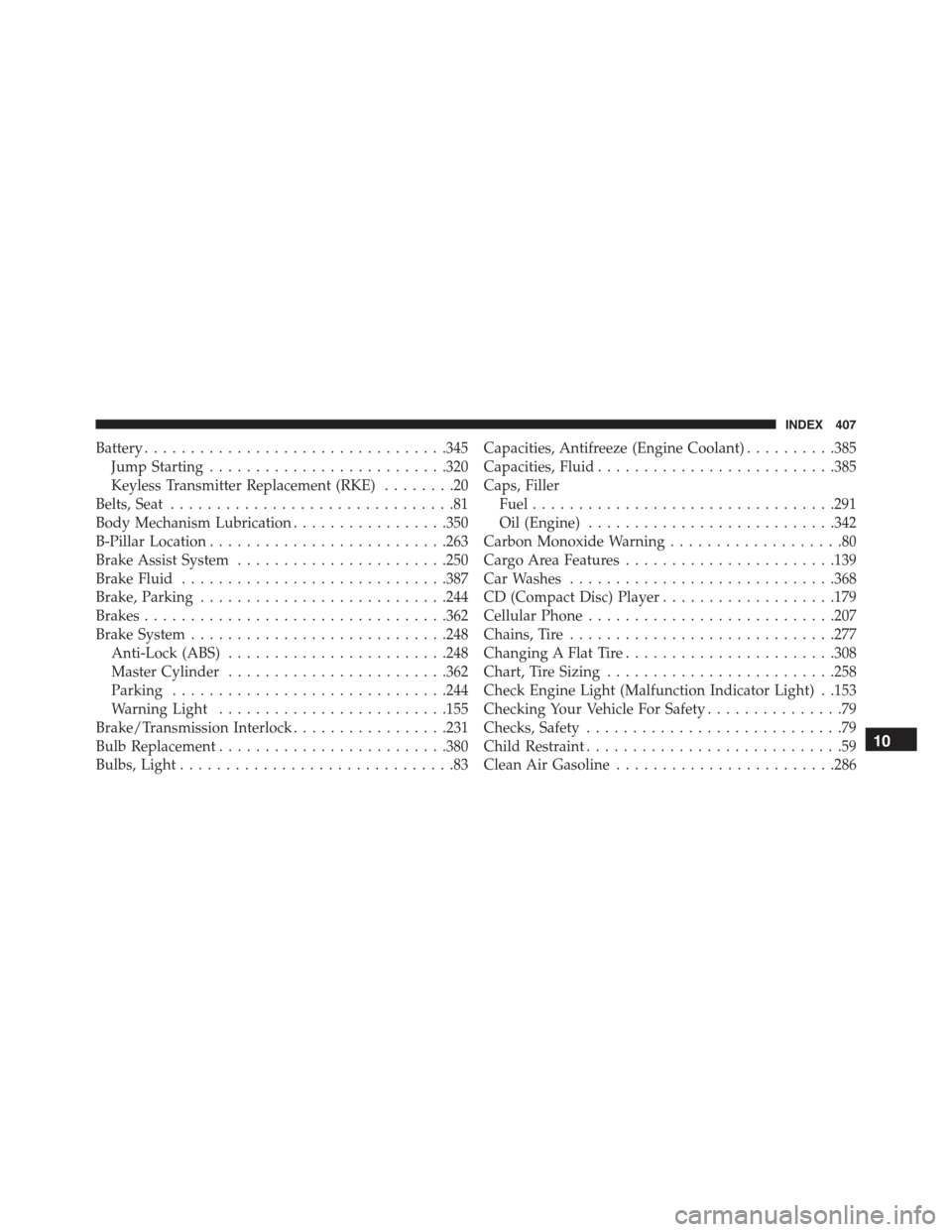
Check Engine Light (Malfunction Indicator Light) . .153
Checking Your Vehicle For Safety...............79
Checks, Safety............................79
Child Restraint............................59
Clean Air Gasoline........................286
10
INDEX 407
Page 411 of 423
Downshifting............................228
Driving
Through Flowing, Rising, or Shallow Standing
Water................................240
Electrical Power Outlets.....................134
Electric Remote Mirrors......................94
Electronic Brake Control System...............249
Brake Assist System.....................250
Electronic Speed Control (Cruise Control)........122
Electronic Stability Control (ESC)..............252
Electronic Vehicle Information Center (EVIC)......160
Emergency, In Case of
Hazard Warning Flasher..................297
Jacking...............................308
Jump Starting..........................320
Towing..............................327
Emission Control System Maintenance..........337
Engine
Air Cleaner...........................344
Break-In Recommendations.................78
Checking Oil Level......................340
Compartment..........................335
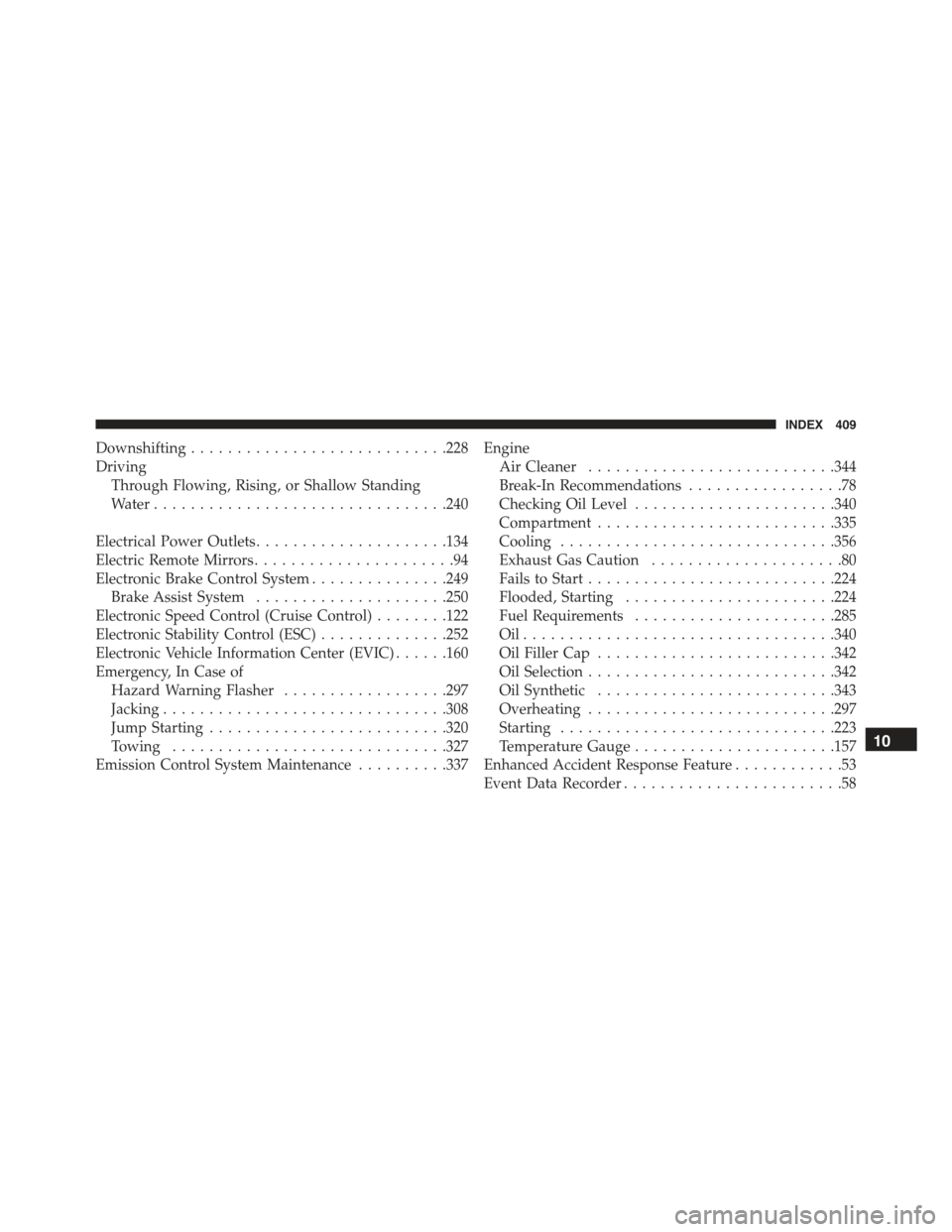
Cooling..............................356
Exhaust Gas Caution.....................80
Fails to Start...........................224
Flooded, Starting.......................224
Fuel Requirements......................285
Oil . . . . . . . . . . . . . . . . . . . . . . . . . . . . . . . . ..340
Oil Filler Cap..........................342
Oil Selection...........................342
Oil Synthetic..........................343
Overheating...........................297
Starting..............................223
Temperature Gauge......................157
Enhanced Accident Response Feature............53
Event Data Recorder........................58
10
INDEX 409
Page 412 of 423
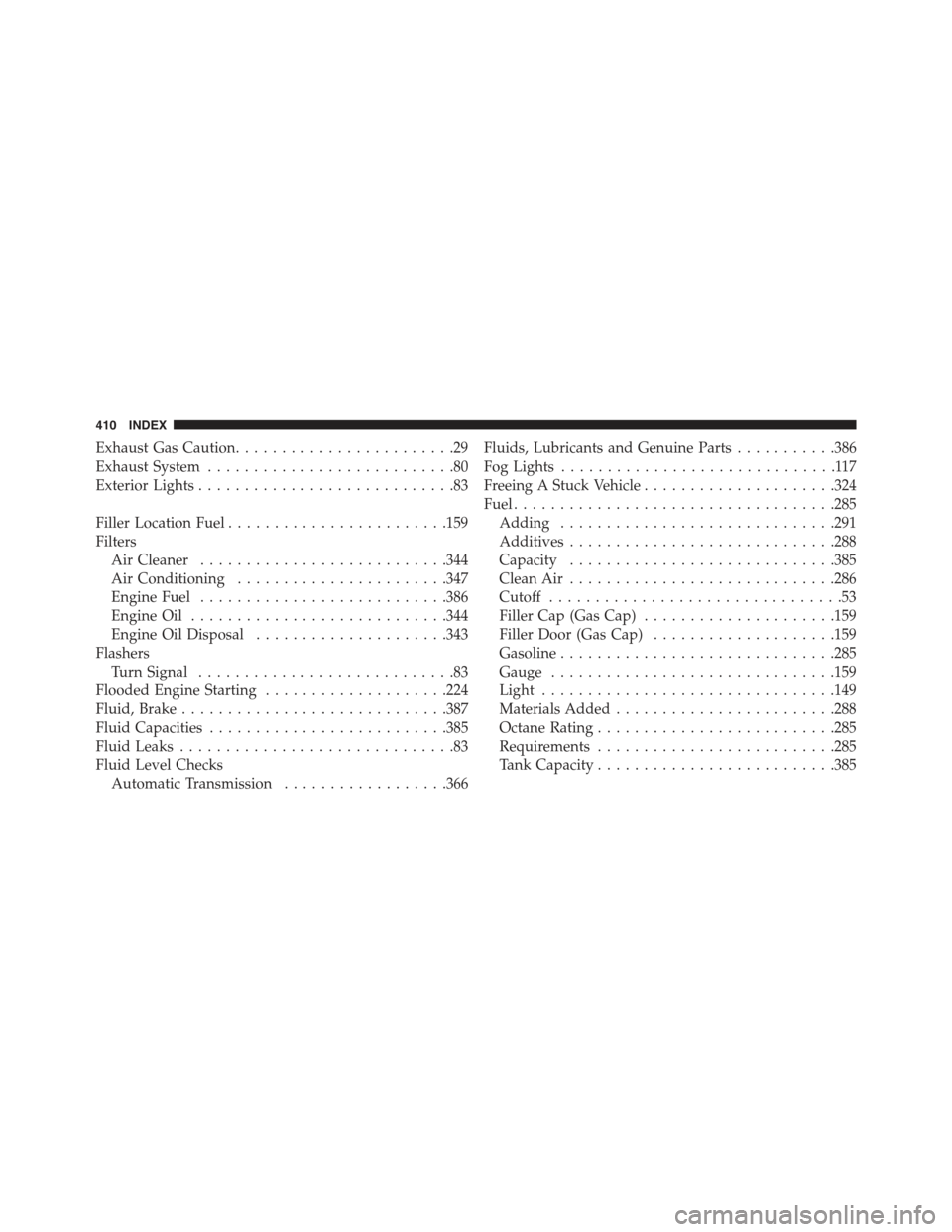
Exhaust Gas Caution........................29
Exhaust System...........................80
Exterior Lights............................83
Filler Location Fuel........................159
Filters
Air Cleaner...........................344
Air Conditioning.......................347
Engine Fuel...........................386
Engine Oil............................344
Engine Oil Disposal.....................343
Flashers
Turn Signal............................83
Flooded Engine Starting....................224
Fluid, Brake.............................387
Fluid Capacities..........................385
Fluid Leaks..............................83
Fluid Level Checks
Automatic Transmission..................366
Fluids, Lubricants and Genuine Parts...........386
Fog Lights..............................117
Freeing A Stuck Vehicle.....................324
Fuel...................................285
Adding..............................291
Additives.............................288
Capacity.............................385
Clean Air.............................286
Cutoff................................53
Filler Cap (Gas Cap).....................159
Filler Door (Gas Cap)....................159
Gasoline..............................285
Gauge...............................159
Light................................149
Materials Added........................288
Octane Rating..........................285
Requirements..........................285
Tank Capacity..........................385
410 INDEX