wheel FIAT 500 2013 2.G Repair Manual
[x] Cancel search | Manufacturer: FIAT, Model Year: 2013, Model line: 500, Model: FIAT 500 2013 2.GPages: 423, PDF Size: 9.86 MB
Page 329 of 423
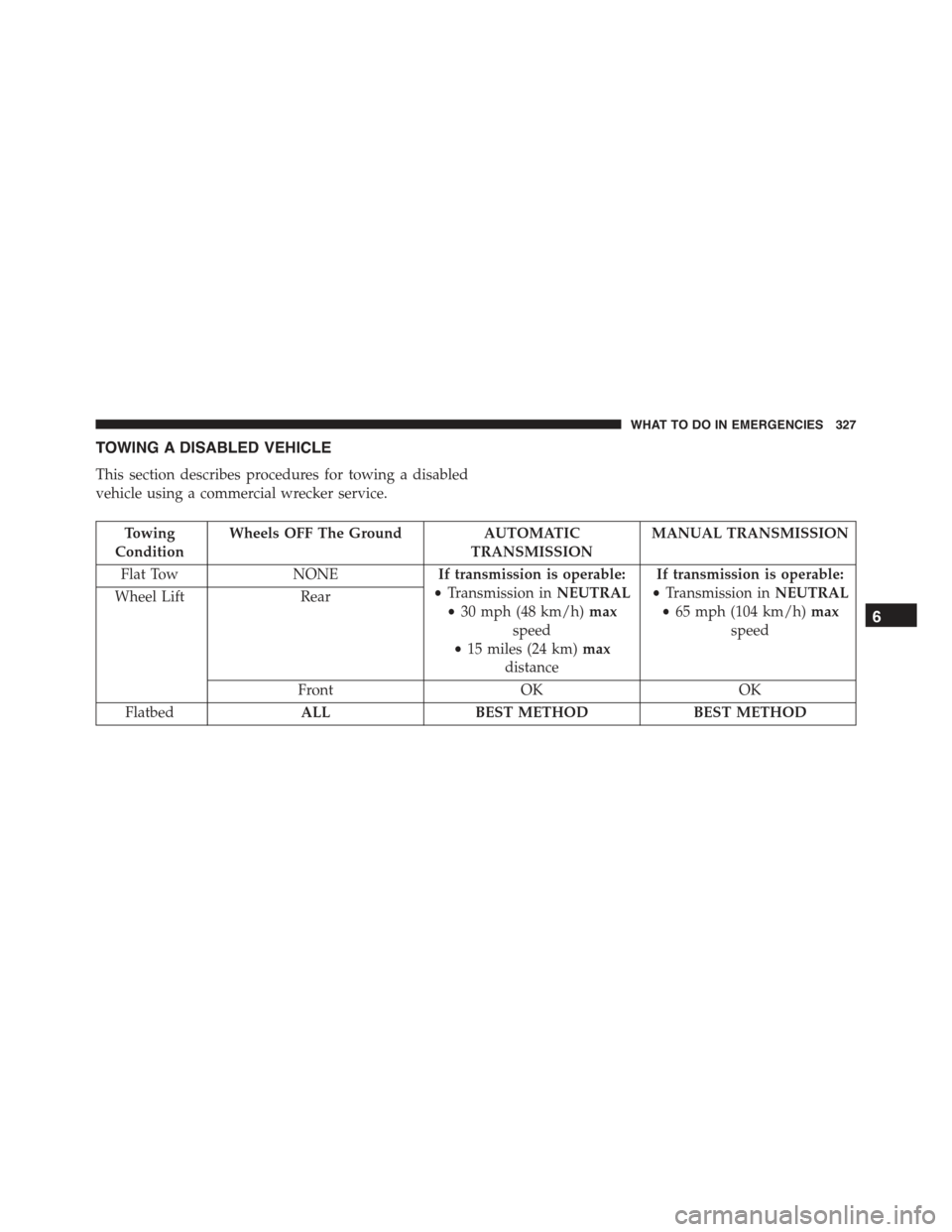
TOWING A DISABLED VEHICLE
This section describes procedures for towing a disabled
vehicle using a commercial wrecker service.
Towing
Condition
Wheels OFF The Ground AUTOMATIC
TRANSMISSION
MANUAL TRANSMISSION
Flat TowNONEIf transmission is operable:
•Transmission inNEUTRAL
•30 mph (48 km/h)max
speed
•15 miles (24 km)max
distance
If transmission is operable:
•Transmission inNEUTRAL
•65 mph (104 km/h)max
speed
Wheel LiftRear
FrontOKOK
FlatbedALLBEST METHODBEST METHOD
6
WHAT TO DO IN EMERGENCIES 327
Page 330 of 423
Proper towing or lifting equipment is required to prevent
damage to your vehicle. Use only tow bars and other
equipment designed for this purpose, following equip-
ment manufacturer ’s instructions. Use of safety chains is
mandatory. Attach a tow bar or other towing device to
main structural members of the vehicle, not to bumpers
or associated brackets. State and local laws regarding
vehicles under tow must be observed.
If you must use the accessories (wipers, defrosters, etc.)
while being towed, the ignition must be in the ON/RUN
position.
If the ignition key is unavailable, or the battery is
discharged, see “Shift Lever Override” in “What To Do In
Emergencies” for instructions on shifting the automatic
transmission out of PARK for towing.
CAUTION!
DO NOT use sling-type equipment when towing.
When securing the vehicle to a flatbed truck, do not
attach to front or rear suspension components. Dam-
age to your vehicle may result from improper towing.
Automatic Transmission
•Vehicle can be towed with the front wheels elevated.
•Vehicle can be towed on a flatbed truck (all wheels off
the ground).
CAUTION!
•DO NOT flat tow any vehicle equipped with an
automatic transmission. Damage to the drivetrain
will result.
(Continued)
328 WHAT TO DO IN EMERGENCIES
Page 331 of 423
CAUTION!(Continued)
•Towing this vehicle in violation of the above re-
quirements can cause severe transmission damage.
Damage from improper towing is not covered un-
der the New Vehicle Limited Warranty.
Manual Transmission
•Vehicle can be flat towed (all four wheels on the
ground) with the transmission in NEUTRAL.
•Vehicle can be towed with the front wheels elevated.
•Vehicle can be towed on a flatbed truck (all wheels off
the ground).
CAUTION!
Towing this vehicle in violation of the above require-
ments can cause severe transmission damage. Dam-
age from improper towing is not covered under the
New Vehicle Limited Warranty.
ENHANCED ACCIDENT RESPONSE SYSTEM
In the event of an impact causing airbag deployment, if
the communication network remains intact, and the
power remains intact, depending on the nature of the
event the ORC will determine whether to have the
Enhanced Accident Response System perform the follow-
ing functions:
•Cut off fuel to the engine.
•Flash hazard lights as long as the battery has power or
until the ignition key is turned off.
6
WHAT TO DO IN EMERGENCIES 329
Page 371 of 423
Special Care
•If you drive on salted or dusty roads or if you drive
near the ocean, hose off the undercarriage at least once
a month.
•It is important that the drain holes in the lower edges
of the doors, rocker panels, and trunk be kept clear and
open.
•If you detect any stone chips or scratches in the paint,
touch them up immediately. The cost of such repairs is
considered the responsibility of the owner.
•If your vehicle is damaged due to a collision or similar
cause that destroys the paint and protective coating,
have your vehicle repaired as soon as possible. The
cost of such repairs is considered the responsibility of
the owner.
•If you carry special cargo such as chemicals, fertilizers,
de-icer salt, etc., be sure that such materials are well
packaged and sealed.
•If a lot of driving is done on gravel roads, consider
mud or stone shields behind each wheel.
•Use MOPAR® Touch Up Paint on scratches as soon as
possible. Your authorized studio has touch up paint to
match the color of your vehicle.
Wheel And Wheel Trim Care
•All wheels and wheel trim, especially aluminum and
chrome plated wheels, should be cleaned regularly
with a mild soap and water to prevent corrosion.
•To remove heavy soil and/or excessive brake dust, use
MOPAR® Wheel Cleaner.
7
MAINTAINING YOUR VEHICLE 369
Page 372 of 423
CAUTION!
Do not use scouring pads, steel wool, a bristle brush,
or metal polishes. Do not use oven cleaner. These
products may damage the wheel’s protective finish.
Avoid automatic car washes that use acidic solutions
or harsh brushes that may damage the wheel’s pro-
tective finish. Only MOPAR® Wheel Cleaner or
equivalent is recommended.
Stain Repel Fabric Cleaning Procedure – If
Equipped
Stain Repel seats may be cleaned in the following manner:
•Remove as much of the stain as possible by blotting
with a clean, dry towel.
•Blot any remaining stain with a clean, damp towel.
•For tough stains, apply MOPAR® Total Clean, or a
mild soap solution to a clean, damp cloth and remove
stain. Use a fresh, damp towel to remove soap residue.
•For grease stains, apply MOPAR® Multi-Purpose
Cleaner to a clean, damp cloth and remove stain. Use
a fresh, damp towel to remove soap residue.
•Do not use any harsh solvents or any other form of
protectants on Stain Repel products.
Interior Care
Use MOPAR® Total Clean to clean fabric upholstery and
carpeting.
Use MOPAR® Total Clean to clean vinyl upholstery.
MOPAR® Total Clean is specifically recommended for
leather upholstery.
Your leather upholstery can be best preserved by regular
cleaning with a damp soft cloth. Small particles of dirt
370 MAINTAINING YOUR VEHICLE
Page 384 of 423
Front Turn Signal, Parking And Daytime Running
Lamps
1. Turn the steering wheel completely to the left or right.
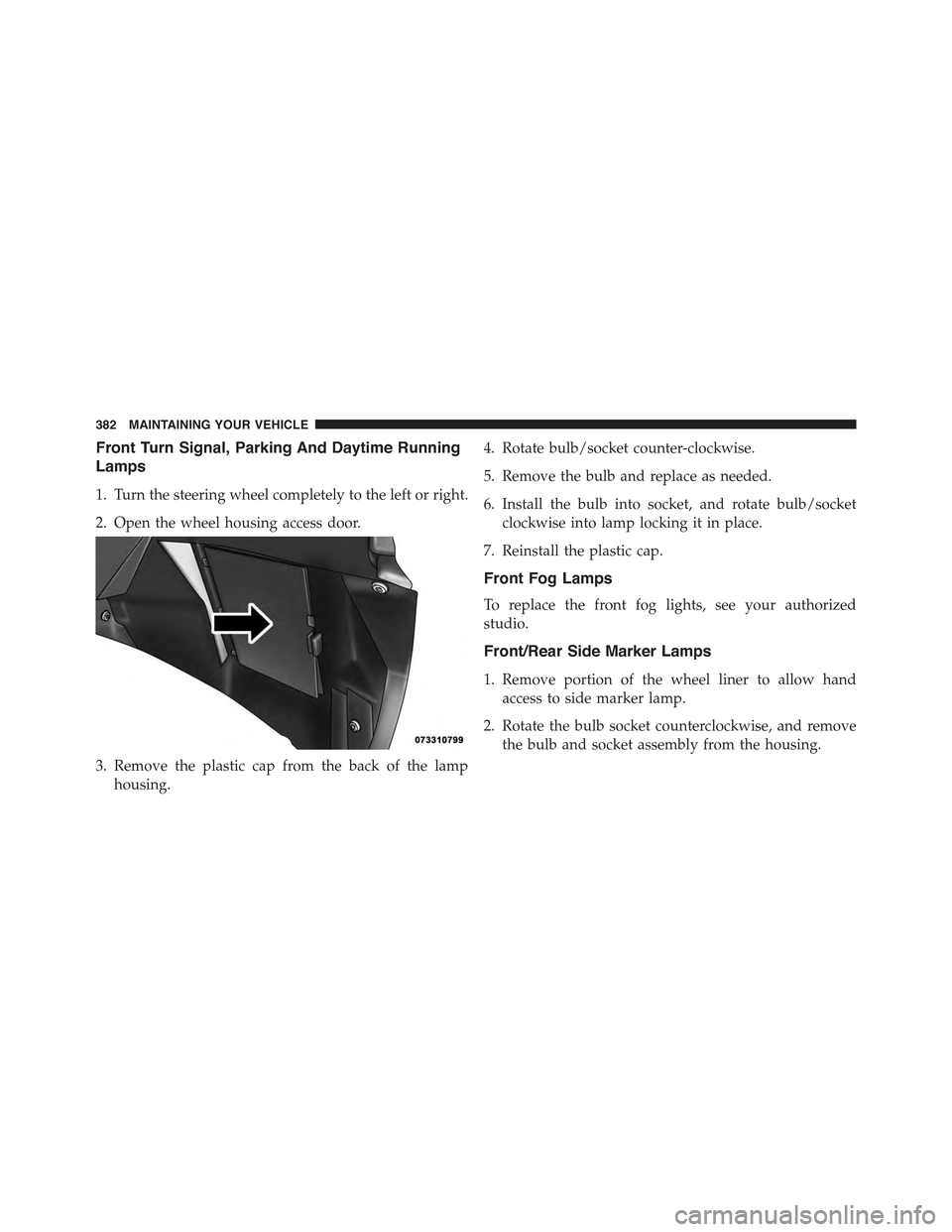
2. Open the wheel housing access door.
3. Remove the plastic cap from the back of the lamp
housing.
4. Rotate bulb/socket counter-clockwise.
5. Remove the bulb and replace as needed.
6. Install the bulb into socket, and rotate bulb/socket
clockwise into lamp locking it in place.
7. Reinstall the plastic cap.
Front Fog Lamps
To replace the front fog lights, see your authorized
studio.
Front/Rear Side Marker Lamps
1. Remove portion of the wheel liner to allow hand
access to side marker lamp.
2. Rotate the bulb socket counterclockwise, and remove
the bulb and socket assembly from the housing.
382 MAINTAINING YOUR VEHICLE
Page 385 of 423
3. Pull the bulb from the socket and insert the replace-
ment bulb.
4. Install the bulb and socket assembly into the housing,
and rotate the socket clockwise to lock it in place.
5. Reinstall the wheel liner.
Rear Tail, Stop, Backup And Turn Signal Lamps
1. Open the liftgate.
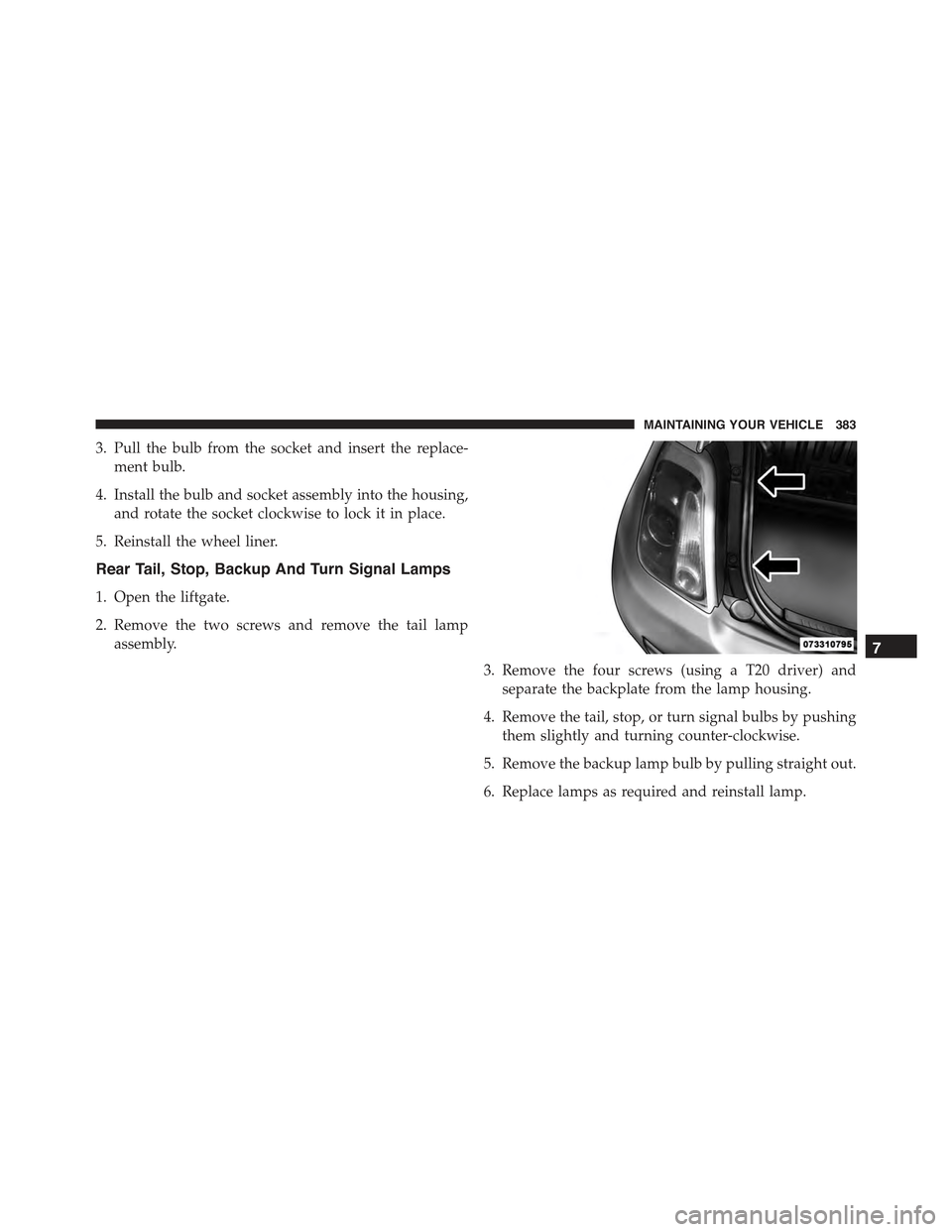
2. Remove the two screws and remove the tail lamp
assembly.
3. Remove the four screws (using a T20 driver) and
separate the backplate from the lamp housing.
4. Remove the tail, stop, or turn signal bulbs by pushing
them slightly and turning counter-clockwise.
5. Remove the backup lamp bulb by pulling straight out.
6. Replace lamps as required and reinstall lamp.
7
MAINTAINING YOUR VEHICLE 383
Page 404 of 423
significantly from the norm due to variations in driving
habits, service practices, and differences in road charac-
teristics and climate.
Traction Grades
The Traction grades, from highest to lowest, are AA, A, B,
and C. These grades represent the tire’s ability to stop on wet
pavement, as measured under controlled conditions on
specified government test surfaces of asphalt and concrete.
A tire marked C may have poor traction performance.
WARNING!
The traction grade assigned to this tire is based on
straight-ahead braking traction tests, and does not
include acceleration, cornering, hydroplaning, or
peak traction characteristics.
Temperature Grades
The temperature grades are A (the highest), B, and C,
representing the tire’s resistance to the generation of heat
and its ability to dissipate heat, when tested under con-
trolled conditions on a specified indoor laboratory test
wheel. Sustained high temperature can cause the material of
the tire to degenerate and reduce tire life, and excessive
temperature can lead to sudden tire failure. The grade C
corresponds to a level of performance, which all passenger
car tires must meet under the Federal Motor Vehicle Safety
Standard No. 109. Grades B and A represent higher levels
of performance on the laboratory test wheel, than the
minimum required by law.
402 IF YOU NEED CONSUMER ASSISTANCE
Page 410 of 423
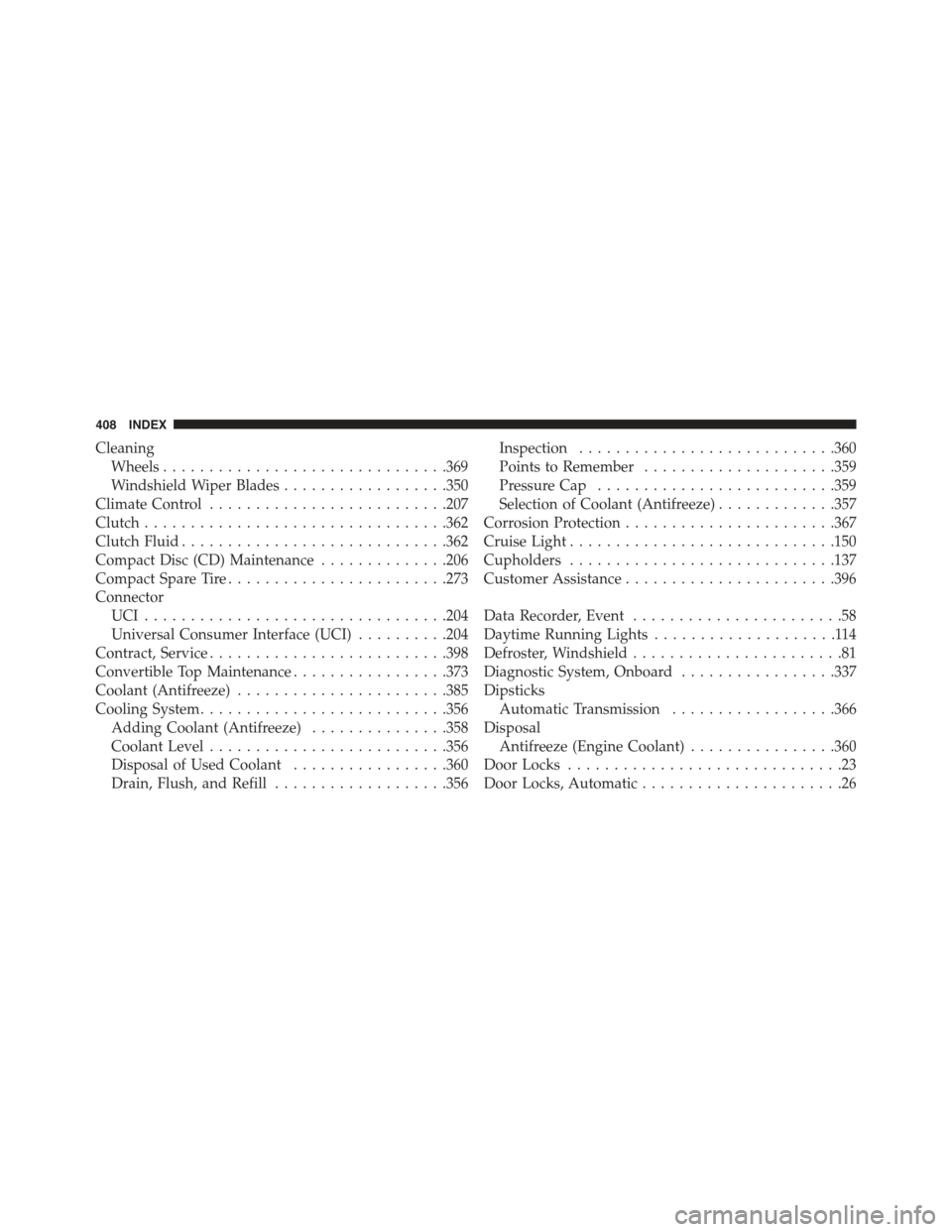
Cleaning
Wheels...............................369
Windshield Wiper Blades..................350
Climate Control..........................207
Clutch.................................362
Clutch Fluid.............................362
Compact Disc (CD) Maintenance..............206
Compact Spare Tire........................273
Connector
UCI . . . . . . . . . . . . . . . . . . . . . . . . . . . . . . . ..204
Universal Consumer Interface (UCI)..........204
Contract, Service..........................398
Convertible Top Maintenance.................373
Coolant (Antifreeze).......................385
Cooling System...........................356
Adding Coolant (Antifreeze)...............358
Coolant Level..........................356
Disposal of Used Coolant.................360
Drain, Flush, and Refill...................356
Inspection............................360
Points to Remember.....................359
Pressure Cap..........................359
Selection of Coolant (Antifreeze).............357
Corrosion Protection.......................367
Cruise Light.............................150
Cupholders.............................137
Customer Assistance.......................396
Data Recorder, Event.......................58
Daytime Running Lights....................114
Defroster, Windshield.......................81
Diagnostic System, Onboard.................337
Dipsticks
Automatic Transmission..................366
Disposal
Antifreeze (Engine Coolant)................360
Door Locks..............................23
Door Locks, Automatic......................26
408 INDEX
Page 419 of 423
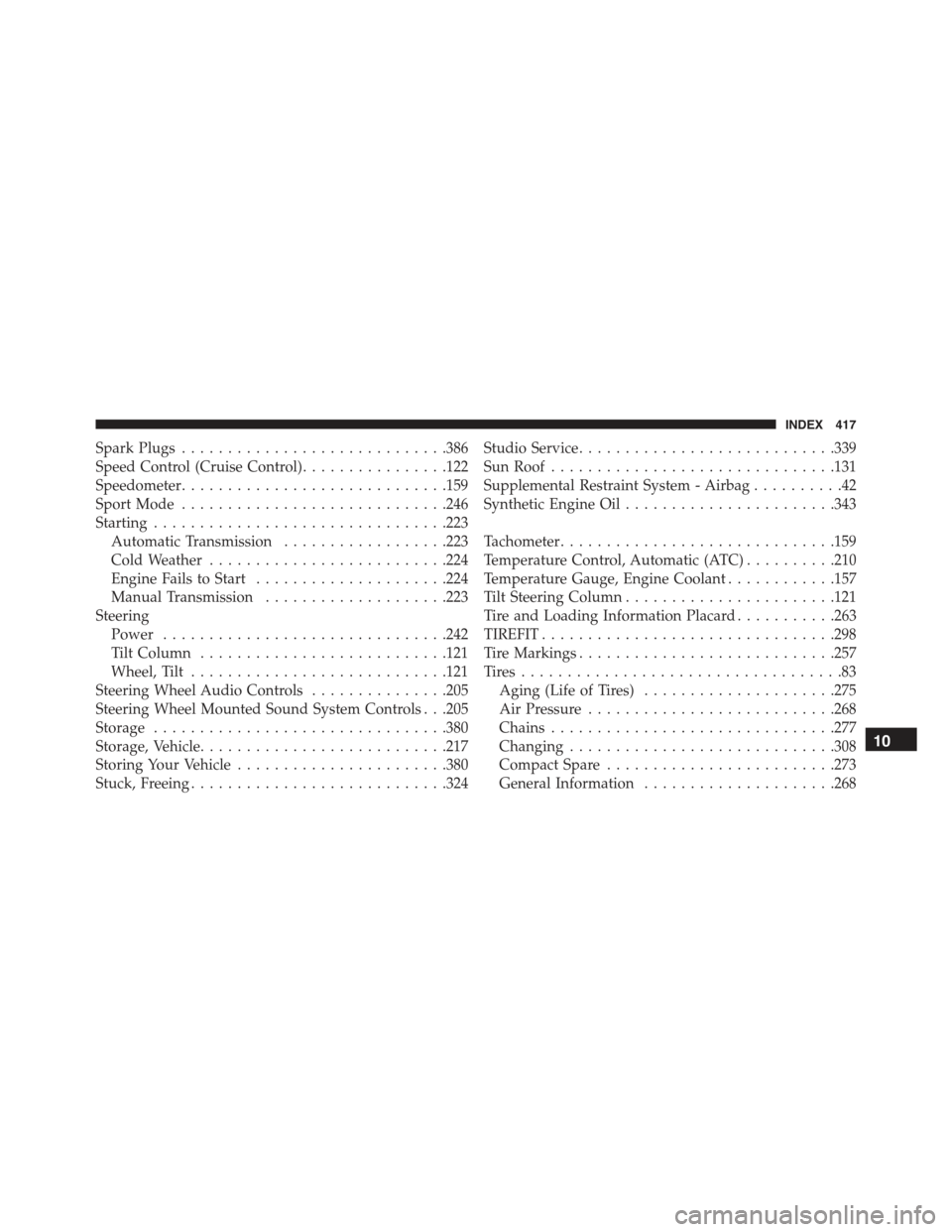
Spark Plugs.............................386
Speed Control (Cruise Control)................122
Speedometer.............................159
Sport Mode.............................246
Starting................................223
Automatic Transmission..................223
Cold Weather..........................224
Engine Fails to Start.....................224
Manual Transmission....................223
Steering
Power...............................242
Tilt Column...........................121
Wheel, Tilt............................121
Steering Wheel Audio Controls...............205
Steering Wheel Mounted Sound System Controls . . .205
Storage................................380
Storage, Vehicle...........................217
Storing Your Vehicle.......................380
Stuck, Freeing............................324
Studio Service............................339
Sun Roof...............................131
Supplemental Restraint System - Airbag..........42
Synthetic Engine Oil.......................343
Tachometer..............................159
Temperature Control, Automatic (ATC)..........210
Temperature Gauge, Engine Coolant............157
Tilt Steering Column.......................121
Tire and Loading Information Placard...........263
TIREFIT................................298
Tire Markings............................257
Ti re s . . . . . . . . . . . . . . . . . . . . . . . . . . . . . . . . . . . 8 3
Aging (Life of Tires).....................275
Air Pressure...........................268
Chains...............................277
Changing.............................308
Compact Spare.........................273
General Information.....................268
10
INDEX 417