ECO mode FIAT 500 2013 2.G Owners Manual
[x] Cancel search | Manufacturer: FIAT, Model Year: 2013, Model line: 500, Model: FIAT 500 2013 2.GPages: 423, PDF Size: 9.86 MB
Page 12 of 423
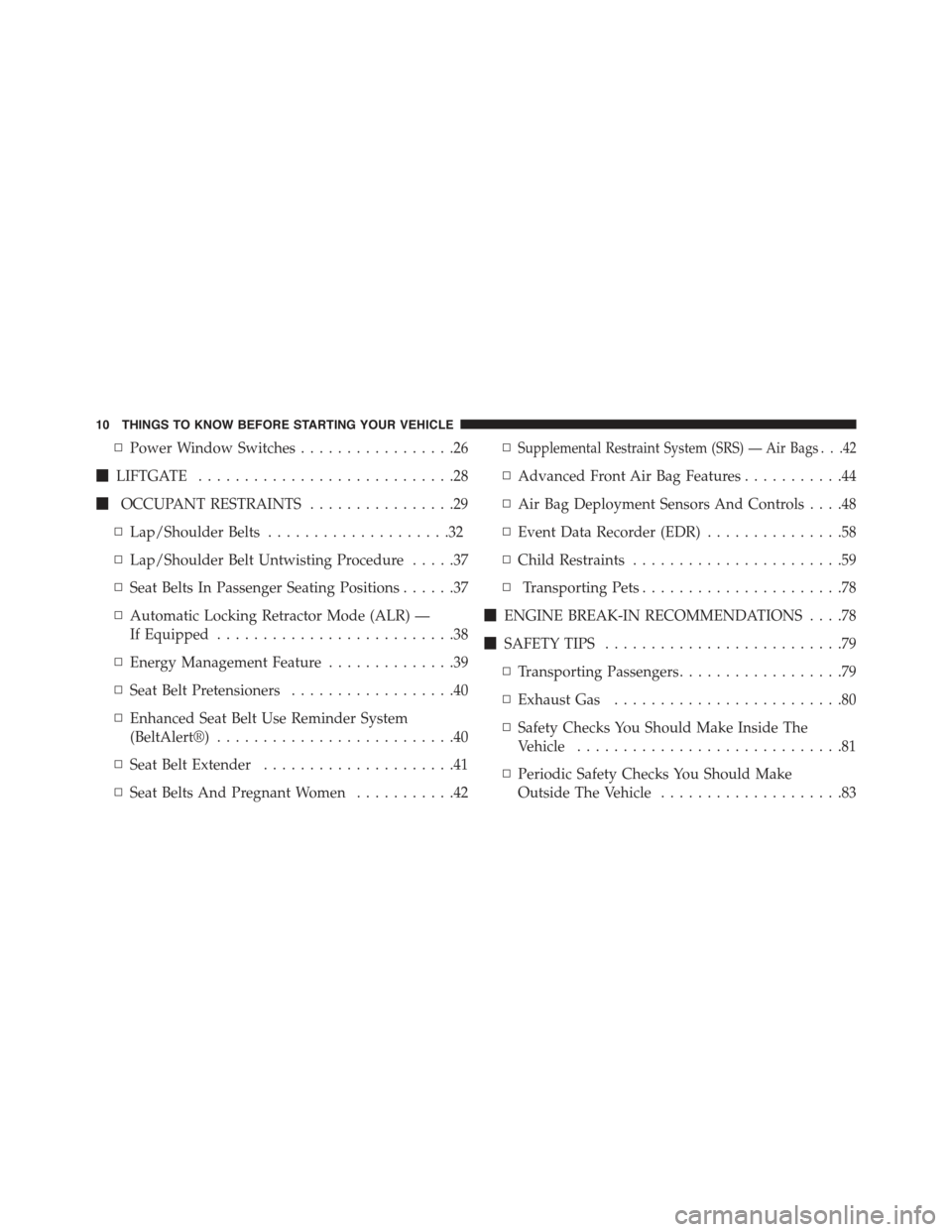
▫Power Window Switches.................26
!LIFTGATE............................28
!OCCUPANT RESTRAINTS................29
▫Lap/Shoulder Belts....................32
▫Lap/Shoulder Belt Untwisting Procedure.....37
▫Seat Belts In Passenger Seating Positions......37
▫Automatic Locking Retractor Mode (ALR) —
If Equipped..........................38
▫Energy Management Feature..............39
▫Seat Belt Pretensioners..................40
▫Enhanced Seat Belt Use Reminder System
(BeltAlert®)..........................40
▫Seat Belt Extender.....................41
▫Seat Belts And Pregnant Women...........42
▫Supplemental Restraint System (SRS) — Air Bags . . .42
▫Advanced Front Air Bag Features...........44
▫Air Bag Deployment Sensors And Controls....48
▫Event Data Recorder (EDR)...............58
▫Child Restraints.......................59
▫Transporting Pets......................78
!ENGINE BREAK-IN RECOMMENDATIONS....78
!SAFETY TIPS..........................79
▫Transporting Passengers..................79
▫Exhaust Gas.........................80
▫Safety Checks You Should Make Inside The
Vehicle.............................81
▫Periodic Safety Checks You Should Make
Outside The Vehicle....................83
10 THINGS TO KNOW BEFORE STARTING YOUR VEHICLE
Page 40 of 423
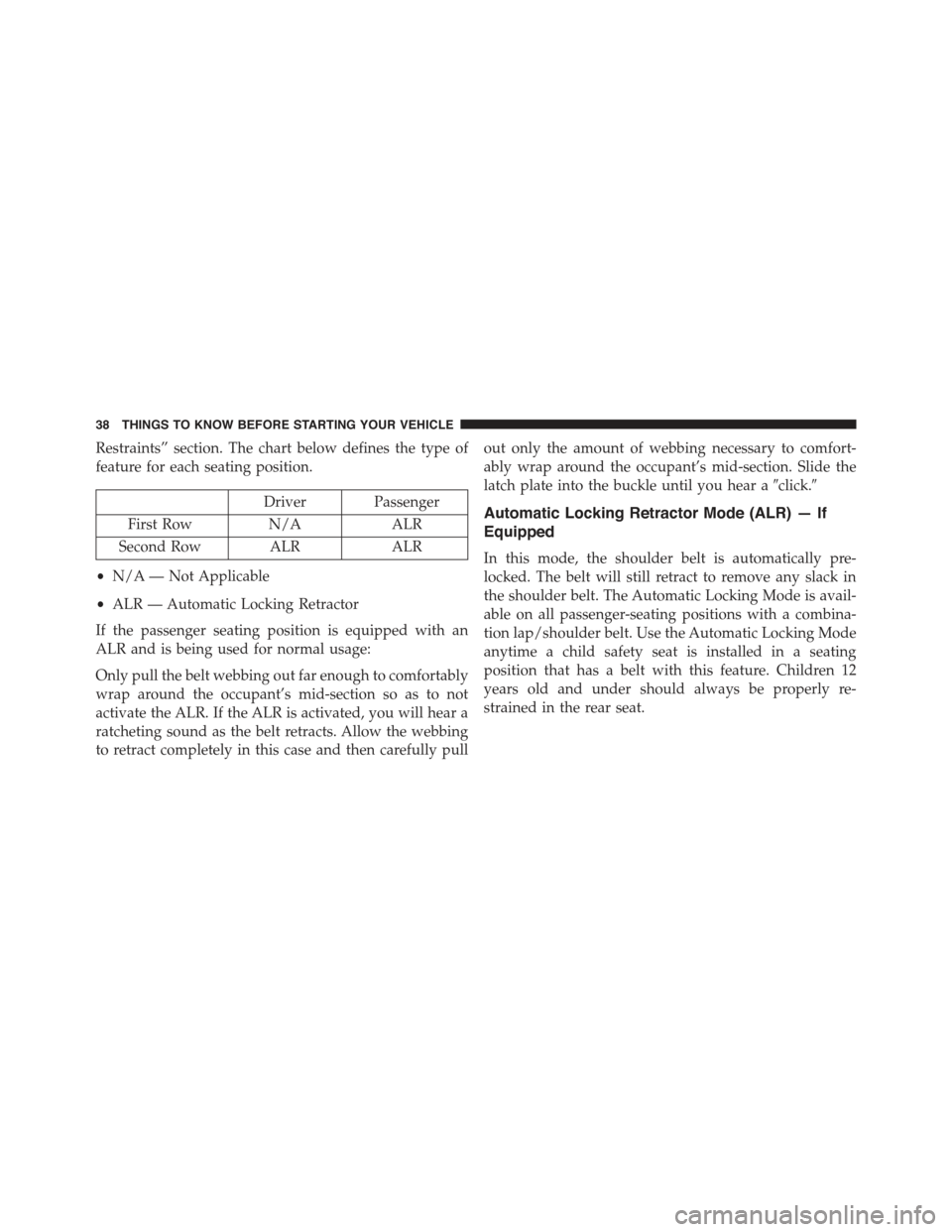
Restraints” section. The chart below defines the type of
feature for each seating position.
Driver Passenger
First RowN/AALR
Second Row ALRALR
•N/A — Not Applicable
•ALR — Automatic Locking Retractor
If the passenger seating position is equipped with an
ALR and is being used for normal usage:
Only pull the belt webbing out far enough to comfortably
wrap around the occupant’s mid-section so as to not
activate the ALR. If the ALR is activated, you will hear a
ratcheting sound as the belt retracts. Allow the webbing
to retract completely in this case and then carefully pull
out only the amount of webbing necessary to comfort-
ably wrap around the occupant’s mid-section. Slide the
latch plate into the buckle until you hear a#click.#
Automatic Locking Retractor Mode (ALR) — If
Equipped
In this mode, the shoulder belt is automatically pre-
locked. The belt will still retract to remove any slack in
the shoulder belt. The Automatic Locking Mode is avail-
able on all passenger-seating positions with a combina-
tion lap/shoulder belt. Use the Automatic Locking Mode
anytime a child safety seat is installed in a seating
position that has a belt with this feature. Children 12
years old and under should always be properly re-
strained in the rear seat.
38 THINGS TO KNOW BEFORE STARTING YOUR VEHICLE
Page 76 of 423
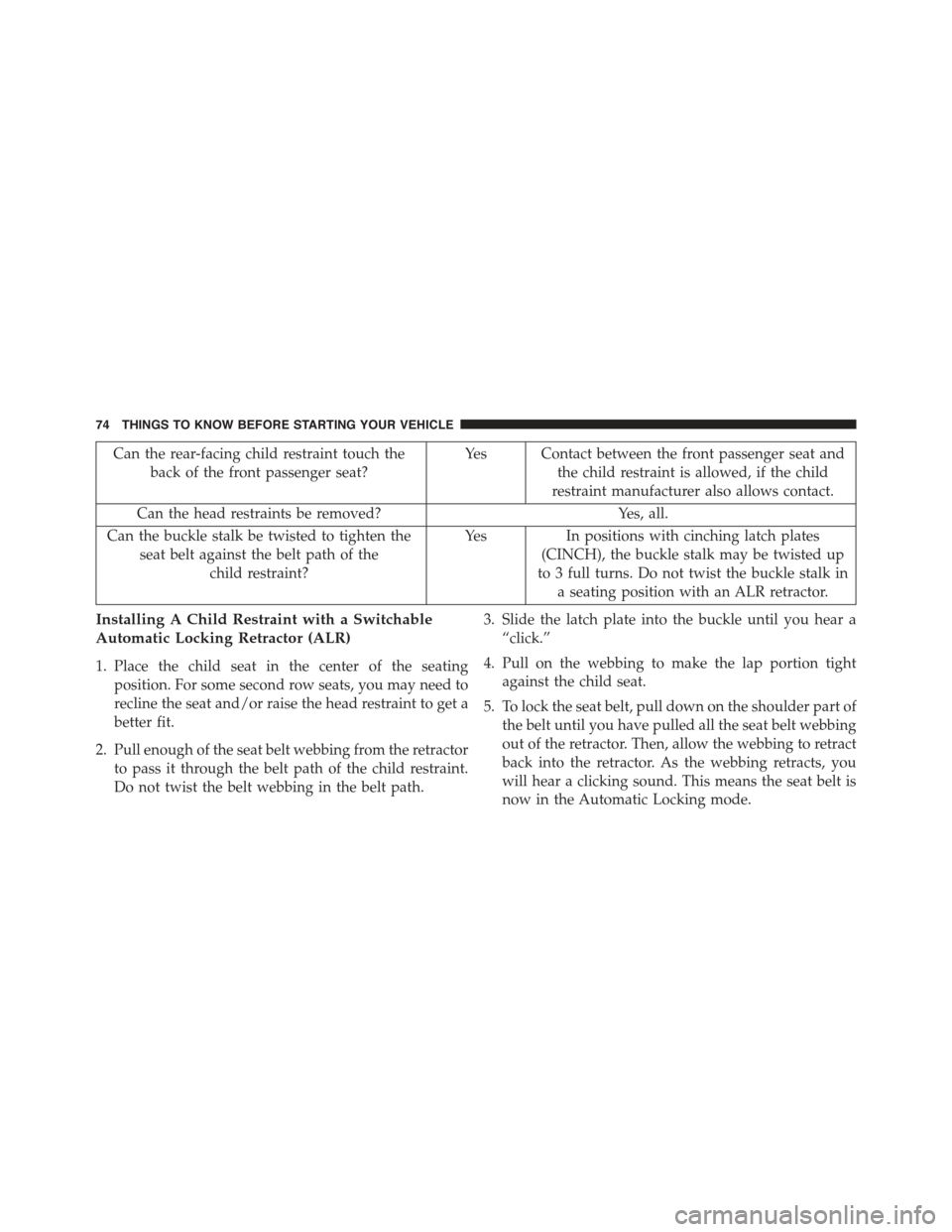
Can the rear-facing child restraint touch the
back of the front passenger seat?
Yes Contact between the front passenger seat and
the child restraint is allowed, if the child
restraint manufacturer also allows contact.
Can the head restraints be removed?Yes, all.
Can the buckle stalk be twisted to tighten the
seat belt against the belt path of the
child restraint?
YesIn positions with cinching latch plates
(CINCH), the buckle stalk may be twisted up
to 3 full turns. Do not twist the buckle stalk in
a seating position with an ALR retractor.
Installing A Child Restraint with a Switchable
Automatic Locking Retractor (ALR)
1. Place the child seat in the center of the seating
position. For some second row seats, you may need to
recline the seat and/or raise the head restraint to get a
better fit.
2. Pull enough of the seat belt webbing from the retractor
to pass it through the belt path of the child restraint.
Do not twist the belt webbing in the belt path.
3. Slide the latch plate into the buckle until you hear a
“click.”
4. Pull on the webbing to make the lap portion tight
against the child seat.
5. To lock the seat belt, pull down on the shoulder part of
the belt until you have pulled all the seat belt webbing
out of the retractor. Then, allow the webbing to retract
back into the retractor. As the webbing retracts, you
will hear a clicking sound. This means the seat belt is
now in the Automatic Locking mode.
74 THINGS TO KNOW BEFORE STARTING YOUR VEHICLE
Page 80 of 423
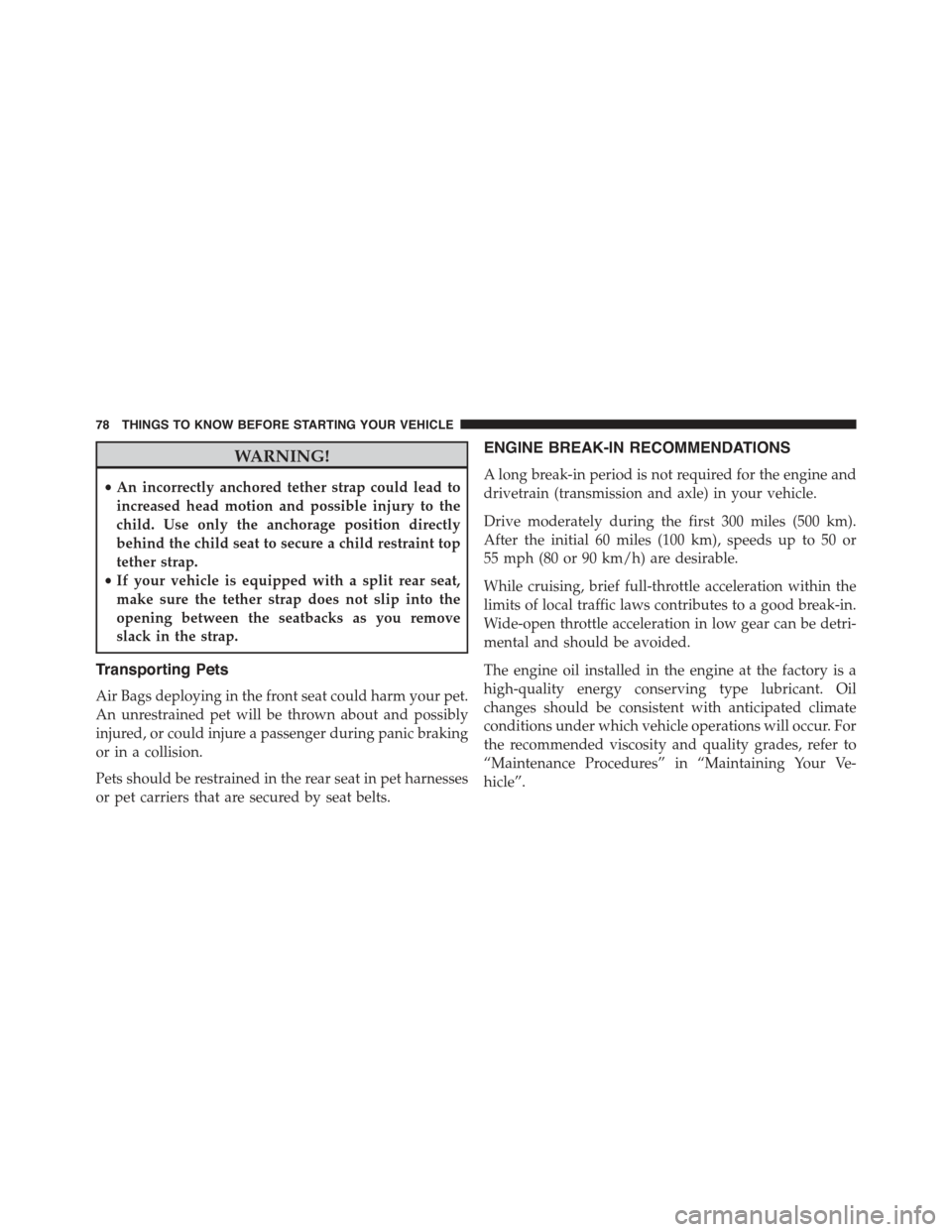
WARNING!
•An incorrectly anchored tether strap could lead to
increased head motion and possible injury to the
child. Use only the anchorage position directly
behind the child seat to secure a child restraint top
tether strap.
•If your vehicle is equipped with a split rear seat,
make sure the tether strap does not slip into the
opening between the seatbacks as you remove
slack in the strap.
Transporting Pets
Air Bags deploying in the front seat could harm your pet.
An unrestrained pet will be thrown about and possibly
injured, or could injure a passenger during panic braking
or in a collision.
Pets should be restrained in the rear seat in pet harnesses
or pet carriers that are secured by seat belts.
ENGINE BREAK-IN RECOMMENDATIONS
A long break-in period is not required for the engine and
drivetrain (transmission and axle) in your vehicle.
Drive moderately during the first 300 miles (500 km).
After the initial 60 miles (100 km), speeds up to 50 or
55 mph (80 or 90 km/h) are desirable.
While cruising, brief full-throttle acceleration within the
limits of local traffic laws contributes to a good break-in.
Wide-open throttle acceleration in low gear can be detri-
mental and should be avoided.
The engine oil installed in the engine at the factory is a
high-quality energy conserving type lubricant. Oil
changes should be consistent with anticipated climate
conditions under which vehicle operations will occur. For
the recommended viscosity and quality grades, refer to
“Maintenance Procedures” in “Maintaining Your Ve-
hicle”.
78 THINGS TO KNOW BEFORE STARTING YOUR VEHICLE
Page 83 of 423
Safety Checks You Should Make Inside The
Vehicle
Seat Belts
Inspect the belt system periodically, checking for cuts,
frays, and loose parts. Damaged parts must be replaced
immediately. Do not disassemble or modify the system.
Front seat belt assemblies must be replaced after a
collision. Rear seat belt assemblies must be replaced after
a collision if they have been damaged (i.e., bent retractor,
torn webbing, etc.). If there is any question regarding belt
or retractor condition, replace the belt.
Air Bag Warning Light
The light should come on and remain on for
four to eight seconds as a bulb check when the
ignition switch is first turned ON. If the light is
not lit during starting, see your authorized
studio. If the light stays on, flickers, or comes on while
driving, have the system checked by an authorized
studio.
Defroster
Check operation by selecting the defrost mode and place
the blower control on high speed. You should be able to
feel the air directed against the windshield. See your
authorized studio for service if your defroster is inoper-
able.
Floor Mat Safety Information
Always use floor mats designed to fit the footwell of your
vehicle. Use only floor mats that leave the pedal area
unobstructed and that are firmly secured so that they
cannot slip out of position and interfere with the pedals
or impair safe operation of your vehicle in other ways.
2
THINGS TO KNOW BEFORE STARTING YOUR VEHICLE 81
Page 91 of 423
NOTE:Vertical movement only operates in auto open/
close mode.
Raising The Power Top
Auto Close
From the convertible top fully open position, push the
top close button for approximately one second for the
three-quarter open/spoiler position. Push the top close
button for approximately one second a second time for
the one-quarter open position. Push and hold close
button to fully close convertible top.
Manual Close
For manual close, push and hold the close button until
desired position until one-quarter open position. Push
and hold again for full close position.
NOTE:Rail lubrication is recommended every 2000
cycles, or if scratching noises due to dust are present.
Refer to “Fluids, Lubes, and Genuine Part” in “Maintain-
ing Your Vehicle” for information.
CAUTION!
Failure to follow these cautions may cause interior
water damage, stains or mildew on the top material:
•Avoid high-pressure car washes, as they can dam-
age the top material. Also, increased water pressure
may force water past the weather strips.
•Remove any standing water from the top and dry
the surface before opening it. Operating the top,
opening a door or lowering a window while the top
is wet may allow water to drip into the vehicles
interior.
(Continued)
3
UNDERSTANDING THE FEATURES OF YOUR VEHICLE 89
Page 92 of 423
CAUTION!(Continued)
•Use care when washing the vehicle, water pressure
directed at the weather strip seals may cause water
to leak into the vehicles interior.
WARNING!
The convertible top does not provide the structural
protection that a reinforced metal roof does and the
fabric top cannot be expected to prevent the ejection
of the occupants in a collision. Therefore, it is impor-
tant that all occupants wear their seat belts at all
times. Death or serious injuries could occur if you are
ejected from the vehicle during a collision.
Power Convertible Top Relearn Procedure
If your power convertible top does not operate in the
Auto Opening/Closing mode (automatically opening/
closing to the one-quarter open and three-quarter open
comfort stops), or if the remote keyless power top
function is inoperable, or if the trunk lid does not open -
the following relearn procedure may be necessary.
1. Confirm that the door/trunk lid are closed.
2. Begin with the top in the fully closed position (using
manual mode).
3. Hold the OPEN button to move the top to the fully
open position.
4. CONTINUE to hold the OPEN button for an addi-
tional three seconds.
5. Release the OPEN button.
90 UNDERSTANDING THE FEATURES OF YOUR VEHICLE
Page 99 of 423
you are not required to train the voice recognition system
to recognize your voice. This implies that the system is
nearly equally performing with different persons, i.e.: the
voice recognition system is of the “speaker independent”
type.
With this system you can also play your favorite music
stored on USB device and select tracks and playback
modes with both voice commands or buttons on the
steering wheel.
This device complies with Part 15 of the FCC rules
subject to the following two conditions:
•This device may not cause harmful interference.
•This device must accept all interference received, includ-
ing interference that may cause undesired operation.
The Hands-Free Kit
The basic characteristic of this hands-free kit is voice
recognition with Bluetooth® wireless technology. With
this system you can make and receive calls safely and
securely by using either voice commands or buttons on
the steering wheel. This can be done under any driving
condition without ever having to take your eyes off the
road or remove your hands from the steering wheel, as
required by current laws.
Bluetooth® wireless technology enables wireless connec-
tion between your mobile phone and the hands-free kit
installed on your car.
To use the hands-free kit, you need a Bluetooth® wireless
technology enabled mobile phone. This hands-free kit
gives you the possibility of interacting vocally with your
mobile phone while driving, even if your mobile device
does not feature this capability. You can also interact with
your mobile phone manually and visually using the
steering wheel controls and the instrument panel multi-
function display.
3
UNDERSTANDING THE FEATURES OF YOUR VEHICLE 97
Page 109 of 423
Lift the seatback upright and push the seat rearward to
its locked position once the rear passengers are seated.
Memory Feature
The driver seat also has a memory feature, which can
operate in two ways:
Memory Function Option 1 — Full Seat Back And
Track Fore/Aft Position Memory:
After using the EZ entry function, the seatback angle and
the Track fore/aft adjuster can both re-lock into the
position they were most recently adjusted to. This is
accomplished if the seat is moved fully rearward to its
last fore/aft position on the tracks before the seat back is
returned upright.
Memory Function Option 2 — Seat Back Only
Memory:
After using the EZ entry function, the seat back may first
be returned upright prior to going back to the last
fore/aft (memory) position on the tracks. This results in
the seat back memory being set only – The track will then
be locked forward of its last set fore/aft memory posi-
tion. To then reset the fore/aft track memory feature (to
reestablish memory function option 1), the seat has to be
returned fully rearward to its last fore/aft memory track
position as described in Memory function option 1.
Heated Seats — If Equipped
On some models, the front driver and passenger seats
may be equipped with heaters in both the seat cushions
and seatbacks. The controls for the front heated seats are
located on the center instrument panel area.
Press the switch once to turn on the heated
seats. Press the switch a second time to shut the
heating elements off.
NOTE:Once a heat setting is selected, heat will be felt
within two to five minutes.
3
UNDERSTANDING THE FEATURES OF YOUR VEHICLE 107
Page 118 of 423

CAUTION!
Before getting out of the vehicle be sure that the
switch is in the center position or that the lights are
off to avoid draining the battery.
Interior Light Timing (Center Position)
There are four different modes of operation that can be
activated in this position:
•When one door is opened a 3 minute timer is activated.
•When the key is removed from the ignition (within
two minutes of the ignition being turned off), a 10
second timer is activated.
•When the doors are unlocked with Key Fob a 10
second timer is activated.
•When the doors are locked with the Key Fob the lights
will turn off.
Interior Light Timing (On/Right Position)
•When all doors are closed a 15 minute timer is
activated.
NOTE:The timer is deactivated when the key is moved
into the ON/RUN position.
11 6 U N D E R S TA N D I N G T H E F E AT U R E S O F Y O U R V E H I C L E