air conditioning FIAT 500 2015 2.G User Guide
[x] Cancel search | Manufacturer: FIAT, Model Year: 2015, Model line: 500, Model: FIAT 500 2015 2.GPages: 438, PDF Size: 2.96 MB
Page 358 of 438
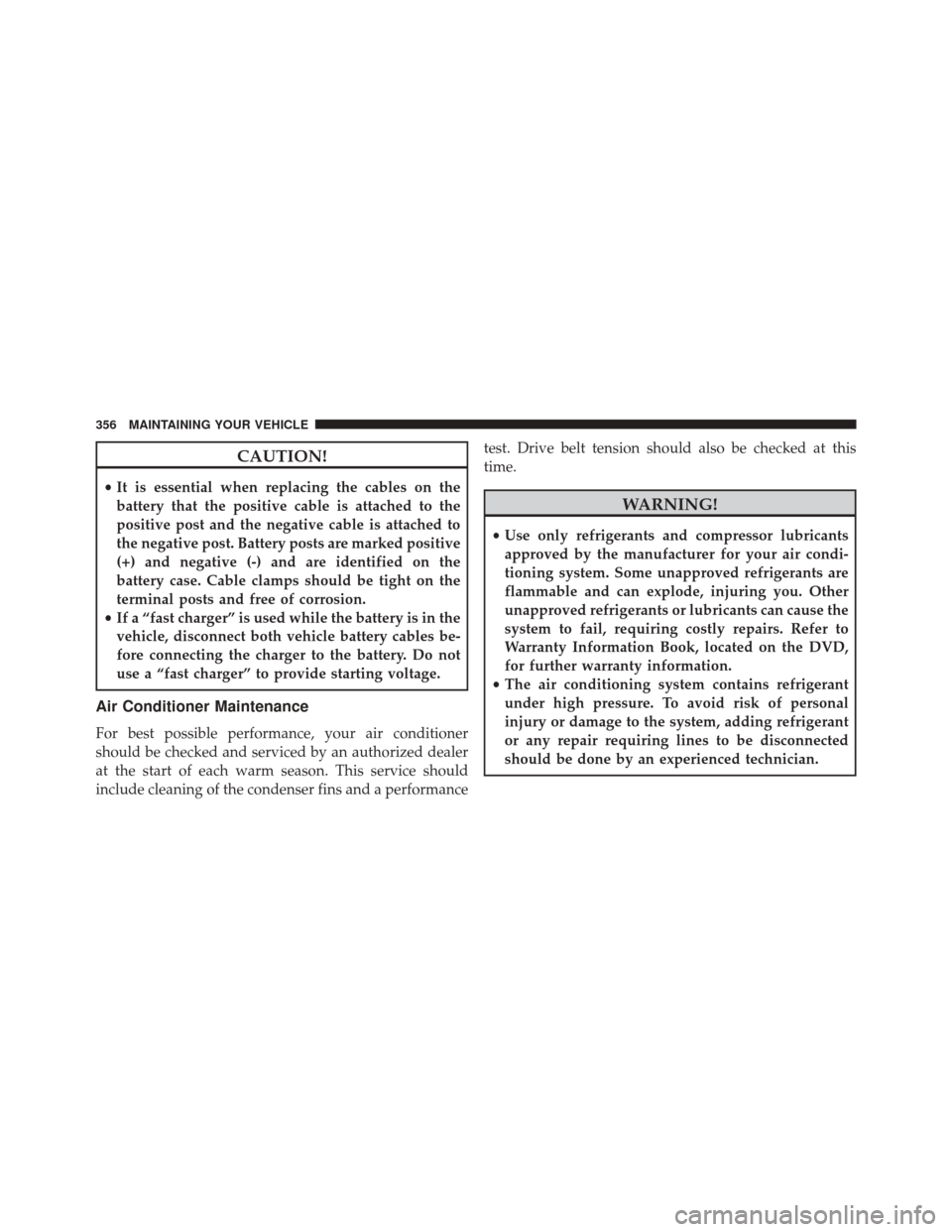
CAUTION!
•It is essential when replacing the cables on the
battery that the positive cable is attached to the
positive post and the negative cable is attached to
the negative post. Battery posts are marked positive
(+) and negative (-) and are identified on the
battery case. Cable clamps should be tight on the
terminal posts and free of corrosion.
• If a “fast charger” is used while the battery is in the
vehicle, disconnect both vehicle battery cables be-
fore connecting the charger to the battery. Do not
use a “fast charger” to provide starting voltage.
Air Conditioner Maintenance
For best possible performance, your air conditioner
should be checked and serviced by an authorized dealer
at the start of each warm season. This service should
include cleaning of the condenser fins and a performance test. Drive belt tension should also be checked at this
time.
WARNING!
•
Use only refrigerants and compressor lubricants
approved by the manufacturer for your air condi-
tioning system. Some unapproved refrigerants are
flammable and can explode, injuring you. Other
unapproved refrigerants or lubricants can cause the
system to fail, requiring costly repairs. Refer to
Warranty Information Book, located on the DVD,
for further warranty information.
• The air conditioning system contains refrigerant
under high pressure. To avoid risk of personal
injury or damage to the system, adding refrigerant
or any repair requiring lines to be disconnected
should be done by an experienced technician.
356 MAINTAINING YOUR VEHICLE
Page 359 of 438
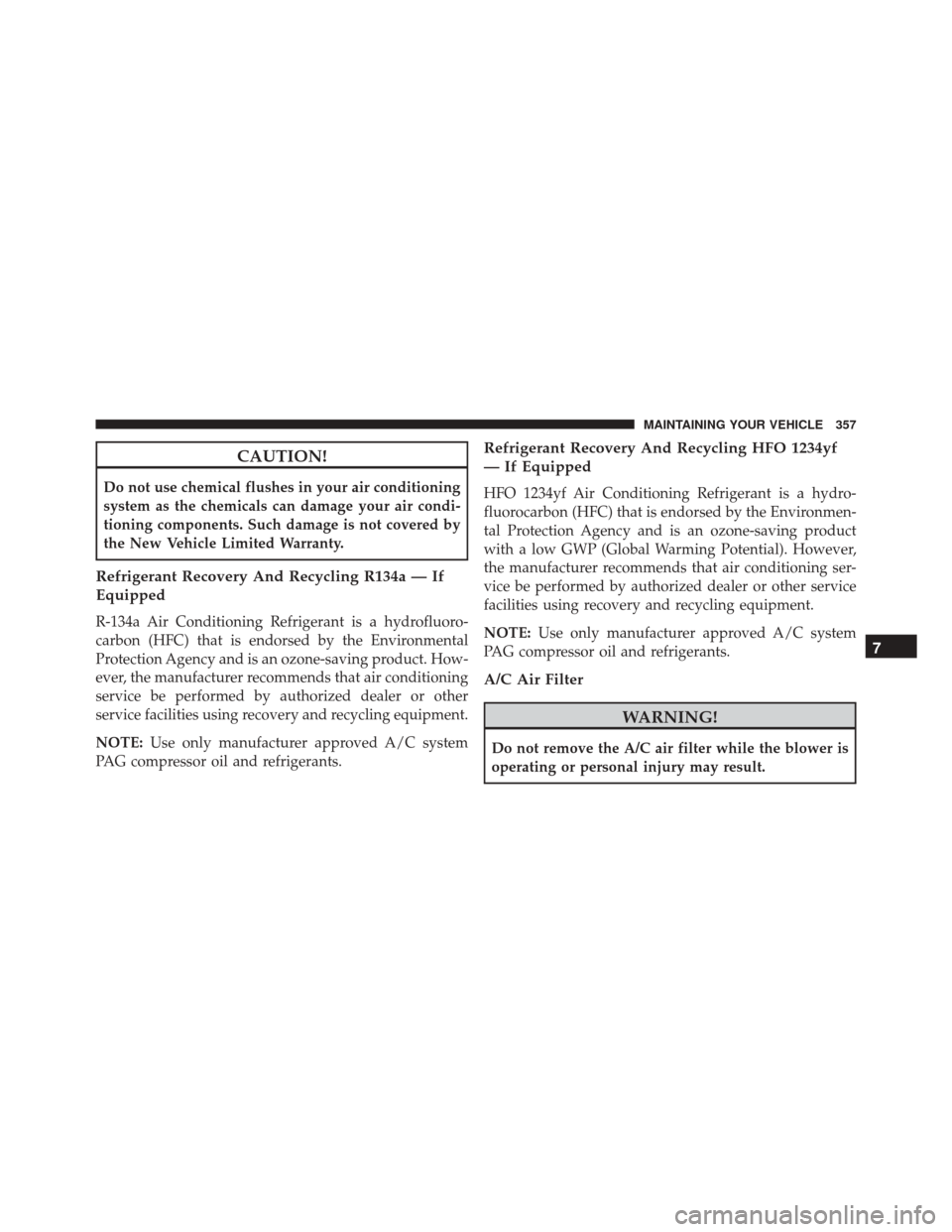
CAUTION!
Do not use chemical flushes in your air conditioning
system as the chemicals can damage your air condi-
tioning components. Such damage is not covered by
the New Vehicle Limited Warranty.
Refrigerant Recovery And Recycling R134a — If
Equipped
R-134a Air Conditioning Refrigerant is a hydrofluoro-
carbon (HFC) that is endorsed by the Environmental
Protection Agency and is an ozone-saving product. How-
ever, the manufacturer recommends that air conditioning
service be performed by authorized dealer or other
service facilities using recovery and recycling equipment.
NOTE:Use only manufacturer approved A/C system
PAG compressor oil and refrigerants.
Refrigerant Recovery And Recycling HFO 1234yf
— If Equipped
HFO 1234yf Air Conditioning Refrigerant is a hydro-
fluorocarbon (HFC) that is endorsed by the Environmen-
tal Protection Agency and is an ozone-saving product
with a low GWP (Global Warming Potential). However,
the manufacturer recommends that air conditioning ser-
vice be performed by authorized dealer or other service
facilities using recovery and recycling equipment.
NOTE: Use only manufacturer approved A/C system
PAG compressor oil and refrigerants.
A/C Air Filter
WARNING!
Do not remove the A/C air filter while the blower is
operating or personal injury may result.
7
MAINTAINING YOUR VEHICLE 357
Page 373 of 438
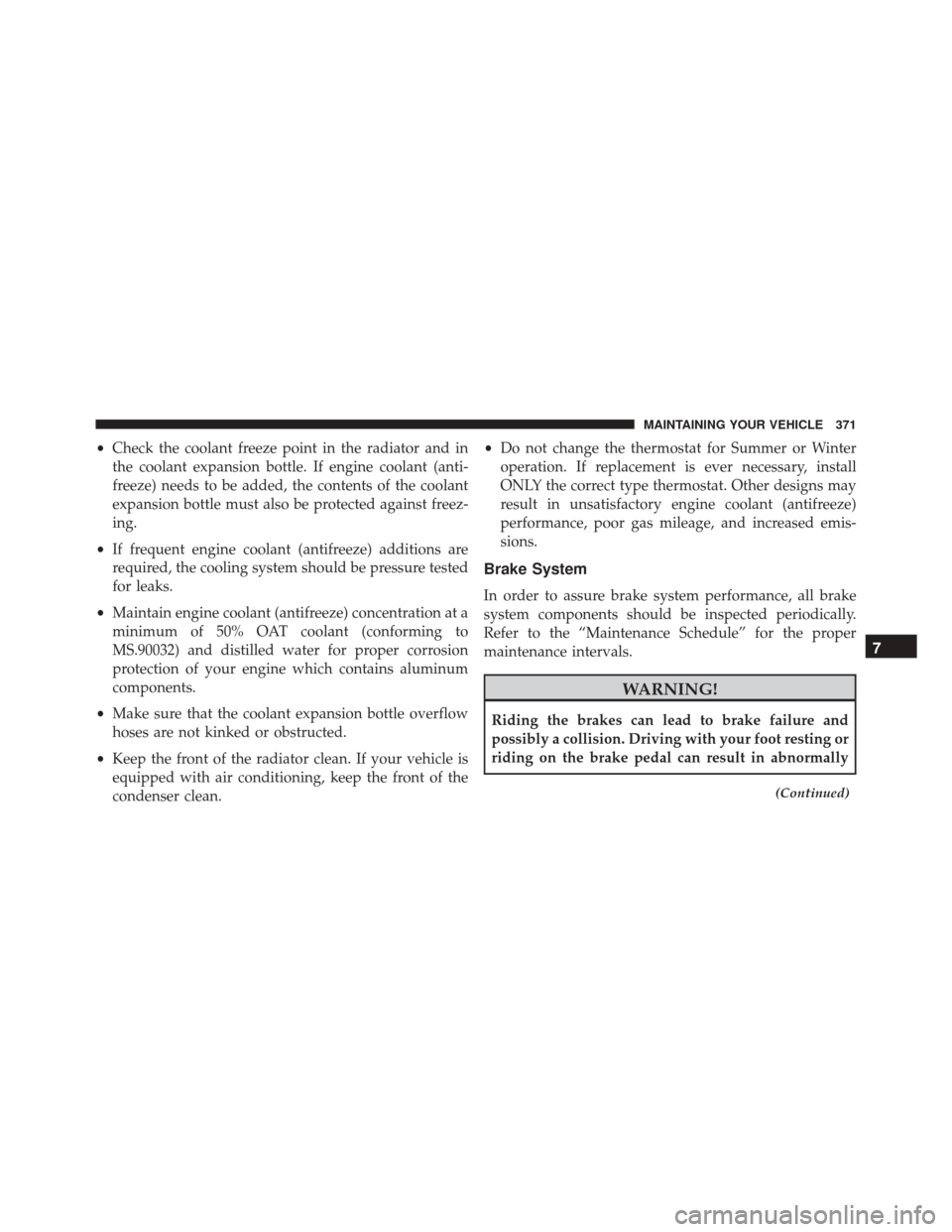
•Check the coolant freeze point in the radiator and in
the coolant expansion bottle. If engine coolant (anti-
freeze) needs to be added, the contents of the coolant
expansion bottle must also be protected against freez-
ing.
• If frequent engine coolant (antifreeze) additions are
required, the cooling system should be pressure tested
for leaks.
• Maintain engine coolant (antifreeze) concentration at a
minimum of 50% OAT coolant (conforming to
MS.90032) and distilled water for proper corrosion
protection of your engine which contains aluminum
components.
• Make sure that the coolant expansion bottle overflow
hoses are not kinked or obstructed.
• Keep the front of the radiator clean. If your vehicle is
equipped with air conditioning, keep the front of the
condenser clean. •
Do not change the thermostat for Summer or Winter
operation. If replacement is ever necessary, install
ONLY the correct type thermostat. Other designs may
result in unsatisfactory engine coolant (antifreeze)
performance, poor gas mileage, and increased emis-
sions.
Brake System
In order to assure brake system performance, all brake
system components should be inspected periodically.
Refer to the “Maintenance Schedule” for the proper
maintenance intervals.
WARNING!
Riding the brakes can lead to brake failure and
possibly a collision. Driving with your foot resting or
riding on the brake pedal can result in abnormally
(Continued)
7
MAINTAINING YOUR VEHICLE 371
Page 392 of 438
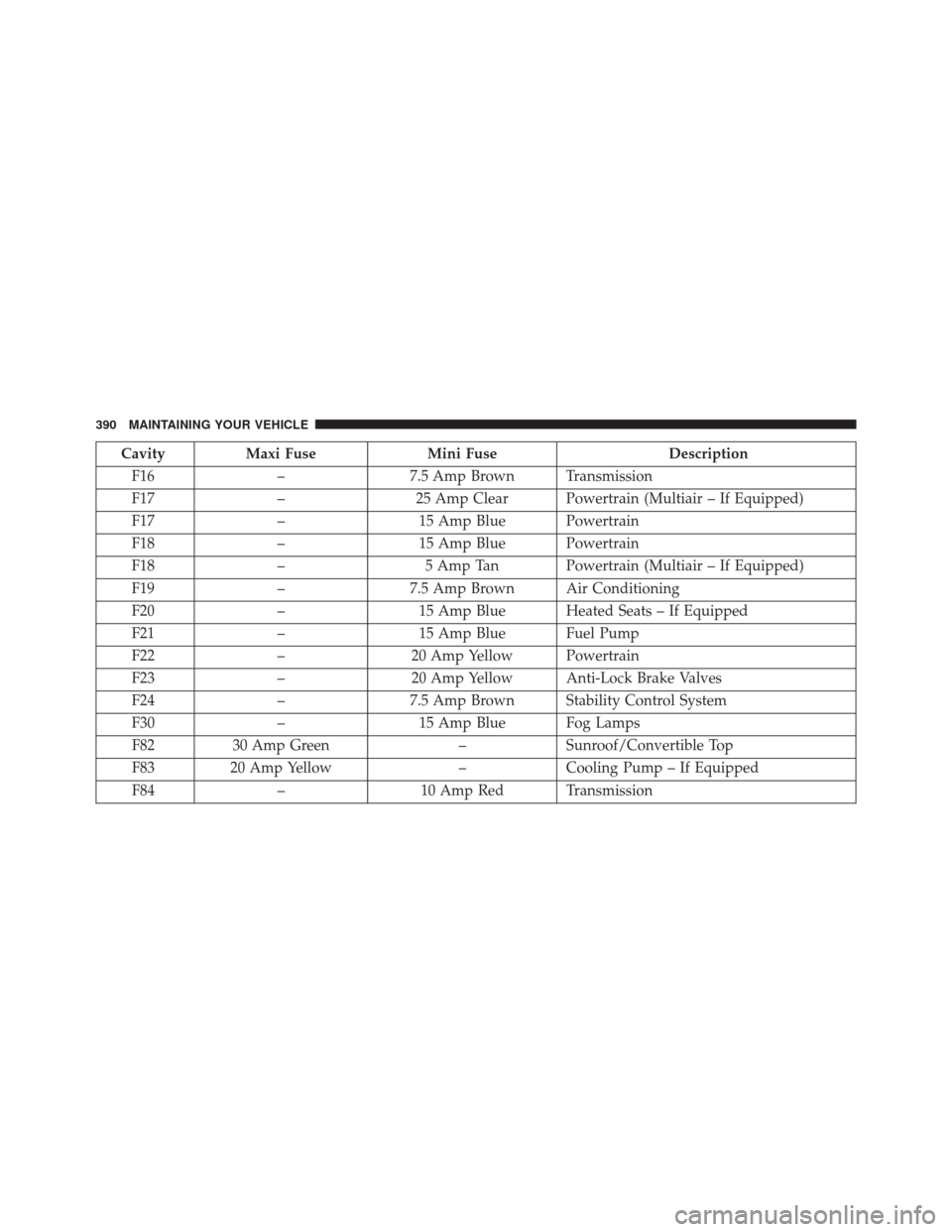
CavityMaxi Fuse Mini Fuse Description
F16 –7.5 Amp Brown Transmission
F17 –25 Amp Clear Powertrain (Multiair – If Equipped)
F17 –15 Amp Blue Powertrain
F18 –15 Amp Blue Powertrain
F18 – 5 Amp Tan Powertrain (Multiair – If Equipped)
F19 –7.5 Amp Brown Air Conditioning
F20 –15 Amp Blue Heated Seats – If Equipped
F21 –15 Amp Blue Fuel Pump
F22 –20 Amp Yellow Powertrain
F23 –20 Amp Yellow Anti-Lock Brake Valves
F24 –7.5 Amp Brown Stability Control System
F30 –15 Amp Blue Fog Lamps
F82 30 Amp Green –Sunroof/Convertible Top
F83 20 Amp Yellow –Cooling Pump – If Equipped
F84 –10 Amp Red Transmission
390 MAINTAINING YOUR VEHICLE
Page 393 of 438
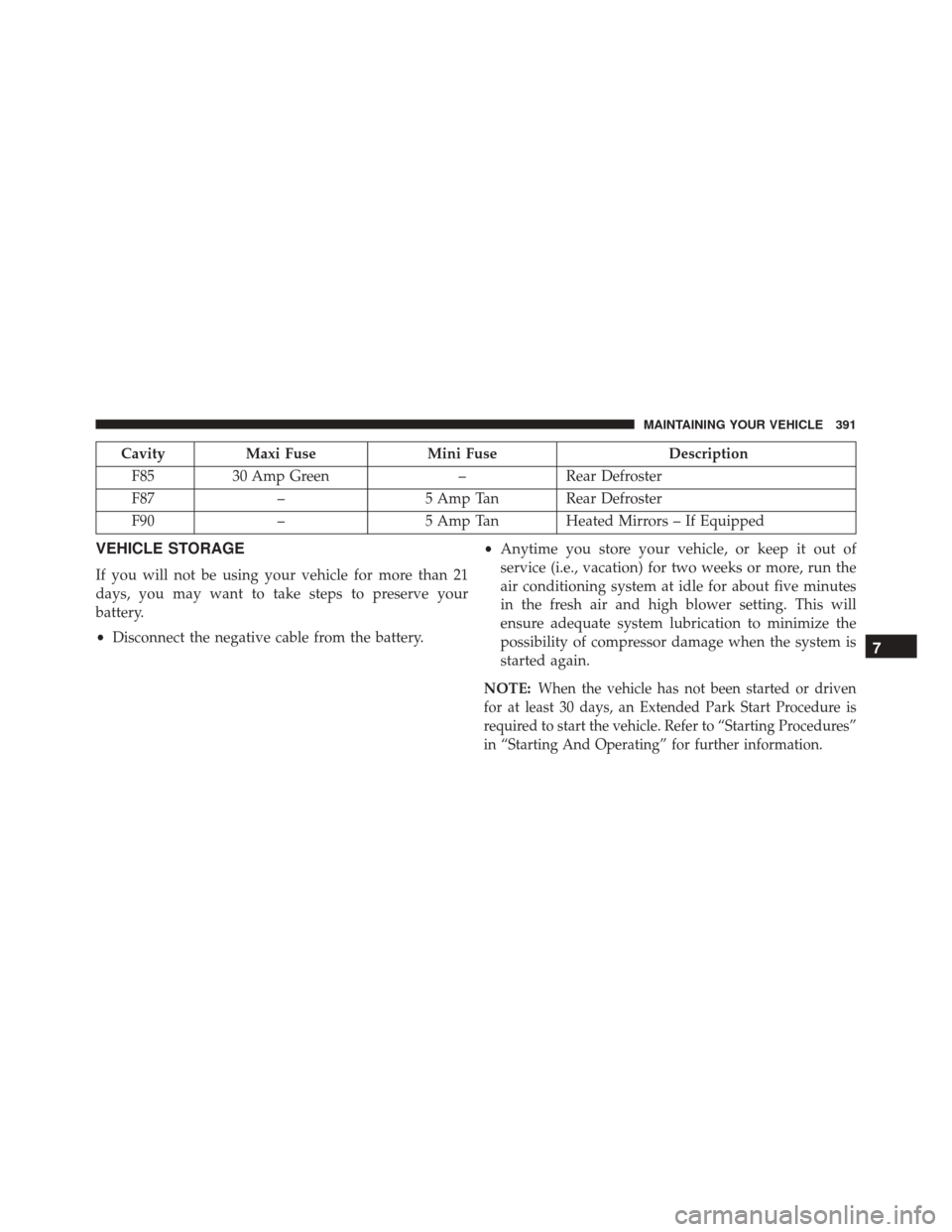
CavityMaxi Fuse Mini Fuse Description
F85 30 Amp Green –Rear Defroster
F87 – 5 Amp Tan Rear Defroster
F90 – 5 Amp Tan Heated Mirrors – If Equipped
VEHICLE STORAGE
If you will not be using your vehicle for more than 21
days, you may want to take steps to preserve your
battery.
•Disconnect the negative cable from the battery. •
Anytime you store your vehicle, or keep it out of
service (i.e., vacation) for two weeks or more, run the
air conditioning system at idle for about five minutes
in the fresh air and high blower setting. This will
ensure adequate system lubrication to minimize the
possibility of compressor damage when the system is
started again.
NOTE:
When the vehicle has not been started or driven
for at least 30 days, an Extended Park Start Procedure is
required to start the vehicle. Refer to “Starting Procedures”
in “Starting And Operating” for further information.
7
MAINTAINING YOUR VEHICLE 391
Page 422 of 438
Adding Engine Coolant (Antifreeze)............368
Adding Fuel ............................ .297
Adding Washer Fluid ..................... .363
Additives, Fuel .......................... .295
AirBag.................................39 Air Bag Operation .......................42
Air Bag Warning Light ....................51
Driver Knee Air Bag ......................43
Enhanced Accident Response ................49
Event Data Recorder (EDR) .................53
FrontAirBag...........................39
If A Deployment Occurs ...................48
Knee Impact Bolsters .....................43
Maintaining Your Air Bag System ............52
Air Bag Deployment ........................39
Air Bag Light ...................... .51, 76, 143
Air Bag Maintenance .......................52
Air Cleaner, Engine (Engine Air Cleaner Filter) . . . .354
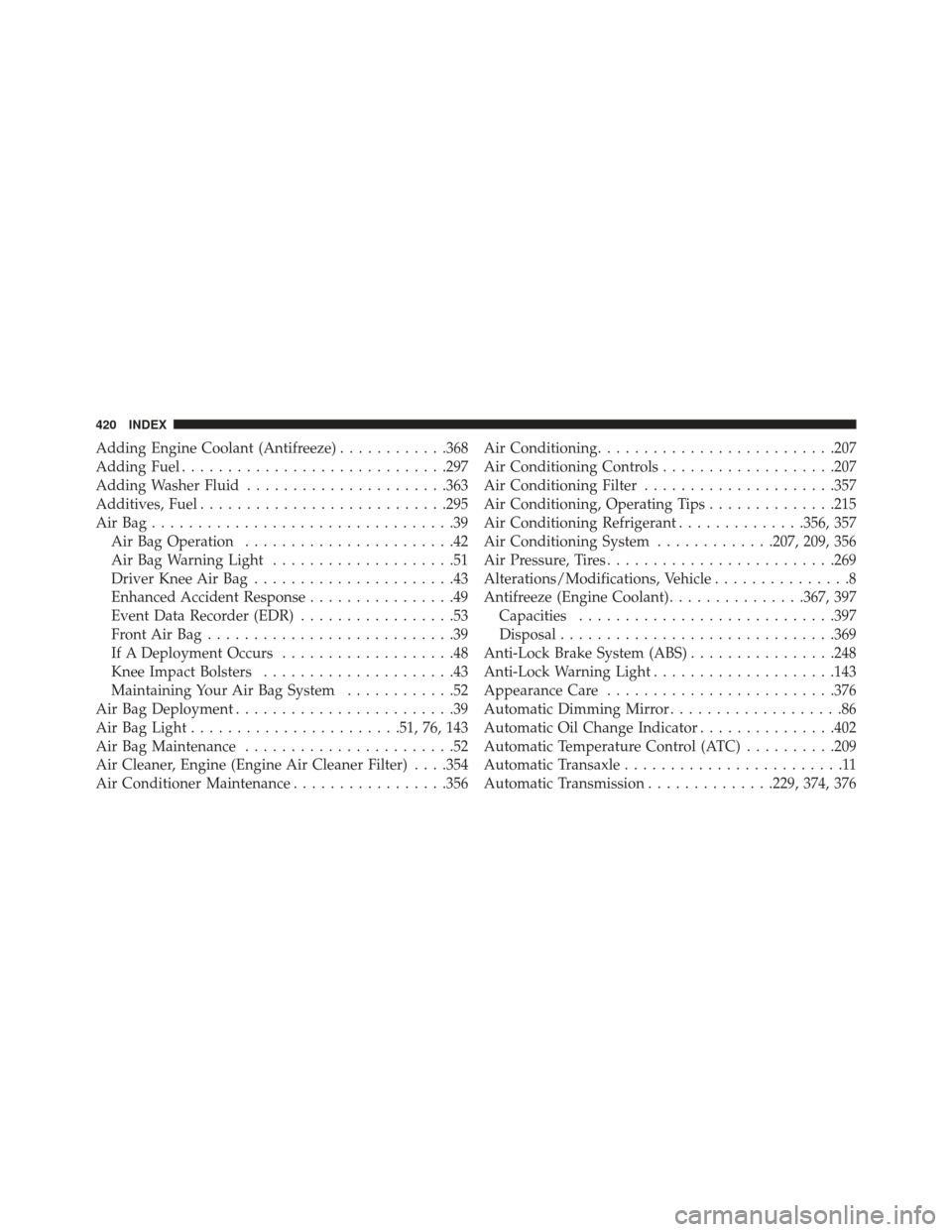
Air Conditioner Maintenance .................356Air Conditioning
......................... .207
Air Conditioning Controls ...................207
Air Conditioning Filter .....................357
Air Conditioning, Operating Tips ..............215
Air Conditioning Refrigerant ..............356, 357
Air Conditioning System .............207, 209, 356
Air Pressure, Tires ........................ .269
Alterations/Modifications, Vehicle ...............8
Antifreeze (Engine Coolant) ...............367, 397
Capacities ........................... .397
Disposal ............................. .369
Anti-Lock Brake System (ABS) ................248
Anti-Lock Warning Light ....................143
Appearance Care ........................ .376
Automatic Dimming Mirror ...................86
Automatic Oil Change Indicator ...............402
Automatic Temperature Control (ATC) ..........209
Automatic Transaxle ........................11
Automatic Transmission ..............229, 374, 376
420 INDEX
Page 426 of 438
NewTrip .............................162
Start Of Trip Procedure ...................162
Trip Computer ........................ .161
Trip Functions ........................ .163
Emergency, In Case Of Hazard Warning Flasher ..................303
Jacking .............................. .316
Jump Starting ......................... .329
Towing ............................. .337
Emission Control System Maintenance ..........347
Engine Air Cleaner .......................... .354
Break-In Recommendations .................73
Checking Oil Level ..................... .350
Compartment ...................... .345, 346
Cooling ............................. .366
Exhaust Gas Caution ..................75, 296
Fails To Start ......................... .225
Flooded, Starting ...................... .225Fuel Requirements
................292, 293, 398
Oil ............................. .350, 397
Oil Filler Cap ...................... .352, 353
Oil Selection ....................351, 352, 398
Oil Synthetic ......................... .353
Overheating .......................... .303
Starting ............................. .223
Enhanced Accident Response Feature .........49, 339
Euro Twin Clutch Transmission Fluid Type ........................... .374
Event Data Recorder ........................53
Exhaust Gas Caution ....................75, 296
Exhaust System ....................... .75, 363
Exterior Lights ........................ .78, 392
Filters Air Cleaner .......................... .354
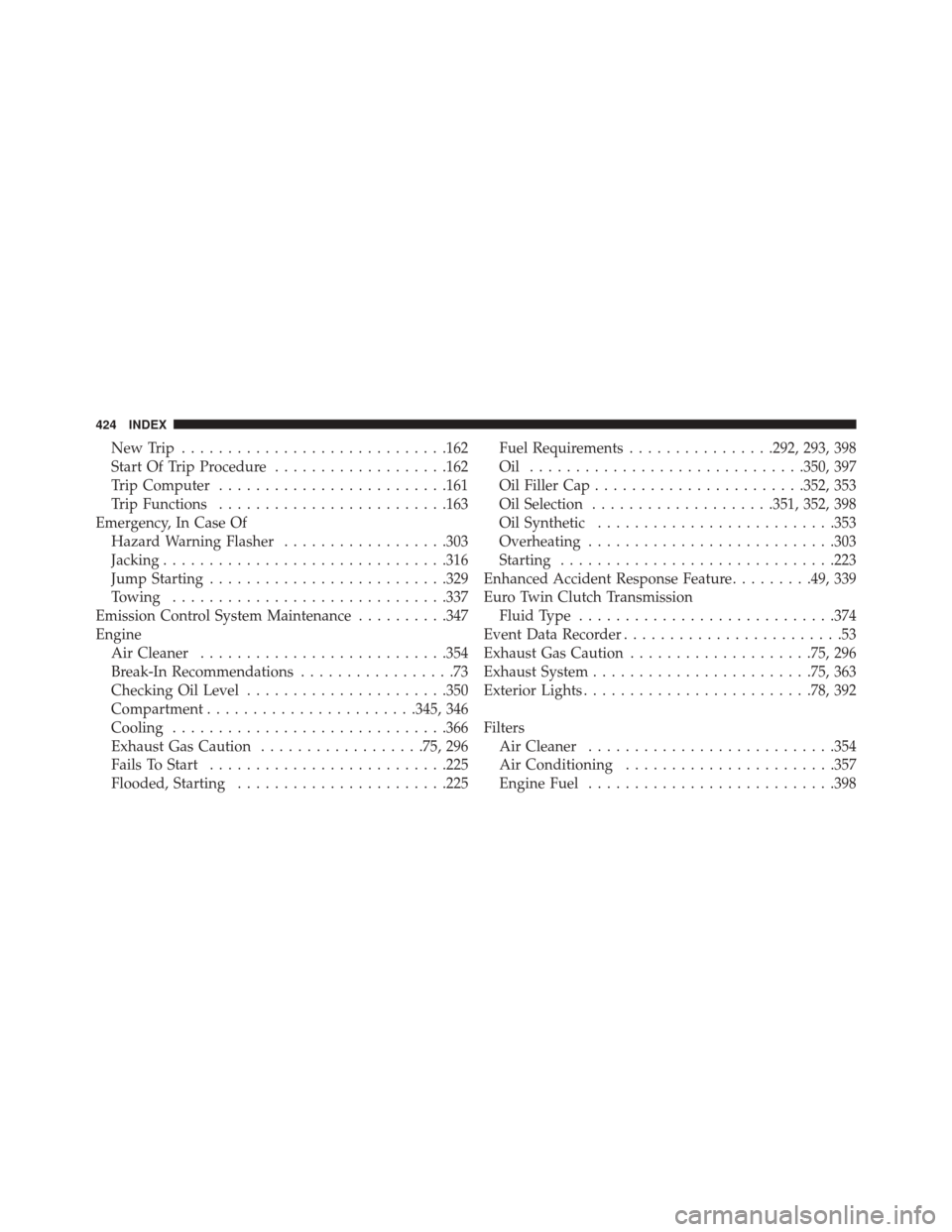
Air Conditioning ...................... .357
Engine Fuel .......................... .398
424 INDEX