cooling FIAT 500 2016 2.G User Guide
[x] Cancel search | Manufacturer: FIAT, Model Year: 2016, Model line: 500, Model: FIAT 500 2016 2.GPages: 442, PDF Size: 3.1 MB
Page 372 of 442
Cooling System
WARNING!
•When working near the radiator cooling fan, dis-
connect the fan motor lead or turn the ignition
switch to the OFF position. The fan is temperature
controlled and can start at any time the ignition
switch is in the ON position.
• You or others can be badly burned by hot engine
coolant (antifreeze) or steam from your radiator. If
you see or hear steam coming from under the hood,
do not open the hood until the radiator has had
time to cool. Never try to open a cooling system
pressure cap when the radiator is hot.
Coolant Checks
Check engine coolant (antifreeze) protection every 12
months (before the onset of freezing weather, where
applicable). If the engine coolant (antifreeze) is dirty or
rusty in appearance, the system should be drained,
flushed and refilled with fresh engine coolant (anti-
freeze). Check the front of the A/C condenser for any
accumulation of bugs, leaves, etc. If dirty, clean by gently
spraying water from a garden hose vertically down the
face of the condenser.
Cooling System — Drain, Flush And Refill
NOTE: Some vehicles require special tools to add coolant
properly. Failure to fill these systems properly could lead
to severe internal engine damage. If any coolant is
needed to be added to the system please contact your
local authorized dealer.
370 MAINTAINING YOUR VEHICLE
Page 373 of 442
If the engine coolant (antifreeze) is dirty or contains visible
sediment, have an authorized dealer clean and flush with
OAT coolant (antifreeze) (conforming to MS.90032).
Refer to the “Maintenance Schedule” for the proper
maintenance intervals.
Selection Of Coolant
Refer to “Fluids, Lubricants, And Genuine Parts” in
“Maintaining Your Vehicle” for further information.
CAUTION!
•Mixing of engine coolant (antifreeze) other than
specified Organic Additive Technology (OAT) en-
gine coolant (antifreeze), may result in engine
damage and may decrease corrosion protection.
Organic Additive Technology (OAT) engine cool-
ant is different and should not be mixed with
(Continued)
CAUTION! (Continued)
Hybrid Organic Additive Technology (HOAT) en-
gine coolant (antifreeze) or any “globally compat-
ible” coolant (antifreeze). If a non-OAT engine
coolant (antifreeze) is introduced into the cooling
system in an emergency, the cooling system will
need to be drained, flushed, and refilled with fresh
OAT coolant (conforming to MS.90032), by an au-
thorized dealer as soon as possible.
• Do not use water alone or alcohol-based engine
coolant (antifreeze) products. Do not use additional
rust inhibitors or antirust products, as they may not
be compatible with the engine coolant and may
plug the radiator.
• This vehicle has not been designed for use with
propylene glycol-based engine coolant (antifreeze).
Use of propylene glycol-based engine coolant (an-
tifreeze) is not recommended.
7
MAINTAINING YOUR VEHICLE 371
Page 374 of 442
Adding Coolant
Your vehicle has been built with an improved engine
coolant (OAT coolant conforming to MS.90032) that al-
lows extended maintenance intervals. This engine cool-
ant (antifreeze) can be used up to ten years or 150,000
miles (240,000 km) before replacement. To prevent reduc-
ing this extended maintenance period, it is important that
you use the same engine coolant (OAT coolant conform-
ing to MS.90032) throughout the life of your vehicle.
Please review these recommendations for using Organic
Additive Technology (OAT) engine coolant (antifreeze)
that meets the requirements of FCA Material Standard
MS.90032. When adding engine coolant (antifreeze):
•We recommend using MOPAR Antifreeze/Coolant 10
Year/150,000 Mile Formula OAT (Organic Additive
Technology) that meets the requirements of FCA Ma-
terial Standard MS.90032. •
Mix a minimum solution of 50% OAT engine coolant
that meets the requirements of FCA Material Standard
MS.90032 and distilled water. Use higher concentra-
tions (not to exceed 70%) if temperatures below 34°F
(37°C) are anticipated. Please contact your authorized
dealer for assistance.
• Use only high purity water such as distilled or deion-
ized water when mixing the water/engine coolant
(antifreeze) solution. The use of lower quality water
will reduce the amount of corrosion protection in the
engine cooling system.
NOTE:
• It is the owner’s responsibility to maintain the proper
level of protection against freezing according to the
temperatures occurring in the area where the vehicle is
operated.
372 MAINTAINING YOUR VEHICLE
Page 375 of 442
•Some vehicles require special tools to add coolant
properly. Failure to fill these systems properly could
lead to severe internal engine damage. If any coolant is
needed to be added to the system, please contact your
local authorized dealer.
• Mixing engine coolant (antifreeze) types is not recom-
mended and can result in cooling system damage. If
HOAT and OAT coolant are mixed in an emergency,
have a authorized dealer drain, flush, and refill with
OAT coolant (conforming to MS.90032) as soon as
possible.
Cooling System Pressure Cap
The cap must be fully tightened to prevent loss of engine
coolant (antifreeze) and to ensure that engine coolant
(antifreeze) will return to the radiator from the coolant
recovery tank. The cap should be inspected and cleaned if there is any
accumulation of foreign material on the sealing surfaces.
WARNING!
•
Do not open hot engine cooling system. Never add
engine coolant (antifreeze) when the engine is
overheated. Do not loosen or remove the cap to cool
an overheated engine. Heat causes pressure to
build up in the cooling system. To prevent scalding
or injury, do not remove the pressure cap while the
system is hot or under pressure.
• Do not use a pressure cap other than the one
specified for your vehicle. Personal injury or en-
gine damage may result.
7
MAINTAINING YOUR VEHICLE 373
Page 377 of 442
If an examination of your engine compartment shows no
evidence of radiator or hose leaks, the vehicle may be
safely driven. The vapor will soon dissipate.
•Do not overfill the coolant expansion bottle.
•
Check the coolant freeze point in the radiator and in the
coolant expansion bottle. If engine coolant (antifreeze)
needs to be added, the contents of the coolant expansion
bottle must also be protected against freezing.
• If frequent engine coolant (antifreeze) additions are
required, the cooling system should be pressure tested
for leaks. •
Maintain engine coolant (antifreeze) concentration at a
minimum of 50% OAT coolant (conforming to
MS.90032) and distilled water for proper corrosion
protection of your engine which contains aluminum
components.
• Make sure that the coolant expansion bottle overflow
hoses are not kinked or obstructed.
• Keep the front of the radiator clean. If your vehicle is
equipped with air conditioning, keep the front of the
condenser clean.
•
Do not change the thermostat for Summer or Winter
operation. If replacement is ever necessary, install ONLY
the correct type thermostat. Other designs may result in
unsatisfactory engine coolant (antifreeze) performance,
poor gas mileage, and increased emissions.7
MAINTAINING YOUR VEHICLE 375
Page 397 of 442
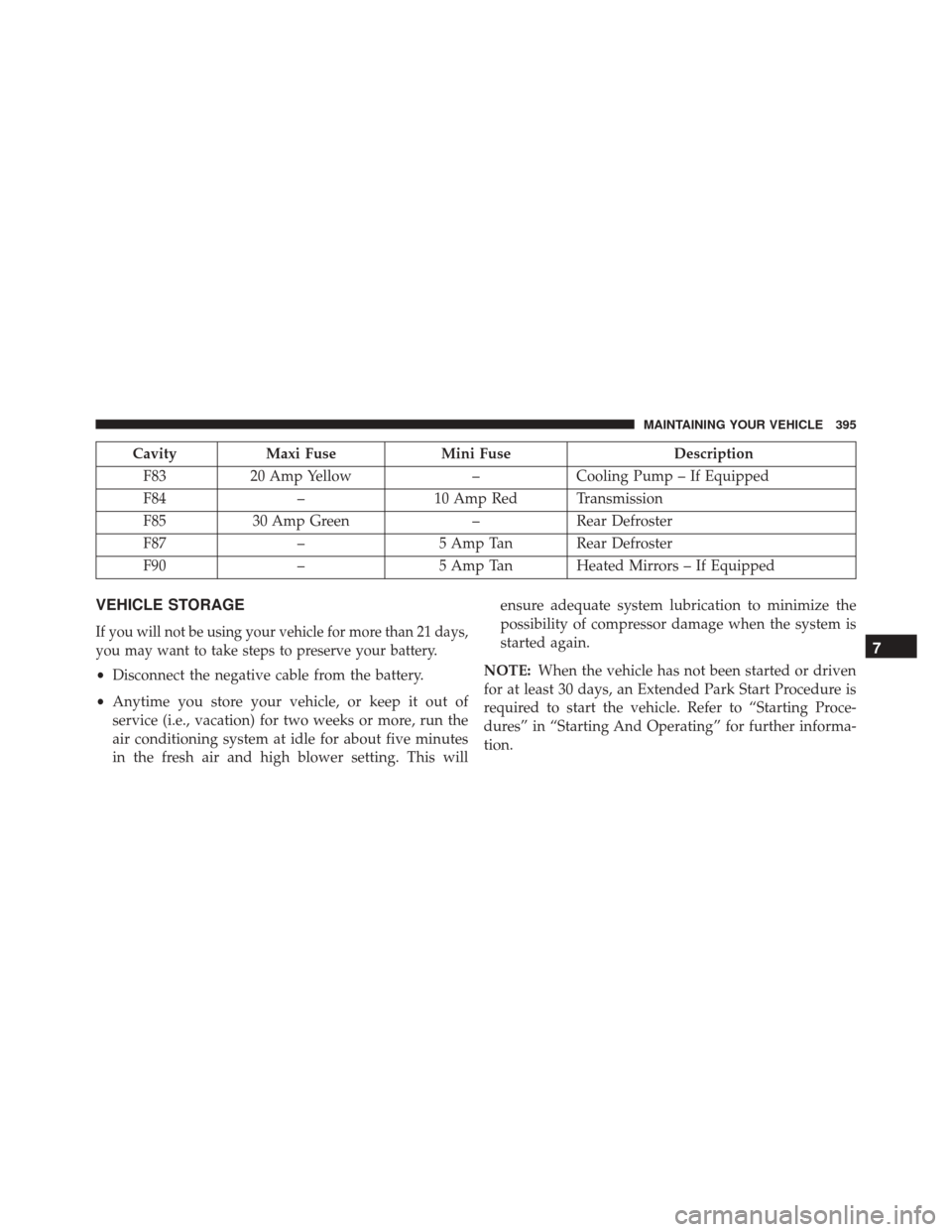
CavityMaxi Fuse Mini Fuse Description
F83 20 Amp Yellow –Cooling Pump – If Equipped
F84 –10 Amp Red Transmission
F85 30 Amp Green –Rear Defroster
F87 –5 Amp Tan Rear Defroster
F90 –5 Amp Tan Heated Mirrors – If Equipped
VEHICLE STORAGE
If you will not be using your vehicle for more than 21 days,
you may want to take steps to preserve your battery.
•Disconnect the negative cable from the battery.
• Anytime you store your vehicle, or keep it out of
service (i.e., vacation) for two weeks or more, run the
air conditioning system at idle for about five minutes
in the fresh air and high blower setting. This will ensure adequate system lubrication to minimize the
possibility of compressor damage when the system is
started again.
NOTE: When the vehicle has not been started or driven
for at least 30 days, an Extended Park Start Procedure is
required to start the vehicle. Refer to “Starting Proce-
dures” in “Starting And Operating” for further informa-
tion.
7
MAINTAINING YOUR VEHICLE 395
Page 402 of 442
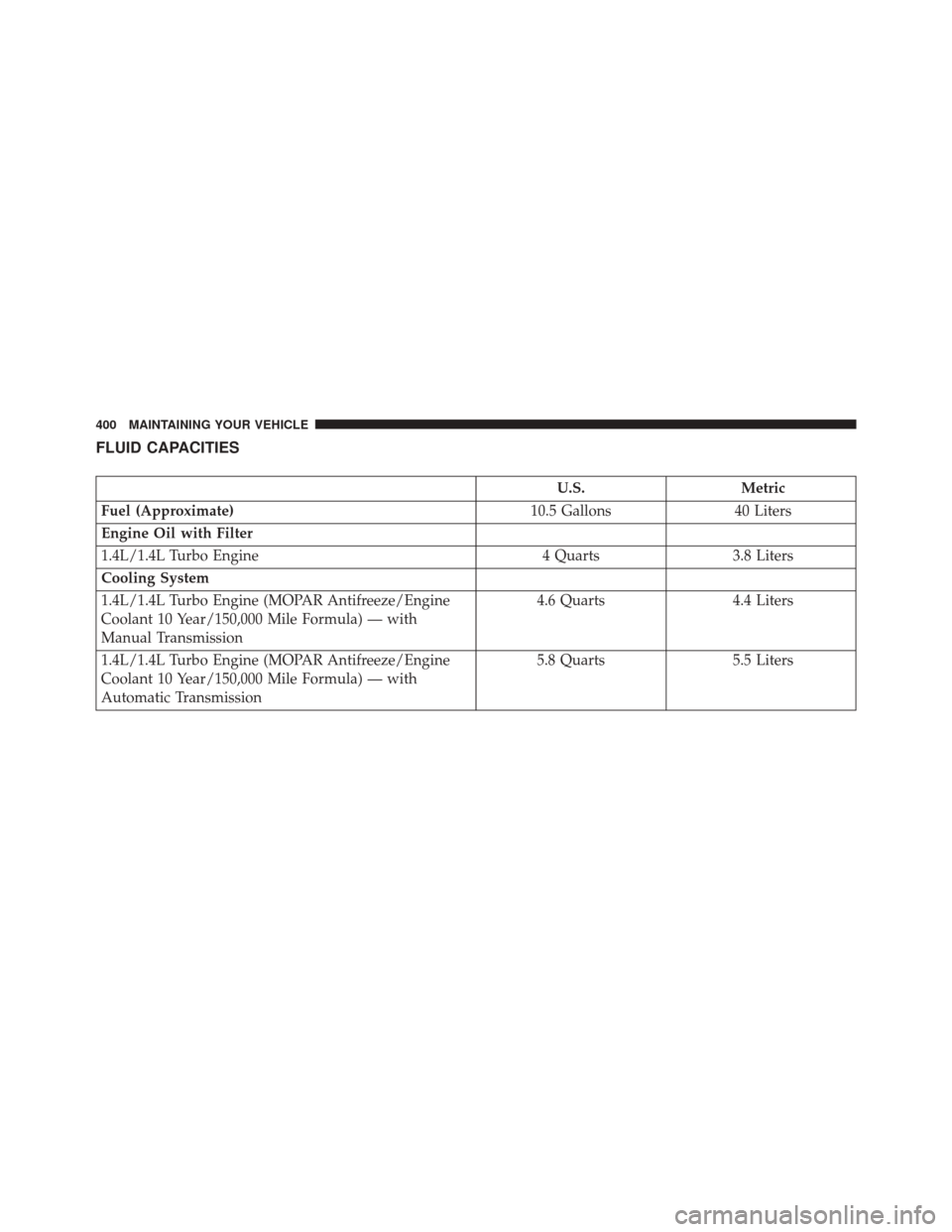
FLUID CAPACITIES
U.S.Metric
Fuel (Approximate) 10.5 Gallons40 Liters
Engine Oil with Filter
1.4L/1.4L Turbo Engine 4 Quarts3.8 Liters
Cooling System
1.4L/1.4L Turbo Engine (MOPAR Antifreeze/Engine
Coolant 10 Year/150,000 Mile Formula) — with
Manual Transmission 4.6 Quarts
4.4 Liters
1.4L/1.4L Turbo Engine (MOPAR Antifreeze/Engine
Coolant 10 Year/150,000 Mile Formula) — with
Automatic Transmission 5.8 Quarts
5.5 Liters
400 MAINTAINING YOUR VEHICLE
Page 404 of 442
CAUTION!
•Mixing of engine coolant (antifreeze) other than
specified Organic Additive Technology (OAT) en-
gine coolant (antifreeze), may result in engine
damage and may decrease corrosion protection.
Organic Additive Technology (OAT) engine cool-
ant is different and should not be mixed with
Hybrid Organic Additive Technology (HOAT) en-
gine coolant (antifreeze) or any “globally compat-
ible” coolant (antifreeze). If a non-OAT engine
coolant (antifreeze) is introduced into the cooling
system in an emergency, the cooling system will
(Continued)
CAUTION! (Continued)
need to be drained, flushed, and refilled with fresh
OAT coolant (conforming to MS.90032), by an au-
thorized dealer as soon as possible.
• Do not use water alone or alcohol-based engine
coolant (antifreeze) products. Do not use additional
rust inhibitors or antirust products, as they may not
be compatible with the radiator engine coolant and
may plug the radiator.
• This vehicle has not been designed for use with
propylene glycol-based engine coolant (antifreeze).
Use of propylene glycol-based engine coolant (an-
tifreeze) is not recommended.
402 MAINTAINING YOUR VEHICLE
Page 409 of 442
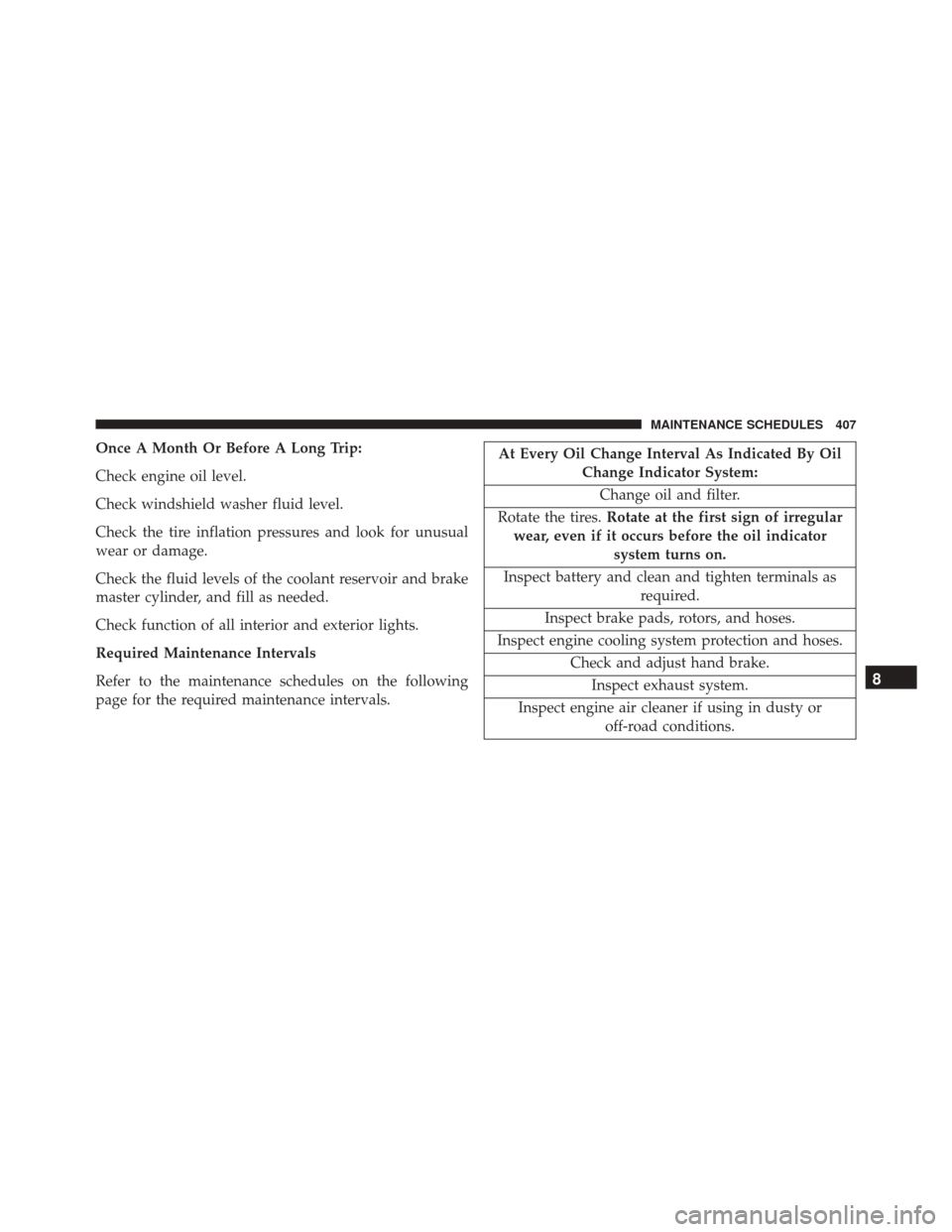
Once A Month Or Before A Long Trip:
Check engine oil level.
Check windshield washer fluid level.
Check the tire inflation pressures and look for unusual
wear or damage.
Check the fluid levels of the coolant reservoir and brake
master cylinder, and fill as needed.
Check function of all interior and exterior lights.
Required Maintenance Intervals
Refer to the maintenance schedules on the following
page for the required maintenance intervals.At Every Oil Change Interval As Indicated By OilChange Indicator System:
Change oil and filter.
Rotate the tires. Rotate at the first sign of irregular
wear, even if it occurs before the oil indicator system turns on.
Inspect battery and clean and tighten terminals as required.
Inspect brake pads, rotors, and hoses.
Inspect engine cooling system protection and hoses. Check and adjust hand brake.Inspect exhaust system.
Inspect engine air cleaner if using in dusty or off-road conditions.
8
MAINTENANCE SCHEDULES 407
Page 429 of 442
Contract, Service......................... .417
Convertible Top Maintenance .................387
Coolant (Antifreeze) ....................400, 401
Cooling System .......................... .370
Adding Coolant (Antifreeze) ...............372
Coolant Capacity ...................... .401
Coolant Level ..................... .370, 374
Disposal Of Used Coolant .................374
Drain, Flush, And Refill ...................370
Inspection ........................... .374
Points To Remember ..................373, 374
Pressure Cap ......................... .373
Selection Of Coolant (Antifreeze) ............371
Corrosion Protection ...................... .380
Cruise Light ......................... .172, 174
Cupholders ............................ .129
Customer Assistance ...................... .415
Customer Programmable Features .............193Data Recorder, Event
.......................55
Daytime Running Lights ....................105
Dealer Service ........................... .352
Defroster, Windshield ....................78, 211
Diagnostic System, Onboard .................349
Dipsticks Automatic Transmission ..................379
Disarming, Security System ...................15
Disposal Antifreeze (Engine Coolant) ................374
Door Ajar .......................... .157, 158
Door Ajar Light ...................... .157, 158
Door Locks ..............................21
Door Locks, Automatic ......................23
Downshifting ........................... .231
Driving Through Flowing, Rising, Or Shallow Standing
Water ............................... .243
10
INDEX 427