instrument panel FIAT 500 2019 Owner handbook (in English)
[x] Cancel search | Manufacturer: FIAT, Model Year: 2019, Model line: 500, Model: FIAT 500 2019Pages: 228, PDF Size: 6.01 MB
Page 61 of 228
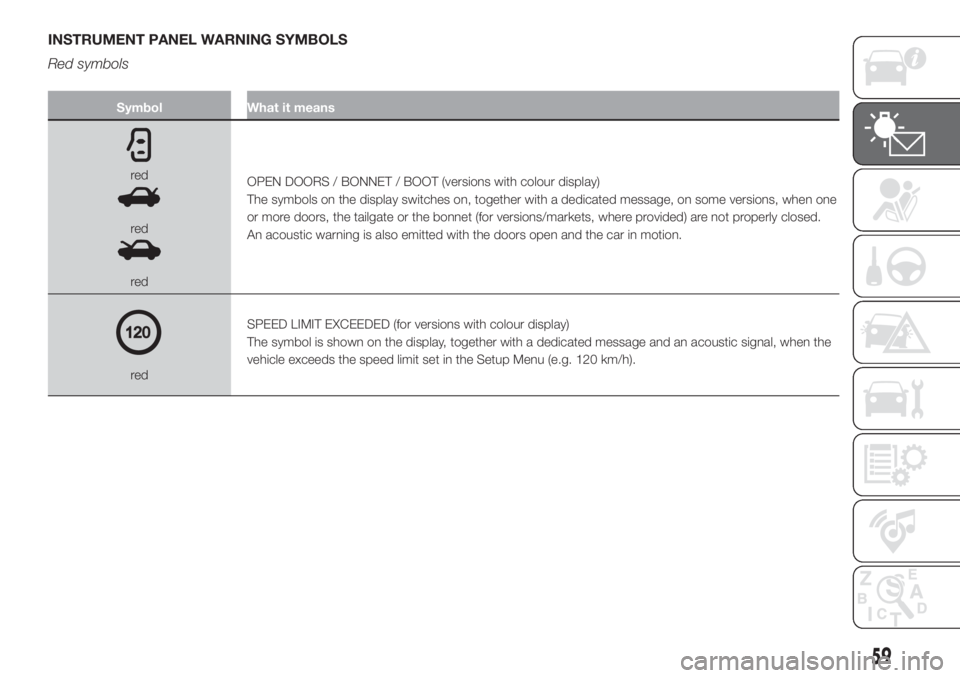
INSTRUMENT PANEL WARNING SYMBOLS
Red symbols
Symbol What it means
red
red
redOPEN DOORS / BONNET / BOOT (versions with colour display)
The symbols on the display switches on, together with a dedicated message, on some versions, when one
or more doors, the tailgate or the bonnet (for versions/markets, where provided) are not properly closed.
An acoustic warning is also emitted with the doors open and the car in motion.
redSPEED LIMIT EXCEEDED (for versions with colour display)
The symbol is shown on the display, together with a dedicated message and an acoustic signal, when the
vehicle exceeds the speed limit set in the Setup Menu (e.g. 120 km/h).
59
Page 62 of 228
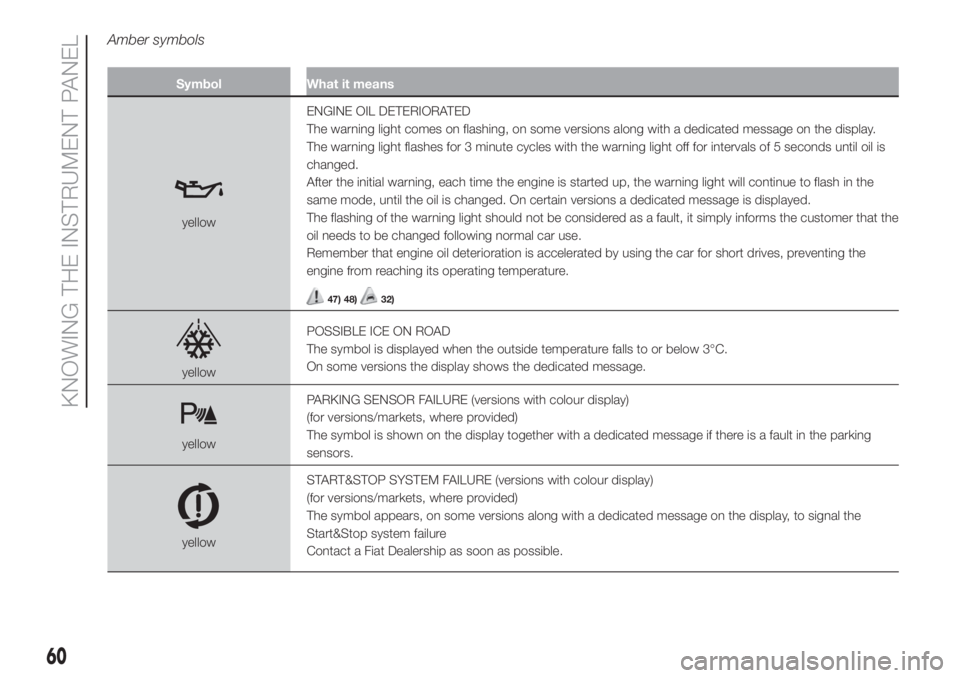
Amber symbols
Symbol What it means
yellowENGINE OIL DETERIORATED
The warning light comes on flashing, on some versions along with a dedicated message on the display.
The warning light flashes for 3 minute cycles with the warning light off for intervals of 5 seconds until oil is
changed.
After the initial warning, each time the engine is started up, the warning light will continue to flash in the
same mode, until the oil is changed. On certain versions a dedicated message is displayed.
The flashing of the warning light should not be considered as a fault, it simply informs the customer that the
oil needs to be changed following normal car use.
Remember that engine oil deterioration is accelerated by using the car for short drives, preventing the
engine from reaching its operating temperature.
47) 48)32)
yellowPOSSIBLE ICE ON ROAD
The symbol is displayed when the outside temperature falls to or below 3°C.
On some versions the display shows the dedicated message.
yellowPARKING SENSOR FAILURE (versions with colour display)
(for versions/markets, where provided)
The symbol is shown on the display together with a dedicated message if there is a fault in the parking
sensors.
yellowSTART&STOP SYSTEM FAILURE (versions with colour display)
(for versions/markets, where provided)
The symbol appears, on some versions along with a dedicated message on the display, to signal the
Start&Stop system failure
Contact a Fiat Dealership as soon as possible.
60
KNOWING THE INSTRUMENT PANEL
Page 64 of 228
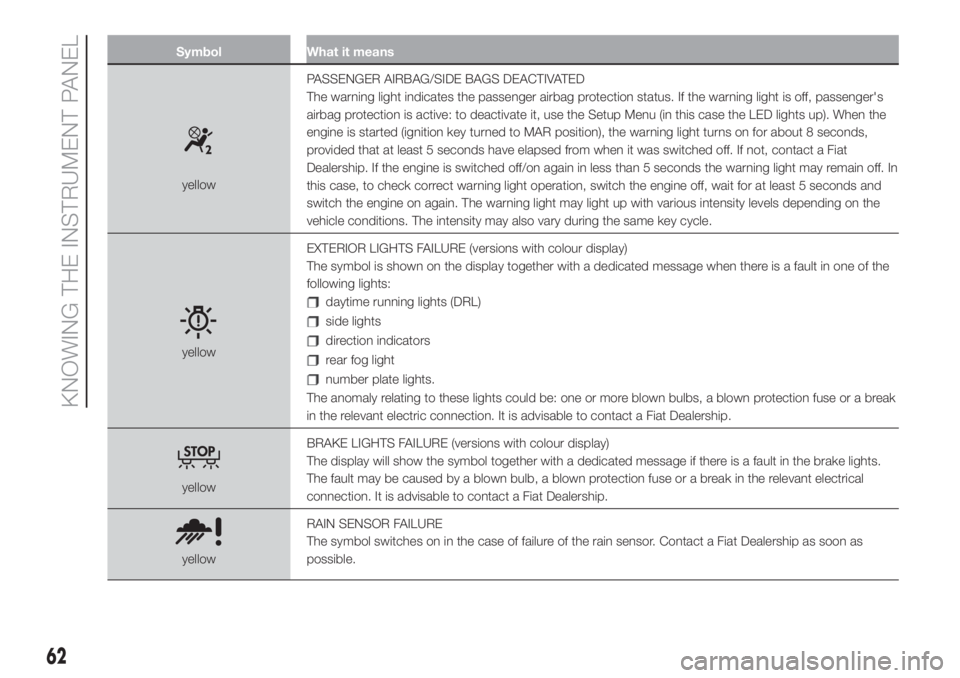
Symbol What it means
yellowPASSENGER AIRBAG/SIDE BAGS DEACTIVATED
The warning light indicates the passenger airbag protection status. If the warning light is off, passenger's
airbag protection is active: to deactivate it, use the Setup Menu (in this case the LED lights up). When the
engine is started (ignition key turned to MAR position), the warning light turns on for about 8 seconds,
provided that at least 5 seconds have elapsed from when it was switched off. If not, contact a Fiat
Dealership. If the engine is switched off/on again in less than 5 seconds the warning light may remain off. In
this case, to check correct warning light operation, switch the engine off, wait for at least 5 seconds and
switch the engine on again. The warning light may light up with various intensity levels depending on the
vehicle conditions. The intensity may also vary during the same key cycle.
yellowEXTERIOR LIGHTS FAILURE (versions with colour display)
The symbol is shown on the display together with a dedicated message when there is a fault in one of the
following lights:
daytime running lights (DRL)
side lights
direction indicators
rear fog light
number plate lights.
The anomaly relating to these lights could be: one or more blown bulbs, a blown protection fuse or a break
in the relevant electric connection. It is advisable to contact a Fiat Dealership.
yellowBRAKE LIGHTS FAILURE (versions with colour display)
The display will show the symbol together with a dedicated message if there is a fault in the brake lights.
The fault may be caused by a blown bulb, a blown protection fuse or a break in the relevant electrical
connection. It is advisable to contact a Fiat Dealership.
yellowRAIN SENSOR FAILURE
The symbol switches on in the case of failure of the rain sensor. Contact a Fiat Dealership as soon as
possible.
62
KNOWING THE INSTRUMENT PANEL
Page 66 of 228

WARNING
32)To avoid damaging the engine it is advisable to change the engine oil when thewarning light flashes. In this case, contact a Fiat
Dealership.
64
KNOWING THE INSTRUMENT PANEL
Page 67 of 228
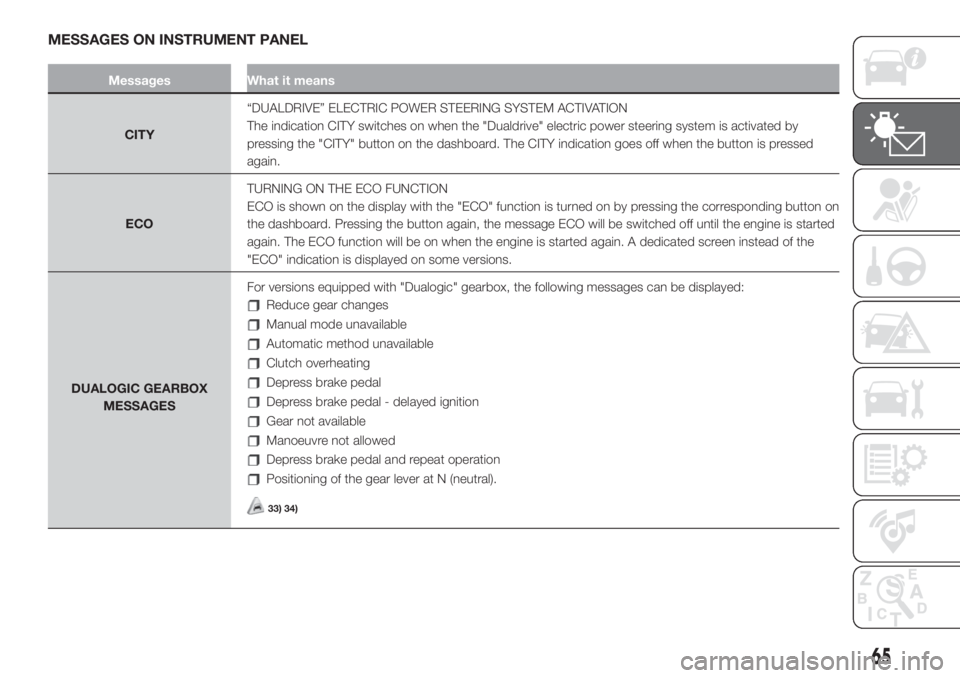
MESSAGES ON INSTRUMENT PANEL
Messages What it means
CITY“DUALDRIVE” ELECTRIC POWER STEERING SYSTEM ACTIVATION
The indication CITY switches on when the "Dualdrive" electric power steering system is activated by
pressing the "CITY" button on the dashboard. The CITY indication goes off when the button is pressed
again.
ECOTURNING ON THE ECO FUNCTION
ECO is shown on the display with the "ECO" function is turned on by pressing the corresponding button on
the dashboard. Pressing the button again, the message ECO will be switched off until the engine is started
again. The ECO function will be on when the engine is started again. A dedicated screen instead of the
"ECO" indication is displayed on some versions.
DUALOGIC GEARBOX
MESSAGESFor versions equipped with "Dualogic" gearbox, the following messages can be displayed:
Reduce gear changes
Manual mode unavailable
Automatic method unavailable
Clutch overheating
Depress brake pedal
Depress brake pedal - delayed ignition
Gear not available
Manoeuvre not allowed
Depress brake pedal and repeat operation
Positioning of the gear lever at N (neutral).
33) 34)
65
Page 68 of 228

WARNING
33)If the messages continue to be shown in the display, contact a Fiat Dealership.
34)In order to safeguard the efficiency of the clutch, do not use the accelerator to keep the car stationary (e.g. when stopped on an incline); if
the clutch overheats it could damage it; use the brake pedal instead and only use the accelerator pedal when you decide to set off.
66
KNOWING THE INSTRUMENT PANEL
Page 70 of 228
ACTIVE SAFETY
SYSTEMS
The vehicle has the following active
safety systems:
ABS (Anti-lock Braking System);
EBD (Electronic Brake force
Distribution);
MSR (Motor Schleppmoment
Regelung);
ESC (Electronic Stability Control);
HH (Hill Holder);
ASR (Antislip Regulation);
HBA (Hydraulic Brake Assist);
For the operation of the systems, see
the following description.
ABS (Anti-lock Braking
System)
This system, which is an integral part of
the braking system, prevents one or
more wheels from locking and slipping
in any road surface condition,
irrespective of the intensity of the
braking action, ensuring that the car
can be controlled even during
emergency braking thus optimising
stopping distances.
The system intervenes during braking
when the wheels are about to lock,
typically in emergency braking or
low-grip conditions, when locking may
be more frequent.The system also improves control and
stability of the car when braking on a
surface where the grip of the left and
right wheels varies, or on corners.
System intervention
A slight pulsing of the brake pedal and
noise indicates the intervention of the
ABS: this is completely normal when
the system intervenes.
49) 50) 51) 52) 53) 54) 55) 56) 57)
EBD (Electronic
Brakeforce Distribution)
SYSTEM
This system (which cannot be
deactivated) recognises emergency
braking conditions according to the
speed of operation of the brake pedal
and provides an additional hydraulic
braking pressure to support that
provided by the driver. This allows
faster and more powerful operation of
the braking system.MSR (Motor
Schleppmoment
Regelung) SYSTEM
The MSR system is an integral part of
the ABS, that intervenes, if there is a
sudden change to a lower gear,
restoring torque to the engine, thereby
preventing excessive drive at the drive
wheels which, especially in poor grip
conditions, could lead to a loss in
stability of the vehicle.
ESC (Electronic Stability
Control) SYSTEM
This is an electronic system that
controls vehicle stability in the event of
tyre grip loss, helping maintain
directional control.
The system is capable of recognising
potentially dangerous situations in
terms of the stability and intervenes
automatically on the brakes in a
differentiated manner for the four
wheels in order to provide a stabilising
torque.
The ESC system switches on
automatically when the engine is
started and cannot be switched off.
System intervention
This is indicated by the flashing of the
warning light
on the instrument
panel, to inform the driver that the car is
in critical stability and grip conditions.
68
SAFETY
Page 71 of 228
58) 59) 60) 61) 62) 63)
HH (Hill Holder) SYSTEM
This is an integral part of the ESC
system and facilitates starting on
slopes, activating automatically in the
following cases:
uphill: car stationary on a road with
a gradient higher than 5%, engine
running, brake pressed and gearbox in
neutral or gear (other than reverse)
engaged;
downhill: car stationary on a road
with a gradient higher than 5%, engine
running, brake pressed and reverse
gear engaged.
When setting off, the ESC system
control unit maintains the braking
pressure on the wheels until the engine
torque necessary for starting is
reached, or in any case for a maximum
of 2 seconds, allowing your right foot
to be moved easily from the brake
pedal to the accelerator.
When the 2 seconds have elapsed,
without starting, the system is
automatically deactivated, gradually
releasing the braking pressure.
During this release stage, the typical
mechanical brake release noise can be
heard, indicating that the car is about
to move.Moving the car on sloping roads
For optimal starting on very steep
gradients, as follows:
Press the brake pedal to activate the
Hill Holder;
completely press the clutch pedal;
engage the gear;
remove your foot from the brake
pedal;
completely press the accelerator
pedal.
In this manner, the engine goes to the
optimal rpm for taking off uphill. The Hill
Holder remains engaged (car braked)
until the clutch is gradually released
(holding the accelerator pedal pressed):
at this point, the system switches off
and the car starts moving. The Hill
Holder function switches off
automatically if the cars does not
take-off within 2 seconds.
The manoeuvre makes it possible to
avoid pressing the accelerator (because
it must remain fully pressed during the
manoeuvre) and to operate only the
clutch, by gradually releasing it.
Operating the handbrake is not
necessary.
On less steep gradients, the system is
active also with the accelerator pedal
not completely pressed.
64) 65)
ASR (AntiSlip
Regulation) SYSTEM
This is an integral part of the ESC
system and automatically operates in
the event of one or both drive wheels
slipping, loss of grip on wet roads
(aquaplaning) and acceleration
on slippery, snowy or icy roads, etc.
Depending on the slipping conditions,
two different control systems are
activated:
if the slipping involves both drive
wheels, the ASR system intervenes,
reducing the power transmitted by the
engine;
if the slipping only involves one of
the drive wheels, it also intervenes
automatically, braking the wheel that is
slipping.
System intervention
This is indicated by the flashing of the
warning light on the instrument panel,
to inform the driver that the car is in
critical stability and grip conditions.
69
Page 74 of 228
DRIVING
ASSISTANCE
SYSTEMS
iTPMS System (indirect
Tyre Pressure
Monitoring System)
77) 78) 79) 80) 81) 82)
DESCRIPTION
The vehicle can be equipped with the
iTPMS (indirect Tyre Pressure
Monitoring System) which monitors the
tyre inflation status thanks to wheel
speed sensors.
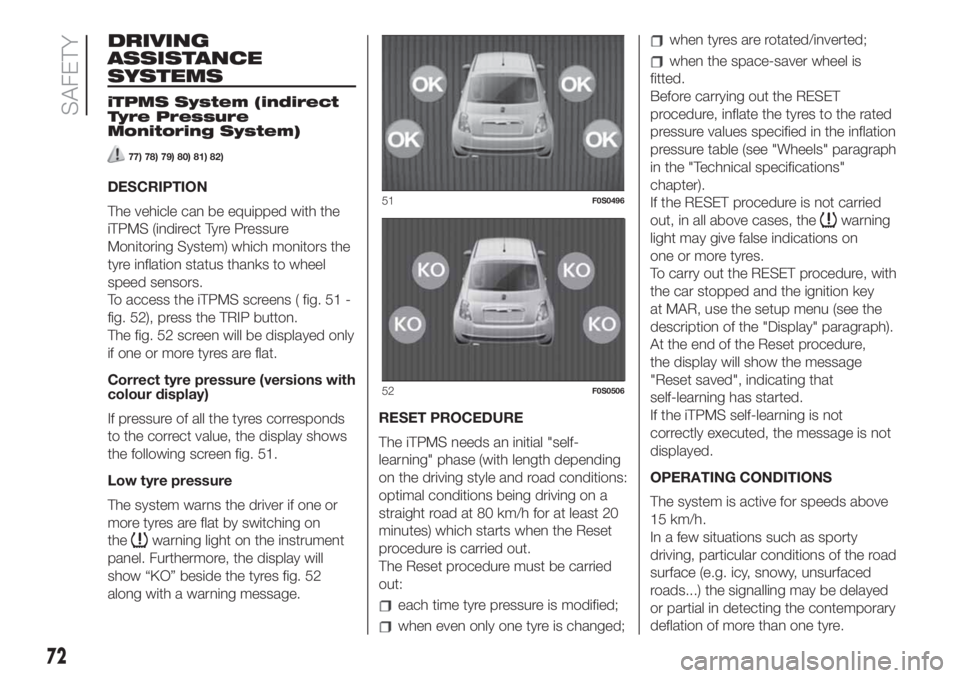
To access the iTPMS screens ( fig. 51 -
fig. 52), press the TRIP button.
The fig. 52 screen will be displayed only
if one or more tyres are flat.
Correct tyre pressure (versions with
colour display)
If pressure of all the tyres corresponds
to the correct value, the display shows
the following screen fig. 51.
Low tyre pressure
The system warns the driver if one or
more tyres are flat by switching on
the
warning light on the instrument
panel. Furthermore, the display will
show “KO” beside the tyres fig. 52
along with a warning message.RESET PROCEDURE
The iTPMS needs an initial "self-
learning" phase (with length depending
on the driving style and road conditions:
optimal conditions being driving on a
straight road at 80 km/h for at least 20
minutes) which starts when the Reset
procedure is carried out.
The Reset procedure must be carried
out:
each time tyre pressure is modified;
when even only one tyre is changed;
when tyres are rotated/inverted;
when the space-saver wheel is
fitted.
Before carrying out the RESET
procedure, inflate the tyres to the rated
pressure values specified in the inflation
pressure table (see "Wheels" paragraph
in the "Technical specifications"
chapter).
If the RESET procedure is not carried
out, in all above cases, the
warning
light may give false indications on
one or more tyres.
To carry out the RESET procedure, with
the car stopped and the ignition key
at MAR, use the setup menu (see the
description of the "Display" paragraph).
At the end of the Reset procedure,
the display will show the message
"Reset saved", indicating that
self-learning has started.
If the iTPMS self-learning is not
correctly executed, the message is not
displayed.
OPERATING CONDITIONS
The system is active for speeds above
15 km/h.
In a few situations such as sporty
driving, particular conditions of the road
surface (e.g. icy, snowy, unsurfaced
roads...) the signalling may be delayed
or partial in detecting the contemporary
deflation of more than one tyre.
51F0S0496
52F0S0506
72
SAFETY
Page 77 of 228
SBR SYSTEM (Seat
Belt Reminder)
(for versions/markets, where provided)
The SBR system warns the passengers
of the front and rear (for versions/
markets, where provided) seats if their
seat belt is not fastened.
The system warnings unfastened seat
belts with visual warnings (warning
lights on in the instrument panel and
icons on the display) and an acoustic
warning (see the following paragraphs).
NOTE Contact a Fiat Dealership to
deactivate this acoustic warning
permanently. The acoustic warning can
be reactivated at any time through the
display Setup Menu.
Seat belts warning light operation
The system warns the driver and the
front passenger if their seat belt is
not fastened, as follows:
flashingwarning light and
intermittent acoustic warning for about
100 seconds.
once the cycle has finished, the
warning light remains on constantly until
the seat belts are fastened.
PRE-TENSIONERS
The car is equipped with front seat
belts pretensioners, that reduce slack in
the belts in the event of a severe frontal
collision. This guarantees the perfect
adherence of the seat belts to the
occupants' bodies before the
restraining action begins.
It is evident that the pretensioners have
operated when the belt withdraws
towards the retractor. This car is also
equipped with a second pretensioner
(fitted in the kick plate area). Its
activation is signalled by the shortening
of the metal cable.
A slight discharge of smoke may be
produced during the activation of the
pretensioner which is not harmful and
does not involve any fire hazard.
The pretensioner does not require any
maintenance or lubrication: any
changes to its original conditions will
invalidate its efficiency.
If, due to unusual natural events (floods,
sea storms, etc.), the device has been
affected by water or mud, have it
replaced.
IMPORTANT To obtain the highest
degree of protection from the action of
the pretensioner, wear the seat belt
tight to the chest and pelvis.
85) 86) 87)
35)
LOAD LIMITERS
To increase occupant safety, the
retractors of the safety belts contain a
load limiter to dose the force acting
on the chest and shoulders during the
belt restraining action in the case of
frontal collisions.
GENERAL
INSTRUCTIONS FOR
USING THE SEAT BELTS
88)
Seat belts are also to be worn by
pregnant women: the risk of injury in
the case of impact is greatly reduced
for them and the unborn child if they
are wearing a seat belt.
Pregnant women must position the
lower part of the belt very low down so
that it passes over the pelvis and under
the abdomen (see fig. 55).
While pregnancy increases, the driver
must adjust both seat and steering
wheel to have full control over the
vehicle (pedals and steering wheel
should be easily accessed).
The maximum clearance should be
kept between the abdomen and the
steering wheel.
75