instrument panel FIAT 500 2019 Owner handbook (in English)
[x] Cancel search | Manufacturer: FIAT, Model Year: 2019, Model line: 500, Model: FIAT 500 2019Pages: 228, PDF Size: 6.01 MB
Page 94 of 228
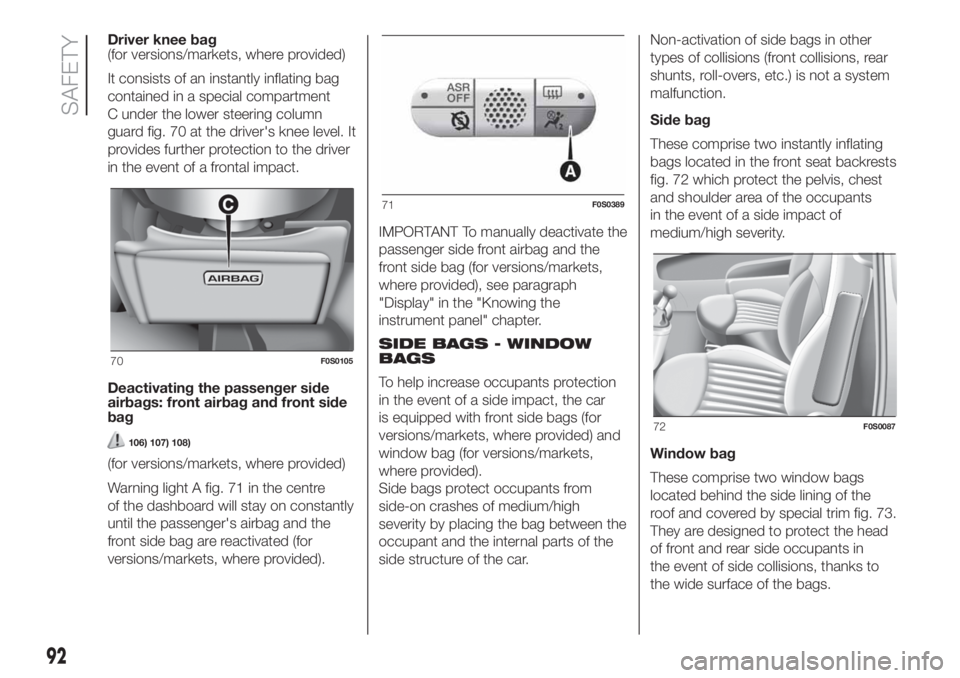
Driver knee bag
(for versions/markets, where provided)
It consists of an instantly inflating bag
contained in a special compartment
C under the lower steering column
guard fig. 70 at the driver's knee level. It
provides further protection to the driver
in the event of a frontal impact.
Deactivating the passenger side
airbags: front airbag and front side
bag
106) 107) 108)
(for versions/markets, where provided)
Warning light A fig. 71 in the centre
of the dashboard will stay on constantly
until the passenger's airbag and the
front side bag are reactivated (for
versions/markets, where provided).IMPORTANT To manually deactivate the
passenger side front airbag and the
front side bag (for versions/markets,
where provided), see paragraph
"Display" in the "Knowing the
instrument panel" chapter.
SIDE BAGS - WINDOW
BAGS
To help increase occupants protection
in the event of a side impact, the car
is equipped with front side bags (for
versions/markets, where provided) and
window bag (for versions/markets,
where provided).
Side bags protect occupants from
side-on crashes of medium/high
severity by placing the bag between the
occupant and the internal parts of the
side structure of the car.Non-activation of side bags in other
types of collisions (front collisions, rear
shunts, roll-overs, etc.) is not a system
malfunction.
Side bag
These comprise two instantly inflating
bags located in the front seat backrests
fig. 72 which protect the pelvis, chest
and shoulder area of the occupants
in the event of a side impact of
medium/high severity.
Window bag
These comprise two window bags
located behind the side lining of the
roof and covered by special trim fig. 73.
They are designed to protect the head
of front and rear side occupants in
the event of side collisions, thanks to
the wide surface of the bags.
70F0S0105
71F0S0389
72F0S0087
92
SAFETY
Page 96 of 228
106)In some versions, in the event of a
LEDfailure (located on the dashboard
panel), thewarning light on the
instrument panel turns on and the
passenger side airbags are deactivated.
107)The
warning light indicates the
passenger side airbag protection status. If
the warning light is off, passenger side
protection is active: to deactivate it, use the
Setup Menu (in this case the LED lights
up). When the car is started (ignition key
turned to MAR position), the warning light
turns on for about 8 seconds, provided
that at least 5 seconds have elapsed from
when it was switched off. If not, contact
a Fiat Dealership. If the engine is switched
off/on again in less than 5 seconds the
warning light may remain off. In this case,
to check correct warning light operation,
switch the engine off, wait for at least 5
seconds and switch the engine on again.
The warning light may light up with various
intensity levels depending on the vehicle
conditions. The intensity may also vary
during the same key cycle. When the
ignition key is turned to MAR, the
warning light switches for few seconds,
then if the passenger airbag protection is
active it should switch off.
108)If a child must be carried on the front
seat in a rearward facing child restraint
system, it is compulsory to deactivate the
passenger side front airbag, making sure
that it is deactivated by checking the
dedicated warning light on the instrument
panel. Move the passenger's seat as far
back as possible to avoid contact between
the child restraint system and the
dashboard.109)Malfunction of the
warning light is
indicated by the activation of an airbag
failure symbol and a dedicated message
on the instrument panel display (or, for
versions where provided, by the activation
of a blinking generic failure warning light). In
this case, the
warning light may not
indicate failures in the restraint systems.
Contact a Fiat Dealership immediately
to have the system checked.
110)Do not use seatcovers on front seats
featuring side airbags.
111)Do not travel carrying objects in your
lap, in front of your chest or between
your lips (pipe, pencils, etc.): they could
cause severe injury if the airbag is
deployed.
112)If the car has been stolen or in the
case of attempt to steal it, if it has been
subjected to vandalism or floods, have the
airbag system checked by a Fiat
Dealership.113)The airbags may also be deployed
when the car is not moving, if the key is in
the ignition and turned to MAR-ON or
when the engine is off, if the car is hit by
another moving vehicle. Therefore, even if
the vehicle is stationary, when an active
front passenger airbag is fitted, DO NOT
install rearward facing child restraint
systems on the front passenger seat.
Deployment of the airbag following an
impact could cause fatal injuries to the
child. Therefore, always deactivate the
passenger side airbag when a rearward
facing child restraint system is installed on
the front passenger seat. The front
passenger seat must also be positioned
back as far as possible in order to prevent
the child restraint system from coming
into contact with the dashboard.
Immediately reactivate the passenger
airbag as soon as the child restraint system
has been removed. Also remember that, if
the key is turned to STOP, none of the
safety devices (airbags or pretensioners)
will be deployed in the event of collision.
Non-deployment in such cases does
not indicate a system malfunction.
114)When the ignition key is turned to
MAR, the
warning light switches for few
seconds, then if the passenger airbag
protection is active it should switch off.
115)Do not wash the seats with water or
pressurised steam (wash by hand or at
automatic seat washing stations).
116)The airbag deployment threshold is
higher than that of the pretensioners.
For collisions in the range between the two
thresholds, it is normal for only the
pretensioners to be activated.
94
SAFETY
Page 99 of 228
STARTING THE
ENGINE
121) 122)
36) 37) 39) 40)
Before starting the engine, adjust the
seat, the interior rear view mirrors,
the door mirrors and fasten the seat
belt correctly.
Never press the accelerator pedal for
starting the engine.
The Start&Stop, ECO and AUTO
functions are activated automatically
whenever the engine is started.
PETROL VERSIONS
Starting the engine
Proceed as follows:
engage the handbrake and put the
gear lever in neutral;
fully depress the clutch pedal
without touching the accelerator;
turn the ignition key to AVV and
release it as soon as the engine starts.
If the engine does not start at the
first attempt, return the ignition key to
STOP before repeating the starting
procedure.If, when the ignition key is at MAR, the
instrument panel warning light or the
symbol
remains lit together with
warning light
turn the key to STOP
and then back to MAR. If the warning
light remains on, try with the other keys
provided with the car.
Contact a Fiat Dealership if you still
cannot start the engine.
VERSIONS WITH
DUALOGIC
TRANSMISSION
123)
The system allows the engine to be
started both with a gear engaged and
with the transmission in neutral (N).
However, the brake pedal must always
be pressed first if neutral is not
engaged. It is therefore advisable to
position the gear lever at N before
starting the engine.
LPG VERSIONS
The engine always starts up on petrol
independently of the previously
selected mode.
38)
WARNING
121)It is dangerous to run the engine in
enclosed areas. The engine consumes
oxygen and engine exhaust contains
carbon dioxide, carbon monoxide and
other toxic gasses.
122)Remember that the brake servo and
electrical power steering system are not
operational until the engine is started,
therefore a greater effort will be required to
press the brake pedal or turn the steering
wheel.
123)If the engine fails to start with a gear
engaged, the potentially dangerous
situation due to the fact that the gearbox is
automatically placed in neutral will be
signalled by an acoustic signal.
WARNING
36)It is advisable not to demand maximum
performance from your car (e.g. excessive
acceleration, long distances at maximum
rpm, excessively intense braking, etc.)
when it is first used.
37)When the engine is switched off never
leave the key turned to MAR to prevent
useless current absorption from draining
the battery.
38)There must therefore always be
enough petrol in the tank to protect the
petrol pump and to guarantee temporary
switching from LPG to petrol operation.
97
Page 100 of 228
39)Never, under any circumstances, jump
start the engine by pushing, towing or
coasting downhill. This could cause fuel to
flow into the catalytic converter and
damage it beyond repair.
40)A quick burst on the accelerator before
stopping the engine serves no practical
purpose; it wastes fuel and is especially
damaging to turbocharged engines.PARKING THE
VEHICLE
When parking and leaving the car,
proceed as follows:
engage a gear (1stgear if facing
uphill or reverse if facing downhill) and
leave the wheels turned;
stop the engine and engage the
handbrake;
always remove the ignition key.
Block the wheels with a wedge or a
stone if the car is parked on a steep
slope.
Do not leave the ignition key on MAR to
avoid draining the battery. Always
remove the key when you leave the car.
Versions with Dualogic
transmission
To park safely it is essential to engage
1
stgear or reverse (R), with your foot on
the brake pedal and, if there is a
gradient, to operate the handbrake.
Before releasing the brake pedal, wait
until P appears on the display.
IMPORTANT NEVER leave the car with
the gearbox in neutral (or, on versions
equipped with automatic transmission,
before placing the gear lever at P).HANDBRAKE
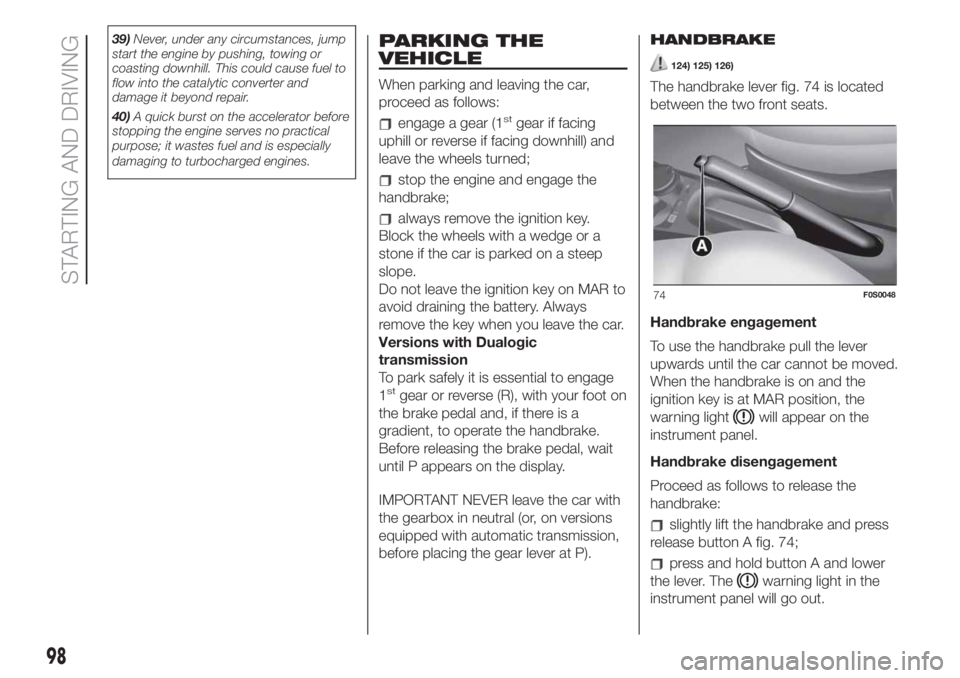
124) 125) 126)
The handbrake lever fig. 74 is located
between the two front seats.
Handbrake engagement
To use the handbrake pull the lever
upwards until the car cannot be moved.
When the handbrake is on and the
ignition key is at MAR position, the
warning light
will appear on the
instrument panel.
Handbrake disengagement
Proceed as follows to release the
handbrake:
slightly lift the handbrake and press
release button A fig. 74;
press and hold button A and lower
the lever. The
warning light in the
instrument panel will go out.
74F0S0048
98
STARTING AND DRIVING
Page 104 of 228
129)Before starting any servicing
operation, stop the engine and remove the
key from the ignition switch to operate
the steering lock, particularly when the
wheels do not touch the ground. If this is
not possible (for example if the key needs
to be turned to MAR or the engine must be
running), remove the main fuse that
protects the electric power steering.START&STOP
SYSTEM
130) 131) 132) 133)
46)
(for versions/markets, where provided)
The Start&Stop system automatically
stops the engine each time the car
is stationary and starts it again when
the driver wants to move off.
In this way, the vehicle efficiency is
increased, by reducing consumption,
dangerous gas emissions and sound
pollution.
OPERATING MODE
Stopping the engine
With manual transmission: with the car
stationary, the engine stops with the
transmission in neutral and the clutch
pedal released.
With Dualogic gearbox: the engine
stops if the car is at a standstill and the
brake pedal is pressed. This condition
can be maintained even if the brake
pedal is not depressed, if the gear lever
is in position N (Neutral).NOTE The engine can only be stopped
automatically over about 10 km/h, to
prevent the engine from being
repeatedly stopped when driving at
walking pace.
Stopping of the engine is indicated by
the warning light or the symbol
on
the instrument panel switching on
(on some versions, together with a
message on the display).
Restarting the engine
With manual transmission: press the
clutch pedal.
With Dualogic gearbox: if the gear lever
is in position N (Neutral), place it in
any other gear, otherwise release the
brake pedal or move the gear lever
to+,–or R (Reverse).
MANUAL SYSTEM
ACTIVATION/
DEACTIVATION
The system can be activated/
deactivated by pressing the button A
fig. 79 on the dashboard.
With the system off, the warning light or
the symbol
appear on the
instrument panel (with a message for
versions with colour display).
Start&Stop mode will be active
whenever the engine is started.
102
STARTING AND DRIVING
Page 109 of 228
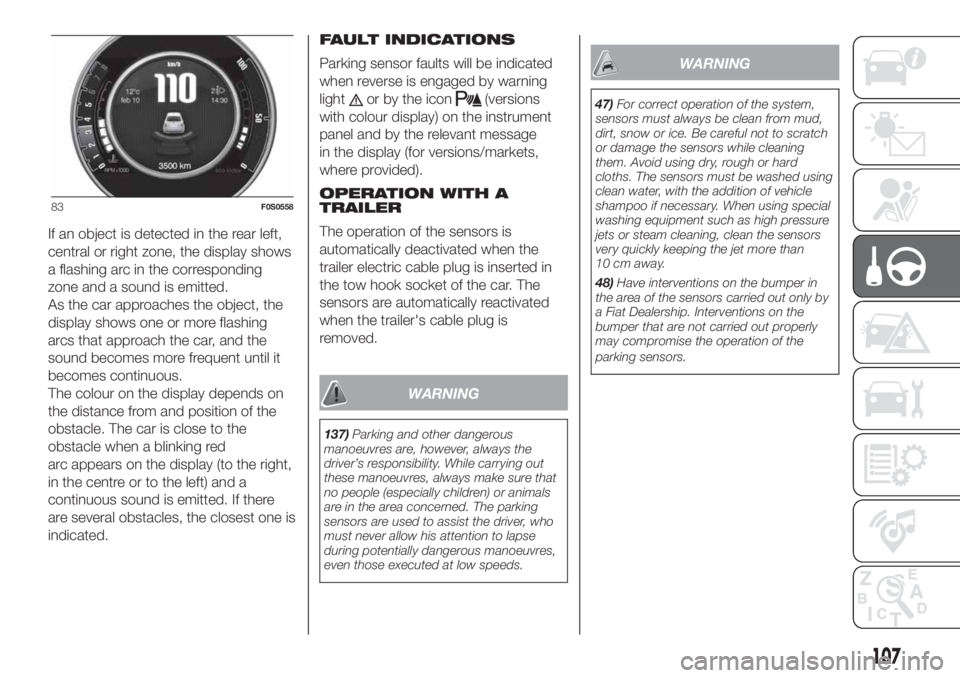
If an object is detected in the rear left,
central or right zone, the display shows
a flashing arc in the corresponding
zone and a sound is emitted.
As the car approaches the object, the
display shows one or more flashing
arcs that approach the car, and the
sound becomes more frequent until it
becomes continuous.
The colour on the display depends on
the distance from and position of the
obstacle. The car is close to the
obstacle when a blinking red
arc appears on the display (to the right,
in the centre or to the left) and a
continuous sound is emitted. If there
are several obstacles, the closest one is
indicated.FAULT INDICATIONS
Parking sensor faults will be indicated
when reverse is engaged by warning
light
or by the icon(versions
with colour display) on the instrument
panel and by the relevant message
in the display (for versions/markets,
where provided).
OPERATION WITH A
TRAILER
The operation of the sensors is
automatically deactivated when the
trailer electric cable plug is inserted in
the tow hook socket of the car. The
sensors are automatically reactivated
when the trailer's cable plug is
removed.
WARNING
137)Parking and other dangerous
manoeuvres are, however, always the
driver’s responsibility. While carrying out
these manoeuvres, always make sure that
no people (especially children) or animals
are in the area concerned. The parking
sensors are used to assist the driver, who
must never allow his attention to lapse
during potentially dangerous manoeuvres,
even those executed at low speeds.
WARNING
47)For correct operation of the system,
sensors must always be clean from mud,
dirt, snow or ice. Be careful not to scratch
or damage the sensors while cleaning
them. Avoid using dry, rough or hard
cloths. The sensors must be washed using
clean water, with the addition of vehicle
shampoo if necessary. When using special
washing equipment such as high pressure
jets or steam cleaning, clean the sensors
very quickly keeping the jet more than
10 cm away.
48)Have interventions on the bumper in
the area of the sensors carried out only by
a Fiat Dealership. Interventions on the
bumper that are not carried out properly
may compromise the operation of the
parking sensors.
83F0S0558
107
Page 116 of 228
HAZARD WARNING
LIGHTS
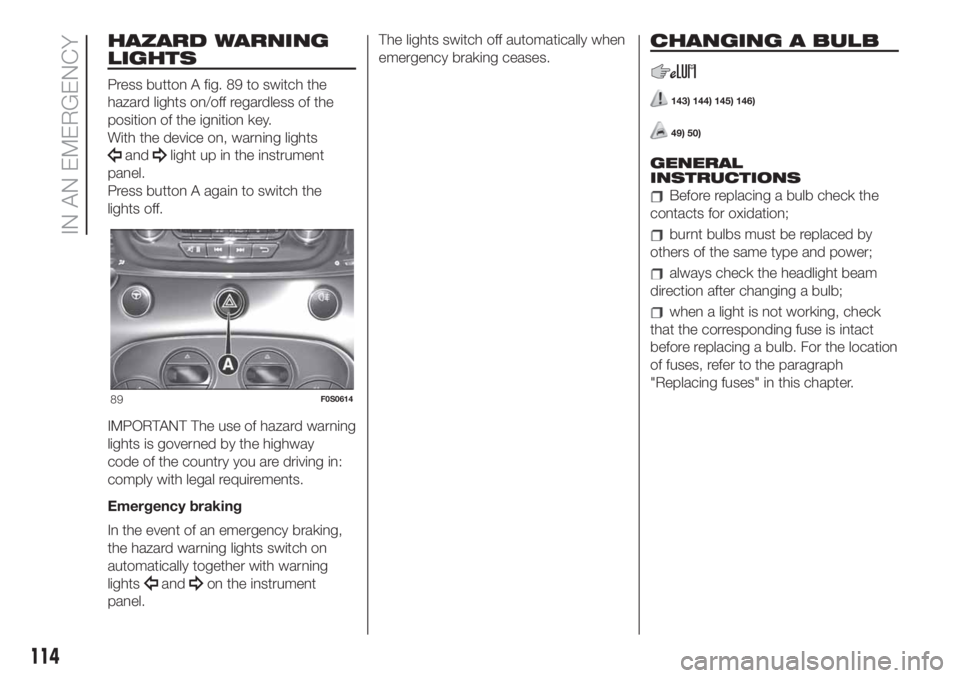
Press button A fig. 89 to switch the
hazard lights on/off regardless of the
position of the ignition key.
With the device on, warning lights
andlight up in the instrument
panel.
Press button A again to switch the
lights off.
IMPORTANT The use of hazard warning
lights is governed by the highway
code of the country you are driving in:
comply with legal requirements.
Emergency braking
In the event of an emergency braking,
the hazard warning lights switch on
automatically together with warning
lights
andon the instrument
panel.The lights switch off automatically when
emergency braking ceases.
CHANGING A BULB
143) 144) 145) 146)
49) 50)
GENERAL
INSTRUCTIONS
Before replacing a bulb check the
contacts for oxidation;
burnt bulbs must be replaced by
others of the same type and power;
always check the headlight beam
direction after changing a bulb;
when a light is not working, check
that the corresponding fuse is intact
before replacing a bulb. For the location
of fuses, refer to the paragraph
"Replacing fuses" in this chapter.
89F0S0614
114
IN AN EMERGENCY
Page 125 of 228
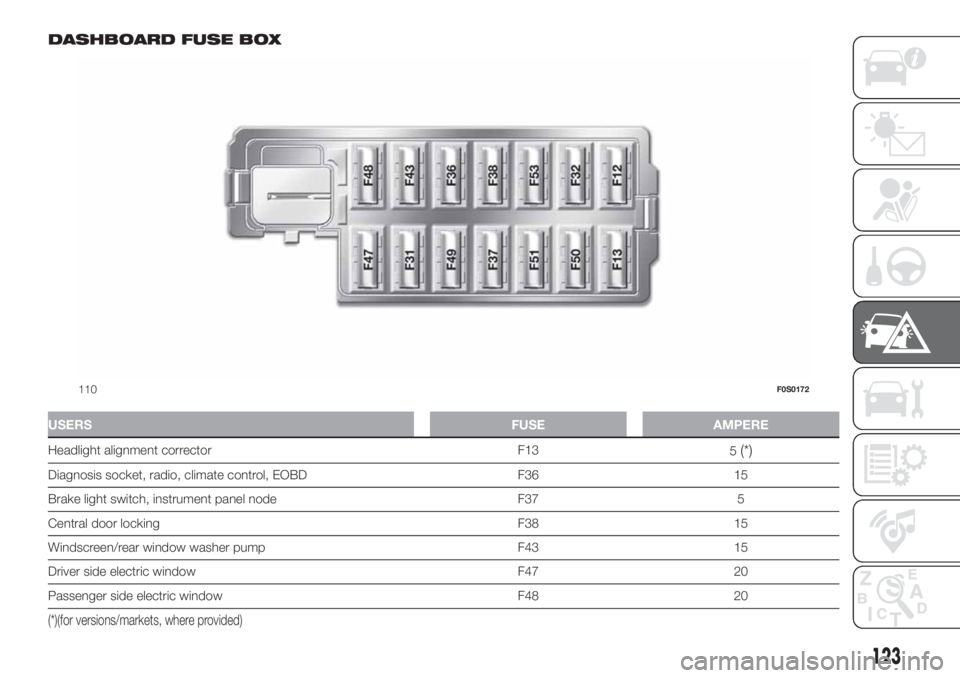
DASHBOARD FUSE BOX
USERSFUSE AMPERE
Headlight alignment corrector F13
5(*)
Diagnosis socket, radio, climate control, EOBD F36 15
Brake light switch, instrument panel node F37 5
Central door locking F38 15
Windscreen/rear window washer pump F43 15
Driver side electric window F47 20
Passenger side electric window F48 20
(*)(for versions/markets, where provided)
110F0S0172
123
Page 126 of 228
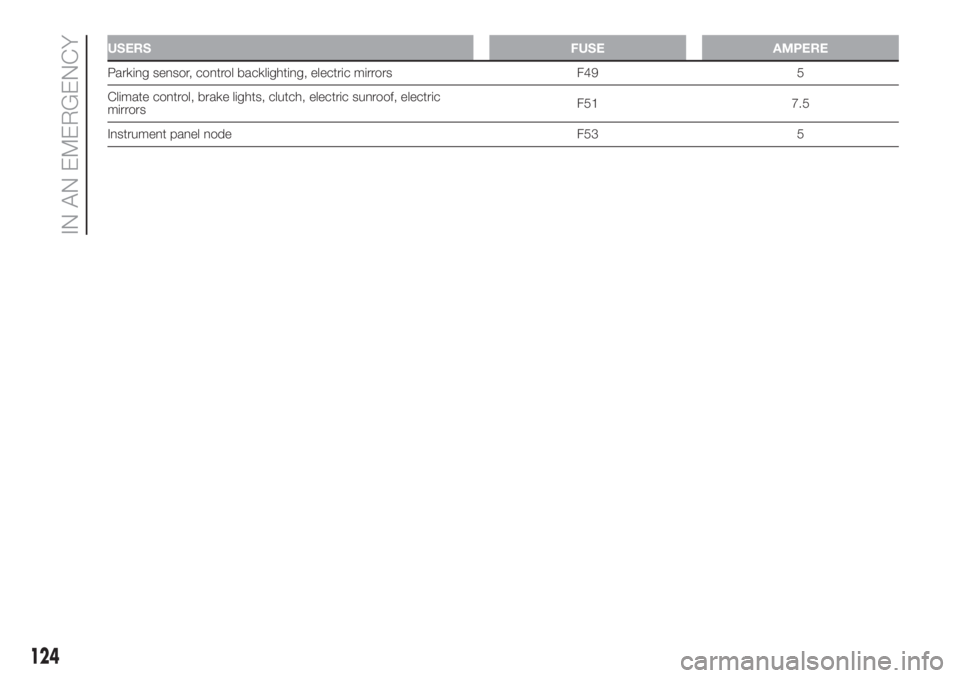
USERSFUSE AMPERE
Parking sensor, control backlighting, electric mirrors F49 5
Climate control, brake lights, clutch, electric sunroof, electric
mirrorsF51 7.5
Instrument panel node F53 5
124
IN AN EMERGENCY
Page 142 of 228
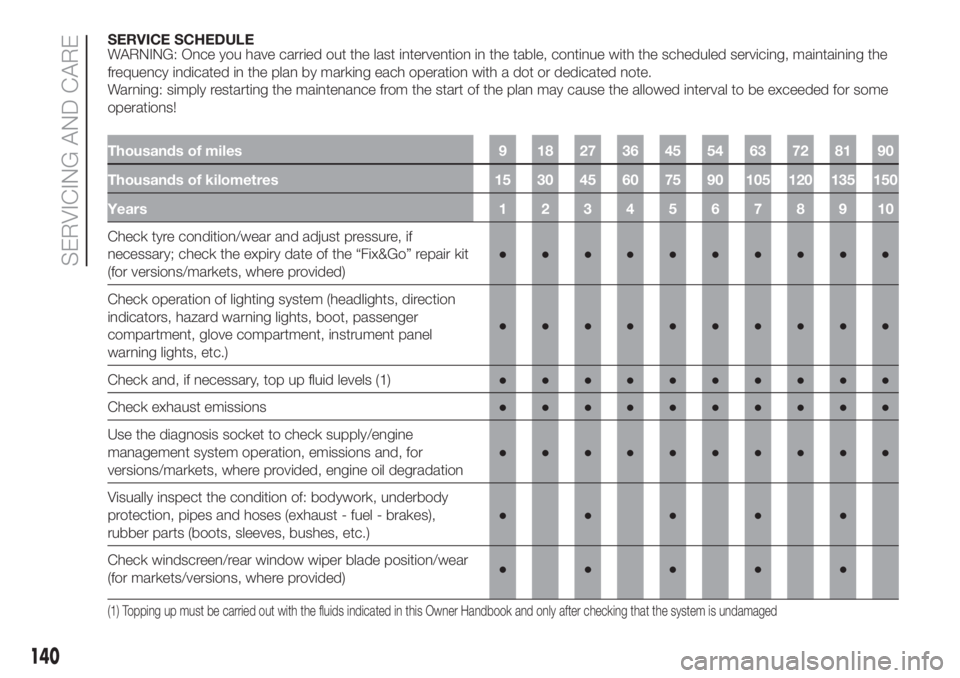
SERVICE SCHEDULE
WARNING: Once you have carried out the last intervention in the table, continue with the scheduled servicing, maintaining the
frequency indicated in the plan by marking each operation with a dot or dedicated note.
Warning: simply restarting the maintenance from the start of the plan may cause the allowed interval to be exceeded for some
operations!
Thousands of miles 9 18 27 36 45 54 63 72 81 90
Thousands of kilometres 15 30 45 60 75 90 105 120 135 150
Years12345678910
Check tyre condition/wear and adjust pressure, if
necessary; check the expiry date of the “Fix&Go” repair kit
(for versions/markets, where provided)●●●●●●●●●●
Check operation of lighting system (headlights, direction
indicators, hazard warning lights, boot, passenger
compartment, glove compartment, instrument panel
warning lights, etc.)●●●●●●●●●●
Check and, if necessary, top up fluid levels (1)●●●●●●●●●●
Check exhaust emissions●●●●●●●●●●
Use the diagnosis socket to check supply/engine
management system operation, emissions and, for
versions/markets, where provided, engine oil degradation●●●●●●●●●●
Visually inspect the condition of: bodywork, underbody
protection, pipes and hoses (exhaust - fuel - brakes),
rubber parts (boots, sleeves, bushes, etc.)●●●●●
Check windscreen/rear window wiper blade position/wear
(for markets/versions, where provided)●●●●●
(1) Topping up must be carried out with the fluids indicated in this Owner Handbook and only after checking that the system is undamaged
140
SERVICING AND CARE