hill FIAT 500 2020 Owner handbook (in English)
[x] Cancel search | Manufacturer: FIAT, Model Year: 2020, Model line: 500, Model: FIAT 500 2020Pages: 228, PDF Size: 6.01 MB
Page 14 of 228
STEERING LOCK
5)
Engagement:when the key is in
position STOP, remove the key and turn
the steering wheel until it is locked.
Disengagement:move the steering
wheel slightly as you turn the ignition
key to MAR.
WARNING
2)If the ignition device has been tampered
with (e.g. an attempted theft), have it
checked by a Fiat Dealership before driving
again.
3)Always remove the key when you leave
your car to prevent someone from
accidentally operating the controls.
Remember to engage the handbrake.
Engage first gear if the vehicle is parked
uphill or reverse if the vehicle is parked
downhill. Never leave children unattended
in the vehicle.
4)Never remove the key while the car is
moving. The steering wheel would
automatically lock as soon as you try to
turn it. This holds true for cars being towed
as well.
5)It is absolutely forbidden to carry out any
after-market operation involving steering
system or steering column modifications
(e.g. installation of anti-theft device) that
could adversely affect performance and
safety, invalidate the warranty and also
result in the car not meeting type-approval
requirements.
THE FIAT CODE
SYSTEM
This is an electronic engine locking
system which increases protection
against attempted thefts of the car. It is
automatically activated when the
ignition key is removed.
Each time the vehicle is started by
turning the ignition key to MAR, the Fiat
CODE system control unit sends a
recognition code to the Powertrain
Control Module to deactivate the
immobiliser.
If, during starting, the code has not
been correctly recognised, the
warning light switches on in the
instrument panel; on some versions a
symbol is shown on the display instead.
In this case, turn the key to STOP and
then to MAR; if it is still locked, try again
with the other keys that come with the
car. Contact a Fiat Dealership if you
still cannot start the engine.
IMPORTANT Each key has its own
code which must be stored by the
system's control unit. Contact a Fiat
Dealership to have new keys (up to 8)
stored with a code.
DOORS
6)
2)
OPENING/CLOSING WITH
KEY
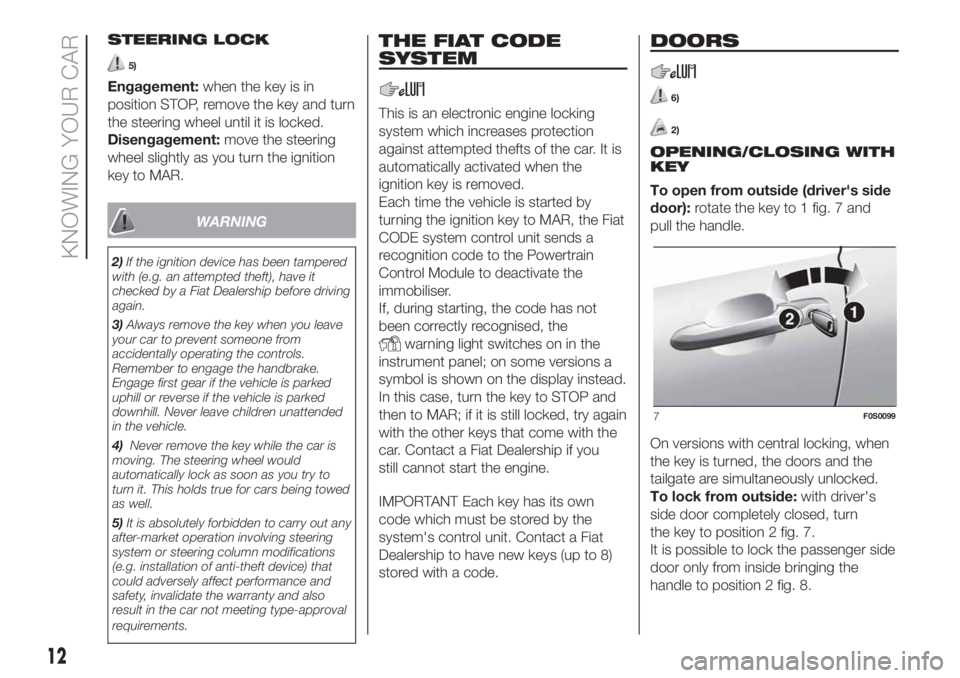
To open from outside (driver's side
door):rotate the key to 1 fig. 7 and
pull the handle.
On versions with central locking, when
the key is turned, the doors and the
tailgate are simultaneously unlocked.
To lock from outside:with driver's
side door completely closed, turn
the key to position 2 fig. 7.
It is possible to lock the passenger side
door only from inside bringing the
handle to position 2 fig. 8.
7F0S0099
12
KNOWING YOUR CAR
Page 40 of 228
WARNING
25)The system operates at temperatures
ranging between −20°C and 100°C.
26)The car is equipped with a gaseous
LPG injection system designed specifically
for it: it is therefore absolutely forbidden
to alter the configuration of the system or
its components. The use of other
components or materials could cause
malfunctions and lead to a reduction in
safety; therefore, in the case of problems,
contact a Fiat Dealership. To prevent
damage to the gas system parts when
towing or raising the vehicle, follow the
instructions in the "Towing the vehicle"
paragraph of the Owner Handbook.
27)When painting in an oven, the LPG
tank must be removed from the car and
later refitted by a Fiat Dealership. Although
the LPG system has numerous safety
features, it is advisable to proceed
as follows every time the vehicle is not in
use for a long period or moved in an
emergency as a result of a breakdown or
accident: unscrew the fastening devices A
fig. 41, then remove the cover B. Close
the LPG cock rotating the ring nut C
clockwise fig. 42; refit the cover and tighten
the fixing devices.28)Periodically (at least once every six
months), it is advisable to let the LPG in the
tank run out and, at the next refuelling,
check that it does not exceed the
maximum capacity of 30.5 litres (reserve
included) (with a tolerance of 2 litres
excess) (see instructions in the "Capacities"
paragraph). If the level is above 30.5 litres
(reserve included) contact a Fiat Dealership
immediately.
29)In particular usage conditions, such as
starting and operation at low ambient
temperature or LPG supply with low
propane content, the system may switch
temporarily to petrol operation, without
a visual indication of switching on the
selector. If the level of LPG in the tank is
low or there is a request for high
performance (e.g. overtaking, car fully
laden, steep hills): the system can
automatically switch to petrol operation to
guarantee the required engine
performance; in this event, the performed
switching is shown by the orange (petrol)
LED lit and the green (LPG) LED off on the
switch. When the above conditions stop,
the system automatically restores the LPG
operation; the orange (petrol) LED turns
off and the green (LPG) LED is lit on the
switch. To achieve the automatic switching
described above, make sure that there is
always enough fuel in the petrol tank.
30)It is strictly forbidden to use any
additive in the LPG.
38
KNOWING YOUR CAR
Page 52 of 228
WARNING
42)If thewarning light switches on when driving (on certain versions together with a dedicated message on the display) stop the engine
immediately and contact a Fiat Dealership.
Warning light What it means
redENGINE COOLANT TEMPERATURE TOO HIGH
The warning light switches on when the ignition key is turned to MAR, but it should switch off after a few
seconds.
The warning light or symbol on the display lights up when the engine is overheated, on some versions,
together with a dedicated message on the display.
In normal driving conditions: stop the car, switch off the engine and check that the fluid level in the
reservoir is not below the MIN mark. In this case, wait for the engine to cool down, then slowly and
carefully open the cap, top up with coolant and check that the level is between the MIN and MAX marks on
the reservoir itself. Also check visually for any fluid leaks. If, when restarting, the warning light switches on
again, contact a Fiat Dealership;
If the car is used under demanding conditions(e.g. towing trailers uphill or fully loaded): slow
down and, if the warning light stays on, stop the car. Stop for two or three minutes with the engine running
and slightly accelerated to facilitate better coolant circulation, then turn the engine off. Check that the
coolant level is correct as described above.
IMPORTANT Over demanding routes, it is advisable to keep the engine running and slightly accelerated for
a few minutes before turning it off.
On certain versions a dedicated message is displayed.
red"DUALOGIC" GEARBOX FAILURE
When the ignition key is turned to MAR, the warning light switches on but should switch off after a few
seconds.
The warning light comes on flashing, along with a dedicated message on the display and an acoustic
warning, to indicate transmission failure.31)
50
KNOWING THE INSTRUMENT PANEL
Page 54 of 228
Amber warning lights
Warning light What it means
yellowBRAKE PAD WEAR
The warning light switches on, together with a dedicated message on the display, if the front or rear brake
pads (on version/markets, where provided) are worn. In this case have them replaced as soon as possible.
amber (versions with
multifunctional display)
amber (versions with colour
display)ESC SYSTEMThe warning light switches on when the ignition key is turned to MAR, but it should switch off
after a few seconds.
ESC system activation
Flashing of the warning light while driving indicates the intervention of the ESC system.
ESC system failure
If the warning light does not go off or stays on together with the LED on the ASR OFF button while driving.
The display will show a dedicated message.
Contact a Fiat Dealership.
Hill Holder failure
This warning light switches on, on some versions together with a dedicated message on the display, in the
event of a Hill Holder system fault.
In this case, contact a Fiat Dealership as soon as possible.
52
KNOWING THE INSTRUMENT PANEL
Page 63 of 228
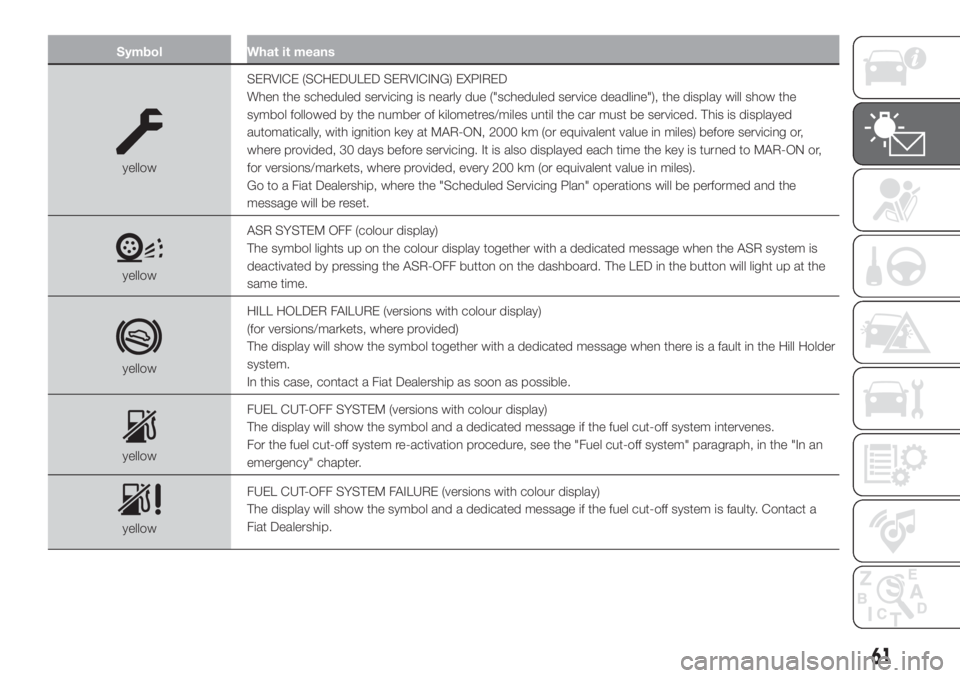
Symbol What it means
yellowSERVICE (SCHEDULED SERVICING) EXPIRED
When the scheduled servicing is nearly due ("scheduled service deadline"), the display will show the
symbol followed by the number of kilometres/miles until the car must be serviced. This is displayed
automatically, with ignition key at MAR-ON, 2000 km (or equivalent value in miles) before servicing or,
where provided, 30 days before servicing. It is also displayed each time the key is turned to MAR-ON or,
for versions/markets, where provided, every 200 km (or equivalent value in miles).
Go to a Fiat Dealership, where the "Scheduled Servicing Plan" operations will be performed and the
message will be reset.
yellowASR SYSTEM OFF (colour display)
The symbol lights up on the colour display together with a dedicated message when the ASR system is
deactivated by pressing the ASR-OFF button on the dashboard. The LED in the button will light up at the
same time.
yellowHILL HOLDER FAILURE (versions with colour display)
(for versions/markets, where provided)
The display will show the symbol together with a dedicated message when there is a fault in the Hill Holder
system.
In this case, contact a Fiat Dealership as soon as possible.
yellowFUEL CUT-OFF SYSTEM (versions with colour display)
The display will show the symbol and a dedicated message if the fuel cut-off system intervenes.
For the fuel cut-off system re-activation procedure, see the "Fuel cut-off system" paragraph, in the "In an
emergency" chapter.
yellowFUEL CUT-OFF SYSTEM FAILURE (versions with colour display)
The display will show the symbol and a dedicated message if the fuel cut-off system is faulty. Contact a
Fiat Dealership.
61
Page 70 of 228
ACTIVE SAFETY
SYSTEMS
The vehicle has the following active
safety systems:
ABS (Anti-lock Braking System);
EBD (Electronic Brake force
Distribution);
MSR (Motor Schleppmoment
Regelung);
ESC (Electronic Stability Control);
HH (Hill Holder);
ASR (Antislip Regulation);
HBA (Hydraulic Brake Assist);
For the operation of the systems, see
the following description.
ABS (Anti-lock Braking
System)
This system, which is an integral part of
the braking system, prevents one or
more wheels from locking and slipping
in any road surface condition,
irrespective of the intensity of the
braking action, ensuring that the car
can be controlled even during
emergency braking thus optimising
stopping distances.
The system intervenes during braking
when the wheels are about to lock,
typically in emergency braking or
low-grip conditions, when locking may
be more frequent.The system also improves control and
stability of the car when braking on a
surface where the grip of the left and
right wheels varies, or on corners.
System intervention
A slight pulsing of the brake pedal and
noise indicates the intervention of the
ABS: this is completely normal when
the system intervenes.
49) 50) 51) 52) 53) 54) 55) 56) 57)
EBD (Electronic
Brakeforce Distribution)
SYSTEM
This system (which cannot be
deactivated) recognises emergency
braking conditions according to the
speed of operation of the brake pedal
and provides an additional hydraulic
braking pressure to support that
provided by the driver. This allows
faster and more powerful operation of
the braking system.MSR (Motor
Schleppmoment
Regelung) SYSTEM
The MSR system is an integral part of
the ABS, that intervenes, if there is a
sudden change to a lower gear,
restoring torque to the engine, thereby
preventing excessive drive at the drive
wheels which, especially in poor grip
conditions, could lead to a loss in
stability of the vehicle.
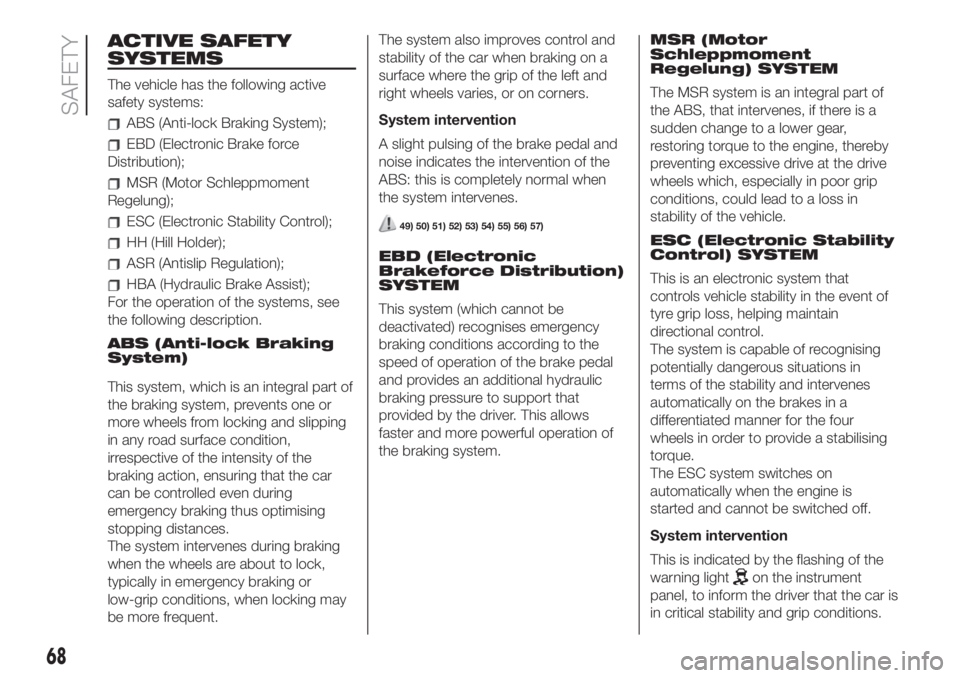
ESC (Electronic Stability
Control) SYSTEM
This is an electronic system that
controls vehicle stability in the event of
tyre grip loss, helping maintain
directional control.
The system is capable of recognising
potentially dangerous situations in
terms of the stability and intervenes
automatically on the brakes in a
differentiated manner for the four
wheels in order to provide a stabilising
torque.
The ESC system switches on
automatically when the engine is
started and cannot be switched off.
System intervention
This is indicated by the flashing of the
warning light
on the instrument
panel, to inform the driver that the car is
in critical stability and grip conditions.
68
SAFETY
Page 71 of 228
58) 59) 60) 61) 62) 63)
HH (Hill Holder) SYSTEM
This is an integral part of the ESC
system and facilitates starting on
slopes, activating automatically in the
following cases:
uphill: car stationary on a road with
a gradient higher than 5%, engine
running, brake pressed and gearbox in
neutral or gear (other than reverse)
engaged;
downhill: car stationary on a road
with a gradient higher than 5%, engine
running, brake pressed and reverse
gear engaged.
When setting off, the ESC system
control unit maintains the braking
pressure on the wheels until the engine
torque necessary for starting is
reached, or in any case for a maximum
of 2 seconds, allowing your right foot
to be moved easily from the brake
pedal to the accelerator.
When the 2 seconds have elapsed,
without starting, the system is
automatically deactivated, gradually
releasing the braking pressure.
During this release stage, the typical
mechanical brake release noise can be
heard, indicating that the car is about
to move.Moving the car on sloping roads
For optimal starting on very steep
gradients, as follows:
Press the brake pedal to activate the
Hill Holder;
completely press the clutch pedal;
engage the gear;
remove your foot from the brake
pedal;
completely press the accelerator
pedal.
In this manner, the engine goes to the
optimal rpm for taking off uphill. The Hill
Holder remains engaged (car braked)
until the clutch is gradually released
(holding the accelerator pedal pressed):
at this point, the system switches off
and the car starts moving. The Hill
Holder function switches off
automatically if the cars does not
take-off within 2 seconds.
The manoeuvre makes it possible to
avoid pressing the accelerator (because
it must remain fully pressed during the
manoeuvre) and to operate only the
clutch, by gradually releasing it.
Operating the handbrake is not
necessary.
On less steep gradients, the system is
active also with the accelerator pedal
not completely pressed.
64) 65)
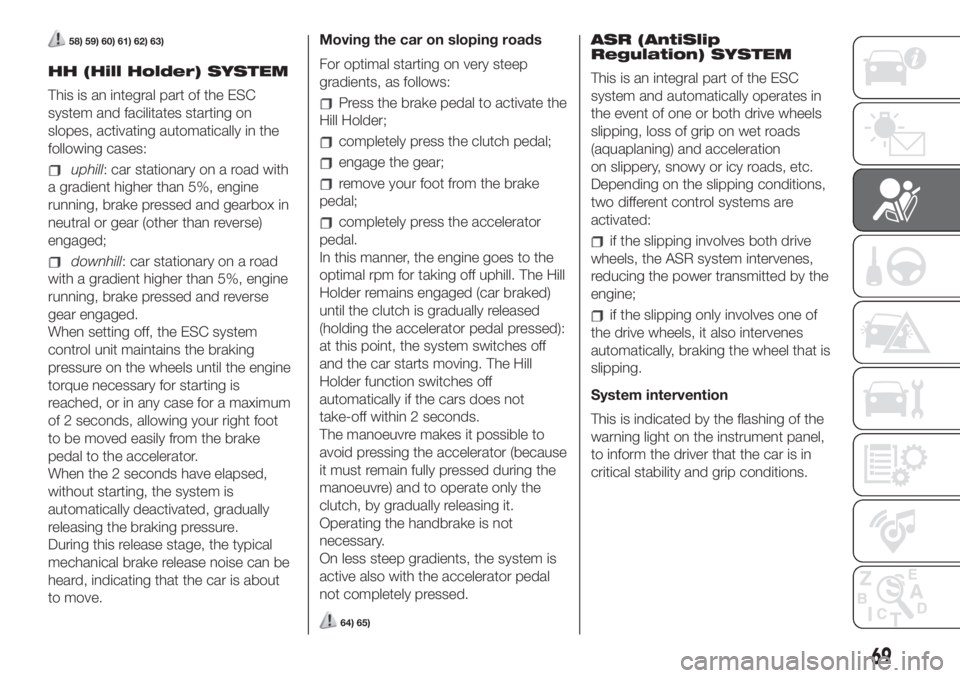
ASR (AntiSlip
Regulation) SYSTEM
This is an integral part of the ESC
system and automatically operates in
the event of one or both drive wheels
slipping, loss of grip on wet roads
(aquaplaning) and acceleration
on slippery, snowy or icy roads, etc.
Depending on the slipping conditions,
two different control systems are
activated:
if the slipping involves both drive
wheels, the ASR system intervenes,
reducing the power transmitted by the
engine;
if the slipping only involves one of
the drive wheels, it also intervenes
automatically, braking the wheel that is
slipping.
System intervention
This is indicated by the flashing of the
warning light on the instrument panel,
to inform the driver that the car is in
critical stability and grip conditions.
69
Page 100 of 228
39)Never, under any circumstances, jump
start the engine by pushing, towing or
coasting downhill. This could cause fuel to
flow into the catalytic converter and
damage it beyond repair.
40)A quick burst on the accelerator before
stopping the engine serves no practical
purpose; it wastes fuel and is especially
damaging to turbocharged engines.PARKING THE
VEHICLE
When parking and leaving the car,
proceed as follows:
engage a gear (1stgear if facing
uphill or reverse if facing downhill) and
leave the wheels turned;
stop the engine and engage the
handbrake;
always remove the ignition key.
Block the wheels with a wedge or a
stone if the car is parked on a steep
slope.
Do not leave the ignition key on MAR to
avoid draining the battery. Always
remove the key when you leave the car.
Versions with Dualogic
transmission
To park safely it is essential to engage
1
stgear or reverse (R), with your foot on
the brake pedal and, if there is a
gradient, to operate the handbrake.
Before releasing the brake pedal, wait
until P appears on the display.
IMPORTANT NEVER leave the car with
the gearbox in neutral (or, on versions
equipped with automatic transmission,
before placing the gear lever at P).HANDBRAKE
124) 125) 126)
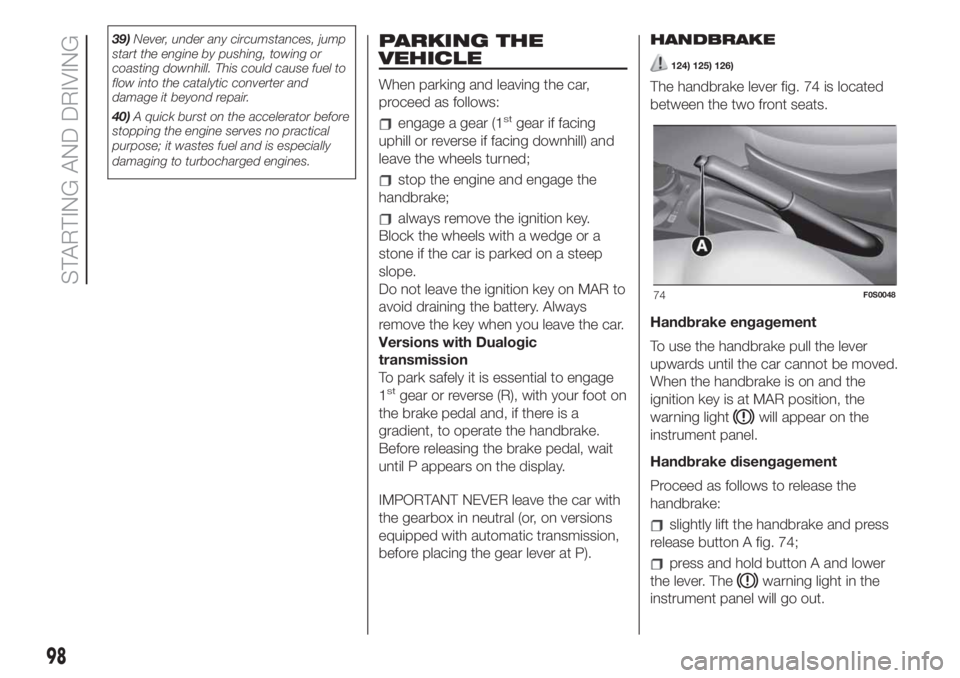
The handbrake lever fig. 74 is located
between the two front seats.
Handbrake engagement
To use the handbrake pull the lever
upwards until the car cannot be moved.
When the handbrake is on and the
ignition key is at MAR position, the
warning light
will appear on the
instrument panel.
Handbrake disengagement
Proceed as follows to release the
handbrake:
slightly lift the handbrake and press
release button A fig. 74;
press and hold button A and lower
the lever. The
warning light in the
instrument panel will go out.
74F0S0048
98
STARTING AND DRIVING
Page 101 of 228
Press the brake pedal when carrying
out this operation to prevent the car
from moving accidentally.
WARNING
124)The car should be braked after a few
clicks of the lever, if it is not, contact a
Fiat Dealership to have it adjusted.
125)Never leave children in the
unattended car. Always remove the ignition
key when leaving the car and take it out
with you.
126)In the case of parking manoeuvres on
roads on a gradient, the front wheels
must be steered towards the pavement
(when parking downhill), or in the opposite
direction if the vehicle is parked uphill.
Block the wheels with a wedge or a stone if
the car is parked on a steep slope.
MANUAL
TRANSMISSION
(for versions/markets, where provided)
127)
41)
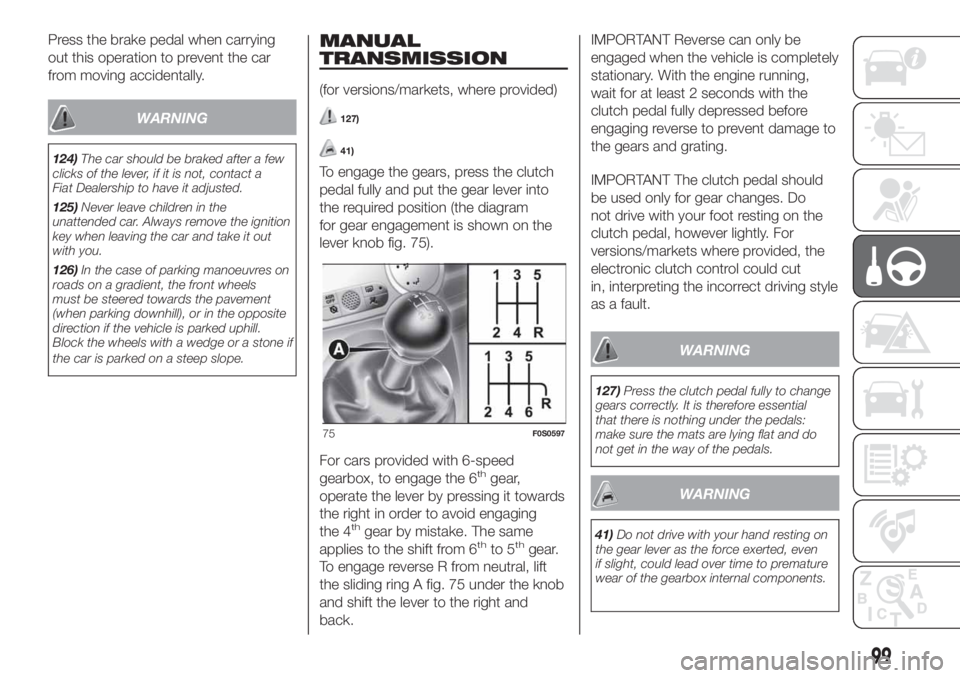
To engage the gears, press the clutch
pedal fully and put the gear lever into
the required position (the diagram
for gear engagement is shown on the
lever knob fig. 75).
For cars provided with 6-speed
gearbox, to engage the 6
thgear,
operate the lever by pressing it towards
the right in order to avoid engaging
the 4
thgear by mistake. The same
applies to the shift from 6thto 5thgear.
To engage reverse R from neutral, lift
the sliding ring A fig. 75 under the knob
and shift the lever to the right and
back.IMPORTANT Reverse can only be
engaged when the vehicle is completely
stationary. With the engine running,
wait for at least 2 seconds with the
clutch pedal fully depressed before
engaging reverse to prevent damage to
the gears and grating.
IMPORTANT The clutch pedal should
be used only for gear changes. Do
not drive with your foot resting on the
clutch pedal, however lightly. For
versions/markets where provided, the
electronic clutch control could cut
in, interpreting the incorrect driving style
as a fault.
WARNING
127)Press the clutch pedal fully to change
gears correctly. It is therefore essential
that there is nothing under the pedals:
make sure the mats are lying flat and do
not get in the way of the pedals.
WARNING
41)Do not drive with your hand resting on
the gear lever as the force exerted, even
if slight, could lead over time to premature
wear of the gearbox internal components.
75F0S0597
99
Page 105 of 228
WARNING
130)If the battery needs to be replaced,
always contact a Fiat Dealership. Replace
the battery with one of the same type
(HEAVY DUTY) and with the same
specifications.
131)Before opening the bonnet, make
sure that the vehicle is switched off and the
key is in the STOP position. Please follow
the instructions on the decal near the front
crossmember. It is advisable to extract
the key when there are other people in the
car. The car should always be left after
the key has been removed or turned to the
STOP position. When refuelling, make
sure that the car is switched off with the
key in the STOP position.132)We recommend that you remove the
key from the ignition if other people remain
in the vehicle. Exit from the vehicle only
after having removed the ignition key
or having rotated it to the STOP position.
During refuelling, make sure that the engine
is off and that the ignition key is in the
STOP position.
133)For cars with Dualogic transmission, if
the engine is automatically stopped on a
slope, the engine should be restarted
by moving the gear lever to + or – without
releasing the brake pedal. For cars with
Dualogic transmission, where the Hill
Holder function is present, in the case of
car stopped on a slope, the engine does
not cut off automatically, so as to make the
Hill Holder function - which is active only
when the engine is running - available.
WARNING
46)If the climate comfort is to be favoured,
the Start&Stop system can be deactivated,
for a continuous operation of the climate
control system.
SPEED LIMITER
(for versions/markets, where provided)
ACTIVATING THE DEVICE
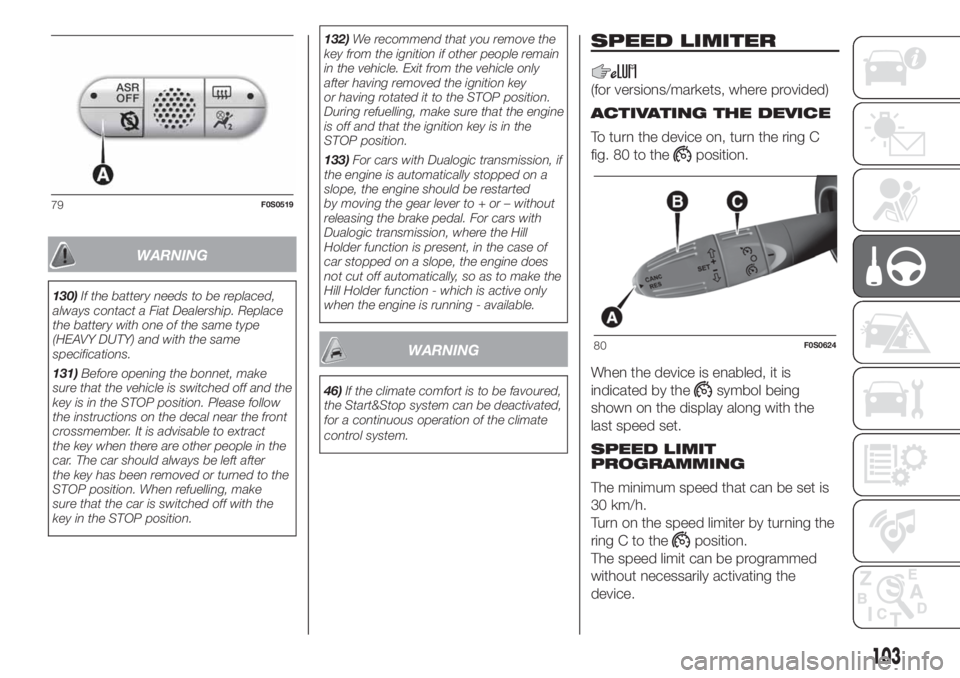
To turn the device on, turn the ring C
fig. 80 to the
position.
When the device is enabled, it is
indicated by the
symbol being
shown on the display along with the
last speed set.
SPEED LIMIT
PROGRAMMING
The minimum speed that can be set is
30 km/h.
Turn on the speed limiter by turning the
ring C to the
position.
The speed limit can be programmed
without necessarily activating the
device.
79F0S0519
80F0S0624
103