light FIAT 500 ABARTH 2014 2.G User Guide
[x] Cancel search | Manufacturer: FIAT, Model Year: 2014, Model line: 500 ABARTH, Model: FIAT 500 ABARTH 2014 2.GPages: 392, PDF Size: 8.74 MB
Page 54 of 392
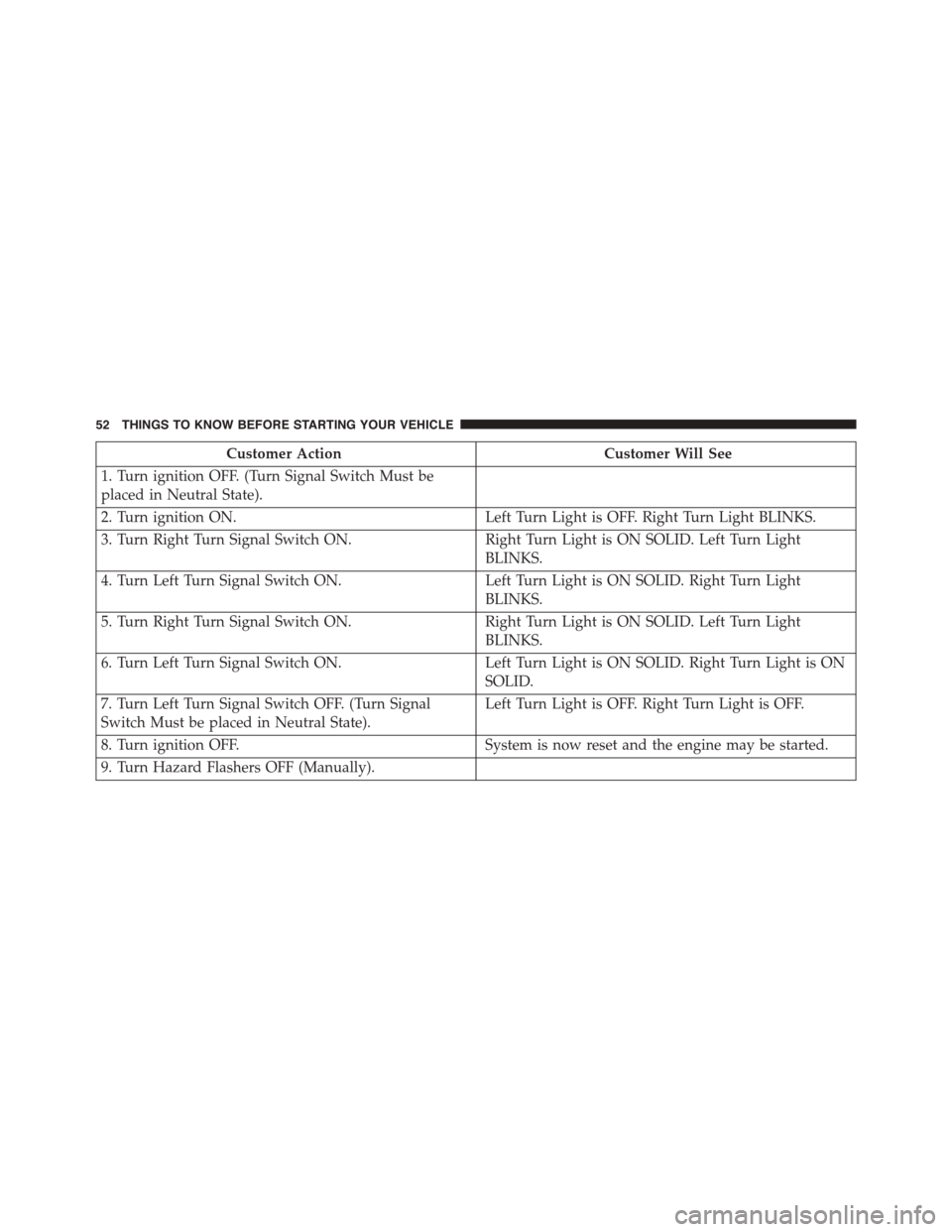
Customer ActionCustomer Will See
1. Turn ignition OFF. (Turn Signal Switch Must be
placed in Neutral State).
2. Turn ignition ON.Left Turn Light is OFF. Right Turn Light BLINKS.
3. Turn Right Turn Signal Switch ON.Right Turn Light is ON SOLID. Left Turn Light
BLINKS.
4. Turn Left Turn Signal Switch ON.Left Turn Light is ON SOLID. Right Turn Light
BLINKS.
5. Turn Right Turn Signal Switch ON.Right Turn Light is ON SOLID. Left Turn Light
BLINKS.
6. Turn Left Turn Signal Switch ON.Left Turn Light is ON SOLID. Right Turn Light is ON
SOLID.
7. Turn Left Turn Signal Switch OFF. (Turn Signal
Switch Must be placed in Neutral State).
Left Turn Light is OFF. Right Turn Light is OFF.
8. Turn ignition OFF.System is now reset and the engine may be started.
9. Turn Hazard Flashers OFF (Manually).
52 THINGS TO KNOW BEFORE STARTING YOUR VEHICLE
Page 55 of 392
If a reset procedure step is not completed within 45
seconds, then the turn signal lights will turn off and the
reset procedure must be performed again in order to be
successful.
If A Deployment Occurs
The Advanced Front Air Bags are designed to deflate
immediately after deployment.
NOTE:Front and/or side air bags will not deploy in all
collisions. This does not mean something is wrong with
the air bag system.
If you do have a collision which deploys the air bags, any
or all of the following may occur:
•The nylon air bag material may sometimes cause
abrasions and/or skin reddening to the driver and
front passenger as the air bags deploy and unfold. The
abrasions are similar to friction rope burns or those
you might get sliding along a carpet or gymnasium
floor. They are not caused by contact with chemicals.
They are not permanent and normally heal quickly.
However, if you haven’t healed significantly within a
few days, or if you have any blistering, see your doctor
immediately.
•As the air bags deflate, you may see some smoke-like
particles. The particles are a normal by-product of the
process that generates the non-toxic gas used for air
bag inflation. These airborne particles may irritate the
skin, eyes, nose, or throat. If you have skin or eye
irritation, rinse the area with cool water. For nose or
throat irritation, move to fresh air. If the irritation
continues, see your doctor. If these particles settle on
your clothing, follow the garment manufacturer’s in-
structions for cleaning.
Do not drive your vehicle after the air bags have de-
ployed. If you are involved in another collision, the air
bags will not be in place to protect you.
2
THINGS TO KNOW BEFORE STARTING YOUR VEHICLE 53
Page 57 of 392
WARNING!(Continued)
•Do not attempt to modify any part of your air bag
system. The air bag may inflate accidentally or may
not function properly if modifications are made.
Take your vehicle to an authorized dealer for any
air bag system service. If your seat, including your
trim cover and cushion, needs to be serviced in any
way (including removal or loosening/tightening of
seat attachment bolts), take the vehicle to your
authorized dealer. Only manufacturer approved
seat accessories may be used. If it is necessary to
modify the air bag system for persons with dis-
abilities, contact your authorized dealer.
(Continued)
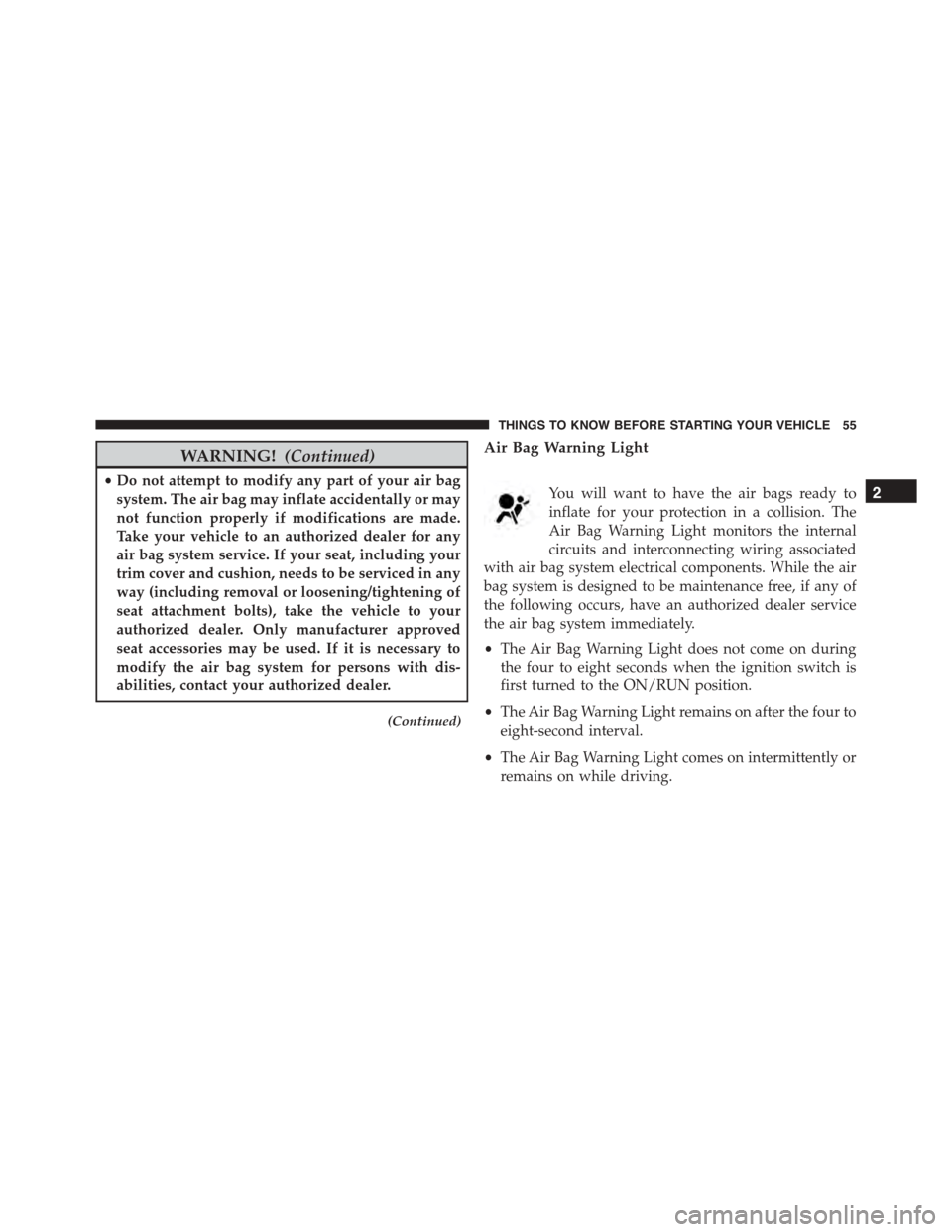
Air Bag Warning Light
You will want to have the air bags ready to
inflate for your protection in a collision. The
Air Bag Warning Light monitors the internal
circuits and interconnecting wiring associated
with air bag system electrical components. While the air
bag system is designed to be maintenance free, if any of
the following occurs, have an authorized dealer service
the air bag system immediately.
•The Air Bag Warning Light does not come on during
the four to eight seconds when the ignition switch is
first turned to the ON/RUN position.
•The Air Bag Warning Light remains on after the four to
eight-second interval.
•The Air Bag Warning Light comes on intermittently or
remains on while driving.
2
THINGS TO KNOW BEFORE STARTING YOUR VEHICLE 55
Page 83 of 392
Safety Checks You Should Make Inside The
Vehicle
Seat Belts
Inspect the belt system periodically, checking for cuts,
frays, and loose parts. Damaged parts must be replaced
immediately. Do not disassemble or modify the system.
Front seat belt assemblies must be replaced after a
collision. Rear seat belt assemblies must be replaced after
a collision if they have been damaged (i.e., bent retractor,
torn webbing, etc.). If there is any question regarding belt
or retractor condition, replace the belt.
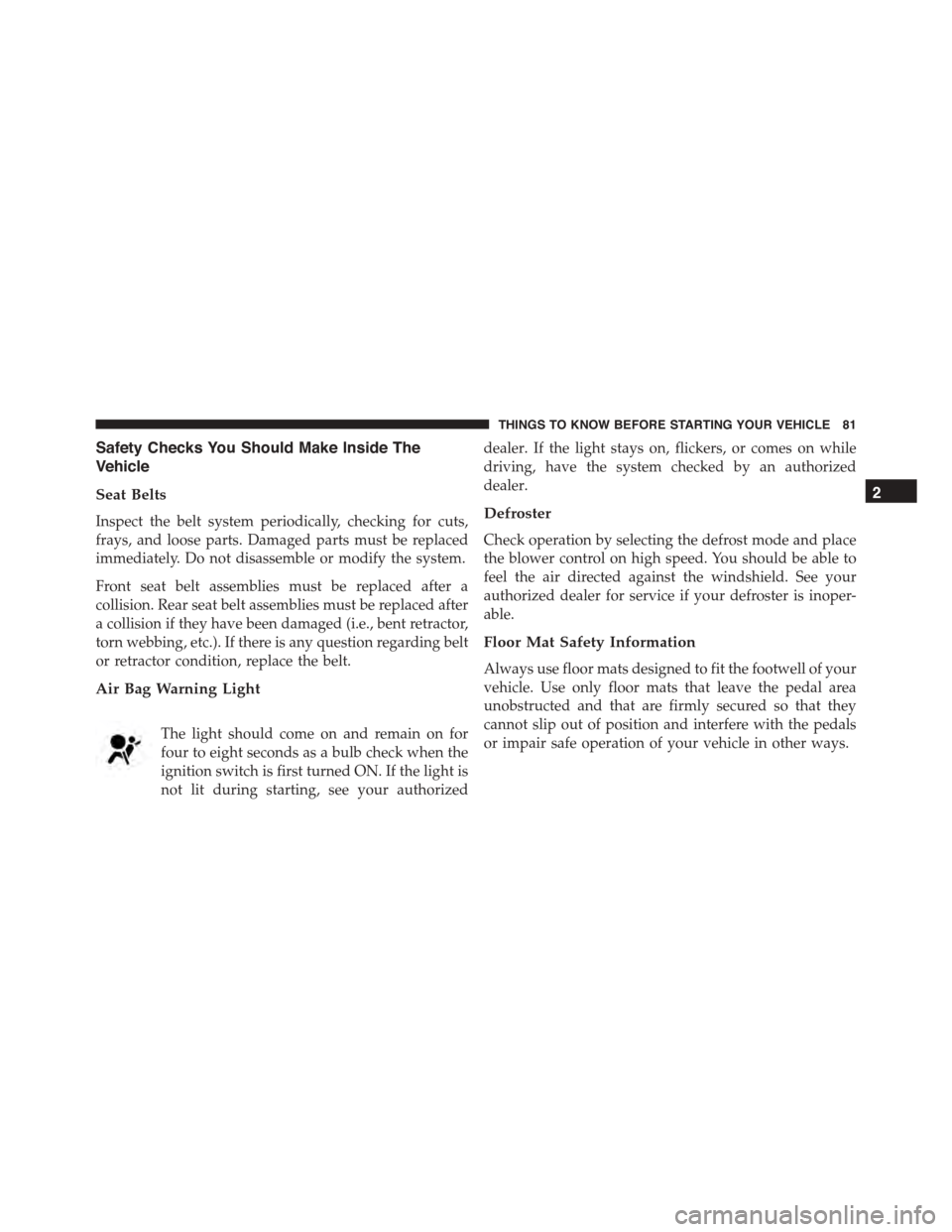
Air Bag Warning Light
The light should come on and remain on for
four to eight seconds as a bulb check when the
ignition switch is first turned ON. If the light is
not lit during starting, see your authorized
dealer. If the light stays on, flickers, or comes on while
driving, have the system checked by an authorized
dealer.
Defroster
Check operation by selecting the defrost mode and place
the blower control on high speed. You should be able to
feel the air directed against the windshield. See your
authorized dealer for service if your defroster is inoper-
able.
Floor Mat Safety Information
Always use floor mats designed to fit the footwell of your
vehicle. Use only floor mats that leave the pedal area
unobstructed and that are firmly secured so that they
cannot slip out of position and interfere with the pedals
or impair safe operation of your vehicle in other ways.
2
THINGS TO KNOW BEFORE STARTING YOUR VEHICLE 81
Page 85 of 392
Periodic Safety Checks You Should Make Outside
The Vehicle
Tires
Examine tires for excessive tread wear and uneven wear
patterns. Check for stones, nails, glass, or other objects
lodged in the tread or sidewall. Inspect the tread for cuts
and cracks. Inspect sidewalls for cuts, cracks and bulges.
Check the wheel bolts for tightness. Check the tires for
proper cold inflation pressure.
Lights
Have someone observe the operation of brake lights and
exterior lights while you work the controls. Check turn
signal and high beam indicator lights on the instrument
panel.
Door Latches
Check for positive closing, latching, and locking.
Fluid Leaks
Check area under vehicle after overnight parking for fuel,
engine coolant, oil, or other fluid leaks. Also, if gasoline
fumes are detected or if fuel, power steering fluid (if
equipped), or brake fluid leaks are suspected, the cause
should be located and corrected immediately.
2
THINGS TO KNOW BEFORE STARTING YOUR VEHICLE 83
Page 88 of 392
▫EZ Entry Feature......................106
▫Memory Feature......................106
▫Heated Seats — If Equipped.............107
▫Head Restraints.......................108
!TO OPEN AND CLOSE THE HOOD.........108
!LIGHTS.............................111
▫Multifunction Lever....................111
▫Headlights..........................111
▫High Beams.........................112
▫Flash-To-Pass........................112
▫Parking Lights.......................112
▫Daytime Running Lights — If Equipped.....112
▫Turn Signals.........................112
▫Lane Change Assist....................113
▫Follow Me Home/Headlight Delay.........113
▫Interior Lights.......................114
▫Front Fog Lights — If Equipped...........115
!WINDSHIELD WIPERS AND WASHERS......116
▫Front Windshield Wiper Operation.........116
▫Rear Windshield Wiper.................118
!TILT STEERING COLUMN — IF EQUIPPED . . .119
!ELECTRONIC SPEED CONTROL...........120
▫To Activate..........................121
▫To Set A Desired Speed.................121
▫To Deactivate........................122
▫To Resume Speed.....................122
86 UNDERSTANDING THE FEATURES OF YOUR VEHICLE
Page 89 of 392
▫To Vary The Speed Setting...............122
▫To Accelerate For Passing................123
!REAR PARK ASSIST — IF EQUIPPED........123
▫Rear Park Assist Sensors................124
▫Rear Park Assist Alerts..................124
▫Failure Indications.....................126
▫Cleaning The Rear Park Assist System.......126
▫Park Assist System Usage Precautions.......127
!POWER SUNROOF — IF EQUIPPED........129
▫To Open............................130
▫To Close............................130
▫Pinch Protect Feature...................130
▫Wind Buffeting.......................130
▫Emergency Operation...................131
▫Sun Shade — If Equipped...............131
!ELECTRICAL POWER OUTLETS...........131
!CIGAR LIGHTER — IF EQUIPPED..........134
!CUPHOLDERS........................135
!STORAGE............................136
▫Glove Box Compartment................136
!CARGO AREA FEATURES................136
!REAR WINDOW FEATURES..............138
▫Rear Window Defroster.................138
3
UNDERSTANDING THE FEATURES OF YOUR VEHICLE 87
Page 94 of 392
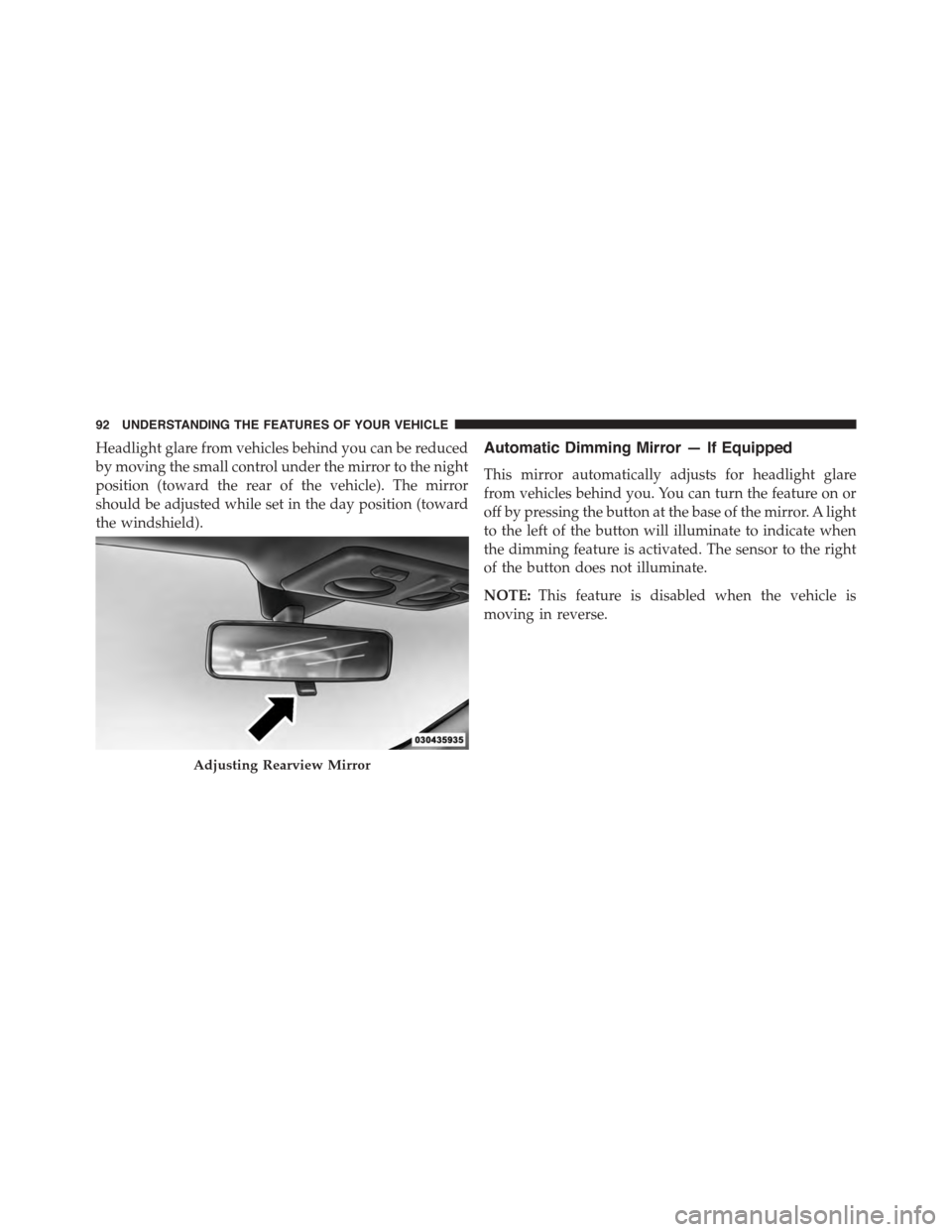
Headlight glare from vehicles behind you can be reduced
by moving the small control under the mirror to the night
position (toward the rear of the vehicle). The mirror
should be adjusted while set in the day position (toward
the windshield).
Automatic Dimming Mirror — If Equipped
This mirror automatically adjusts for headlight glare
from vehicles behind you. You can turn the feature on or
off by pressing the button at the base of the mirror. A light
to the left of the button will illuminate to indicate when
the dimming feature is activated. The sensor to the right
of the button does not illuminate.
NOTE:This feature is disabled when the vehicle is
moving in reverse.
Adjusting Rearview Mirror
92 UNDERSTANDING THE FEATURES OF YOUR VEHICLE
Page 113 of 392
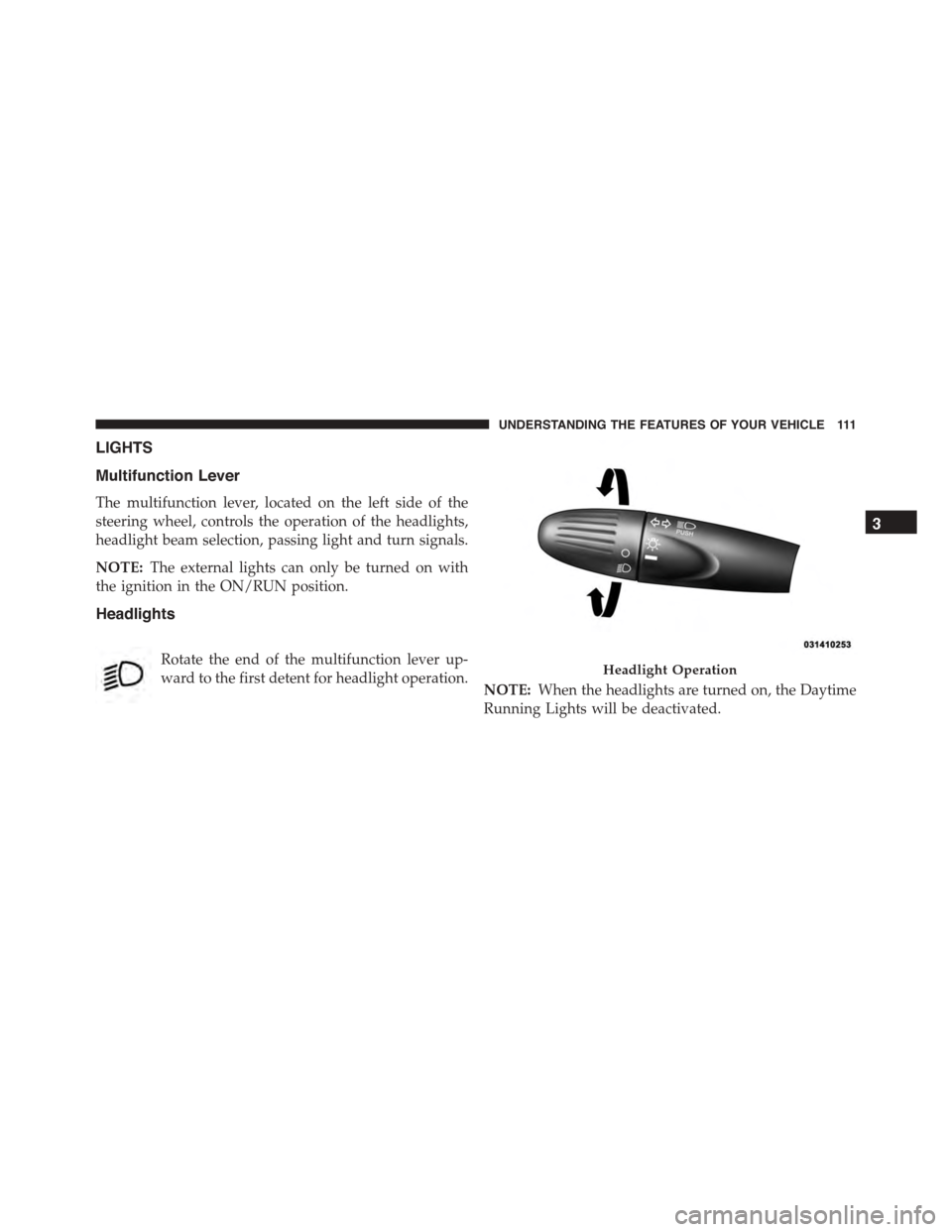
LIGHTS
Multifunction Lever
The multifunction lever, located on the left side of the
steering wheel, controls the operation of the headlights,
headlight beam selection, passing light and turn signals.
NOTE:The external lights can only be turned on with
the ignition in the ON/RUN position.
Headlights
Rotate the end of the multifunction lever up-
ward to the first detent for headlight operation.NOTE:When the headlights are turned on, the Daytime
Running Lights will be deactivated.
Headlight Operation
3
UNDERSTANDING THE FEATURES OF YOUR VEHICLE 111
Page 114 of 392
High Beams
With the low beams activated, push the multi-
function lever towards the instrument panel to
turn on the high beams. Pull the multifunction lever
toward the steering wheel to turn off the high beams.
Flash-To-Pass
You can signal another vehicle with your headlights by
lightly pulling the multifunction lever toward the steer-
ing wheel. This will turn on the high beams until the
lever is released.
Parking Lights
To turn on the parking lights, remove the key
or turn the ignition to OFF/LOCK position and
turn on the headlights.
Daytime Running Lights — If Equipped
To activate the Daytime Running Lights (DRL), rotate the
end of the multifunction lever to theOsymbol.
NOTE:The low beams and side/taillights will not be on
with DRL.
If allowed by law in the country in which the vehicle was
purchased the DRL function can be turned on or off using
the display menus. Refer to “Electronic Vehicle Informa-
tion Center (EVIC)” in “Understanding Your Instrument
Panel” for further information.
Turn Signals
Push the multifunction lever upward to signal a right
turn or downward to signal a left turn. The correspond-
ing indicator in the instrument cluster will blink to
indicate the operation of the turn signal.
11 2 U N D E R S TA N D I N G T H E F E AT U R E S O F Y O U R V E H I C L E