window FIAT 500 ABARTH 2014 2.G Owners Manual
[x] Cancel search | Manufacturer: FIAT, Model Year: 2014, Model line: 500 ABARTH, Model: FIAT 500 ABARTH 2014 2.GPages: 392, PDF Size: 8.74 MB
Page 11 of 392
THINGS TO KNOW BEFORE STARTING YOUR VEHICLE
CONTENTS
!A WORD ABOUT YOUR KEYS.............11
▫Ignition Key Removal...................11
▫Locking Doors With A Key................13
▫Key-In-Ignition Reminder................13
!SENTRY KEY®.........................13
▫Replacement Keys.....................14
▫General Information....................15
!REMOTE KEYLESS ENTRY (RKE) — IF
EQUIPPED............................15
▫To Unlock The Doors And Liftgate..........15
▫Remote Key Unlock, Driver Door/All Doors 1st
Press . . . . . . . . . . . . . . . . . . . . . . . . . . . . . . .16
▫Opening Power Top Remote Function.......16
▫To Lock The Doors And Liftgate............18
▫Programming Additional Transmitters........18
▫Transmitter Battery Replacement...........18
▫General Information....................20
!DOOR LOCKS.........................20
▫Power Door Locks.....................22
!POWER WINDOWS.....................23
▫Power Window Switches.................23
2
Page 14 of 392
7. Release the clutch pedal.WARNING!
•Before exiting a vehicle, always turn the ignition to
the OFF/LOCK position, apply the parking brake,
shift the transmission into REVERSE gear, and
remove the key fob from the ignition. When leav-
ing the vehicle, always lock your vehicle.
•Never leave children alone in a vehicle, or with
access to an unlocked vehicle.
•Allowing children to be in a vehicle unattended is
dangerous for a number of reasons. A child or
others could be seriously or fatally injured. Chil-
dren should be warned not to touch the parking
brake, brake pedal or the shift lever.
•Do not leave the Key Fob in or near the vehicle, or
in a location accessible to children. A child could
operate power windows, other controls, or move
the vehicle.
(Continued)
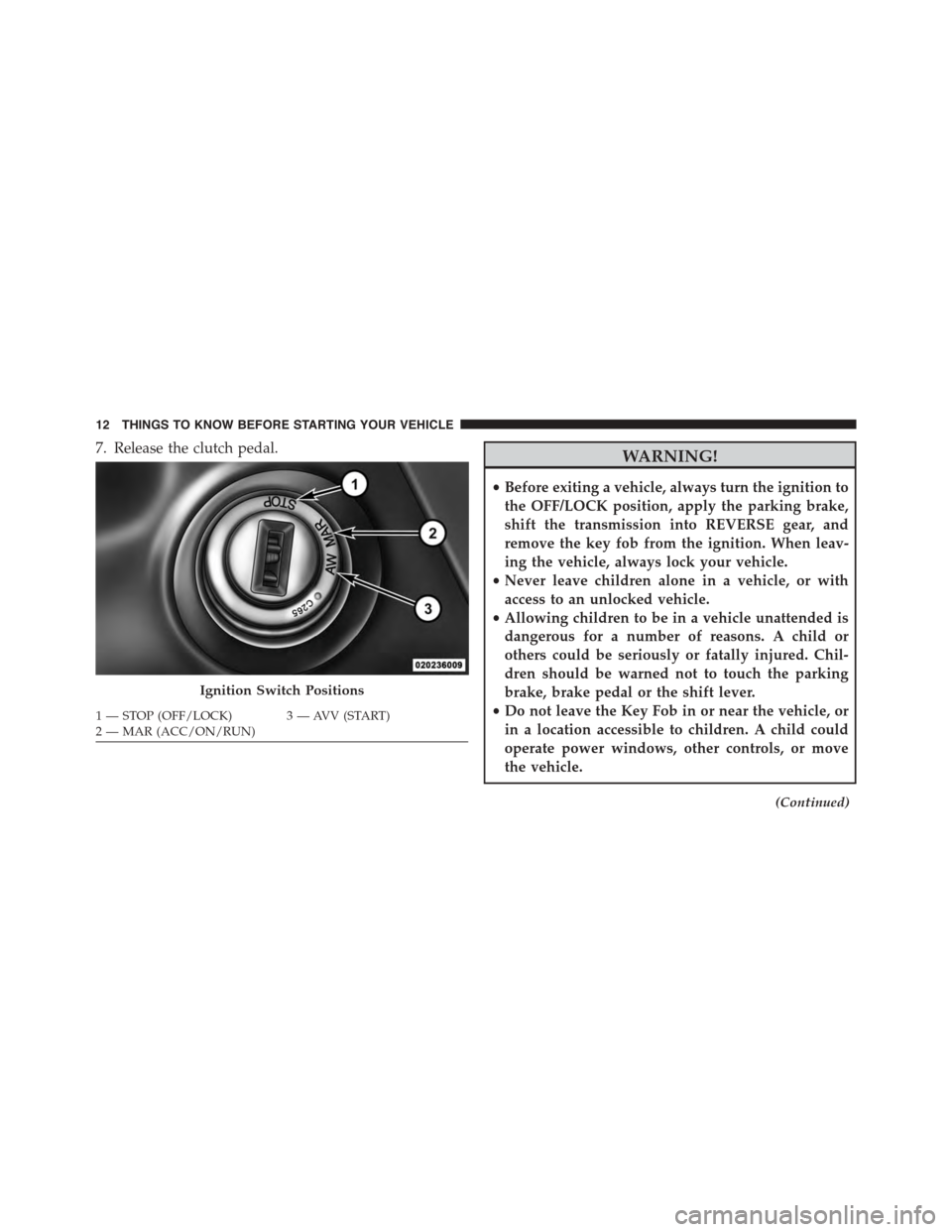
Ignition Switch Positions
1—STOP(OFF/LOCK) 3—AVV(START)2—MAR(ACC/ON/RUN)
12 THINGS TO KNOW BEFORE STARTING YOUR VEHICLE
Page 24 of 392
WARNING!(Continued)
•Do not leave the Key Fob in or near the vehicle, or
in a location accessible to children. A child could
operate power windows, other controls, or move
the vehicle.
CAUTION!
An unlocked vehicle is an invitation to thieves.
Always remove the key from the ignition and lock all
of the doors when leaving the vehicle unattended.
Power Door Locks
A power door lock switch is incorporated into the driver
door handle. Push or pull the handle to lock or unlock the
doors and liftgate. If the driver ’s door handle is pushed
a red lock indicator will show on the driver ’s door handle
(indicating locked) when the door is closed, the door will
lock.
NOTE:To prevent the key from being locked in the
vehicle, the doors will automatically unlock if the driv-
er’s door handle is pushed when the key is in the ignition
and either front door is open.
22 THINGS TO KNOW BEFORE STARTING YOUR VEHICLE
Page 25 of 392
Autoclose
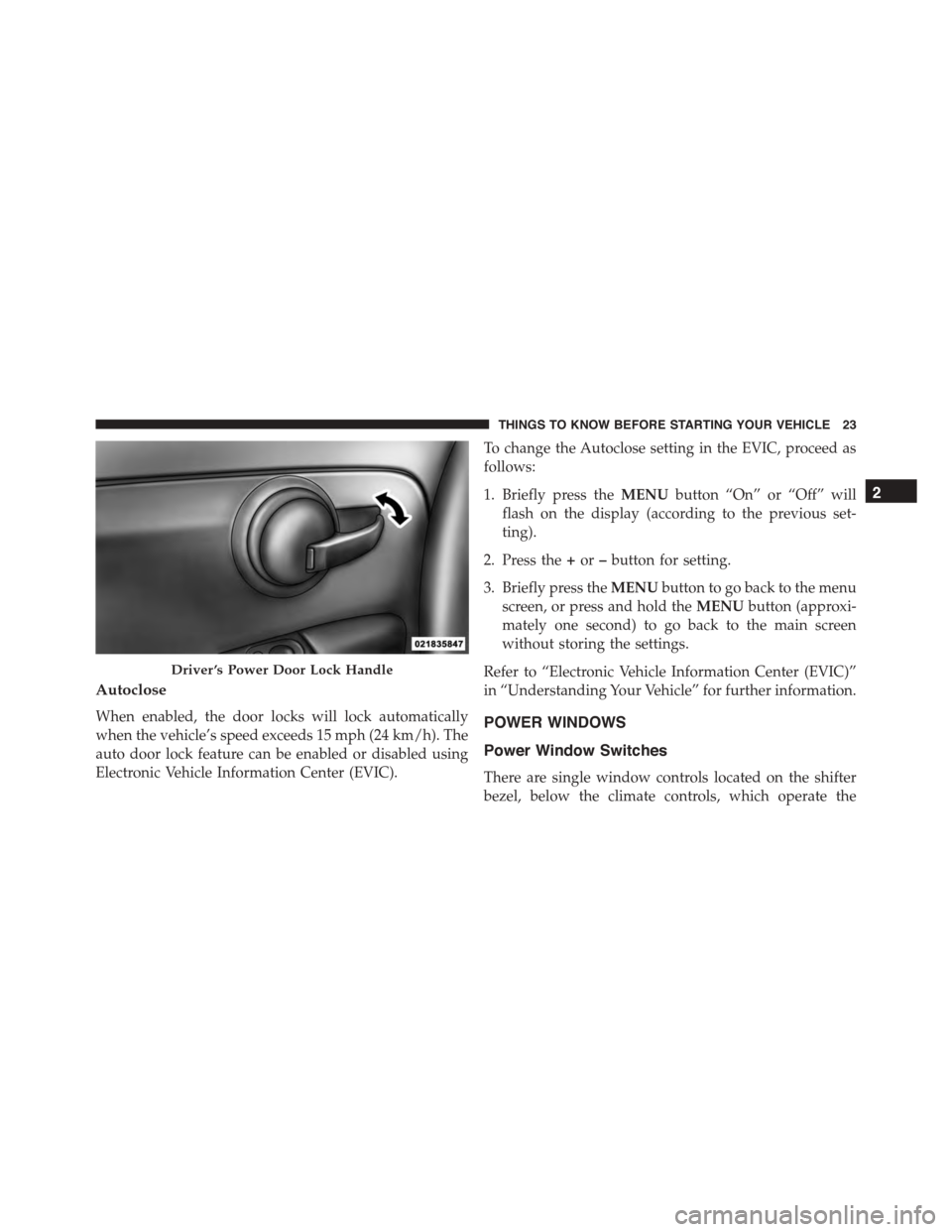
When enabled, the door locks will lock automatically
when the vehicle’s speed exceeds 15 mph (24 km/h). The
auto door lock feature can be enabled or disabled using
Electronic Vehicle Information Center (EVIC).
To change the Autoclose setting in the EVIC, proceed as
follows:
1. Briefly press theMENUbutton “On” or “Off” will
flash on the display (according to the previous set-
ting).
2. Press the+or–button for setting.
3. Briefly press theMENUbutton to go back to the menu
screen, or press and hold theMENUbutton (approxi-
mately one second) to go back to the main screen
without storing the settings.
Refer to “Electronic Vehicle Information Center (EVIC)”
in “Understanding Your Vehicle” for further information.
POWER WINDOWS
Power Window Switches
There are single window controls located on the shifter
bezel, below the climate controls, which operate the
Driver ’s Power Door Lock Handle
2
THINGS TO KNOW BEFORE STARTING YOUR VEHICLE 23
Page 26 of 392
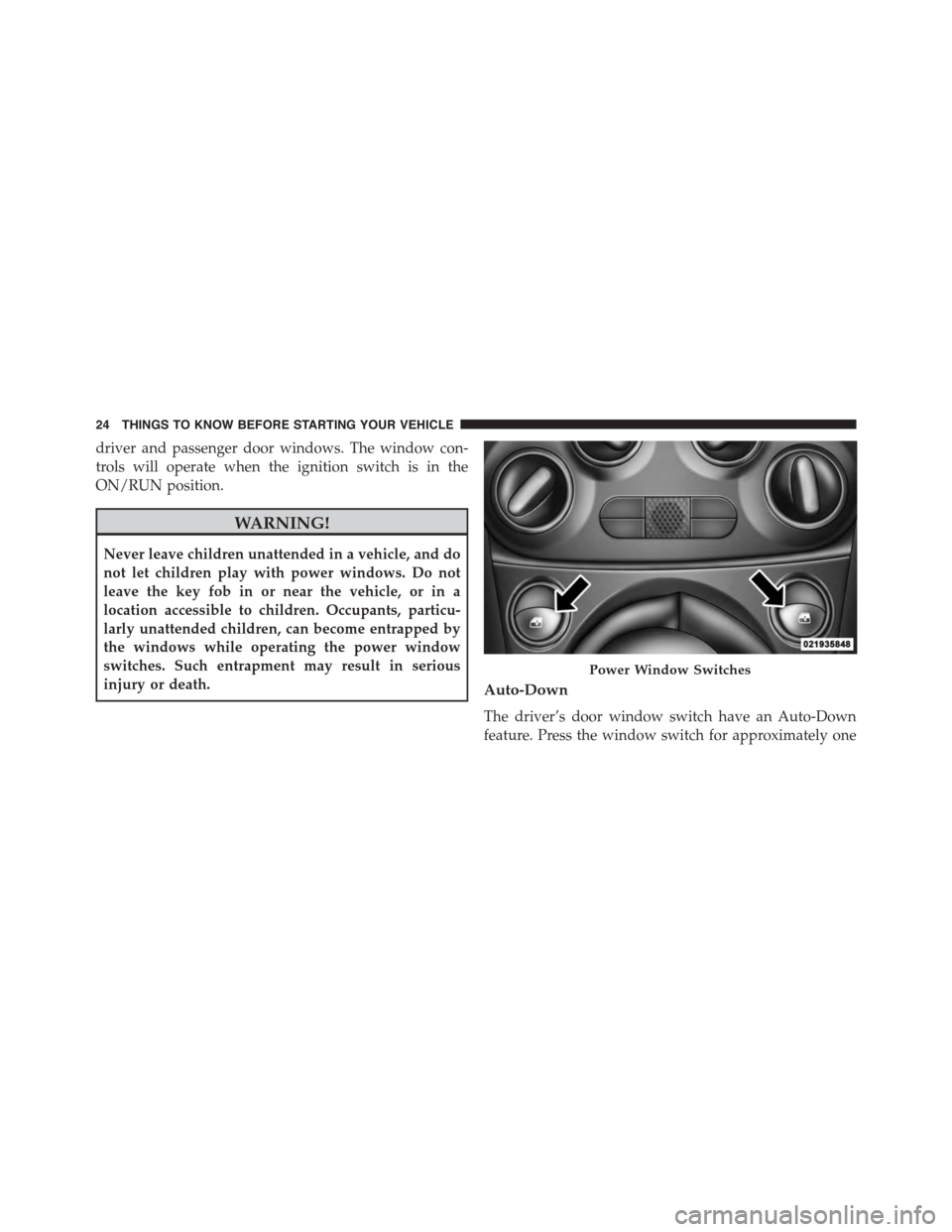
driver and passenger door windows. The window con-
trols will operate when the ignition switch is in the
ON/RUN position.
WARNING!
Never leave children unattended in a vehicle, and do
not let children play with power windows. Do not
leave the key fob in or near the vehicle, or in a
location accessible to children. Occupants, particu-
larly unattended children, can become entrapped by
the windows while operating the power window
switches. Such entrapment may result in serious
injury or death.Auto-Down
The driver’s door window switch have an Auto-Down
feature. Press the window switch for approximately one
Power Window Switches
24 THINGS TO KNOW BEFORE STARTING YOUR VEHICLE
Page 27 of 392
second, release, and the window will go down automati-
cally. To cancel the Auto-Down movement, operate the
switch in either the up or down direction and release the
switch.
Wind Buffeting
Wind buffeting can be described as the perception of
pressure on the ears or a helicopter-type sound in the
ears. Your vehicle may exhibit wind buffeting with the
windows down, or the sunroof (if equipped) in certain
open or partially open positions. This is a normal occur-
rence and can be minimized. If the buffeting occurs with
the sunroof open, adjust the sunroof opening to minimize
the buffeting or open any window.
LIFTGATE
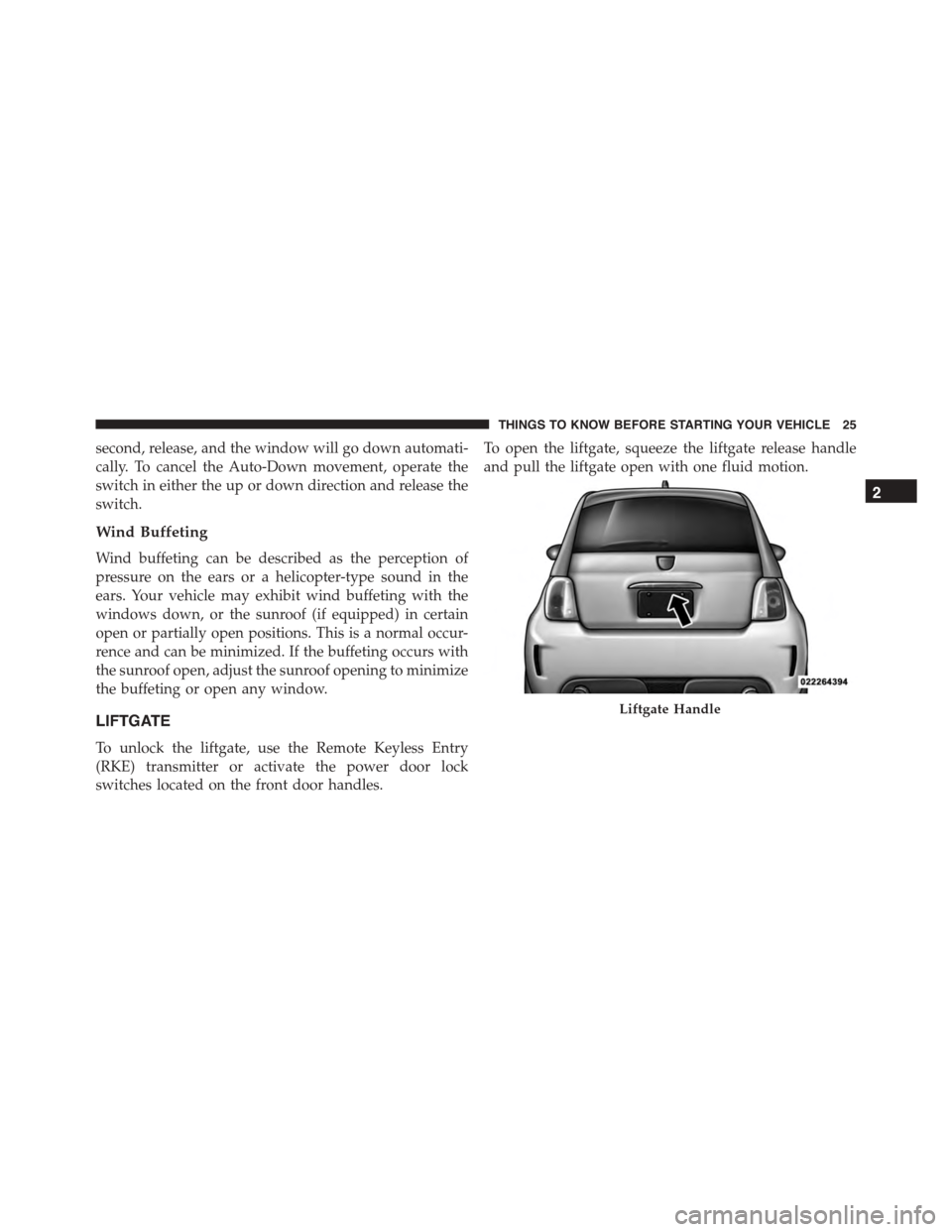
To unlock the liftgate, use the Remote Keyless Entry
(RKE) transmitter or activate the power door lock
switches located on the front door handles.
To open the liftgate, squeeze the liftgate release handle
and pull the liftgate open with one fluid motion.
Liftgate Handle
2
THINGS TO KNOW BEFORE STARTING YOUR VEHICLE 25
Page 28 of 392
WARNING!
•Driving with the liftgate open can allow poisonous
exhaust gases into your vehicle. You and your
passengers could be injured by these fumes. Keep
the liftgate closed when you are operating the
vehicle.
•If you are required to drive with the liftgate open,
make sure that all windows are closed, and the
climate control blower switch is set at high speed.
Do not use the recirculation mode.
Gas props support the liftgate in the open position.
However, because the gas pressure drops with tempera-
ture, it may be necessary to assist the props when
opening the liftgate in cold weather.
OCCUPANT RESTRAINTS
Some of the most important safety features in your
vehicle are the restraint systems:
•Three-point lap and shoulder belts for all seating
positions
•Advanced Front Air Bags for driver and front passen-
ger
•Supplemental Driver Side Knee Air Bag
•Supplemental Side Air Bag Inflatable Curtains (SABIC)
for the driver and passengers seated next to a window
•Supplemental Seat-Mounted Side Air Bags (SAB)
•Knee bolsters/blockers for front seat occupants
•Front seat belts incorporate pretensioners that may
enhance occupant protection by managing occupant
energy during an impact event
26 THINGS TO KNOW BEFORE STARTING YOUR VEHICLE
Page 30 of 392
ride properly buckled up in the rear seat. Never allow
children to slide the shoulder belt behind them or under
their arm.
You should read the instructions provided with your
child restraint to make sure that you are using it properly.
2. All occupants should always wear their lap and
shoulder belts properly.
3. The driver and front passenger seats should be moved
back as far as practical to allow the Advanced Front
Air Bags room to inflate.
4. Do not lean against the door or window. Your vehicle
has Supplemental Side Air Bag Inflatable Curtains
(SABIC) or Supplemental Seat-Mounted Side Air Bags
(SAB), and when deployment occurs, the SABIC and
SAB air bags will inflate forcefully into the space
between you and the door.
5. If the air bag system in this vehicle needs to be
modified to accommodate a disabled person, contact
the Customer Center. Phone numbers are provided in
#If You Need Consumer Assistance.#
WARNING!
•Relying on the air bags alone could lead to more
severe injuries in a collision. The air bags work
with your seat belt to restrain you properly. In
some collisions, the air bags won’t deploy at all.
Always wear your seat belts even though you have
air bags.
(Continued)
28 THINGS TO KNOW BEFORE STARTING YOUR VEHICLE
Page 31 of 392
WARNING!(Continued)
•Being too close to the steering wheel or instrument
panel during Advanced Front Air Bag deployment
could cause serious injury, including death. Air
bags need room to inflate. Sit back, comfortably
extending your arms to reach the steering wheel or
instrument panel.
•Side air bags also need room to inflate. Do not lean
against the door or window. Sit upright in the
center of the seat.
•In a collision, you and your passengers can suffer
much greater injuries if you are not properly buck-
led up. You can strike the interior of your vehicle or
other passengers, or you can be thrown out of the
vehicle. Always be sure you and others in your
vehicle are buckled up properly.
Buckle up even though you are an excellent driver, even
on short trips. Someone on the road may be a poor driver
and cause a collision that includes you. This can happen
far away from home or on your own street.
Research has shown that seat belts save lives, and they
can reduce the seriousness of injuries in a collision. Some
of the worst injuries happen when people are thrown
from the vehicle. Seat belts reduce the possibility of
ejection and the risk of injury caused by striking the
inside of the vehicle. Everyone in a motor vehicle should
be belted at all times.
Lap/Shoulder Belts
All the seating positions in your vehicle are equipped
with combination lap/shoulder belts.
The belt webbing retractor is designed to lock during
very sudden stops or collisions. This feature allows the
shoulder part of the belt to move freely with you under
normal conditions. However in a collision, the belt will
2
THINGS TO KNOW BEFORE STARTING YOUR VEHICLE 29
Page 43 of 392
This vehicle is equipped with Supplemental Side Air Bag
Inflatable Curtains (SABIC) to protect the driver, front,
and rear passengers sitting next to a window. The SABIC
are located above the side windows. The trim covering
the SABIC is labeled SRS AIRBAG.
This vehicle is equipped with Supplemental Seat-
Mounted Side Air Bags (SAB). The SAB are marked with
an air bag label sewn into the outboard side of the front
seats.
NOTE:
•Air Bag covers may not be obvious in the interior trim,
but they will open during air bag deployment.
•After any collision, the vehicle should be taken to an
authorized dealer immediately.
Air Bag System Components
Your vehicle may be equipped with the following air bag
system components:
•Occupant Restraint Controller (ORC)
•Air Bag Warning Light
•Steering Wheel and Column
•Instrument Panel
•Supplemental Driver Side Knee Air Bag
•Knee Impact Bolsters
•Driver Advanced Front Air Bag
•Passenger Advanced Front Air Bag
•Supplemental Seat-Mounted Side Air Bags (SAB)
•Supplemental Side Air Bag Inflatable Curtains (SABIC)
•Front and Side Impact Sensors
•Front Seat Belt Pretensioners, Seat Belt Buckle Switch,
and Seat Track Position Sensors
2
THINGS TO KNOW BEFORE STARTING YOUR VEHICLE 41