automatic transmission FIAT 500 ABARTH 2015 2.G User Guide
[x] Cancel search | Manufacturer: FIAT, Model Year: 2015, Model line: 500 ABARTH, Model: FIAT 500 ABARTH 2015 2.GPages: 426, PDF Size: 9.89 MB
Page 245 of 426
•The transmission will automatically downshift to first
gear when coming to a stop. After a stop, the driver
should manually upshift (+) the transmission as the
vehicle is accelerated.
•You can start out (from a stop) in first, second, or third
gear. Starting out in second or third gear can be helpful
in snow or icy conditions. To select second or third
gear after the vehicle is brought to a stop, tap the shift
lever rearward (+) once or twice.
•The system will ignore shift commands that would
cause engine lugging or overspeed. An audible beep
will sound if an inappropriate gear is requested.
•Avoid using speed control when AutoStick is engaged
because the transmission will not shift automatically.
•Transmission shifting will be more noticeable when
AutoStick is engaged.
•The system may revert to automatic shift mode if a
fault or overheat condition is detected.
To disengage AutoStick mode, return the shift lever to the
DRIVE position. You can shift in or out of the AutoStick
position at any time without taking your foot off the
accelerator pedal.
WARNING!
Do not downshift for additional engine braking on a
slippery surface. The drive wheels could lose their
grip and the vehicle could skid, causing a collision or
personal injury.
5
STARTING AND OPERATING 243
Page 253 of 426
Automatic Transmission — If Equipped
The Sport mode increases steering feedback to the driver
with slight increase in effort and changes the transmis-
sion shift schedules for more aggressive shifting. This
driving mode is useful while driving on twisty roads
where more steering precision is desired in spirited
cornering.
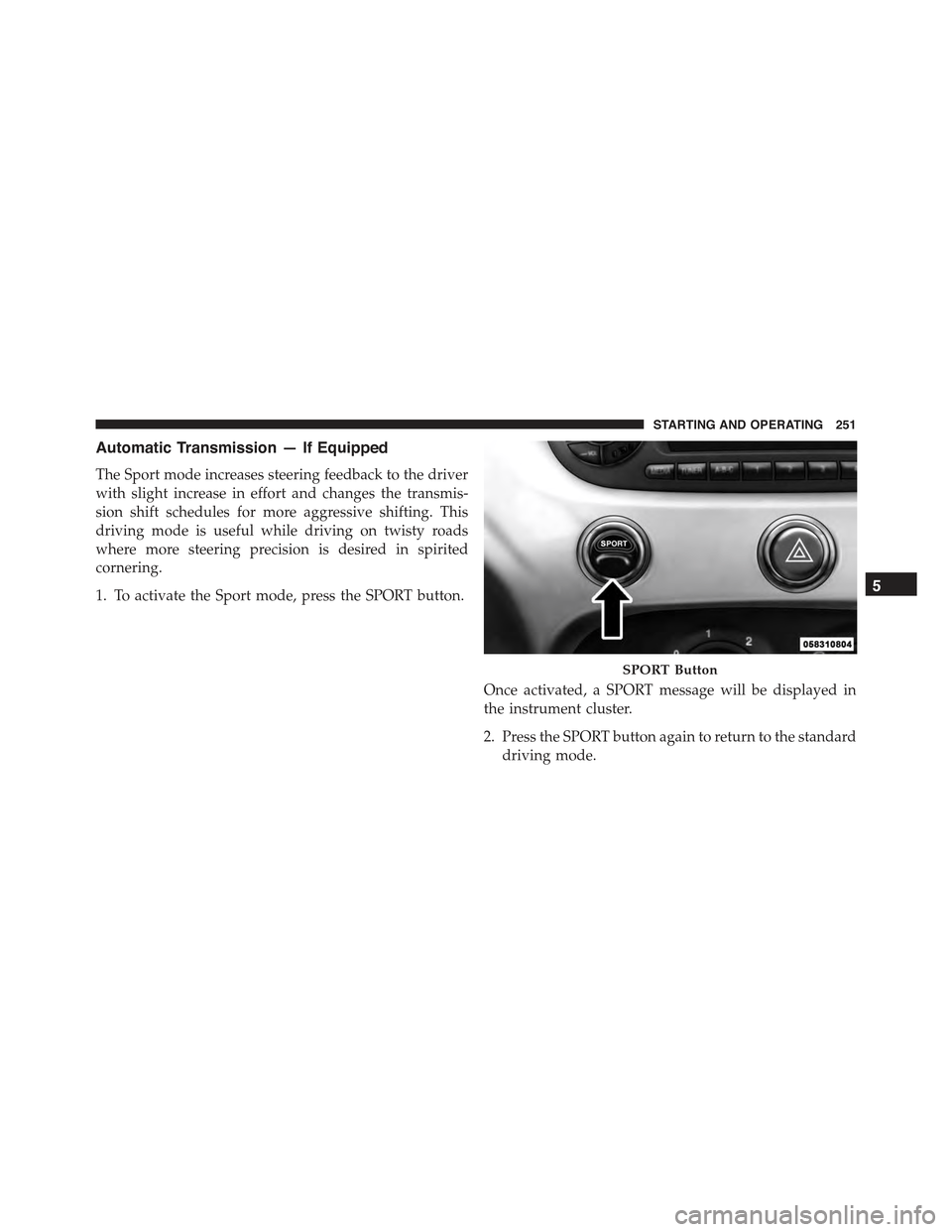
1. To activate the Sport mode, press the SPORT button.
Once activated, a SPORT message will be displayed in
the instrument cluster.
2. Press the SPORT button again to return to the standard
driving mode.
SPORT Button
5
STARTING AND OPERATING 251
Page 257 of 426
wheel(s) and engine power is reduced to provide en-
hanced acceleration and stability. A feature of the TCS
system, Brake Limited Differential (BLD), functions simi-
lar to a limited slip differential and controls the wheel
spin across a driven axle. If one wheel on a driven axle is
spinning faster than the other, the system will apply the
brake of the spinning wheel. This will allow more engine
torque to be applied to the wheel that is not spinning.
This feature remains active even if TCS and ESC are in
the Partial Off mode or Full Off mode. Refer to “Elec-
tronic Stability Control (ESC)” in this section for further
information.
Hill Start Assist (HSA)
The HSA system is designed to assist the driver when
starting a vehicle from a stop on a hill. HSA will maintain
the level of brake pressure the driver applied for a short
period of time after the driver takes his foot off the brake
pedal. If the driver does not apply the throttle during this
short period of time, the system will release brake
pressure and the vehicle will roll down the hill. The
system will release brake pressure in proportion to the
amount of throttle applied as the vehicle starts to move in
the intended direction of travel.
HSA Activation Criteria
The following criteria must be met in order for HSA to
activate:
•Vehicle must be stopped.
•Vehicle must be on a 2.5% (manual transmission) or
7% grade or greater (automatic transmission) grade
hill.
•Gear selection matches vehicle uphill direction (i.e.,
vehicle in NEUTRAL [manual transmission], vehicle
facing uphill is in forward gear; vehicle backing uphill
is in REVERSE gear).
5
STARTING AND OPERATING 255
Page 259 of 426
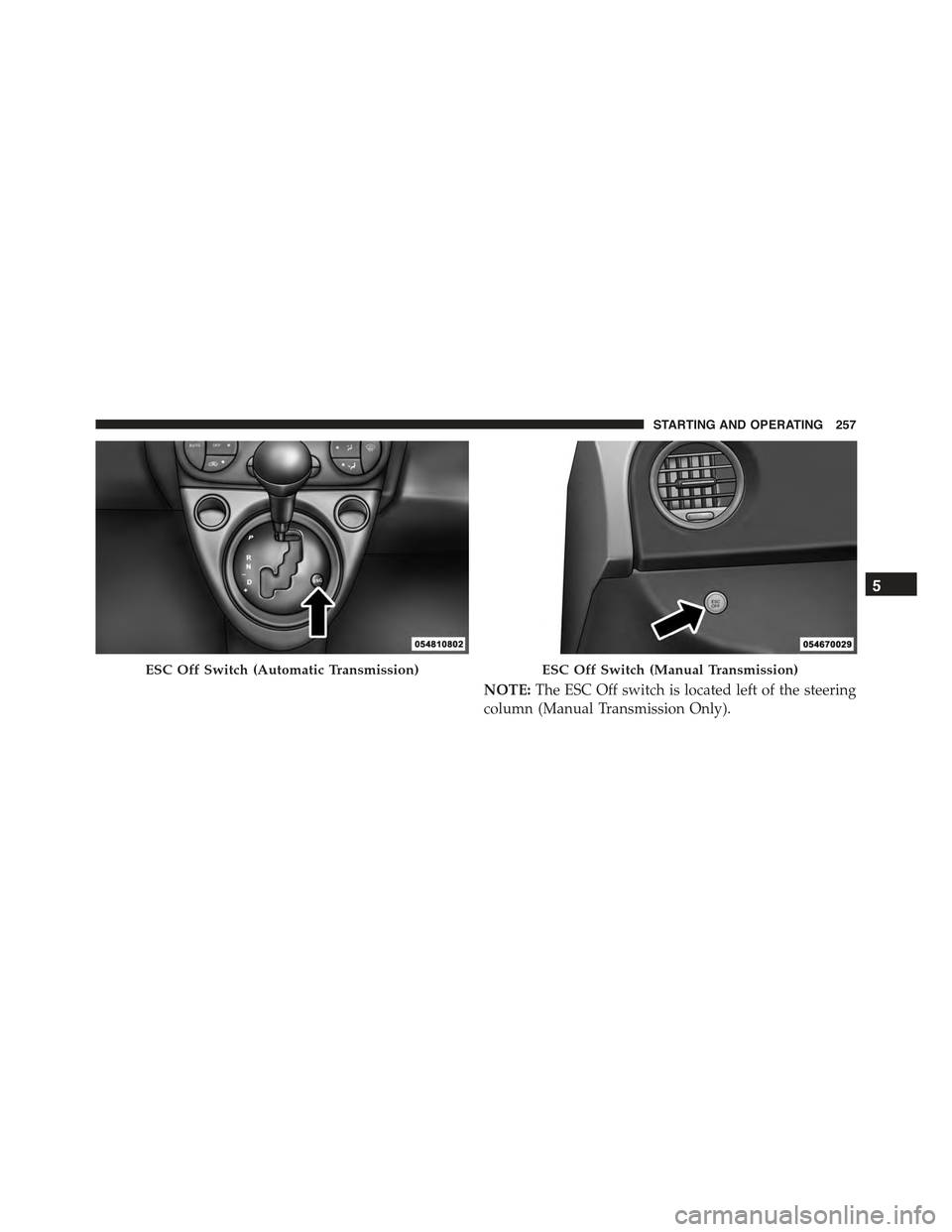
NOTE:The ESC Off switch is located left of the steering
column (Manual Transmission Only).
ESC Off Switch (Automatic Transmission)ESC Off Switch (Manual Transmission)
5
STARTING AND OPERATING 257
Page 304 of 426
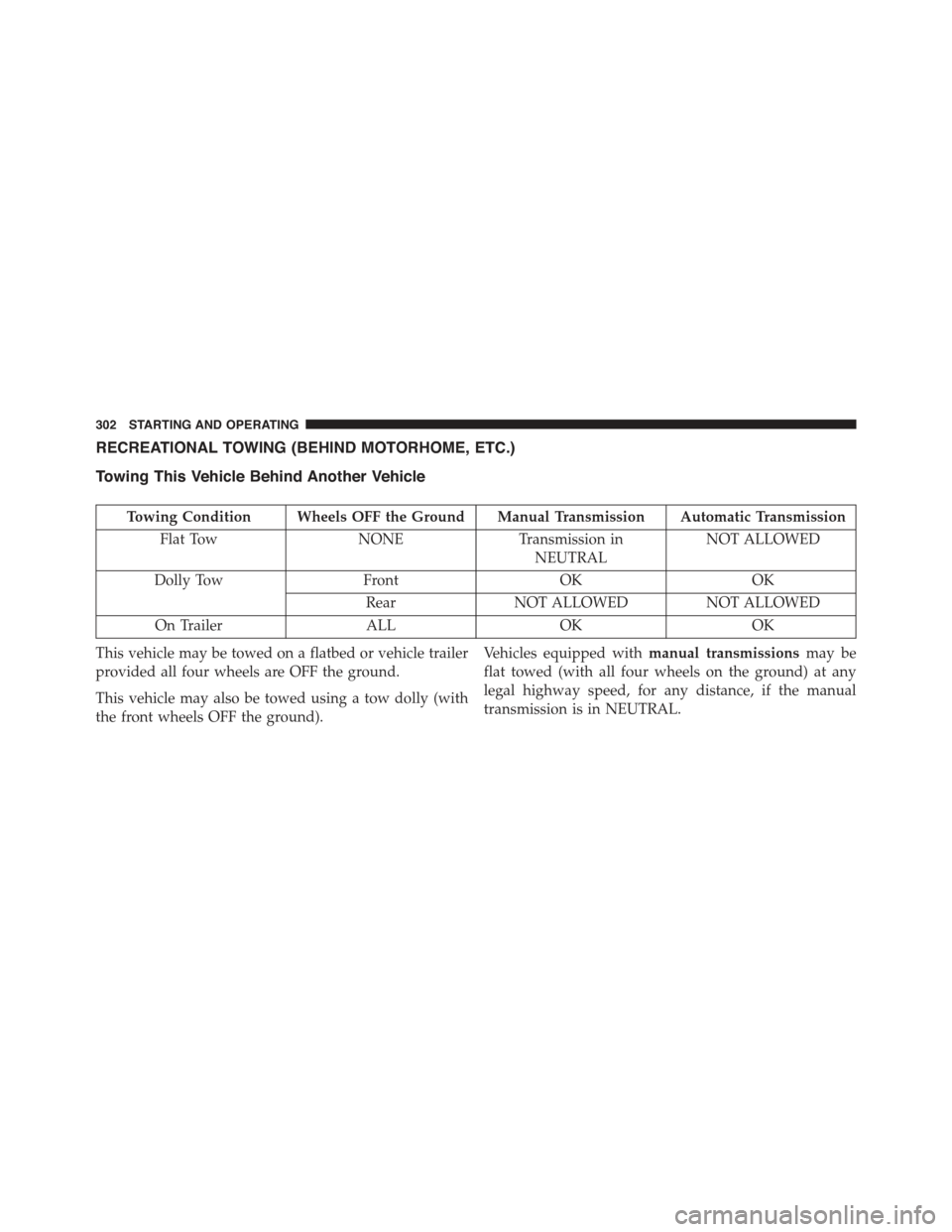
RECREATIONAL TOWING (BEHIND MOTORHOME, ETC.)
Towing This Vehicle Behind Another Vehicle
Towing Condition Wheels OFF the Ground Manual Transmission Automatic Transmission
Flat TowNONETransmission in
NEUTRAL
NOT ALLOWED
Dolly TowFrontOKOK
RearNOT ALLOWEDNOT ALLOWED
On TrailerALLOKOK
This vehicle may be towed on a flatbed or vehicle trailer
provided all four wheels are OFF the ground.
This vehicle may also be towed using a tow dolly (with
the front wheels OFF the ground).
Vehicles equipped withmanual transmissionsmay be
flat towed (with all four wheels on the ground) at any
legal highway speed, for any distance, if the manual
transmission is in NEUTRAL.
302 STARTING AND OPERATING
Page 305 of 426
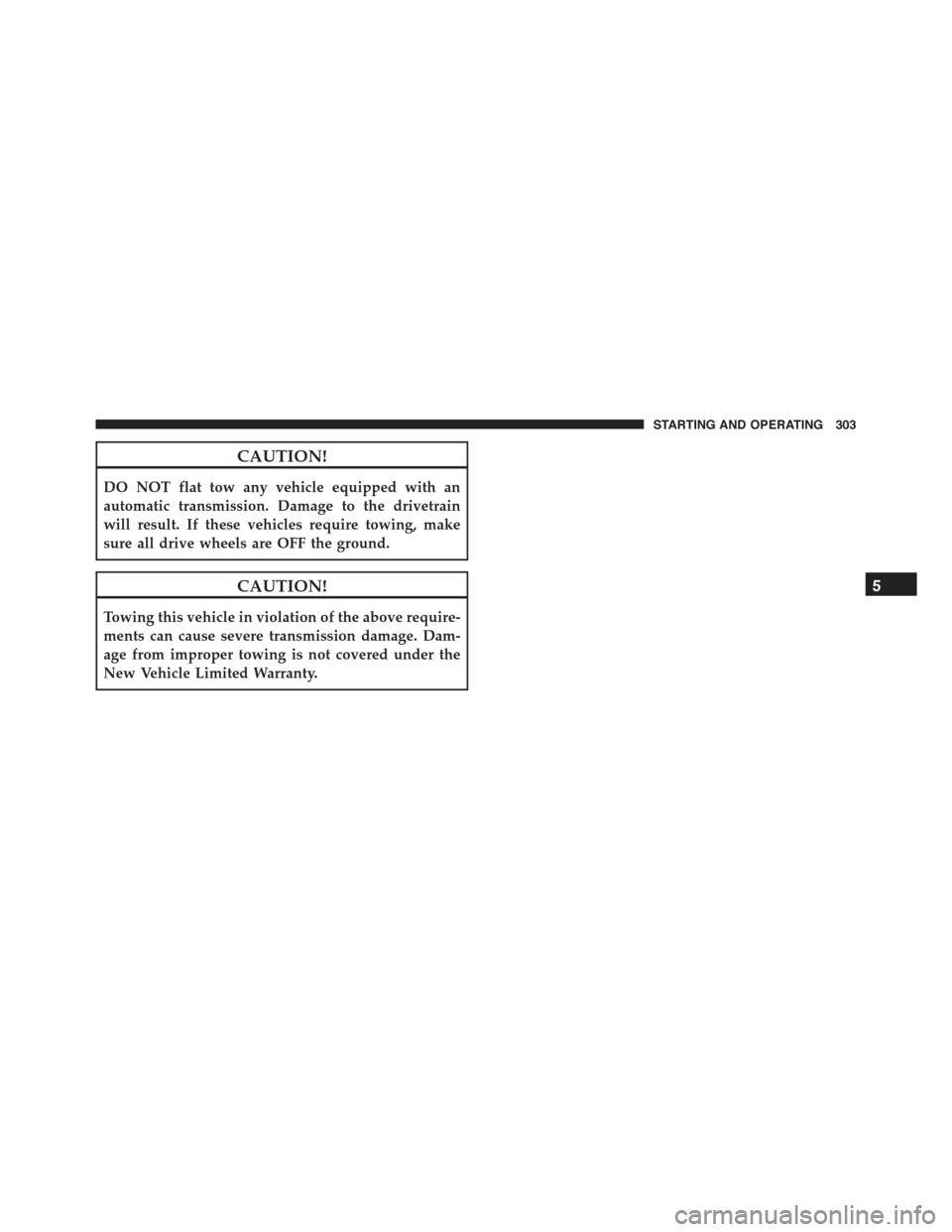
CAUTION!
DO NOT flat tow any vehicle equipped with an
automatic transmission. Damage to the drivetrain
will result. If these vehicles require towing, make
sure all drive wheels are OFF the ground.
CAUTION!
Towing this vehicle in violation of the above require-
ments can cause severe transmission damage. Dam-
age from improper towing is not covered under the
New Vehicle Limited Warranty.
5
STARTING AND OPERATING 303
Page 308 of 426
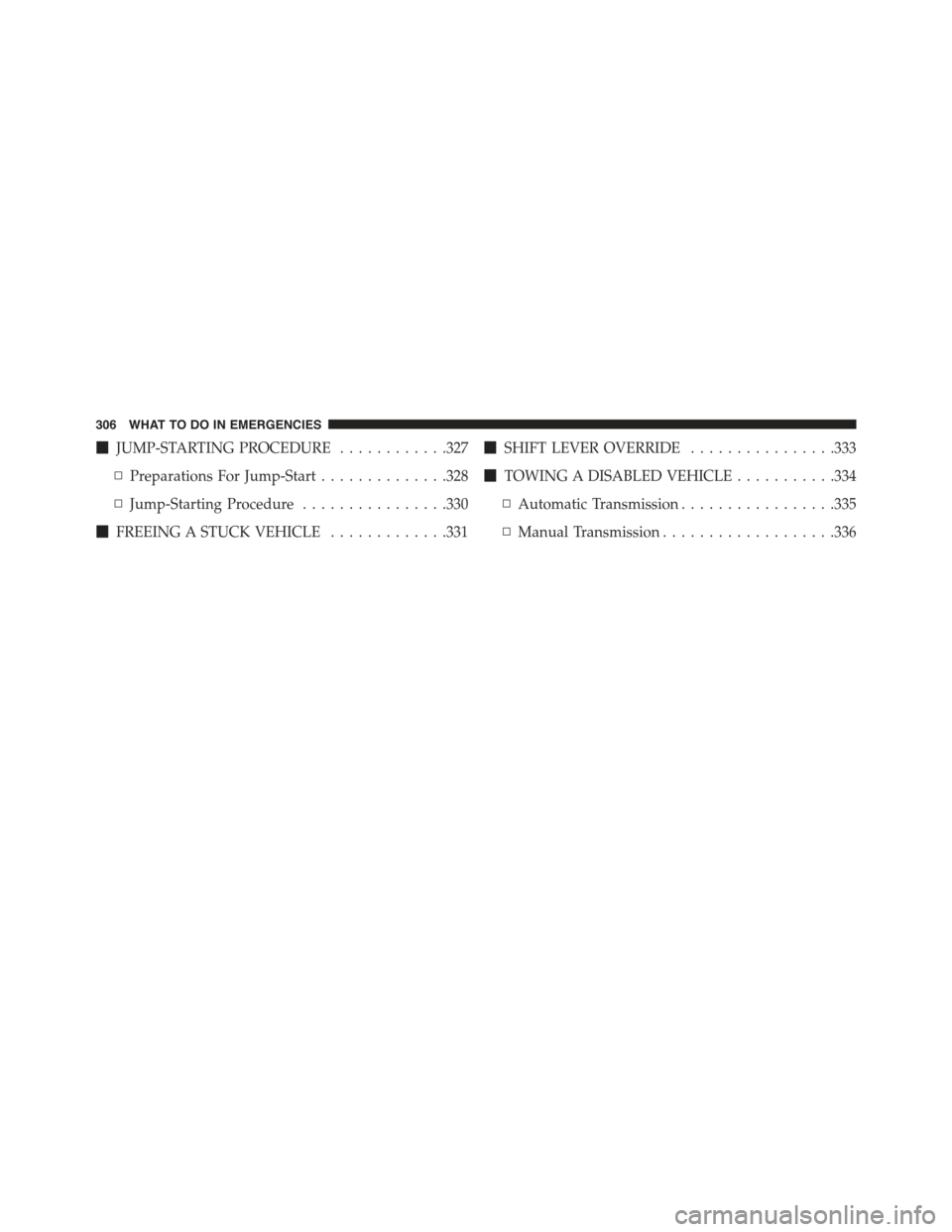
!JUMP-STARTING PROCEDURE............327
▫Preparations For Jump-Start..............328
▫Jump-Starting Procedure................330
!FREEING A STUCK VEHICLE.............331
!SHIFT LEVER OVERRIDE................333
!TOWING A DISABLED VEHICLE...........334
▫Automatic Transmission.................335
▫Manual Transmission...................336
306 WHAT TO DO IN EMERGENCIES
Page 325 of 426
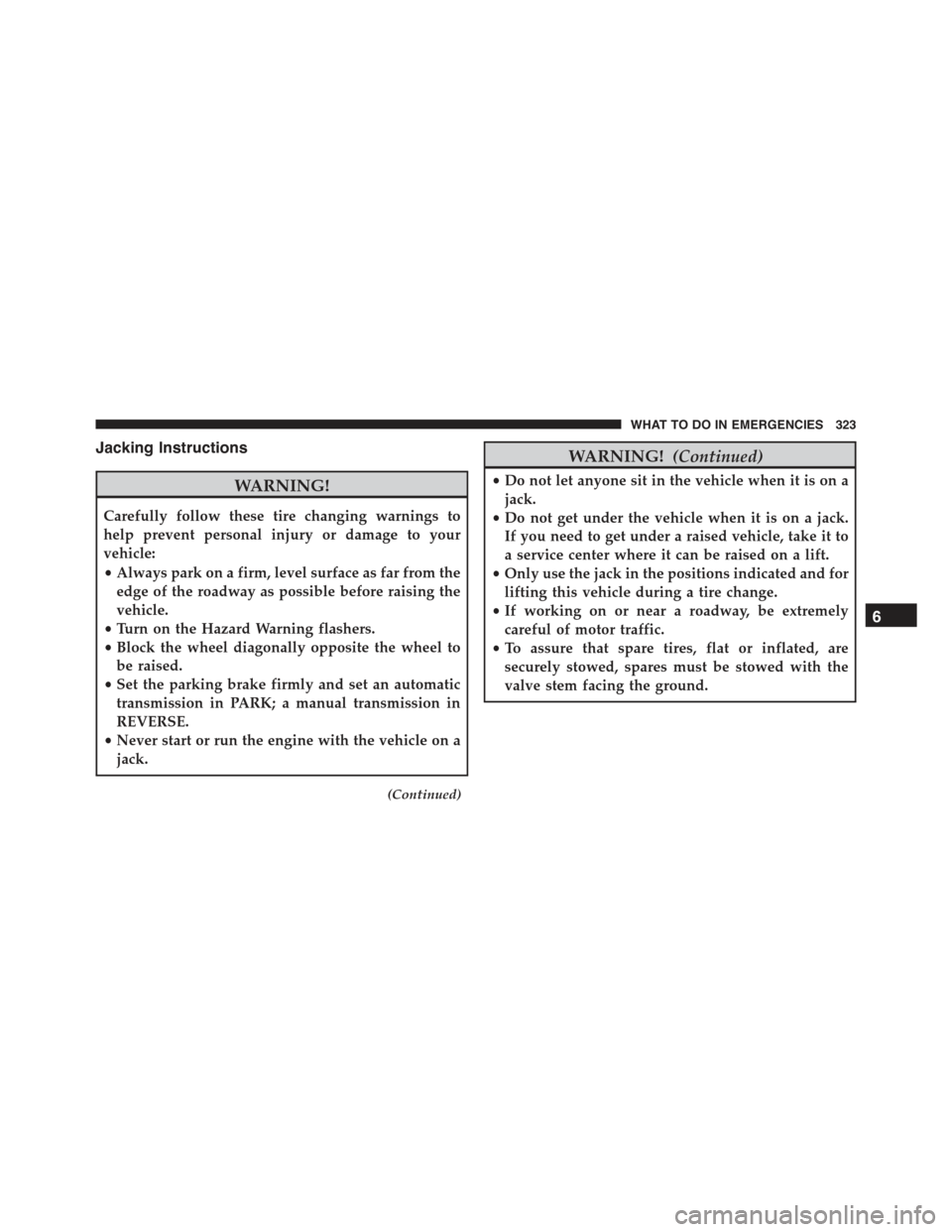
Jacking Instructions
WARNING!
Carefully follow these tire changing warnings to
help prevent personal injury or damage to your
vehicle:
•Always park on a firm, level surface as far from the
edge of the roadway as possible before raising the
vehicle.
•Turn on the Hazard Warning flashers.
•Block the wheel diagonally opposite the wheel to
be raised.
•Set the parking brake firmly and set an automatic
transmission in PARK; a manual transmission in
REVERSE.
•Never start or run the engine with the vehicle on a
jack.
(Continued)
WARNING!(Continued)
•Do not let anyone sit in the vehicle when it is on a
jack.
•Do not get under the vehicle when it is on a jack.
If you need to get under a raised vehicle, take it to
a service center where it can be raised on a lift.
•Only use the jack in the positions indicated and for
lifting this vehicle during a tire change.
•If working on or near a roadway, be extremely
careful of motor traffic.
•To assure that spare tires, flat or inflated, are
securely stowed, spares must be stowed with the
valve stem facing the ground.
6
WHAT TO DO IN EMERGENCIES 323
Page 333 of 426
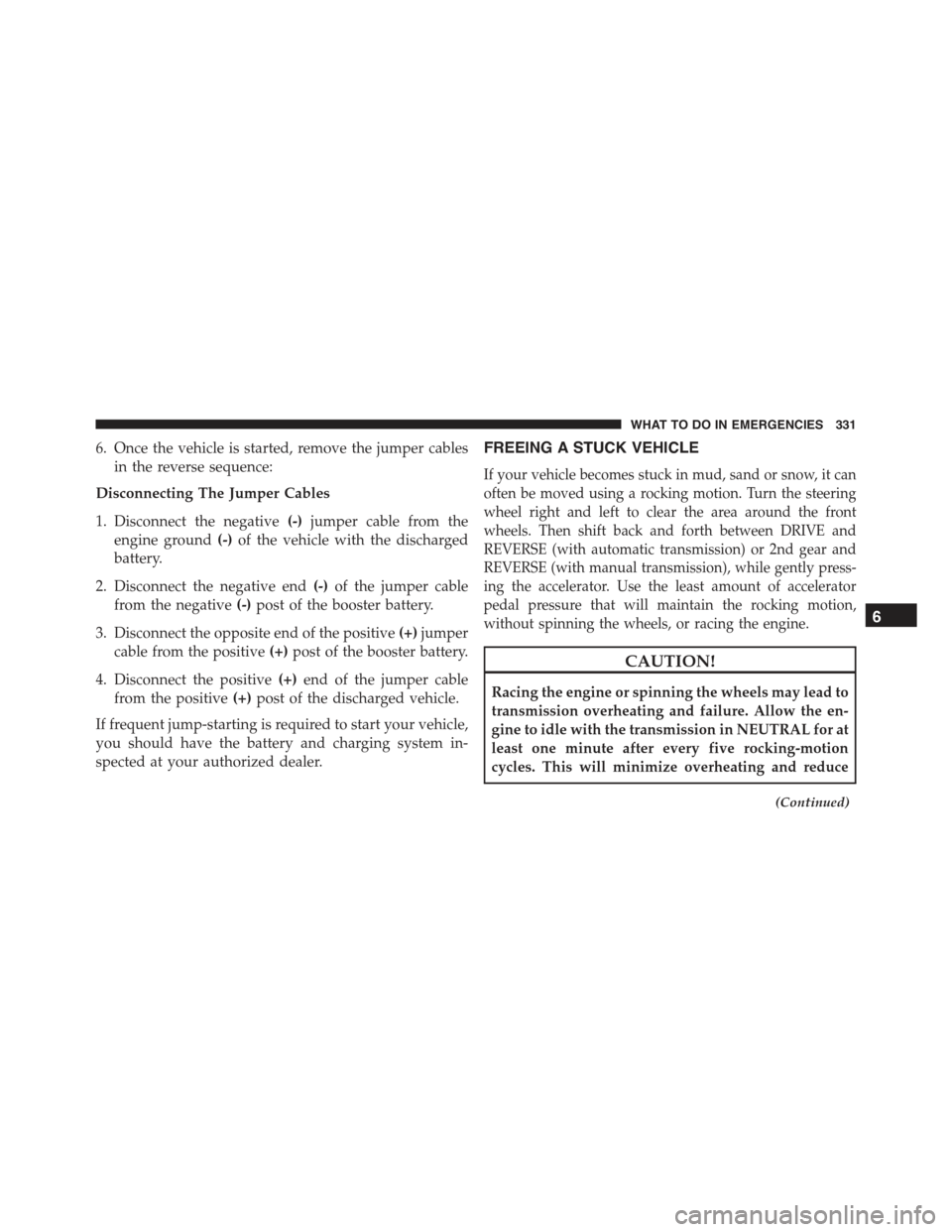
6. Once the vehicle is started, remove the jumper cables
in the reverse sequence:
Disconnecting The Jumper Cables
1. Disconnect the negative(-)jumper cable from the
engine ground(-)of the vehicle with the discharged
battery.
2. Disconnect the negative end(-)of the jumper cable
from the negative(-)post of the booster battery.
3. Disconnect the opposite end of the positive(+)jumper
cable from the positive(+)post of the booster battery.
4. Disconnect the positive(+)end of the jumper cable
from the positive(+)post of the discharged vehicle.
If frequent jump-starting is required to start your vehicle,
you should have the battery and charging system in-
spected at your authorized dealer.
FREEING A STUCK VEHICLE
If your vehicle becomes stuck in mud, sand or snow, it can
often be moved using a rocking motion. Turn the steering
wheel right and left to clear the area around the front
wheels. Then shift back and forth between DRIVE and
REVERSE (with automatic transmission) or 2nd gear and
REVERSE (with manual transmission), while gently press-
ing the accelerator. Use the least amount of accelerator
pedal pressure that will maintain the rocking motion,
without spinning the wheels, or racing the engine.
CAUTION!
Racing the engine or spinning the wheels may lead to
transmission overheating and failure. Allow the en-
gine to idle with the transmission in NEUTRAL for at
least one minute after every five rocking-motion
cycles. This will minimize overheating and reduce
(Continued)
6
WHAT TO DO IN EMERGENCIES 331
Page 336 of 426
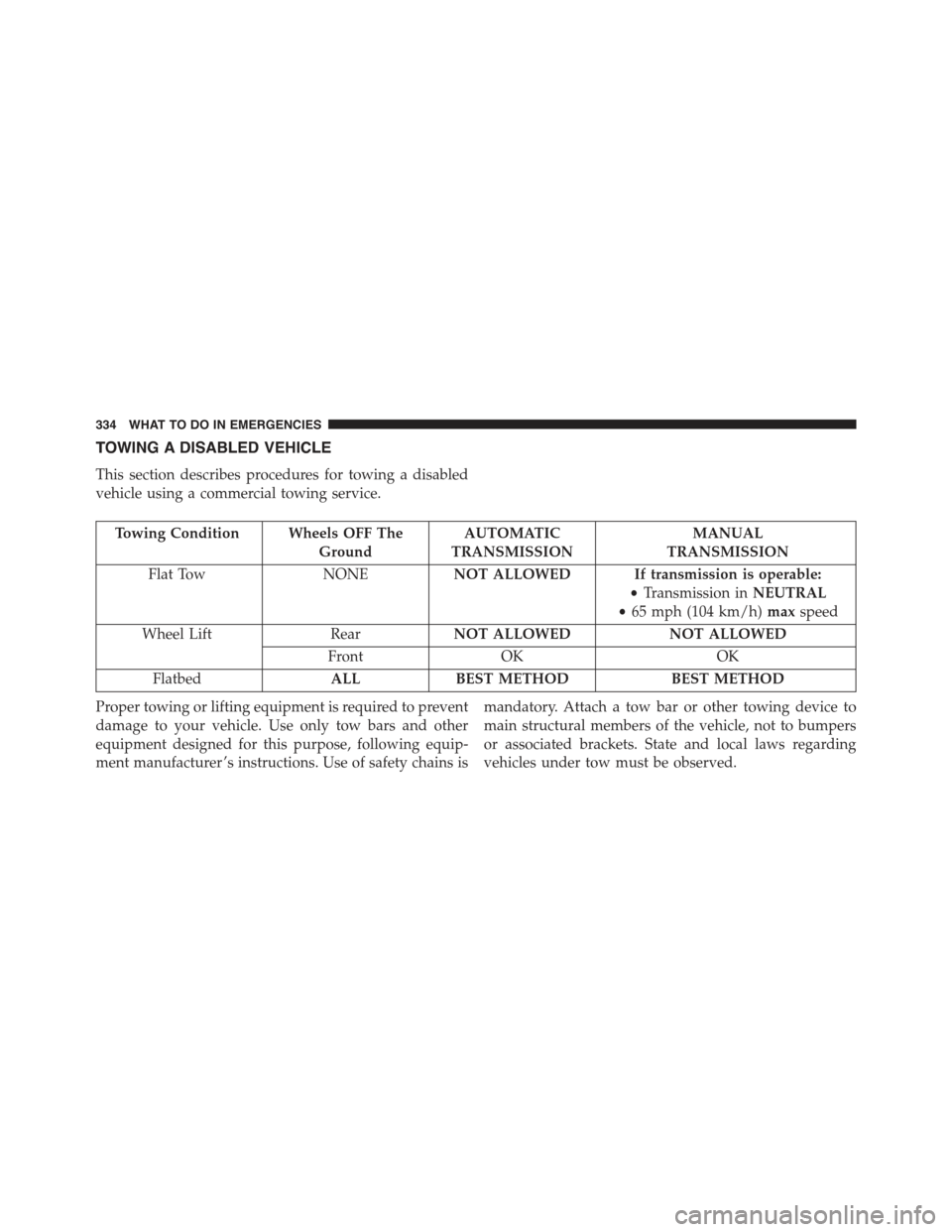
TOWING A DISABLED VEHICLE
This section describes procedures for towing a disabled
vehicle using a commercial towing service.
Towing Condition Wheels OFF The
Ground
AUTOMATIC
TRANSMISSION
MANUAL
TRANSMISSION
Flat Tow NONENOT ALLOWED If transmission is operable:
•Transmission inNEUTRAL
•65 mph (104 km/h)maxspeed
Wheel LiftRearNOT ALLOWEDNOT ALLOWED
FrontOKOK
FlatbedALLBEST METHODBEST METHOD
Proper towing or lifting equipment is required to prevent
damage to your vehicle. Use only tow bars and other
equipment designed for this purpose, following equip-
ment manufacturer ’s instructions. Use of safety chains is
mandatory. Attach a tow bar or other towing device to
main structural members of the vehicle, not to bumpers
or associated brackets. State and local laws regarding
vehicles under tow must be observed.
334 WHAT TO DO IN EMERGENCIES