brake FIAT 500 ABARTH 2015 2.G User Guide
[x] Cancel search | Manufacturer: FIAT, Model Year: 2015, Model line: 500 ABARTH, Model: FIAT 500 ABARTH 2015 2.GPages: 426, PDF Size: 9.89 MB
Page 182 of 426
Hill Start Assist
This function is used when starting a vehicle from a stop
on a hill. Hill Start Assist maintains the same level of
brake pressure the driver applied for a short period of
time after the foot has been removed from the brake
pedal.
Proceed as follows to switch this function on or off:
1. Briefly push and release theMENUbutton. Push and
release the UPor DOWNbutton to highlight
the Hill Start Assist. Push and release theMENU
button to enter the Hill Start AssistMENU.
2. Push and release the UPor DOWNbutton for
setting.
3. Briefly push and release theMENUbutton to go back
to the menu screen, or push and hold the button
(approximately one second) to go back to the main
screen without storing the settings.
Tire Pressure
This function will be used to display the tire pressures
individually for all four tires by location.
Proceed as follows:
1. Briefly push and release theMENUbutton. Push and
release the UPor DOWNbutton to highlight
the Tire Pressure. Push and release theMENU
button to enter the Tire PressureMENU.
2. Push and release the UP or DOWN button to scroll
through all four tire pressure value locations.
3. Briefly push and release theMENUbutton to go back
to the menu screen, or push and hold the button
(approximately one second) to go back to the main
screen.
180 UNDERSTANDING YOUR INSTRUMENT PANEL
Page 225 of 426
STARTING AND OPERATING
CONTENTS
!STARTING PROCEDURES................227
▫Manual Transmission — If Equipped.......227
▫Automatic Transmission — If Equipped.....227
▫Normal Starting.......................227
▫Cold Weather Operation................228
▫Extended Park Starting..................228
▫If Engine Fails To Start.................229
▫After Starting........................230
▫Turbocharger “Cool Down”..............230
!MANUAL TRANSMISSION — IF EQUIPPED . . .230
▫Five-Speed Manual Transmission...........230
▫Recommended Shift Speeds..............232
▫Downshifting........................232
!AUTOMATIC TRANSMISSION —
IF EQUIPPED.........................233
▫Key Ignition Park Interlock...............235
▫Brake/Transmission Shift Interlock System . . .235
▫Six-Speed Automatic Transmission.........235
▫Gear Ranges.........................237
5
Page 226 of 426
!AUTOSTICK..........................242
▫Operation...........................242
!DRIVING ON SLIPPERY SURFACES.........244
▫Acceleration.........................244
▫Traction............................244
!DRIVING THROUGH WATER.............245
▫Flowing/Rising Water..................245
▫Shallow Standing Water.................245
!POWER STEERING.....................247
!PARKING BRAKE......................248
!SPORT MODE.........................250
▫Manual Transmission — If Equipped........250
▫Automatic Transmission — If Equipped......251
!BRAKE SYSTEM.......................252
!ELECTRONIC BRAKE CONTROL SYSTEM . . . .252
▫Four-Wheel Anti-Lock Brake System (ABS) . . .252
▫Brake Assist System (BAS)...............254
▫Traction Control System (TCS)............254
▫Hill Start Assist (HSA).................255
▫Electronic Stability Control (ESC)..........256
▫ESC Activation/Malfunction Indicator Light
And ESC OFF Indicator Light............260
!TIRE SAFETY INFORMATION.............261
▫Tire Markings........................261
▫Tire Identification Number (TIN)...........264
▫Tire Terminology And Definitions..........266
224 STARTING AND OPERATING
Page 229 of 426
STARTING PROCEDURES
Before starting your vehicle, adjust your seat, adjust both
inside and outside mirrors, and fasten your seat belts.
WARNING!
•Never leave children alone in a vehicle, or with
access to an unlocked vehicle.
•Allowing children to be in a vehicle unattended is
dangerous for a number of reasons. A child or
others could be seriously or fatally injured. Chil-
dren should be warned not to touch the parking
brake, brake pedal or the shift lever.
•Do not leave the Key Fob in or near the vehicle (or
in a location accessible to children). A child could
operate power windows, other controls, or move
the vehicle.
Manual Transmission — If Equipped
Apply the parking brake, place the shift lever in NEU-
TRAL, and press the clutch pedal before starting the
vehicle. This vehicle is equipped with a clutch interlock-
ing ignition system. It will not start unless the clutch
pedal is pressed to the floor.
Automatic Transmission — If Equipped
The shift lever must be in the PARK or NEUTRAL
position before you can start the engine. Depress the
brake pedal before shifting to any driving gear.
NOTE:You must press the brake pedal before shifting
out of PARK.
Normal Starting
NOTE:Normal starting of either a cold or a warm engine
is obtained without pumping or pressing the accelerator
pedal.
5
STARTING AND OPERATING 227
Page 232 of 426
After Starting
The idle speed will automatically decrease as the engine
warms up.
Turbocharger “Cool Down”
This vehicle is equipped with an after-run pump to cool
the turbocharger after the engine is shut off. Depending
on the type of driving and the amount of cargo, the pump
will run for up to 10 minutes after the engine has been
shut off to circulate coolant through the turbocharger.
Although the pump is rubber-mounted for quiet opera-
tion, it is normal to hear it running during this time.
MANUAL TRANSMISSION — IF EQUIPPED
Five-Speed Manual Transmission
WARNING!
You or others could be injured if you leave the
vehicle unattended without having the parking
brake fully applied. The parking brake should al-
ways be applied when the driver is not in the vehicle,
especially on an incline.
230 STARTING AND OPERATING
Page 234 of 426
Recommended Shift Speeds
To use your manual transmission for optimal fuel
economy, it should be upshifted as listed in the following
table.
Manual Transmission Recommended Shift Speeds
Units In mph (km/h)
Engine
Size
Accel-
era-
tion
Rate
1to2 2to3 3to4 4to5
1.4L
Turbo
Accel 14
(23)
23
(37)
29
(47)
38
(61)
Cruise 12
(19)
18
(29)
25
(40)
32
(52)
Downshifting
Proper downshifting will improve fuel economy and
prolong engine life.
CAUTION!
If you skip a gear while downshifting or downshift
at too high of a vehicle speed, these conditions may
cause the engine to overspeed if too low of a gear is
selected and the clutch pedal is released. Damage to
the clutch and the transmission can result from
skipping a gear while downshifting or downshifting
at too high of a vehicle speed even if the clutch pedal
is held pressed (i.e., not released).
To maintain a safe speed and prolong brake life, shift
down to second or first gear when descending a steep
grade.
232 STARTING AND OPERATING
Page 235 of 426
When turning a corner or driving up a steep grade,
downshift early so that the engine will not be overbur-
dened.
AUTOMATIC TRANSMISSION — IF EQUIPPED
CAUTION!
Damage to the transmission may occur if the follow-
ing precautions are not observed:
•Shift into or out of PARK or REVERSE only after
the vehicle has come to a complete stop.
•Do not shift between PARK, REVERSE, NEU-
TRAL, or DRIVE when the engine is above idle
speed.
•Before shifting into any gear, make sure your foot
is firmly pressing the brake pedal.
NOTE:You must press and hold the brake pedal while
shifting out of PARK.
WARNING!
•It is dangerous to shift out of PARK or NEUTRAL
if the engine speed is higher than idle speed. If
your foot is not firmly pressing the brake pedal, the
vehicle could accelerate quickly forward or in re-
verse. You could lose control of the vehicle and hit
someone or something. Only shift into gear when
the engine is idling normally and your foot is
firmly pressing the brake pedal.
(Continued)
5
STARTING AND OPERATING 233
Page 236 of 426
WARNING!(Continued)
•Unintended movement of a vehicle could injure
those in or near the vehicle. As with all vehicles,
you should never exit a vehicle while the engine is
running. Before exiting a vehicle, always apply the
parking brake, shift the transmission into PARK,
turn the engine OFF, and remove the ignition key.
Once the key is removed, the transmission is
locked in PARK, securing the vehicle against un-
wanted movement.
•When leaving the vehicle, always remove the igni-
tion key from the vehicle and lock the vehicle.
(Continued)
WARNING!(Continued)
•Never leave children alone in a vehicle, or with
access to an unlocked vehicle. Allowing children to
be in a vehicle unattended is dangerous for a
number of reasons. A child or others could be
seriously or fatally injured. Children should be
warned not to touch the parking brake, brake pedal
or the transmission gear selector.
•Do not leave the ignition key in or near the vehicle
(or in a location accessible to children). A child
could operate power windows, other controls, or
move the vehicle.
234 STARTING AND OPERATING
Page 237 of 426
Key Ignition Park Interlock
This vehicle is equipped with a Key Ignition Park Inter-
lock which requires the transmission to be in PARK
before the ignition switch can be turned to the LOCK/
OFF (key removal) position. The key can only be re-
moved from the ignition when the ignition is in the
LOCK/OFF position, and once removed, the transmis-
sion is locked in PARK.
Brake/Transmission Shift Interlock System
This vehicle is equipped with a Brake Transmission Shift
Interlock System (BTSI) that holds the shift lever in PARK
unless the brakes are applied. To shift the transmission
out of PARK, the ignition switch must be turned to the
ON/RUN position (engine running or not) and the brake
pedal must be pressed.
Six-Speed Automatic Transmission
The transmission gear position display (located in the
instrument cluster) indicates the transmission gear range.
You must press the brake pedal to move the shift lever
out of PARK (Refer to “Brake/Transmission Shift Inter-
lock System” in this section). To drive, move the shift
lever from PARK or NEUTRAL to the DRIVE position.
The electronically-controlled transmission provides a
precise shift schedule. The transmission electronics are
self-calibrating; therefore, the first few shifts on a new
vehicle may be somewhat abrupt. This is a normal
condition, and precision shifts will develop within a few
hundred miles (kilometers).
5
STARTING AND OPERATING 235
Page 238 of 426
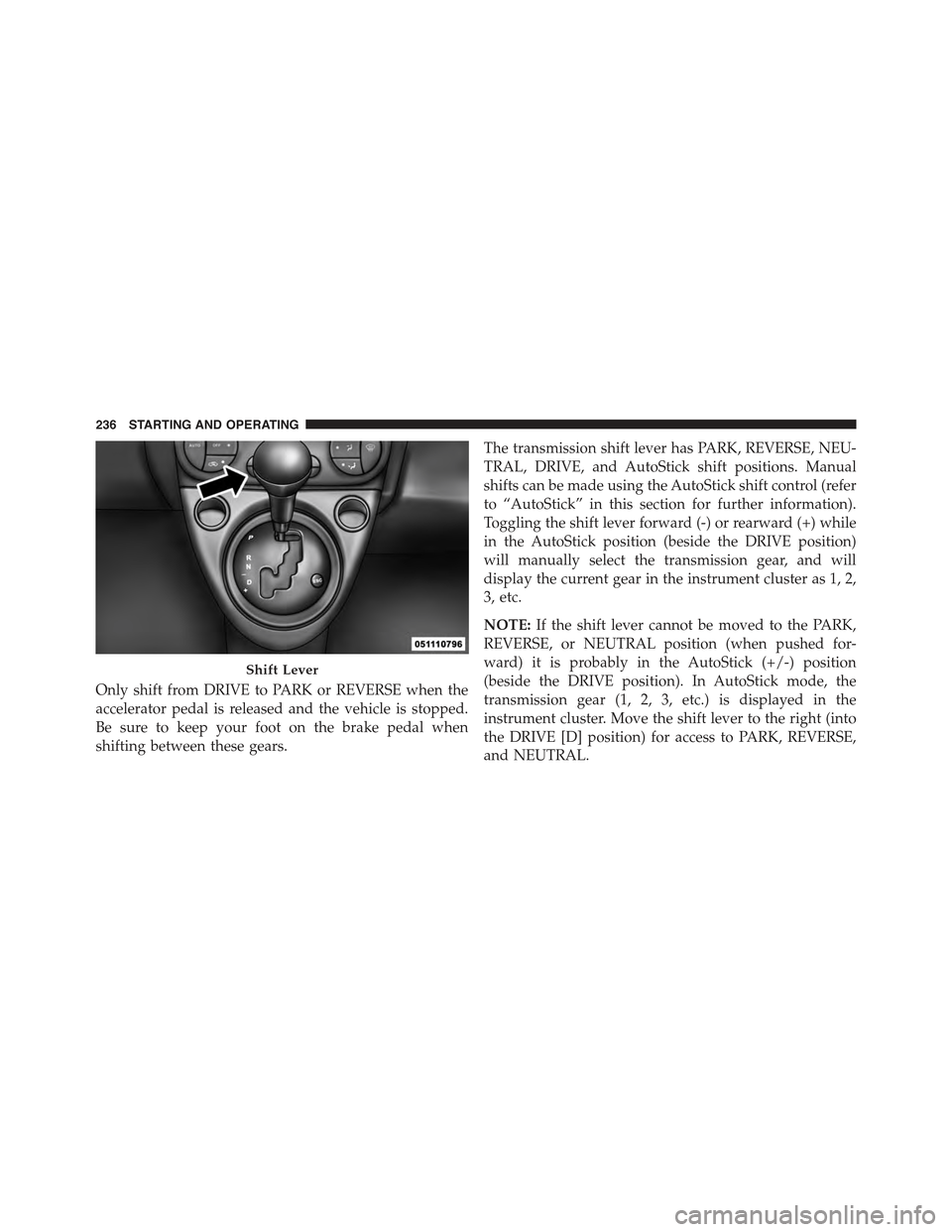
Only shift from DRIVE to PARK or REVERSE when the
accelerator pedal is released and the vehicle is stopped.
Be sure to keep your foot on the brake pedal when
shifting between these gears.
The transmission shift lever has PARK, REVERSE, NEU-
TRAL, DRIVE, and AutoStick shift positions. Manual
shifts can be made using the AutoStick shift control (refer
to “AutoStick” in this section for further information).
Toggling the shift lever forward (-) or rearward (+) while
in the AutoStick position (beside the DRIVE position)
will manually select the transmission gear, and will
display the current gear in the instrument cluster as 1, 2,
3, etc.
NOTE:If the shift lever cannot be moved to the PARK,
REVERSE, or NEUTRAL position (when pushed for-
ward) it is probably in the AutoStick (+/-) position
(beside the DRIVE position). In AutoStick mode, the
transmission gear (1, 2, 3, etc.) is displayed in the
instrument cluster. Move the shift lever to the right (into
the DRIVE [D] position) for access to PARK, REVERSE,
and NEUTRAL.
Shift Lever
236 STARTING AND OPERATING