climate control FIAT 500 ABARTH CABRIO 2017 2.G User Guide
[x] Cancel search | Manufacturer: FIAT, Model Year: 2017, Model line: 500 ABARTH CABRIO, Model: FIAT 500 ABARTH CABRIO 2017 2.GPages: 338, PDF Size: 2.78 MB
Page 179 of 338
NOTE:In cold weather, use of recirculation mode may
lead to excessive window fogging. The recirculation
feature may be unavailable (button on the touchscreen
greyed out) if conditions exist that could create fogging
on the inside of the windshield. On systems with
Manual Climate Controls, the Recirculation mode is not
allowed in Defrost mode to improve window clearing
operation. Recirculation will be disabled automatically
if this mode is selected. Attempting to use Recirculation
while in this mode will cause the LED in the control
button to blink and then turn off.
Automatic Temperature Control (ATC) — If
Equipped
Automatic Operation
1. Push the AUTO button on the faceplate, or the AUTO button on the touchscreen on the Automatic Tem-
perature Control (ATC) Panel.
2. Next, adjust the temperature you would like the system to maintain by adjusting the driver and
passenger temperature control buttons. Once the
desired temperature is displayed, the system will
achieve and automatically maintain that comfort
level. 3. When the system is set up for your comfort level, it
is not necessary to change the settings. You will
experience the greatest efficiency by simply allowing
the system to function automatically.
NOTE:
• It is not necessary to move the temperature settings
for cold or hot vehicles. The system automatically
adjusts the temperature, mode, and blower speed to
provide comfort as quickly as possible.
• The temperature can be displayed in U.S. or Metric
units by selecting the US/Metric customer-
programmable feature. Refer to the “Customer Pro-
grammable Features — Uconnect System Settings” in
this section of the manual.
To provide you with maximum comfort in the Auto-
matic mode during cold start-ups, the blower fan will
remain on low until the engine warms up. The blower
will increase in speed and transition into Auto mode.
4
UNDERSTANDING YOUR INSTRUMENT PANEL 177
Page 181 of 338
Outside Air Intake
Make sure the air intake, located directly in front of the
windshield, is free of obstructions such as leaves.
Leaves collected in the air intake may reduce airflow,
and if they enter the plenum, they could plug the water
drains. In winter months, make sure the air intake is
clear of ice, slush, and snow.
A/C Air Filter
The climate control system filters out dust and pollen
from the air. Contact your authorized dealer to service
your A/C air filter, and to have it replaced when
needed.
4
UNDERSTANDING YOUR INSTRUMENT PANEL 179
Page 233 of 338
All passenger vehicle tires must conform to Federal
safety requirements in addition to these grades.
Treadwear
The Treadwear grade is a comparative rating, based on
the wear rate of the tire when tested under controlled
conditions on a specified government test course. For
example, a tire graded 150 would wear one and one-
half times as well on the government course as a tire
graded 100. The relative performance of tires depends
upon the actual conditions of their use, however, and
may depart significantly from the norm due to varia-
tions in driving habits, service practices, and differences
in road characteristics and climate.
Traction Grades
The Traction grades, from highest to lowest, are AA, A,
B, and C. These grades represent the tire’s ability to stop
on wet pavement, as measured under controlled condi-
tions on specified government test surfaces of asphalt
and concrete. A tire marked C may have poor traction
performance.
WARNING!
The traction grade assigned to this tire is based on
straight-ahead braking traction tests, and does not
include acceleration, cornering, hydroplaning, or
peak traction characteristics.
Temperature Grades
The temperature grades are A (the highest), B, and C,
representing the tire’s resistance to the generation of
heat and its ability to dissipate heat, when tested under
controlled conditions on a specified indoor laboratory
test wheel. Sustained high temperature can cause the
material of the tire to degenerate and reduce tire life,
and excessive temperature can lead to sudden tire
failure. The grade C corresponds to a level of perfor-
mance, which all passenger vehicle tires must meet
under the Federal Motor Vehicle Safety Standard No.
109. Grades B and A represent higher levels of perfor-
mance on the laboratory test wheel, than the minimum
required by law.
5
STARTING AND OPERATING 231
Page 302 of 338
CavityVehicle Fuse
Number Mini Fuse
Description
1 F127.5 Amp Brown Right Low Beam
2 F325 Amp Tan Front and Rear Ceiling Lights Trunk and
Door Courtesy Lights
3 F535 Amp Tan Instrument Panel Node
4 F3820 Amp Yellow Central Door Locking
5 F3610 Amp Red Diagnostic Socket, Vehicle Radio, Climate
Control System
6 F4320 Amp Yellow Bi-Directional Washer
7 F4820 Amp Yellow Passenger Power Window
8 F137.5 Amp Brown Left Low Beam, Headlamp Leveling
9 F507.5 Amp Brown Airbag
10 F515 Amp Tan Vehicle Radio Switch, Climate Control
System, Stop Light, Clutch
11 F375 Amp Tan Stop Light Switch, Instrument Panel Node
12 F495 Amp Tan Exterior Mirror, GPS, Electric Mirror,
Parking Sensor
13 F315 Amp Tan Ignition, Climate Control
14 F4720 Amp Yellow Driver Power Window
300 MAINTAINING YOUR VEHICLE
Page 327 of 338
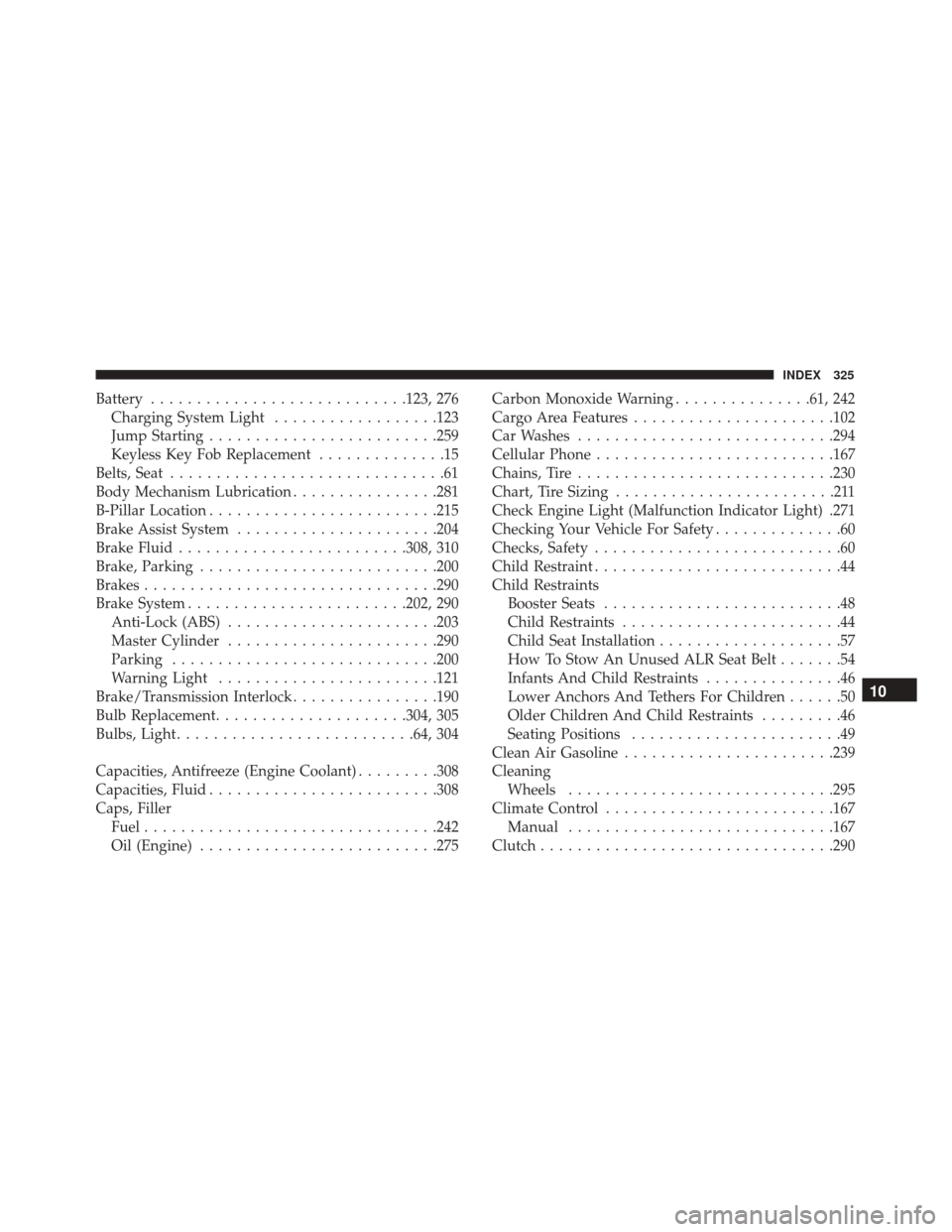
Battery........................... .123, 276
Charging System Light ..................123
Jump Starting ........................ .259
Keyless Key Fob Replacement ..............15
Belts, Seat ..............................61
Body Mechanism Lubrication ................281
B-Pillar Location ........................ .215
Brake Assist System ..................... .204
Brake Fluid ........................ .308, 310
Brake, Parking ......................... .200
Brakes ............................... .290
Brake System ....................... .202, 290
Anti-Lock (ABS) ...................... .203
Master Cylinder ...................... .290
Parking ............................ .200
Warning Light ....................... .121
Brake/Transmission Interlock ................190
Bulb Replacement .....................304, 305
Bulbs, Light ......................... .64, 304
Capacities, Antifreeze (Engine Coolant) .........308
Capacities, Fluid ........................ .308
Caps, Filler Fuel ............................... .242
Oil (Engine) ......................... .275Carbon Monoxide Warning
...............61, 242
Cargo Area Features ..................... .102
Car Washes ........................... .294
Cellular Phone ......................... .167
Chains, Tire ........................... .230
Chart, Tire Sizing ........................211
Check Engine Light (Malfunction Indicator Light) .271
Checking Your Vehicle For Safety ..............60
Checks, Safety ...........................60
Child Restraint ...........................44
Child Restraints Booster Seats ..........................48
Child Restraints ........................44
Child Seat Installation ....................57
How To Stow An Unused ALR Seat Belt .......54
Infants And Child Restraints ...............46
Lower
Anchors And Tethers For Children ......50
Older Children And Child Restraints .........46
Seating Positions .......................49
Clean Air Gasoline ...................... .239
Cleaning Wheels ............................ .295
Climate Control ........................ .167
Manual ............................ .167
Clutch ............................... .29010
INDEX 325