warning FIAT 500 ABARTH CABRIO 2017 2.G Service Manual
[x] Cancel search | Manufacturer: FIAT, Model Year: 2017, Model line: 500 ABARTH CABRIO, Model: FIAT 500 ABARTH CABRIO 2017 2.GPages: 338, PDF Size: 2.78 MB
Page 71 of 338
NOTE:
•Vertical movement only operates in auto open/close
mode.
• If you are traveling at speeds above 50 mph
(80 km/h) and wish to open the top, it will open to
only three-quarter of the way.
Raising The Power Top
Auto Close
From the convertible top fully open position, push the
top close button for approximately one second for the
three-quarter open/spoiler position. Push the top close
button for approximately one second a second time for
the one-quarter open position. Push and hold close
button to fully close convertible top.
Manual Close
For manual close, push and hold the close button until
desired position until one-quarter open position. Push
and hold again for full close position. NOTE:
•
If the top is three-quarter of the way open, you can
close the top if vehicle speeds are above 50 mph
(80 km/h).
• If the top is fully open and the vehicle is traveling at
50 mph (80 km/h) or above, it will not allow you to
close the top.
NOTE: Rail lubrication is recommended every 2000
cycles, or if scratching noises due to dust are present.
Refer to “Fluids, Lubes, and Genuine Part” in “Main-
taining Your Vehicle” for information.
WARNING!
The convertible top does not provide the structural
protection that a reinforced metal roof does and the
fabric top cannot be expected to prevent the ejection
of the occupants in a collision. Therefore, it is
important that all occupants wear their seat belts at
all times. Death or serious injuries could occur if
you are ejected from the vehicle during a collision.
3
UNDERSTANDING THE FEATURES OF YOUR VEHICLE 69
Page 75 of 338
WARNING!
Vehicles and other objects seen in the passenger side
convex mirror will look smaller and farther away than
they really are. Relying too much on your passenger
side mirror could cause you to collide with another
vehicle or other object. Use your inside mirror when
judging the size or distance of a vehicle seen in the
passenger side convex mirror.
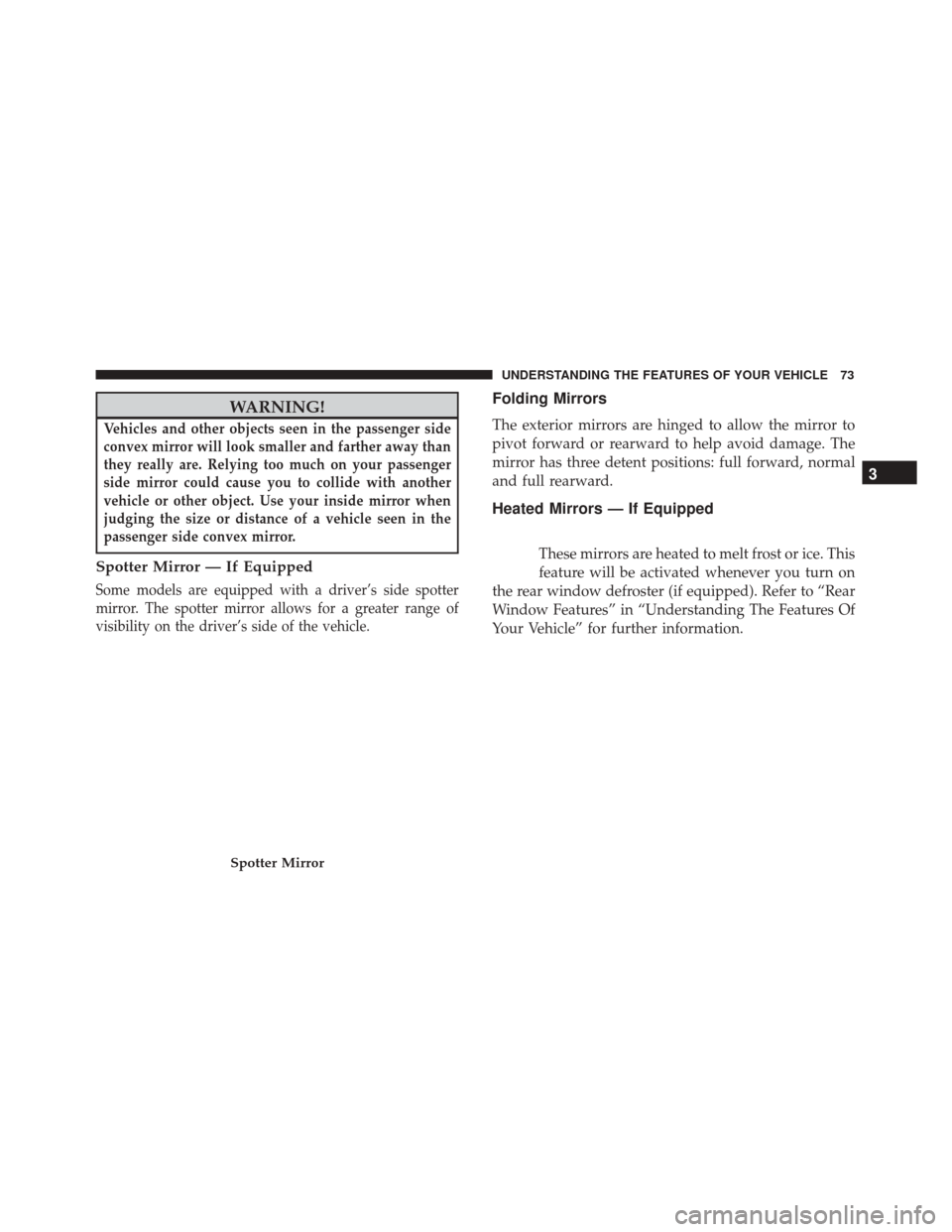
Spotter Mirror — If Equipped
Some models are equipped with a driver’s side spotter
mirror. The spotter mirror allows for a greater range of
visibility on the driver’s side of the vehicle.
Folding Mirrors
The exterior mirrors are hinged to allow the mirror to
pivot forward or rearward to help avoid damage. The
mirror has three detent positions: full forward, normal
and full rearward.
Heated Mirrors — If Equipped
These mirrors are heated to melt frost or ice. This
feature will be activated whenever you turn on
the rear window defroster (if equipped). Refer to “Rear
Window Features” in “Understanding The Features Of
Your Vehicle” for further information.
Spotter Mirror
3
UNDERSTANDING THE FEATURES OF YOUR VEHICLE 73
Page 76 of 338
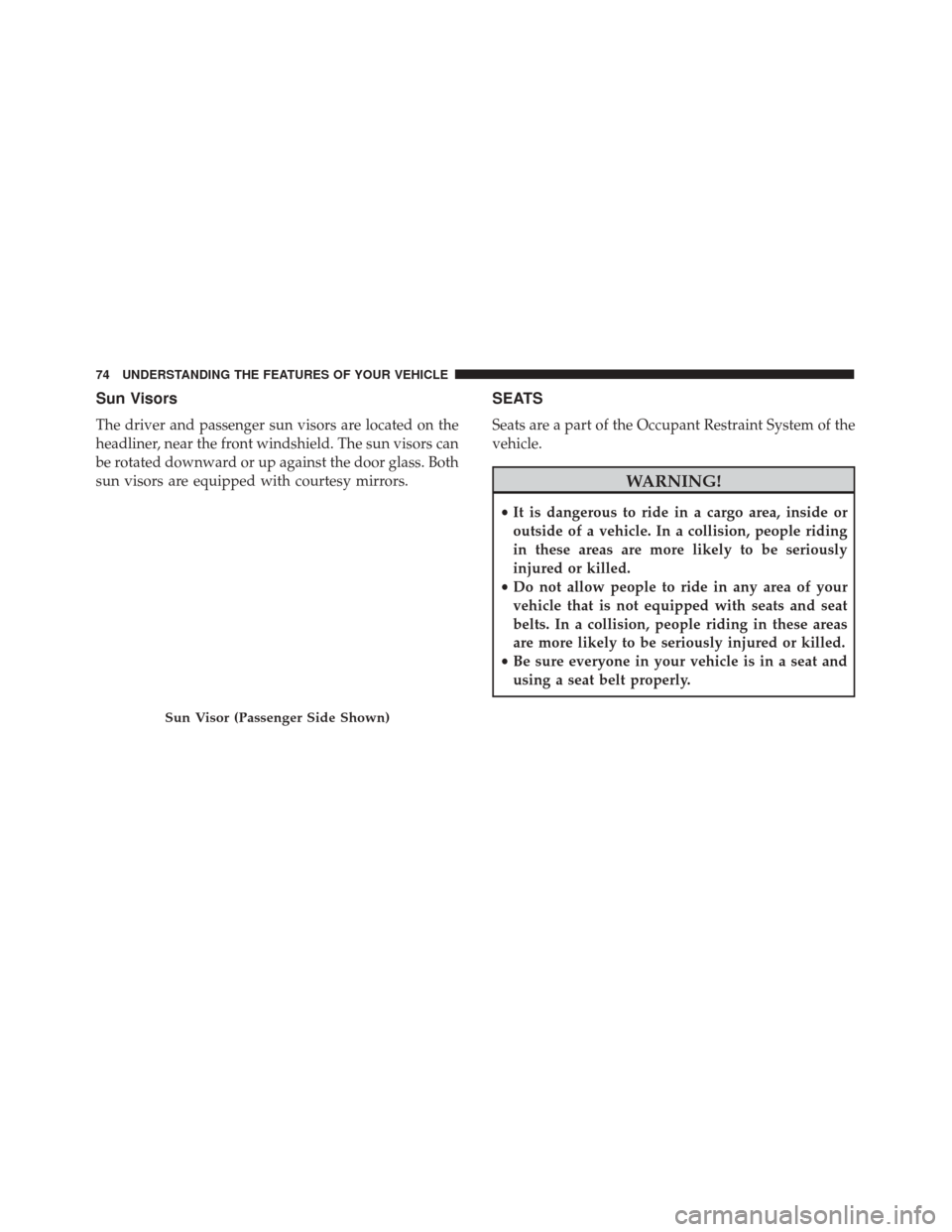
Sun Visors
The driver and passenger sun visors are located on the
headliner, near the front windshield. The sun visors can
be rotated downward or up against the door glass. Both
sun visors are equipped with courtesy mirrors.
SEATS
Seats are a part of the Occupant Restraint System of the
vehicle.
WARNING!
•It is dangerous to ride in a cargo area, inside or
outside of a vehicle. In a collision, people riding
in these areas are more likely to be seriously
injured or killed.
• Do not allow people to ride in any area of your
vehicle that is not equipped with seats and seat
belts. In a collision, people riding in these areas
are more likely to be seriously injured or killed.
• Be sure everyone in your vehicle is in a seat and
using a seat belt properly.
Sun Visor (Passenger Side Shown)
74 UNDERSTANDING THE FEATURES OF YOUR VEHICLE
Page 77 of 338
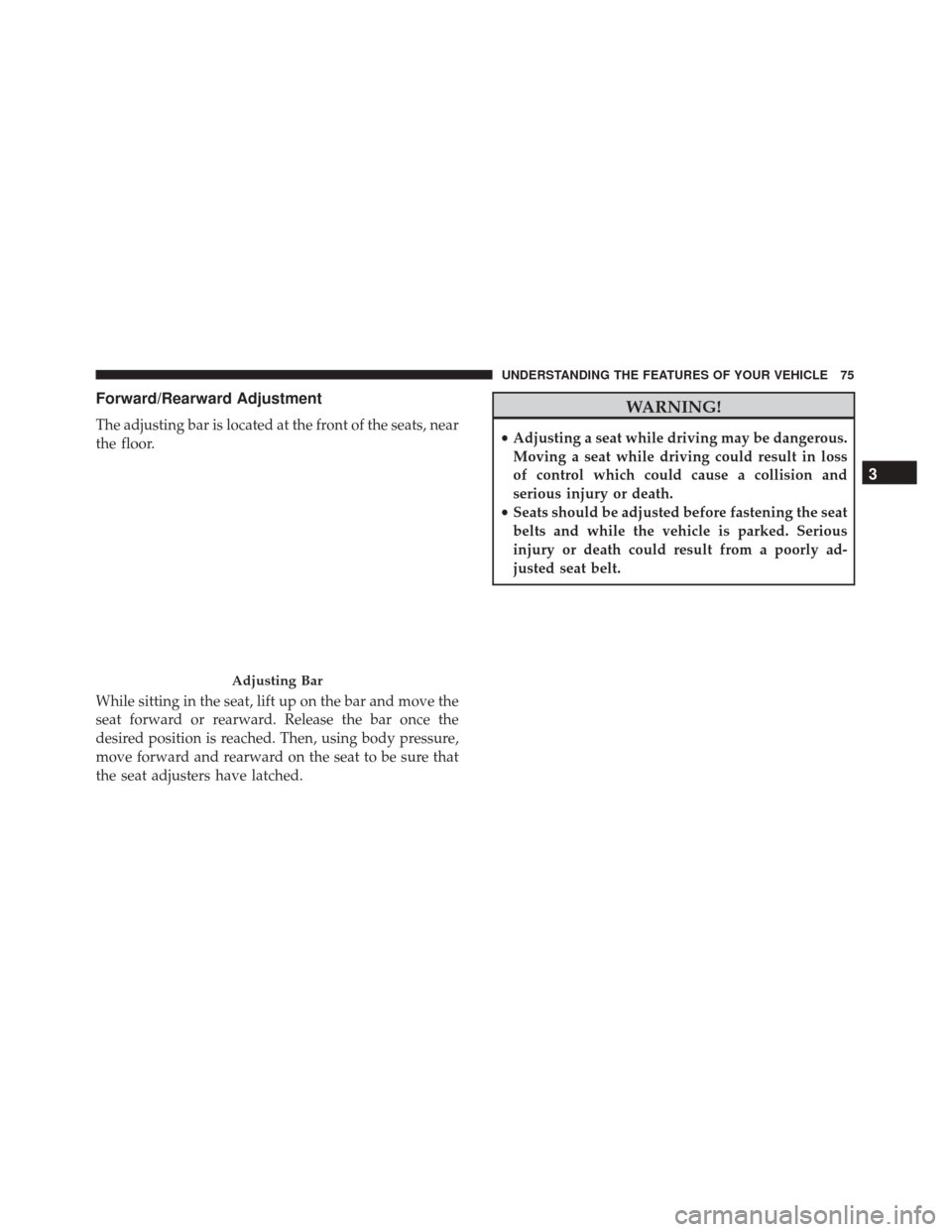
Forward/Rearward Adjustment
The adjusting bar is located at the front of the seats, near
the floor.
While sitting in the seat, lift up on the bar and move the
seat forward or rearward. Release the bar once the
desired position is reached. Then, using body pressure,
move forward and rearward on the seat to be sure that
the seat adjusters have latched.
WARNING!
•Adjusting a seat while driving may be dangerous.
Moving a seat while driving could result in loss
of control which could cause a collision and
serious injury or death.
• Seats should be adjusted before fastening the seat
belts and while the vehicle is parked. Serious
injury or death could result from a poorly ad-
justed seat belt.
Adjusting Bar
3
UNDERSTANDING THE FEATURES OF YOUR VEHICLE 75
Page 78 of 338
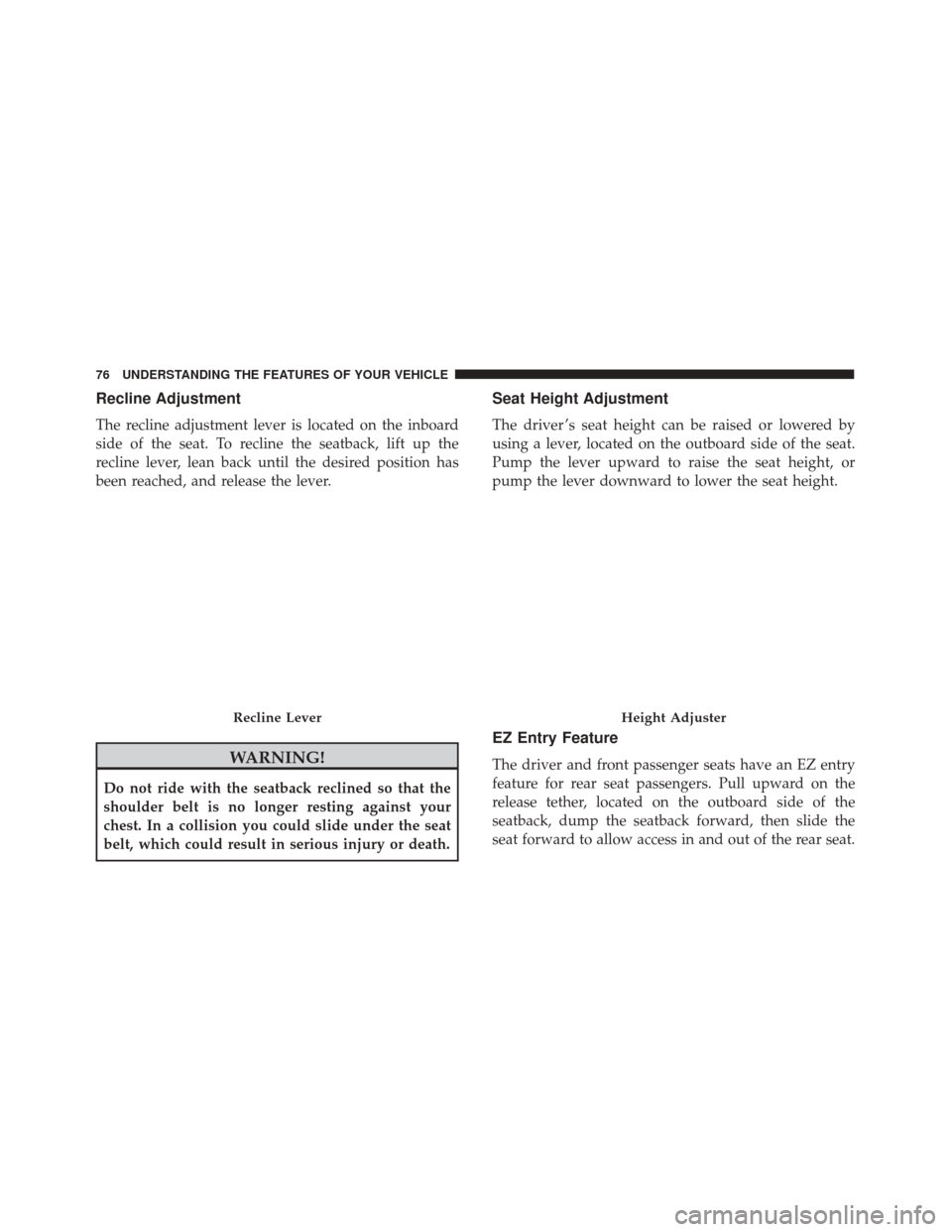
Recline Adjustment
The recline adjustment lever is located on the inboard
side of the seat. To recline the seatback, lift up the
recline lever, lean back until the desired position has
been reached, and release the lever.
WARNING!
Do not ride with the seatback reclined so that the
shoulder belt is no longer resting against your
chest. In a collision you could slide under the seat
belt, which could result in serious injury or death.
Seat Height Adjustment
The driver ’s seat height can be raised or lowered by
using a lever, located on the outboard side of the seat.
Pump the lever upward to raise the seat height, or
pump the lever downward to lower the seat height.
EZ Entry Feature
The driver and front passenger seats have an EZ entry
feature for rear seat passengers. Pull upward on the
release tether, located on the outboard side of the
seatback, dump the seatback forward, then slide the
seat forward to allow access in and out of the rear seat.
Recline LeverHeight Adjuster
76 UNDERSTANDING THE FEATURES OF YOUR VEHICLE
Page 80 of 338
NOTE:Once a heat setting is selected, heat will be felt
within two to five minutes.
WARNING!
• Persons who are unable to feel pain to the skin
because of advanced age, chronic illness, diabe-
tes, spinal cord injury, medication, alcohol use,
exhaustion or other physical condition must exer-
cise care when using the seat heater. It may cause
burns even at low temperatures, especially if used
for long periods of time.
• Do not place anything on the seat or seatback that
insulates against heat, such as a blanket or cush-
ion. This may cause the seat heater to overheat.
Sitting in a seat that has been overheated could
cause serious burns due to the increased surface
temperature of the seat.
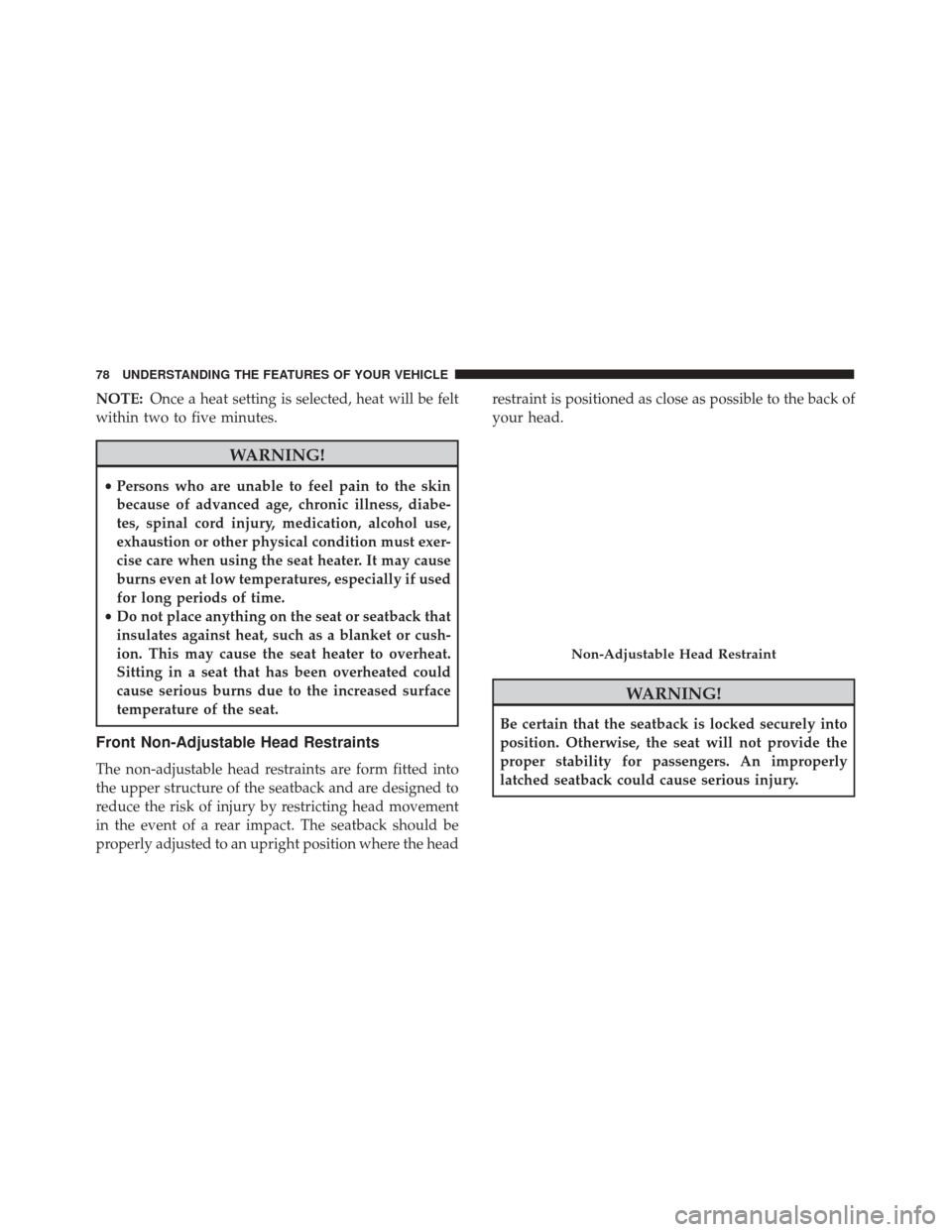
Front Non-Adjustable Head Restraints
The non-adjustable head restraints are form fitted into
the upper structure of the seatback and are designed to
reduce the risk of injury by restricting head movement
in the event of a rear impact. The seatback should be
properly adjusted to an upright position where the head restraint is positioned as close as possible to the back of
your head.
WARNING!
Be certain that the seatback is locked securely into
position. Otherwise, the seat will not provide the
proper stability for passengers. An improperly
latched seatback could cause serious injury.
Non-Adjustable Head Restraint
78 UNDERSTANDING THE FEATURES OF YOUR VEHICLE
Page 81 of 338
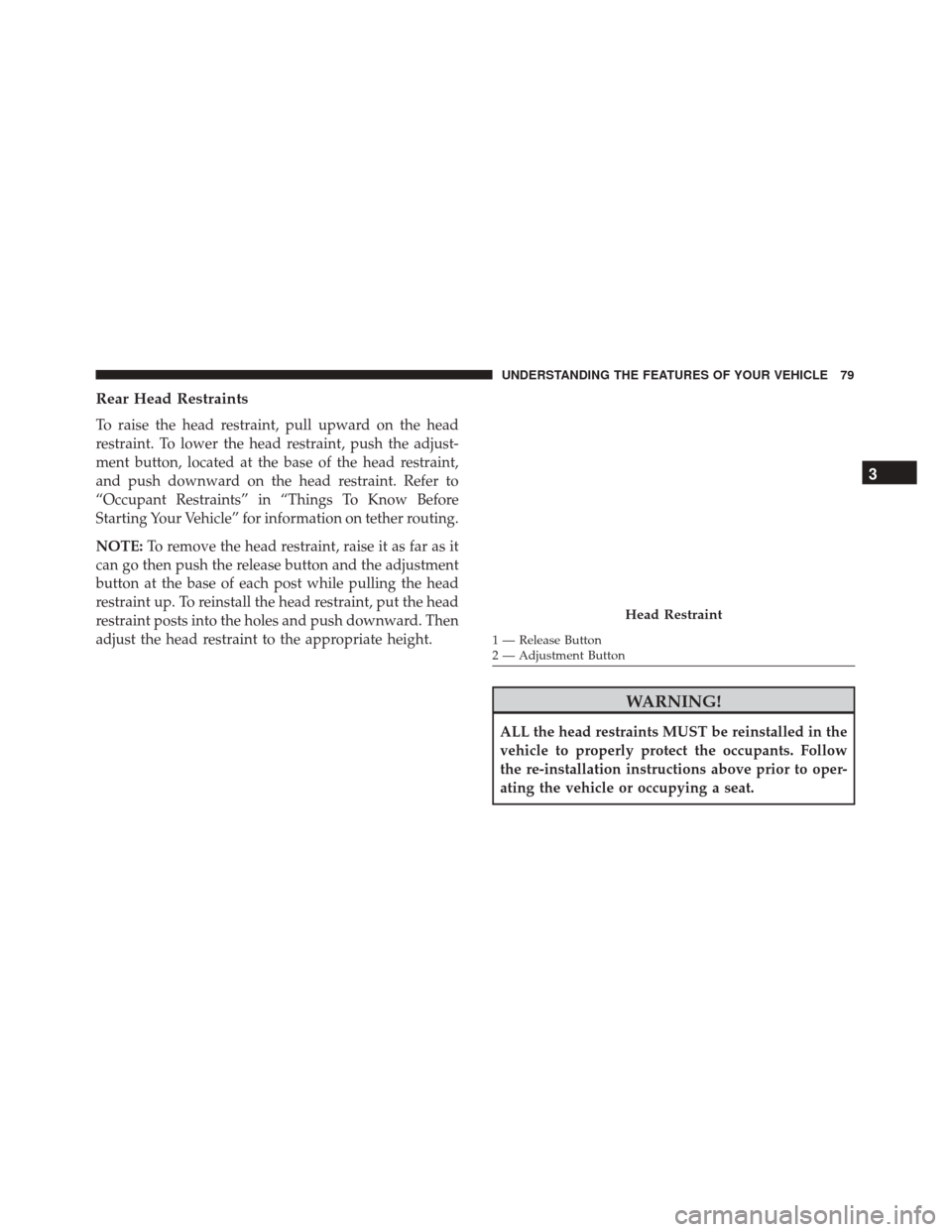
Rear Head Restraints
To raise the head restraint, pull upward on the head
restraint. To lower the head restraint, push the adjust-
ment button, located at the base of the head restraint,
and push downward on the head restraint. Refer to
“Occupant Restraints” in “Things To Know Before
Starting Your Vehicle” for information on tether routing.
NOTE:To remove the head restraint, raise it as far as it
can go then push the release button and the adjustment
button at the base of each post while pulling the head
restraint up. To reinstall the head restraint, put the head
restraint posts into the holes and push downward. Then
adjust the head restraint to the appropriate height.
WARNING!
ALL the head restraints MUST be reinstalled in the
vehicle to properly protect the occupants. Follow
the re-installation instructions above prior to oper-
ating the vehicle or occupying a seat.
Head Restraint
1 — Release Button
2 — Adjustment Button
3
UNDERSTANDING THE FEATURES OF YOUR VEHICLE 79
Page 83 of 338
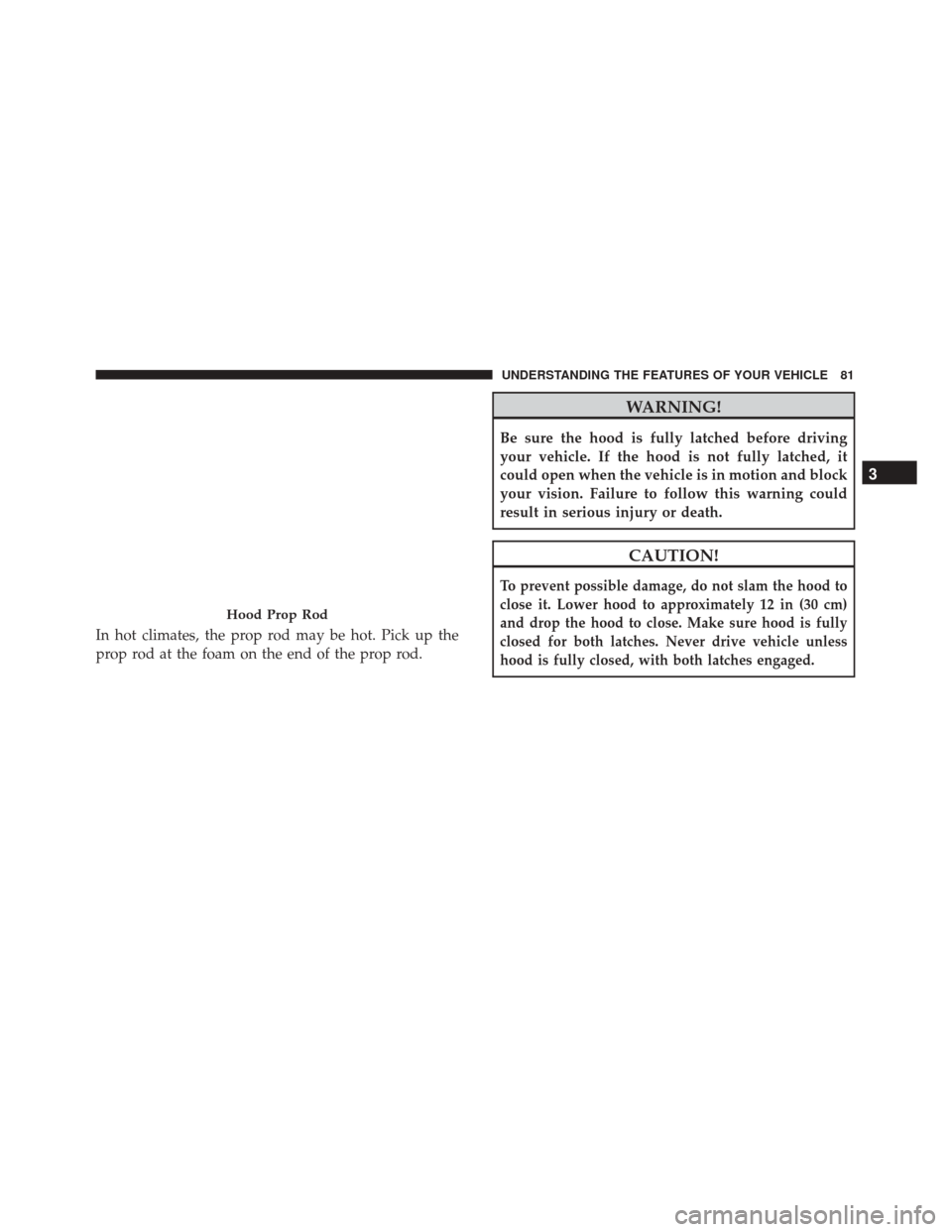
In hot climates, the prop rod may be hot. Pick up the
prop rod at the foam on the end of the prop rod.
WARNING!
Be sure the hood is fully latched before driving
your vehicle. If the hood is not fully latched, it
could open when the vehicle is in motion and block
your vision. Failure to follow this warning could
result in serious injury or death.
CAUTION!
To prevent possible damage, do not slam the hood to
close it. Lower hood to approximately 12 in (30 cm)
and drop the hood to close. Make sure hood is fully
closed for both latches. Never drive vehicle unless
hood is fully closed, with both latches engaged.
Hood Prop Rod
3
UNDERSTANDING THE FEATURES OF YOUR VEHICLE 81
Page 91 of 338
Push down on the lever to unlock the column. With one
hand firmly on the steering wheel, move the steering
column up or down as desired. Push the lever up to
lock the column firmly in place.
WARNING!
Do not adjust the steering column while driving.
Adjusting the steering column while driving or driv-
ing with the steering column unlocked, could cause
the driver to lose control of the vehicle. Failure to
follow this warning may result in serious injury or
death.
ELECTRONIC SPEED CONTROL
When engaged, the Electronic Speed Control takes over
accelerator operations at speeds greater than 25 mph
(40 km/h).
The Electronic Speed Control buttons are located on the
right side of the steering wheel.
Tilt Control Lever
Electronic Speed Control Buttons
3
UNDERSTANDING THE FEATURES OF YOUR VEHICLE 89
Page 92 of 338
NOTE:In order to ensure proper operation, the Elec-
tronic Speed Control system has been designed to shut
down if multiple Speed Control functions are operated
at the same time. If this occurs, the Electronic Speed
Control system can be reactivated by pushing the
Electronic Speed Control ON/OFF button and resetting
the desired vehicle set speed.
To Activate
Push the ON/OFF button. The Cruise Indicator Light in
the Instrument Cluster Display will illuminate. To turn
the system off, push the ON/OFF button a second time.
The Cruise Indicator Light will turn off. The system
should be turned off when not in use.
WARNING!
Leaving the Electronic Speed Control system on
when not in use is dangerous. You could acciden-
tally set the system or cause it to go faster than you
want. You could lose control and have an accident.
Always leave the system OFF when you are not
using it.
To Set A Desired Speed
Turn the Electronic Speed Control ON. When the ve-
hicle has reached the desired speed, push the SET (-)
button and release. Release the accelerator and the
vehicle will operate at the selected speed.
NOTE: The vehicle should be traveling at a steady speed
and on level ground before pushing the SET (-) button.
To Deactivate
A soft tap on the brake pedal, pushing the CANC
button, or normal brake pressure while slowing the
vehicle will deactivate Electronic Speed Control with-
out erasing the set speed memory. Pushing the ON/
OFF button or turning the ignition switch OFF erases
the set speed in memory.
To Resume Speed
To resume a previously set speed, push the RES (+)
button and release. Resume can be used at any speed
above 25 mph (40 km/h).
90 UNDERSTANDING THE FEATURES OF YOUR VEHICLE