warning FIAT 500 GUCCI 2012 2.G Owner's Manual
[x] Cancel search | Manufacturer: FIAT, Model Year: 2012, Model line: 500 GUCCI, Model: FIAT 500 GUCCI 2012 2.GPages: 80, PDF Size: 1.87 MB
Page 45 of 80
•We recommend that you do not operate the vehicle or engine damage will occur. Have the
vehicle serviced immediately.
CAUTION!
Driving with a hot cooling system could damage your vehicle. If the temperature gauge
reads hot, pull over and stop the vehicle. Idle the vehicle with the air conditioner turned
off until the pointer drops back into the normal range. If the pointer remains on hot,
turn the engine off immediately and call for service.
WARNING!
You or others can be badly burned by hot engine coolant (antifreeze) or steam from
your radiator. If you see or hear steam coming from under the hood, do not open the
hood until the radiator has had time to cool. Never try to open a cooling system
pressure cap when the radiator or coolant bottle is hot.
JACKING AND TIRE CHANGING
Jack Location
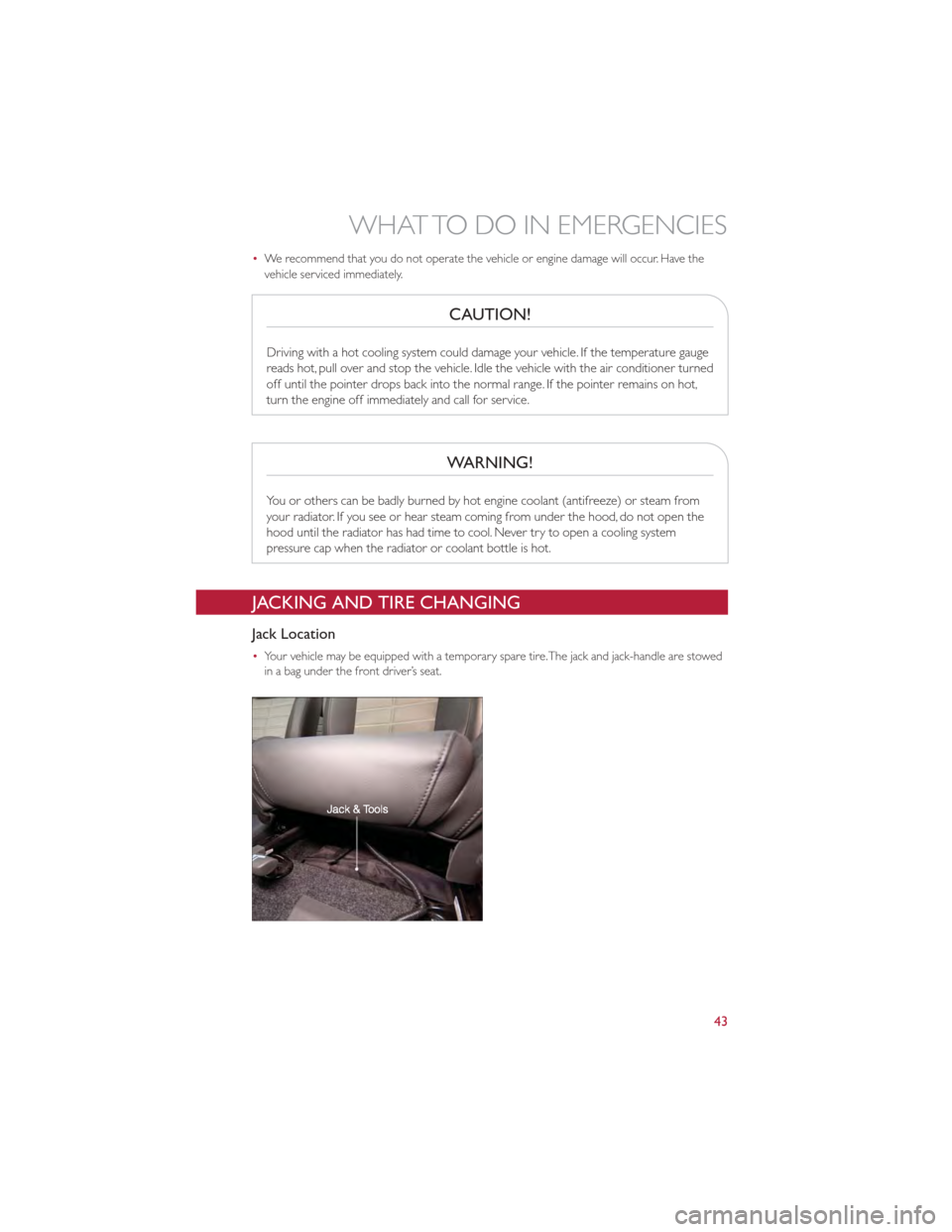
•Your vehicle may be equipped with a temporary spare tire.The jack and jack-handle are stowed
in a bag under the front driver’s seat.
WHAT TO DO IN EMERGENCIES
43
Page 47 of 80
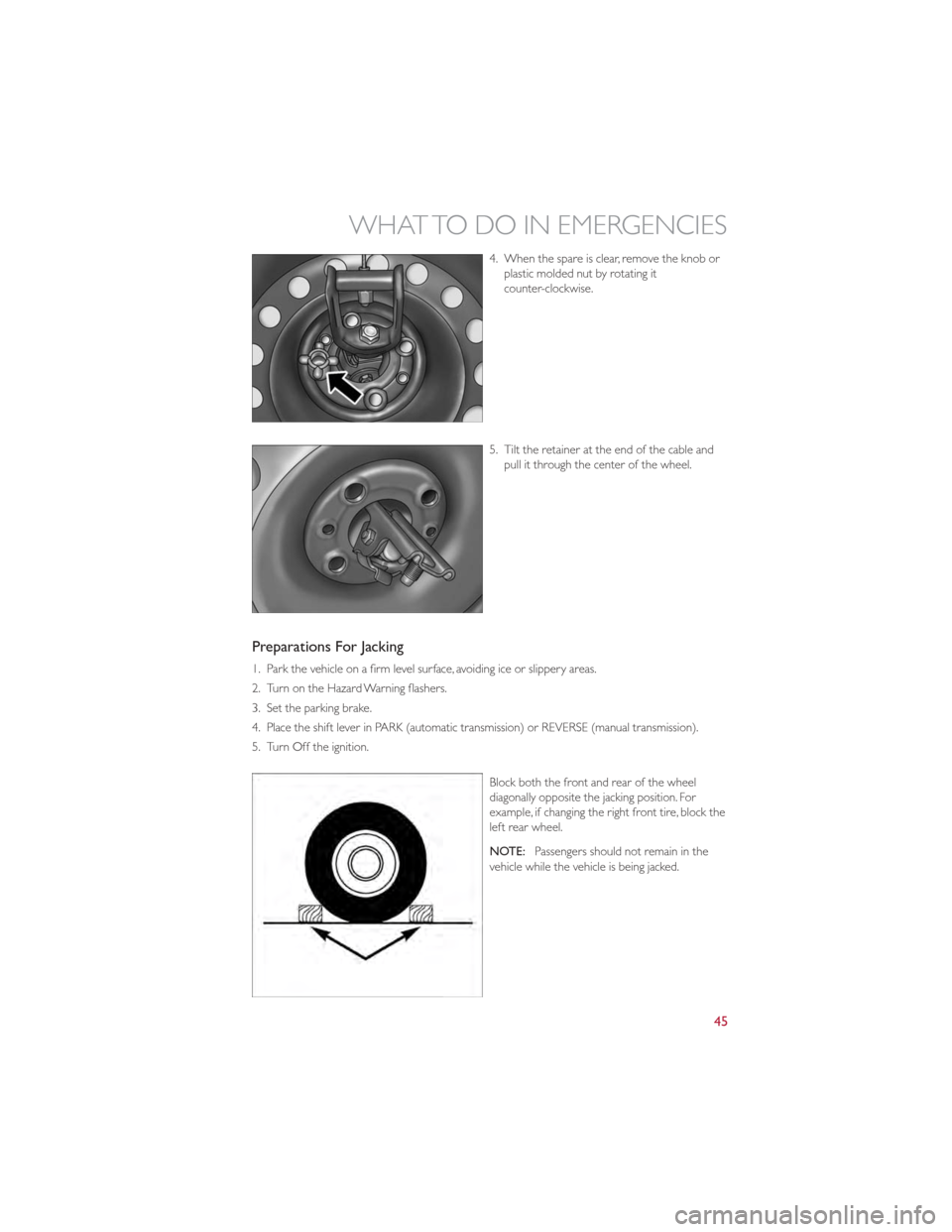
4. When the spare is clear, remove the knob orplastic molded nut by rotating it
counter-clockwise.
5. Tilt the retainer at the end of the cable and pull it through the center of the wheel.
Preparations For Jacking
1. Park the vehicle on a firm level surface, avoiding ice or slippery areas.
2. Turn on the Hazard Warning flashers.
3. Set the parking brake.
4. Place the shift lever in PARK (automatic transmission) or REVERSE (manual transmission).
5. Turn Off the ignition.
Block both the front and rear of the wheel
diagonally opposite the jacking position. For
example, if changing the right front tire, block the
left rear wheel.
NOTE:Passengers should not remain in the
vehicle while the vehicle is being jacked.
WHAT TO DO IN EMERGENCIES
45
Page 50 of 80
WARNING!
•Do not attempt to change a tire on the side of the vehicle close to moving traffic.
Pull far enough off the road to avoid the danger of being hit when operating the jack
or changing the wheel.
• Being under a jacked-up vehicle is dangerous.The vehicle could slip off the jack and
fall on you.You could be crushed. Never put any part of your body under a vehicle
that is on a jack.
• Never start or run the engine while the vehicle is on a jack. If you need to get under
a raised vehicle, take it to a service center where it can be raised on a lift.
• The jack is designed to be used as a tool for changing tires only.The jack should not
be used to lift the vehicle for service purposes.The vehicle should be jacked on a
firm level surface only.Avoid ice or slippery areas.
• Carefully follow these tire changing warnings to help prevent personal injury or
damage to your vehicle:
• Always park on a firm, level surface as far from the edge of the roadway as possible
before raising the vehicle.
• Turn on the Hazard Warning flashers.
• Block the wheel diagonally opposite the wheel to be raised.
• Set the parking brake firmly and set an automatic transmission in PARK; a manual
transmission in REVERSE.
• Never start or run the engine with the vehicle on a jack.
• Do not let anyone sit in the vehicle when it is on a jack.
• Do not get under the vehicle when it is on a jack.
• Only use the jack in the positions indicated and for lifting this vehicle during a tire
change.
• If working on or near a roadway, be extremely careful of motor traffic.
• To assure that spare tires, flat or inflated, are securely stowed, spares must be stowed
with the valve stem facing the ground.
• Raising the vehicle higher than necessary can make the vehicle less stable. It could slip
off the jack and hurt someone near it. Raise the vehicle only enough to remove the
tire.
• To avoid the risk of forcing the vehicle off the jack, do not fully tighten the wheel
bolts until the vehicle has been lowered. Failure to follow this warning may result in
personal injury.
• To avoid possible personal injury, handle the wheel covers with care to avoid contact
with any sharp edges.
• A loose tire or jack thrown forward in a collision or hard stop could endanger the
occupants of the vehicle.Always stow the jack parts and the spare tire in the places
provided.
WHAT TO DO IN EMERGENCIES
48
Page 52 of 80
•When the TIREFIT sealant is in a liquid form, clean water, and a damp cloth will remove the
material from the vehicle or tire and wheel components. Once the sealant dries, it can easily be
peeled off and properly discarded.
• For optimum performance, make sure the valve stem on the wheel is free of debris before
connecting the TIREFIT kit.
• You can use the TIREFIT air pump to inflate bicycle tires.The kit also comes with two needles,
located in the Accessory Storage Compartment (on the bottom of the air pump) for inflating
sport balls, rafts, or similar inflatable items. However, use only the Air Pump Hose (7) and make
sure the Mode Select Knob (5) is in the Air Mode when inflating such items to avoid injecting
sealant into them.The TIREFIT Sealant is only intended to seal punctures less than
1∕4in (6 mm)
diameter in the tread of your vehicle.
• Do not lift or carry the TIREFIT kit by the hoses.
Sealing A Tire With TIREFIT
(A) Whenever You Stop To Use TIREFIT:
1. Pull over to a safe location and turn on the vehicle’s Hazard Warning flashers.
2. Verify that the valve stem (on the wheel with the deflated tire) is in a position that is near to
the ground.This will allow the TIREFIT Hoses (6) and (7) to reach the valve stem and keep the
TIREFIT kit flat on the ground.This will provide the best positioning of the kit when injecting the
sealant into the deflated tire and running the air pump. Move the vehicle as necessary to place
the valve stem in this position before proceeding.
3. Place the transmission in PARK (auto transmission) or in Gear (manual transmission) and turn Off the ignition.
4. Set the parking brake.
(B) Setting Up To Use TIREFIT:
1. Turn the Mode Select Knob (5) to the Sealant Mode position.
2. Uncoil the Sealant Hose (6) and then remove the cap from the fitting at the end of the hose.
3. Place the TIREFIT kit flat on the ground next to the deflated tire.
4. Remove the cap from the valve stem and then screw the fitting at the end of the Sealant Hose (6) onto the valve stem.
5. Uncoil the Power Plug (8) and insert the plug into the vehicle’s 12 Volt power outlet.
NOTE: Do not remove foreign objects (e.g., screws or nails) from the tire.
(C) Injecting TIREFIT Sealant Into The Deflated Tire:
• Always start the engine before turning ON the TIREFIT kit.
NOTE: Manual transmission vehicles must have the parking brake engaged and the shift lever in
NEUTRAL.
• After pressing the Power Button (4), the sealant (white fluid) will flow from the Sealant Bottle
(1) through the Sealant Hose (6) and into the tire.
NOTE: Sealant may leak out through the puncture in the tire.
WHAT TO DO IN EMERGENCIES
50
Page 55 of 80
WARNING!
•Do not attempt to seal a tire on the side of the vehicle closest to traffic. Pull far
enough off the road to avoid the danger of being hit when using the TIREFIT kit.
• Do not use TIREFIT or drive the vehicle under the following circumstances:
− If the puncture in the tire tread is approximately 1/4 in. (6 mm) or larger.
− If the tire has any sidewall damage.
− If the tire has any damage from driving with extremely low tire pressure.
− If the tire has any damage from driving on a flat tire.
− If the wheel has any damage.
− If you are unsure of the condition of the tire or the wheel.
• Keep TIREFIT away from open flames or heat source.
• A loose TIREFIT kit thrown forward in a collision or hard stop could endanger the
occupants of the vehicle.Always stow the TIREFIT kit in the place provided. Failure to
follow these warnings can result in injuries that are serious or fatal to you, your
passengers, and others around you.
• Take care not to allow the contents of TIREFIT to come in contact with hair, eyes, or
clothing.TIREFIT is harmful if inhaled, swallowed, or absorbed through the skin. It
causes skin, eye, and respiratory irritation. Flush immediately with plenty of water if
there is any contact with eyes or skin. Change clothing as soon as possible, if there is
any contact with clothing.
• TIREFIT Sealant solution contains latex. In case of an allergic reaction or rash, consult
a physician immediately. Keep TIREFIT out of reach of children. If swallowed, rinse
mouth immediately with plenty of water and drink plenty of water. Do not induce
vomiting! Consult a physician immediately.
• TIREFIT is not a permanent flat tire repair. Have the tire inspected and repaired or
replaced after using TIREFIT. Do not exceed 55 mph (88 km/h) until the tire is
repaired or replaced. Failure to follow this warning can result in injuries that are
serious or fatal to you, your passengers, and others around you.
JUMP-STARTING PROCEDURE
•If your vehicle has a discharged battery, it can be jump-started using a set of jumper cables and a
battery in another vehicle or by using a portable battery booster pack. Jump-starting can be
dangerous if done improperly so please follow the procedures in this section carefully.
NOTE: When using a portable battery booster pack, follow the manufacturer’s operating
instructions and precautions.
WHAT TO DO IN EMERGENCIES
53
Page 57 of 80
CAUTION!
•Accessories that can be plugged into the vehicle power outlets draw power from
the vehicle’s battery, even when not in use (i.e., cellular phones, etc.). Eventually, if
plugged in long enough, the vehicle’s battery will discharge sufficiently to degrade
battery life and/or prevent the engine from starting.
• Do not use a portable battery booster pack or any other booster source with a
system voltage greater than 12 Volts or damage to the battery, starter motor,
alternator or electrical system may occur.
• Failure to follow these procedures could result in damage to the charging system of
the booster vehicle or the discharged vehicle.
WARNING!
•Do not attempt jump-starting if the battery is frozen. It could rupture or explode
and cause personal injury.
• Take care to avoid the radiator cooling fan whenever the hood is raised. It can start
anytime the ignition switch is ON.You can be injured by moving fan blades.
• Remove any metal jewelry such as watch bands or bracelets that might make an
inadvertent electrical contact.You could be seriously injured.
• Batteries contain sulfuric acid that can burn your skin or eyes and generate hydrogen
gas which is flammable and explosive. Keep open flames or sparks away from the
battery.
• Do not allow vehicles to touch each other as this could establish a ground
connection and personal injury could result.
• Failure to follow this procedure could result in personal injury or property damage
due to battery explosion.
• Do not connect the cable to the negative post (-)of the discharged battery.The
resulting electrical spark could cause the battery to explode and could result in
personal injury.
WHAT TO DO IN EMERGENCIES
55
Page 61 of 80
WARNING!
Fast spinning tires can be dangerous. Forces generated by excessive wheel speeds may
cause damage, or even failure, of the axle and tires.A tire could explode and injure
someone. Do not spin your vehicle's wheels faster than 30 mph (48 km/h) or for
longer than 30 seconds continuously without stopping when you are stuck and do not
let anyone near a spinning wheel, no matter what the speed.
EVENT DATA RECORDER (EDR)
•This vehicle is equipped with an event data recorder (EDR).The main purpose of an EDR is to
record, in certain crash or near crash-like situations, such as an air bag deployment or hitting a
road obstacle, data that will assist in understanding how a vehicle’s systems performed.The EDR
is designed to record data related to vehicle dynamics and safety systems for a short period of
time, typically 30 seconds or less.The EDR in this vehicle is designed to record such data as:
•How various systems in your vehicle were operating;
• Whether or not the driver and passenger safety belts were buckled/fastened;
• How far (if at all) the driver was depressing the accelerator and/or brake pedal; and,
• How fast the vehicle was traveling.
• These data can help provide a better understanding of the circumstances in which crashes and
injuries occur.
NOTE: EDR data are recorded by your vehicle only if a non-trivial crash situation occurs; no data
are recorded by the EDR under normal driving conditions and no personal data (e.g. name, gender,
age, and crash location) are recorded. However, other parties, such as law enforcement, could
combine the EDR data with the type of personally identifying data routinely acquired during a
crash investigation.
• To read data recorded by an EDR, special equipment is required, and access to the vehicle or the
EDR is needed. In addition to the vehicle manufacturer, other parties such as law enforcement,
that have the special equipment, can read the information if they have access to the vehicle or
the EDR.
WHAT TO DO IN EMERGENCIES
59
Page 62 of 80
OPENING THE HOOD
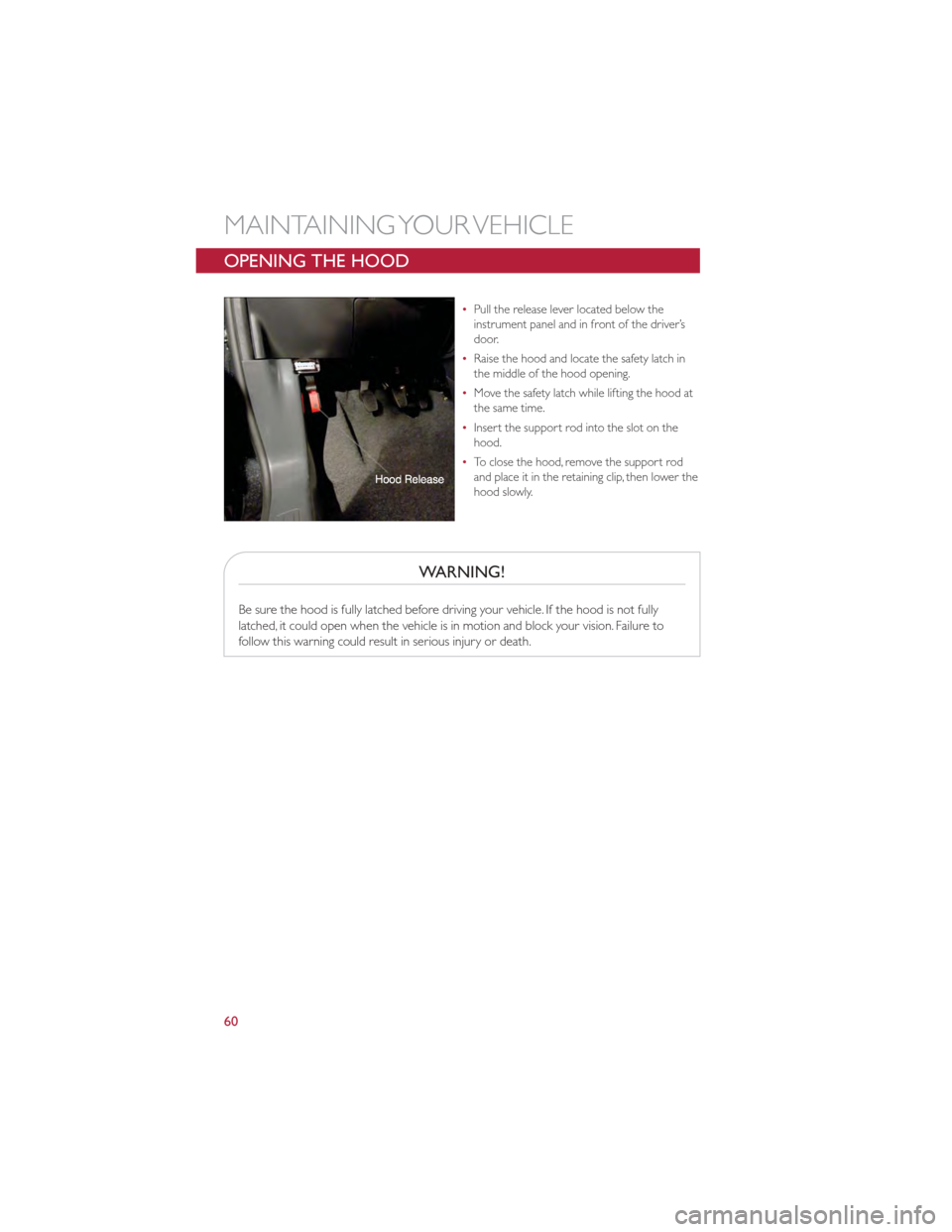
•Pull the release lever located below the
instrument panel and in front of the driver’s
door.
• Raise the hood and locate the safety latch in
the middle of the hood opening.
• Move the safety latch while lifting the hood at
the same time.
• Insert the support rod into the slot on the
hood.
• To close the hood, remove the support rod
and place it in the retaining clip, then lower the
hood slowly.
WARNING!
Be sure the hood is fully latched before driving your vehicle. If the hood is not fully
latched, it could open when the vehicle is in motion and block your vision. Failure to
follow this warning could result in serious injury or death.
MAINTAINING YOUR VEHICLE
60
Page 68 of 80
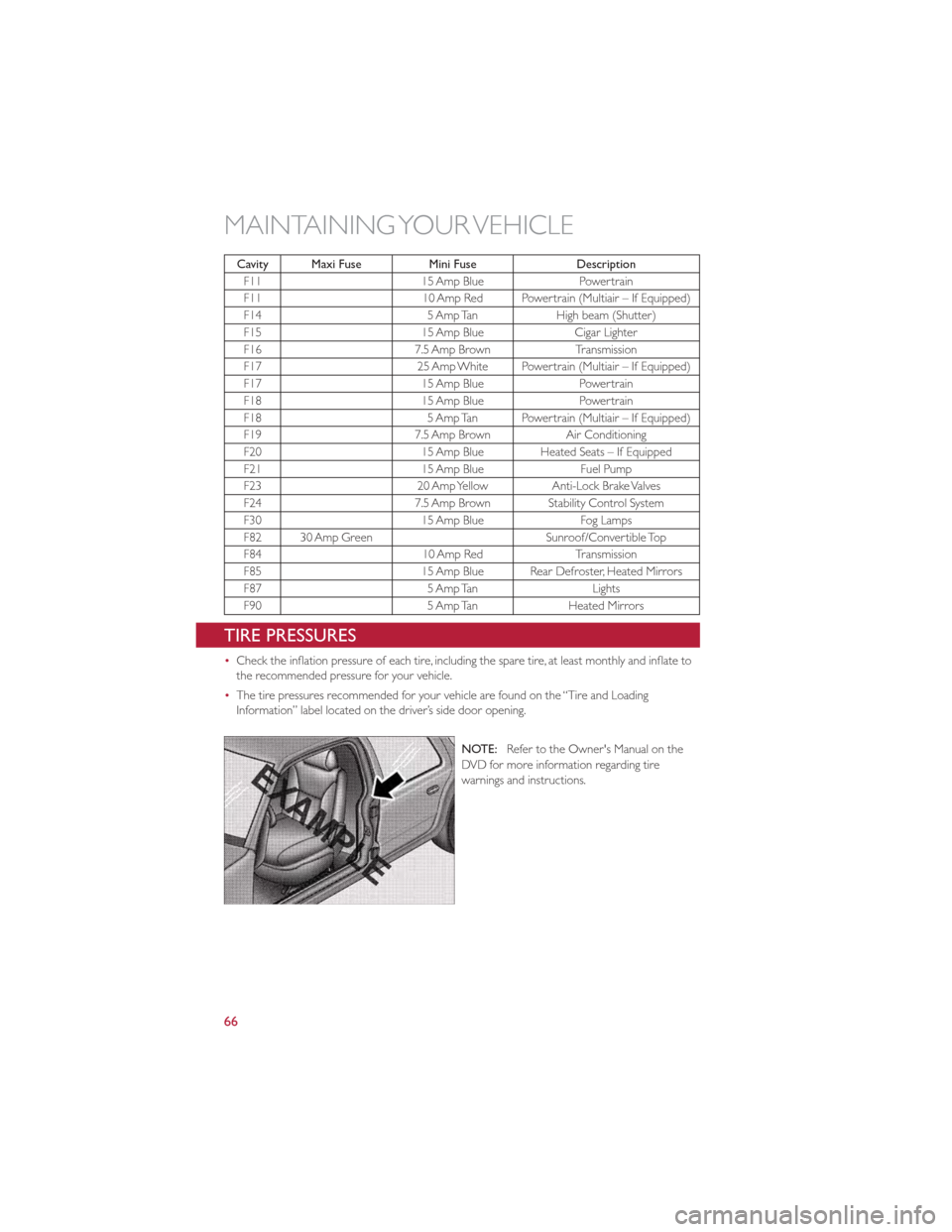
Cavity Maxi FuseMini FuseDescription
F11 15 Amp BluePowertrain
F11 10 Amp Red Powertrain (Multiair – If Equipped)
F14 5 Amp TanHigh beam (Shutter)
F15 15 Amp BlueCigar Lighter
F16 7.5 Amp BrownTransmission
F17 25 Amp White Powertrain (Multiair – If Equipped)
F17 15 Amp BluePowertrain
F18 15 Amp BluePowertrain
F18 5 Amp Tan Powertrain (Multiair – If Equipped)
F19 7.5 Amp BrownAir Conditioning
F20 15 Amp Blue Heated Seats – If Equipped
F21 15 Amp BlueFuel Pump
F23 20 Amp YellowAnti-Lock Brake Valves
F24 7.5 Amp Brown Stability Control System
F30 15 Amp BlueFog Lamps
F82 30 Amp Green Sunroof/Convertible Top
F84 10 Amp RedTransmission
F85 15 Amp Blue Rear Defroster, Heated Mirrors
F87 5 Amp TanLights
F90 5 Amp TanHeated Mirrors
TIRE PRESSURES
•Check the inflation pressure of each tire, including the spare tire, at least monthly and inflate to
the recommended pressure for your vehicle.
• The tire pressures recommended for your vehicle are found on the “Tire and Loading
Information” label located on the driver’s side door opening.
NOTE:Refer to the Owner's Manual on the
DVD for more information regarding tire
warnings and instructions.
MAINTAINING YOUR VEHICLE
66
Page 69 of 80
WARNING!
•Overloading of your tires is dangerous. Overloading can cause tire failure, affect
vehicle handling, and increase your stopping distance. Use tires of the recommended
load capacity for your vehicle. Never overload them.
• Improperly inflated tires are dangerous and can cause collisions. Under-inflation is
the leading cause of tire failure and may result in severe cracking, component
separation, or “blow out”. Over-inflation reduces a tire’s ability to cushion shock.
Objects on the road and chuck holes can cause damage that results in tire failure.
Unequal tire pressures can cause steering problems.You could lose control of your
vehicle. Over-inflated or under-inflated tires can affect vehicle handling and can fail
suddenly, resulting in loss of vehicle control.
WHEEL AND WHEEL TRIM CARE
•All wheels and wheel trim, especially aluminum and chrome plated wheels, should be cleaned
regularly with a mild soap and water to prevent corrosion.
• To remove heavy soil and/or excessive brake dust, use a wheel cleaner or select a non-abrasive,
non-acidic cleaner.
CAUTION!
Do not use scouring pads, steel wool, a bristle brush, or metal polishes. Do not use
oven cleaner.These products may damage the wheel's protective finish.Avoid
automatic car washes that use acidic solutions or harsh brushes that may damage the
wheel's protective finish.
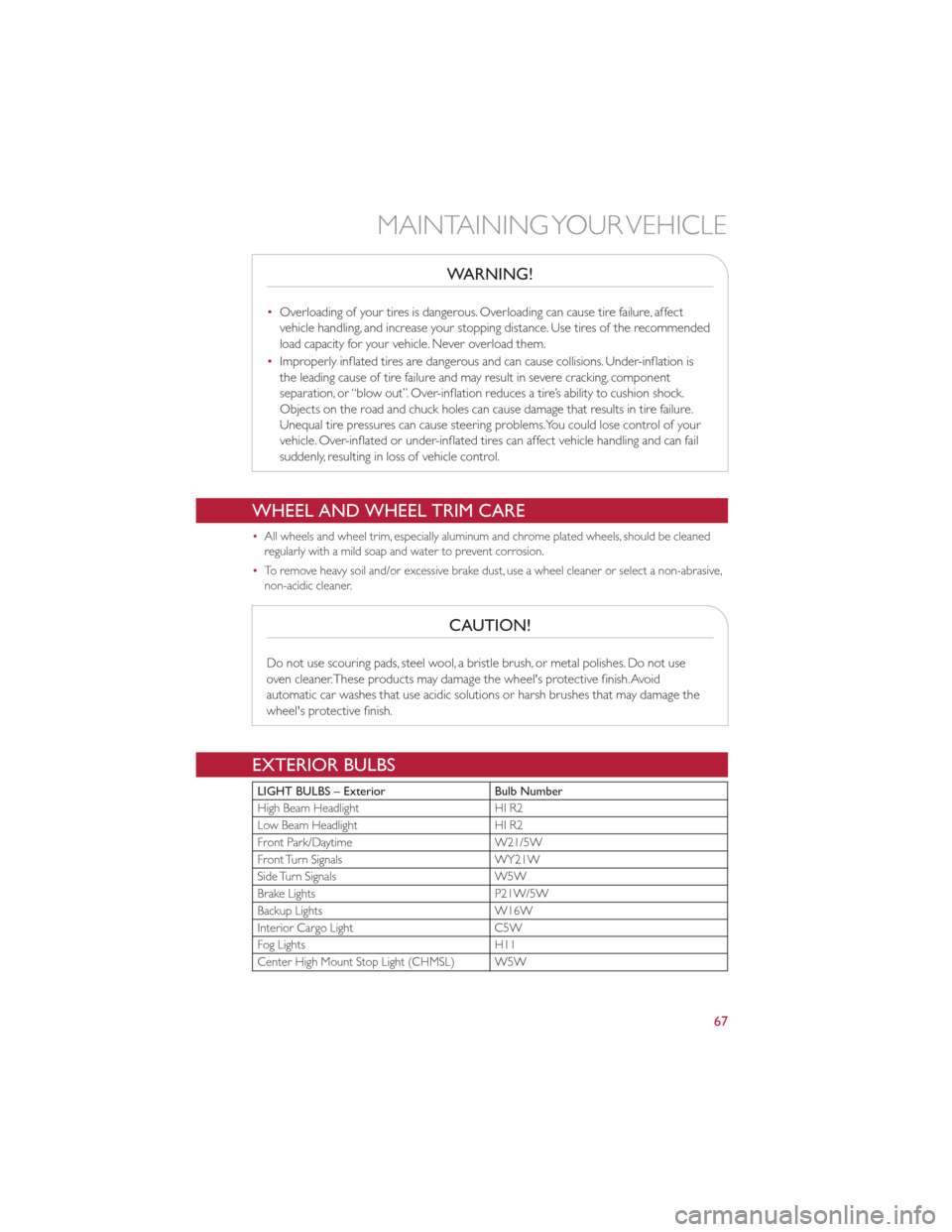
EXTERIOR BULBS
LIGHT BULBS – Exterior Bulb Number
High Beam Headlight HI R2
Low Beam Headlight HI R2
Front Park/Daytime W21/5W
Front Turn Signals WY21W
Side Turn Signals W5W
Brake Lights P21W/5W
Backup Lights W16W
Interior Cargo Light C5W
Fog Lights H11
Center High Mount Stop Light (CHMSL) W5W
MAINTAINING YOUR VEHICLE
67