air condition FIAT 500 GUCCI 2012 2.G User Guide
[x] Cancel search | Manufacturer: FIAT, Model Year: 2012, Model line: 500 GUCCI, Model: FIAT 500 GUCCI 2012 2.GPages: 80, PDF Size: 1.87 MB
Page 23 of 80
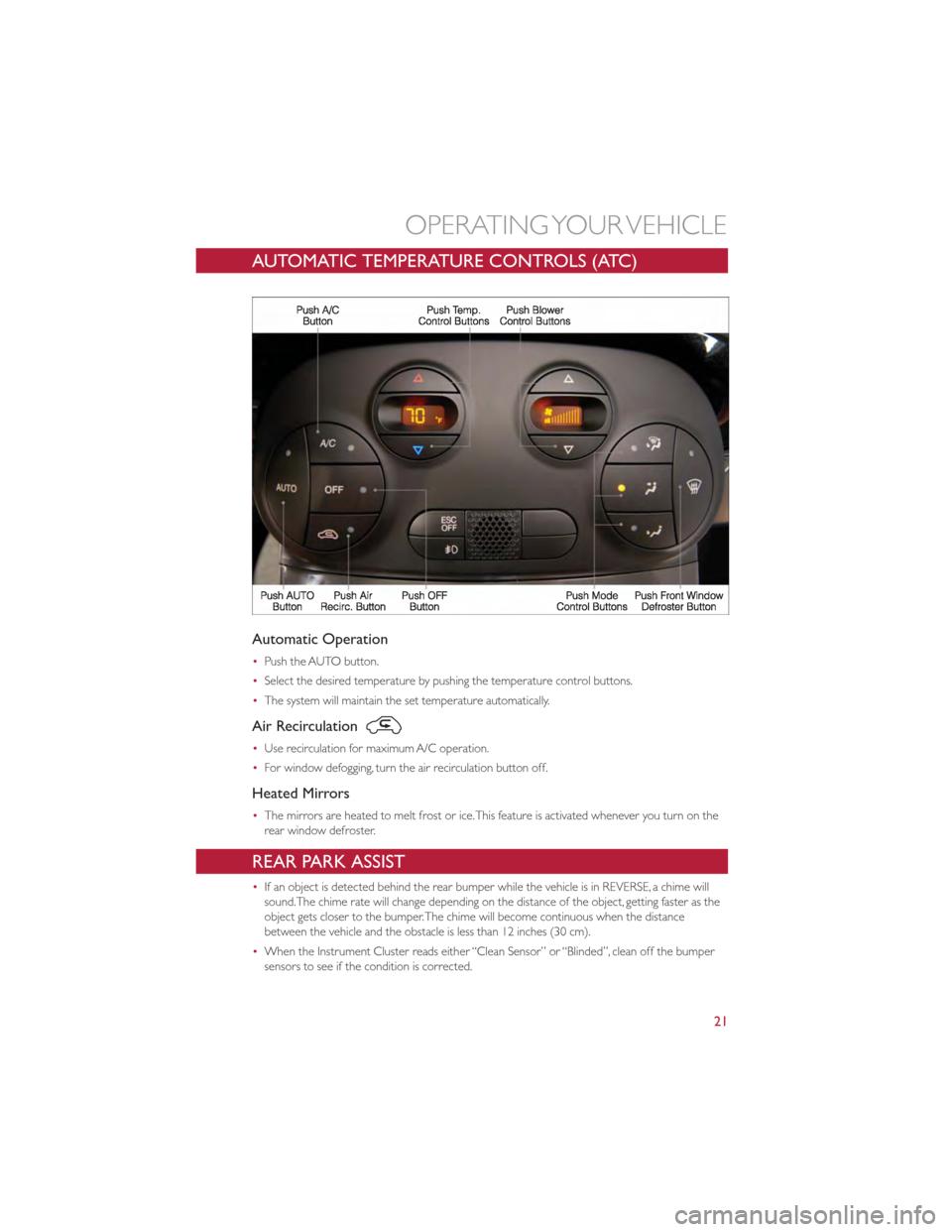
AUTOMATIC TEMPERATURE CONTROLS (ATC)
Automatic Operation
•Push the AUTO button.
• Select the desired temperature by pushing the temperature control buttons.
• The system will maintain the set temperature automatically.
Air Recirculation
•Use recirculation for maximum A/C operation.
• For window defogging, turn the air recirculation button off.
Heated Mirrors
•The mirrors are heated to melt frost or ice.This feature is activated whenever you turn on the
rear window defroster.
REAR PARK ASSIST
•If an object is detected behind the rear bumper while the vehicle is in REVERSE, a chime will
sound.The chime rate will change depending on the distance of the object, getting faster as the
object gets closer to the bumper.The chime will become continuous when the distance
between the vehicle and the obstacle is less than 12 inches (30 cm).
• When the Instrument Cluster reads either “Clean Sensor” or “Blinded”, clean off the bumper
sensors to see if the condition is corrected.
OPERATING YOUR VEHICLE
21
Page 27 of 80
COLD WEATHER OPERATION (Engine Block Heater)
Engine Block Heater
•To prevent possible engine damage while starting at low temperatures, this vehicle will inhibit
engine cranking when the ambient temperature is less than –22° F (–30° C) and the oil
temperature sensor reading indicates an engine block heater has not been used.An
externally-powered electric engine block heater is available as optional equipment or from your
authorized dealer.
• The message "plug in engine heater" will be displayed in the instrument cluster when the
ambient temperature is below 5° F (–15° C) at the time the engine is shut off as a reminder to
avoid possible crank delays at the next cold start.
If Engine Fails To Start
CAUTION!
•Use of the recommended SAE 5W-30 oil and adhering to the prescribed oil change
intervals is important to prevent engine damage and ensure satisfactory starting in
cold conditions.
• Do not attempt to push or tow your vehicle to get it started.Vehicles equipped with
an automatic transmission cannot be started this way. Unburned fuel could enter the
catalytic converter and once the engine has started, ignite and damage the converter
and vehicle.
• To prevent damage to the starter, do not continuously crank the engine for more
than 15 seconds at a time.Wait 10 to 15 seconds before trying again.
WARNING!
Never pour fuel or other flammable liquids into the throttle body air inlet opening in
an attempt to start the vehicle.This could result in a flash fire causing serious personal
injury.
OPERATING YOUR VEHICLE
25
Page 43 of 80
•Please note that the TPMS is not a substitute for proper tire maintenance, and it is the driver’s
responsibility to maintain correct tire pressure, even if under-inflation has not reached the level
to trigger illumination of the TPMS low tire pressure telltale.
• Your vehicle has also been equipped with a TPMS malfunction indicator to indicate when the
system is not operating properly.The TPMS malfunction indicator is combined with the low tire
pressure telltale.When the system detects a malfunction, the telltale will flash for approximately
one minute and then remain continuously illuminated.This sequence will continue each time the
vehicle is restarted as long as the malfunction exists.
• When the malfunction indicator is illuminated, the system may not be able to detect or signal
low tire pressure as intended.TPMS malfunctions may occur for a variety of reasons, including
the installation of replacement or alternate tires or wheels on the vehicle that prevent the TPMS
from functioning properly.Always check the TPMS malfunction telltale after replacing one or
more tires or wheels on your vehicle, to ensure that the replacement or alternate tires and
wheels allow the TPMS to continue to function properly.
NOTE: Tire pressures change by approximately 1 psi (7 kPa) per 12° F (7° C) of air temperature
change. Keep this in mind when checking tire pressure inside a garage, especially in the Winter.
Example: If garage temperature is 68°F (20°C) and the outside temperature is 32°F (0°C), then
the cold tire inflation pressure should be increased by 3 psi (21 kPa), which equals 1 psi (7 kPa) for
every 12°F (7°C) for this outside temperature condition.
CAUTION!
The TPMS has been optimized for the original equipment tires and wheels.TPMS
pressures and warning have been established for the tire size equipped on your vehicle.
Undesirable system operation or sensor damage may result when using replacement
equipment that is not of the same size, type, and/or style.Aftermarket wheels can cause
sensor damage. Do not use tire sealant from a can, or balance beads if your vehicle is
equipped with a TPMS, as damage to the sensors may result.
BRAKE- Brake Warning Light
• The Brake Warning light illuminates when there is either a system malfunction or the parking
brake is applied. If the light is on and the parking brake is not applied, it indicates a possible brake
hydraulic malfunction, brake booster problem or an Anti-Lock Brake System problem.
• Please have your vehicle serviced immediately.
WARNING!
Driving a vehicle with the red brake light on is dangerous. Part of the brake system may
have failed. It will take longer to stop the vehicle.You could have a collision. Have the
vehicle checked immediately.
WHAT TO DO IN EMERGENCIES
41
Page 44 of 80
- Malfunction Indicator Light (MIL)
•Certain conditions, such as a loose or missing gas cap, poor fuel quality, etc., may illuminate the
MIL after engine start.The vehicle should be serviced if the light stays on through several typical
driving cycles. In most situations, the vehicle will drive normally and not require towing.
• If the MIL flashes when the engine is running, serious conditions may exist that could lead to
immediate loss of power or severe catalytic converter damage.We recommend you do not
operate the vehicle. Have the vehicle serviced immediately.
- Charging System Light
•This light shows the status of the electrical charging system. If the charging system light remains
on, it means that the vehicle is experiencing a problem with the charging system.
• We recommend you do not continue driving if the charging system light is on. Have the vehicle
serviced immediately.
- Oil Pressure Warning Light
•This light indicates low engine oil pressure. If the light turns on while driving, stop the vehicle and
shut off the engine as soon as possible.A chime will sound for four minutes when this light turns
on.
• We recommend you do not operate the vehicle or engine damage will occur. Have the vehicle
serviced immediately.
- Anti-Lock Brake (ABS) Light
•This light monitors the Anti-Lock Brake System (ABS).
• If the light is not on during starting, stays on, or turns on while driving, we recommend you drive
to the nearest service center and have the vehicle serviced immediately.
- Air Bag Warning Light
•If the light is not on during starting, stays on, or turns on while driving, have the vehicle serviced
by an authorized service center immediately.
IF YOUR ENGINE OVERHEATS
•In any of the following situations, you can reduce the potential for overheating by taking the
appropriate action.
•On the highways — slow down.
• In city traffic — while stopped, shift transmission into NEUTRAL, but do not increase engine
idle speed.
NOTE: There are steps that you can take to slow down an impending overheat condition:
• If your air conditioner (A/C) is on, turn it off.The A/C system adds heat to the engine cooling
system and turning the A/C off can help remove this heat.
• You can also turn the Temperature control to maximum heat, the Mode control to floor and the
Fan control to high.This allows the heater core to act as a supplement to the radiator and aids in
removing heat from the engine cooling system.
• If the temperature reading does not return to normal, turn the engine off immediately.
WHAT TO DO IN EMERGENCIES
42
Page 45 of 80
•We recommend that you do not operate the vehicle or engine damage will occur. Have the
vehicle serviced immediately.
CAUTION!
Driving with a hot cooling system could damage your vehicle. If the temperature gauge
reads hot, pull over and stop the vehicle. Idle the vehicle with the air conditioner turned
off until the pointer drops back into the normal range. If the pointer remains on hot,
turn the engine off immediately and call for service.
WARNING!
You or others can be badly burned by hot engine coolant (antifreeze) or steam from
your radiator. If you see or hear steam coming from under the hood, do not open the
hood until the radiator has had time to cool. Never try to open a cooling system
pressure cap when the radiator or coolant bottle is hot.
JACKING AND TIRE CHANGING
Jack Location
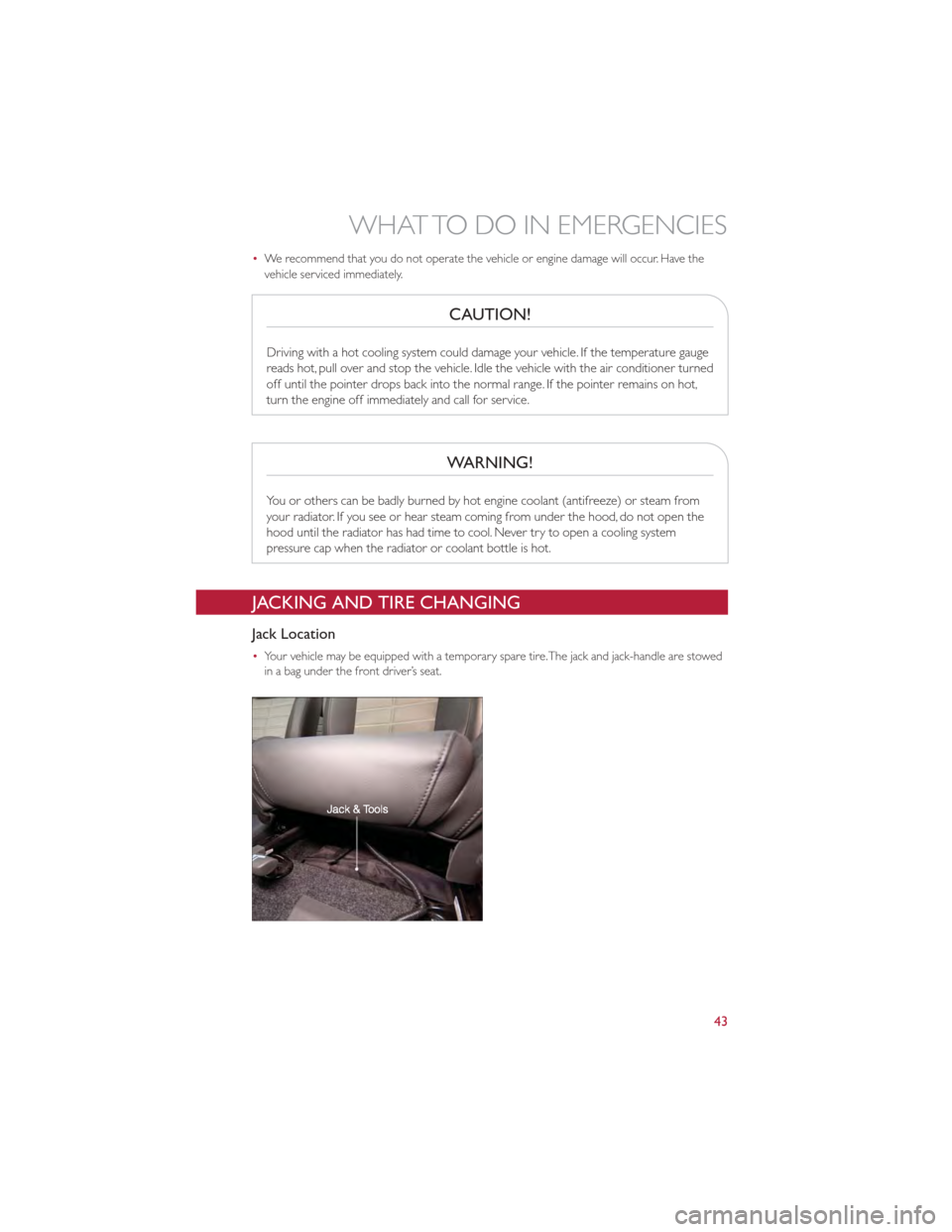
•Your vehicle may be equipped with a temporary spare tire.The jack and jack-handle are stowed
in a bag under the front driver’s seat.
WHAT TO DO IN EMERGENCIES
43
Page 55 of 80
WARNING!
•Do not attempt to seal a tire on the side of the vehicle closest to traffic. Pull far
enough off the road to avoid the danger of being hit when using the TIREFIT kit.
• Do not use TIREFIT or drive the vehicle under the following circumstances:
− If the puncture in the tire tread is approximately 1/4 in. (6 mm) or larger.
− If the tire has any sidewall damage.
− If the tire has any damage from driving with extremely low tire pressure.
− If the tire has any damage from driving on a flat tire.
− If the wheel has any damage.
− If you are unsure of the condition of the tire or the wheel.
• Keep TIREFIT away from open flames or heat source.
• A loose TIREFIT kit thrown forward in a collision or hard stop could endanger the
occupants of the vehicle.Always stow the TIREFIT kit in the place provided. Failure to
follow these warnings can result in injuries that are serious or fatal to you, your
passengers, and others around you.
• Take care not to allow the contents of TIREFIT to come in contact with hair, eyes, or
clothing.TIREFIT is harmful if inhaled, swallowed, or absorbed through the skin. It
causes skin, eye, and respiratory irritation. Flush immediately with plenty of water if
there is any contact with eyes or skin. Change clothing as soon as possible, if there is
any contact with clothing.
• TIREFIT Sealant solution contains latex. In case of an allergic reaction or rash, consult
a physician immediately. Keep TIREFIT out of reach of children. If swallowed, rinse
mouth immediately with plenty of water and drink plenty of water. Do not induce
vomiting! Consult a physician immediately.
• TIREFIT is not a permanent flat tire repair. Have the tire inspected and repaired or
replaced after using TIREFIT. Do not exceed 55 mph (88 km/h) until the tire is
repaired or replaced. Failure to follow this warning can result in injuries that are
serious or fatal to you, your passengers, and others around you.
JUMP-STARTING PROCEDURE
•If your vehicle has a discharged battery, it can be jump-started using a set of jumper cables and a
battery in another vehicle or by using a portable battery booster pack. Jump-starting can be
dangerous if done improperly so please follow the procedures in this section carefully.
NOTE: When using a portable battery booster pack, follow the manufacturer’s operating
instructions and precautions.
WHAT TO DO IN EMERGENCIES
53
Page 61 of 80
WARNING!
Fast spinning tires can be dangerous. Forces generated by excessive wheel speeds may
cause damage, or even failure, of the axle and tires.A tire could explode and injure
someone. Do not spin your vehicle's wheels faster than 30 mph (48 km/h) or for
longer than 30 seconds continuously without stopping when you are stuck and do not
let anyone near a spinning wheel, no matter what the speed.
EVENT DATA RECORDER (EDR)
•This vehicle is equipped with an event data recorder (EDR).The main purpose of an EDR is to
record, in certain crash or near crash-like situations, such as an air bag deployment or hitting a
road obstacle, data that will assist in understanding how a vehicle’s systems performed.The EDR
is designed to record data related to vehicle dynamics and safety systems for a short period of
time, typically 30 seconds or less.The EDR in this vehicle is designed to record such data as:
•How various systems in your vehicle were operating;
• Whether or not the driver and passenger safety belts were buckled/fastened;
• How far (if at all) the driver was depressing the accelerator and/or brake pedal; and,
• How fast the vehicle was traveling.
• These data can help provide a better understanding of the circumstances in which crashes and
injuries occur.
NOTE: EDR data are recorded by your vehicle only if a non-trivial crash situation occurs; no data
are recorded by the EDR under normal driving conditions and no personal data (e.g. name, gender,
age, and crash location) are recorded. However, other parties, such as law enforcement, could
combine the EDR data with the type of personally identifying data routinely acquired during a
crash investigation.
• To read data recorded by an EDR, special equipment is required, and access to the vehicle or the
EDR is needed. In addition to the vehicle manufacturer, other parties such as law enforcement,
that have the special equipment, can read the information if they have access to the vehicle or
the EDR.
WHAT TO DO IN EMERGENCIES
59
Page 68 of 80
Cavity Maxi FuseMini FuseDescription
F11 15 Amp BluePowertrain
F11 10 Amp Red Powertrain (Multiair – If Equipped)
F14 5 Amp TanHigh beam (Shutter)
F15 15 Amp BlueCigar Lighter
F16 7.5 Amp BrownTransmission
F17 25 Amp White Powertrain (Multiair – If Equipped)
F17 15 Amp BluePowertrain
F18 15 Amp BluePowertrain
F18 5 Amp Tan Powertrain (Multiair – If Equipped)
F19 7.5 Amp BrownAir Conditioning
F20 15 Amp Blue Heated Seats – If Equipped
F21 15 Amp BlueFuel Pump
F23 20 Amp YellowAnti-Lock Brake Valves
F24 7.5 Amp Brown Stability Control System
F30 15 Amp BlueFog Lamps
F82 30 Amp Green Sunroof/Convertible Top
F84 10 Amp RedTransmission
F85 15 Amp Blue Rear Defroster, Heated Mirrors
F87 5 Amp TanLights
F90 5 Amp TanHeated Mirrors
TIRE PRESSURES
•Check the inflation pressure of each tire, including the spare tire, at least monthly and inflate to
the recommended pressure for your vehicle.
• The tire pressures recommended for your vehicle are found on the “Tire and Loading
Information” label located on the driver’s side door opening.
NOTE:Refer to the Owner's Manual on the
DVD for more information regarding tire
warnings and instructions.
MAINTAINING YOUR VEHICLE
66
Page 73 of 80
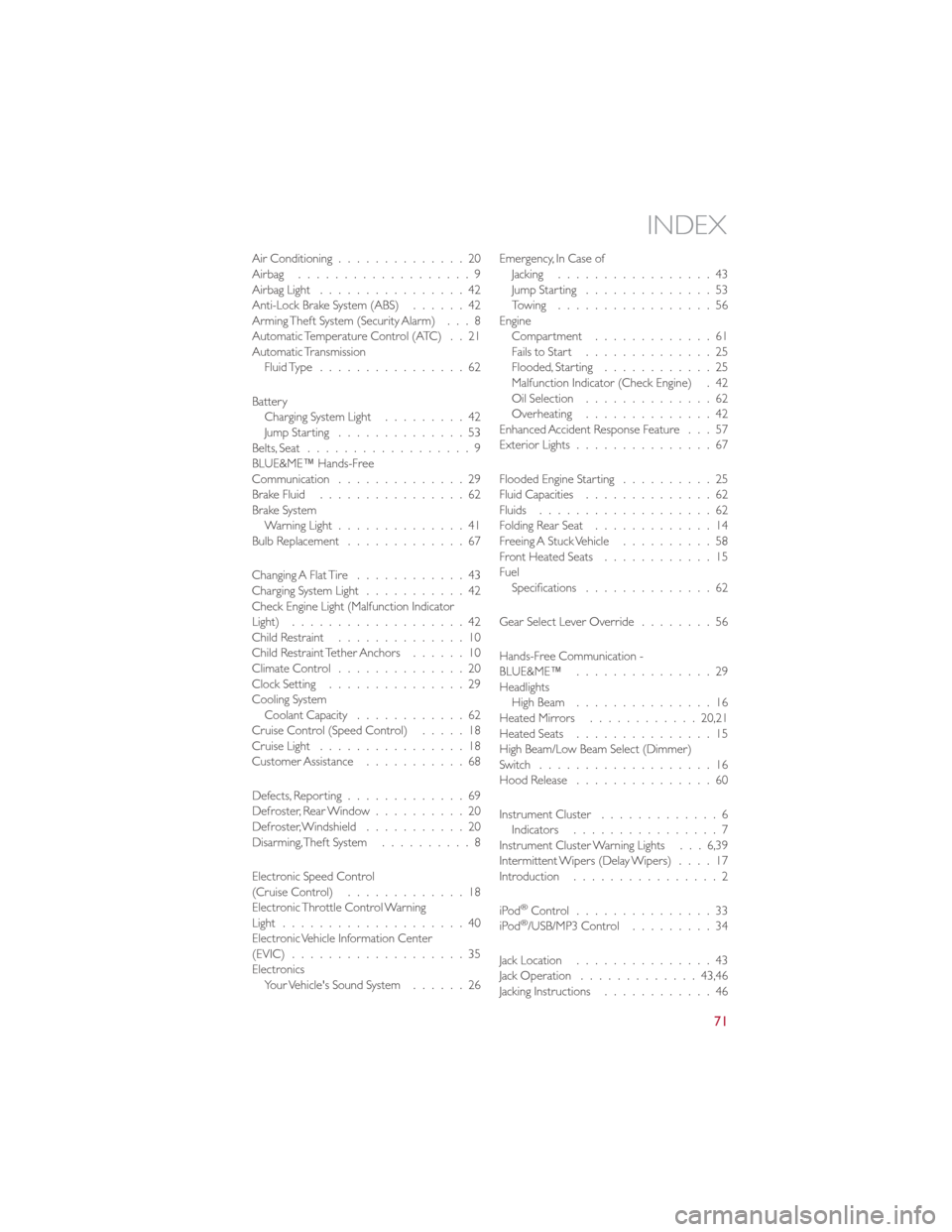
Air Conditioning..............20
Airbag ...................9
Airbag Light ................42
Anti-Lock Brake System (ABS) ......42
Arming Theft System (Security Alarm) . . . 8
Automatic Temperature Control (ATC) . . 21
Automatic Transmission Fluid Type ................62
Battery Charging System Light .........42
Jump Starting ..............53
Belts,Seat ..................9
BLUE&ME™ Hands-Free
Communication ..............29
Brake Fluid ................62
Brake System Warning Light ..............41
Bulb Replacement .............67
Changing A Flat Tire ............43
Charging System Light ...........42
Check Engine Light (Malfunction Indicator
Light) ...................42
Child Restraint ..............10
Child Restraint Tether Anchors ......10
ClimateControl ..............20
Clock Setting ...............29
Cooling System Coolant Capacity ............62
Cruise Control (Speed Control) .....18
Cruise Light ................18
Customer Assistance ...........68
Defects, Reporting .............69
Defroster,RearWindow..........20
Defroster,Windshield ...........20
Disarming,Theft System ..........8
Electronic Speed Control
(Cruise Control) .............18
Electronic Throttle Control Warning
Light ....................40
Electronic Vehicle Information Center
(EVIC)...................35
Electronics Your Vehicle's Sound System ......26Emergency, In Case of
Jacking .................43
Jump Starting ..............53
Towing .................56
Engine Compartment .............61
Fails to Start ..............25
Flooded, Starting ............25
Malfunction Indicator (Check Engine) . 42
Oil Selection ..............62
Overheating ..............42
Enhanced Accident Response Feature . . . 57
Exterior Lights ...............67
Flooded Engine Starting ..........25
Fluid Capacities ..............62
Fluids ...................62
Folding Rear Seat .............14
Freeing A Stuck Vehicle ..........58
FrontHeatedSeats ............15
Fuel Specifications ..............62
Gear Select Lever Override ........56
Hands-Free Communication -
BLUE&ME™ ...............29
Headlights High Beam ...............16
HeatedMirrors ............ 20,21
HeatedSeats ...............15
High Beam/Low Beam Select (Dimmer)
Switch ...................16
Hood Release ...............60
Instrument Cluster .............6
Indicators ................7
Ins
trument Cluster Warning Lights . . . 6,39
Intermittent Wipers (Delay Wipers) ....17
Introduction ................2
iPod
®Control ...............33
iPod®/USB/MP3Control .........34
Jack Location ...............43
JackOperation ............. 43,46
Jacking Instructions ............46
INDEX
71