window FIAT 500C 2013 2.G User Guide
[x] Cancel search | Manufacturer: FIAT, Model Year: 2013, Model line: 500C, Model: FIAT 500C 2013 2.GPages: 423, PDF Size: 9.86 MB
Page 49 of 423
The system includes side impact sensors that are cali-
brated to deploy the Seat-Mounted Side Air Bags (SAB)
and SABIC during impacts that require air bag occupant
protection.
SAB and SABIC air bags are a supplement to the seat belt
restraint system. Occupants, including children who are
up against or very close to SAB or SABIC air bags can be
seriously injured or killed. Occupants, especially chil-
dren, should not lean on or sleep against the door, side
windows, or area where the SAB or SABIC air bags
inflate, even if they are in an infant or child restraint.
Always sit upright as possible with your back against the
seat back, use the seat belts properly, and use the
appropriate sized child restraint, infant restraint or
booster seat recommended for the size and weight of the
child.
WARNING!
•Your vehicle is equipped with left and right
Supplemental Side Air Bag Inflatable Curtain
(SABIC), do not stack luggage or other cargo up
high enough to block the location of the SABIC.
The area where the SABIC is located should remain
free from any obstructions.
•Do not use accessory seat covers or place objects
between you and the side air bags; the performance
could be adversely affected and/or objects could be
pushed into you, causing serious injury.
(Continued)
2
THINGS TO KNOW BEFORE STARTING YOUR VEHICLE 47
Page 50 of 423
WARNING!(Continued)
•Your vehicle is equipped with SABIC air bags, do
not have any accessory items installed which will
alter the roof, including adding a sunroof to your
vehicle. Do not add roof racks that require perma-
nent attachments (bolts or screws) for installation
on the vehicle roof. Do not drill into the roof of the
vehicle for any reason.
•Do not allow occupants to extend any part of their
body outside of the window.
Supplemental Driver Side Knee Air Bag
The Supplemental Driver Side Knee Air Bag provides
enhanced protection and works together with the Driver
Advanced Front Air Bag during a frontal impact.
Knee Impact Bolster
The Knee Impact Bolster helps protect the knees of the
front passenger, and position the front occupant for the
best interaction with the Advanced Front Air Bag.
Along with seat belts and pretensioners, Advanced Front
Air Bags work with the Supplemental Driver Side Knee
Air Bag and the passenger side knee bolster to provide
improved protection for the driver and front passenger.
Side air bags also work with seat belts to improve
occupant protection.
Air Bag Deployment Sensors And Controls
Occupant Restraint Controller (ORC)
The ORC is part of a Federally regulated safety system
required for this vehicle.
The ORC determines if deployment of the front and/or
side air bags in a frontal or side collision is required.
Based on the impact sensor’s signals, a central electronic
48 THINGS TO KNOW BEFORE STARTING YOUR VEHICLE
Page 54 of 423
triggered, releasing a quantity of non-toxic gas. The
inflating SAB exits through the seat seam into the space
between the occupant and the door. The SAB fully inflate
in about 10 milliseconds. The side air bag moves at a very
high speed and with such a high force that it could injure
you if you are not seated properly, or if items are
positioned in the area where the side air bag inflates. This
especially applies to children.
Supplemental Side Air Bag Inflatable Curtain
(SABIC) Inflator Units
During collisions where the impact is confined to a
particular area of the side of the vehicle, the ORC may
deploy the Supplemental Side Air Bag Inflatable Curtain
(SABIC), depending on several factors, including the
severity and type of collision. In these events, the ORC
will deploy the SABIC only on the impact side of the
vehicle.
A quantity of non-toxic gas is generated to inflate the side
curtain air bag. The inflating side curtain air bag pushes
the outside edge of the headliner out of the way and
covers the window. The air bag inflates in about 30
milliseconds (about one-quarter of the time that it takes
to blink your eyes) with enough force to injure you if you
are not belted and seated properly, or if items are
positioned in the area where the side curtain air bag
inflates. This especially applies to children. The side
curtain air bag is about 3-1/2 in (9 cm) thick when it is
inflated.
Because air bag sensors estimate deceleration over time,
vehicle speed and damage are not good indicators of
whether or not an air bag should have deployed.
Front And Side Impact Sensors
In front and side impacts, impact sensors can aid the
ORC in determining appropriate response to impact
events.
52 THINGS TO KNOW BEFORE STARTING YOUR VEHICLE
Page 82 of 423
Exhaust Gas
WARNING!
Exhaust gases can injure or kill. They contain carbon
monoxide (CO), which is colorless and odorless.
Breathing it can make you unconscious and can
eventually poison you. To avoid breathing (CO),
follow these safety tips:
•Do not run the engine in a closed garage or in
confined areas any longer than needed to move
your vehicle in or out of the area.
•If you are required to drive with the trunk/liftgate
open, make sure that all windows are closed and
the climate control BLOWER switch is set at high
speed. DO NOT use the recirculation mode.
(Continued)
WARNING!(Continued)
•If it is necessary to sit in a parked vehicle with the
engine running, adjust your heating or cooling
controls to force outside air into the vehicle. Set the
blower at high speed.
The best protection against carbon monoxide entry into
the vehicle body is a properly maintained engine exhaust
system.
Whenever a change is noticed in the sound of the exhaust
system, when exhaust fumes can be detected inside the
vehicle, or when the underside or rear of the vehicle is
damaged, have a competent mechanic inspect the com-
plete exhaust system and adjacent body areas for broken,
damaged, deteriorated, or mispositioned parts. Open
seams or loose connections could permit exhaust fumes
to seep into the passenger compartment. In addition,
inspect the exhaust system each time the vehicle is raised
for lubrication or oil change. Replace as required.
80 THINGS TO KNOW BEFORE STARTING YOUR VEHICLE
Page 89 of 423
▫To Vary The Speed Setting...............124
▫To Accelerate For Passing................124
!REAR PARK ASSIST — IF EQUIPPED........125
▫Rear Park Assist Sensors................125
▫Rear Park Assist Alerts..................126
▫Failure Indications.....................128
▫Cleaning The Rear Park Assist System.......128
▫Park Assist System Usage Precautions.......129
!POWER SUNROOF — IF EQUIPPED........131
▫To Open............................132
▫To Close............................132
▫Pinch Protect Feature...................132
▫Wind Buffeting.......................132
▫Emergency Operation...................133
▫Sun Shade — If Equipped...............133
!ELECTRICAL POWER OUTLETS...........134
!CIGAR LIGHTER — IF EQUIPPED..........136
!CUPHOLDERS........................137
!STORAGE............................138
▫Glove Box Compartment................138
▫Passenger Seat Storage — If Equipped.......138
!CARGO AREA FEATURES................139
!REAR WINDOW FEATURES..............140
▫Rear Window Defroster.................140
3
UNDERSTANDING THE FEATURES OF YOUR VEHICLE 87
Page 91 of 423
NOTE:Vertical movement only operates in auto open/
close mode.
Raising The Power Top
Auto Close
From the convertible top fully open position, push the
top close button for approximately one second for the
three-quarter open/spoiler position. Push the top close
button for approximately one second a second time for
the one-quarter open position. Push and hold close
button to fully close convertible top.
Manual Close
For manual close, push and hold the close button until
desired position until one-quarter open position. Push
and hold again for full close position.
NOTE:Rail lubrication is recommended every 2000
cycles, or if scratching noises due to dust are present.
Refer to “Fluids, Lubes, and Genuine Part” in “Maintain-
ing Your Vehicle” for information.
CAUTION!
Failure to follow these cautions may cause interior
water damage, stains or mildew on the top material:
•Avoid high-pressure car washes, as they can dam-
age the top material. Also, increased water pressure
may force water past the weather strips.
•Remove any standing water from the top and dry
the surface before opening it. Operating the top,
opening a door or lowering a window while the top
is wet may allow water to drip into the vehicles
interior.
(Continued)
3
UNDERSTANDING THE FEATURES OF YOUR VEHICLE 89
Page 94 of 423

MIRRORS
Inside Day/Night Mirror
The mirror can be adjusted up, down, left, and right for
various drivers. The mirror should be adjusted to center
on the view through the rear window.
Headlight glare from vehicles behind you can be reduced
by moving the small control under the mirror to the night
position (toward the rear of the vehicle). The mirror
should be adjusted while set in the day position (toward
the windshield).
Adjusting Rearview Mirror
92 UNDERSTANDING THE FEATURES OF YOUR VEHICLE
Page 97 of 423

Spotter Mirror — If Equipped
Some models are equipped with a driver’s side spotter
mirror. The spotter mirror allows for a greater range of
visibility on the driver’s side of the vehicle.
Folding Mirrors
The exterior mirrors are hinged to allow the mirror to
pivot forward or rearward to help avoid damage. The
mirror has three detent positions: full forward, normal
and full rearward.
Heated Mirrors — If Equipped
These mirrors are heated to melt frost or ice. This
feature can be activated whenever you turn on the
rear window defroster if equipped. Some vehicles may
not be equipped with rear window defroster, in this case
the heated mirrors will still function as intended. Refer to
“Rear Window Features” in “Understanding The Fea-
tures Of Your Vehicle” for further information.
Spotter Mirror
3
UNDERSTANDING THE FEATURES OF YOUR VEHICLE 95
Page 98 of 423
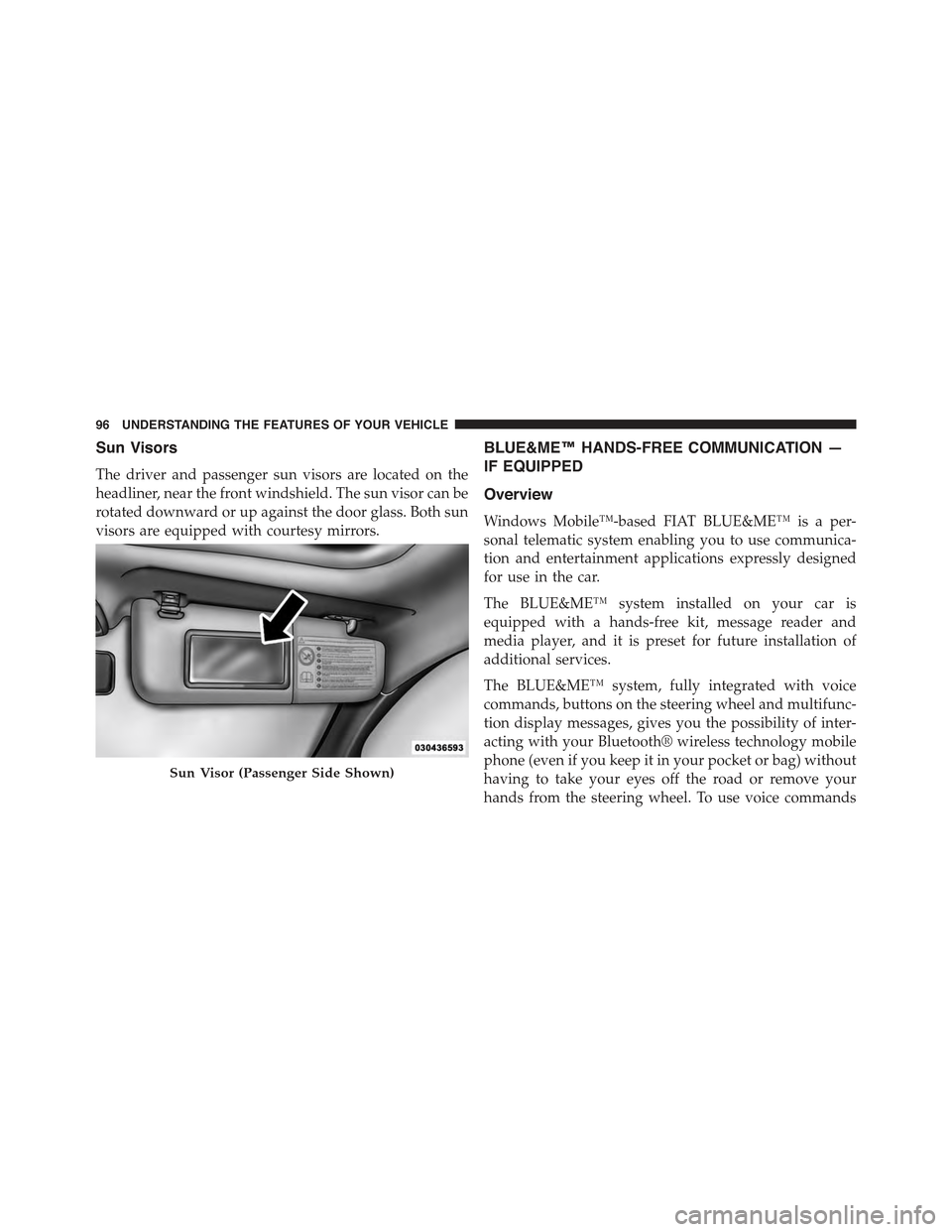
Sun Visors
The driver and passenger sun visors are located on the
headliner, near the front windshield. The sun visor can be
rotated downward or up against the door glass. Both sun
visors are equipped with courtesy mirrors.
BLUE&ME™ HANDS-FREE COMMUNICATION —
IF EQUIPPED
Overview
Windows Mobile™-based FIAT BLUE&ME™ is a per-
sonal telematic system enabling you to use communica-
tion and entertainment applications expressly designed
for use in the car.
The BLUE&ME™ system installed on your car is
equipped with a hands-free kit, message reader and
media player, and it is preset for future installation of
additional services.
The BLUE&ME™ system, fully integrated with voice
commands, buttons on the steering wheel and multifunc-
tion display messages, gives you the possibility of inter-
acting with your Bluetooth® wireless technology mobile
phone (even if you keep it in your pocket or bag) without
having to take your eyes off the road or remove your
hands from the steering wheel. To use voice commands
Sun Visor (Passenger Side Shown)
96 UNDERSTANDING THE FEATURES OF YOUR VEHICLE
Page 134 of 423
To Open
Press and hold the power sunroof switch rearward for
approximately one second and the sunroof will stop at
the vented position. Press the switch a second time and
hold for approximately one second and release, the
sunroof will open fully, then stop automatically. This is
called “Express Open”. During Express Open operation,
any movement of the sunroof switch will stop the
sunroof.
To Close
With the sunroof in the full open position, pull the power
sunroof button and hold it for approximately one second,
the sunroof will return to the vented position. Pull the
switch a second time and hold for approximately one
second to completely close the sunroof.
Pinch Protect Feature
This feature will detect an obstruction in the opening of
the sunroof during Express Close operation. If an ob-
struction in the path of the sunroof is detected, the
sunroof will automatically retract. Remove the obstruc-
tion if this occurs. Next, press the switch forward and
release to Express Close.
Wind Buffeting
Wind buffeting can be described as the perception of
pressure on the ears or a helicopter-type sound in the
ears. Your vehicle may exhibit wind buffeting with the
windows down, or the sunroof (if equipped) in certain
open or partially open positions. This is a normal occur-
rence and can be minimized. If the buffeting occurs with
the rear windows open, open the front and rear windows
together to minimize the buffeting. If the buffeting occurs
with the sunroof open, adjust the sunroof opening to
minimize the buffeting or open any window.
132 UNDERSTANDING THE FEATURES OF YOUR VEHICLE