warning light FIAT 500C 2016 2.G Workshop Manual
[x] Cancel search | Manufacturer: FIAT, Model Year: 2016, Model line: 500C, Model: FIAT 500C 2016 2.GPages: 442, PDF Size: 3.1 MB
Page 296 of 442
limit, upon the next ignition switch cycle, the “Tire
Pressure Monitoring Telltale Light” will remain on and
a chime will sound. In addition, the graphic in the
EVIC will still display a low pressure message and a
tire highlighted in a different color.
• After driving the vehicle for up to 20 minutes above
15 mph (24 km/h), the “Tire Pressure Monitoring
Telltale Light” will flash on and off for 75 seconds and
then remain on solid. In addition, the EVIC will
display a “Service TPM System” message.
• For each subsequent ignition switch cycle, a chime will
sound, the “Tire Pressure Monitoring Telltale Light”
will flash on and off for 75 seconds and then remain on
solid, and the EVIC will display a “Service Tire Pres-
sure Monitoring System” message.
Once you repair or replace the original road tire and
reinstall it, the TPMS will update automatically. In addi-
tion, the “Tire Pressure Monitoring Telltale Light” will turn off as long as no tire pressure is below the low-
pressure warning limit in any of the four active road tires.
The vehicle may need to be driven for up to 20 minutes
above 15 mph (24 km/h) in order for the TPMS to receive
this information.
General Information
This device complies with Part 15 of the FCC rules and
RSS-210 of Industry Canada. Operation is subject to the
following two conditions:
(1) This device may not cause harmful interference.
(2) This device must accept any interference received,
including interference that may cause undesired opera-
tion.
NOTE:
Changes or modifications not expressly approved
by the party responsible for compliance could void the
user ’s authority to operate the equipment.
294 STARTING AND OPERATING
Page 302 of 442
CAUTION!
•Damage to the fuel system or emission control
system could result from using an improper fuel
filler cap. A poorly fitting cap could let impurities
(Continued)
CAUTION! (Continued)
into the fuel system. Also, a poorly fitting aftermar-
ket cap can cause the “Malfunction Indicator Light
(MIL)” to illuminate, due to fuel vapors escaping
from the system.
• To avoid fuel spillage and overfilling, do not “top
off” the fuel tank after filling.
WARNING!
• Never have any smoking materials lit in or near the
vehicle when the gas cap is removed or the tank is
being filled.
• Never add fuel when the engine is running. It may
cause the MIL to turn on and could cause a fire.
• A fire may result if gasoline is pumped into a
portable container that is inside of a vehicle. You
could be burned. Always place gas containers on
the ground while filling.
Fuel Filler Cap
300 STARTING AND OPERATING
Page 332 of 442
5. Using the swivel wrench, raise the vehicle by turningthe jack screw to the right. Raise the vehicle only until
the tire just clears the surface and enough clearance is
obtained to install the spare tire. Minimum tire lift
provides maximum stability.
6. Remove the wheel bolts and pull the wheel off the hub. For vehicles equipped with aluminum wheels,
the center caps must be removed to remove the wheel
bolts. For vehicles equipped with steel wheels the
wheel covers must be removed to remove the wheel
bolts.
WARNING!
To avoid the risk of forcing the vehicle off the jack,
do not fully tighten the wheel bolts until the vehicle
has been lowered. Failure to follow this warning may
result in serious injury.
CAUTION!
Be sure to mount the spare tire with the valve stem
facing outward. The vehicle could be damaged if the
spare tire is mounted incorrectly.
WARNING!
To avoid possible personal injury, handle the wheel
covers with care to avoid contact with any sharp
edges.
7. Install the spare wheel and hand start the wheel bolts. Lightly tighten the bolts. To avoid the risk of forcing
the vehicle off the jack, do not tighten the bolts fully
until the vehicle has been lowered.
330 WHAT TO DO IN EMERGENCIES
Page 335 of 442
6. Align the valve notch in the wheel cover with thevalve stem on the wheel. Install the cover by hand. Do
not use a hammer or excessive force to install the
cover.
Vehicles Without Wheel Covers
1. Mount the road tire on the axle.
2. Install the remaining wheel bolts with the cone shapedend of the nut toward the wheel. Lightly tighten the
wheel bolts.
WARNING!
To avoid the risk of forcing the vehicle off the jack,
do not fully tighten the lug nuts until the vehicle has
been lowered. Failure to follow this warning may
result in serious injury. 3. Lower the vehicle to the ground by turning the jack
handle counterclockwise.
4. Finish tightening the wheel bolts. Push down on the wrench while at the end of the handle for increased
leverage. Refer to “Torque Specifications” in this sec-
tion for correct wheel bolt torque.
5. After 25 miles (40 km) check the wheel bolt torque with a torque wrench to ensure that all wheel bolts are
properly seated against the wheel.
Spare Tire Stowage
Reverse instructions of the spare removal section.
Rotate the jack wrench tool on the winch drive nut
clockwise until effort becomes heavy and an audible click
is heard indicating the spare is properly stowed.
6
WHAT TO DO IN EMERGENCIES 333
Page 336 of 442
CAUTION!
The winch mechanism is designed for use with the
jack wrench extension tool only. Use of air wrench or
power tool may damage the winch.
JUMP-STARTING PROCEDURE
If your vehicle has a discharged battery, it can be jump-
started using a set of jumper cables and a battery in
another vehicle or by using a portable battery booster
pack. Jump-starting can be dangerous if done improperly
so please follow the procedures in this section carefully.
NOTE:When using a portable battery booster pack,
follow the manufacturer ’s operating instructions and
precautions.
CAUTION!
Do not use a portable battery booster pack or any
other booster source with a system voltage greater
than 12 Volts or damage to the battery, starter motor,
alternator or electrical system may occur.
WARNING!
Do not attempt jump-starting if the battery is frozen.
It could rupture or explode and cause personal injury.
Preparations For Jump-Start
The battery in your vehicle is located between the left
front headlight assembly and the left front wheel splash
shield.
334 WHAT TO DO IN EMERGENCIES
Page 352 of 442
access this information to assist with the diagnosis and
service of your vehicle and emissions system.
WARNING!
•ONLY an authorized service technician should con-
nect equipment to the OBD II connection port in
order to diagnose or service your vehicle.
• If unauthorized equipment is connected to the
OBD II connection port, such as a driver-behavior
tracking device, it may:
• Be possible that vehicle systems, including
safety related systems, could be impaired or a
loss of vehicle control could occur that may result
in an accident involving serious injury or death.
• Access, or allow others to access, information
stored in your vehicle systems, including per-
sonal information. For further information, refer to “Cybersecurity” in “Un-
derstanding Your Instrument Panel” in your Owner ’s
Manual on the DVD.
EMISSIONS INSPECTION AND MAINTENANCE
PROGRAMS
In some localities, it may be a legal requirement to pass
an inspection of your vehicle’s emissions control system.
Failure to pass could prevent vehicle registration.
For states that require an Inspection and Mainte-
nance (I/M), this check verifies the “Malfunction
Indicator Light (MIL)” is functioning and is not
on when the engine is running, and that the OBD II
system is ready for testing.
Normally, the OBD II system will be ready. The OBD II
system may notbe ready if your vehicle was recently
350 MAINTAINING YOUR VEHICLE
Page 378 of 442
Brake System
In order to assure brake system performance, all brake
system components should be inspected periodically.
Refer to the “Maintenance Schedule” for the proper
maintenance intervals.
WARNING!
Riding the brakes can lead to brake failure and
possibly a collision. Driving with your foot resting or
riding on the brake pedal can result in abnormally
high brake temperatures, excessive lining wear, and
possible brake damage. Riding the brakes may also
reduce braking capacity in an emergency.
Brake Master Cylinder
The fluid level in the master cylinder should be checked
when performing under hood services, or immediately if
the “Brake Warning Light” is on.Be sure to clean the top of the master cylinder area before
removing the cap. If necessary, add fluid to bring the
fluid level up to the requirements described on the brake
fluid reservoir. Fluid level can be expected to fall as the
brake pads wear. The brake fluid level should be checked
when the pads are replaced. However, low fluid level
may be caused by a leak and a checkup may be needed.
NOTE:
If your vehicle is equipped with a manual
transmission, the brake fluid reservoir supplies fluid to
both the brake system and the clutch release system. The
two systems are separated in the reservoir, and a leak in
one system will not affect the other system. The manual
transmission clutch release system should not require
fluid replacement during the life of the vehicle. If the
brake fluid reservoir is low and the brake system does
not indicate any leaks or other problems, it may be a
result of a leak in the hydraulic clutch release system. See
your local authorized dealer for service.
376 MAINTAINING YOUR VEHICLE
Page 420 of 442
The manufacturer will not stand behind any service
contract that is not the manufacturer’s service contract.
It is not responsible for any service contract other than
the manufacturer’s service contract. If you purchased a
service contract that is not a manufacturer’s service
contract, and you require service after the manufacturer’s
New Vehicle Limited Warranty expires, please refer to the
contract documents, and contact the person listed in
those documents.
We appreciate that you have made a major investment
when you purchased the vehicle. An authorized dealer
has also made a major investment in facilities, tools, and
training to assure that you are absolutely delighted with
the ownership experience. You will be pleased with their
sincere efforts to resolve any warranty issues or related
concerns.WARNING!
Engine exhaust (internal combustion engines only),
some of its constituents, and certain vehicle compo-
nents contain, or emit, chemicals known to the State
of California to cause cancer and birth defects, or
other reproductive harm. In addition, certain fluids
contained in vehicles and certain products of compo-
nent wear contain, or emit, chemicals known to the
State of California to cause cancer and birth defects,
or other reproductive harm.
WARRANTY INFORMATION
See the Warranty Information Booklet, located on the
DVD, for the terms and provisions of FCA USA LLC
warranties applicable to this vehicle and market.
418 IF YOU NEED CONSUMER ASSISTANCE
Page 426 of 442
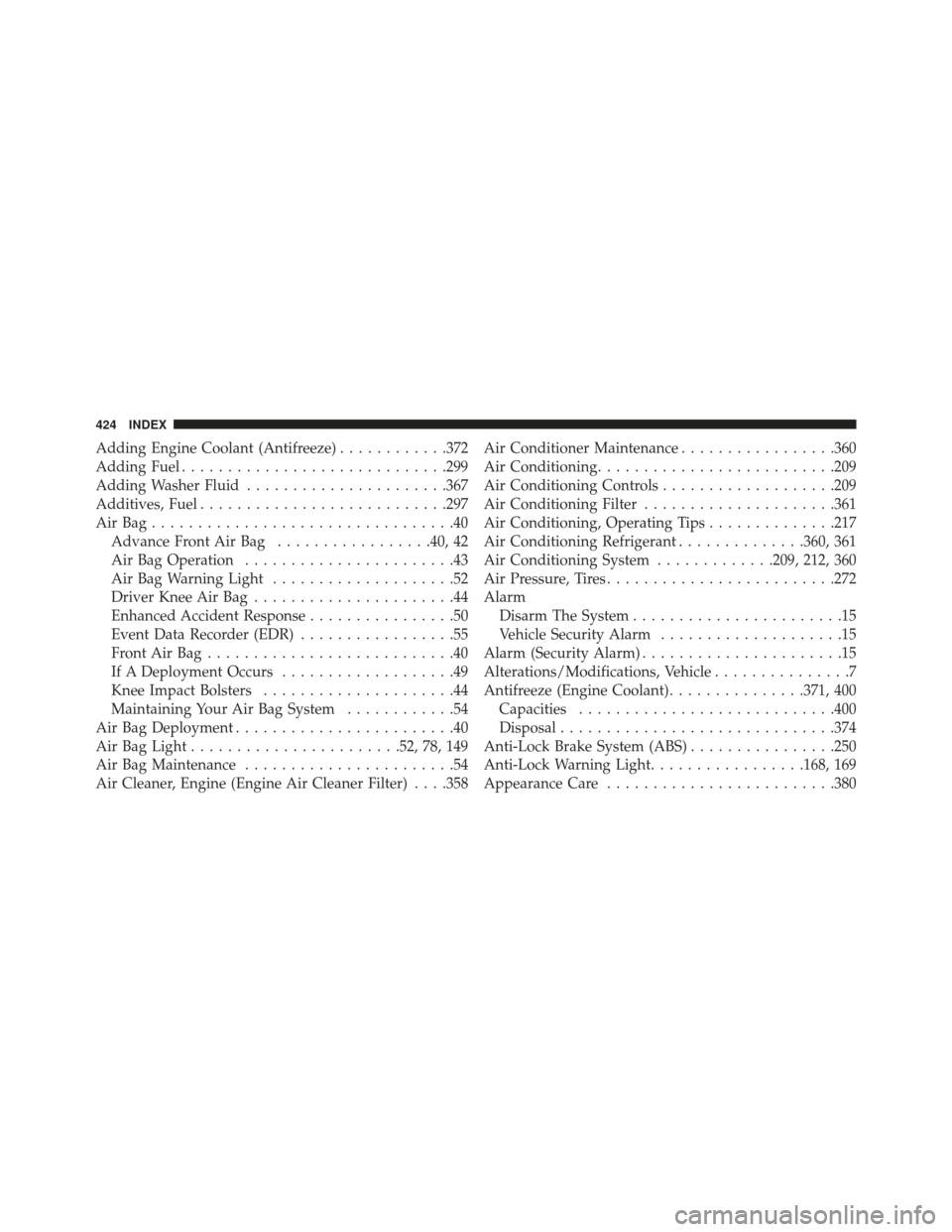
Adding Engine Coolant (Antifreeze)............372
Adding Fuel ............................ .299
Adding Washer Fluid ..................... .367
Additives, Fuel .......................... .297
AirBag.................................40 Advance Front Air Bag .................40, 42
Air Bag Operation .......................43
Air Bag Warning Light ....................52
Driver Knee Air Bag ......................44
Enhanced Accident Response ................50
Event Data Recorder (EDR) .................55
FrontAirBag...........................40
If A Deployment Occurs ...................49
Knee Impact Bolsters .....................44
Maintaining Your Air Bag System ............54
Air Bag Deployment ........................40
Air Bag Light ...................... .52, 78, 149
Air Bag Maintenance .......................54
Air Cleaner, Engine (Engine Air Cleaner Filter) . . . .358 Air Conditioner Maintenance
.................360
Air Conditioning ......................... .209
Air Conditioning Controls ...................209
Air Conditioning Filter .....................361
Air Conditioning, Operating Tips ..............217
Air Conditioning Refrigerant ..............360, 361
Air Conditioning System .............209, 212, 360
Air Pressure, Tires ........................ .272
Alarm Disarm The System .......................15
Vehicle Security Alarm ....................15
Alarm (Security Alarm) ......................15
Alterations/Modifications, Vehicle ...............7
Antifreeze (Engine Coolant) ...............371, 400
Capacities ........................... .400
Disposal ............................. .374
Anti-Lock Brake System (ABS) ................250
Anti-Lock Warning Light .................168, 169
Appearance Care ........................ .380
424 INDEX
Page 427 of 442
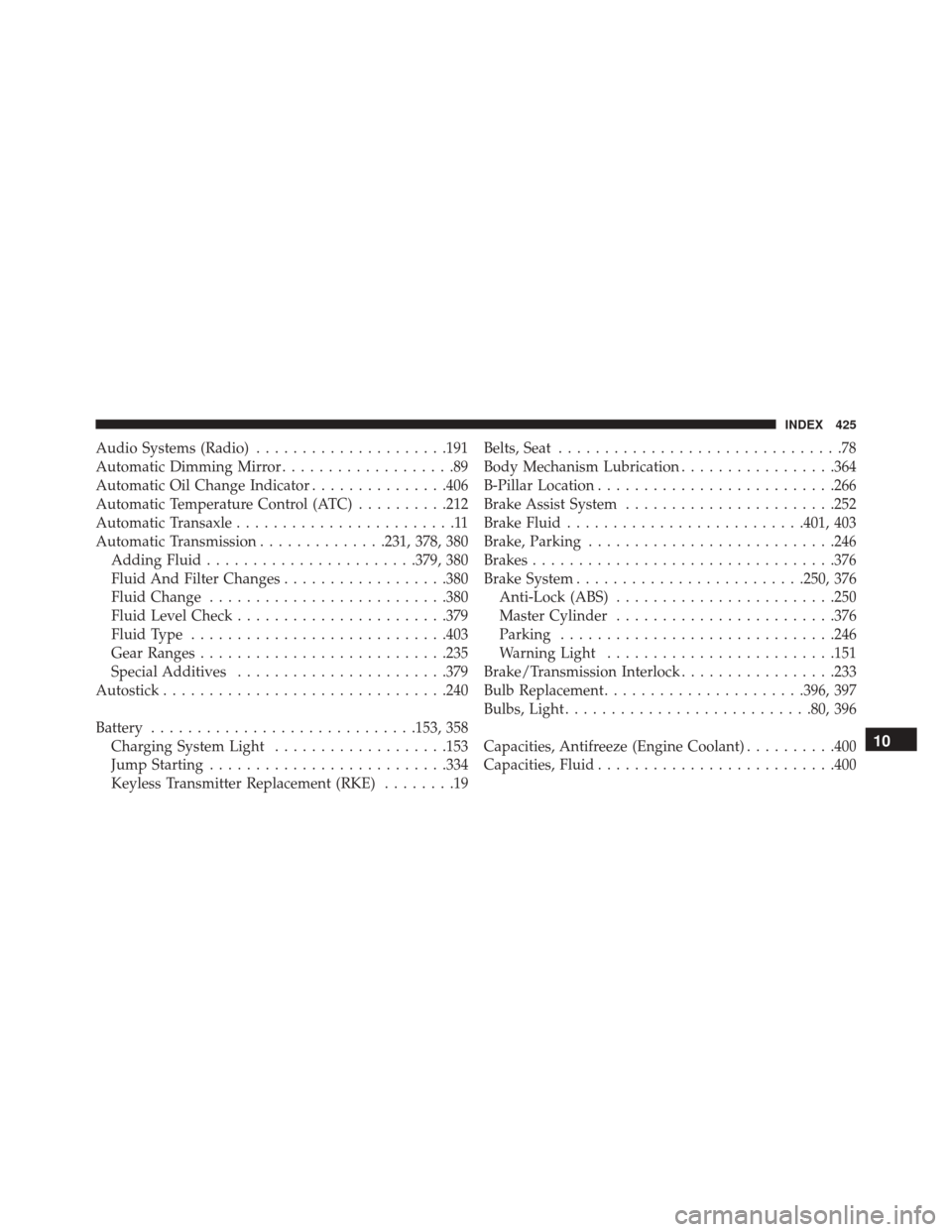
Audio Systems (Radio).....................191
Automatic Dimming Mirror ...................89
Automatic Oil Change Indicator ...............406
Automatic Temperature Control (ATC) ..........212
Automatic Transaxle ........................11
Automatic Transmission ..............231, 378, 380
Adding Fluid ...................... .379, 380
Fluid And Filter Changes ..................380
Fluid Change ......................... .380
Fluid Level Check ...................... .379
Fluid Type ........................... .403
Gear Ranges .......................... .235
Special Additives ...................... .379
Autostick .............................. .240
Battery ............................ .153, 358
Charging System Light ...................153
Jump Starting ......................... .334
Keyless Transmitter Replacement (RKE) ........19Belts, Seat
...............................78
Body Mechanism Lubrication .................364
B-Pillar Location ......................... .266
Brake Assist System ...................... .252
Brake Fluid ......................... .401, 403
Brake, Parking .......................... .246
Brakes ................................ .376
Brake System ........................ .250, 376
Anti-Lock (ABS) ....................... .250
Master Cylinder ....................... .376
Parking ............................. .246
Warning Light ........................ .151
Brake/Transmission Interlock .................233
Bulb Replacement ..................... .396, 397
Bulbs, Light .......................... .80, 396
Capacities, Antifreeze (Engine Coolant) ..........400
Capacities, Fluid ......................... .400
10
INDEX 425