Instrument FIAT 500C 2017 2.G Owners Manual
[x] Cancel search | Manufacturer: FIAT, Model Year: 2017, Model line: 500C, Model: FIAT 500C 2017 2.GPages: 350, PDF Size: 3.01 MB
Page 249 of 350
HAZARD WARNING FLASHERS
The Hazard Warning flasher switch is located on the
instrument panel below the radio.Push the switch to turn on the Hazard Warning
flashers. When the switch is activated, all direc-
tional turn signals will flash on and off to warn oncom-
ing traffic of an emergency. Push the switch a second
time to turn off the Hazard Warning flashers.
Do not use this emergency warning system when the
vehicle is in motion. Use it when your vehicle is
disabled and it is creating a safety hazard for other
motorists.
If it is necessary to leave the vehicle to go for service, the
Hazard Warning flashers will continue to operate with
the ignition key removed and the vehicle locked.
NOTE: With extended use, the Hazard Warning flash-
ers may wear down your battery.
IF YOUR ENGINE OVERHEATS
In any of the following situations, you can reduce the
potential for overheating by taking the appropriate action.
• On the highways — slow down. •
In city traffic — while stopped, place the transmis-
sion in NEUTRAL, but do not increase engine idle
speed.
NOTE: There are steps that you can take to slow down
an impending overheat condition:
• If your air conditioner (A/C) is on, turn it off. The
A/C system adds heat to the engine cooling system
and turning the A/C off can help remove this heat.
• You can also turn the temperature control to maxi-
mum heat, the mode control to floor and the blower
control to high. This allows the heater core to act as a
supplement to the radiator and aids in removing heat
from the engine cooling system.
WARNING!
You or others can be badly burned by hot engine
coolant (antifreeze) or steam from your radiator. If
you see or hear steam coming from under the hood,
do not open the hood until the radiator has had time
to cool. Never try to open a cooling system pressure
cap when the radiator or coolant bottle is hot.
6
WHAT TO DO IN EMERGENCIES 247
Page 250 of 350
CAUTION!
Driving with a hot cooling system could damage
your vehicle. If the pointer rises to the H (red) mark,
the instrument cluster will sound a chime. When
safe, pull over and stop the vehicle with the engine
at idle. Turn off the air conditioning and wait until
the pointer drops back into the normal range. If the
pointer remains on the H (red) mark for more than
a minute, turn the engine off immediately and call
for service.
TIRE SERVICE KIT — IF EQUIPPED
Small punctures up to 1/4 inch (6 mm) in the tire tread
can be sealed with Tire Service Kit. Foreign objects (e.g.,
screws or nails) should not be removed from the tire.
Tire Service Kit can be used in outside temperatures
down to approximately -4°F (-20°C).
This kit will provide a temporary tire seal, allowing you
to drive your vehicle up to 100 miles (160 km) with a
maximum speed of 55 mph (90 km/h).
Tire Service Kit Storage
The Tire Service Kit is located under the front driver’s
seat.
Tire Service Kit Location
248 WHAT TO DO IN EMERGENCIES
Page 257 of 350
3. Uncoil the Air Pump Hose (7) (black in color) andscrew the fitting at the end of hose (7) onto the valve
stem.
4. Check the pressure in the tire by reading the Pressure Gauge (3).
If tire pressure is less than 19 psi (1.3 Bar):
The tire is too badly damaged. Do not attempt to drive
the vehicle further. Call for assistance.
If the tire pressure is 19 psi (1.3 Bar) or higher:
1. Push the Power Button (4) to turn on Tire Service Kit and inflate the tire to the pressure indicated on the
tire and loading information label on the driver-side
door opening.
NOTE: If the tire becomes over-inflated, push the
Deflation Button to reduce the tire pressure to the
recommended inflation pressure before continuing.
2. Disconnect the Tire Service Kit from the valve stem, reinstall the cap on the valve stem and unplug from
12 Volt outlet.
3. Place the Tire Service Kit in its proper storage area in the vehicle. 4. Have the tire inspected and repaired or replaced at
the earliest opportunity at an Authorized Dealer or
tire service center.
5. Remove the Speed Limit sticker from the instrument panel after the tire has been repaired.
6. Replace the Sealant Bottle (1) and Sealant Hose (6) assembly at your Authorized Dealer as soon as
possible. Refer to (F) “Sealant Bottle and Hose Re-
placement”.
NOTE: When having the tire serviced, advise the
Authorized Dealer or service center that the tire has
been sealed using the Tire Service Kit.
(F) Sealant Bottle And Hose Replacement:
1. Uncoil the Sealant Hose (6) (clear in color).
2. Locate the round Sealant Bottle release button in the recessed area under the sealant bottle.
3. Push the Sealant Bottle release button. The Sealant Bottle (1) will pop up. Remove the bottle and dispose
of it accordingly.
4. Clean any remaining sealant from the Tire Service Kit housing.
6
WHAT TO DO IN EMERGENCIES 255
Page 283 of 350
WARNING!(Continued)
•If unauthorized equipment is connected to the
OBD II connection port, such as a driver-behavior
tracking device, it may:
• Be possible that vehicle systems, including
safety related systems, could be impaired or a
loss of vehicle control could occur that may
result in an accident involving serious injury or
death.
• Access, or allow others to access, information
stored in your vehicle systems, including per-
sonal information.
For further information, refer to “Cybersecurity” in the
“Understanding Your Instrument Panel” section.
EMISSIONS INSPECTION AND MAINTENANCE
PROGRAMS
In some localities, it may be a legal requirement to pass
an inspection of your vehicle’s emissions control sys-
tem. Failure to pass could prevent vehicle registration. For states that require an Inspection and Main-
tenance (I/M), this check verifies the “Malfunc-
tion Indicator Light (MIL)” is functioning and is
not on when the engine is running, and that the OBD II
system is ready for testing.
Normally, the OBD II system will be ready. The OBD II
system may notbe ready if your vehicle was recently
serviced, recently had a dead battery or a battery
replacement. If the OBD II system should be deter-
mined not ready for the I/M test, your vehicle may fail
the test.
Your vehicle has a simple ignition actuated test, which
you can use prior to going to the test station. To check
if your vehicle’s OBD II system is ready, you must do
the following:
1. Cycle the ignition switch to the ON position, but do not crank or start the engine.
7
MAINTAINING YOUR VEHICLE 281
Page 309 of 350
WARNING!
Do not use volatile solvents for cleaning purposes.
Many are potentially flammable, and if used in
closed areas they may cause respiratory harm.
CAUTION!
Direct contact of air fresheners, insect repellents,
suntan lotions, or hand sanitizers to the plastic,
painted, or decorated surfaces of the interior may
cause permanent damage. Wipe away immediately.
CAUTION!
Damage caused by these type of products may not
be covered by your New Vehicle Limited Warranty.
CAUTION!
Do not use Alcohol and Alcohol-based and/or Ke-
ton based cleaning products to clean leather seats,
as damage to the seat may result.
Cleaning Headlights
Your vehicle has plastic headlights that are lighter and
less susceptible to stone breakage than glass headlights.
Plastic is not as scratch resistant as glass and therefore
different lens cleaning procedures must be followed.
To minimize the possibility of scratching the lenses and
reducing light output, avoid wiping with a dry cloth. To
remove road dirt, wash with a mild soap solution
followed by rinsing.
Do not use abrasive cleaning components, solvents,
steel wool or other aggressive material to clean the
lenses.
Glass Surfaces
All glass surfaces should be cleaned on a regular basis
with MOPAR Glass Cleaner, or any commercial
household-type glass cleaner. Never use an abrasive
type cleaner. Use caution when cleaning the inside rear
window equipped with electric defrosters or windows
equipped with radio antennas. Do not use scrapers or
other sharp instrument that may scratch the elements.
7
MAINTAINING YOUR VEHICLE 307
Page 310 of 350
When cleaning the rear view mirror, spray cleaner on
the towel or cloth that you are using. Do not spray
cleaner directly on the mirror.
Instrument Panel Cover
The instrument panel cover has a low glare surface
which minimizes reflections on the windshield. Do not
use protectants or other products which may cause
undesirable reflections. Use soap and warm water to
restore the low glare surface.
Instrument Panel Bezels
CAUTION!
When installing hanging air fresheners in your
vehicle, read the installation instructions carefully.
Some air fresheners will damage the finish of
painted or decorated parts if allowed to directly
contact any surface.
Cleaning Plastic Instrument Cluster Lenses
The lenses in front of the instruments in this vehicle are
molded in clear plastic. When cleaning the lenses, care
must be taken to avoid scratching the plastic.
1. Clean with a wet soft cloth. A mild soap solutionmay be used, but do not use high alcohol content or
abrasive cleaners. If soap is used, wipe clean with a
clean damp cloth.
2. Dry with a soft cloth.
Seat Belt Maintenance
Do not bleach, dye or clean the belts with chemical
solvents or abrasive cleaners. This will weaken the
fabric. Sun damage can also weaken the fabric.
If the belts need cleaning, use a mild soap solution or
lukewarm water. Do not remove the belts from the
vehicle to wash them. Dry with a soft cloth.
Replace the belts if they appear frayed or worn or if the
buckles do not work properly.
NOTE: If the belts retract slowly, inspect the upper
turning loop for soiling. If soiling is present, clean with
a wet soft cloth until all residue is removed.
308 MAINTAINING YOUR VEHICLE
Page 313 of 350
WARNING!(Continued)
•If the replaced fuse blows again, contact an au-
thorized dealer.
• If a general protection fuse for safety systems (air
bag system, braking system), power unit systems
(engine system, gearbox system) or steering sys-
tem blows, contact an authorized dealer.
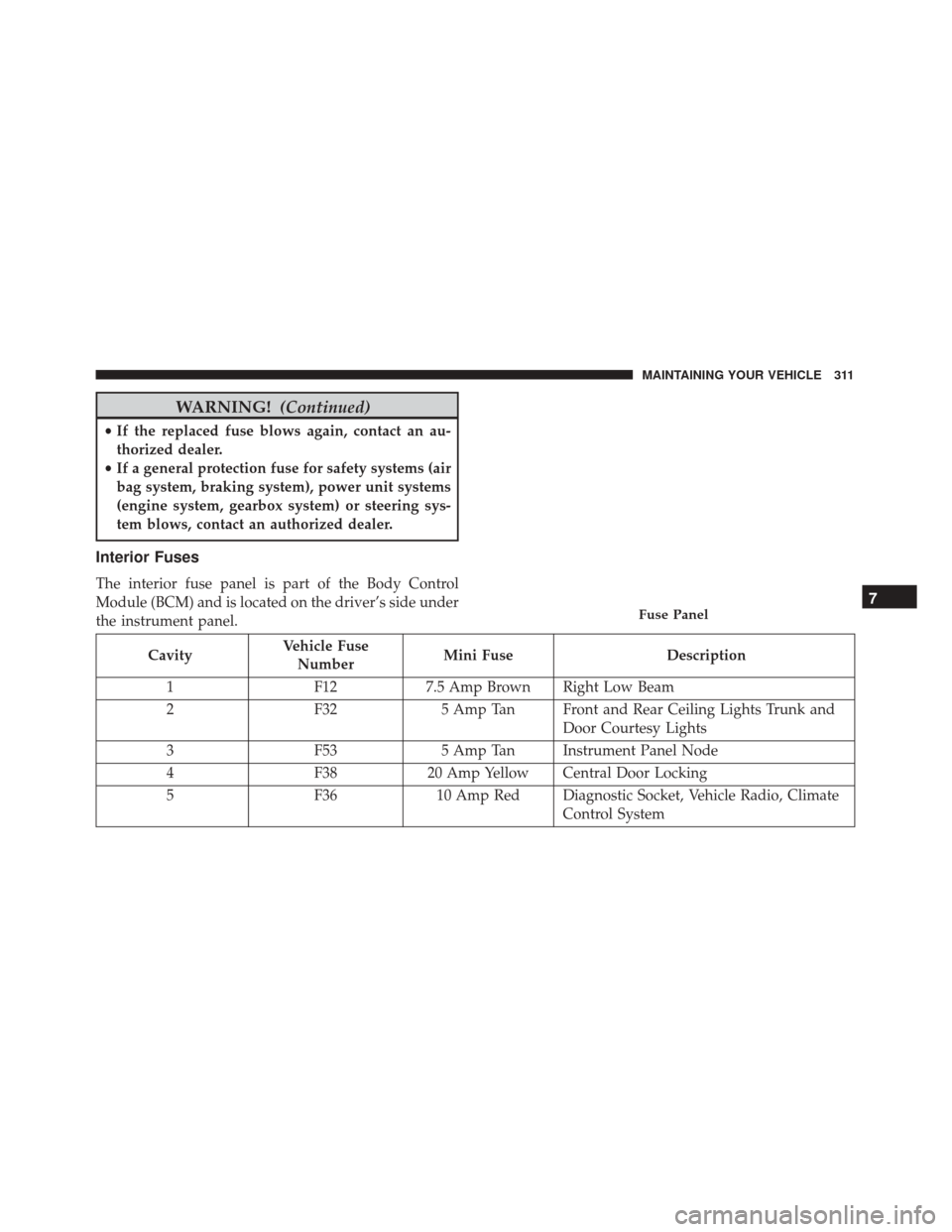
Interior Fuses
The interior fuse panel is part of the Body Control
Module (BCM) and is located on the driver’s side under
the instrument panel.
Cavity Vehicle Fuse
Number Mini Fuse
Description
1 F127.5 Amp Brown Right Low Beam
2 F325 Amp Tan Front and Rear Ceiling Lights Trunk and
Door Courtesy Lights
3 F535 Amp Tan Instrument Panel Node
4 F3820 Amp Yellow Central Door Locking
5 F3610 Amp Red Diagnostic Socket, Vehicle Radio, Climate
Control System
Fuse Panel7
MAINTAINING YOUR VEHICLE 311
Page 314 of 350
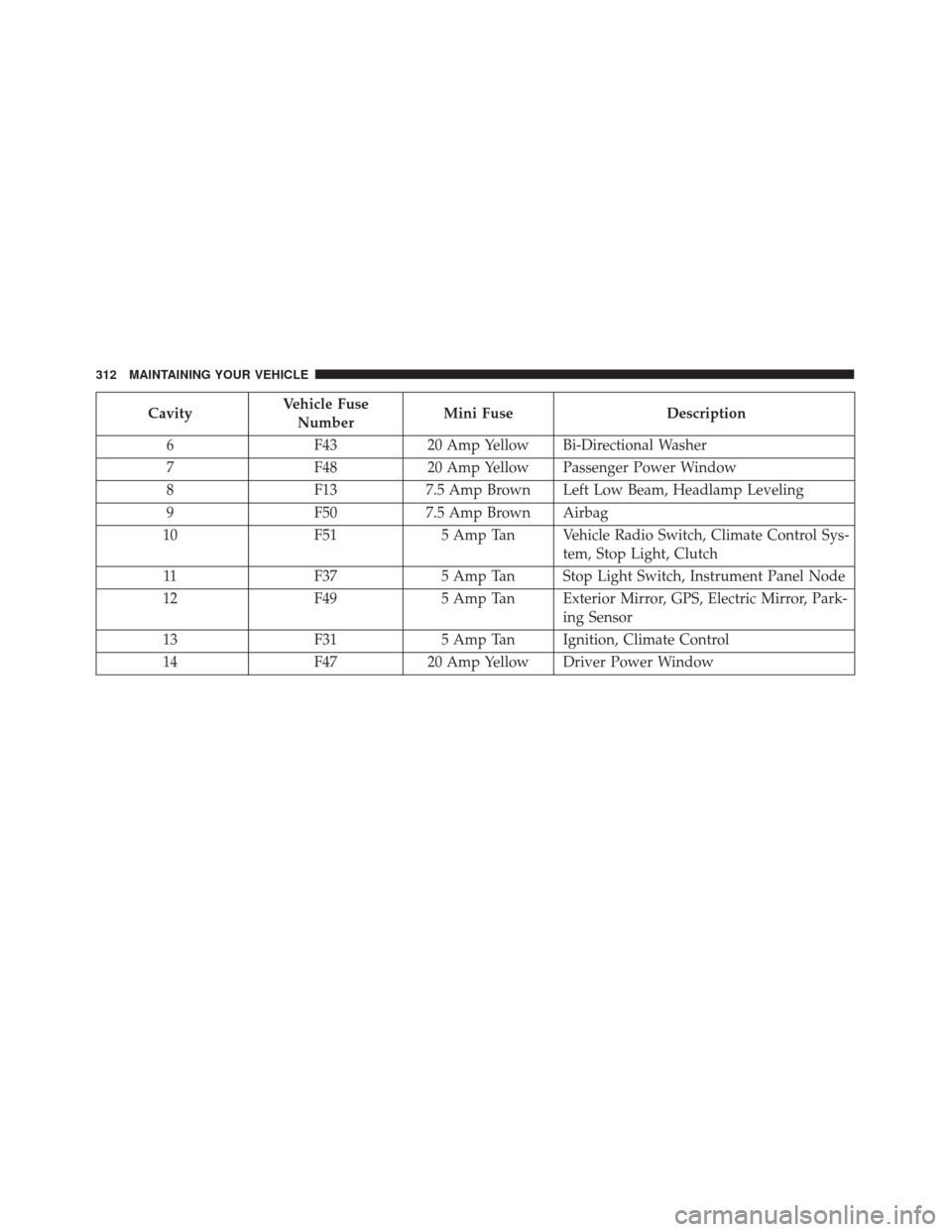
CavityVehicle Fuse
Number Mini Fuse
Description
6 F4320 Amp Yellow Bi-Directional Washer
7 F4820 Amp Yellow Passenger Power Window
8 F137.5 Amp Brown Left Low Beam, Headlamp Leveling
9 F507.5 Amp Brown Airbag
10 F515 Amp Tan Vehicle Radio Switch, Climate Control Sys-
tem, Stop Light, Clutch
11 F375 Amp Tan Stop Light Switch, Instrument Panel Node
12 F495 Amp Tan Exterior Mirror, GPS, Electric Mirror, Park-
ing Sensor
13 F315 Amp Tan Ignition, Climate Control
14 F4720 Amp Yellow Driver Power Window
312 MAINTAINING YOUR VEHICLE
Page 342 of 350
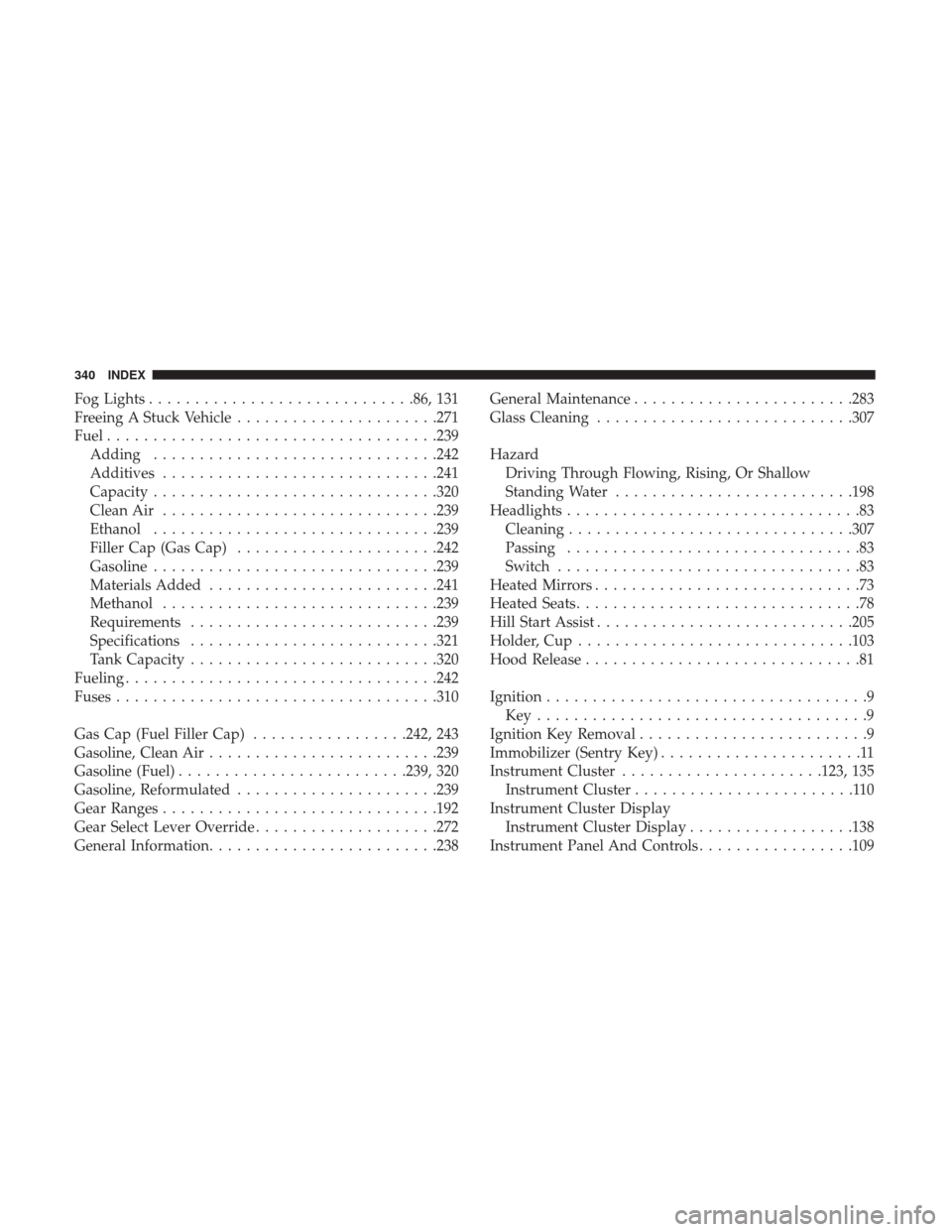
Fog Lights............................ .86, 131
Freeing A Stuck Vehicle ..................... .271
Fuel ................................... .239
Adding .............................. .242
Additives ............................. .241
Capacity .............................. .320
Clean Air ............................. .239
Ethanol .............................. .239
Filler Cap (Gas Cap) ..................... .242
Gasoline .............................. .239
Materials Added ........................ .241
Methanol ............................. .239
Requirements .......................... .239
Specifications .......................... .321
Tank Capacity .......................... .320
Fueling ................................. .242
Fuses .................................. .310
Gas Cap (Fuel Filler Cap) .................242, 243
Gasoline, Clean Air ........................ .239
Gasoline (Fuel) ........................ .239, 320
Gasoline, Reformulated ..................... .239
Gear Ranges ............................. .192
Gear Select Lever Override ....................272
General Information ........................ .238General Maintenance
....................... .283
Glass Cleaning ........................... .307
Hazard Driving Through Flowing, Rising, Or Shallow
Standing Water ......................... .198
Headlights ................................83
Cleaning .............................. .307
Passing ................................83
Switch .................................83
Heated Mirrors .............................73
Heated Seats ...............................78
Hill Start Assist ........................... .205
Holder, Cup ............................. .103
Hood Release ..............................
81
Ignition ...................................9
Key....................................9
Ignition Key Removal .........................9
Immobilizer (Sentry Key) ......................11
Instrument Cluster ..................... .123, 135
Instrument Cluster ........................110
Instrument Cluster Display Instrument Cluster Display ..................138
Instrument Panel And Controls .................109
340 INDEX
Page 343 of 350
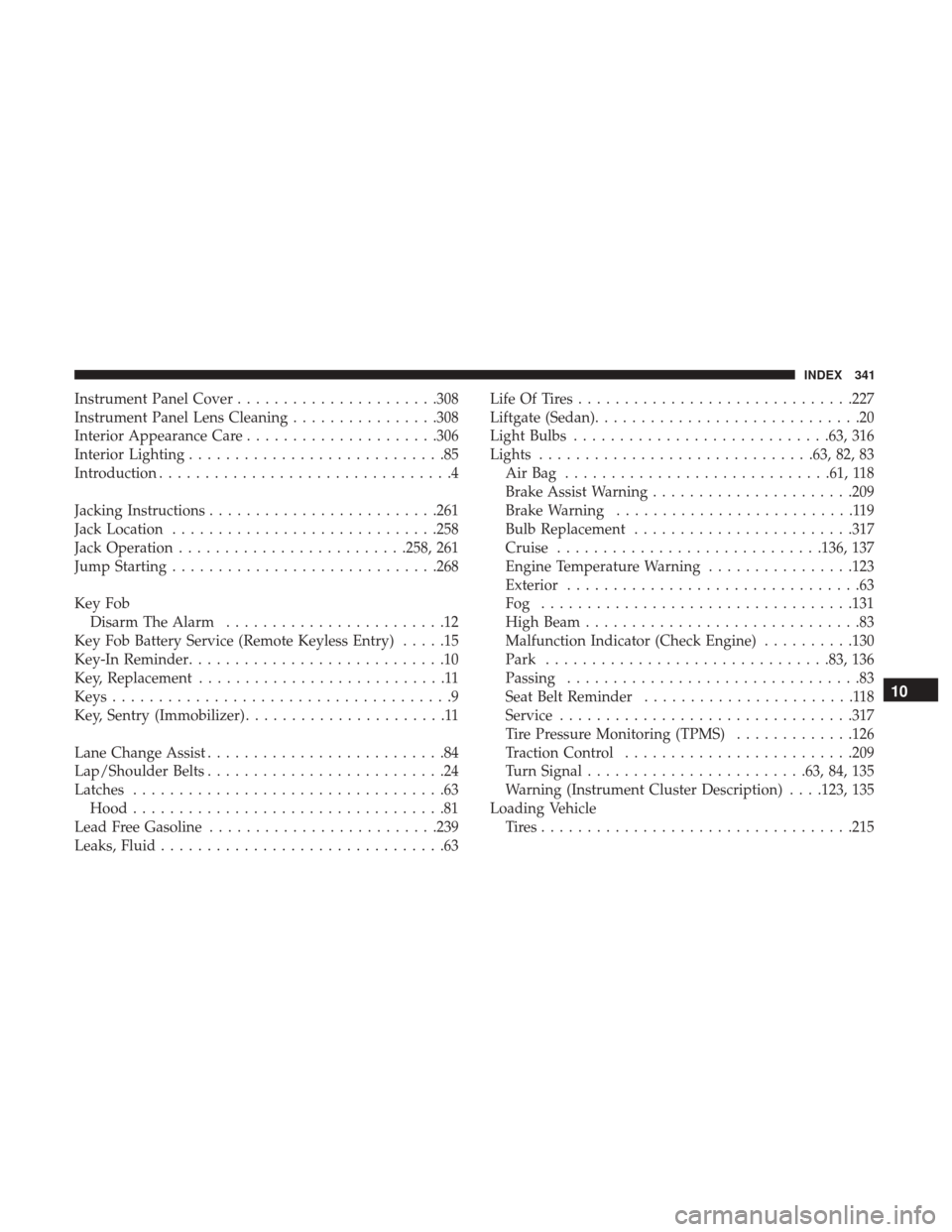
Instrument Panel Cover..................... .308
Instrument Panel Lens Cleaning ................308
Interior Appearance Care .....................306
Interior Lighting ............................85
Introduction ................................4
Jacking Instructions ........................ .261
Jack Location ............................ .258
Jack Operation ........................ .258, 261
Jump Starting ............................ .268
Key Fob Disarm The Alarm ........................12
Key Fob Battery Service (Remote Keyless Entry) .....15
Key-In Reminder ............................10
Key, Replacement ...........................11
Keys .....................................9
Key, Sentry (Immobilizer) ......................11
Lane Change Assist ..........................84
Lap/Shoulder Belts ..........................24
Latches ..................................63
Hood ..................................81
Lead Free Gasoline ........................ .239
Leaks, Fluid ...............................63 Life Of Tires
............................. .227
Liftgate (Sedan) .............................20
Light Bulbs ........................... .63, 316
Lights ............................. .63, 82, 83
AirBag ............................ .61, 118
Brake Assist Warning ..................... .209
Brake Warning ..........................119
Bulb Replacement ....................... .317
Cruise ............................ .136, 137
Engine Temperature Warning ................123
Exterior ................................63
Fog ................................. .131
High Beam ..............................83
Malfunction Indicator (Check Engine) ..........130
Park .............................. .83, 136
Passing ................................83
Seat Belt Reminder .......................118
Service ............................... .317
Tire Pressure Monitoring (TPMS) .............126
Traction Control ........................ .209
T
urn Signal ....................... .63, 84, 135
Warning (Instrument Cluster Description) . . . .123, 135
Loading Vehicle Tires................................. .215
10
INDEX 341