belt FIAT 500C 2017 2.G Owner's Guide
[x] Cancel search | Manufacturer: FIAT, Model Year: 2017, Model line: 500C, Model: FIAT 500C 2017 2.GPages: 350, PDF Size: 3.01 MB
Page 57 of 350
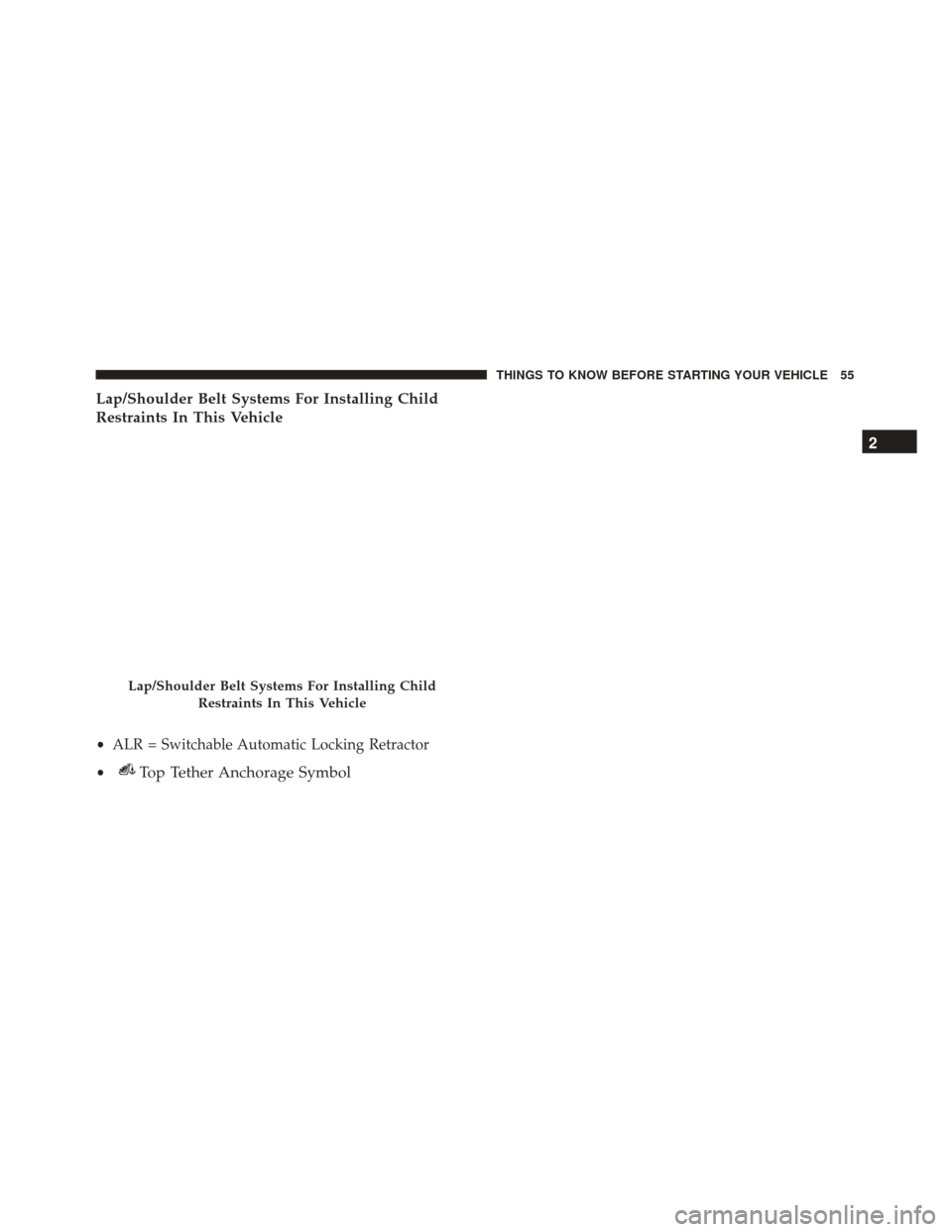
Lap/Shoulder Belt Systems For Installing Child
Restraints In This Vehicle
Lap/Shoulder Belt Systems For Installing ChildRestraints In This Vehicle
•ALR = Switchable Automatic Locking Retractor
•
Top Tether Anchorage Symbol 2
THINGS TO KNOW BEFORE STARTING YOUR VEHICLE 55
Page 58 of 350
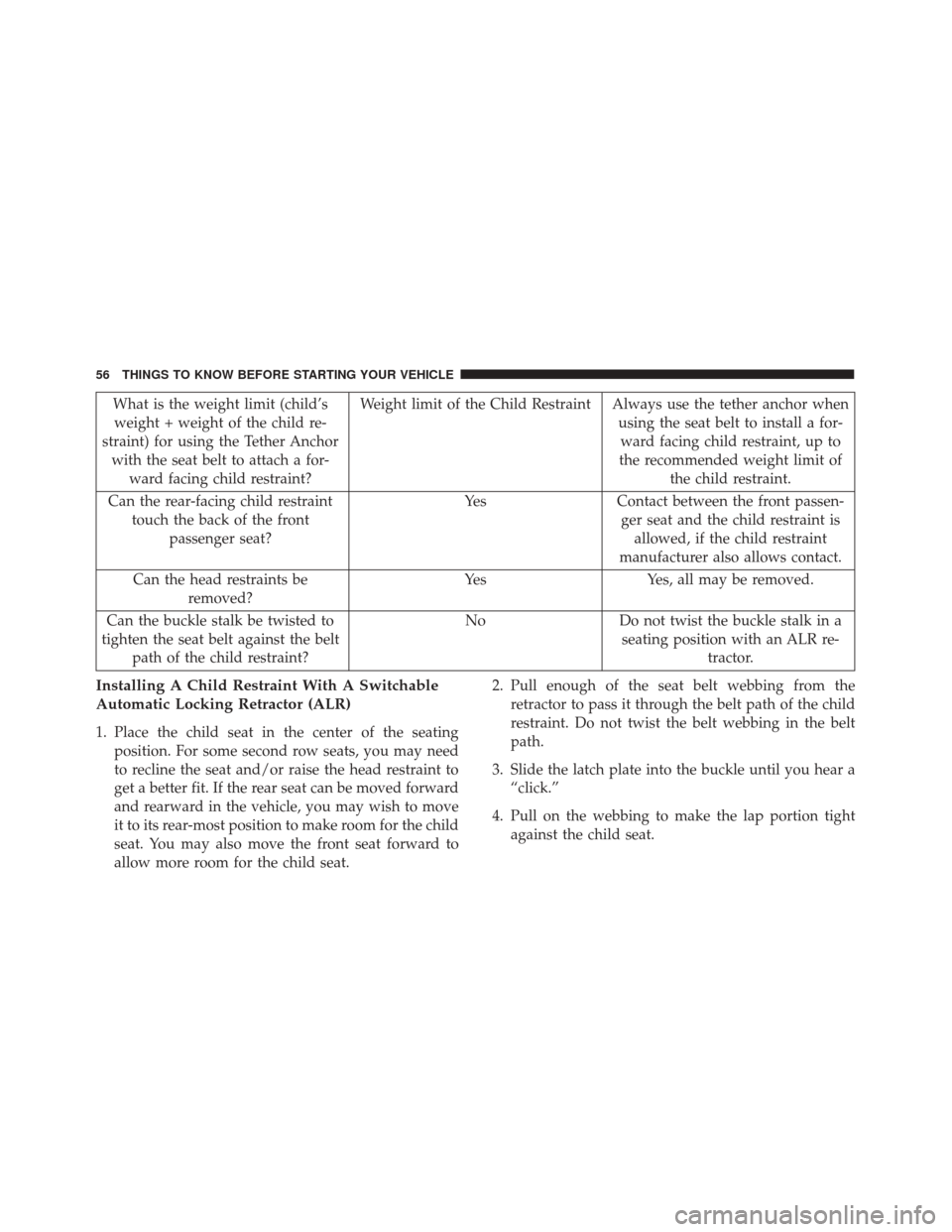
What is the weight limit (child’sweight + weight of the child re-
straint) for using the Tether Anchor with the seat belt to attach a for- ward facing child restraint? Weight limit of the Child Restraint Always use the tether anchor when
using the seat belt to install a for-ward facing child restraint, up to
the recommended weight limit of the child restraint.
Can the rear-facing child restraint touch the back of the front passenger seat? Yes
Contact between the front passen-
ger seat and the child restraint is allowed, if the child restraint
manufacturer also allows contact.
Can the head restraints be removed? Yes
Yes, all may be removed.
Can the buckle stalk be twisted to
tighten the seat belt against the belt path of the child restraint? No
Do not twist the buckle stalk in a
seating position with an ALR re- tractor.
Installing A Child Restraint With A Switchable
Automatic Locking Retractor (ALR)
1. Place the child seat in the center of the seatingposition. For some second row seats, you may need
to recline the seat and/or raise the head restraint to
get a better fit. If the rear seat can be moved forward
and rearward in the vehicle, you may wish to move
it to its rear-most position to make room for the child
seat. You may also move the front seat forward to
allow more room for the child seat. 2. Pull enough of the seat belt webbing from the
retractor to pass it through the belt path of the child
restraint. Do not twist the belt webbing in the belt
path.
3. Slide the latch plate into the buckle until you hear a “click.”
4. Pull on the webbing to make the lap portion tight against the child seat.
56 THINGS TO KNOW BEFORE STARTING YOUR VEHICLE
Page 59 of 350
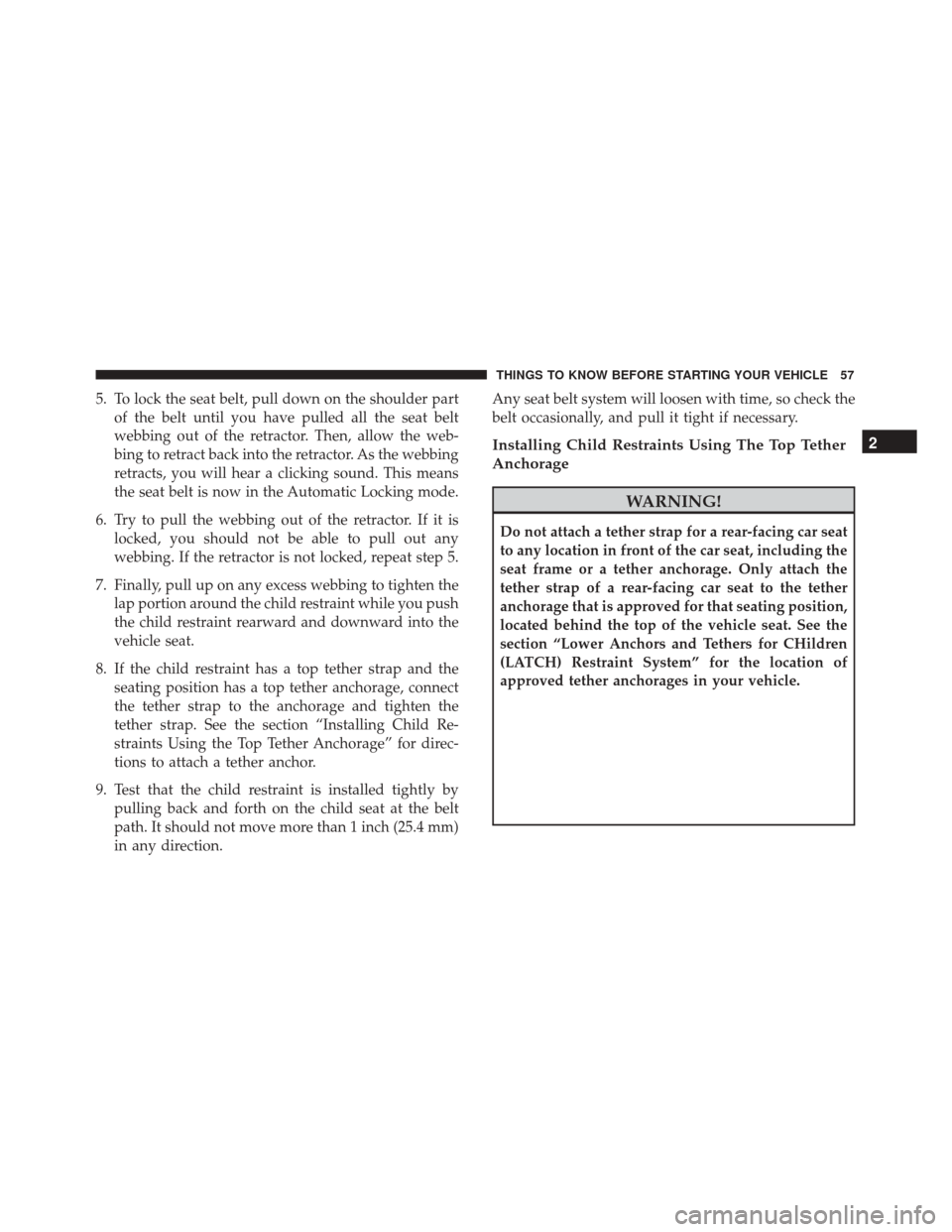
5. To lock the seat belt, pull down on the shoulder partof the belt until you have pulled all the seat belt
webbing out of the retractor. Then, allow the web-
bing to retract back into the retractor. As the webbing
retracts, you will hear a clicking sound. This means
the seat belt is now in the Automatic Locking mode.
6. Try to pull the webbing out of the retractor. If it is locked, you should not be able to pull out any
webbing. If the retractor is not locked, repeat step 5.
7. Finally, pull up on any excess webbing to tighten the lap portion around the child restraint while you push
the child restraint rearward and downward into the
vehicle seat.
8. If the child restraint has a top tether strap and the seating position has a top tether anchorage, connect
the tether strap to the anchorage and tighten the
tether strap. See the section “Installing Child Re-
straints Using the Top Tether Anchorage” for direc-
tions to attach a tether anchor.
9. Test that the child restraint is installed tightly by pulling back and forth on the child seat at the belt
path. It should not move more than 1 inch (25.4 mm)
in any direction. Any seat belt system will loosen with time, so check the
belt occasionally, and pull it tight if necessary.
Installing Child Restraints Using The Top Tether
Anchorage
WARNING!
Do not attach a tether strap for a rear-facing car seat
to any location in front of the car seat, including the
seat frame or a tether anchorage. Only attach the
tether strap of a rear-facing car seat to the tether
anchorage that is approved for that seating position,
located behind the top of the vehicle seat. See the
section “Lower Anchors and Tethers for CHildren
(LATCH) Restraint System” for the location of
approved tether anchorages in your vehicle.
2
THINGS TO KNOW BEFORE STARTING YOUR VEHICLE 57
Page 61 of 350
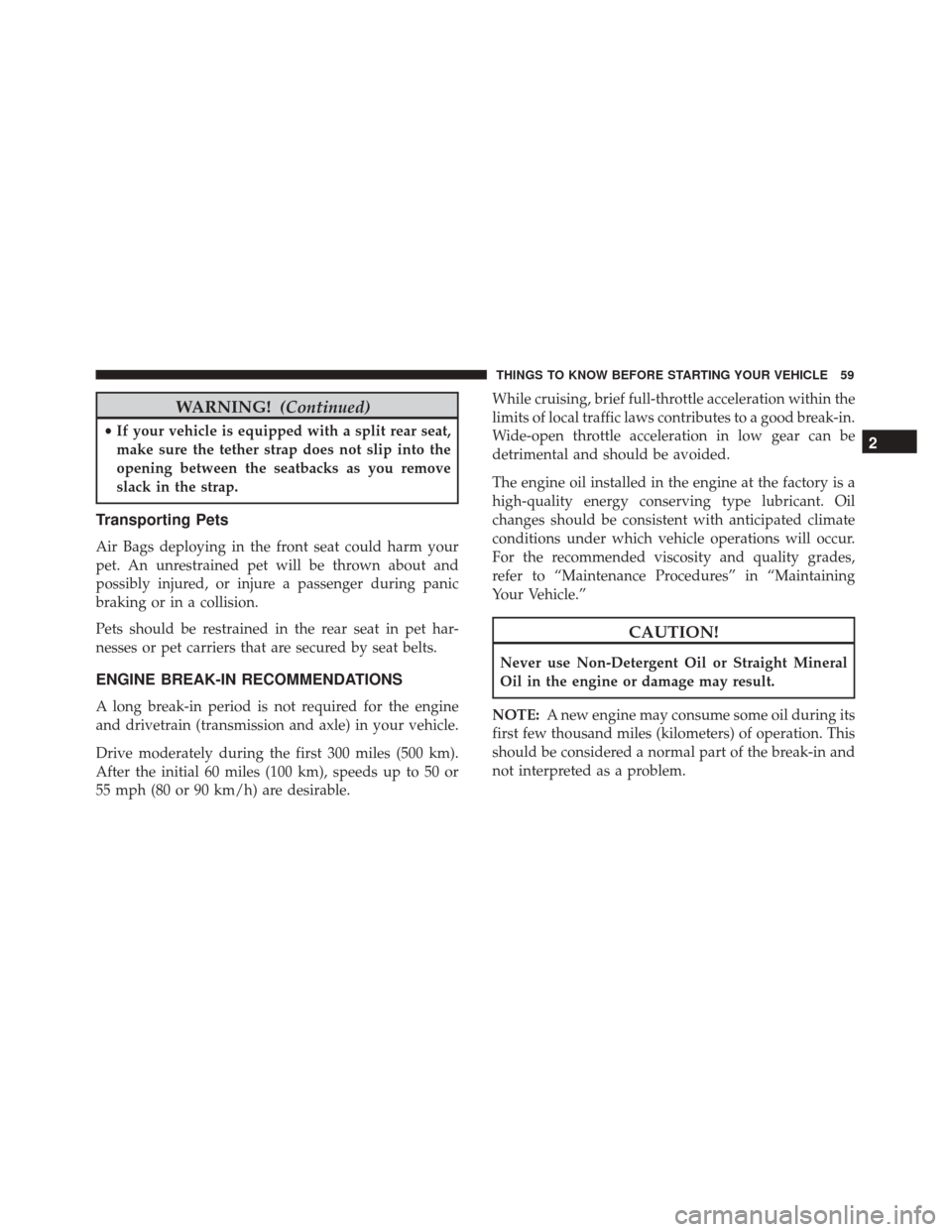
WARNING!(Continued)
•If your vehicle is equipped with a split rear seat,
make sure the tether strap does not slip into the
opening between the seatbacks as you remove
slack in the strap.
Transporting Pets
Air Bags deploying in the front seat could harm your
pet. An unrestrained pet will be thrown about and
possibly injured, or injure a passenger during panic
braking or in a collision.
Pets should be restrained in the rear seat in pet har-
nesses or pet carriers that are secured by seat belts.
ENGINE BREAK-IN RECOMMENDATIONS
A long break-in period is not required for the engine
and drivetrain (transmission and axle) in your vehicle.
Drive moderately during the first 300 miles (500 km).
After the initial 60 miles (100 km), speeds up to 50 or
55 mph (80 or 90 km/h) are desirable. While cruising, brief full-throttle acceleration within the
limits of local traffic laws contributes to a good break-in.
Wide-open throttle acceleration in low gear can be
detrimental and should be avoided.
The engine oil installed in the engine at the factory is a
high-quality energy conserving type lubricant. Oil
changes should be consistent with anticipated climate
conditions under which vehicle operations will occur.
For the recommended viscosity and quality grades,
refer to “Maintenance Procedures” in “Maintaining
Your Vehicle.”
CAUTION!
Never use Non-Detergent Oil or Straight Mineral
Oil in the engine or damage may result.
NOTE: A new engine may consume some oil during its
first few thousand miles (kilometers) of operation. This
should be considered a normal part of the break-in and
not interpreted as a problem.
2
THINGS TO KNOW BEFORE STARTING YOUR VEHICLE 59
Page 62 of 350
SAFETY TIPS
Transporting Passengers
NEVER TRANSPORT PASSENGERS IN THE CARGO
AREA.
WARNING!
•Do not leave children or animals inside parked
vehicles in hot weather. Interior heat build-up
may cause serious injury or death.
• It is extremely dangerous to ride in a cargo area,
inside or outside of a vehicle. In a collision,
people riding in these areas are more likely to be
seriously injured or killed.
• Do not allow people to ride in any area of your
vehicle that is not equipped with seats and seat
belts.
• Be sure everyone in your vehicle is in a seat and
using a seat belt properly.
Exhaust Gas
WARNING!
Exhaust gases can injure or kill. They contain
carbon monoxide (CO), which is colorless and odor-
less. Breathing it can make you unconscious and
can eventually poison you. To avoid breathing
(CO), follow these safety tips:
• Do not run the engine in a closed garage or in
confined areas any longer than needed to move
your vehicle in or out of the area.
• If you are required to drive with the trunk/
liftgate/rear doors open, make sure that all win-
dows are closed and the climate control BLOWER
switch is set at high speed. DO NOT use the
recirculation mode.
• If it is necessary to sit in a parked vehicle with the
engine running, adjust your heating or cooling
controls to force outside air into the vehicle. Set
the blower at high speed.
The best protection against carbon monoxide entry into
the vehicle body is a properly maintained engine ex-
haust system.
60 THINGS TO KNOW BEFORE STARTING YOUR VEHICLE
Page 63 of 350
Whenever a change is noticed in the sound of the
exhaust system, when exhaust fumes can be detected
inside the vehicle, or when the underside or rear of the
vehicle is damaged, have a competent mechanic inspect
the complete exhaust system and adjacent body areas
for broken, damaged, deteriorated, or mispositioned
parts. Open seams or loose connections could permit
exhaust fumes to seep into the passenger compartment.
In addition, inspect the exhaust system each time the
vehicle is raised for lubrication or oil change. Replace as
required.
Safety Checks You Should Make Inside The
Vehicle
Seat Belts
Inspect the seat belt system periodically, checking for
cuts, frays, and loose parts. Damaged parts must be
replaced immediately. Do not disassemble or modify
the system.
Front seat belt assemblies must be replaced after a
collision. Rear seat belt assemblies must be replaced
after a collision if they have been damaged (i.e., bent
retractor, torn webbing, etc.). If there is any question
regarding seat belt or retractor condition, replace the
seat belt.
Air Bag Warning Light
The Air Bag warning lightwill turn on for four to
eight seconds as a bulb check when the ignition is
first placed in the ON/RUN position. If the light is
either not on during starting, stays on, or turns on
while driving, have the system inspected at an
authorized dealer as soon as possible. This light will
illuminate with a single chime when a fault with the
Air Bag Warning Light has been detected, it will stay
on until the fault is cleared. If the light comes on
intermittently or remains on while driving, have an
authorized dealer service the vehicle immediately.
Refer to “Occupant Restraints” for further
information.
Defroster
Check operation by selecting the defrost mode and
place the blower control on high speed. You should be
able to feel the air directed against the windshield. See
your authorized dealer for service if your defroster is
inoperable.
Floor Mat Safety Information
Always use floor mats designed to fit the footwell of
your vehicle. Use only floor mats that leave the pedal
2
THINGS TO KNOW BEFORE STARTING YOUR VEHICLE 61
Page 71 of 350
•If you are traveling at speeds above 50 mph
(80 km/h) and wish to open the top, it will open to
only three-quarter of the way.
Raising The Power Top
Auto Close
From the convertible top fully open position, push the
top close button for approximately one second for the
three-quarter open/spoiler position. Push the top close
button for approximately one second a second time for
the one-quarter open position. Push and hold close
button to fully close convertible top.
Manual Close
For manual close, push and hold the close button until
desired position until one-quarter open position. Push
and hold again for full close position.
NOTE:
• If the top is three-quarter of the way open, you can
close the top if vehicle speeds are above 50 mph
(80 km/h).
• If the top is fully open and the vehicle is traveling at
50 mph (80 km/h) or above, it will not allow you to
close the top. NOTE:
Rail lubrication is recommended every 2000
cycles, or if scratching noises due to dust are present.
Refer to “Fluids, Lubes, and Genuine Part” in “Main-
taining Your Vehicle” for information.WARNING!
The convertible top does not provide the structural
protection that a reinforced metal roof does and the
fabric top cannot be expected to prevent the ejection
of the occupants in a collision. Therefore, it is
important that all occupants wear their seat belts at
all times. Death or serious injuries could occur if
you are ejected from the vehicle during a collision.
CAUTION!
Failure to follow these cautions may cause interior
water damage, stains or mildew on the top material:
• Avoid high-pressure car washes, as they can dam-
age the top material. Also, increased water pres-
sure may force water past the weather strips.
• Remove any standing water from the top and dry
the surface before opening it. Operating the top,
(Continued)
3
UNDERSTANDING THE FEATURES OF YOUR VEHICLE 69
Page 76 of 350
Sun Visors
The driver and passenger sun visors are located on the
headliner, near the front windshield. The sun visors can
be rotated downward or up against the door glass. Both
sun visors are equipped with courtesy mirrors.
SEATS
Seats are a part of the Occupant Restraint System of the
vehicle.
WARNING!
•It is dangerous to ride in a cargo area, inside or
outside of a vehicle. In a collision, people riding
in these areas are more likely to be seriously
injured or killed.
• Do not allow people to ride in any area of your
vehicle that is not equipped with seats and seat
belts. In a collision, people riding in these areas
are more likely to be seriously injured or killed.
• Be sure everyone in your vehicle is in a seat and
using a seat belt properly.
Sun Visor (Passenger Side Shown)
74 UNDERSTANDING THE FEATURES OF YOUR VEHICLE
Page 77 of 350
Forward/Rearward Adjustment
The adjusting bar is located at the front of the seats, near
the floor.
While sitting in the seat, lift up on the bar and move the
seat forward or rearward. Release the bar once the
desired position is reached. Then, using body pressure,
move forward and rearward on the seat to be sure that
the seat adjusters have latched.
WARNING!
•Adjusting a seat while driving may be dangerous.
Moving a seat while driving could result in loss
of control which could cause a collision and
serious injury or death.
• Seats should be adjusted before fastening the seat
belts and while the vehicle is parked. Serious
injury or death could result from a poorly ad-
justed seat belt.
Recline Adjustment
The recline adjustment lever is located on the inboard
side of the seat. To recline the seatback, lift up the
recline lever, lean back until the desired position has
been reached, and release the lever.
Adjusting Bar
3
UNDERSTANDING THE FEATURES OF YOUR VEHICLE 75
Page 78 of 350
WARNING!
Do not ride with the seatback reclined so that the
shoulder belt is no longer resting against your
chest. In a collision you could slide under the seat
belt, which could result in serious injury or death.
Seat Height Adjustment
The driver ’s seat height can be raised or lowered by
using a lever, located on the outboard side of the seat.
Pump the lever upward to raise the seat height, or
pump the lever downward to lower the seat height.
Recline Lever
Height Adjuster
76 UNDERSTANDING THE FEATURES OF YOUR VEHICLE