brake light FIAT 500C 2018 User Guide
[x] Cancel search | Manufacturer: FIAT, Model Year: 2018, Model line: 500C, Model: FIAT 500C 2018Pages: 338, PDF Size: 4 MB
Page 167 of 338
WARNING! (Continued)• Be sure the parking brake is fully disengaged before
driving; failure to do so can lead to brake failure and
a collision.
• Always fully apply the parking brake when leaving
your vehicle, or it may roll and cause damage or
injury. Also be certain to leave a manual transmis-
sion in FIRST gear or REVERSE gear. Failure to do so
may allow the vehicle to roll and cause damage or
injury.
CAUTION!If the Brake Warning Light remains on with the park-
ing brake released, a brake system malfunction is
indicated. Have the brake system serviced by an au-
thorized dealer immediately. MANUAL TRANSMISSION — IF EQUIPPED
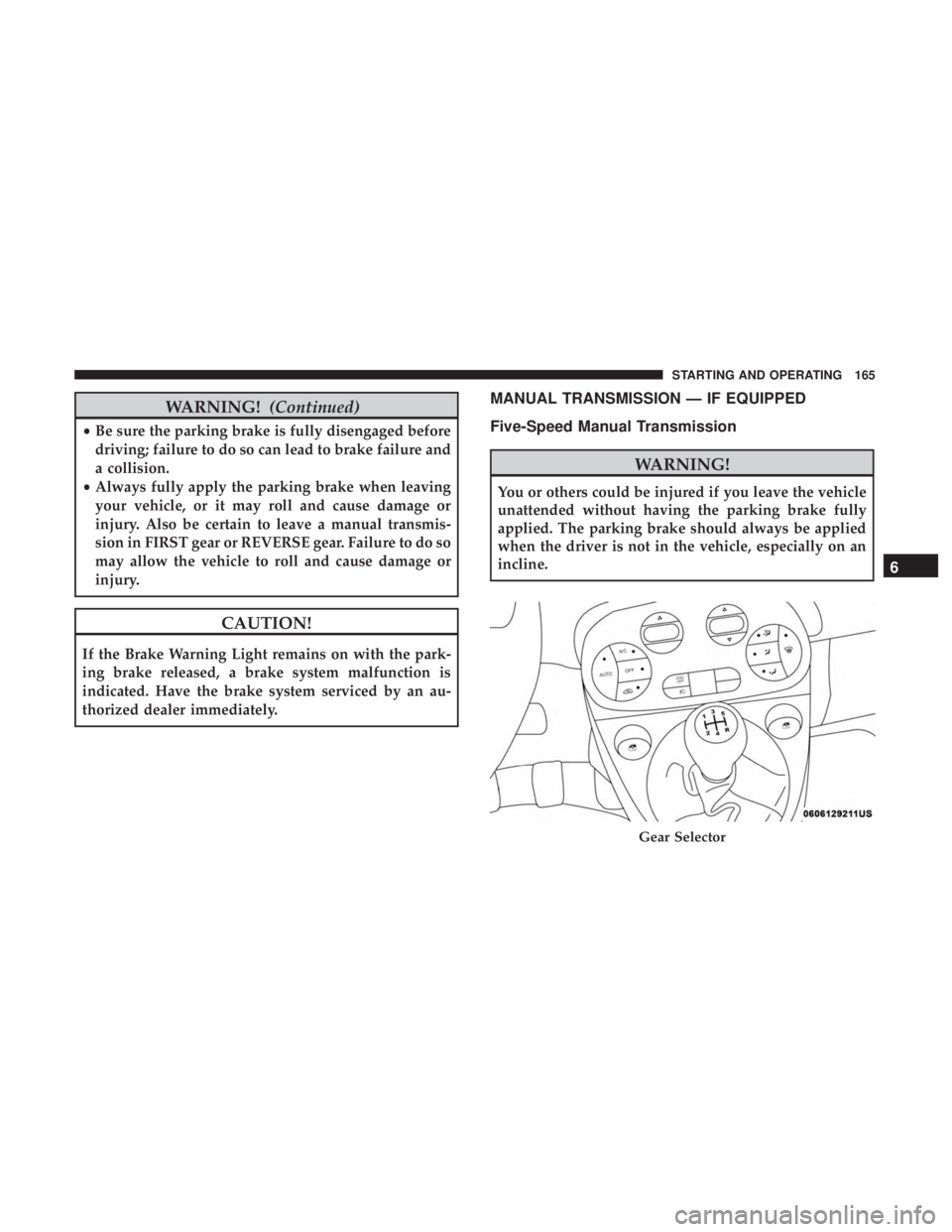
Five-Speed Manual Transmission
WARNING!You or others could be injured if you leave the vehicle
unattended without having the parking brake fully
applied. The parking brake should always be applied
when the driver is not in the vehicle, especially on an
incline.
Gear Selector 6STARTING AND OPERATING 165
Page 182 of 338
• If the button is continually pushed, the set speed will
continue to decrease until the button is released, then the
new set speed will be established.
Metric Speed (km/h)
• Pushing the SET (-) button once will result in a 1 km/h
decrease in set speed. Each subsequent tap of the button
results in a decrease of 1 km/h.
• If the button is continually pushed, the set speed will
continue to decrease until the button is released, then the
new set speed will be established.
To Accelerate For Passing
Press the accelerator as you would normally. When the
pedal is released, the vehicle will return to the set speed.
Using Speed Control On Hills
The transmission may downshift on hills to maintain the
vehicle set speed.
NOTE: The Speed Control system maintains speed up and
down hills. A slight speed change on moderate hills is
normal. On steep hills, a greater speed loss or gain may occur so it
may be preferable to drive without Speed Control.
WARNING!Speed Control can be dangerous where the system
cannot maintain a constant speed. Your vehicle could
go too fast for the conditions, and you could lose
control and have an accident. Do not use Speed Control
in heavy traffic or on roads that are winding, icy,
snow-covered or slippery.
To Resume Speed
To resume a previously set speed, push the RES (+) button
and release. Resume can be used at any speed above
25 mph (40 km/h).
To Deactivate
A soft tap on the brake pedal, pushing the CANC button,
or normal brake pressure while slowing the vehicle will
deactivate the Speed Control without erasing the set speed
from memory.
Pushing the ON/OFF button or turning the ignition switch
OFF erases the set speed from memory.180 STARTING AND OPERATING
Page 194 of 338
Flowing/Rising Water
WARNING!Do not drive on or across a road or path where water is
flowing and/or rising (as in storm run-off). Flowing
water can wear away the road or path’s surface and
cause your vehicle to sink into deeper water. Further-
more, flowing and/or rising water can carry your ve-
hicle away swiftly. Failure to follow this warning may
result in injuries that are serious or fatal to you, your
passengers, and others around you.
Shallow Standing Water
Although your vehicle is capable of driving through shal-
low standing water, consider the following Cautions and
Warnings before doing so.
WARNING!• Driving through standing water limits your vehicle’s
traction capabilities. Do not exceed 5 mph (8 km/h)
when driving through standing water. (Continued) WARNING! (Continued)• Driving through standing water limits your vehicle’s
braking capabilities, which increases stopping dis-
tances. Therefore, after driving through standing
water, drive slowly and lightly press on the brake
pedal several times to dry the brakes.
• Failure to follow these warnings may result in inju-
ries that are serious or fatal to you, your passengers,
and others around you.
CAUTION!• Always check the depth of the standing water before
driving through it. Never drive through standing
water that is deeper than the bottom of the tire rims
mounted on the vehicle.
• Determine the condition of the road or the path that
is under water and if there are any obstacles in the
way before driving through the standing water.
• Do not exceed 5 mph (8 km/h) when driving through
standing water. This will minimize wave effects. (Continued)192 STARTING AND OPERATING
Page 205 of 338
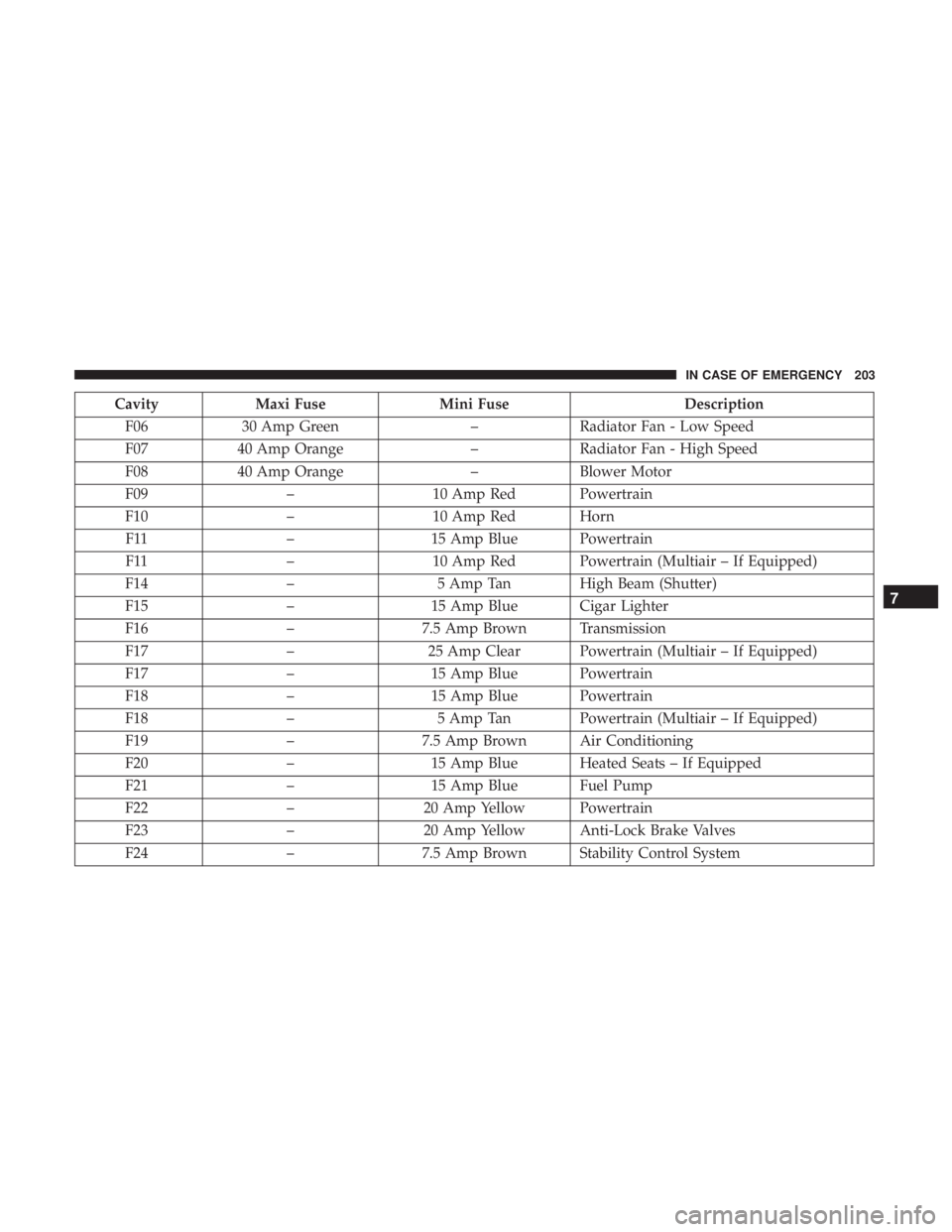
Cavity Maxi Fuse Mini Fuse Description
F06 30 Amp Green – Radiator Fan - Low Speed
F07 40 Amp Orange – Radiator Fan - High Speed
F08 40 Amp Orange – Blower Motor
F09 – 10 Amp Red Powertrain
F10 – 10 Amp Red Horn
F11 – 15 Amp Blue Powertrain
F11 – 10 Amp Red Powertrain (Multiair – If Equipped)
F14 – 5 Amp Tan High Beam (Shutter)
F15 – 15 Amp Blue Cigar Lighter
F16 – 7.5 Amp Brown Transmission
F17 – 25 Amp Clear Powertrain (Multiair – If Equipped)
F17 – 15 Amp Blue Powertrain
F18 – 15 Amp Blue Powertrain
F18 – 5 Amp Tan Powertrain (Multiair – If Equipped)
F19 – 7.5 Amp Brown Air Conditioning
F20 – 15 Amp Blue Heated Seats – If Equipped
F21 – 15 Amp Blue Fuel Pump
F22 – 20 Amp Yellow Powertrain
F23 – 20 Amp Yellow Anti-Lock Brake Valves
F24 – 7.5 Amp Brown Stability Control System 7IN CASE OF EMERGENCY 203
Page 233 of 338
SCHEDULED SERVICING
Your vehicle is equipped with an automatic oil change
indicator system. The oil change indicator system will
remind you that it is time to take your vehicle in for
scheduled maintenance.
Based on engine operation conditions, the oil change
indicator message will illuminate. This means that service
is required for your vehicle. Operating conditions such as
frequent short-trips, trailer tow, extremely hot or cold
ambient temperatures, and E85 fuel usage will influence
when the “Change Oil” or “Oil Change Required” message
is displayed. Severe Operating Conditions can cause the
change oil message to illuminate as early as 3,500 miles
(5,600 km) since last reset. Have your vehicle serviced as
soon as possible, within the next 500 miles (805 km).
Your authorized dealer will reset the oil change indicator
message after completing the scheduled oil change. If a
scheduled oil change is performed by someone other than
your authorized dealer, the message can be reset by
referring to the steps described under “Instrument Cluster
Display” in “Getting To Know Your Instrument Panel” for
further information. NOTE: Under no circumstances should oil change inter-
vals exceed 10,000 miles (16,000 km), twelve months or
350 hours of engine run time, whichever comes first. The
350 hours of engine run or idle time is generally only a
concern for fleet customers.
Severe Duty All Models
Change Engine Oil at 4,000 miles (6,500 km) if the vehicle
is operated in a dusty and off road environment or is
operated predominantly at idle or only very low engine
RPM’s. This type of vehicle use is considered Severe Duty.
Once A Month Or Before A Long Trip:
Check engine oil level.
Check windshield washer fluid level.
Check the tire inflation pressures and look for unusual
wear or damage.
Check the fluid levels of the coolant reservoir and brake
master cylinder, and fill as needed.
Check function of all interior and exterior lights. 8SERVICING AND MAINTENANCE 231
Page 255 of 338
Brake Master Cylinder
The fluid in the master cylinder should be checked when
performing under hood services or immediately if the
“Brake Warning Light” is illuminated.
Be sure to clean the top of the master cylinder area before
removing the cap. If necessary, add fluid to bring the fluid
level up to the requirements described on the brake fluid
reservoir. With disc brakes, fluid level can be expected to
fall as the brake pads wear. Brake fluid level should be
checked when pads are replaced. However, low fluid level
may be caused by a leak and a checkup may be needed.
Use only manufacturer’s recommended brake fluid. Refer
to “Fluids And Lubricants” in “Technical Specifications”
for further information.
WARNING!• Use only manufacturer’s recommended brake fluid.
Refer to “Fluids And Lubricants” in “Technical
Specifications” for further information. Using the
wrong type of brake fluid can severely damage your
brake system and/or impair its performance. The (Continued) WARNING! (Continued)proper type of brake fluid for your vehicle is also
identified on the original factory installed hydraulic
master cylinder reservoir.
• To avoid contamination from foreign matter or mois-
ture, use only new brake fluid or fluid that has been
in a tightly closed container. Keep the master cylin-
der reservoir cap secured at all times. Brake fluid in
a open container absorbs moisture from the air
resulting in a lower boiling point. This may cause it
to boil unexpectedly during hard or prolonged brak-
ing, resulting in sudden brake failure. This could
result in a collision.
• Overfilling the brake fluid reservoir can result in
spilling brake fluid on hot engine parts, causing the
brake fluid to catch fire. Brake fluid can also damage
painted and vinyl surfaces, care should be taken to
avoid its contact with these surfaces.
• Do not allow petroleum based fluid to contaminate
the brake fluid. Brake seal components could be
damaged, causing partial or complete brake failure.
This could result in a collision. 8SERVICING AND MAINTENANCE 253
Page 287 of 338
BRAKE SYSTEM
Your vehicle is equipped with dual hydraulic brake sys-
tems. If either of the two hydraulic systems loses normal
capability, the remaining system will still function. How-
ever, there will be some loss of overall braking effective-
ness. You may notice increased pedal travel during appli-
cation, greater pedal force required to slow or stop, and
potential activation of the Brake Warning Light.
In the event power assist is lost for any reason (i.e.,
repeated brake applications with the engine OFF) the
brakes will still function. However, the effort required to
brake the vehicle will be much greater than that required
with the power system operating. WHEEL AND TIRE TORQUE SPECIFICATIONS
Proper lug nut/bolt torque is very important to ensure that
the wheel is properly mounted to the vehicle. Any time a
wheel has been removed and reinstalled on the vehicle, the
lug nuts/bolts should be torqued using a properly cali-
brated torque wrench using a high quality six sided (hex)
deep wall socket.
Torque Specifications
Lug Nut/Bolt Torque **Lug Nut/
Bolt Size Lug Nut/
Bolt Socket
Size
66 Ft-Lbs (90 N·m)
Steel Wheels Only
74 Ft-Lbs (100 N·m)
Aluminum Wheels
Only M12 x 1.25 17 mm
**Use only your authorized dealer recommended lug nuts/
bolts and clean or remove any dirt or oil before tightening. 9TECHNICAL SPECIFICATIONS 285
Page 324 of 338
About Your Brakes ........................ .285
Adding Engine Coolant (Antifreeze) ............ .250
Adding Fuel ............................. .186
Adding Washing Fluid ...................... .236
Additives, Fuel ........................... .287
Air Bag
Air Bag Operation ....................... .127
Air Bag Warning Light .................... .124
Driver Knee Air Bag ..................... .128
Enhanced Accident Response ............ .133, 228
Event Data Recorder (EDR) ................ .228
If Deployment Occurs .................... .132
Knee Impact Bolsters ..................... .127
Maintaining Your Air Bag System ............ .136
Maintenance ........................... .136
Side Air Bags .......................... .128
Transporting Pets ....................... .153
Air Bag Light ...................... .84, 124, 155
Air Cleaner, Engine (Engine Air Cleaner Filter) ..... .240
Air Conditioner Maintenance ................. .240
Air Conditioner Refrigerant ............... .240, 241
Air Conditioner System ..................... .240
Air Conditioning Filter ................... .55, 242
Air Conditioning, Operating Tips ................54
Air Conditioning Refrigerant ................. .241 Air Filter ............................... .240
Air Pressure
Tires................................. .264
Alarm
Security Alarm ...........................22
Alarm System
Security Alarm ...........................22
Alterations/Modifications, Vehicle ................5
Antifreeze (Engine Coolant) ............... .249, 290
Capacities ............................. .290
Disposal .............................. .251
Anti-Lock Brake System (ABS) ................ .100
Anti-Lock Warning Light .................. .88, 93
Arming System
Security Alarm ........................... 2 2
Audio Systems (Radio) ...................... .296
Automatic Dimming Mirror ................ .34, 35
Automatic Oil Change Indicator ............... .231
Automatic Transmission ................. .168, 254
Adding Fluid .......................... .255
Autostick ............................. .174
Fluid And Filter Change .................. .255
Fluid Change .......................... .255
Fluid Level Check ....................... .255
Fluid Type ......................... .254, 293322 INDEX
Page 325 of 338
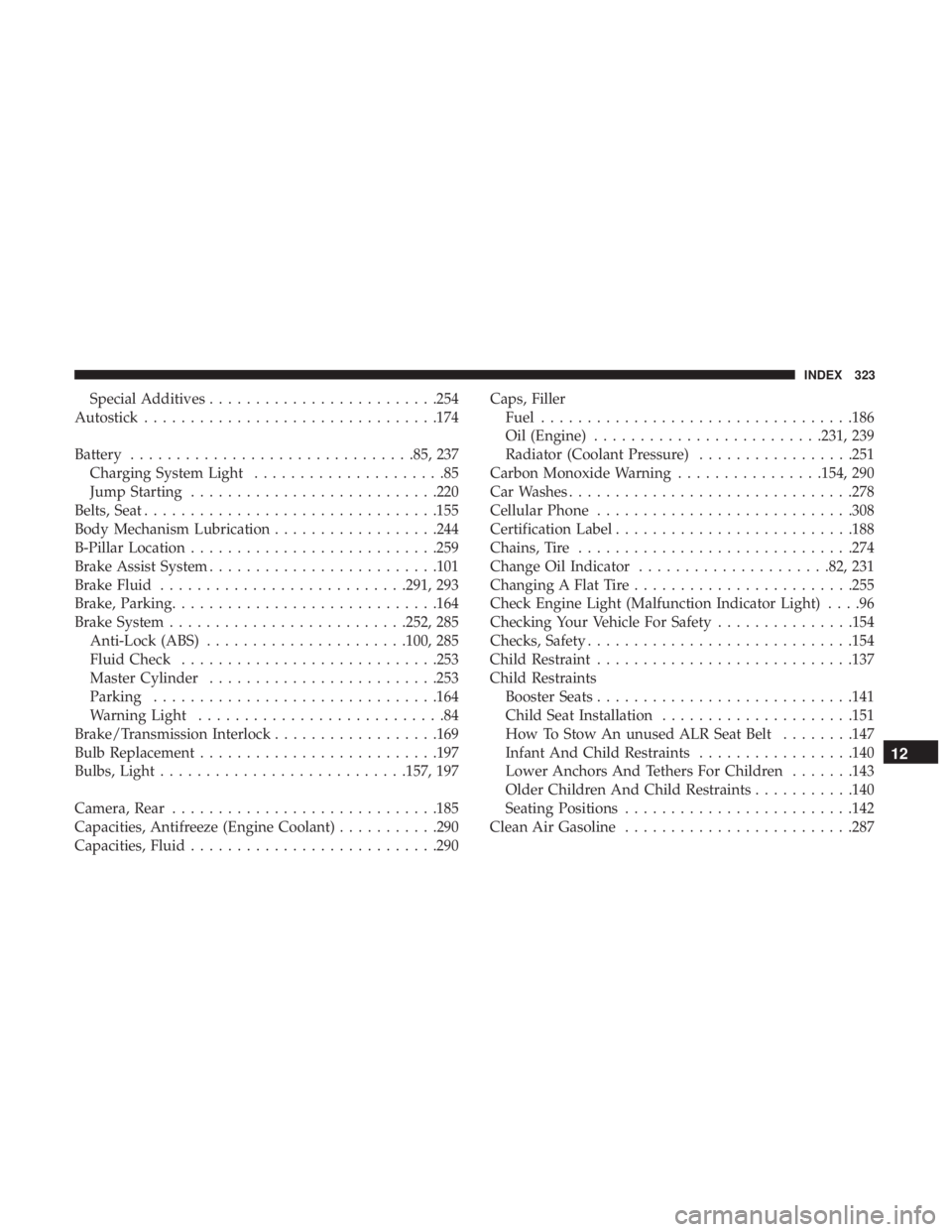
Special Additives ........................ .254
Autostick ............................... .174
Battery .............................. .85, 237
Charging System Light .....................85
Jump Starting .......................... .220
Belts, Seat ............................... .155
Body Mechanism Lubrication ................. .244
B-Pillar Location .......................... .259
Brake Assist System ........................ .101
Brake Fluid .......................... .291, 293
Brake, Parking ............................ .164
Brake System ......................... .252, 285
Anti-Lock (ABS) ..................... .100, 285
Fluid Check ........................... .253
Master Cylinder ........................ .253
Parking .............................. .164
Warning Light ...........................84
Brake/Transmission Interlock ................. .169
Bulb Replacement ......................... .197
Bulbs, Light .......................... .157, 197
Camera, Rear ............................ .185
Capacities, Antifreeze (Engine Coolant) .......... .290
Capacities, Fluid .......................... .290 Caps, Filler
Fuel ................................. .186
Oil (Engine) ........................ .231, 239
Radiator (Coolant Pressure) ................ .251
Carbon Monoxide Warning ............... .154, 290
Car Washes .............................. .278
Cellular Phone ........................... .308
Certification Label ......................... .188
Chains, Tire ............................. .274
Change Oil Indicator .................... .82, 231
Changing A Flat Tire ....................... .255
Check Engine Light (Malfunction Indicator Light) ....96
Checking Your Vehicle For Safety .............. .154
Checks, Safety ............................ .154
Child Restraint ........................... .137
Child Restraints
Booster Seats ........................... .141
Child Seat Installation .................... .151
How To Stow An unused ALR Seat Belt ....... .147
Infant And Child Restraints ................ .140
Lower Anchors And Tethers For Children ...... .143
Older Children And Child Restraints .......... .140
Seating Positions ........................ .142
Clean Air Gasoline ........................ .28712 INDEX 323
Page 327 of 338
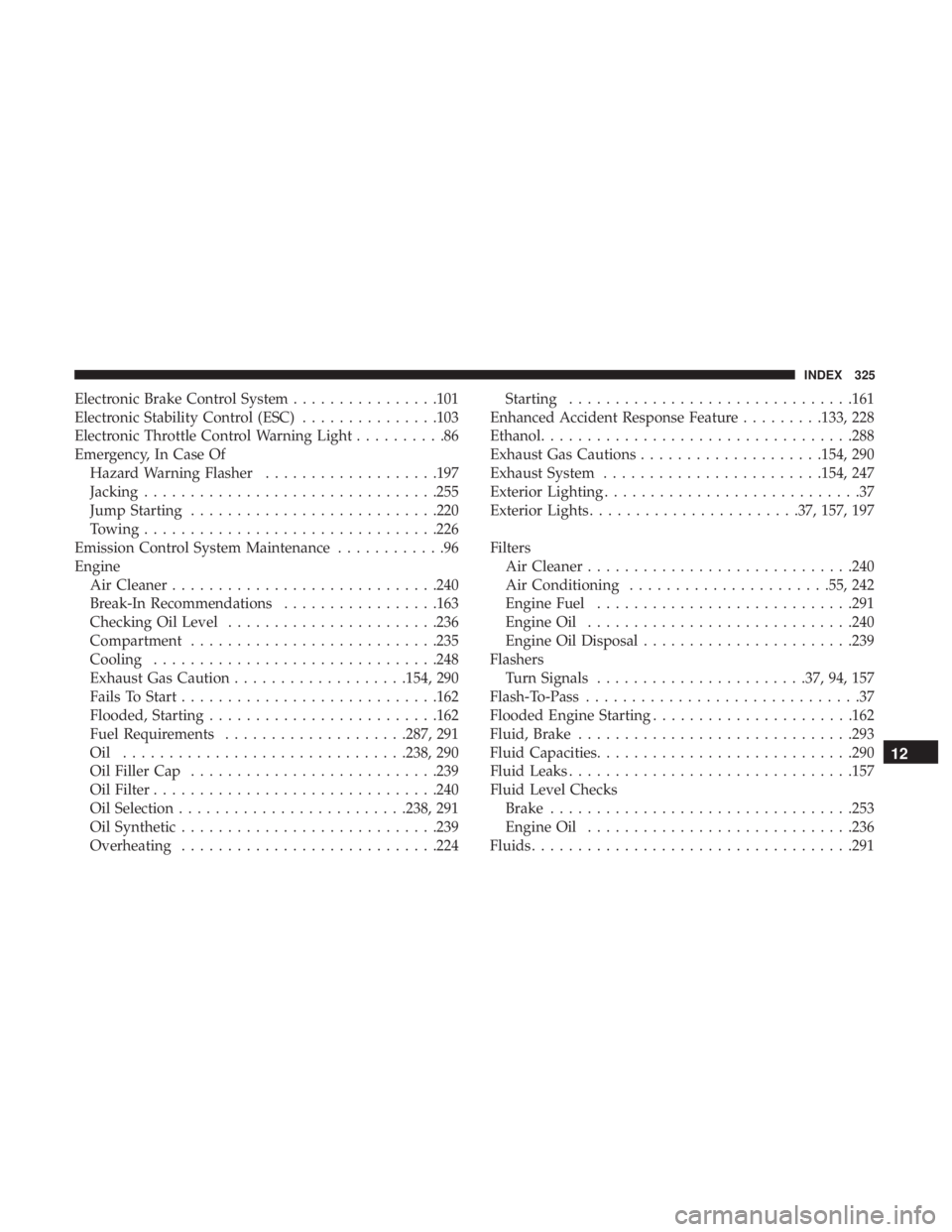
Electronic Brake Control System ............... .101
Electronic Stability Control (ESC) .............. .103
Electronic Throttle Control Warning Light ..........86
Emergency, In Case Of
Hazard Warning Flasher .................. .197
Jacking ............................... .255
Jump Starting .......................... .220
Towing ............................... .226
Emission Control System Maintenance ............96
Engine
Air Cleaner ............................ .240
Break-In Recommendations ................ .163
Checking Oil Level ...................... .236
Compartment .......................... .235
Cooling .............................. .248
Exhaust Gas Caution .................. .154, 290
Fails To Start ........................... .162
Flooded, Starting ........................ .162
Fuel Requirements ................... .287, 291
Oil .............................. .238, 290
Oil Filler Cap .......................... .239
Oil Filter .............................. .240
Oil Selection ........................ .238, 291
Oil Synthetic ........................... .239
Overheating ........................... .224 Starting .............................. .161
Enhanced Accident Response Feature ........ .133, 228
Ethanol ................................. .288
Exhaust Gas Cautions ................... .154, 290
Exhaust System ....................... .154, 247
Exterior Lighting ............................37
Exterior Lights ...................... .37, 157, 197
Filters
Air Cleaner ............................ .240
Air Conditioning ..................... .55, 242
Engine Fuel ........................... .291
Engine Oil ............................ .240
Engine Oil Disposal ...................... .239
Flashers
Turn Signals ...................... .37, 94, 157
Flash-To-Pass ..............................37
Flooded Engine Starting ..................... .162
Fluid, Brake ............................. .293
Fluid Capacities ........................... .290
Fluid Leaks .............................. .157
Fluid Level Checks
Brake ................................ .253
Engine Oil ............................ .236
Fluids .................................. .29112 INDEX 325