air condition FIAT 500C 2018 Owner's Guide
[x] Cancel search | Manufacturer: FIAT, Model Year: 2018, Model line: 500C, Model: FIAT 500C 2018Pages: 338, PDF Size: 4 MB
Page 268 of 338
Consult an authorized tire dealer for tire repairs and
additional information.
Damaged Run Flat tires, or Run Flat tires that have
experienced a loss of pressure should be replaced immedi-
ately with another Run Flat tire of identical size and service
description (Load Index and Speed Symbol).
Run Flat Tires — If Equipped
Run Flat tires allow you the capability to drive 50 miles
(80 km) at 50 mph (80 km/h) after a rapid loss of inflation
pressure. This rapid loss of inflation is referred to as the
Run Flat mode. A Run Flat mode occurs when the tire
inflation pressure is of/or below 14 psi (96 kPa). Once a
Run Flat tire reaches the run flat mode it has limited
driving capabilities and needs to be replaced immediately.
A Run Flat tire is not repairable.
It is not recommended driving a vehicle loaded at full
capacity or to tow a trailer while a tire is in the run flat
mode.
See the tire pressure monitoring section for more informa-
tion. Tire Spinning
When stuck in mud, sand, snow, or ice conditions, do not
spin your vehicle’s wheels above 30 mph (48 km/h) or for
longer than 30 seconds continuously without stopping.
Refer to “Freeing A Stuck Vehicle” in “In Case Of Emer-
gency” for further information.
WARNING!Fast spinning tires can be dangerous. Forces generated
by excessive wheel speeds may cause tire damage or
failure. A tire could explode and injure someone. Do
not spin your vehicle’s wheels faster than 30 mph
(48 km/h) for more than 30 seconds continuously when
you are stuck, and do not let anyone near a spinning
wheel, no matter what the speed.
Tread Wear Indicators
Tread wear indicators are in the original equipment tires to
help you in determining when your tires should be re-
placed.266 SERVICING AND MAINTENANCE
Page 279 of 338
corresponds to a level of performance, which all pas-
senger vehicle tires must meet under the Federal Motor
Vehicle Safety Standard No. 109. Grades B and A
represent higher levels of performance on the laboratory
test wheel, than the minimum required by law.
WARNING!The temperature grade for this tire is established for
a tire that is properly inflated and not overloaded.
Excessive speed, under-inflation, or excessive load-
ing, either separately or in combination, can cause
heat buildup and possible tire failure.
VEHICLE STORAGE
If you will not be using your vehicle for more than 21 days,
you may want to take steps to preserve your battery.
• Disconnect the negative cable from the battery.
• Anytime you store your vehicle, or keep it out of service
(i.e., vacation) for two weeks or more, run the air
conditioning system at idle for about five minutes in the
fresh air and high blower setting. This will ensure
adequate system lubrication to minimize the possibility
of compressor damage when the system is started again. NOTE: When the vehicle has not been started or driven
for at least 30 days, an Extended Park Start Procedure is
required to start the vehicle. Refer to “Starting The Engine”
in “Starting And Operating” for further information.
BODYWORK
Protection From Atmospheric Agents
Vehicle body care requirements vary according to geo-
graphic locations and usage. Chemicals that make roads
passable in snow and ice and those that are sprayed on
trees and road surfaces during other seasons are highly
corrosive to the metal in your vehicle. Outside parking,
which exposes your vehicle to airborne contaminants, road
surfaces on which the vehicle is operated, extreme hot or
cold weather and other extreme conditions will have an
adverse effect on paint, metal trim, and underbody protec-
tion.
The following maintenance recommendations will enable
you to obtain maximum benefit from the corrosion resis-
tance built into your vehicle.
What Causes Corrosion?
Corrosion is the result of deterioration or removal of paint
and protective coatings from your vehicle. 8SERVICING AND MAINTENANCE 277
Page 316 of 338
CD/DVD DISC MAINTENANCE
To keep a CD/DVD in good condition, take the following
precautions:
• Handle the disc by its edge; avoid touching the surface.
• If the disc is stained, clean the surface with a soft cloth,
wiping from center to edge.
• Do not apply paper or tape to the disc; avoid scratching
the disc.
• Do not use solvents such as benzene, thinner, cleaners,
or anti-static sprays.
• Store the disc in its case after playing.
• Do not expose the disc to direct sunlight.
• Do not store the disc where temperatures may become
too high.
NOTE: If you experience difficulty in playing a particular
disc, it may be damaged (e.g., scratched, reflective coating
removed, a hair, moisture or dew on the disc), oversized, or
have protection encoding. Try a known good disc before
considering disc player service. 314 MULTIMEDIA
Page 324 of 338
About Your Brakes ........................ .285
Adding Engine Coolant (Antifreeze) ............ .250
Adding Fuel ............................. .186
Adding Washing Fluid ...................... .236
Additives, Fuel ........................... .287
Air Bag
Air Bag Operation ....................... .127
Air Bag Warning Light .................... .124
Driver Knee Air Bag ..................... .128
Enhanced Accident Response ............ .133, 228
Event Data Recorder (EDR) ................ .228
If Deployment Occurs .................... .132
Knee Impact Bolsters ..................... .127
Maintaining Your Air Bag System ............ .136
Maintenance ........................... .136
Side Air Bags .......................... .128
Transporting Pets ....................... .153
Air Bag Light ...................... .84, 124, 155
Air Cleaner, Engine (Engine Air Cleaner Filter) ..... .240
Air Conditioner Maintenance ................. .240
Air Conditioner Refrigerant ............... .240, 241
Air Conditioner System ..................... .240
Air Conditioning Filter ................... .55, 242
Air Conditioning, Operating Tips ................54
Air Conditioning Refrigerant ................. .241 Air Filter ............................... .240
Air Pressure
Tires................................. .264
Alarm
Security Alarm ...........................22
Alarm System
Security Alarm ...........................22
Alterations/Modifications, Vehicle ................5
Antifreeze (Engine Coolant) ............... .249, 290
Capacities ............................. .290
Disposal .............................. .251
Anti-Lock Brake System (ABS) ................ .100
Anti-Lock Warning Light .................. .88, 93
Arming System
Security Alarm ........................... 2 2
Audio Systems (Radio) ...................... .296
Automatic Dimming Mirror ................ .34, 35
Automatic Oil Change Indicator ............... .231
Automatic Transmission ................. .168, 254
Adding Fluid .......................... .255
Autostick ............................. .174
Fluid And Filter Change .................. .255
Fluid Change .......................... .255
Fluid Level Check ....................... .255
Fluid Type ......................... .254, 293322 INDEX
Page 327 of 338
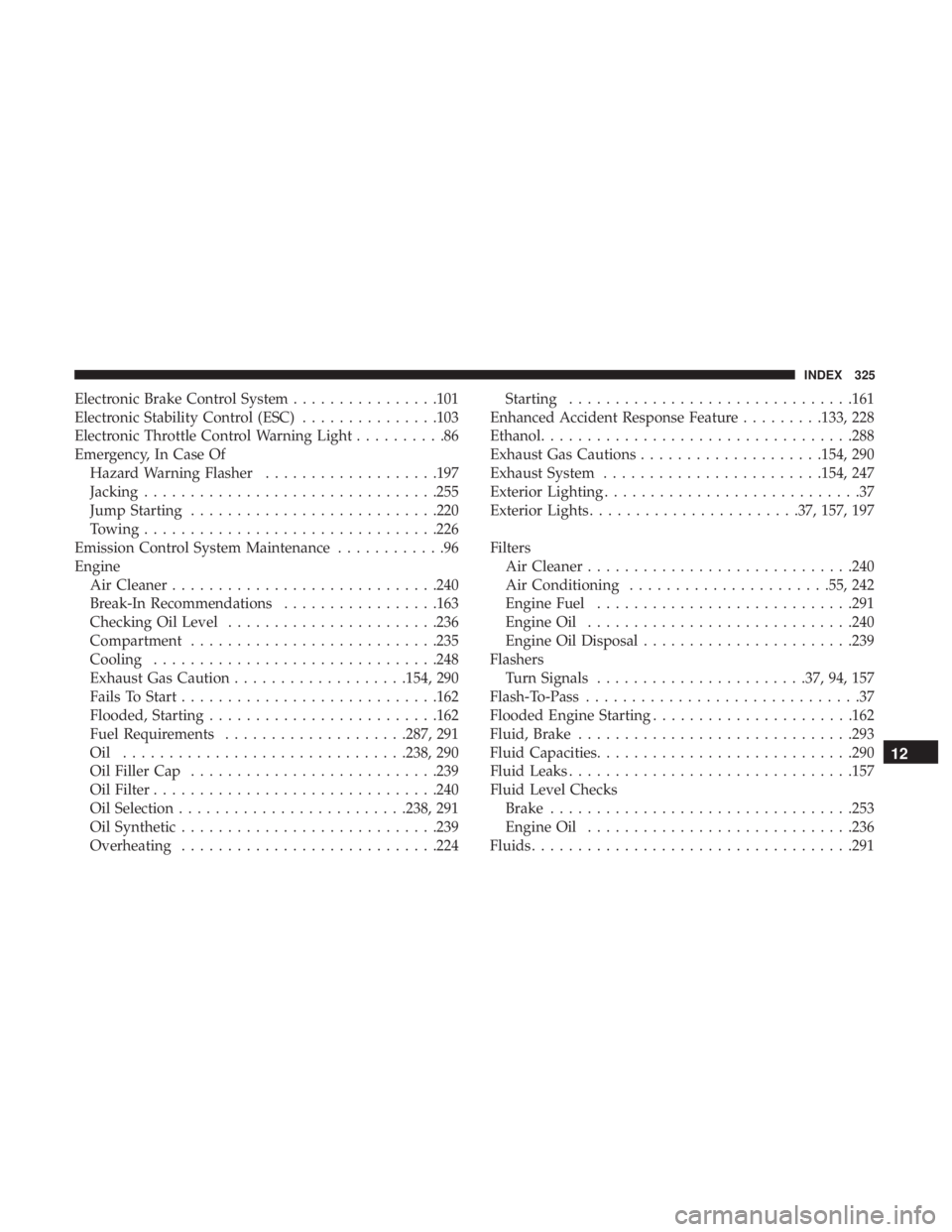
Electronic Brake Control System ............... .101
Electronic Stability Control (ESC) .............. .103
Electronic Throttle Control Warning Light ..........86
Emergency, In Case Of
Hazard Warning Flasher .................. .197
Jacking ............................... .255
Jump Starting .......................... .220
Towing ............................... .226
Emission Control System Maintenance ............96
Engine
Air Cleaner ............................ .240
Break-In Recommendations ................ .163
Checking Oil Level ...................... .236
Compartment .......................... .235
Cooling .............................. .248
Exhaust Gas Caution .................. .154, 290
Fails To Start ........................... .162
Flooded, Starting ........................ .162
Fuel Requirements ................... .287, 291
Oil .............................. .238, 290
Oil Filler Cap .......................... .239
Oil Filter .............................. .240
Oil Selection ........................ .238, 291
Oil Synthetic ........................... .239
Overheating ........................... .224 Starting .............................. .161
Enhanced Accident Response Feature ........ .133, 228
Ethanol ................................. .288
Exhaust Gas Cautions ................... .154, 290
Exhaust System ....................... .154, 247
Exterior Lighting ............................37
Exterior Lights ...................... .37, 157, 197
Filters
Air Cleaner ............................ .240
Air Conditioning ..................... .55, 242
Engine Fuel ........................... .291
Engine Oil ............................ .240
Engine Oil Disposal ...................... .239
Flashers
Turn Signals ...................... .37, 94, 157
Flash-To-Pass ..............................37
Flooded Engine Starting ..................... .162
Fluid, Brake ............................. .293
Fluid Capacities ........................... .290
Fluid Leaks .............................. .157
Fluid Level Checks
Brake ................................ .253
Engine Oil ............................ .236
Fluids .................................. .29112 INDEX 325