tow FIAT 500C 2018 Owner's Guide
[x] Cancel search | Manufacturer: FIAT, Model Year: 2018, Model line: 500C, Model: FIAT 500C 2018Pages: 338, PDF Size: 4 MB
Page 233 of 338
SCHEDULED SERVICING
Your vehicle is equipped with an automatic oil change
indicator system. The oil change indicator system will
remind you that it is time to take your vehicle in for
scheduled maintenance.
Based on engine operation conditions, the oil change
indicator message will illuminate. This means that service
is required for your vehicle. Operating conditions such as
frequent short-trips, trailer tow, extremely hot or cold
ambient temperatures, and E85 fuel usage will influence
when the “Change Oil” or “Oil Change Required” message
is displayed. Severe Operating Conditions can cause the
change oil message to illuminate as early as 3,500 miles
(5,600 km) since last reset. Have your vehicle serviced as
soon as possible, within the next 500 miles (805 km).
Your authorized dealer will reset the oil change indicator
message after completing the scheduled oil change. If a
scheduled oil change is performed by someone other than
your authorized dealer, the message can be reset by
referring to the steps described under “Instrument Cluster
Display” in “Getting To Know Your Instrument Panel” for
further information. NOTE: Under no circumstances should oil change inter-
vals exceed 10,000 miles (16,000 km), twelve months or
350 hours of engine run time, whichever comes first. The
350 hours of engine run or idle time is generally only a
concern for fleet customers.
Severe Duty All Models
Change Engine Oil at 4,000 miles (6,500 km) if the vehicle
is operated in a dusty and off road environment or is
operated predominantly at idle or only very low engine
RPM’s. This type of vehicle use is considered Severe Duty.
Once A Month Or Before A Long Trip:
Check engine oil level.
Check windshield washer fluid level.
Check the tire inflation pressures and look for unusual
wear or damage.
Check the fluid levels of the coolant reservoir and brake
master cylinder, and fill as needed.
Check function of all interior and exterior lights. 8SERVICING AND MAINTENANCE 231
Page 250 of 338
Under normal operating conditions, the catalytic converter
will not require maintenance. However, it is important to
keep the engine properly tuned to assure proper catalyst
operation and prevent possible catalyst damage.
NOTE: Intentional tampering with emissions control sys-
tems can result in civil penalties being assessed against
you.
In unusual situations involving grossly malfunctioning
engine operation, a scorching odor may suggest severe and
abnormal catalyst overheating. If this occurs, stop the
vehicle, turn off the engine and allow it to cool. Service,
including a tune-up to manufacturer’s specifications,
should be obtained immediately.
To minimize the possibility of catalytic converter damage:
• Do not interrupt the ignition when the transmission is in
gear and the vehicle is in motion.
• Do not try to start the vehicle by pushing or towing the
vehicle.
• Do not idle the engine with any ignition components
disconnected or removed, such as when diagnostic
testing, or for prolonged periods during very rough idle
or malfunctioning operating conditions. Cooling System
WARNING!• You or others can be badly burned by hot engine
coolant (antifreeze) or steam from your radiator. If
you see or hear steam coming from under the hood,
do not open the hood until the radiator has had time
to cool. Never open a cooling system pressure cap
when the radiator or coolant bottle is hot.
• Keep hands, tools, clothing, and jewelry away from
the radiator cooling fan when the hood is raised. The
fan starts automatically and may start at any time,
whether the engine is running or not.
• When working near the radiator cooling fan, discon-
nect the fan motor lead or turn the ignition to the
OFF mode. The fan is temperature controlled and can
start at any time the ignition is in the ON mode.
Coolant Checks
Check engine coolant (antifreeze) protection every 12
months (before the onset of freezing weather, where appli-
cable). If the engine coolant (antifreeze) is dirty or rusty in
appearance, the system should be drained, flushed and248 SERVICING AND MAINTENANCE
Page 262 of 338
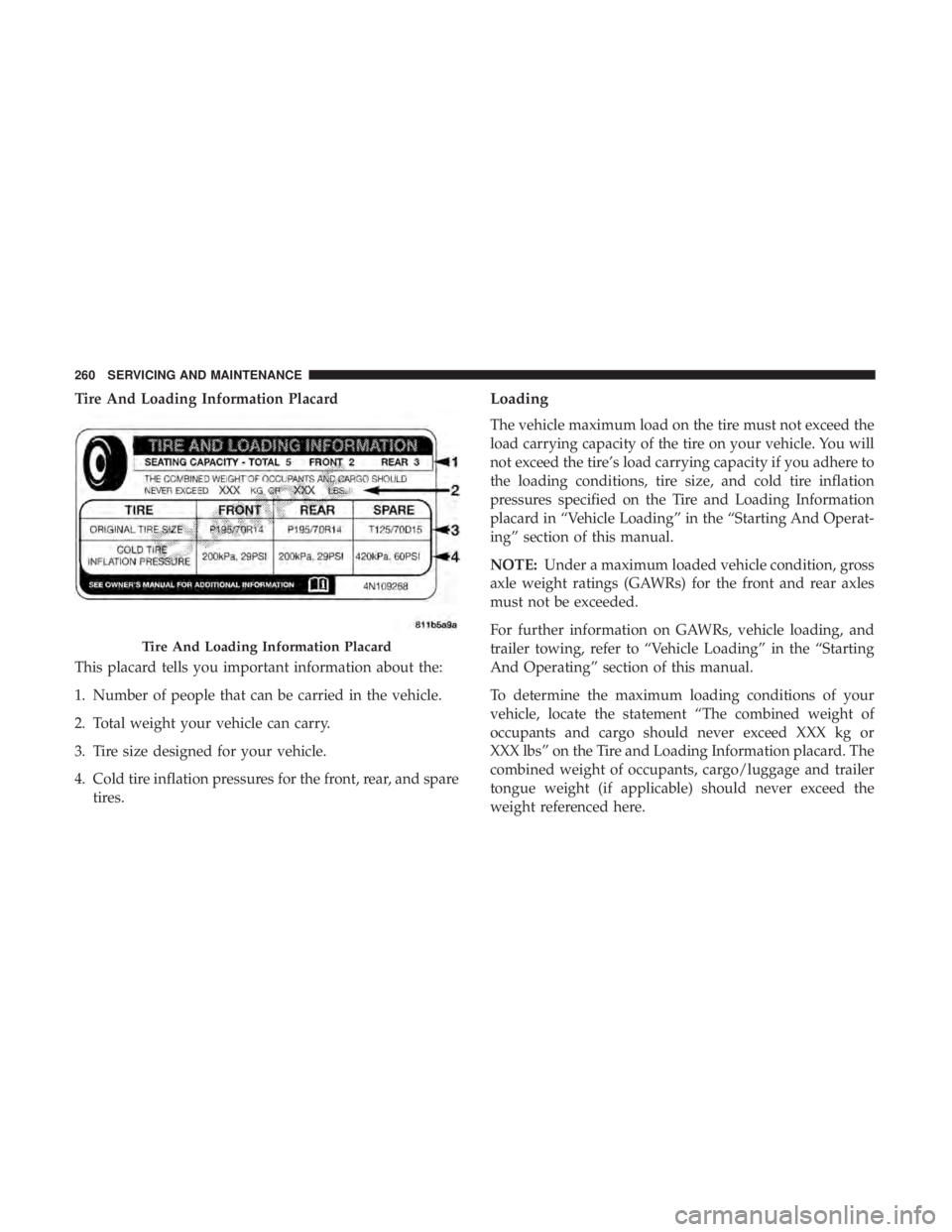
Tire And Loading Information Placard
This placard tells you important information about the:
1. Number of people that can be carried in the vehicle.
2. Total weight your vehicle can carry.
3. Tire size designed for your vehicle.
4. Cold tire inflation pressures for the front, rear, and spare
tires. Loading
The vehicle maximum load on the tire must not exceed the
load carrying capacity of the tire on your vehicle. You will
not exceed the tire’s load carrying capacity if you adhere to
the loading conditions, tire size, and cold tire inflation
pressures specified on the Tire and Loading Information
placard in “Vehicle Loading” in the “Starting And Operat-
ing” section of this manual.
NOTE: Under a maximum loaded vehicle condition, gross
axle weight ratings (GAWRs) for the front and rear axles
must not be exceeded.
For further information on GAWRs, vehicle loading, and
trailer towing, refer to “Vehicle Loading” in the “Starting
And Operating” section of this manual.
To determine the maximum loading conditions of your
vehicle, locate the statement “The combined weight of
occupants and cargo should never exceed XXX kg or
XXX lbs” on the Tire and Loading Information placard. The
combined weight of occupants, cargo/luggage and trailer
tongue weight (if applicable) should never exceed the
weight referenced here.Tire And Loading Information Placard260 SERVICING AND MAINTENANCE
Page 263 of 338
Steps For Determining Correct Load Limit—
(1) Locate the statement “The combined weight of
occupants and cargo should never exceed XXX kg or
XXX lbs.” on your vehicle’s placard.
(2) Determine the combined weight of the driver and
passengers that will be riding in your vehicle.
(3) Subtract the combined weight of the driver and
passengers from XXX kg or XXX lbs.
(4) The resulting figure equals the available amount of
cargo and luggage load capacity. For example, if “XXX”
amount equals 1400 lbs. and there will be five 150 lb
passengers in your vehicle, the amount of available
cargo and luggage load capacity is 650 lbs. (1400-750
(5x150) = 650 lbs.)
(5) Determine the combined weight of luggage and
cargo being loaded on the vehicle. That weight may not
safely exceed the available cargo and luggage load
capacity calculated in Step 4. (6) If your vehicle will be towing a trailer, load from
your trailer will be transferred to your vehicle. Consult
this manual to determine how this reduces the available
cargo and luggage load capacity of your vehicle.
Metric Example For Load Limit
For example, if “XXX” amount equals 635 kg and there will
be five 68 kg passengers in your vehicle, the amount of
available cargo and luggage load capacity is 295 kg (635-
340 (5x68) = 295 kg) as shown in step 4.
NOTE:
• If your vehicle will be towing a trailer, load from your
trailer will be transferred to your vehicle. The following
table shows examples on how to calculate total load,
cargo/luggage, and towing capacities of your vehicle
with varying seating configurations and number and
size of occupants. This table is for illustration purposes
only and may not be accurate for the seating and load
carry capacity of your vehicle.
• For the following example, the combined weight of occu-
pants and cargo should never exceed 865 lbs (392 kg). 8SERVICING AND MAINTENANCE 261
Page 268 of 338
Consult an authorized tire dealer for tire repairs and
additional information.
Damaged Run Flat tires, or Run Flat tires that have
experienced a loss of pressure should be replaced immedi-
ately with another Run Flat tire of identical size and service
description (Load Index and Speed Symbol).
Run Flat Tires — If Equipped
Run Flat tires allow you the capability to drive 50 miles
(80 km) at 50 mph (80 km/h) after a rapid loss of inflation
pressure. This rapid loss of inflation is referred to as the
Run Flat mode. A Run Flat mode occurs when the tire
inflation pressure is of/or below 14 psi (96 kPa). Once a
Run Flat tire reaches the run flat mode it has limited
driving capabilities and needs to be replaced immediately.
A Run Flat tire is not repairable.
It is not recommended driving a vehicle loaded at full
capacity or to tow a trailer while a tire is in the run flat
mode.
See the tire pressure monitoring section for more informa-
tion. Tire Spinning
When stuck in mud, sand, snow, or ice conditions, do not
spin your vehicle’s wheels above 30 mph (48 km/h) or for
longer than 30 seconds continuously without stopping.
Refer to “Freeing A Stuck Vehicle” in “In Case Of Emer-
gency” for further information.
WARNING!Fast spinning tires can be dangerous. Forces generated
by excessive wheel speeds may cause tire damage or
failure. A tire could explode and injure someone. Do
not spin your vehicle’s wheels faster than 30 mph
(48 km/h) for more than 30 seconds continuously when
you are stuck, and do not let anyone near a spinning
wheel, no matter what the speed.
Tread Wear Indicators
Tread wear indicators are in the original equipment tires to
help you in determining when your tires should be re-
placed.266 SERVICING AND MAINTENANCE
Page 284 of 338
Cleaning Plastic Instrument Cluster Lenses
The lenses in front of the instruments in this vehicle are
molded in clear plastic. When cleaning the lenses, care
must be taken to avoid scratching the plastic.
1. Clean with a wet soft cloth. A mild soap solution may be
used, but do not use high alcohol content or abrasive
cleaners. If soap is used, wipe clean with a clean damp
cloth.
2. Dry with a soft cloth.
Leather Parts
Mopar Total Clean is specifically recommended for leather
upholstery.
Your leather upholstery can be best preserved by regular
cleaning with a damp soft cloth. Small particles of dirt can
act as an abrasive and damage the leather upholstery and
should be removed promptly with a damp cloth. Stubborn
soils can be removed easily with a soft cloth and Mopar
Total Clean. Care should be taken to avoid soaking your
leather upholstery with any liquid. Please do not use
polishes, oils, cleaning fluids, solvents, detergents, or
ammonia-based cleaners to clean your leather upholstery.
Application of a leather conditioner is not required to
maintain the original condition. NOTE:
If equipped with light colored leather, it tends to
show any foreign material, dirt, and fabric dye transfer more
so than darker colors. The leather is designed for easy
cleaning, and FCA recommends Mopar total care leather
cleaner applied on a cloth to clean the leather seats as needed.
CAUTION!Do not use Alcohol and Alcohol-based and/or Ketone
based cleaning products to clean leather upholstery, as
damage to the upholstery may result.
Glass Surfaces
All glass surfaces should be cleaned on a regular basis with
Mopar Glass Cleaner, or any commercial household-type
glass cleaner. Never use an abrasive type cleaner. Use
caution when cleaning the inside rear window equipped
with electric defrosters or windows equipped with radio
antennas. Do not use scrapers or other sharp instruments
that may scratch the elements.
When cleaning the rear view mirror, spray cleaner on the
towel or cloth that you are using. Do not spray cleaner
directly on the mirror.282 SERVICING AND MAINTENANCE
Page 325 of 338
Special Additives ........................ .254
Autostick ............................... .174
Battery .............................. .85, 237
Charging System Light .....................85
Jump Starting .......................... .220
Belts, Seat ............................... .155
Body Mechanism Lubrication ................. .244
B-Pillar Location .......................... .259
Brake Assist System ........................ .101
Brake Fluid .......................... .291, 293
Brake, Parking ............................ .164
Brake System ......................... .252, 285
Anti-Lock (ABS) ..................... .100, 285
Fluid Check ........................... .253
Master Cylinder ........................ .253
Parking .............................. .164
Warning Light ...........................84
Brake/Transmission Interlock ................. .169
Bulb Replacement ......................... .197
Bulbs, Light .......................... .157, 197
Camera, Rear ............................ .185
Capacities, Antifreeze (Engine Coolant) .......... .290
Capacities, Fluid .......................... .290 Caps, Filler
Fuel ................................. .186
Oil (Engine) ........................ .231, 239
Radiator (Coolant Pressure) ................ .251
Carbon Monoxide Warning ............... .154, 290
Car Washes .............................. .278
Cellular Phone ........................... .308
Certification Label ......................... .188
Chains, Tire ............................. .274
Change Oil Indicator .................... .82, 231
Changing A Flat Tire ....................... .255
Check Engine Light (Malfunction Indicator Light) ....96
Checking Your Vehicle For Safety .............. .154
Checks, Safety ............................ .154
Child Restraint ........................... .137
Child Restraints
Booster Seats ........................... .141
Child Seat Installation .................... .151
How To Stow An unused ALR Seat Belt ....... .147
Infant And Child Restraints ................ .140
Lower Anchors And Tethers For Children ...... .143
Older Children And Child Restraints .......... .140
Seating Positions ........................ .142
Clean Air Gasoline ........................ .28712 INDEX 323
Page 327 of 338
Electronic Brake Control System ............... .101
Electronic Stability Control (ESC) .............. .103
Electronic Throttle Control Warning Light ..........86
Emergency, In Case Of
Hazard Warning Flasher .................. .197
Jacking ............................... .255
Jump Starting .......................... .220
Towing ............................... .226
Emission Control System Maintenance ............96
Engine
Air Cleaner ............................ .240
Break-In Recommendations ................ .163
Checking Oil Level ...................... .236
Compartment .......................... .235
Cooling .............................. .248
Exhaust Gas Caution .................. .154, 290
Fails To Start ........................... .162
Flooded, Starting ........................ .162
Fuel Requirements ................... .287, 291
Oil .............................. .238, 290
Oil Filler Cap .......................... .239
Oil Filter .............................. .240
Oil Selection ........................ .238, 291
Oil Synthetic ........................... .239
Overheating ........................... .224 Starting .............................. .161
Enhanced Accident Response Feature ........ .133, 228
Ethanol ................................. .288
Exhaust Gas Cautions ................... .154, 290
Exhaust System ....................... .154, 247
Exterior Lighting ............................37
Exterior Lights ...................... .37, 157, 197
Filters
Air Cleaner ............................ .240
Air Conditioning ..................... .55, 242
Engine Fuel ........................... .291
Engine Oil ............................ .240
Engine Oil Disposal ...................... .239
Flashers
Turn Signals ...................... .37, 94, 157
Flash-To-Pass ..............................37
Flooded Engine Starting ..................... .162
Fluid, Brake ............................. .293
Fluid Capacities ........................... .290
Fluid Leaks .............................. .157
Fluid Level Checks
Brake ................................ .253
Engine Oil ............................ .236
Fluids .................................. .29112 INDEX 325
Page 331 of 338
Checking ............................. .236
Dipstick .............................. .236
Disposal .............................. .239
Filter ................................ .240
Filter Disposal .......................... .239
Identification Logo ...................... .238
Materials Added To ...................... .239
Pressure Warning Light .....................87
Recommendation .................... .238, 290
Synthetic ............................. .239
Viscosity .............................. .239
Oil Filter, Change ......................... .240
Oil Filter, Selection ......................... .240
Oil Pressure Light ...........................87
Onboard Diagnostic System ....................95
Operating Precautions ........................95
Operator Manual (Owner’s Manual) ...............5
Outlet
Power .................................68
Outside Rearview Mirrors .....................34
Overheating, Engine ....................... .224
Owner’s Manual (Operator Manual) ...........5,320
Paint Care ............................... .277
Parking Brake ............................ .164 Passing Light ..............................38
Pets ................................... .153
Placard, Tire And Loading Information .......... .259
Power
Brakes ............................... .285
Door Locks ..............................25
Mirrors ................................36
Outlet (Auxiliary Electrical Outlet) .............68
Steering .............................. .177
Sunroof ................................57
Pregnant Women And Seat Belts ............... .120
Pretensioners
Seat Belts ............................. .121
Radial Ply Tires ........................... .265
Radiator Cap (Coolant Pressure Cap) ............ .251
Radio Frequency
General Information .................... .19, 22
Radio Operation .......................... .308
Rear Camera ............................. .185
Rear Liftgate (Sedan) .........................65
Recreational Towing ........................ .190
Reformulated Gasoline ...................... .287
Refrigerant .............................. .241
Release, Hood ..............................63 12 INDEX 329
Page 334 of 338
Inflation Pressure ....................... .264
Jacking ............................... .255
Life Of Tires ........................... .267
Load Capacity ...................... .259, 260
Pressure Monitoring System (TPMS) ............91
Pressure Monitor System (TPMS) ............ .106
Quality Grading ........................ .276
Radial ............................... .265
Replacement ........................... .268
Rotation .............................. .275
Safety ............................ .256, 263
Snow Tires ............................ .270
Spare Tires ......................... .270, 272
Spinning .............................. .266
Tread Wear Indicators .................... .266
Wheel Nut Torque ....................... .285
Tire Safety Information ...................... .256
Tire Service Kit ............. .204, 205, 206, 208, 210,
211, 212, 213, 214, 216, 218, 219
To Open Hood .............................63
Towing ................................. .189
Disabled Vehicle ........................ .226
Recreational ........................... .190
Towing Behind A Motorhome ................. .190
Traction ................................ .191 Traction Control .......................... .101
Trailer Towing ............................ .189
Transmission
Automatic ......................... .168, 254
Manual ............................... .165
Transporting Pets ......................... .153
Tread Wear Indicators ...................... .266
Turn Signals ......................... .37, 40, 94
Uconnect
Uconnect Settings ....................... .297
Uniform Tire Quality Grades ................. .276
Unleaded Gasoline ........................ .287
Untwisting Pr ocedur e, Seat Belt ................119
USB................................... .308
Vehicle Identification Number (VIN) ............ .284
Vehicle Loading ....................... .188, 260
Vehicle Modifications/Alterations .................5
Vehicle Security Alarm ........................22
Vehicle Storage ......................... .55, 277
Voice Recognition System (VR) ................ .309
Warning Lights (Instrument Cluster Descriptions) ....88
Warnings And Cautions .......................5332 INDEX