air conditioning FIAT 500C 2018 Owners Manual
[x] Cancel search | Manufacturer: FIAT, Model Year: 2018, Model line: 500C, Model: FIAT 500C 2018Pages: 338, PDF Size: 4 MB
Page 47 of 338
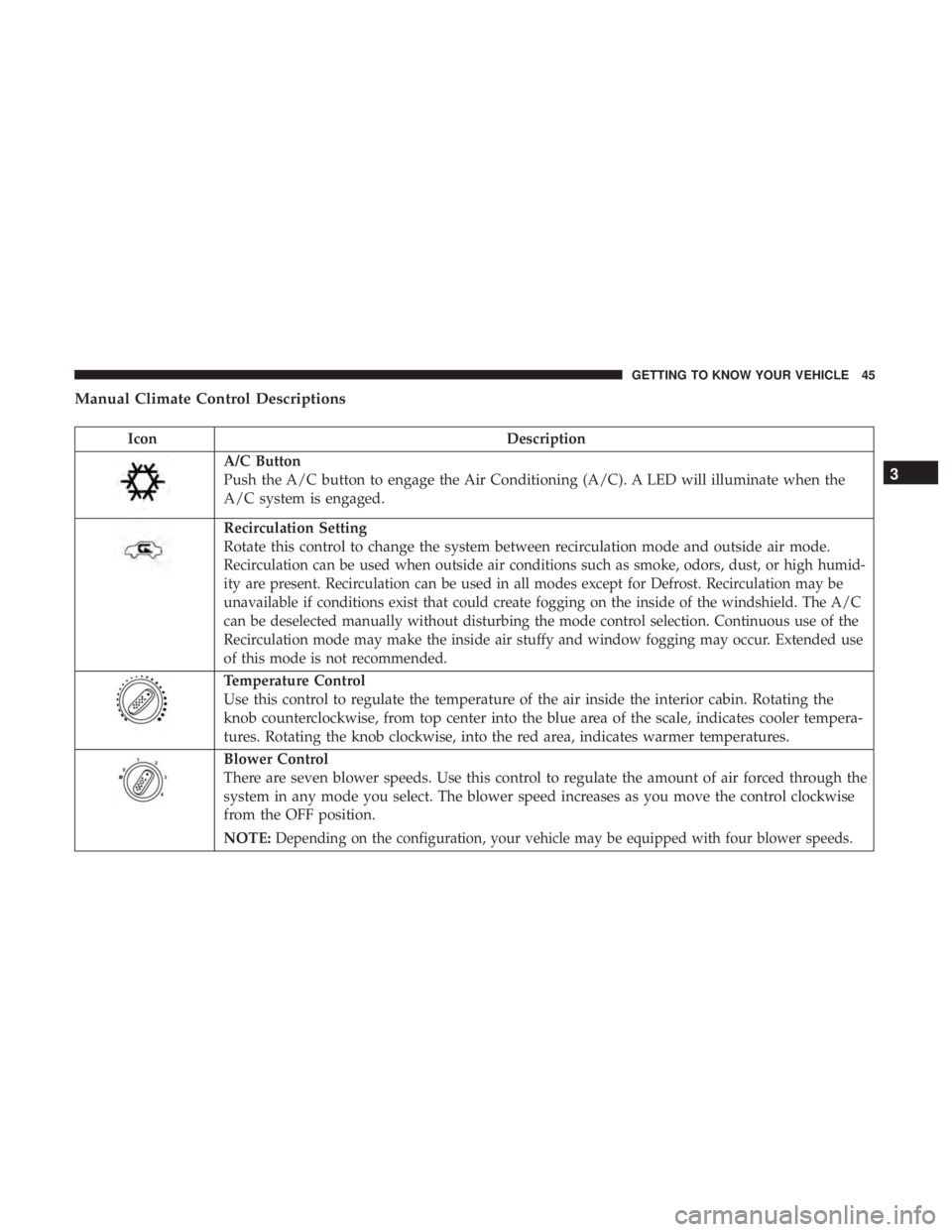
Manual Climate Control Descriptions
Icon Description
A/C Button
Push the A/C button to engage the Air Conditioning (A/C). A LED will illuminate when the
A/C system is engaged.
Recirculation Setting
Rotate this control to change the system between recirculation mode and outside air mode.
Recirculation can be used when outside air conditions such as smoke, odors, dust, or high humid-
ity are present. Recirculation can be used in all modes except for Defrost. Recirculation may be
unavailable if conditions exist that could create fogging on the inside of the windshield. The A/C
can be deselected manually without disturbing the mode control selection. Continuous use of the
Recirculation mode may make the inside air stuffy and window fogging may occur. Extended use
of this mode is not recommended.
Temperature Control
Use this control to regulate the temperature of the air inside the interior cabin. Rotating the
knob counterclockwise, from top center into the blue area of the scale, indicates cooler tempera-
tures. Rotating the knob clockwise, into the red area, indicates warmer temperatures.
Blower Control
There are seven blower speeds. Use this control to regulate the amount of air forced through the
system in any mode you select. The blower speed increases as you move the control clockwise
from the OFF position.
NOTE: Depending on the configuration, your vehicle may be equipped with four blower speeds. 3GETTING TO KNOW YOUR VEHICLE 45
Page 55 of 338
Climate Control Functions
A/C (Air Conditioning)
The Air Conditioning (A/C) button allows the operator to
manually activate or deactivate the air conditioning sys-
tem. When the air conditioning system is turned on, cool
dehumidified air will flow through the outlets into the
cabin. For improved fuel economy, push the A/C button to
turn off the air conditioning and manually adjust the
blower and airflow mode settings. Also, make sure to select
only Panel, Bi-Level or Floor modes.
NOTE:
• For Manual Climate Controls, if the system is in Mix,
Floor or Defrost Mode, the A/C can be turned off, but
the A/C system shall remain active to prevent fogging of
the windows.
• If fog or mist appears on the windshield or side glass,
select Defrost mode, and increase blower speed if needed.
• If your air conditioning performance seems lower than
expected, check the front of the A/C condenser (located
in front of the radiator), for an accumulation of dirt or
insects. Clean with a gentle water spray from the front of
the radiator and through the condenser. Recirculation
In cold weather, use of Recirculation mode may lead to
excessive window fogging. The Recirculation feature may
be unavailable if conditions exist that could create fogging
on the inside of the windshield.
On systems with Manual Climate Controls, if equipped,
the Recirculation mode is not allowed in Defrost mode to
improve window clearing operation. Recirculation is dis-
abled automatically if this mode is selected. Attempting to
use Recirculation while in this mode causes the LED in the
control button to blink and then turns off.
Automatic Temperature Control (ATC) —
If Equipped
Automatic Operation
1. Push the AUTO button on the faceplate.
2. Next, adjust the temperature you would like the system
to maintain by adjusting the temperature control but-
tons. Once the desired temperature is displayed, the
system achieves and automatically maintains that com-
fort level. 3GETTING TO KNOW YOUR VEHICLE 53
Page 57 of 338
Vacation/Storage
Before you store your vehicle, or keep it out of service (i.e.,
vacation) for two weeks or more, run the air conditioning
system at idle for about five minutes, in fresh air with the
blower setting on high. This will ensure adequate system
lubrication to minimize the possibility of compressor dam-
age when the system is started again.
Window Fogging
Vehicle windows tend to fog on the inside in mild, rainy
and/or humid weather. To clear the windows, select De-
frost or Mix mode and increase the front blower speed. Do
not use the Recirculation mode without A/C for long
periods, as fogging may occur.
CAUTION!Failure to follow these cautions can cause damage to
the heating elements:
• Use care when washing the inside of the rear win-
dow. Do not use abrasive window cleaners on the
interior surface of the window. Use a soft cloth and a (Continued) CAUTION! (Continued)mild washing solution, wiping parallel to the heat-
ing elements. Labels can be peeled off after soaking
with warm water.
• Do not use scrapers, sharp instruments, or abrasive
window cleaners on the interior surface of the win-
dow.
• Keep all objects a safe distance from the window.
Outside Air Intake
Make sure the air intake, located directly in front of the
windshield, is free of obstructions such as leaves. Leaves
collected in the air intake may reduce airflow, and if they
enter the plenum, they could plug the water drains. In
winter months, make sure the air intake is clear of ice,
slush, and snow.
A/C Air Filter
The climate control system filters out dust and pollen from
the air. Contact an authorized dealer to service your A/C
air filter, and to have it replaced when needed. 3GETTING TO KNOW YOUR VEHICLE 55
Page 205 of 338
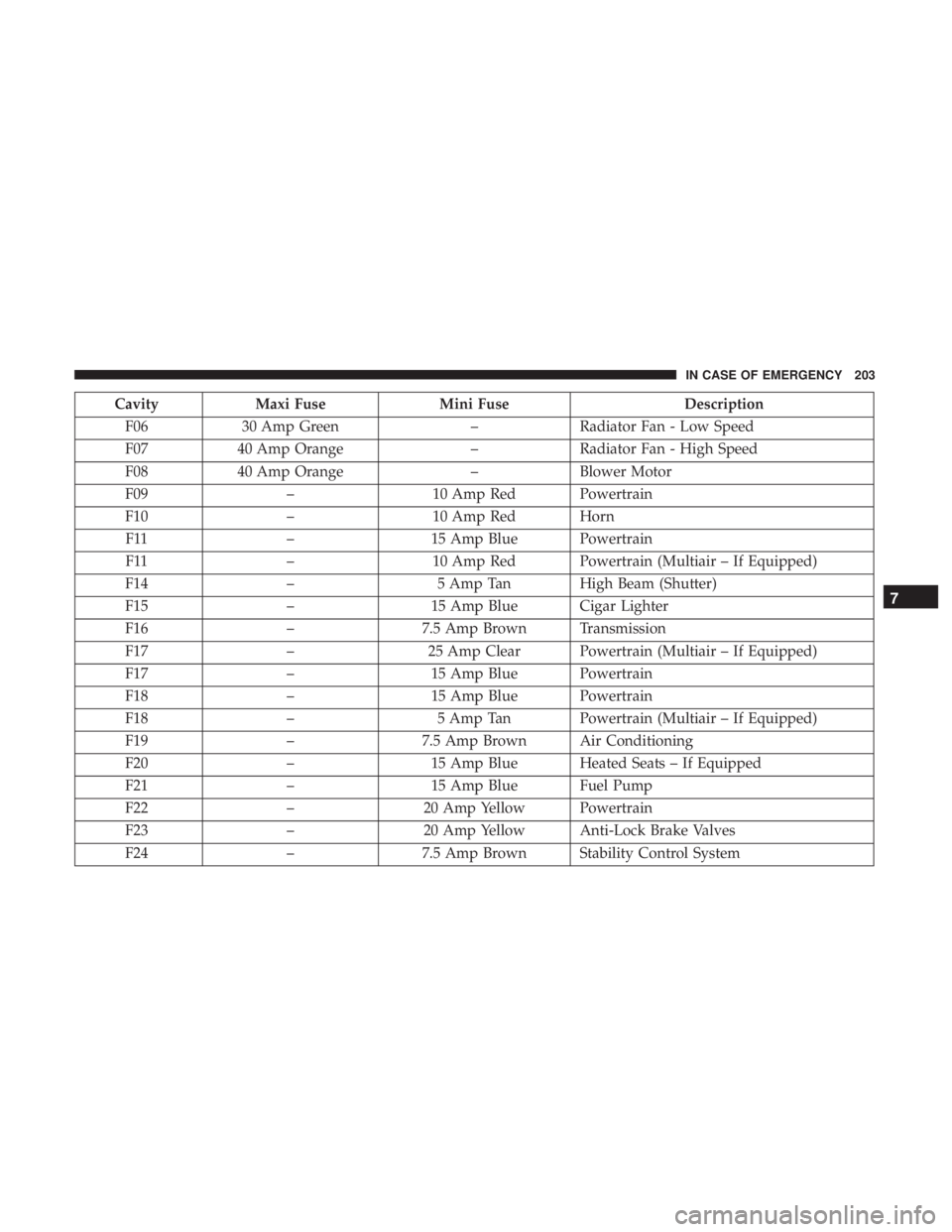
Cavity Maxi Fuse Mini Fuse Description
F06 30 Amp Green – Radiator Fan - Low Speed
F07 40 Amp Orange – Radiator Fan - High Speed
F08 40 Amp Orange – Blower Motor
F09 – 10 Amp Red Powertrain
F10 – 10 Amp Red Horn
F11 – 15 Amp Blue Powertrain
F11 – 10 Amp Red Powertrain (Multiair – If Equipped)
F14 – 5 Amp Tan High Beam (Shutter)
F15 – 15 Amp Blue Cigar Lighter
F16 – 7.5 Amp Brown Transmission
F17 – 25 Amp Clear Powertrain (Multiair – If Equipped)
F17 – 15 Amp Blue Powertrain
F18 – 15 Amp Blue Powertrain
F18 – 5 Amp Tan Powertrain (Multiair – If Equipped)
F19 – 7.5 Amp Brown Air Conditioning
F20 – 15 Amp Blue Heated Seats – If Equipped
F21 – 15 Amp Blue Fuel Pump
F22 – 20 Amp Yellow Powertrain
F23 – 20 Amp Yellow Anti-Lock Brake Valves
F24 – 7.5 Amp Brown Stability Control System 7IN CASE OF EMERGENCY 203
Page 226 of 338
IF YOUR ENGINE OVERHEATS
In any of the following situations, you can reduce the
potential for overheating by taking the appropriate action.
• On the highways — slow down.
• In city traffic — while stopped, place the transmission in
NEUTRAL, but do not increase engine idle speed.
NOTE: There are steps that you can take to slow down an
impending overheat condition:
• If your air conditioner (A/C) is on, turn it off. The A/C
system adds heat to the engine cooling system and
turning the A/C off can help remove this heat.
• You can also turn the temperature control to maximum
heat, the mode control to floor and the blower control to
high. This allows the heater core to act as a supplement
to the radiator and aids in removing heat from the
engine cooling system.
WARNING!You or others can be badly burned by hot engine
coolant (antifreeze) or steam from your radiator. If you
see or hear steam coming from under the hood, do not (Continued) WARNING! (Continued)open the hood until the radiator has had time to cool.
Never try to open a cooling system pressure cap when
the radiator or coolant bottle is hot.
CAUTION!Driving with a hot cooling system could damage your
vehicle. If the pointer rises to the H (red) mark, the
instrument cluster will sound a chime. When safe, pull
over and stop the vehicle with the engine at idle. Turn
off the air conditioning and wait until the pointer
drops back into the normal range. If the pointer
remains on the H (red) mark for more than a minute,
turn the engine off immediately and call for service.
FREEING A STUCK VEHICLE
If your vehicle becomes stuck in mud, sand or snow, it can
often be moved using a rocking motion. Turn the steering
wheel right and left to clear the area around the front
wheels. Then shift back and forth between DRIVE and
REVERSE (with automatic transmission) or SECOND224 IN CASE OF EMERGENCY
Page 243 of 338
WARNING!• Use only refrigerants and compressor lubricants ap-
proved by the manufacturer for your air conditioning
system. Some unapproved refrigerants are flam-
mable and can explode, injuring you. Other unap-
proved refrigerants or lubricants can cause the sys-
tem to fail, requiring costly repairs. Refer to
Warranty Information Book, located in your owner ’s
information kit, for further warranty information.
• The air conditioning system contains refrigerant un-
der high pressure. To avoid risk of personal injury or
damage to the system, adding refrigerant or any
repair requiring lines to be disconnected should be
done by an experienced technician.
CAUTION!Do not use chemical flushes in your air conditioning
system as the chemicals can damage your air condition-
ing components. Such damage is not covered by the
New Vehicle Limited Warranty. Refrigerant Recovery And Recycling R134a —
If Equipped
R-134a Air Conditioning Refrigerant is a hydrofluoro-
carbon (HFC) that is an ozone-saving product. However,
the manufacturer recommends that air conditioning ser-
vice be performed by authorized dealer or other service
facilities using recovery and recycling equipment.
NOTE: Use only manufacturer approved A/C system PAG
compressor oil and refrigerants.
Refrigerant Recovery And Recycling — R–1234yf
R–1234yf Air Conditioning Refrigerant is a hydrofluo-
roolefin (HFO) that is endorsed by the Environmental
Protection Agency and is an ozone-friendly substance with
a low global-warming potential. The manufacturer recom-
mends that air conditioning service be performed by an
authorized dealer using recovery and recycling equipment.
NOTE: Use only manufacturer approved A/C system
PAG compressor oil, and refrigerants. 8SERVICING AND MAINTENANCE 241
Page 254 of 338
Points To Remember
NOTE: When the vehicle is stopped after a few miles/
kilometers of operation, you may observe vapor coming
from the front of the engine compartment. This is normally
a result of moisture from rain, snow, or high humidity
accumulating on the radiator and being vaporized when
the thermostat opens, allowing hot engine coolant (anti-
freeze) to enter the radiator.
If an examination of your engine compartment shows no
evidence of radiator or hose leaks, the vehicle may be
safely driven. The vapor will soon dissipate.
• Do not overfill the coolant expansion bottle.
• Check the coolant freeze point in the radiator and in the
coolant expansion bottle. If engine coolant (antifreeze)
needs to be added, the contents of the coolant expansion
bottle must also be protected against freezing.
• If frequent engine coolant (antifreeze) additions are
required, the cooling system should be pressure tested
for leaks.
• Maintain engine coolant (antifreeze) concentration at a
minimum of 50% OAT coolant (conforming to MS.90032)
and distilled water for proper corrosion protection of your
engine which contains aluminum components. • Keep the front of the radiator clean. If your vehicle is
equipped with air conditioning, keep the front of the
condenser clean.
• Do not change the thermostat for Summer or Winter
operation. If replacement is ever necessary, install ONLY
the correct type thermostat. Other designs may result in
unsatisfactory engine coolant (antifreeze) performance,
poor gas mileage, and increased emissions.
Brake System
In order to assure brake system performance, all brake
system components should be inspected periodically. Refer
to the “Maintenance Plan” in this section for the proper
maintenance intervals.
WARNING!Riding the brakes can lead to brake failure and possi-
bly a collision. Driving with your foot resting or riding
on the brake pedal can result in abnormally high brake
temperatures, excessive lining wear, and possible
brake damage. You would not have your full braking
capacity in an emergency.252 SERVICING AND MAINTENANCE
Page 279 of 338
corresponds to a level of performance, which all pas-
senger vehicle tires must meet under the Federal Motor
Vehicle Safety Standard No. 109. Grades B and A
represent higher levels of performance on the laboratory
test wheel, than the minimum required by law.
WARNING!The temperature grade for this tire is established for
a tire that is properly inflated and not overloaded.
Excessive speed, under-inflation, or excessive load-
ing, either separately or in combination, can cause
heat buildup and possible tire failure.
VEHICLE STORAGE
If you will not be using your vehicle for more than 21 days,
you may want to take steps to preserve your battery.
• Disconnect the negative cable from the battery.
• Anytime you store your vehicle, or keep it out of service
(i.e., vacation) for two weeks or more, run the air
conditioning system at idle for about five minutes in the
fresh air and high blower setting. This will ensure
adequate system lubrication to minimize the possibility
of compressor damage when the system is started again. NOTE: When the vehicle has not been started or driven
for at least 30 days, an Extended Park Start Procedure is
required to start the vehicle. Refer to “Starting The Engine”
in “Starting And Operating” for further information.
BODYWORK
Protection From Atmospheric Agents
Vehicle body care requirements vary according to geo-
graphic locations and usage. Chemicals that make roads
passable in snow and ice and those that are sprayed on
trees and road surfaces during other seasons are highly
corrosive to the metal in your vehicle. Outside parking,
which exposes your vehicle to airborne contaminants, road
surfaces on which the vehicle is operated, extreme hot or
cold weather and other extreme conditions will have an
adverse effect on paint, metal trim, and underbody protec-
tion.
The following maintenance recommendations will enable
you to obtain maximum benefit from the corrosion resis-
tance built into your vehicle.
What Causes Corrosion?
Corrosion is the result of deterioration or removal of paint
and protective coatings from your vehicle. 8SERVICING AND MAINTENANCE 277
Page 324 of 338
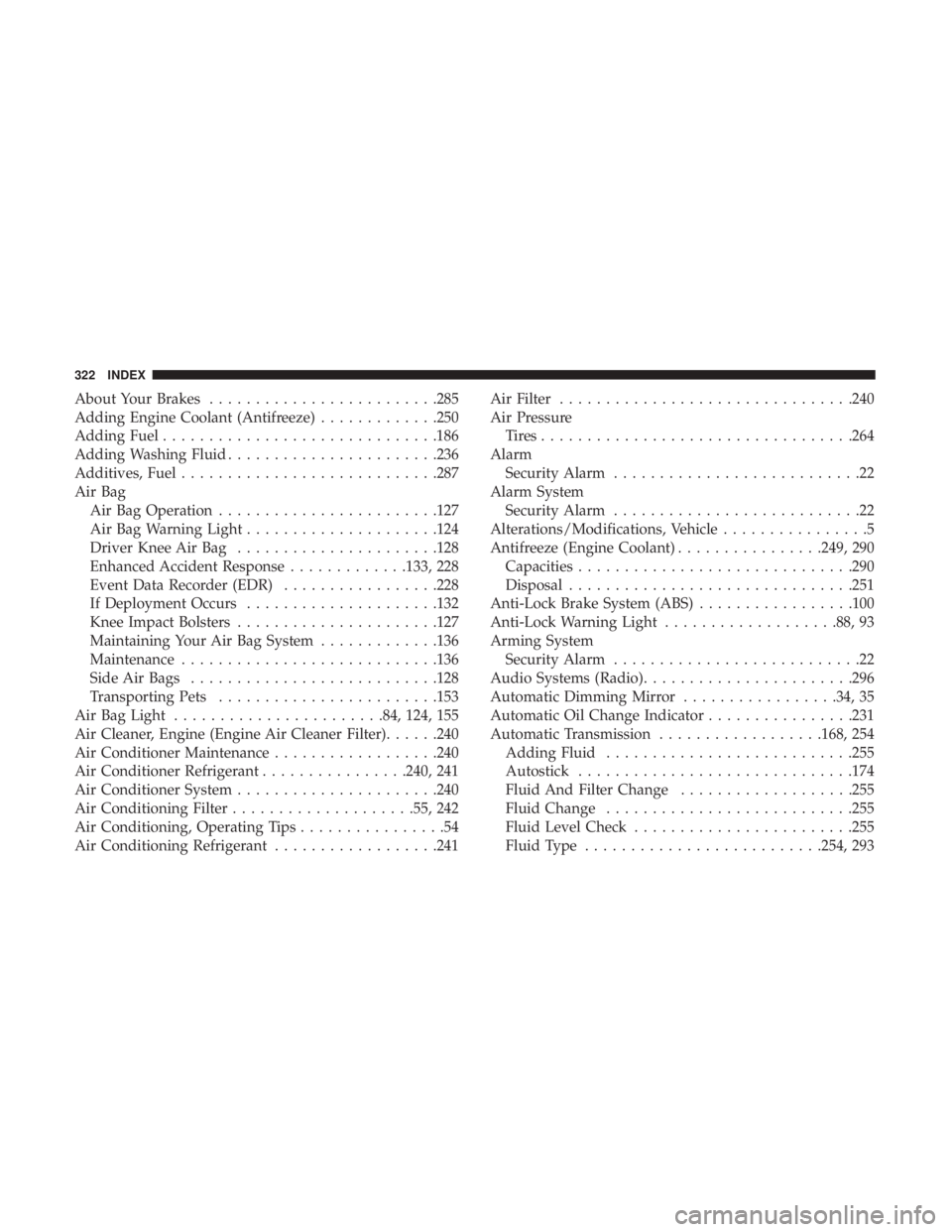
About Your Brakes ........................ .285
Adding Engine Coolant (Antifreeze) ............ .250
Adding Fuel ............................. .186
Adding Washing Fluid ...................... .236
Additives, Fuel ........................... .287
Air Bag
Air Bag Operation ....................... .127
Air Bag Warning Light .................... .124
Driver Knee Air Bag ..................... .128
Enhanced Accident Response ............ .133, 228
Event Data Recorder (EDR) ................ .228
If Deployment Occurs .................... .132
Knee Impact Bolsters ..................... .127
Maintaining Your Air Bag System ............ .136
Maintenance ........................... .136
Side Air Bags .......................... .128
Transporting Pets ....................... .153
Air Bag Light ...................... .84, 124, 155
Air Cleaner, Engine (Engine Air Cleaner Filter) ..... .240
Air Conditioner Maintenance ................. .240
Air Conditioner Refrigerant ............... .240, 241
Air Conditioner System ..................... .240
Air Conditioning Filter ................... .55, 242
Air Conditioning, Operating Tips ................54
Air Conditioning Refrigerant ................. .241 Air Filter ............................... .240
Air Pressure
Tires................................. .264
Alarm
Security Alarm ...........................22
Alarm System
Security Alarm ...........................22
Alterations/Modifications, Vehicle ................5
Antifreeze (Engine Coolant) ............... .249, 290
Capacities ............................. .290
Disposal .............................. .251
Anti-Lock Brake System (ABS) ................ .100
Anti-Lock Warning Light .................. .88, 93
Arming System
Security Alarm ........................... 2 2
Audio Systems (Radio) ...................... .296
Automatic Dimming Mirror ................ .34, 35
Automatic Oil Change Indicator ............... .231
Automatic Transmission ................. .168, 254
Adding Fluid .......................... .255
Autostick ............................. .174
Fluid And Filter Change .................. .255
Fluid Change .......................... .255
Fluid Level Check ....................... .255
Fluid Type ......................... .254, 293322 INDEX
Page 327 of 338
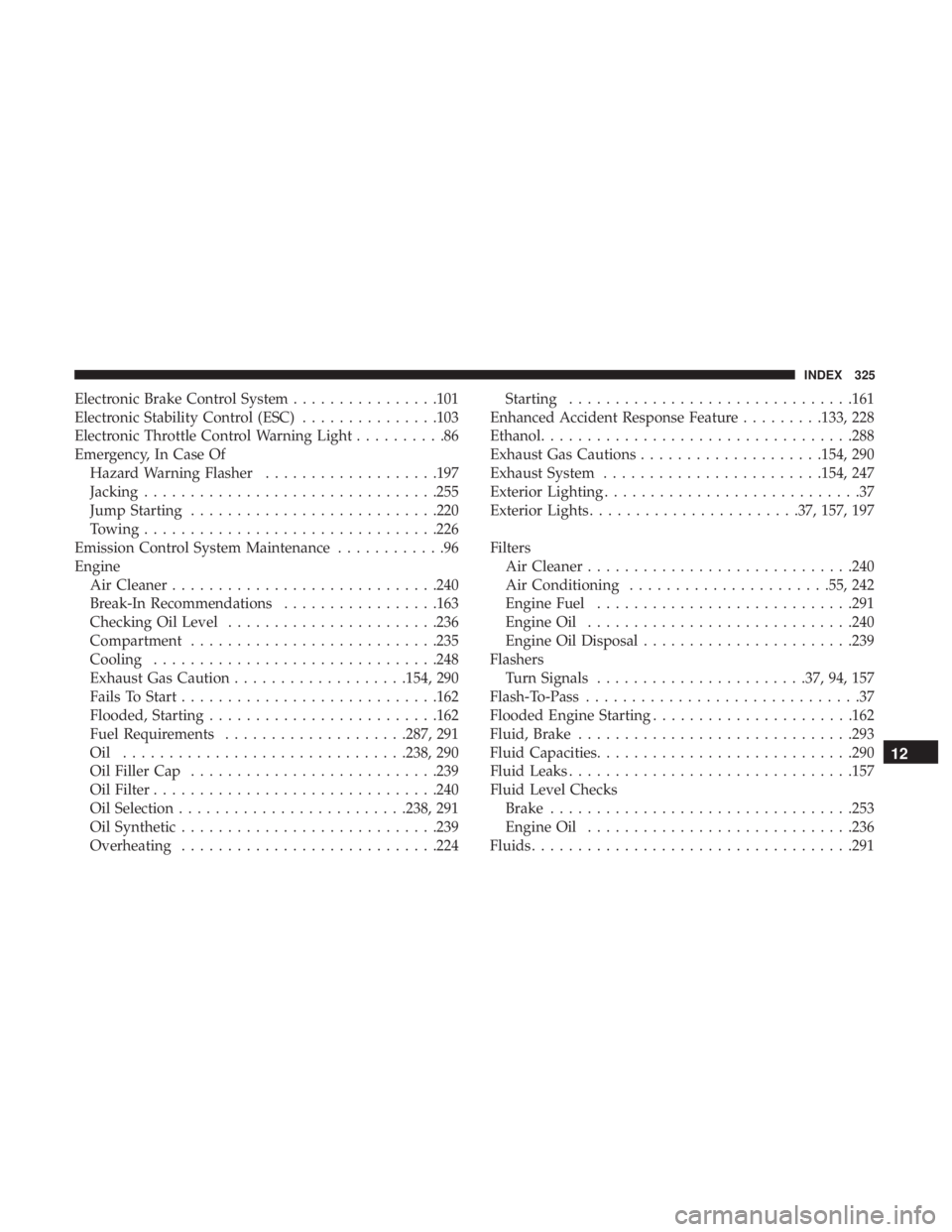
Electronic Brake Control System ............... .101
Electronic Stability Control (ESC) .............. .103
Electronic Throttle Control Warning Light ..........86
Emergency, In Case Of
Hazard Warning Flasher .................. .197
Jacking ............................... .255
Jump Starting .......................... .220
Towing ............................... .226
Emission Control System Maintenance ............96
Engine
Air Cleaner ............................ .240
Break-In Recommendations ................ .163
Checking Oil Level ...................... .236
Compartment .......................... .235
Cooling .............................. .248
Exhaust Gas Caution .................. .154, 290
Fails To Start ........................... .162
Flooded, Starting ........................ .162
Fuel Requirements ................... .287, 291
Oil .............................. .238, 290
Oil Filler Cap .......................... .239
Oil Filter .............................. .240
Oil Selection ........................ .238, 291
Oil Synthetic ........................... .239
Overheating ........................... .224 Starting .............................. .161
Enhanced Accident Response Feature ........ .133, 228
Ethanol ................................. .288
Exhaust Gas Cautions ................... .154, 290
Exhaust System ....................... .154, 247
Exterior Lighting ............................37
Exterior Lights ...................... .37, 157, 197
Filters
Air Cleaner ............................ .240
Air Conditioning ..................... .55, 242
Engine Fuel ........................... .291
Engine Oil ............................ .240
Engine Oil Disposal ...................... .239
Flashers
Turn Signals ...................... .37, 94, 157
Flash-To-Pass ..............................37
Flooded Engine Starting ..................... .162
Fluid, Brake ............................. .293
Fluid Capacities ........................... .290
Fluid Leaks .............................. .157
Fluid Level Checks
Brake ................................ .253
Engine Oil ............................ .236
Fluids .................................. .29112 INDEX 325