charging FIAT 500C 2018 Owners Manual
[x] Cancel search | Manufacturer: FIAT, Model Year: 2018, Model line: 500C, Model: FIAT 500C 2018Pages: 338, PDF Size: 4 MB
Page 70 of 338
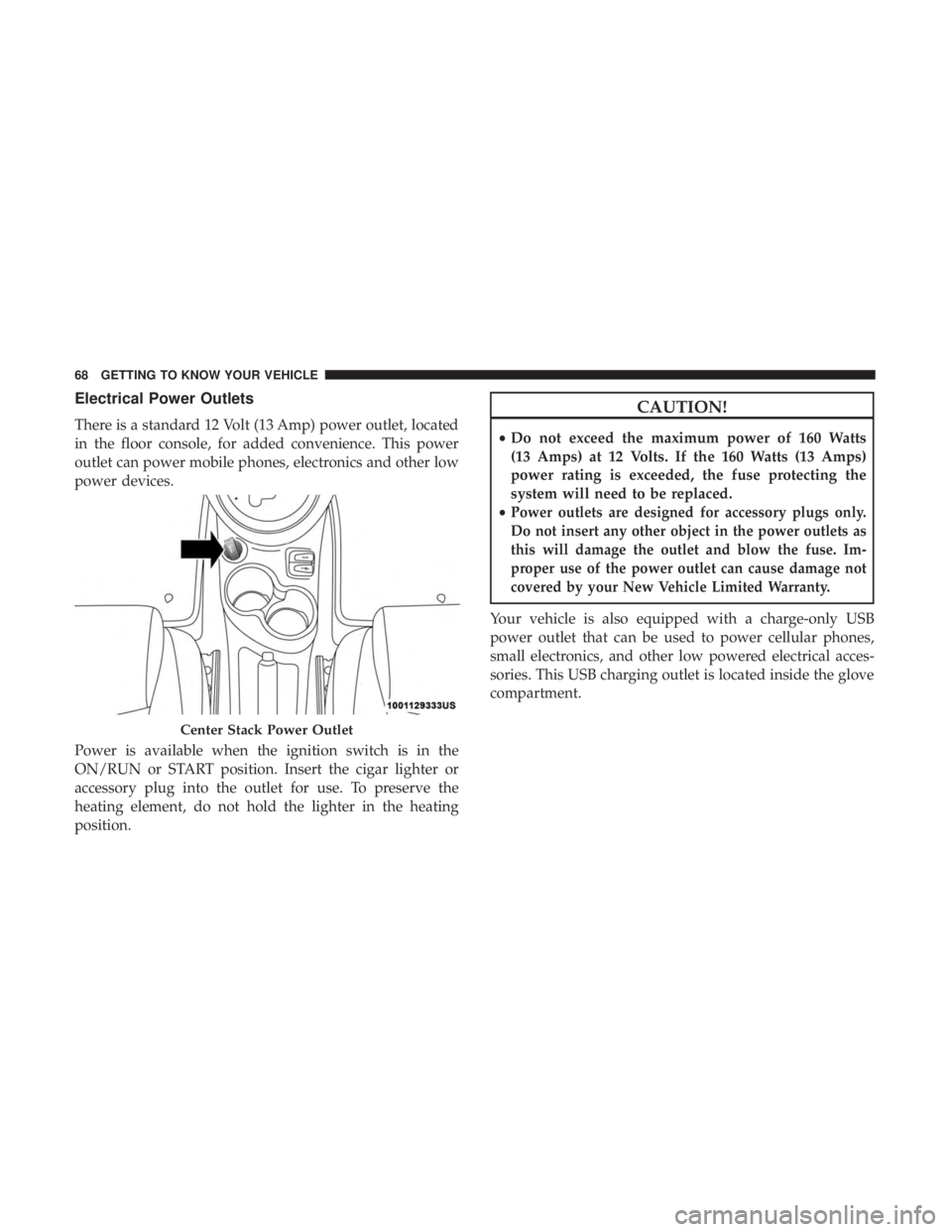
Electrical Power Outlets
There is a standard 12 Volt (13 Amp) power outlet, located
in the floor console, for added convenience. This power
outlet can power mobile phones, electronics and other low
power devices.
Power is available when the ignition switch is in the
ON/RUN or START position. Insert the cigar lighter or
accessory plug into the outlet for use. To preserve the
heating element, do not hold the lighter in the heating
position. CAUTION!• Do not exceed the maximum power of 160 Watts
(13 Amps) at 12 Volts. If the 160 Watts (13 Amps)
power rating is exceeded, the fuse protecting the
system will need to be replaced.
• Power outlets are designed for accessory plugs only.
Do not insert any other object in the power outlets as
this will damage the outlet and blow the fuse. Im-
proper use of the power outlet can cause damage not
covered by your New Vehicle Limited Warranty.
Your vehicle is also equipped with a charge-only USB
power outlet that can be used to power cellular phones,
small electronics, and other low powered electrical acces-
sories. This USB charging outlet is located inside the glove
compartment.Center Stack Power Outlet68 GETTING TO KNOW YOUR VEHICLE
Page 87 of 338
In this case, the light will remain on until the condition has
been corrected. If the problem is related to the brake
booster, the ABS pump will run when applying the brake,
and a brake pedal pulsation may be felt during each stop.
The dual brake system provides a reserve braking capacity
in the event of a failure to a portion of the hydraulic
system. A leak in either half of the dual brake system is
indicated by the Brake Warning Light, which will turn on
when the brake fluid level in the master cylinder has
dropped below a specified level.
The light will remain on until the cause is corrected.
NOTE: The light may flash momentarily during sharp
cornering maneuvers, which change fluid level conditions.
The vehicle should have service performed, and the brake
fluid level checked.
If brake failure is indicated, immediate repair is necessary.
WARNING!Driving a vehicle with the red brake light on is
dangerous. Part of the brake system may have failed. It
will take longer to stop the vehicle. You could have a
collision. Have the vehicle checked immediately. Vehicles equipped with the Anti-Lock Brake System (ABS)
are also equipped with Electronic Brake Force Distribution
(EBD). In the event of an EBD failure, the Brake Warning
Light will turn on along with the ABS Light. Immediate
repair to the ABS system is required.
Operation of the Brake Warning Light can be checked by
turning the ignition switch from the OFF position to the
ON/RUN position. The light should illuminate for ap-
proximately two seconds. The light should then turn off
unless the parking brake is applied or a brake fault is
detected. If the light does not illuminate, have the light
inspected by an authorized dealer.
The light also will turn on when the parking brake is
applied with the ignition switch in the ON/RUN position.
NOTE: This light shows only that the parking brake is
applied. It does not show the degree of brake application.
— Battery Charge Warning Light
This warning light will illuminate when the battery is not
charging properly. If it stays on while the engine is run-
ning, there may be a malfunction with the charging system.
Contact an authorized dealer as soon as possible.
This indicates a possible problem with the electrical system
or a related component. 4GETTING TO KNOW YOUR INSTRUMENT PANEL 85
Page 223 of 338
WARNING!• Take care to avoid the radiator cooling fan whenever
the hood is raised. It can start anytime the ignition
switch is ON. You can be injured by moving fan
blades.
• Remove any metal jewelry such as rings, watch
bands and bracelets that could make an inadvertent
electrical contact. You could be seriously injured.
• Batteries contain sulfuric acid that can burn your
skin or eyes and generate hydrogen gas which is
flammable and explosive. Keep open flames or
sparks away from the battery.
1. Apply the parking brake, shift the automatic transmis-
sion into PARK and turn the ignition to LOCK.
2. Turn off the heater, radio, and all unnecessary electrical
accessories.
3. Remove the protective cover over the positive (+) bat-
tery post. To remove the cover, push the locking tab and
pull upward on the cover. 4. If using another vehicle to jump start the battery, park
the vehicle within the jumper cables reach, apply the
parking brake and make sure the ignition is OFF.
WARNING!Do not allow vehicles to touch each other as this could
establish a ground connection and personal injury
could result.
Jump Starting Procedure
WARNING!Failure to follow this jump starting procedure could
result in personal injury or property damage due to
battery explosion.
CAUTION!Failure to follow these procedures could result in
damage to the charging system of the booster vehicle
or the discharged vehicle. 7IN CASE OF EMERGENCY 221
Page 224 of 338
Connecting The Jumper Cables
1. Connect the positive (+) end of the jumper cable to the
positive (+) post of the discharged vehicle.
2. Connect the opposite end of the positive (+) jumper
cable to the positive (+) post of the booster battery.
3. Connect the negative end (-) of the jumper cable to the
negative (-) post of the booster battery.
4. Connect the opposite end of the negative (-) jumper
cable to a good engine ground (exposed metal part of
the discharged vehicle’s engine) away from the battery
and the fuel injection system.
WARNING!Do not connect the jumper cable to the negative (-) post
of the discharged battery. The resulting electrical spark
could cause the battery to explode and could result in
personal injury. Only use the specific ground point, do
not use any other exposed metal parts.
5. Start the engine in the vehicle that has the booster
battery, let the engine idle a few minutes, and then start
the engine in the vehicle with the discharged battery. 6. Once the engine is started, remove the jumper cables in
the reverse sequence.
Disconnecting The Jumper Cables
1. Disconnect the negative (-) jumper cable from the engine
ground (-) of the vehicle with the discharged battery.
2. Disconnect the negative end (-) of the jumper cable from
the negative (-) post of the booster battery.
3. Disconnect the opposite end of the positive (+) jumper
cable from the positive (+) post of the booster battery.
4. Disconnect the positive (+) end of the jumper cable from
the positive (+) post of the discharged vehicle.
If frequent jump starting is required to start your vehicle,
you should have the battery and charging system in-
spected at an authorized dealer.
CAUTION!Accessories plugged into the vehicle power outlets
draw power from the vehicle’s battery, even when not
in use (i.e., cellular devices, etc.). Eventually, if plugged (Continued)222 IN CASE OF EMERGENCY
Page 325 of 338
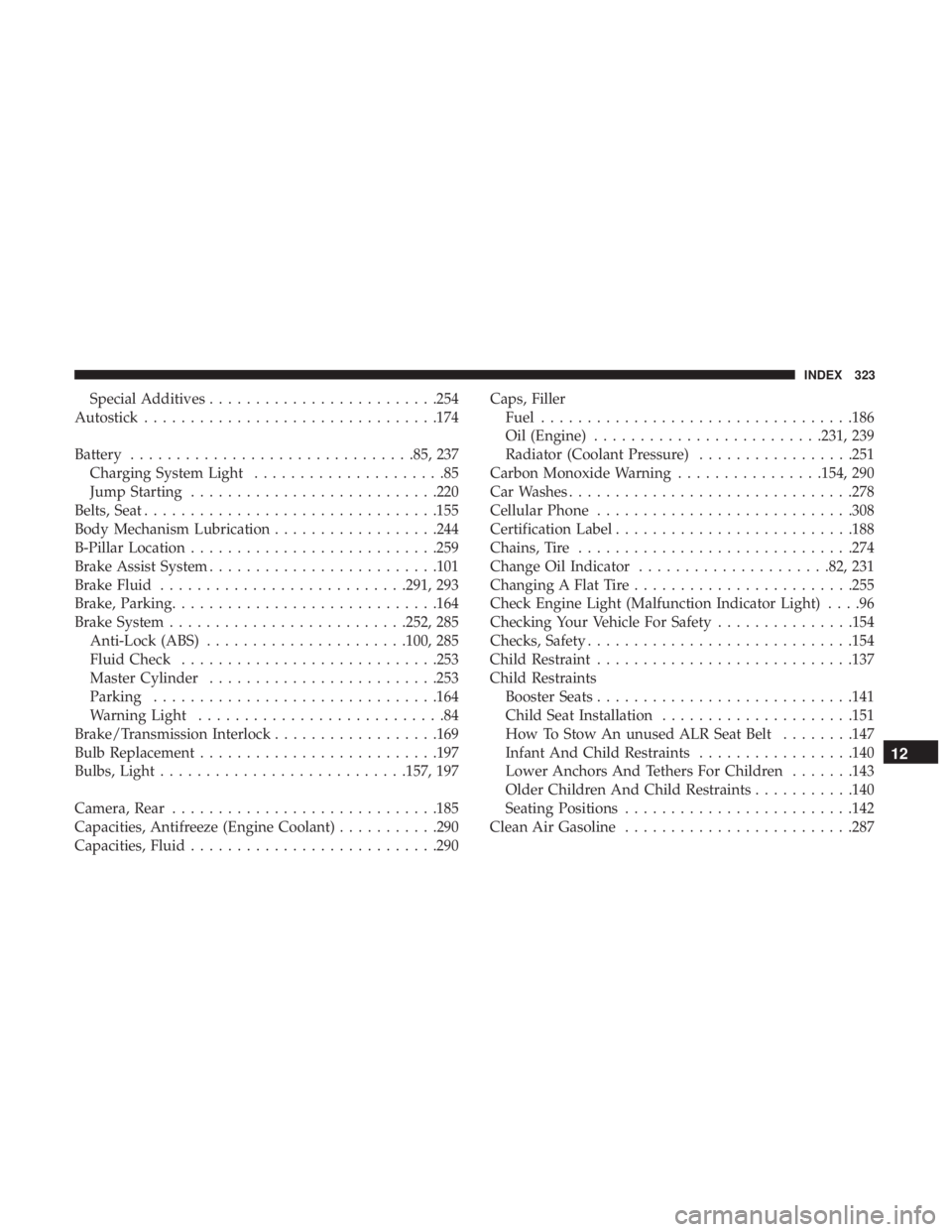
Special Additives ........................ .254
Autostick ............................... .174
Battery .............................. .85, 237
Charging System Light .....................85
Jump Starting .......................... .220
Belts, Seat ............................... .155
Body Mechanism Lubrication ................. .244
B-Pillar Location .......................... .259
Brake Assist System ........................ .101
Brake Fluid .......................... .291, 293
Brake, Parking ............................ .164
Brake System ......................... .252, 285
Anti-Lock (ABS) ..................... .100, 285
Fluid Check ........................... .253
Master Cylinder ........................ .253
Parking .............................. .164
Warning Light ...........................84
Brake/Transmission Interlock ................. .169
Bulb Replacement ......................... .197
Bulbs, Light .......................... .157, 197
Camera, Rear ............................ .185
Capacities, Antifreeze (Engine Coolant) .......... .290
Capacities, Fluid .......................... .290 Caps, Filler
Fuel ................................. .186
Oil (Engine) ........................ .231, 239
Radiator (Coolant Pressure) ................ .251
Carbon Monoxide Warning ............... .154, 290
Car Washes .............................. .278
Cellular Phone ........................... .308
Certification Label ......................... .188
Chains, Tire ............................. .274
Change Oil Indicator .................... .82, 231
Changing A Flat Tire ....................... .255
Check Engine Light (Malfunction Indicator Light) ....96
Checking Your Vehicle For Safety .............. .154
Checks, Safety ............................ .154
Child Restraint ........................... .137
Child Restraints
Booster Seats ........................... .141
Child Seat Installation .................... .151
How To Stow An unused ALR Seat Belt ....... .147
Infant And Child Restraints ................ .140
Lower Anchors And Tethers For Children ...... .143
Older Children And Child Restraints .......... .140
Seating Positions ........................ .142
Clean Air Gasoline ........................ .28712 INDEX 323