ignition FIAT 500E 2014 2.G Service Manual
[x] Cancel search | Manufacturer: FIAT, Model Year: 2014, Model line: 500E, Model: FIAT 500E 2014 2.GPages: 363, PDF Size: 2.66 MB
Page 235 of 363
NOTE:
•The ESC Activation/Malfunction Indicator Light and
the ESC OFF Indicator Light come on momentarily
each time the ignition switch is turned ON.
• Each time the ignition is turned ON, the ESC system
will be ON even if it was turned off previously.
The ESC OFF Indicator Light indicates the
Electronic Stability Control (ESC) is partially
off.
Regenerative Braking
Your 500e has a Regenerative Braking System
(RBS). The RBS increases the fuel economy of
the vehicle, particularly in stop-and-go city
traffic. The electric motors which propel the
vehicle forward can operate as generators when braking. The RBS recharges the high voltage battery under certain
braking conditions by recapturing energy that would
otherwise be lost while braking. The electric power that is
generated goes back into the high voltage battery for later
use, for example when acceleration is desired.
The RBS uses conventional hydraulic friction brakes,
regenerative braking, or a combination to slow the ve-
hicle. If the system detects slippery conditions while
braking, ONLY friction is used to slow the vehicle. The
RBS can result in extended life of the hydraulic service
brakes; however, all inspection, scheduled maintenance,
and service intervals for the vehicle service brakes must
be followed.
5
STARTING AND OPERATING 233
Page 266 of 363
If the ignition switch is cycled, this sequence will repeat,
providing the system fault still exists. If the system fault
no longer exists, the “Tire Pressure Monitoring Telltale
Light” will no longer flash, and the “Service TPM Sys-
tem” message will no longer display, and a pressure
value will display in place of the dashes.NOTE:
•
The TPMS will not monitor the pressure in a replace-
ment tire installed without a tire pressure sensor.
• If you install a replacement tire in place of a road tire
that has a pressure below the low-pressure warning
limit, upon the next ignition switch cycle, the “Tire
Pressure Monitoring Telltale Light” will remain on and
a chime will sound. In addition, the graphic in the
EVIC will still display a pressure value in a different
color.
• After driving the vehicle for up to 20 minutes above
15 mph (24 km/h), the “Tire Pressure Monitoring
Telltale Light” will flash on and off for 75 seconds and
then remain on solid. In addition, the EVIC will
display a “Service TPM System” message and then
display dashes (- -) in place of the pressure value.
Service TPM System Message
264 STARTING AND OPERATING
Page 267 of 363
•For each subsequent ignition switch cycle, a chime will
sound, the “Tire Pressure Monitoring Telltale Light”
will flash on and off for 75 seconds and then remain on
solid, and the EVIC will display a “Service TPM
System” message and dashes (- -) in place of the
pressure value.
Once you repair or replace the original road tire and
reinstall it, the TPMS will update automatically. In addi-
tion, the “Tire Pressure Monitoring Telltale Light” will
turn off and the graphic in the EVIC will display a new
pressure value instead of dashes (- -), as long as no tire
pressure is below the low-pressure warning limit in any
of the four active road tires. The vehicle may need to be
driven for up to 20 minutes above 15 mph (24 km/h) in
order for the TPMS to receive this information.General Information
This device complies with Part 15 of the FCC rules and
RSS 210 of Industry Canada. Operation is subject to the
following conditions:
• This device may not cause harmful interference.
• This device must accept any interference received,
including interference that may cause undesired op-
eration. The tire pressure sensors are covered under
one of the following licenses: United States
MRXC4W4MA4 Canada 2546A-C4W4MA4 1.
TRAILER TOWING
Trailer towing with this vehicle is not recommended.
5
STARTING AND OPERATING 265
Page 274 of 363
HAZARD WARNING FLASHERS
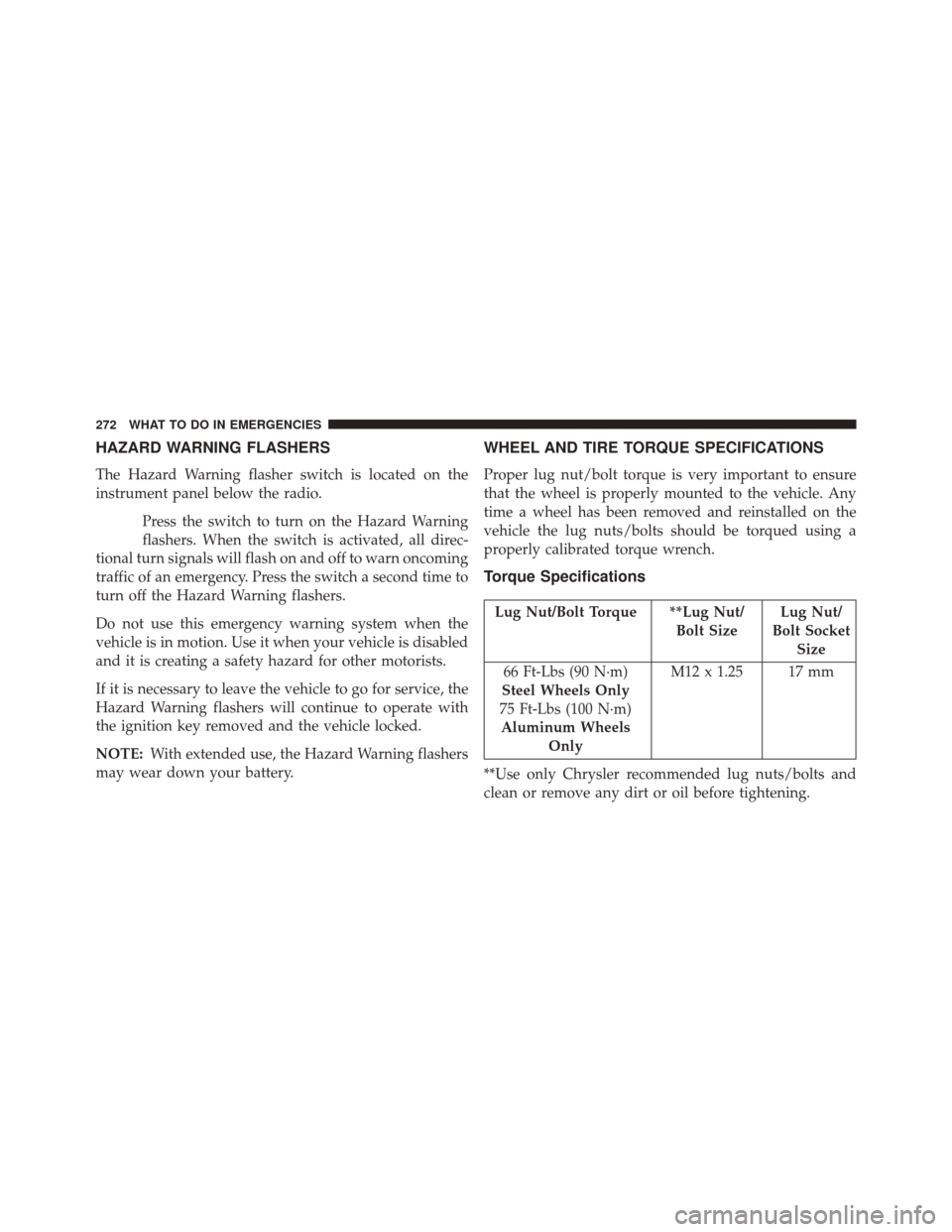
The Hazard Warning flasher switch is located on the
instrument panel below the radio.Press the switch to turn on the Hazard Warning
flashers. When the switch is activated, all direc-
tional turn signals will flash on and off to warn oncoming
traffic of an emergency. Press the switch a second time to
turn off the Hazard Warning flashers.
Do not use this emergency warning system when the
vehicle is in motion. Use it when your vehicle is disabled
and it is creating a safety hazard for other motorists.
If it is necessary to leave the vehicle to go for service, the
Hazard Warning flashers will continue to operate with
the ignition key removed and the vehicle locked.
NOTE: With extended use, the Hazard Warning flashers
may wear down your battery.
WHEEL AND TIRE TORQUE SPECIFICATIONS
Proper lug nut/bolt torque is very important to ensure
that the wheel is properly mounted to the vehicle. Any
time a wheel has been removed and reinstalled on the
vehicle the lug nuts/bolts should be torqued using a
properly calibrated torque wrench.
Torque Specifications
Lug Nut/Bolt Torque **Lug Nut/ Bolt SizeLug Nut/
Bolt Socket Size
66 Ft-Lbs (90 N·m)
Steel Wheels Only
75 Ft-Lbs (100 N·m) Aluminum Wheels Only M12 x 1.25 17 mm
**Use only Chrysler recommended lug nuts/bolts and
clean or remove any dirt or oil before tightening.
272 WHAT TO DO IN EMERGENCIES
Page 287 of 363
WARNING!
•Take care to avoid the radiator cooling fan when-
ever the hood is raised. It can start anytime the
ignition switch is ON. You can be injured by
moving fan blades.
• Remove any metal jewelry such as rings, watch
bands and bracelets that could make an inadvertent
electrical contact. You could be seriously injured.
• Batteries contain sulfuric acid that can burn your
skin or eyes and generate hydrogen gas which is
flammable and explosive. Keep open flames or
sparks away from the battery.
1. Set the parking brake, place the transmission into PARK and turn the ignition to LOCK.
2. Turn off the heater, radio, and all unnecessary electri- cal accessories.
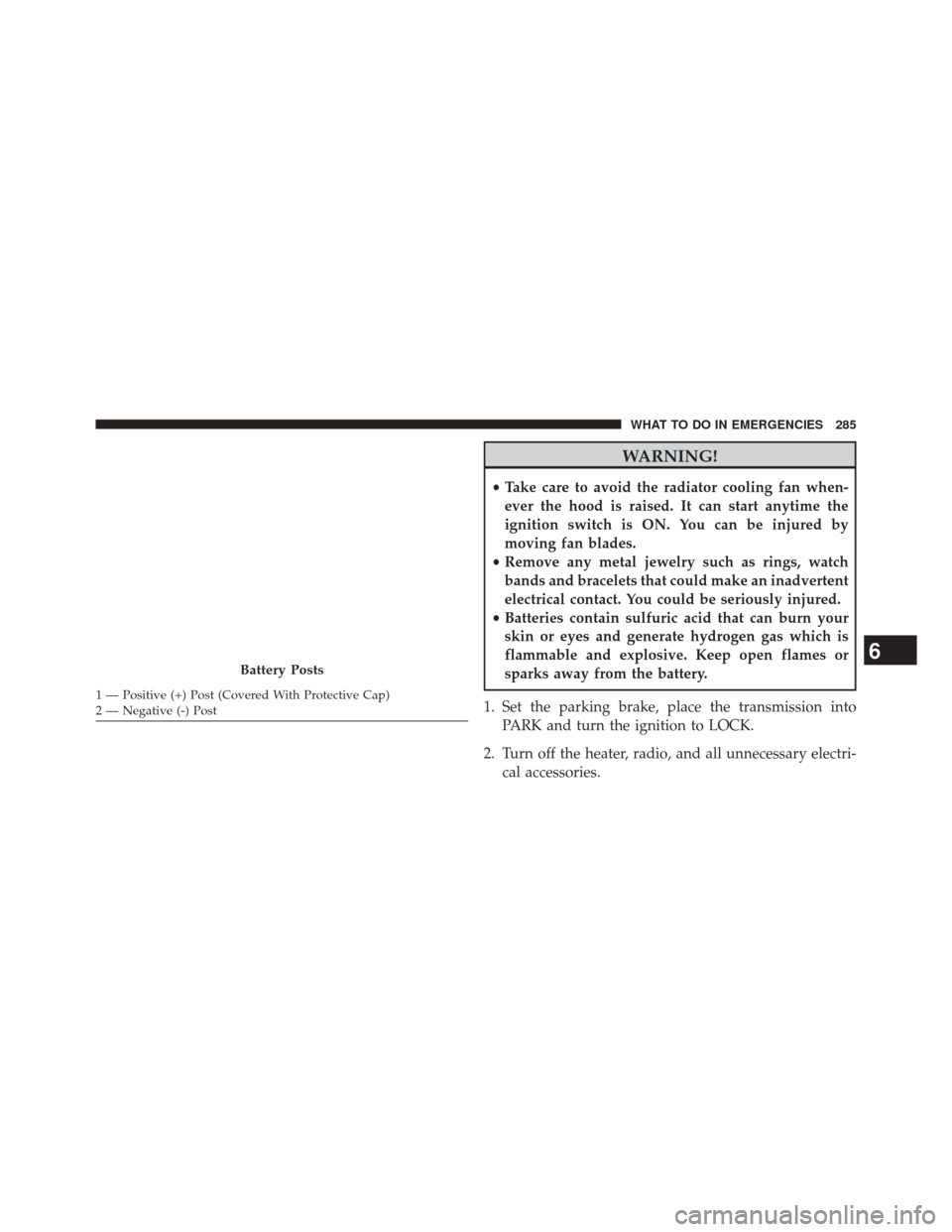
Battery Posts
1 — Positive (+) Post (Covered With Protective Cap)
2 — Negative (-) Post
6
WHAT TO DO IN EMERGENCIES 285
Page 288 of 363
3. Remove the protective cover over the positive(+)
battery post.
4. If using another vehicle to jump-start the battery, park the vehicle within the jumper cables reach, set the
parking brake and make sure the ignition is OFF.
WARNING!
Do not allow vehicles to touch each other as this
could establish a ground connection and personal
injury could result.
Jump-Starting Procedure
WARNING!
Failure to follow this jump-starting procedure could
result in personal injury or property damage due to
battery explosion.
CAUTION!
Failure to follow these procedures could result in
damage to the charging system of the booster vehicle
or the discharged vehicle.
Connecting The Jumper Cables
1. Connect the positive (+)end of the jumper cable to the
positive (+)post of the discharged vehicle.
2. Connect the opposite end of the positive (+)jumper
cable to the positive (+)post of the booster battery.
3. Connect the negative end (-)of the jumper cable to the
negative (-)post of the booster battery.
4. Connect the opposite end of the negative (-)jumper
cable to a good engine ground (exposed metal part of
the discharged vehicle underhood compartment)
away from the battery.
286 WHAT TO DO IN EMERGENCIES
Page 293 of 363
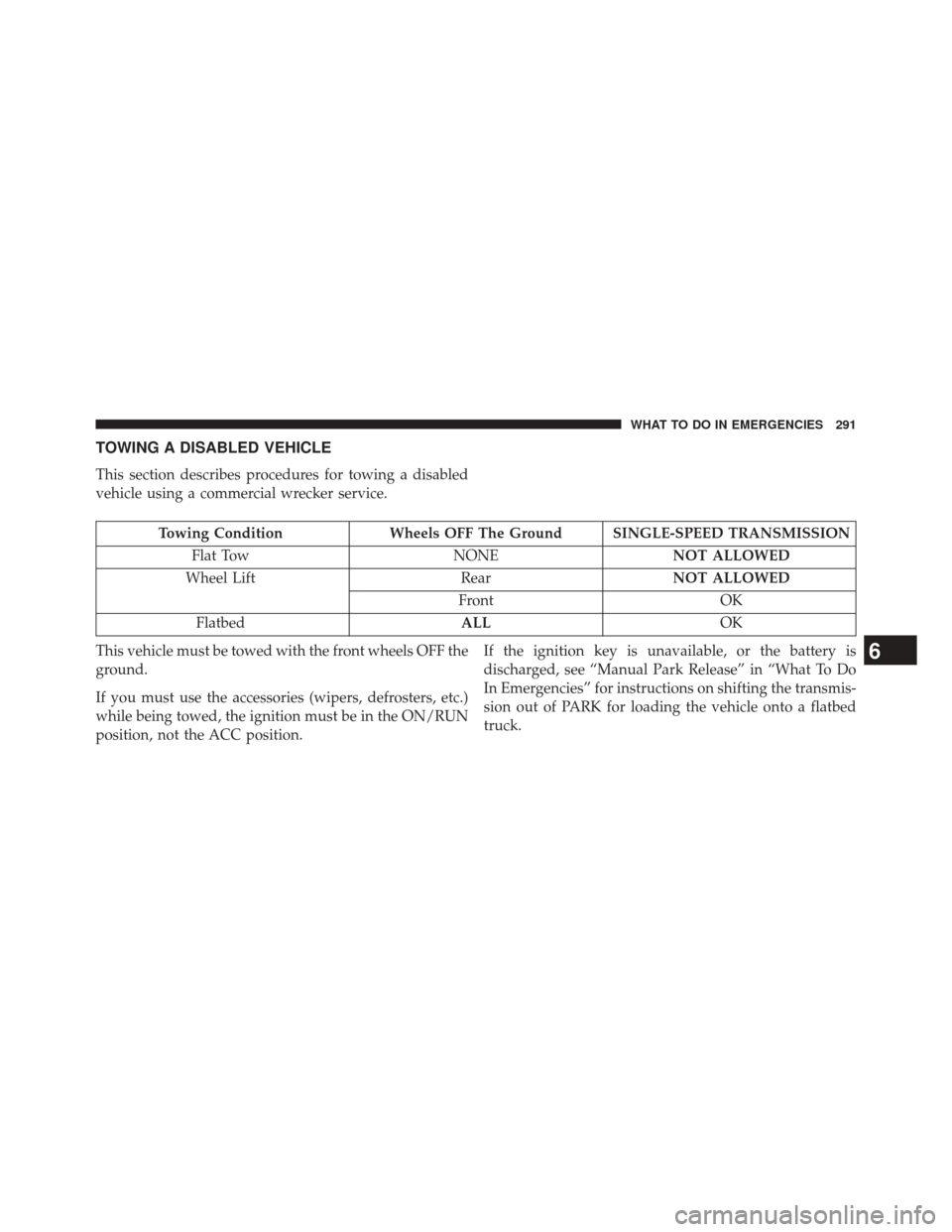
TOWING A DISABLED VEHICLE
This section describes procedures for towing a disabled
vehicle using a commercial wrecker service.
Towing ConditionWheels OFF The Ground SINGLE-SPEED TRANSMISSION
Flat Tow NONENOT ALLOWED
Wheel Lift RearNOT ALLOWED
Front OK
Flatbed ALLOK
This vehicle must be towed with the front wheels OFF the
ground.
If you must use the accessories (wipers, defrosters, etc.)
while being towed, the ignition must be in the ON/RUN
position, not the ACC position. If the ignition key is unavailable, or the battery is
discharged, see “Manual Park Release” in “What To Do
In Emergencies” for instructions on shifting the transmis-
sion out of PARK for loading the vehicle onto a flatbed
truck.
6
WHAT TO DO IN EMERGENCIES 291
Page 321 of 363
FUSES
WARNING!
•When replacing a blown fuse, always use an ap-
propriate replacement fuse with the same amp
rating as the original fuse. Never replace a fuse
with another fuse of higher amp rating. Never
replace a blown fuse with metal wires or any other
material. Failure to use proper fuses may result in
serious personal injury, fire and/or property dam-
age.
• Before replacing a fuse, make sure that the ignition
is off and that all the other services are switched off
and/or disengaged.
• If the replaced fuse blows again, contact an autho-
rized dealer.
(Continued)
WARNING! (Continued)
•If a general protection fuse for safety systems (air
bag system, braking system), power unit systems
(engine system, gearbox system) or steering system
blows, contact an authorized dealer.
Interior Fuses
The interior fuse panel is part of the Body Control
Module (BCM) and is located on the driver’s side under
the instrument panel.
7
MAINTAINING YOUR VEHICLE 319
Page 324 of 363
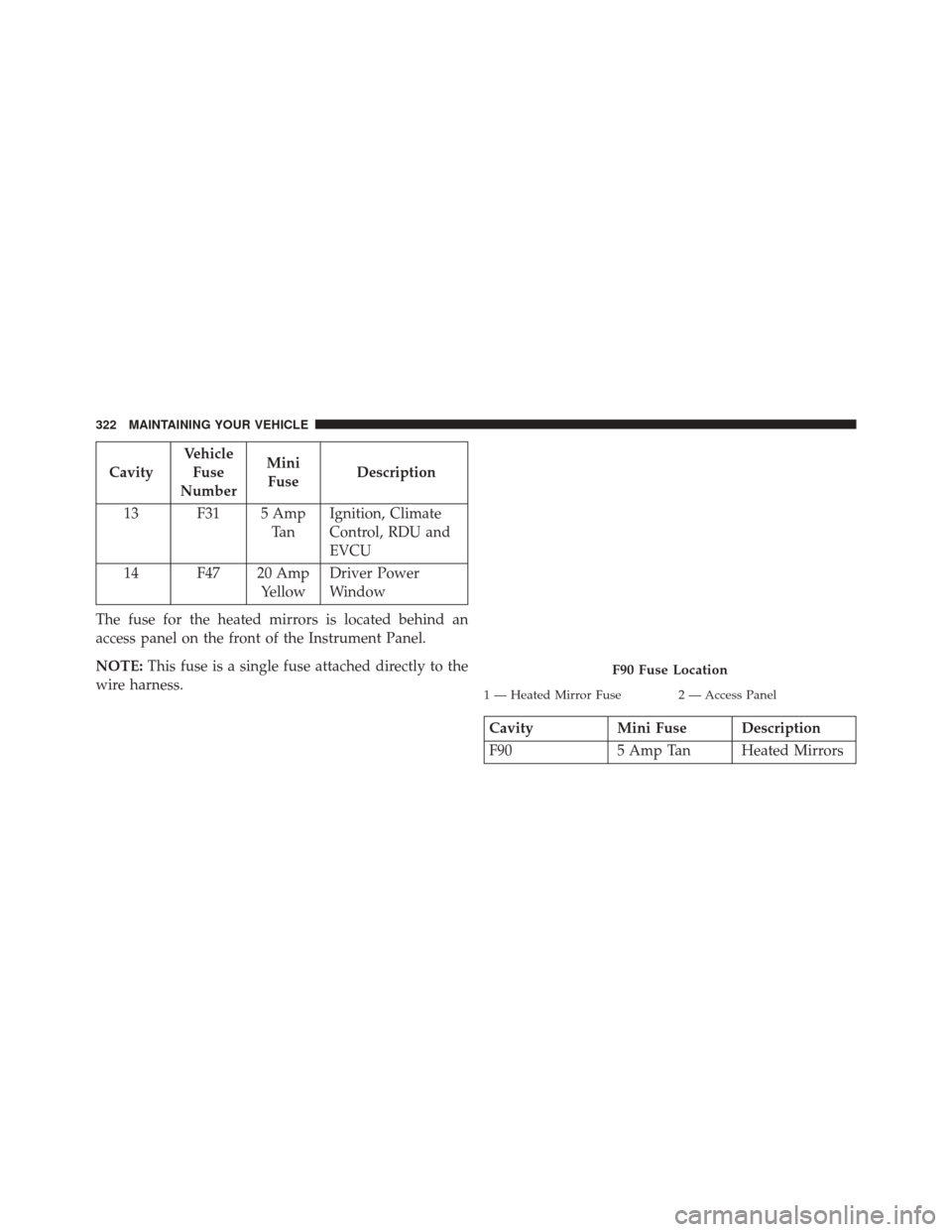
CavityVehicle
Fuse
Number Mini
Fuse Description
13 F31 5 Amp Ta nIgnition, Climate
Control, RDU and
EVCU
14 F47 20 Amp YellowDriver Power
Window
The fuse for the heated mirrors is located behind an
access panel on the front of the Instrument Panel.
NOTE: This fuse is a single fuse attached directly to the
wire harness.
1 — Heated Mirror Fuse 2 — Access Panel
Cavity Mini Fuse Description
F90 5 Amp Tan Heated Mirrors
F90 Fuse Location
322 MAINTAINING YOUR VEHICLE
Page 325 of 363
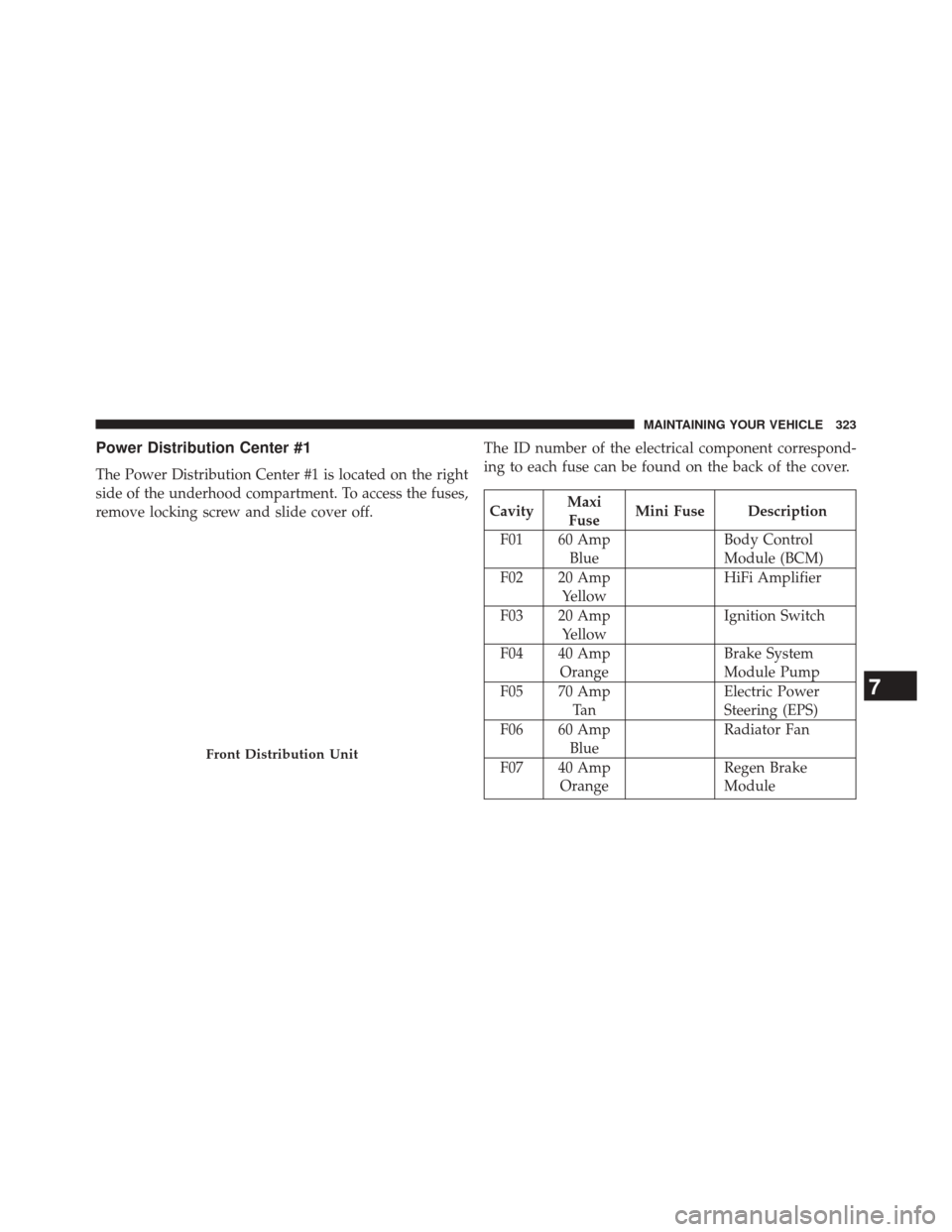
Power Distribution Center #1
The Power Distribution Center #1 is located on the right
side of the underhood compartment. To access the fuses,
remove locking screw and slide cover off.The ID number of the electrical component correspond-
ing to each fuse can be found on the back of the cover.
Cavity
Maxi
Fuse Mini Fuse Description
F01 60 Amp Blue Body Control
Module (BCM)
F02 20 Amp Yellow HiFi Amplifier
F03 20 Amp Yellow Ignition Switch
F04 40 Amp Orange Brake System
Module Pump
F05 70 Amp Ta n Electric Power
Steering (EPS)
F06 60 Amp Blue Radiator Fan
F07 40 Amp Orange Regen Brake
Module
Front Distribution Unit
7
MAINTAINING YOUR VEHICLE 323